What happened to the Virgin Mary?

Once there was a church that had the happiest people. They all worshipped together in harmony, young and old. They had many statues and one was a wooden statue of the Virgin and Child. One day the Deacon noticed that it was gone. Everyone was tasked with looking for her, but she was nowhere to be found and they organized a team of youngsters to find out what happened. They were Connor, Paul, Meagan, Alicia, and Linda. The committee of children went out to look for her.

They scoured the neighborhood and found the guilty party: a band of hoodlums. Connor asked them to give it back.

“No way,” said the chief hoodlum. “Only if you give us a ransom.” Connor thought fast.

“If we tell you a good story, can we get her back for free?”

“Ok” said the boy.

Each child set out to find a piece of the story that would bring the Madonna and Child back to the church.

Connor went looking around the neighborhood. He came across some people that were celebrating a gender reveal. One arch of pink balloons in the sky. It was beautiful. The parents were so happy as they looked around at their friends.

Paul tried to leave home to help find the statue, but before he could, his mother said, “Aunt Cheri is having her baby shower today and I can’t go. I have too much to do. Could you go instead? Here is your gift.”

“Ok, sure,” said Paul. He walked to his aunt’s house.

“So happy to see you, Paul!” Cheri said. The guests enjoyed hors d’oeuvres, played games like Guess the Name of the Baby, and opened gifts of clothes, baby food and toys.

Meagan went to St Luke’s hospital because she thought someone might have taken the statue for their patients. She passed by the baby ward and looked at the babies. They were so cute. She thought to herself “What if one of these was the baby Jesus?” It was hard to think of. Maybe Jesus would have had a golden aura around him, or maybe he would just look like an ordinary baby. She decided to tell the team that all the babies had a magical aura around them.

Alicia went back to the church to scour for the statue. When she was there, a crowd of people processed in. They filed in and the last ones were some proud parents with a baby in their arms dressed in white. They gave the baby to the priest who held it over the basin and said, “I baptize you in the name of the Father, and of the Son, and of the Holy Spirit,” while pouring water over the child’s head. She was fascinated with the process: a white glow seemed to emanate from the child’s clothes.

Finally, there was Linda, the youngest. She got a ride from her sister to the police station because she thought someone might have turned it in there. She sat down in the waiting room and shortly there was a huge uproar as some people excitedly came in. There was a young child with them and then a burst of joy from some other people as she was brought in. “Thank God, you found her,” they cried. There was much hugging and rejoicing. Then her sister told her it was time to go.

Each team member told the hoodlums their part of the story. When they were done, the hoodlum said “So that’s it?”

Connor said, “It’s the Joyful Mysteries: the Annunciation, the Visitation, the Nativity, the Presentation and the Finding in the Temple.”

The other group conferred and decided it was a good story after all. So that is how they all found the Virgin Mary.


©Copyright 2025 by Cecile Bianco

Featured AI Image generated in Midjourney.com by Mary McWilliams

I Learned What Home Could Be: Writing, Faith, and the Meantime Life

“I learned—at least—what Home could be—

How ignorant I had been…”—Emily Dickinson

Finding Peace in the Meantime

Life for me and my family has, up until this point, consisted of checking in and out of hotels and riding in a car packed with dirty laundry—and, of course, my son’s little blue scooter. At least he made the most of our situation. Both my husband and I were unemployed, living off a credit card, and looking for work and housing, but my son had his scooter. He’d zoom through hotel lobbies and circle playgrounds while we unpacked fast-food dinners on a park bench.

This transient life made it hard for me to be creative. When I tried to journal, it was messy. My notebooks soon became a mix of practice responses for job interviews, math problems for budgeting, and scattered reflections.

I had to find a way to bring peace into my life. First thing, the kids were going to summer camp. Not that I didn’t enjoy being in one room with two toddlers and a teen, but they needed summer memories, friends, and crafts. It also meant they could spend hours being kids instead of overhearing arguments between my husband and me about money or where we’d go once our hotel stay ended.

I made an effort to add normalcy and routine—morning walks, reading books for myself and to the kids at bedtime. I started Bible plans as a way to focus my prayer life, especially when my mind was stressed with money and marriage worries. Looking back now, I’m reminded of a workbook I cherished in high school: In the Meantime by Iyanla Vanzant. It’s a 40-day workbook structured to mirror sacred time in Scripture—the 40 years of Israel, the 40 days of Jesus. Christian workbooks and Bible plans can steady our faith when life feels unsettled.

Key practices that brought peace:

  • Summer camp for the kids
  • Morning walks and bedtime reading routines
  • Bible plans and focused prayer
  • Christian workbooks for spiritual grounding

The Power of Conversation and Community

When writing was hard for me, conversation came naturally. It was instinct to call my family and friends for support. Back in college, I attended women’s circles. Although that season of my life was steeped in new age philosophies, those circles gave women of different ages and walks of life a space to share struggles and dreams, and to lift each other with encouraging words. As women, we often lose ourselves serving our families, isolating from community.

Now, as a Catholic, I see the deeper truth behind that longing to gather. Conversation and community are part of our faith. Jesus didn’t write books; He spoke to people, told parables, and offered encouragement. The early Church grew from circles of believers who prayed, listened, and shared stories. For writers, it’s a reminder that conversation is just as important as writing; I know I sometimes forget this myself.

What conversation and community offer:

  • A space to share struggles and dreams
  • Encouragement from people at different life stages
  • Connection to our Faith tradition
  • A reminder that writing and speaking both matter

What Home Really Is

I recently moved into a home, although it’s a short-term lease, on Dickens Ave. The name makes me think of Emily Dickinson, who wrote so much about home. Her poems remind us that home is not simply an apartment number, but a pattern of life: morning walks, dinners (even if it is a combo number), and bedtime stories. During my months in hotels, I realized the same truth. Wherever we stayed, I hung a cross on the wall. It was my way of reminding myself and my children that our true home is not found in an address but in Christ.

Home is not a place, but:

  • A pattern of daily rhythms and routines
  • A spiritual anchor in faith
  • A reminder of what truly matters

Finding Your Way in the Meantime

So if you find yourself “in the meantime” of life, have faith that you can work with it and through it. The apostles wrote on the move; they didn’t have office space. They wrote from jail cells or while sitting on a rock. St. Paul didn’t have a content calendar, yet the Holy Spirit inspired him to write thoughtful letters and action plans for Christians. Don’t judge messy writing. Life doesn’t always fit neatly in the margins, and writing doesn’t have to either. Messy writing is authentic and raw. We don’t always see its value in the moment, but later it becomes a treasure, just like finding your middle school diary in your mom’s closet.

If you aren’t ready to write, create an action plan to stay grounded in prayer—adopt a Bible plan, pick up a Christian workbook. Or simply pick up the phone and talk to a good friend. The power of conversation is a tool for healing and evangelizing. Like the apostles, we are called to share the Gospel no matter what place in life we’re in. Like Dickinson, we search for what home could be. And like Christ, we discover that home is already within us.

If you’re in the meantime:

  • Embrace messy, authentic work—it becomes a treasure later
  • Consider a Bible plan or Christian workbook if writing feels impossible
  • Call a friend; conversation is healing and evangelizing
  • Remember: the Gospel spreads through your presence, wherever you are

When I Behold Your Heavens: Hope

“ For I know the plans I have for you…”—Jeremiah 29:11

My writing life might have continued like a lost balloon soaring aimlessly into the evening sky, but the 2019 Florida Eucharistic Congress in Jacksonville changed its course. Thanks are long overdue to the Most Reverend Felipe J. Estevez, S.T.D., retired Bishop of St. Augustine. Back then, during his busy tenure, he took the time to read my newly published book, Everywhere Hope, and penned a treasured letter about it shortly after the Congress, of which the theme was “Hope.” 

Bishop Estevez’s warm encouragement spurred me to continue writing, but with a clearer purpose.  I went on to define my author mission—“to be God’s instrument in building up the Body of Christ”—and was content to define my audience as primarily Catholic. My desire changed from pursuing publication to simply encouraging the faithful, even if only one person benefited from my words.  

In an excerpt from his letter, Bishop Estevez wrote, “The last chapter on Language was deeply Catholic in a profound acceptance of cultures as John Paul II envisioned it—diversity enriching unity… [W]hat a contrast to the threats of nativism and White Supremacy movements affecting us these days… Paula, your book is so rich for it integrates poetry and spirituality, lived experience and wisdom, deep Catholic practice and real human experience, a genius of feminine perception… .”  

I can’t express enough how grateful I am to have been in a diocese under the shepherding of Felipe J. Estevez, S.T.D.  He truly imitated Jesus and always showed reverence, love, devotion, and kindness to his flock.  My deepest personal thanks for his unexpected letter in response to the book I gifted him on behalf of our local Catholic Writers Guild years ago is not enough to thank this holy and humble man of God. 

“O Lord, our Lord, how glorious is your name over all the earth! …When I behold your heavens, the work of your fingers, the moon and the stars which you set in place—what is man that you should be mindful of him, or the son of man that you should care for him?”—Psalm 8: 1,3–4

Bishop Estevez especially liked the photo above and the poem “Sweet Light” (about marriage) that accompanied the picture.  Here is the poem:


Sweet Light

by Paula Veloso Babadi


No shadows here when light is

L’Heure Bleue” to artist eyes

Or “sweet” to camera canvas.


One side of Earth

Basks in your sunlight

While I rest shadowed

On the other side.


You are brilliant day—

Burning, tumultuous, blinding, busy, wide awake.

I am subdued night—

Serene, quiescent, muted, dreaming, slumbering.


You own most phases of the Earth’s turning as

Your searing light often blinds onlookers

To the pale beauty behind your blaze.

My light reflects gently on the quieter side where,

When you’re gone, the stars become visible.


Our co-existence is casually questionable,

And yet, for all our differences,

We twice share Twilight

When Earth succumbs to neither night nor day.

In the blue hour of this sweet light, we are one.

It is enough for me.


Copyright 2025 Paula Veloso Babadi

Photo license purchased from Shutterstock

Edited by Gabriella Batel

The Shepherd’s Pie: Christian-Jewish Relations

The Shepherd’s Pie: Christian-Jewish Relations


“A slice of hope to raise faithful kids.”

This uplifting, ecumenical show uses engaging conversations and fun entertainment reviews to offer positive insights and media resources for families and youth leaders. We discuss current issues that impact young people at home, in school, and in the world today.

In this episode of The Shepherd’s Pie, Antony Barone Kolenc speaks with Jonathan Feldstein about building bridges between Christians and Jews,
discussing his organization, the Genesis 123 Foundation.


Check out other episodes of The Shepherd’s Pie.


Copyright 2025 Antony Barone Kolenc

Have You Doodled Today?

Have You Doodled Today?

Why Doodling, Graphic Novels, and Bible Journaling Belong in Every Catholic Writer’s Creative Life

I remember how I made my first friend in high school. On the school bus, I sat next to a blond-haired girl with wispy bangs and bright blue eyes. With her notebook on her lap, she taught me how to doodle an elephant. This was Josie’s signature doodle. She doodled that elephant all the time—even getting in trouble for it during class. Especially in Mr. Noble’s English class. He’d call on her for an answer and embarrass her for escaping once again into her elephant world of squiggly ears and squiggly trunks.

Because of this, I was too afraid to doodle in class until college. College was finally a space where students were treated as adults and given the freedom to learn in their own way. As I listened to lectures, fluttering butterflies and leafy vines climbed their way up and around the margins of my notebook. For me, doodling was a way to relax and allow the information to sink in.

Doodling as Creative Storytelling

When I had a baby during the COVID-19 lockdown, doodling became a way for me to linger on the page a little longer. After journaling about my day, I’d sketch a small scene alongside my entry. The drawings weren’t “good,” but they felt good.

Then I discovered One of Those Days, a funny comic series about first-time parenting. I immediately connected with the vivid scenes of real parenting moments. It opened my eyes to how graphic art can deeply resonate with readers—and to a new way of storytelling: memoir comics.

A Non-Artist’s Introduction to Comics: The Joy of SAW

Recently, I found the Sequential Artists Workshop (SAW), a nonprofit that offers comics courses and free Friday-night Zoom workshops. These weekly sessions draw people from all over the world. You don’t have to be an artist to join. I certainly don’t consider myself one—just a lifelong doodler.

People of all ages attend and make it their own. Some treat it as self-care time. Others show up with friends for a “creative happy hour.” And for me, it’s become a way to bond with my daughter, who’s a talented artist and graphic novel fan.

How Graphic Novels Helped My Daughter Fall in Love with Reading

I credit graphic novels with helping my daughter fall in love with reading and discover her artistic style. As a mom, I turned to graphic novels once I realized that my daughter wasn’t into traditional chapter books. Once I discovered her niche, I went all in. I’d buy her Archie comics in line at the grocery store and check out every graphic novel series I could find at our local library.

Why Catholic Writers Should Embrace Graphic Art

As Catholic writers, we often focus on words—Bible verses, Scripture reflections, essays. But art is also a powerful way to reflect, to pray, and to connect with others. In recent years, there’s been a rise in Bible journaling, doodling in the margins of Scripture, and Christian adult coloring books as tools for stress relief and meditation.

Catholic publishers are taking note, too. Graphic novels like The Saint Chronicles by Sophia Institute Press and The Action Bible by David C. Cook bring saints and sacred stories to life through stunning visual storytelling. These Christian comics are a wonderful way to reach young readers—especially those, like my daughter, who prefer illustrated formats.

Explore Other Creative Communities

If you’re looking for new ways to be creative and feel inspired, I encourage you to check out SAW’s Friday Night Workshops. I promise you won’t get in trouble for doodling. And who knows? You might even make a new friend or discover a whole new way to tell your story.


Copyright 2025 Janet Tamez

Edited by Gabriella Batel

Accepting Onions

Accepting Onions

by Paula Veloso Babadi

“For if their rejection is the reconciliation of the world, what will their acceptance be but life from the dead!” (Romans 11:15)

My husband and I recently celebrated our 50th wedding anniversary.  There was no big party or extravagant vacation, just a quiet dinner reminiscing about what a journey it had been. We were grateful to be where we are now through tears and laughter, peaks and valleys. Then, my husband reminded me proudly that after all these years he was still my onion!

Something as simple as an onion contains contradictions. When it is pulled from the ground, it is at once intense, pungent, and strong, yet so easily torn by handling its delicate skin. It is sweet when sautéed, but causes us to cry in its raw state.  Scientists have tried to suppress the onion enzyme that brings on the tears, but in doing so, they discovered their engineering caused unwanted changes in the onion’s essence and compromised its health benefits.

Over the years, I learned that soaking an onion in water before you chop it can lessen tears, that the flavor becomes sweeter when sautéed gently on lower heat, and that when peeling, be careful because the best nutrition is preserved under that first skin. You could say the same about my own “onion.”  I decided long ago to accept onions (and my husband) as they are, without alteration— to endure raw tears and enjoy delectable taste.  My husband and I laugh over a poem I wrote about our relationship (below). We have been through raw, sweet, and savory times. You know what I mean: I love onions, but they still make me cry now and then. 


Accepting Onions

by Paula Veloso Babadi


I’m an onion through and through.

You like me when I’m in the stew, 

Flavor mingling with the rest

I think that’s when you like me best.

When you face me raw, I make you cry,

My taste too strong for you to try,

But persevere and you will find

The secrets in each layer of mine— 

For though my flavor is intense,

My benefits are quite immense.

Polyphenols, flavenoids,

Boost the heart, fill diet voids.

They reside in my first layer,

So peel me with the greatest care.

Anti-bacterial, good with liver,

Even helps with the blood sugar.

To get these benefits, you must commit

to take me daily and never quit.

Don’t like onions? Think again,

I give you paper from my skin.

Pungent taste enjoyed through time

I’m the star of feta, pita, herbs, and wine.


Those who’ve learned to appreciate me

Discovered there’s more than what they see.

I know I’m harsh and sometimes rotten, then

You throw me out, completely forgotten.

But I’m also tasty, savory, and sweet.

The choice is yours whether or not to eat.

And when my Panthial S-Oxide makes you cry

Remember my qualities that elicit a sigh.

I may be just your onion,

In some ways good and some not,

But without you to complete me,

I’m only food in the pot.

It’s when you accept me for what I am,

I become the finest pick in the land.


Copyright 2025 by Paula Veloso Babadi 

Edited by Gabriella Batel

A Playground and a Carnival

A Playground and a Carnival


Violence affects everyone.  Love is the way to help our brothers and sisters affected.

I was raised in California to two middle class parents. I had a good childhood except for the playground. I would get up in the morning with a sick stomach. My father and mother would greet me cheerfully and bring me the breakfast they had made.

“Ok it’s time for school,” they would say optimistically. They knew I dreaded school but they did not know why. During their childhoods, playgrounds were made safe with playground monitors who didn’t tolerate nonsense.

There were three rules to the playground:

-Dress and act like everyone else.

-Don’t be too smart or too dumb.

-Don’t ever draw attention to yourself.

Those who did not follow the rules were going to see bullying and harassment.

One time there was a new boy who came. He didn’t obey the rules. He had on foreign clothes and had an accent. He drew plenty of attention.

I remember one day in particular in June as classes were getting out, he was being harassed. The children pulled out some of his hair and tore his clothes. Then they dragged him to the sandbox and buried him. They thought they could dig him up but he was dead.  I still remember it as if it were yesterday. I didn’t say anything to help him.

Today I am going into my office at the toy company I work at. We don’t seem to get anywhere with our products. Today is another product idea presentation. It is Lydia again and the bosses hate her. There are many reasons. She dresses sloppy and her shirt is buttoned eschew.  Sometimes she wears two different shoes. She is a genius and gets her work done early in the day. The rest of the time, she stares into the ceiling.

Her idea is to have balls that bounce up and down on the ceiling.  They will be multicolored balls: red, orange, yellow, and green. She can see them in her mind’s eye bouncing around.

The bosses say that will never work.

Her next idea was a system of arms and legs that danced with you. You could tune it to many different styles of dancing including waltz, disco, salsa, two step.

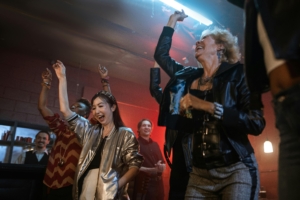
She tries it on and it dances her around to the tune of “You Should be Dancing” by the Bee Gees. It looks silly but she is laughing while she is dancing and moving all over the floor of the office. People are looking her way. Some of them look intrigued. Then the three people who like her the least are jealous. They start laughing at her and messing up her steps. I feel nervous and nauseated. The flashback comes of the boy I didn’t save. I am getting angry at the bullies. The world is swirling around me.

I glance at Bryan the ex-Marine. He too is struggling. He is thinking of the battles with the enemy and he’s clenching his fist.

I look at my friend Ming and she shakes her head at me. Violence is not the answer.

I remember the words of the great man, Rev. Dr. Martin Luther King, Jr.: “Darkness cannot drive out darkness, only light can do that. Hate cannot drive out hate, only love can do that.”

Then Sonia speaks up.  “I like it!” she exclaims. I want to try it!  She gets it and makes it play “La Vida es un Carnaval” by Celia Cruz.

“Anyone that thinks that life is unfair

They really need to know it’s not like that

Life is a beautiful thing, we have to live it

Anyone that thinks they are alone and that it’s wrong

They really need to know it’s not like that

In this life there’s no one alone, there’s always Someone

You see, life is a carnival, and singing though it is lovely

You see, life is a carnival, and those sorrows disappear singing

You see, life is a carnival, and singing though it is lovely

You see, life is a carnival, and those sorrows disappear singing”

— La Vida es un Carnaval*

© Copyright 2025 by Cecile Bianco

*Daniel, V. (1998). La vida es un carnaval [Recorded by Celia Cruz]. On Mi vida es cantar [CD]. N.Y., N.Y., United States: RMM Records.

Translation of “La vida es un carnaval” found on https://www.letras.com/celia-cruz/9256/english.html#google_vignette

Ferris Wheel Image by Image by Harut Movsisyan https://pixabay.com

People dancing Photo by RDNE Stock project: https://www.pexels.com/photo/group-of-people-smiling-and-dancing-6173868/

Two by Two

Jesus summoned the Twelve and began to send them out two by two. (Mark 6:7)


Two by two. Not alone. Not in a group. Jesus sent out the twelve two by two.

Jesus could have sent the disciples out on their own. After all, there would come a time when they would each go their own way — James to Spain, Thomas to present-day Iran, Andrew to Greece, John to Asia, Matthew to Africa, and so on. He could have told them that this first sending out was meant to prepare them for what was to come. He could have told them that there are times in life when they would feel and be alone, and they would have nobody to turn to or consult or just talk to.

Likewise, He could have sent them in two groups of six or three groups of four. There’s safety in numbers. Plus, groups of young men traveling around the globe attracting audiences have always been popular, right?


Two Are Better than One

Instead, Jesus sent them two by two. He knew that two is better than one, and often two work better than a group. In Ecclesiastes, we read,

Two are better than one … If the one falls, the other will help the fallen one. But woe to the solitary person! If that one should fall, there is no other to help. (Ecclesiastes 4:9-10)

C.S. Lewis takes it even farther. He tells us in the introduction to  Athanasius’ On The Incarnation, “Two heads are better than one, not because either is infallible, but because they are unlikely to go wrong in the same direction.” Two people are more accountable and hold each other accountable. They recognize when one is going off course and can steer each other to the right place, be it a safe harbor or a challenging cliff that can only be climbed together.


Finding A Second

For several years, I have thought about whether I need a spiritual advisor. Of course, being human and being the independent, forge ahead at all costs person I am, I’ve always laughed it off as something I don’t need and certainly don’t have time for! I never stopped to think that maybe I don’t have time for one because I’m not making the time or because I’m not where I’m meant to be and am too busy running around to see it.

More and more, this concept of having someone else in my spiritual corner — someone to help me when I’m falling, when I’m off course, when I need help — has been weighing more and more on my heart. I finally reached out to a friend who is a spiritual advisor and asked her opinion. As expected, she told me that “the Holy Spirit is a nudger worth listening to.”

In sending the Apostles out two by two, Jesus affirmed the view of two people working together to help each other out, to receive help when one falls, and direction when off-course, to further the Kingdom. If Jesus felt that this was the best way to go about our missions and bring His Word to the world, who am I to try to make the journey solo?


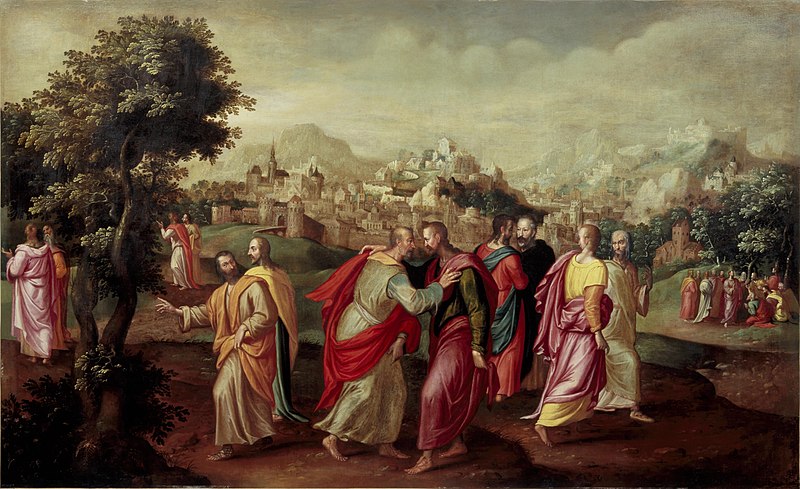
Christ Sends Apostles Out in Pairs Anonymous Dutch Painting, Public Domain

Christ Sends Apostles Out in Pairs Anonymous Dutch Painting, Public Domain


We Can’t Do It Alone

So they went off and preached repentance. The Twelve drove out many demons, and they anointed with oil many who were sick and cured them. (Mark 6:12-13)

As two together, the Apostles experienced the fruits of the Holy Spirit. They were successful, doing as Jesus told them, and healing may of their afflictions, both spiritual and physical. Perhaps they would not have been able to accomplish this on their own. Even after Jesus died, and they were to carry on the mission, they needed the Holy Spirit to descend upon them and grace them with confidence and ability. They couldn’t do it alone.

My brothers and sisters, if you are pondering where to turn for guidance and companionship on your spiritual journey, know that you are not alone and that you aren’t meant to be. If not a spiritual advisor, seek someone who will share the mission with you, be there when you fall, and steer you in the right direction. Two are better than one.

“For where two or three are gathered together in my name, there am I in the midst of them.” (Matthew 18:20)


Let us pray: Lord, I ask you to open my heart and my mind to the nudging of the Holy Spirit. I pray that you lead me to the person you have chosen as my spiritual partner. Help us to further Your Kingdom as we walk two by two. Amen.


Copyright 2025 Amy Schisler

Retreat and Discernment

Retreat and Discernment

Our gospel reading this weekend reports that “Jesus took Peter, James, and his brother, John, and led them up a high mountain by themselves.” (Matthew 17:1) (1)

Other passages in scripture also demonstrate how our Lord retired into the wilderness, alone or with spiritual companions, as an integral part of his spiritual rhythm. He used these respites to focus on prayer, and to replenish his energies during a demanding physical ministry of teaching, preaching, and healing.

Retreats and spiritual direction offer refreshment for our own lives as Catholics, too. Recently, I participated in a first formal one-day orientation to the teachings of St. Ignatius.

For many years, my primary resource for discernment has been Authenticity: A Biblical Theology of Discernment, written by Thomas Dubay, S.M. (2)

That reading provided a welcome foundation for what I experienced at “Image & Imagination in Prayer,” an Ignatian retreat sponsored by Emmaus House in Urbandale, Iowa on July 22.

Emmaus House was founded in the Diocese of Des Moines by Jesuit priests in 1973, at the invitation of then-Bishop Maurice Dingman. At first, Emmaus House served the diocese by providing spiritual direction and retreats exclusively for Catholic clergy. But it quickly expanded to offer these resources for members of the Catholic lay community as well as some Protestant clergy. (3)

I was intrigued by how original spiritual methods developed by St. Ignatius of Loyola in the 16th century anticipated several techniques employed by archetypal psychologists today.

Swiss physician C. G. Jung, the founder of archetypal psychology, studied Ignatius’ teachings in the early 20th century, and gave a series of lectures about their value in Zurich between 1933 and 1941. English translations of these lectures have been published only recently, in January of 2023.

Both approaches focus on events in ordinary daily life. Both are designed to bring forth the full flowering of human individuality. Both honor the integrity of images and feelings as they emerge from a person’s inner being, and use “active imagination” to help deepen relationship with the unique divine spark alive in each of us.

What Dubay calls outer verifications occurred throughout my one-day introduction to Ignatian method. I crossed paths with dear friends from different parts of the diocese as well as from different eras in my life; and encountered new acquaintances who wandered in my direction for a purpose we discovered together only as we met.

Under leadership of spiritual director Amy Hoover (4), we contemplated a series of readings and questions offered for private prayer and reflection. Then time was provided for optional sharing with individual retreat partners at our tables.

Reported movements of the Holy Spirit permeated the retreat throughout the day. These repeated, meaningful ‘coincidences’ — simultaneous events without any causal relationship — are what Jung called “synchronicities.”

In one humorous example, intending to excuse myself for a trip to the coffee table during a break, I commented to my companion, “I think I need some sugar.”

Snickers bars immediately dropped down from above our heads, right in front of our faces, like manna from heaven.

We both looked up to see the refreshment hostess making rounds with a bag of candy. But how did she manage to arrive at our table — one of more than twenty in a large parish hall — to be there at the exact moment I spoke?

Later, we were asked to write what we noticed about a picture postcard. While I had written about the display of creation — seasonal weather, contrasts in foliage, moss growing on ancient stones — one of my table mates had first noticed that “there’s no human being here.” She had placed herself and her husband taking a walk, right into the picture, as her focus for the scene.

Another companion among us had been seized first by curiosity about the path’s curve into a distance that lay behind bushes and trees. He had written with poetic insight about what might lie unseen around the bend.

Most dioceses in the United States publish a list of trained spiritual directors and local retreat opportunities, often right on their websites. If you haven’t yet experienced these gifts of our faith, it might be worth exploring what resources are available near you.

Scriptural readings for the Memorial of St. Ignatius of Loyola on July 31, and for the Feast of Transfiguration of the Lord on August 6, are rich with vivid images for further contemplation on your own, too.

I pray that each of us can experience a personal transfiguration this August. May we feel the awe and wonder that enlightened Peter, James, and John two thousand years ago, when they witnessed our Lord in earnest conversation with Moses and Elijah on Mount Tabor.

©Copyright 2023 by Margaret King Zacharias

Featured Photo: View frim summit of Mount Tabor ©Copyright 2023 by Margaret King Zacharias 

NOTES:

  1. https://bible.usccb.org/bible/readings/080623.cfm.
  2. San Francisco: Ignatius Press, 1977, originally published by Dimension Books.
  3. https://www.theemmaushouse.org/history.
  4. https://www.theemmaushouse.org/eighth-annual-ignatian-retreat