The Better Way to Bee: A Fable for the Young of Age and Heart

Busy as can be, busy as the life of a honeybee.

Busy, you see, is the better way to be;

To keep the hive alive

And free from harming its harmony.


Nimble Thimble, the humble bee, was married to Grumble Rumble, the bigger bee.

Nimble Thimble flew with grace and ease,

Weaving and gliding like a garden breeze.

Bigger than three bees, was he, yet Grumble Rumble the bigger bee might fumble, or tumble, or trip on his wings, so this bee so big, flew so little.

Yet Grumble Rumble could hum, and other bees liked to hear his buzz.


Bonny Bee wore a bonnet of leaves.

How pretty she looked with her hat all aflutter; like a small bush in flight, or a miniature mad-hatter.


Sweet Pea, the honeybee, wore a yellow jacket that all could see was a brighter color yellow than her sister bees.

Sweet Pea swept by, saying, “No one can deny how spry look I in this brightest yellow.”

A storm in the swarm blew like breezes of bees as the sister bees suffered such stabbing envies.

The sound of the hive could not be heard, as bees blew roaring raspberries when Sweet Pea flew past.


All five eyes of each bee showed such surprise as they surmised the scope of the sting evoked by pride and jealousy.


Grover Clover was a clever bee.

Grover Clover offered advice for being nice.

Beware of envy and strife, don’t brag or boast.

Don’t try to be the most.

A hive needs peace and sympathy to form an apian symphony.


“Oh, no,” came a murmuring mumble from Grumble Rumble, the bigger bee.

“It is not for we to be better or worse than other bees.

Don’t we each have a place in the whole of the hive,” he hummed?


But the hive was alive with a clackety racket over the brightest yellow jacket.

Cacophony, disharmony, discordancy abounding; a disturbance most astounding.

The day was gray, the sun away, no play from they, no work today.

Flowers wilting, petals tilting, bees feeling sticky over souring honey.


No one wished to disturb the Queen Maureen, the Serene, the Ever-Calm of the honeycomb. Yet the hive made a sound like a hundred yellow jackets zipping, which woke the Queen.


The buzz in the hive was that the Queen so Serene had failed to keep calm the honeycomb.

Queen Maureen, the Serene, the Ever-Calm of the honeycomb felt stung by those barbed remarks; she felt abused, and she was not amused.


“This, you see, is the way it should be,” announced Queen Maureen, the Serene, the Ever-Calm of the honeycomb.

“Each bee is a special bee, in a different way for every bee.

Unity of the hive can thrive

When each is the best bee they can be,

And they strive for the harmony of the whole of we.”


Now Grumble Rumble, the bigger bee, mumbled out in apian glee.

“Ho, ho, and hum, hum; that is the way we should behave in the beehive.”


———————————————————————————————————————————————-

The Moral of the Story


No bee can be the best bee; as every bee belongs beside the other bees. The work of the bees is the honey on our bread, the fertilizing of flowers, the refreshing of fields.

For flowers and trees, for fields and groves, the humming of bees is the bringing of blessings, the bringing of pollen, the lacing of links that tie these thankful things.

I alone, am not alone, you should see; you cannot be just one when you stand beneath the sun, where everyone alive is a member of the hive that is the whole earth.


copyright 2026 Tom Medlar

Follow Me to Little Jesus: Part 3


Follow Me to Little Jesus:  Part 3


Bart revealed the first message of the Little Jesus vision.

“‘Follow me,” he said the first week. Only Amie heard him.

“Catholics aren’t required to believe in private revelation,” Maeve said impatiently.

“Right you are, Miss,” Mel agreed. “But I would challenge you to tell that to anyone who’s been to Medjugorje. And not everyone on that day believed. Some saw and just went about their business. If you recall, folks didn’t much take to the visions of Fatima and Lourdes at first. Or to St. Faustina and the Lord’s message of Divine Mercy.”

Maeve blushed and looked down, examining her hands. Her cousin experienced healing at Medjugorje, one Maeve believed.

“You said the first week, Bart. Did he come back?” Ross was captivated by the story and images.

The sequence showed people kneeling around the little boy.

“Indeed, he did,” Mel said like an animated docent giving a tour. For two more Sundays. He came to the shore, each time walking out from the early morning fog, delivering his message to Amie, then disappearing back into the mist.

“What were the other messages?” Maeve asked, surprised by her sudden interest.

“His second message was ‘Fear not.’ Just like Jesus said so many times in Scripture,” Mel said.

They moved to another sketch. The people in the image were kneeling like the other, but the focal point was Amie and Little Jesus. Amie was also kneeling, with both arms outstretched toward him, looking as though she were pleading with him.

“She didn’t want him to go,” Bart said. “She begged him to stay. ‘We need you, Little Jesus, please stay!’ Before he left, he said, ‘I am with you always.’ Until her dying day, Aunt Amie cried when she told people that part.”

“Bart, what did the people think the vision was trying to tell them?” Ross asked.

“As I said, it wasn’t much of a Christian community. You might say it was downright heathen. The only catechesis Amie and her family had was from a missionary priest who got lost trying to find the city. He stayed for a week, preaching and teaching, and baptizing. He left Bibles, rosaries, crucifixes, and a Baltimore Catechism. Amie took it all to heart and believed.”

“What did she think about the vision?” Maeve said. She couldn’t even feign disinterest at this point. Still skeptical, she also wanted to know more.

“Amie thought it was a call to conversion. She essentially became the community’s spiritual leader – at only 13 years old — because she read all of it, over and over, and talked about it all the time. On the night of the first vision, she began leading rosaries at her home for the community. They were out the door, on the porch, and in the yard, praying. Some thought the catches would improve again. But Amie believed the vision wasn’t about them. She said it was about Jesus, and he was calling them.”

Ross continued to scrutinize the sketches. “The messages are eternal,” he said thoughtfully. “Amie must have known that to record everything so meticulously.”

Leo ran over to his parents and held out a plastic statuette of the boy.

“I think Little Jesus is about my age,” he told them. “He grew up to be a carpenter, but he must have loved to fish.”

“Most people had to back then, Leo,” Maeve told him flatly. “But Jesus Christ’s childhood is a mystery to us, other than for a few events recorded in Scripture.”

Bart showed them to their table and took their pie orders. When he returned with the slices, Leo peered at each one and lowered his face to sniff each flavor.

“Mine’s chocolate, but I like the fruit pies too!”

“Sure you do, Son,” Ross said, taking off a large corner of his cherry pie and putting it on Leo’s plate. Maeve did the same with her blueberry. Leo tried those first before his chocolate. He finished his pie quickly without leaving a crumb on the plate and asked to be excused to pick out a statue or picture for their priest, Fr. Ted.

The brothers laughed, delighted by the boy and the closeness of the family. They continued with the history of their little community.

“Around 1930, the catches started to dwindle, and no one knew why. Little by little, it died away,” Mel said. “When the Little Jesus appeared, they were already feeling it. By 1935, there wasn’t enough shellfish to keep a family in stew for a week. Generations had lived off the bay, but now they had to go to the city to work in factories. Times were dire here. Decades later, we learned a rare disease killed off marine life.”

“It killed life around here, too,” Mel continued. “Folks had to leave to survive. Our little spot wasn’t worth anything to anyone but us.”

They remained silent until Leo burst into the dining room.

“Hey, Dad! Dad! Jesus was a little boy just like me! He was eight years old once. I never think of him that way. I just think of him as a grown man on the cross. But he had friends, and went to church and to school, played baseball, and helped his mom set the table, and made his bed. If I lived during ancient times, we might’ve been friends. We could’ve gone fishing together and played on the same team. Boy, that’s a guy who’d never let you down!”

“I think you’re right, Son,” Ross said, pleased. “But how did you come to these theories?”

“I just kept looking at the picture on the wall, Dad, and thought about it, and it just came to me! I’m gonna see what else I can find out!” Leo ran off again to study the picture. Bart and Mel also left to greet more guests. The dining room was filling up, but Maeve noticed no one else was getting the same attention as the little family.

Once they were alone, Maeve leaned in toward her husband and spoke quietly.

“Well, this has been interesting,” she said.

“You say that like you think they’re crazy,” Ross said. “I’ll admit it’s a little far out, but fascinating. I’d love copies of these drawings. Amie had some natural talent.”

“It’s just that Leo seems so taken with this idea. And they’re giving us so much attention. We don’t know these people; we’ve never heard of this vision. We live 30 miles from here. I go to the diocese for meetings a few times each year, and I’ve never heard anyone speak of it.”

“How often do people talk about the 1930s, Maeve? Whether or not it’s what they say it is, they seem sincere. Each of us needs to address it with the discernment God gave us and take it to Him in prayer and Confession. And discuss it as a family with Fr. Ted.”

Ross reached over to Maeve’s plate and used his fork to cut a bite of her blueberry pie. He chewed the pie piece slowly, and Maeve pushed her plate toward him to finish the slice.

“Do you want to know what I’m taking from this?” Ross continued between bites. “Did you hear how Leo talked about Jesus? Like a friend. Like someone he wants to spend time with and someone he knows he can count on. Maeve, if nothing else, this day has shown Leo who Jesus is. My concern is that, as sports and hormones take over his life, he’ll start to forget that. Our job is to make sure he doesn’t.”

The family was late heading back from their outing. They drove home silently in the dark, exhausted from what started as a search for pie. Maeve noticed the whole car smelled like pie. Not just the beef pot pie in the box they were bringing home, or the extra slice of chocolate for Leo. It was like a harmonious blending of many pies. It was just … heavenly? How could the aroma be so overwhelming? Maeve inhaled the homey scent. Is this what Jesus smells like, she thought and laughed to herself.

She glanced at her husband, who was wide awake and alert, determined to get his family home safely. She looked back at her son, peacefully asleep. Two heads peeked out from his jacket pocket—the statuettes they had bought for Leo and Fr. Ted. She reflected on her husband’s quiet and steadfast faith that she saw today, and her son’s joyful and innocent faith. She thought about the dedication and perseverance that stemmed from Mel, Bart, and their sister, Amie’s faith.

Follow me. Fear not. I am with you always.

But did she? Lately, she felt like she had been following fear more than God. Afraid of Ross losing his job since his company was bought by big corporate. A lack of trust in his ability to start his own business. Did today have a special message for her? Maeve sighed and put her head back on the seat. The old car’s engine sounded quieter than usual tonight. Or maybe it was her anxiety that was calmer. For the first time, she didn’t feel the need to keep watch during a night drive. She relaxed back in the seat, content to see how this day would rest on her family in the morning.


Read Part 1

Read Part 2

Author’s note: The Biblical references noted are inspired by the following Scripture passages:

  • Follow Me: Matthew 4:19
  • Not all who saw believed: John 22: 26-28
  • Fear Not: Acts 18:9
  • I Am with You Always: Matthew 28:20

© Mary McWilliams 2026

Banner Image generated in Adobe Firefly Gemini 3.1 (with nano Banana 2)

Edited by: PV Babadi

Follow Me to Little Jesus: Part 2

Twenty minutes later, Ross, Maeve, and Leo drove through a blinking red light at a four-way intersection and found a run-down roadside café with a dirt parking lot. A worn, hand-painted sign said, “Welcome to Little Jesus Pie Café and Gift Shop.” The family parked near the door and was happy for a chance to get out and stretch. Leo ran inside. Ross and Maeve hesitated, then entered to assure their son’s safety.

The couple paused inside and gazed in awe at the wall covered with framed sketches and paintings. Shelves brimmed with plastic statuettes, all of which appeared to be a rendition of a Jesus-like child in a tunic, his right arm outstretched in a beckoning motion. In the paintings, the boy was pictured standing on a foggy shoreline with people kneeling around him.

Leo was already speaking to a tall man, at least 6 feet 5, with thick, gray hair that made him look younger than his 70s. He bore an animated personality toward the boy. Briskly, he stepped out from behind a hostess podium and pointed to the wall, acknowledging Ross and Maeve with a “come along” gesture. Leo, meanwhile, busied himself studying one of the paintings at eye level.

“We call him Our Little Jesus of the Bayshore,” the man announced. AND our little church, built in 1933.”

“You have a church here called Our Little Jesus of the Bayshore?” Maeve deadpanned. “I’m a catechist for our church, and I’ve held positions over the years with our diocese, and I have never heard of a church by that name.”

“No, Miss, unfortunately, you wouldn’t,” the man admitted sadly. “I said that’s what we call it. The diocese calls it St. Bernadette.” 

“Oh, I think I have heard of St. Bernadette’s. More like a little chapel,” Maeve admitted weakly.

“That’s the one. I guess it was named that because she had been newly canonized. My name’s Mel, by the way. I’m one of the owners here and nephew of Amie – Amie with an ‘ie’ — who first saw the vision of the Little Jesus.”

“The vision,” Maeve said flatly, already skeptical of Mel’s story.

“Yes, Miss,” he said respectfully and continued. “She was only about 13, but wise enough to record all the events back in 1932.”

“Is that so?” Ross said, a graphic artist, almost as fascinated by the pictures on the walls as his son. “Did she do all these pictures?” 

“She did indeed,” Mel confirmed, “And at the time had no training —”

“Excuse me,” Maeve interrupted impatiently, waving her hand in the air as though she were erasing something. “Have you ever looked into mission status? Surely there is a larger church that would take you on as a mission church.”

“The nearest church is about 50 miles away, and that’s struggling a bit from what I hear, so that they wouldn’t want us,” Mel said.

Another man, who looked much like Mel but with white hair instead of gray, emerged from the dining room.

 “That big donkey’s my twin brother, Bart,” Mel told them and then informed Bart that the family followed their sister Ami – with just an ‘i’ — here, thanks to that little fellow, Leo. Bart said that she had just gotten back from a shopping trip.

“She’ll be pleased to know the bumper sticker paid off. Were you telling them about Aunt Amie and the Little Jesus?” Bart said.

“I was just starting,” Mel said. “You can help me.” Maeve flashed Ross a glance, raising her eyebrows and exhaling deeply. They had come to the café for pie but were given a special tour and history lesson. Was she the only one who thought this was strange? Ross, a graphic artist, wanted to know more about the pictures and the story behind them. Leo had wandered off to the other end of the lobby, intrigued by the statues and the pictures of the boy Bart and Mel were calling “Little Jesus.”

The twins began telling Ross and Maeve the story of the vision of Our Little Jesus of the Bayshore. They followed a string of child-like, detailed sketches high on the wall behind the podium and cash register. They provided the backstory but let the pictures do the telling.

“Our Aunt Amie was only about 13 at the time in 1932,” Mel began. “Before the 1930s, this area was booming for clams, crabs, oysters, and mussels. But it was kind of a secret spot for the folks who lived here. They made good money back then by going into the city and selling fresh shellfish. They were very isolated, though.” 

“No one wanted this area,” Bart started to explain. “People made up folktales over the years about half-man, half-animal demons running around at night, and babies being born with fangs and horns, so people stayed away, and this little stretch was largely unknown. Funny how some were so quick to believe that nonsense but thought the Little Jesus couldn’t be true. It wasn’t very Christian here, but some folks understood about Jesus Christ being our Savior. A few went the distance to a church, but most didn’t.”

“They could always find a bottle and some trouble, though,” Mel interjected. 

Mel pointed out the first sketch of people along the shoreline digging for crabs. Some boats moored off in the distance. Another drawing showed a little girl with her mouth agape, pointing ahead. 

“Now that’s our Aunt Amie,” Mel said. 

Maeve looked away and sighed.

Another pencil drawing showed a boy walking along a foggy shoreline, reaching out with his right hand.

“That’s Our Little Jesus of the Bayshore,” Bart said proudly. “You’ll notice the same image in the paintings.”

The brothers told them that in September of 1932, he came back three Sundays in a row in the early morning fog. Each Sunday, he delivered a different message, but only Amie heard him. Then he disappeared into the fog.


Next month: The family learns the messages that Amie heard from the boy in the fog, and Leo makes a friend.

© 2026 Mary McWilliams

Featured AI image rendered through Adobe Firefly & Gemini 3.1 Nano Banana 2

Edited by Paula V. Babadi

The Shepherd’s Pie: Letting Our Adult Kids Go

“A slice of hope to raise faithful kids.”

This uplifting, ecumenical show uses engaging conversations and fun entertainment reviews to offer positive insights and media resources for families and youth leaders. We discuss current issues that impact young people at home, in school, and in the world today.

In this episode of The Shepherd’s Pie, Antony Barone Kolenc speaks with Stephanie Landsem about the challenges of letting our adult children make their own mistakes, and we discuss her novel, The Fault Between Us.


Check out other episodes of The Shepherd’s Pie.


Copyright 2026 Antony Barone Kolenc

Molly Chase: An Inspirational Work of Catholic Literature

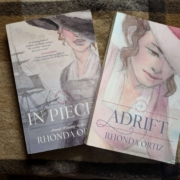
Last month, Chrism Press released the third and final installment of Rhonda Ortiz’s Molly Chase series. The work, titled Keeper of Keys, was a masterful conclusion to an equally masterful series – one that will return to my reading list as worthy of a re-read as a whole. 

Having now the whole story available to read, I wanted to highlight some of the story’s aspects that have really impacted and inspired me as a reader.

The collection of three novels primarily focuses on the heroine, Molly Chase, though she is surrounded by many other intertwining plotlines concerned with her friends and family. Molly’s story is one of romance with her childhood friend Josiah Robb, healing from the trauma of discovering her father’s body after his suicide, and involvement in a mission of political espionage on behalf of the fledgling government of the United States. One might consider Molly’s story verging on confusing with the multi-layered narrative. Additionally, the story is written from the unique points of view of various characters, each offering a glimpse into various aspects of Molly’s story. Confusing as such a multi-faceted type of storytelling may seem, I thoroughly enjoyed it and found it created a lot of depth and realism.

However, what struck me most deeply throughout the series was Ortiz’s capability to write like a real, Catholic novelist. I have repeatedly been frustrated with the lack of good contemporary works which both hold up as a compelling story and are able to enrich the mind as Catholic art. The Molly Chase series does both.

I was swept up throughout all three books by the real, well-paced story, filled with political tension, familial and societal drama, and a good deal of romance. I love a story that leaves you, at the end of each chapter, eager to see how your main characters will sort out their lovers’ quarrel, or what will become of the friend who seems somehow embroiled in enemy plots, or how the beloved heroine will ever conquer her PTSD following her father’s suicide. Each of these plotlines is woven throughout Molly Chase’s story, along with many more. The work as a whole is almost Dickensian in scale – a great compliment from a Dickens enthusiast like myself! In short, the Molly Chase series holds its own as a collection of well-crafted novels.

More importantly, the series was honestly enriching as a deeply Catholic work. The Catholicism is obviously present and very central to the familial and societal plotlines, yet I was refreshed by the lack of “preachiness” in the work. The wise, matronly lady of the series, Mrs. Sarah Robb, certainly provides a vocal moral compass throughout the three books, yet never comes across as a jarring interference from an author seeking to insert religious education. Mrs. Robb is the mother of a central character, so she is simply doing her characteristic, maternal duty by her children when sermonizing. Josiah’s conversion to Catholicism too, was not something that struck me as “preaching” or overly emotional – another weakening aspect of Christian literature that can detract from a story’s quality. Emotion is involved in Josiah’s journey to the Catholic faith, but the main, compelling force of conversion seems grounded in a rational, educated decision to come to the true faith. Mrs. Ortiz’s Dominican background certainly shines through in Josiah’s reading his way into Catholicism.

Beyond simply involving the Catholic Church and creed, Molly Chase as a series is Catholic in its universality. The work may be a historical fiction, but the subject matter it deals with is far from being history. The issues of sin, repentance, forgiveness, suffering, and dealing with death are applicable to all humanity, no matter the era or culture. Watching Molly journey through trauma following her father’s death is Catholic because everyone must face loss, grief, and healing at some point in life. A great work of Catholic literature does not confine itself to talking about God as a distant deity or a magician who offers earthly happiness – it unveils the dark moments of human life where God is still somehow present amid the blood and tears. Catholic art is to remind us that God is present to everyone, at every moment in life.

If my emphasis on the deep, heavy aspects of the Molly Chase series does not exactly recommend the book to readers looking for entertainment and gaiety, let me say there is yet a good deal of life and joy in the series as well. Ortiz has a lively sense of humour and her books are certainly no mournful Russian tomes! Do not let the presence of death and sorrow frighten you away from reading In Pieces, Adrift, and Keeper of Keys. Yes, your heart may be left a little bit raw after completing the three, but you will have gained a host of wonderful characters as your literary friends.

For writers of today, Mrs. Ortiz might offer you an inspiration, as she did for me, that the days of great literature are not dead and gone. There are authors in our contemporary world who craft beautiful works of art to enrich the imagination and lead us to God.


Copyright 2026 Maggie Rosario

The Silver Horn of Adorini

Slowly, as silently as a goldfinch landing on a branch, Ella knelt in the lilies of the valley and peered carefully through the pink azalea blossoms, as her younger brother, Kieran, ran about Grammy’s backyard, searching for her hiding spot. Suddenly, Ella noticed a glimmer of silver under the lilies of the valley.

Kieran knelt beside her, not talking, but staring also at a small silver horn as Ella moved the lilies aside with her hand.

“It’s clean. Pick it up,” Kieran said. “I don’t think it’s dirty. Blow it and see what it sounds like,” he said, looking at his big sister.

Ella held a small and shiny bugle, maybe eight inches long. It felt just right in her hand, and she felt a surge of excitement blowing into it. She pictured herself calling an army to her side with this horn.

Ella blew a long note on the horn, and it sounded like singing and shouting, more than music, and suddenly a smiling girl stood in front of Ella and Kieran.

They looked at each other and looked at the girl.

“My name is Adorini,” she said, still smiling. “That horn is mine. Usually you don’t see the horn, or me. Your eyes often startle me, Ella. I didn’t just drop my horn on the ground. I accidentally dropped it into time.”

Kieran and Ella didn’t know if they were in a dream, or if this was magic, or if this was how things were always supposed to be but rarely were.

Adorini looked from Ella to Kieran and said, “You are wondering how I know you. I’ve known you all your lives. I think you do know that, in a way,” she said. Still, Ella and Kieran were silent, just staring at Adorini.

“Yes, you’re exactly right Ella. I’m your guardian angel,” Adorini said, responding to Ella’s thoughts. “I use my horn to call for help if you are getting into trouble.

“Yes, Ella, Kieran has a guardian angel also. His name is Teleos,” Adorini said.

“No, Kieran,” Adorini responded to the question in Kieran’s mind. “He doesn’t have a silver horn. He uses a sword.”

“Is his sword made of silver?” Kieran asked, finding his voice at last.

Adorini answered, “No, it’s made of fire. He is standing right behind you. He’s always right behind you, Kieran.”

Teleos smiled at Kieran, and Kieran wasn’t afraid, even though Teleos’ eyes were also made of fire.  “I am always here to fight for you, my beloved Kieran!” he said.

Adorini and Teleos turned suddenly, looking to the East. Ella and Kieran couldn’t see them and wondered if they had left, or if a bright ray of sunlight simply blocked them from view.

Then, smiling at the children, Teleos said, “We soon must go, but first we want to tell you some things, things that will grow inside you over time.  Just let these words be planted like seeds in you for now.

Let these words be planted like seeds in you for now.

“Kieran, some people may tell you to only stay in the moment, but that is not helpful advice. No, you should always be attentive to where the moment is headed. If you focus only on this moment, you will be more easily swayed by temptations and likely to be pulled into bad choices.”

Adorini knelt in front of Ella and said, “No, Ella, this is not how I always look, and no, Kieran, Teleos does not always look that way, either. This is the way that we are appearing to you today.

“And Ella,” Adorini continued, “you and Kieran do not only look to us the way you do now that we are with you inside a moment of time.

“To me, Ella, looking at you is something like looking into shallow, sunlit water, and closely watching the activity of all the life in the water. Or, it’s like looking at an abstract painting of bright colors, but the colors are alive, and they move, and they take different shapes as I watch. We can see you as you are outside of the boundaries of time. There are different parts, or levels, of what you are.

“The lower level is your emotions.

“Thinking is the next higher level. How you learn to think will help you guide and control your emotions, but they are not the most unique parts of who and what you are, Ella and Kieran.

“I know you will not understand these things now. You may not understand them for years, but it is important that I tell them to you. How many times will you speak face to face with me, or with another angel?

“The next higher part of you is your will—that is, your intentions, your determination, your decisions to act.

“There is a higher part of you that lifts your will higher still, and that is what you call beliefs, or faith. Faith attaches your will to the best kinds of choices.

“The strongest and most unique part of you is your will, so that is the part we watch most closely.

“There are other angels who are unclean. They are bad, and they want to hurt you. That is why God has us watching over you. These unclean angels do try to influence your feelings and your thoughts, but what they mostly want to control is your will and your faith—the things you believe.

“They come closer and seek to move your will, and that is when I blow my horn, and when Teleos draws his sword, and we fight them. Partly we fight them by touching your faith and will with ours, and that can help you turn away from bad actions that you may feel tempted to do.

“Ella and Kieran, after this you may not see us, and you may not sense our presence with you, but we will always be there. Just keep talking to us, like this. We will hear, and we will help.”

copyright 2026 Tom Medlar

Grab Me a Coke and a Character

“Grab me a Coke,” my husband said over the phone, as I was driving home from work. He drinks a Coca-Cola at least once a day and skipping it feels like withdrawal, so I stopped at the Navarro store a few blocks from home.

When I put my things on the register, the cashier leaned toward me and said, “Can you imagine this lady is eighty-one?” She was referring to a woman standing next to me, putting her change away in her purse.

Because I was prompted to judge this woman based on what a typical eighty-year-old might be like, I gave her a second look, a closer look. The woman looked really good for her age. She had great skin, a flawless complexion, not a wrinkle on her face. She wore a long fake brown ponytail and had perfectly painted-on eyebrows, not what I would expect from an eighty-year-old with shaky hands. Perfect arch. Filled in. On point.

“Wow, you look great,” I said in Spanish.

She laughed and went on to brag about her many boyfriends (younger ones at that) and about women who accused her of looking at their husbands. She boldly replied, “That’s how I like my men… married.” It was a lot of information to dump on a stranger at the register and definitely unexpected from an elderly woman. She shrugged and said she had several boyfriends, and why not? Men have two, three girls, and no one says anything to them. She clearly didn’t like the double standard. At her age, she knew who she was and felt confident sharing it.

If it were me, I would have written her as a little old lady quietly counting her change in her coin purse and walking home to watch telenovelas until she fell asleep, not the main character of one. Who would have guessed she still had a libido, an appetite for younger men… married men, and was unapologetic about it?

If I hadn’t been asked to take a second look, I would have cast her as an extra in the grocery store scene: (Abuela putting coins into her pouch). I had unconsciously boxed her into a role before she ever spoke.

The Danger of Catholic Writing

As a Catholic writer, I struggle to write characters who behave badly. I want to write moral characters. I don’t want readers to think I’m condoning bad behavior, and when I do write about characters behaving badly, I often box them into the villain role. But why can’t they be the protagonist?

In the Gospels, we encounter many flawed characters, and the narrator doesn’t pause to explain or moralize. There are no footnotes saying, “Don’t do what this person did.” We’re simply told who they are: a tax collector, an adulteress, a denier, a betrayer for thirty denarii.

Some become saints. One becomes a traitor we pity. What makes these stories powerful is that these characters are human, complex, contradictory, not flat and predictable.

Even great writers who write about the authentic human experience receive backlash. Zora Neale Hurston, both a writer and anthropologist, wrote people as they were, not as archetypes, not as political statements, not as moral lessons. Some criticized her use of dialect and portrayal of Black life in the South, but she didn’t care. She wanted to write people, not politics.

As writers, we can fall into creating characters to serve agendas, for preaching, teaching, or moral messaging. The bad guy has a foul mouth, a scar through his eyebrow, tattoos, a raspy voice. But what if the good guy did?

What I Learned from the Diva Eighty-Year-Old at the Register

I learned to accept her, not judge her, to accept that there are eighty-year-old women who still feel sexy and live life on their own terms. I’m not condoning her behavior, but I value her confidence and her refusal to fall into society’s idea of a well-behaved woman, or grandmother.

People are interesting, and so should our characters. God does not reduce us to stereotypes. He sees us truthfully, beautifully, and with dignity, in all our complexity and contradiction. As writers, we’re called to see people the same way.

Ask yourself:

  • Has my character fallen into a stereotype?
  • How can I write flawed characters, even antagonists, with dignity?
  • How can I write surprisingly flawed protagonists?
  • Where is the contradiction in this person?

Reflection

When I first saw the eighty-one-year-old woman, I saw a hunched-over elderly woman counting her change. But when I was stopped and asked to give her a second look, I was the one dealing with change. A revelation was made to me: people are wild cards, and so should be our characters. Her anecdotes replayed in my mind as I walked away with a Coke and a smile.


copyright 2026 Janet Tamez

Pilgrim Tales: The Glorious Pilgrimage of Margaret Henderson

Margaret Henderson, or Mama Mags as she was affectionately called, had been a shining example of feminine genius—faithful, organized, empathetic, and calm—for as far back as Veronica could remember. – “The Glorious Pilgrimage of Margaret Henderson” 

 “The Glorious Pilgrimage of a Margaret Henderson” was inspired by the bravery of my elderly parents after the sudden death of one of my brothers in a car accident. They signed up for a European pilgrimage! My mom had flown to Florida once or twice, and both of my parents had gone to Vegas, but they had never flown across an ocean. To learn that they were going to France, Italy, and Spain was shocking. To think they had saved that much money after beginning their family in the Depression and raising eight children on one income, and not a very high income at that, was unbelievable to twenty-one-year-old me. 

Upon their return, they were on cloud nine, eager to tell of their experiences, especially of being slain in the Spirit while in Lourdes. They invited each of their married adult children to their home to share this, some of whom had fallen away from the faith. It should have held more weight than it probably did, especially because of my convert dad’s profound feeling that only God could do that. I remember being skeptical of it myself, as I had never heard of such a thing happening. Still, the memory stuck, and my parents’ pilgrimage adventure instilled in me the desire to travel to Europe and visit the holy places of all those saints I learned about during my years of Catholic elementary school. 

After my dad’s passing, my mother embarked on another pilgrimage with my godfather’s wife, and two more compatible travel buddies would be hard to find. My godfather’s family has always been considered an extension of our family. So much so that their daughter, Lucy, is the inspiration for the character of David in my anthology story. Anyway, my mom and her dearest friend joined a tour group and headed to Germany, Austria, and Switzerland. Being half-German, my mother brought back gifts from that country, such as an authentic beer stein, ivory-carved mini-statues of angels singing, and hand-embroidered doilies with crocheted cotton lace. 

Margaret Henderson is only a tiny bit like my mom. The main inspiration for that genteel character is a combination of three graceful women outside of my family, as well as from the faith I witnessed at the more recent passing of my ninety-four-year-old brother-in-law. He seemed ready, as if he had prepared for death all his life. 

Last year, my husband and I were privileged to spend 42 days in Europe in various parts of Ireland, France, and Italy. We ended our time with nine days in Rome. We had no idea we would love the Eternal City so much! A highlight of our European journey was the dozens of Catholic churches we were privileged to walk into. We cherish the time we had to admire, dream, reflect, and pray. The whole adventure turned into our very own pilgrimage, and we give God all the thanks and glory for it! 

A selfie of the author and her husband in a Catholic church in Sienna.


The Thayers in Siena (October 2024). St. Catherine of Siena is Mary Jo’s Confirmation saint.


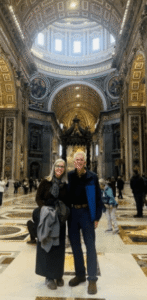
A picture of the author and her husband in St. Peter's basilica.

The Thayers inside St. Peter’s Basilica (November 2024) after having attended Sunday Mass celebrated by Pope Francis and then praying the Angelus with him in St. Peter’s Square.


Read “The Glorious Pilgrimage of Margaret Henderson,” and other short stories by the Catholic Writers Guild in Pilgrim Tales: a Catholic Writers Guild Short Story Anthology available now on Amazon in print and e-book.

Feature Photo: Pixabay

© Copyright 2026 by Mary Jo Thayer


Edited by Rietta Parker

Pilgrim Tales: Kyrie

“I had taken the first steps on my pilgrimage, a pilgrimage that was only just beginning…Kyrie eleison.”

The Quick and the Dead

“He will come in glory to judge the living and the dead,” reads the Nicene Creed, or as we used to say, “the quick and the dead.”

The words resonated with me more than usual, following a series of losses over the past couple of years. First, my mother, then my father, and lastly my German Shepherd, Rex, my heart dog, passed away.

The quick and the dead. What could I do with those words? Surely a basis for a story – or a series of stories – lay within that short phrase. As I mulled it over, the “quick” became Jonathan Quick, a bereaved composer, and the “dead” became Meredith de’Ath (spelled like “death” but pronounced “Deeth”), his recently deceased fiancée. 

I have long enjoyed reading and writing ghost stories. So Meredith became a ghost, though not a haunting revenant, but returned by the grace of God to guide the faltering Jonathan to perform various works of mercy and restore him to faith. Hence, the title of the first of what has become a series of stories, “Kyrie”. Lord, have mercy.

Both Jonathan and Meredith are on pilgrimage – a pilgrimage to heaven. Jonathan in this life, Meredith completing her pilgrimage in the next – returning from purgatory, perhaps.

“Kyrie” takes place in England because I am English and enjoy writing stories set in my homeland, sometimes using locations that I have visited as background.

We, too, are on pilgrimage, and “Kyrie” illustrates the unexpected twists and turns our pilgrimages may take and how we might be surprised by the mysterious and unfathomable mercy and grace of God. 


Copyright 2026 by Andrew M. Seddon

Edited by Paula V. Babadi

Photo credit: Trek_Jason, Pixabay

Read “Kyrie,” and other short stories by the Catholic Writers Guild in Pilgrim Tales: a Catholic Writers Guild Short Story Anthology, available now on Amazon in print and e-book.

E-book: https://www.amazon.com/dp/B0G5VZ7WV8

Print: https://www.amazon.com/dp/B0G5WZF1PV


Pilgrim Tales: The Story Behind “Faithful Journeys, Hidden Sanctuaries”

They stood in silence for a moment, the old man and the young, united by faith, by craft, by blood, and by the shared knowledge of what it meant to be touched by something beyond understanding. -“Faithful Journeys, Hidden Sanctuaries”

When invited to contribute to the CWG Anthology, I was happy for the opportunity to write a historical fiction story as a way to learn about the saints. In particular, a group of saints that we learned about while traveling through England this past winter. 

We expected our visit to York to be about Yorkshire pudding and Vikings. Instead, we learned of the extraordinary courage of people who risked everything to practice their faith, the  Forty Martyrs of England and Wales. Among them was Margaret Clitherow, the “Pearl of York,” a wife and mother who hid priests in her home and died under torture rather than betray them.  

Our first stop was The Red Lion pub for lunch.  Besides steak pie and real ale, this medieval pub featured a priest hole. Further research revealed the remarkable tale of Nicholas Owen, a carpenter whose genius for concealment saved countless lives through his construction of priest holes—those hiding places built into the walls, floors, and chimneys of Catholic homes during the persecution in Elizabethan times.

Picture of a bread oven circa 1300s- brick surrounding a fire pit structure

Bread oven circa 1300’s at The Red Lion pub in York. Photo credit: John Ruberto


These two figures captivated me, and I knew I wanted to honor them in fiction. But how do you tell this story? St. Margaret Clitherow held secret Mass at her home, protecting so many Catholics in York, and St. Thomas Owen, who operated in Oxford, built over one hundred priest holes across England before his death by torture in the Tower of London. They were separated by time and distance. 

That’s when the pilgrimage tradition entered my imagination, to tie in another amazing experience traveling through Great Briton. 

 Our Lady of Walsingham had been England’s greatest pilgrimage site for centuries before Henry VIII ordered its destruction in 1538. What if a young Nicholas Owen—grieving, questioning, struggling with faith—journeyed to the ruins of Walsingham? What if that pilgrimage became the crucible where his calling was forged?

Picture of the ruins of the Priory in Walsingham - looks like a giant stone castle-like arch with lush greenery in the background

Remains of the Priory in Walsingham, once a great pilgrimage site in England.
Photo credit: John Ruberto

The resulting story follows a fictionalized Nicholas on a journey from Yorkshire to Norfolk, encountering Margaret Clitherow along the way. It’s a coming-of-age tale set against the dangerous backdrop of Elizabethan England, where celebrating Mass could cost you your life and harboring a priest meant death.

Through Nicholas’s eyes, we see how pilgrimage—even to a destroyed shrine—can transform a heart. We witness how grief can become purpose, how craftsmanship can become ministry, and how ordinary people become saints not through grand gestures but through faithful, hidden service.

“Faithful Journeys, Hidden Sanctuaries” appears in the anthology Pilgrim Tales, celebrating the tradition of Christian pilgrimage through fiction. It’s my small attempt to remember those who built secret sanctuaries and kept the faith alive through England’s darkest era.


John Ruberto and his wife, Laura, write about their pilgrimage experiences on their blog, The Hallowed Way

Read “Faithful Journeys, Hidden Sanctuaries,” and other short stories by the Catholic Writers Guild in Pilgrim Tales: a Catholic Writers Guild Short Story Anthology available now on Amazon in print and e-book.

Feature Photo by John Ruberto

© Copyright 2026 by John Ruberto


Edited by Rietta Parker

Stay in the Know

Join Our Newsletter

Members and supporters can get the latest on CWG news and events by signing up for our newsletter.

Please wait...

Thank you for signing up!

Catholic Writers Guild
P.O. Box 77
Eaton, IN 47338