
Grab Me a Coke and a Character

“Grab me a Coke,” my husband said over the phone, as I was driving home from work. He drinks a Coca-Cola at least once a day and skipping it feels like withdrawal, so I stopped at the Navarro store a few blocks from home.

When I put my things on the register, the cashier leaned toward me and said, “Can you imagine this lady is eighty-one?” She was referring to a woman standing next to me, putting her change away in her purse.

Because I was prompted to judge this woman based on what a typical eighty-year-old might be like, I gave her a second look, a closer look. The woman looked really good for her age. She had great skin, a flawless complexion, not a wrinkle on her face. She wore a long fake brown ponytail and had perfectly painted-on eyebrows, not what I would expect from an eighty-year-old with shaky hands. Perfect arch. Filled in. On point.

“Wow, you look great,” I said in Spanish.

She laughed and went on to brag about her many boyfriends (younger ones at that) and about women who accused her of looking at their husbands. She boldly replied, “That’s how I like my men… married.” It was a lot of information to dump on a stranger at the register and definitely unexpected from an elderly woman. She shrugged and said she had several boyfriends, and why not? Men have two, three girls, and no one says anything to them. She clearly didn’t like the double standard. At her age, she knew who she was and felt confident sharing it.

If it were me, I would have written her as a little old lady quietly counting her change in her coin purse and walking home to watch telenovelas until she fell asleep, not the main character of one. Who would have guessed she still had a libido, an appetite for younger men… married men, and was unapologetic about it?

If I hadn’t been asked to take a second look, I would have cast her as an extra in the grocery store scene: (Abuela putting coins into her pouch). I had unconsciously boxed her into a role before she ever spoke.

The Danger of Catholic Writing

As a Catholic writer, I struggle to write characters who behave badly. I want to write moral characters. I don’t want readers to think I’m condoning bad behavior, and when I do write about characters behaving badly, I often box them into the villain role. But why can’t they be the protagonist?

In the Gospels, we encounter many flawed characters, and the narrator doesn’t pause to explain or moralize. There are no footnotes saying, “Don’t do what this person did.” We’re simply told who they are: a tax collector, an adulteress, a denier, a betrayer for thirty denarii.

Some become saints. One becomes a traitor we pity. What makes these stories powerful is that these characters are human, complex, contradictory, not flat and predictable.

Even great writers who write about the authentic human experience receive backlash. Zora Neale Hurston, both a writer and anthropologist, wrote people as they were, not as archetypes, not as political statements, not as moral lessons. Some criticized her use of dialect and portrayal of Black life in the South, but she didn’t care. She wanted to write people, not politics.

As writers, we can fall into creating characters to serve agendas, for preaching, teaching, or moral messaging. The bad guy has a foul mouth, a scar through his eyebrow, tattoos, a raspy voice. But what if the good guy did?

What I Learned from the Diva Eighty-Year-Old at the Register

I learned to accept her, not judge her, to accept that there are eighty-year-old women who still feel sexy and live life on their own terms. I’m not condoning her behavior, but I value her confidence and her refusal to fall into society’s idea of a well-behaved woman, or grandmother.

People are interesting, and so should our characters. God does not reduce us to stereotypes. He sees us truthfully, beautifully, and with dignity, in all our complexity and contradiction. As writers, we’re called to see people the same way.

Ask yourself:

  • Has my character fallen into a stereotype?
  • How can I write flawed characters, even antagonists, with dignity?
  • How can I write surprisingly flawed protagonists?
  • Where is the contradiction in this person?

Reflection

When I first saw the eighty-one-year-old woman, I saw a hunched-over elderly woman counting her change. But when I was stopped and asked to give her a second look, I was the one dealing with change. A revelation was made to me: people are wild cards, and so should be our characters. Her anecdotes replayed in my mind as I walked away with a Coke and a smile.


copyright 2026 Janet Tamez

Gifts From My Backyard

Gifts From My Backyard

I learn a lot from enjoying life in my backyard. My ears perk up listening to the sounds of a red-crested woodpecker helping itself to bugs in our maple tree, and I am thankful to be relieved of the crawly creatures it consumes.  I once spotted a hawk atop the highest pine tree and did a double-take when I realized a snake dangled from its beak. I was grateful for its predatory nature.  

An anhinga (also known as a snakebird) lives around our pond. It extends its snake-like neck before it dives underwater searching for fish, seemingly holding its breath for an eternity. When it finally emerges, it sits atop a log or brush pile, spreading its wings to dry. Once, a brown owl let me take its picture before it disappeared into the canopy. 

The bright red cardinals chase their mates from tree to tree. Every spring, families of ducks glide across the mirror-like water. Gray herons sometimes land and wade before they take flight, and flocks of white egrets sometimes flock around the water’s edge, grazing the shoreline, looking for goodies. 

Then there are the chickens, endlessly pecking and scratching at the ground, or perching, preening, and cleaning. They give us perfect eggs every day, and I marvel at their productivity. Each of these birds has given me joy in some way, just by their existence and by doing what is natural for them. 

“Now there are varieties of gifts, but the same Spirit; and there are varieties of services, but the same Lord; and there are varieties of activities, but it is the same God who activates all of them in everyone. To each is given the manifestation of the Spirit for the common good.”1 Corinthians 12:4–7

This past weekend, I was blessed to attend the Catholic Writers Guild (CWG) Online Conference. I came away with deep gratitude for this group, realizing these Catholic authors and presenters are gifts from my writing backyard.  This community provides a rich, robust environment for cultivating the writing life and encouraging one another at every stage. I came away resolved to hone my own gift and let that light shine in whatever way God directs it. Through the years, the CWG has helped me gain greater confidence, challenged me to step out in faith, and grow as a writer. For all these backyard gifts, thank you, Lord.

“No one after lighting a lamp puts it under the bushel basket, but on the lampstand, and it gives light to all in the house. In the same way, let your light shine before others, so that they may see your good works and give glory to your Father in Heaven.”Matthew 5: 15–1

Copyright Paula Veloso Babadi 2026

Edited by Gabriella Batel

Brown owl photo taken by the author in her backyard.

Have You Doodled Today?

Have You Doodled Today?

Why Doodling, Graphic Novels, and Bible Journaling Belong in Every Catholic Writer’s Creative Life

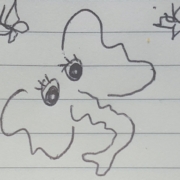
I remember how I made my first friend in high school. On the school bus, I sat next to a blond-haired girl with wispy bangs and bright blue eyes. With her notebook on her lap, she taught me how to doodle an elephant. This was Josie’s signature doodle. She doodled that elephant all the time—even getting in trouble for it during class. Especially in Mr. Noble’s English class. He’d call on her for an answer and embarrass her for escaping once again into her elephant world of squiggly ears and squiggly trunks.

Because of this, I was too afraid to doodle in class until college. College was finally a space where students were treated as adults and given the freedom to learn in their own way. As I listened to lectures, fluttering butterflies and leafy vines climbed their way up and around the margins of my notebook. For me, doodling was a way to relax and allow the information to sink in.

Doodling as Creative Storytelling

When I had a baby during the COVID-19 lockdown, doodling became a way for me to linger on the page a little longer. After journaling about my day, I’d sketch a small scene alongside my entry. The drawings weren’t “good,” but they felt good.

Then I discovered One of Those Days, a funny comic series about first-time parenting. I immediately connected with the vivid scenes of real parenting moments. It opened my eyes to how graphic art can deeply resonate with readers—and to a new way of storytelling: memoir comics.

A Non-Artist’s Introduction to Comics: The Joy of SAW

Recently, I found the Sequential Artists Workshop (SAW), a nonprofit that offers comics courses and free Friday-night Zoom workshops. These weekly sessions draw people from all over the world. You don’t have to be an artist to join. I certainly don’t consider myself one—just a lifelong doodler.

People of all ages attend and make it their own. Some treat it as self-care time. Others show up with friends for a “creative happy hour.” And for me, it’s become a way to bond with my daughter, who’s a talented artist and graphic novel fan.

How Graphic Novels Helped My Daughter Fall in Love with Reading

I credit graphic novels with helping my daughter fall in love with reading and discover her artistic style. As a mom, I turned to graphic novels once I realized that my daughter wasn’t into traditional chapter books. Once I discovered her niche, I went all in. I’d buy her Archie comics in line at the grocery store and check out every graphic novel series I could find at our local library.

Why Catholic Writers Should Embrace Graphic Art

As Catholic writers, we often focus on words—Bible verses, Scripture reflections, essays. But art is also a powerful way to reflect, to pray, and to connect with others. In recent years, there’s been a rise in Bible journaling, doodling in the margins of Scripture, and Christian adult coloring books as tools for stress relief and meditation.

Catholic publishers are taking note, too. Graphic novels like The Saint Chronicles by Sophia Institute Press and The Action Bible by David C. Cook bring saints and sacred stories to life through stunning visual storytelling. These Christian comics are a wonderful way to reach young readers—especially those, like my daughter, who prefer illustrated formats.

Explore Other Creative Communities

If you’re looking for new ways to be creative and feel inspired, I encourage you to check out SAW’s Friday Night Workshops. I promise you won’t get in trouble for doodling. And who knows? You might even make a new friend or discover a whole new way to tell your story.


Copyright 2025 Janet Tamez

Edited by Gabriella Batel

A Champion in God’s Eyes

By Kimberly Novak


“Our world is obsessed with success. But how does God define success? Success in God’s eyes is faithfulness to His calling.”   

Billy Graham


In any line of work, the rewards or fruits of our labor are often unknown. There are occasions when recognition occurs, but eight out of ten times, we do not know our impact upon someone or something. As an author, I try to get the yellow stars on Amazon, positive reviews for my blog, and the occasional kudos from a colleague. 

It’s natural to strive for success in a chosen craft, especially when the project responds to God’s call upon our hearts. Aside from the occasional nudges of spiritual warfare, I am confident that I am walking in God’s Will for my life. However, until recently, I always thought my day job, or station, was my life’s work. That was until I met Lizzy. 

Lizzy came into my life not by coincidence but through the gentle hands of God. On New Year’s Day, my phone rang, and on the other end, it was the most fabulous gift—a friend with a message from God.

My friend, an acquaintance of Lizzy’s, was calling to share some exciting news.  Lizzy had been dealing with new cognitive deficits, which affected daily living. Lizzy and she often met to discuss these things when Lizzy’s outlook suddenly changed from sorrow to joy. One day, Lizzy held something tight in her grasp, and as her fingers released it, my chapter book, Bella’s Beautiful Miracle, was in her hands. Written primarily for middle-grade children in the voice of bugs, it shares Bella’s journey from caterpillar to butterfly. However, Bella’s journey is for all ages. With themes of prayer, renewal, and faith, it resonates with adults looking for more in their relationship with God, just like Lizzy.  

As it turns out, I signed books at a local craft fair in December, and a friend of Lizzy’s purchased the book for her. Quite often, those without little ones to shop for will walk on by. Therefore,  I make it a point to invite them over and share how Bella’s story relates to readers of all ages. Lucky for me, Lizzy’s friend was one of those people who was willing to listen. 

I remember the conversation we had that day. She was attracted to the book because of Lizzy’s love for butterflies. I would say the cover art worked its magic at that moment! Signing and selling books at craft fairs can be tricky. Sometimes, I do better at churches, but then there are times when I have had success in unexpected places… No matter what,  I always set the bar low to sell one book and plant one seed knowing that God will ensure its growth. On this particular day, God only needed one book to make a difference. 

We had to meet! My friend arranged a time for the three of us to chat, and it was glorious! The best recognition of any writer has got to be face-to-face with the one God had you craft your story for. I was anxious at first at Lizzy’s star-struck reaction. I’m just a little woman in a normal suburb, living a normal life. As we sat and talked, we both became settled and natural. I felt God’s presence in the room, and I knew that the moment was designed by God and for His glory. 

God took that one purchase and turned it into a miracle! Lizzy has become a new version of herself. She carries the book around and sees herself as Bella the caterpillar.  Lizzy now shines in her smile and shares Jesus with those who will listen. Bella’s story, exactly! 

I might not win awards or be the best-selling author, but my trophy awaits me in heaven. Recognition from God for a job well done and the memory of Lizzy’s smile as she held tightly to my written words is gold star enough for me! My meeting with Lizzy was a true blessing and gift from God. This experience has shed light upon my life’s work; God has shown me that my life’s work is all about bringing people closer to Him. That might be through my day job or writing, but I am open to answering that call. 


(Names and experiences were modified to maintain confidentiality).


©️ 2025 Kimberly Novak

Edited by Janet Tamez

Protecting Your Writing

Protecting Your Writing

In this day and age, it is very easy for a hacker to break into your Amazon, Lulu, or another print-on-demand self-publishing account. When this happens, it is very difficult for a writer to control their emotions.

The writer panics and worries about their stolen manuscripts. How are they going to recover them? What if the hacker breaks into their social media platforms and steals all their information? Their followers, their contacts, etc?

It is very scary for us to think about. But this type of thing does happen to writers, publishers, and, yes, even literary agents. Stealing information from people is a very common thing among hackers. The scary part is that it can affect a person’s career.

Why am I writing about this topic? The main answer is that I’m very concerned about this issue. This issue is growing, and it is not going away! It is very important, especially nowadays, for a new writer to think about how he or she can protect his or her writing.

No matter if a person is a self-published author or a traditional published author, they must put a plan into action!

I suggest:

  1. Write down your story in a notebook. Make sure that it is in a safe location inside your house.
  2. Download an extra copy of your manuscript or sample illustrations. Store them on your computer.
  3. Don’t respond to the hacker! Sometimes a hacker might try to send you an email or a message on your social media page. Delete the email or the message right away. Even if the hacker tries to pretend they are your friend or a family member.
  4. Keep a list of your email contact information on a piece of paper. Place it beside your computer or your smartphone.

It s a very good idea for any writer, whether they are a new writer or an experienced writer, to do these things. Just in case a hacker breaks into their account. In the meantime, keep on writing! Continue your career! Don’t let a hacker ruin it for you.

Copyright 2024 Angela Lano


Serendipity

“The wind* blows where it wills, and you can hear the sound it makes, but you do not know where it comes from or where it goes; so it is with everyone who is born of the Spirit.” John 3:8 (1)

Serendipity

The winds of March always have been infamous. Some days you might be lucky enough to fly a kite along the beach, or above an open field where the grass is beginning to show a bit of green. Other days you might cower inside, with a hot cup of tea, while a raging blizzard or northeaster demolishes the emerging shoots of spring bulbs.

Whether you are experiencing the lamb or the lion as you read this, on our first March Saturday of 2024, I want to introduce you to some new friends in faith I’ve been blessed to encounter through the wind of the Holy Spirit this Lent.

Even though I’ve written and edited for small literary publications for most of my adult life, I grew up in the era of print. The role of managing editor for an online literary journal is relatively new for me. So, with a good intention towards “continuing education” — but little real hope — I ran a Google search.

And behold! An organization called Catholic Literary Arts (3) popped up in the search results, with a class entitled “How to Run a Literary Journal: The How, Why, and Wherewith” (4).

Founded by multi-faceted literary artist and president, Sarah Cortez (5), in 2020 –the year of their first Sacred Poetry Contest (6) — Catholic Literary Arts is based in the state of Texas. Already it is blessed by, and welcomes, writers from a variety of different cultural backgrounds.

The organization received assistance with its establishment, Sarah told me, from Catholic Writers Guild’s own beloved founder, supporter, and former vice president, Deacon Arthur Powers, who also served as one of CLA’s first instructors for online classes (7).

Two additional seminars on the 2024 CLA website looked so appealing that I signed up for those, as well.

Dr. J. Larry Allums’ seminar, now concluded, “The Short Story’s Brilliance and Clarity in Revealing Spiritual Truth,” focused on classical writers Nathaniel Hawthorne, Gustav Flaubert, Gabriel Garcia Marquez, and James Joyce (8).

I was amazed and delighted by the openness of sharing about spiritual insights among participants. I appreciated the opportunity to recollect how important it is to study the classical spiritual writers.

Ryan Wilson, Editor-in-Chief for Literary Matters (9), based at the Catholic University of America, and the CLA instructor for “How to Run a Literary Journal …” already in our first session offered an in-depth history of literary journals; and updated participants with the latest news about an extensive list of contemporary journals. He highlighted those that are most open to submissions from writers with a spiritual focus, especially for poets (10).

I’m looking forward to “Image, Tone, and Pacing …” with popular poet Tamara Nicholl-Smith, whose work appears in some astonishing venues around the city of Albuquerque, New Mexico; as well as in the prestigious Guttenberg Bible display at the University of St. Thomas (11), in her class that will be coming up next.

Although CLA discussions thus far have taken a slightly more “academic” and classical approach to Catholic writing than the sessions I enjoyed so much at our Catholic Writers Guild live meeting with the Catholic Publishers Association meeting in Chicago last May 30-June 1, 2023 — I’ve found the warm hospitality in Catholic Literary Arts sessions equally welcoming.

With taglines like “Write with Spirit” and “Fearless Catholic Writing” (12), CLA shares with CWG a common call, and we stand together on the same home ground. Their mission statement reveals how congruent they are with our own commitment to work in the world with our God-given talents, and to help bring about the creative vision of Saint Pope John Paul II.

“Catholic Literary Arts encourages ongoing growth in literary, artistic, and spiritual development of artists and writers so that the Cultural Patrimony and rich treasures of the Catholic Church may be more perfectly explored and used to draw all peoples to God.” (13)

If you’re a published or aspiring author of Catholic children’s books, and would like to connect with influential editors from Our Sunday Visitor, Word on Fire’s new children’s imprint Spark, and Pauline Books & Media, there’s still time to register for CLA’s Meet-the-Editor Panel: Children’s Edition, on March 6 at 7:00 PM CST (14).

This might be a worthwhile option to help sustain your motivation from CWCO last month, stay on task, and relieve some of the letdown that can follow periods of deep fellowship with our spiritual colleagues at conferences.

Whatever life you are living as a Catholic writer and wherever you must go this month, may you dance in the winds of March with the Holy Spirit, who leads us all through crucifixion to resurrection.

The author, out for a walk after the March 2, 2023 snowstorm in Tucson, Arizona.
Author’s personal photo, used with permission.
Margaret King Zacharias

© 2024 by Margaret King Zacharias

Feature photo: Snowstorm rolling into Tucson, Arizona on March 2, 2023. Author’s personal photo, used with permission.

Notes:

  1. 1. https://bible.usccb.org/bible/john/3#51003008-f
  2. https://bible.usccb.org/bible/john/3#51003008-f
  3. https://www.catholicliteraryarts.org
  4. https://www.catholicliteraryarts.org/classes
  5. https://www.catholicliteraryarts.org/our-board#cortezs
  6. https://www.catholicliteraryarts.org/2020-contests
  7. Sarah Cortez, personal communication.
  8. https://www.catholicliteraryarts.org/classes
  9. https://www.literarymatters.org
  10. https://www.catholicliteraryarts.org/classes
  11. https://www.catholicliteraryarts.org/classes
  12. https://www.catholicliteraryarts.org
  13. https://www.catholicliteraryarts.org/our-mission
  14. https://www.catholicliteraryarts.org/classes

Rewriting a Story

Writing a story is not easy. Sometimes a writer has to change his or her manuscript. Sometimes the plot doesn’t make sense, or the ending doesn’t work. Maybe a character doesn’t fit in the story and has to be removed.

Or maybe the writer can’t finish the story and leaves it on their hard drive as an unfinished manuscript. Sometimes the idea is good, but the story itself is a failure.

Are you in that situation? Are you struggling with writer’s block? Coming up with a good story idea is one thing, but trying to finish it can be frustrating. You want to please your fans. You want your future readers, a literary agent, or a publisher to accept your story. You want the characters to be believable to your audience.

Before you finish your manuscript, think about one of your favorite books or movies. Why do you reread that story or rewatch that particular show over and over and over again? Could it be that the writers of those stories make things come alive in your mind? Is it the characters that grab your imagination? Is it the plot or the scenery?

Let me give you an example. I’m currently rewatching a very clean, family-friendly series. I have seen these series before; the characters and the plot are very believable. When one of the characters was killed on this show, I cried for two weeks. I felt sorry for his wife and for everybody else in that small town.

I wanted to find out what happens next to the characters. The production company announced that they are currently working on the next season. Sometimes scriptwriters disappoint their fans. Some fans want a character to do such and such a thing on the show, but when they don’t get their wish, then they are upset. That is how a modern-day show touches people’s lives. People want the make-believe characters to be happy. They want them to be a good example for their children. Think about these things while you are having writer’s block. Ask God to help you in this area. Find a beta reader to read your manuscript. Find a freelance editor to help you with your manuscript.

Copyright 2024 Angela Lano

Catholic Writers Conference Online

Two years ago, a friend told me about the Catholic Writers Guild and their annual online conference. At the time, I had just started dreaming of publishing a Catholic chapter book series, but I didn’t know where to start. Feeling overwhelmed, I pursued the Catholic Writers Guild website to see about this conference.

The skeptical part of my brain told me it was too good to be true. The frugal part of my brain told me $40 was a honey of a deal for access to three days’ worth of presentations. (The conference is free for clergy and $60 if you’re not a Catholic Writers Guild member; also, membership is totally worth the $40/year dues). Additionally, all the sessions are recorded, so I could go back and rewatch my favorites and check out the ones my schedule conflicted with.

To say my mind was blown by what $40 got me is an understatement. I took almost a whole journal’s worth of notes and gathered ideas for what it means to be a Catholic writer in the world today. I learned about things that I didn’t even know I needed to know, and felt the Holy Spirit reaffirming that this is what I am called to do. I met other people who shared my passion for writing within a Catholic lens. I started to believe I could actually do this.

I left that conference on fire. Since then, in the last two years, I have published the first three books of my chapter book series, visited Catholic schools to talk about my stories, written and published countless articles (one was even translated into Hungarian!), and started writing and editing Catholic curriculum. None of this would have happened without the Catholic Writers Guild.

The Guild is composed of fellow Catholics who want to use their gifts from God for good. Our genres and styles are as varied as we are, but we all strive to grow in holiness as we write. During the online conference, some presentations were more relevant and helpful to me, but I learned something from every talk.

This year, I am counted among the presenters, and I’m thrilled to volunteer to share my own experiences in the hopes of encouraging and educating other Catholic writers. Sure, I get a small stipend and exposure to other Catholic writers, but that’s not why I’m presenting this year.

Two years ago, women and men from the Catholic Writers Guild planted seeds that have begun to sprout in my life. With God’s continued light and watering, I know I will have full-grown trees one day. In the meantime, I want to spend my time planting seeds of my own.

You don’t have to be an established writer to attend this conference. You don’t have to know what you want to write or even the genre. All you need is an interest: a tiny prompting of the Holy Spirit that the written word may be one of your gifts He is asking you to share.

Join us at the online conference this year from February 23–25, 2024. Worst-case scenario? You’re out $40. Best-case scenario? Well, only God knows that.

© Maria Riley 2024

Five (Free!) Ways to Support an Author You Love

Five (Free!) Ways to Support an Author You Love

The other day I had an awesome milestone as an author: I found my books on the shelf in our public library! This might seem like a very little thing, but for me, it made my whole month. I brought my kids to the library for their weekly perusal and book check-outs, and there they were, on the New Books shelf in the children’s room.

I gushed and geeked out a bit, complete with pictures and a video for an Instagram reel, and I drew the attention of a fellow patron. She was thrilled to meet an author and excited to see good, Catholic books in the public library. After I took my pics, she eagerly added them to her own check-out pile (even more excitement for me!).

The process of getting my books in the public library was as simple as filling out a form on the library’s website. As a patron of the library, I can request titles for the library to purchase, and then they buy them. I’ve requested all sorts of books, and I’ve never had a title refused by my library.

This got me wondering if everyone knows about requesting books for your library to purchase. It is a free and tremendously helpful thing for authors, since you can only request books at your own library. Having my books at libraries is wonderful because not only can all readers have a chance to experience my books without the purchase price being a barrier, but also, some people who may otherwise not pick up my book may choose to do so since it won’t cost them a thing. My goal is to have as many kids as possible read my series, Adventures with the Saints, so having them in tons of libraries is a phenomenal way to do that!

While we’re talking about free ways to support your favorite authors (I hope that includes me!), leaving reviews is high on the list. Amazon is the biggest one, but reviews on Barnes and Noble, Goodreads, the author’s website, and anywhere else you buy the book (like local bookshops that sell online, etc.), have a huge impact and can make the difference when someone is thinking about purchasing the book. While you’re on there, be sure to “like” the other five-star reviews so they populate at the top of the list. The best reviews mention specific things that you loved and why you would recommend it, but even just taking 30 seconds on Amazon to click five-stars without writing anything helps! 

Another simple, fun, and free way to support authors is to engage with them on social media. Following your favorite authors and liking their posts is a great start, but the algorithms require engagement to boost a post. A reel or post that has a lot of comments will have more exposure, and one that has multiple shares will see the most traffic. Next time you’re scrolling, take that quick second to comment, tag your friends who would also enjoy the post, and share the content on your own feed. You can find me on Facebook and Instagram @mariarileyauthor if you want to engage with me there!

My next suggestion has less to do with increasing sales and everything to do with encouraging your favorite author: send fan mail. There is something profoundly uplifting and motivating about a reader who loved your book and wanted to let you know. Nothing brightens my day more than reading an email from a child who loved my books. Bonus points for the seven-year-old’s note that included a picture of her holding my book. Seriously, a three-minute email could be exactly the thing that an author needs to stay focused and determined when writing her next book. It might be the difference between her throwing in the towel or continuing writing. As authors, we put ourselves out there and hope that people will like and buy our books. It’s tough business. A few kind words really go a long way, and they won’t cost you a cent.

Finally, if you have a book and author that you love, tell everyone you know. There is no marketing like word of mouth, and personal recommendations are second to none. If you loved a book, chances are your friends will too. Make it a habit to spread the word about your favorite books and hopefully turn a new reader onto his new favorite author.

Of course, buying a copy of a book for yourself (and maybe two more for friends) is always the most direct way to support an author. But when the budget is tight (or you’ve already got the book), spend a little bit of time and no money at all to support us in this crazy craft of writing!

© Copyright 2023 Maria Riley

Do Whatever He Tells You by Maria Riley

I love meditating on the Wedding at Cana. Attending a wedding seems like such an ordinary event for Jesus and his friends to attend. I imagine them laughing and enjoying themselves, much the way I do when I attend weddings, which helps me remember that Jesus was fully human too.

Another reason that I love the Wedding at Cana is that Jesus, as an adult, remained obedient to His mother. As a mom myself, I love this. His obedience also is a significant part of our understanding of Mary as the great mediator. She brings each of us closer to Christ by bridging the gap between us and Him. She tells Jesus that the wine has run out, and despite Him telling her it’s not yet His hour, Jesus obeys His mother (cf. John 2:3-4). Jesus’s first public miracle happened through the intercession of Mary.

Recently, while I meditated on this mystery, my mind didn’t focus on Jesus, His friends, nor His mother. Instead, my thoughts lingered on the servants, those who assisted Jesus in His first miracle. These servants aren’t even named in the scripture, yet by following the advice of Mary and obeying Jesus’s command, they partook in a beautiful miracle that all Christians know about.

They did whatever He told them (cf. John 2:5). And here’s the amazing thing—all He asked them to do was fill some pitchers with water. That was it! Jesus basically said, “Just go grab some water, and then leave the rest to me.” Because of the servants’ obedience, a miracle ensued.

Sometimes I think I’m not doing enough to live out my faith. I think I need to live in more drastic poverty or pray for hours every day. But maybe, just like the servants, Jesus is actually asking me to do something simple and well within my abilities, training, and current life situation.

When I stop to listen, this is what I hear Jesus say to me: “Fill this cup of milk, then graciously clean the spilled milk for the eighth time today. Write this story. Feed this family I have given you. Read aloud with this child.”

These commands, doing whatever He tells me, may not be as complicated as I think. Easy? Not always. Almost every day He reminds me, “Love your husband, and forgive him for not being perfect. In all things, selflessly love the way that I love you.”

If I humble myself and accept these charges from Him, then I open the door for the miracle to happen. If I do my small part, no matter how insignificant it may seem, I am honoring the will of God.

I’m not in the business of turning water into wine. But filling pitchers with water? I can do that.