Follow Me to Little Jesus: Part 2

Twenty minutes later, Ross, Maeve, and Leo drove through a blinking red light at a four-way intersection and found a run-down roadside café with a dirt parking lot. A worn, hand-painted sign said, “Welcome to Little Jesus Pie Café and Gift Shop.” The family parked near the door and was happy for a chance to get out and stretch. Leo ran inside. Ross and Maeve hesitated, then entered to assure their son’s safety.

The couple paused inside and gazed in awe at the wall covered with framed sketches and paintings. Shelves brimmed with plastic statuettes, all of which appeared to be a rendition of a Jesus-like child in a tunic, his right arm outstretched in a beckoning motion. In the paintings, the boy was pictured standing on a foggy shoreline with people kneeling around him.

Leo was already speaking to a tall man, at least 6 feet 5, with thick, gray hair that made him look younger than his 70s. He bore an animated personality toward the boy. Briskly, he stepped out from behind a hostess podium and pointed to the wall, acknowledging Ross and Maeve with a “come along” gesture. Leo, meanwhile, busied himself studying one of the paintings at eye level.

“We call him Our Little Jesus of the Bayshore,” the man announced. AND our little church, built in 1933.”

“You have a church here called Our Little Jesus of the Bayshore?” Maeve deadpanned. “I’m a catechist for our church, and I’ve held positions over the years with our diocese, and I have never heard of a church by that name.”

“No, Miss, unfortunately, you wouldn’t,” the man admitted sadly. “I said that’s what we call it. The diocese calls it St. Bernadette.” 

“Oh, I think I have heard of St. Bernadette’s. More like a little chapel,” Maeve admitted weakly.

“That’s the one. I guess it was named that because she had been newly canonized. My name’s Mel, by the way. I’m one of the owners here and nephew of Amie – Amie with an ‘ie’ — who first saw the vision of the Little Jesus.”

“The vision,” Maeve said flatly, already skeptical of Mel’s story.

“Yes, Miss,” he said respectfully and continued. “She was only about 13, but wise enough to record all the events back in 1932.”

“Is that so?” Ross said, a graphic artist, almost as fascinated by the pictures on the walls as his son. “Did she do all these pictures?” 

“She did indeed,” Mel confirmed, “And at the time had no training —”

“Excuse me,” Maeve interrupted impatiently, waving her hand in the air as though she were erasing something. “Have you ever looked into mission status? Surely there is a larger church that would take you on as a mission church.”

“The nearest church is about 50 miles away, and that’s struggling a bit from what I hear, so that they wouldn’t want us,” Mel said.

Another man, who looked much like Mel but with white hair instead of gray, emerged from the dining room.

 “That big donkey’s my twin brother, Bart,” Mel told them and then informed Bart that the family followed their sister Ami – with just an ‘i’ — here, thanks to that little fellow, Leo. Bart said that she had just gotten back from a shopping trip.

“She’ll be pleased to know the bumper sticker paid off. Were you telling them about Aunt Amie and the Little Jesus?” Bart said.

“I was just starting,” Mel said. “You can help me.” Maeve flashed Ross a glance, raising her eyebrows and exhaling deeply. They had come to the café for pie but were given a special tour and history lesson. Was she the only one who thought this was strange? Ross, a graphic artist, wanted to know more about the pictures and the story behind them. Leo had wandered off to the other end of the lobby, intrigued by the statues and the pictures of the boy Bart and Mel were calling “Little Jesus.”

The twins began telling Ross and Maeve the story of the vision of Our Little Jesus of the Bayshore. They followed a string of child-like, detailed sketches high on the wall behind the podium and cash register. They provided the backstory but let the pictures do the telling.

“Our Aunt Amie was only about 13 at the time in 1932,” Mel began. “Before the 1930s, this area was booming for clams, crabs, oysters, and mussels. But it was kind of a secret spot for the folks who lived here. They made good money back then by going into the city and selling fresh shellfish. They were very isolated, though.” 

“No one wanted this area,” Bart started to explain. “People made up folktales over the years about half-man, half-animal demons running around at night, and babies being born with fangs and horns, so people stayed away, and this little stretch was largely unknown. Funny how some were so quick to believe that nonsense but thought the Little Jesus couldn’t be true. It wasn’t very Christian here, but some folks understood about Jesus Christ being our Savior. A few went the distance to a church, but most didn’t.”

“They could always find a bottle and some trouble, though,” Mel interjected. 

Mel pointed out the first sketch of people along the shoreline digging for crabs. Some boats moored off in the distance. Another drawing showed a little girl with her mouth agape, pointing ahead. 

“Now that’s our Aunt Amie,” Mel said. 

Maeve looked away and sighed.

Another pencil drawing showed a boy walking along a foggy shoreline, reaching out with his right hand.

“That’s Our Little Jesus of the Bayshore,” Bart said proudly. “You’ll notice the same image in the paintings.”

The brothers told them that in September of 1932, he came back three Sundays in a row in the early morning fog. Each Sunday, he delivered a different message, but only Amie heard him. Then he disappeared into the fog.


Next month: The family learns the messages that Amie heard from the boy in the fog, and Leo makes a friend.

© 2026 Mary McWilliams

Featured AI image rendered through Adobe Firefly & Gemini 3.1 Nano Banana 2

Edited by Paula V. Babadi

The Shepherd’s Pie: Letting Our Adult Kids Go

“A slice of hope to raise faithful kids.”

This uplifting, ecumenical show uses engaging conversations and fun entertainment reviews to offer positive insights and media resources for families and youth leaders. We discuss current issues that impact young people at home, in school, and in the world today.

In this episode of The Shepherd’s Pie, Antony Barone Kolenc speaks with Stephanie Landsem about the challenges of letting our adult children make their own mistakes, and we discuss her novel, The Fault Between Us.


Check out other episodes of The Shepherd’s Pie.


Copyright 2026 Antony Barone Kolenc

Follow Me to Little Jesus: Part 1

Follow Me to Little Jesus: Part 1

Leo checked the license plates of every car that passed them on the highway.

He’d seen Pennsylvania, Delaware, South Carolina, North Carolina, and Nebraska.

“Dad, there goes Alaska!” Leo cried out. “I’ve never seen an Alaska plate before!”

“That’s pretty cool, Son. They’re probably in the Coast Guard here.”

“I think that makes seven, right, Mom? Did you get them all down?”

“I did, Leo, and that makes eight,” his mother corrected.

Leo bit his lip and sat back in his seat, trying to recall the state he had forgotten.

“Oh, right! South Carolina. The Palmetto State. I can never remember that one.” Leo hit his head with his hand.

“Just remember the palm trees outside the church we attended when we visited Myrtle Beach last year,” his father reminded him. “And we talked about the palms on Palm Sunday.”

“Oh, right,” Leo said, looking out the window, watching for a new plate. Suddenly, he sat up.

“DAD!” he shouted. “Dad, you have to follow that car! That little gray car!”

“Leo, what are you talking about?” His mother turned slightly from the front seat to face him. “Your father can’t just chase after cars.”

“No … please …” Leo begged. “It had a bumper sticker I’ve never seen. It said, ‘Follow me to Little Jesus.’ We have to follow that car to see what the rest of the bumper sticker says. We have to find out where the Little Jesus is!”

Leo’s parents, Ross and Maeve, looked at each other and shrugged. Sunday was family day. After church and breakfast, they usually went on some kind of outing — to a fair, ballgame, or historical site. Today was their drive to nowhere, to see what they could see and go where they could go. They had stopped at a couple of car dealerships to look at used cars. They were a one-car family, and their hatchback, nearing 180,000 miles, was also beginning to limit their family outings. Today’s journey began to push it. Other than that, they had no plans. Why not find the Little Jesus?

“Maybe it’s a shrine,” Ross said. “I wouldn’t mind visiting it.”

“Well, I’ve never heard of it,” Maeve said, some resentment in her voice.

Leo thrust his arm between the two front car seats. 

“There’s the car! It’s the only car on the road older than ours!” His mother said nothing but glanced side-eyed at him. His father pressed the accelerator a bit harder.

“Ross, I don’t think you should force the car to go that fast,” his wife cautioned. Within seconds, they were close enough to read the bumper sticker:

Follow me to Little Jesus

The most divine pie café and gift shop on earth

Rt 12 & 4th St., Heavens Gate

“What? It’s a pie café?” his mother said in disbelief. “Is that blasphemous?”

“I don’t know,” Ross laughed. “I didn’t think Heavens Gate was a real town. I just thought it was a section some people really liked. It’s in the middle of nowhere.”

“Yeah, nobody wants to go there. But we are approaching the exit,” Maeve said, checking the directions on her phone. “Isn’t that a coincidence?” She was becoming impatient. But Leo leaned forward anxiously, waiting for his parents’ final decision.

“I could go for a slice of cherry pie,” his father said. “What harm is there in checking it out?”

“Okay,” his mother sighed, looking out the passenger side window. “What else have we got to do?”

“Oh, thank you!” Leo cried out.

Next Month:  Maeve remains skeptical as she, Ross, and Leo meet the family of the visionary behind Little Jesus.


© 2026 Mary McWilliams

Edited by Paula V Babadi

AI Image created in Adobe Firefly

The Shepherd’s Pie: History Through Fiction

The Shepherd’s Pie: History Through Fiction


“A slice of hope to raise faithful kids.”

This uplifting, ecumenical show uses engaging conversations and fun entertainment reviews to offer positive insights and media resources for families and youth leaders. We discuss current issues that impact young people at home, in school, and in the world today.

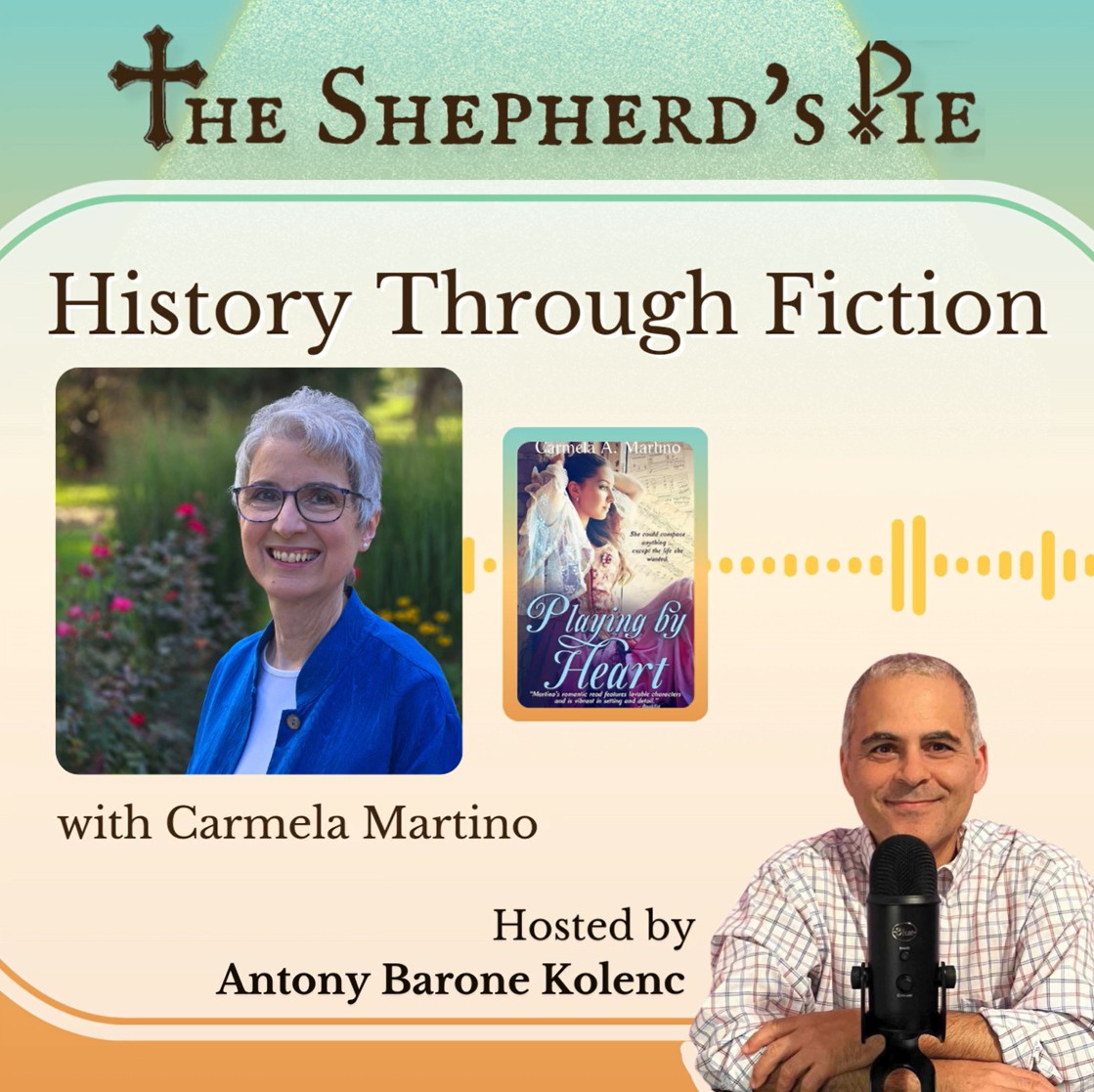
In this episode of The Shepherd’s Pie, Antony Barone Kolenc speaks with Carmela Martino about how fiction authors write history into their
novels, and we discuss her historical romance novel, Playing By Heart.


Check out other episodes of The Shepherd’s Pie.


Copyright 2026 Antony Barone Kolenc

The Virtuous Center

“Four pivotal human virtues: prudence, justice, fortitude, and temperance. The human virtues are stable dispositions of the intellect and will that govern our acts, order our passions, and guide our conduct in accordance with reason and faith.” Catechism of the Catholic Church, 1804.

Have you read Sense and Sensibility by Jane Austen? If not, get it right away and do yourself a kind favor: read it with deep curiosity and be rewarded with deeper insights.

Jane Austen is a genius who writes with a penetrating focus on the moral dimensions of human behavior. She is often misunderstood, and simplistically considered by some to be writing drawing room dramas. Her novels, though, illuminate the moral underpinnings of human actions, and portray how moral choices cause pain and alienation, or bring joy and peace to relationships.

Her novel, Sense and Sensibility, is centered on the four cardinal virtues, and on the one character who exemplifies them. Elinor Dashwood is the heroine of the story, the virtuous center, the figure around whom all others are seen as possessing or lacking in virtue. Elinor Dashwood demonstrates in her everyday actions those stable dispositions of intellect and will that govern, order, and guide our conduct according to reason and faith, as described by the Catechism of the Catholic Church.

In Plato’s Symposium, Agathon speaks in praise of love by referencing the four cardinal virtues: prudence, justice, fortitude, and temperance.

In The Four Cardinal Virtues, Joseph Pieper says, “The precept of prudence is the ‘permanently exterior prototype’ by which the good deed is what it is; a good action becomes just, brave, temperate only as a consequence of the prototypical decree of prudence.”
In his reference to the permanently exterior prototype of prudence, Pieper highlights the objective and autonomous pattern that we should strive to adopt in our everyday conduct.

Some might wonder if the cardinal virtues still hold relevance for our modern lives. Right acting, according to objective and eternal standards, cannot lose relevance but we can fall away from awareness of or commitment to such standards.

In his book After Virtue, Alasdair MacIntyre said, “It is her uniting of Christian and Aristotelian themes in a determinate social context that makes Jane Austen the last great, effective imaginative voice of the tradition of thought about, and practice of, the virtues I have tried to identify.”

Elinor Dashwood is the moral center of the plot of Sense and Sensibility, and the central figure whose moral choices bring to light the ethical essence of the other characters. She serves this role due to her consistent embodiment of the four cardinal virtues: prudence,
justice, temperance, and fortitude.

The words prudent or prudently are mentioned 14 times, and the words imprudence, imprudent, or imprudently are written 15 times in the novel. Justice or injustice is mentioned five times. Fortitude is referred to eight times, and temperance once in the novel. In which other novel could you even find these words, let alone a story that portrays their essential role in our personal lives?

The ethical qualities, or character, of each figure in Sense and Sensibility can be observed and judged according to the presence or the absence of the cardinal virtues in their conduct. The crucial pivot point in the story is not the resolution of a romantic relationship. Instead, it is the moral awakening of Elinor’s sister, Marianne, to her own imprudence and want of fortitude (pages 221 to 223).

Elinor reveals how she has suffered silently for four months, and Marianne wonders how she has borne it. It has “been the effect of constant and painful exertion,” Elinor says.

The cardinal virtues are human-sized objective moral standards that we are to grow into through persistent and prolonged personal efforts. The virtues are autonomous, not changing fashions. We are measured, like the characters in Sense and Sensibility, by the presence or the absence of the four cardinal virtues in our daily exertions at right living and deep loving.

Elinor Dashwood is the virtuous center of the novel, Sense and Sensibility. For whom do we serve as the virtuous center? Do we practice the cardinal virtues in our daily lives and our personal relations? Does our conduct awaken anyone else to their want of virtue? This story, and the character of Elinor Dashwood, will inspire you to better conduct.

I believe Plato would have loved Sense and Sensibility, and I’m certain you will, too, when you read or reread this illuminating novel.


After Virtue, Alasdair MacIntyre, Third Edition, University of Notre Dame Press, page 240.
The Four Cardinal Virtues, Joseph Pieper, University of Notre Dame Press, page 7.
Sense and Sensibility, Jane Austen, Penguin Books.

copyright 2026 Tom Medlar

The Shepherd’s Pie: The Gift of Giving

The Shepherd’s Pie: The Gift of Giving

“A slice of hope to raise faithful kids.”

This uplifting, ecumenical show uses engaging conversations and fun entertainment reviews to offer positive insights and media resources for families and youth leaders. We discuss current issues that impact young people at home, in school, and in the world today.

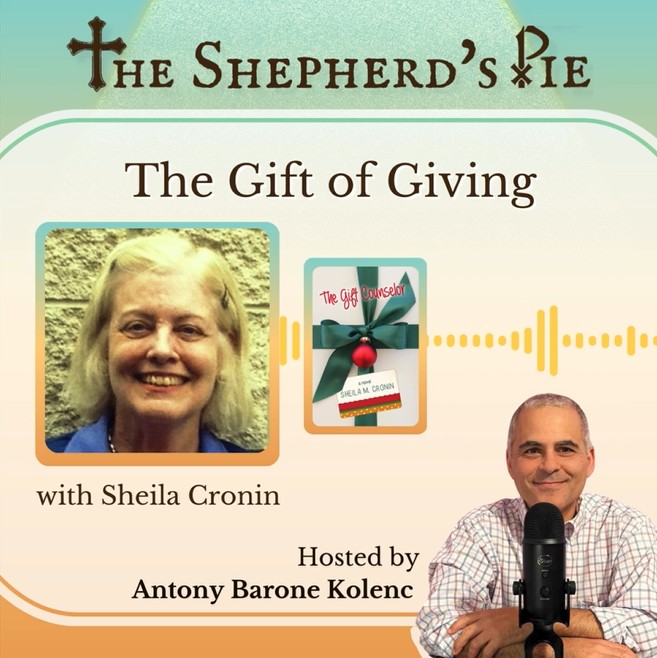
In this episode of The Shepherd’s Pie, Antony Barone Kolenc speaks with Sheila Cronin about the importance of giving gifts, especially during
the upcoming holiday season, and we discuss her novel, The Gift Counselor.


Check out other episodes of The Shepherd’s Pie.


Copyright 2025 Antony Barone Kolenc

The Shepherd’s Pie: Faith and Remembrance

The Shepherd’s Pie: Faith and Remembrance

“A slice of hope to raise faithful kids.”

This uplifting, ecumenical show uses engaging conversations and fun entertainment reviews to offer positive insights and media resources for families and youth leaders. We discuss current issues that impact young people at home, in school, and in the world today.

In this episode of The Shepherd’s Pie, Antony Barone Kolenc speaks with Father Jonathan Torres about his journey as a priest-author, and how the theme of remembrance is central to the Christian faith, and we discuss his fantasy novel, Blinding Dawn.


(info about this episode, get that here: https://anchor.fm/the-shepherds-pie )

Check out other episodes of The Shepherd’s Pie.

"The Shepherd's Pie: Faith and Remembrance" by Antony Barone Kolenc (Catholic Writers Guild blog)


Copyright 2025 Antony Barone Kolenc

A Day in Toledo,1933

A Day in Toledo, 1933


Hard times brought families together.

“Ew,” said Gertie.

“It’s God’s creature and he loves all his creatures,” said Agnes.

Agnes was goody-goody. Gertie was baddy-baddy.

“Good Lord,” said Mother. “What now?”  It was a large centipede that had crawled out of the drain.

“Eat it,” said Gertie. Agnes said, “You have to let him outside.”

It was the 1930s in Toledo, Ohio during the Great Depression. They lived in a house with a boarder, Andy. The father worked in a steel plant.

“My water’s cold,” yelled Andy.

“Coming,” said Mother. “I just have to heat it on the stove.”

“Hurry” said Andy. “What’s for dinner?”

“Fried chicken,” said Mother.

Andy always got the biggest piece of chicken, followed by Father. The rest of them got smaller pieces. The two girls, Gertie and Agnes, and the youngest two, Charles and the baby, Daisy.

When Father came home from the plant to eat his chicken and biscuits, he told a sad tale.

“The guy next to me fell into a vat and was vaporized.”  “The wife and kids are left.”

“At least they got his life insurance,” said Mother.

“No life insurance,” said Father. “The foreman told the wife he never came to work. They live nearby. Their name’s Mantellini.”

“Why don’t we make them some dinner?  They must be hungry,” said Mother. “They are Italian, right?  Let’s make them some spaghetti. What’s in spaghetti?  Tomatoes, peppers, and garlic?”

“And slugs,” added Gertie.

Mother told Agnes and Gertie to go to the store and get the dried pasta and the vegetables on credit.

When the Mantellinis came over they were wearing clothes made of the flour bags but no one laughed.

Gertie said by way of conversation, “I heard a funny song on the radio today, it was called, ‘Yes we have no bananas.’”

The mother of the other family said, “I brought some vegetables from the garden and some wine my husband made.”

“Oh we couldn’t,” Father said.

“It really means a lot to us that you have it with us,” Mrs. Mantellini told them.

Before dinner, they prayed.

“In nomine Patris et Filii et Spiritus Sancti” said the Italian mother. “Bless us, O Lord and these Thy gifts, which we are about to receive from Thy bounty, through Christ our Lord. Amen.”

Over dinner, Andy told stories of the Great War.

“It was a war in trenches. There was the mustard gas and bullets. You would run out between trenches in No Man’s Land and get shot. There were diseases like the Spanish flu.” Then he winked and said, “The only good thing was the French girls.”

“Stop that,” Mother said.

“What do you mean,”  Gertie asked.

“They made nice cheese,” said Mother.

“They lined them up and shot every third man to improve morale.”  Mother shot him a glance.

Andy continued. “But seriously, it was a terrible war. It was trench warfare. When we charged, we went over No Man’s Land where you got shot.  There was mustard gas and so we had to wear masks. Seeing my comrades suffer and die was the worst experience of my life.”

After dinner, they washed the dishes together. They joked around about Italian food versus American food and how rough the times were.

Mother said, “I heard on the radio that President Roosevelt said the only thing we have to fear is fear itself.  I sure hope so.”

They decided that the family would help the Mantellinis with food and watching the kids for awhile until they got back on their feet. The mother would work as a laundress. The kids would get jobs sweeping the streets and selling popcorn after school.

World War II came and, with it, jobs in factories and greater prosperity. They continued their friendship for many years.

© Copyright 2025 by Cecile Bianco

Image by Bernd Hildebrandt from Pixabay

The Shepherd’s Pie: History and Christ’s Life

The Shepherd’s Pie: History and Christ’s Life

“A slice of hope to raise faithful kids.”

This uplifting, ecumenical show uses engaging conversations and fun entertainment reviews to offer positive insights and media resources for families and youth leaders. We discuss current issues that impact young people at home, in school, and in the world today.

In this episode of The Shepherd’s Pie, Antony Barone Kolenc speaks with Bill Kassel about the life of Christ as seen through the eyes of his family, and we discuss his historical fiction novel, My Brother’s Keeper.


Check out other episodes of The Shepherd’s Pie.


Copyright 2025 Antony Barone Kolenc

A Christmas Wish

A Christmas Wish

I am writing to tell you about a story about an old veteran that I knew. He was a Vietnam veteran. I was assigned to the VA to be a counselor to these old warriors. There was one in particular that I remember that had it really hard. He had gone to jail under strange circumstances, and had some psychotic breaks, so I took an interest in him. This was about Christmastime.

I interviewed him one day about his life. He was born in Portland, OR. He had an uneventful childhood but his parents were middle class. He enlisted and was sent to Vietnam. He believed in the cause and wanted to prove himself.

When he went to combat it was nothing he expected.

“All the bombs, all the bullets, the Agent Orange, and the other chemical warfare,” he recalled.

“Are those memories troubling you?”

“No. That’s not all of it,” he said. “I ran. I was a coward.”

“So then,” I said, “how is it that you got convicted of aggravated assault?”

He said, “Well, when I got back home, I got a job as a mailman, but I drank heavily to cope. Maybe 5-6 drinks at night. One night I had the worst dream I was running away from the Viet Cong. And I heard my commander say, ‘Attack!’ and I didn’t want to fail again. So I went to my bar with my gun and I was going to shoot the Viet Cong. Well, it ended up I shot up the bar and injured some people.”

“Did you mean to kill anyone,” I asked.

He said, “I don’t remember because I blacked out. But I am a good shot, so if I meant to kill anyone, I would have done it. After that, I got sent to Oklahoma for jail for 6 years. It was the worst time of my life. I was there with people who meant to do harm and I was worried I might turn out like them.”

I said, “Well, it’s Christmastime, so I imagine if you had a Christmas wish, it would be you didn’t run from the Viet Cong.”

He said, “No, I wish I could meet my granddaughter. I had a brief relationship in Oregon, and in jail I found out she got pregnant with a girl and then recently she told me her daughter had a daughter. So that’s my Christmas wish to meet her.”

I asked permission to try to contact his daughter and he said yes. I was able to find her and asked if she would like to contact him and she did. After a few months I arranged a meeting but I found out our veteran was in the hospital with liver disease, so I thought about a short meeting and showing the child some military pictures and got one of Vietnam. The woman and her daughter came to the hospital.

“What’s your name,” he asked the little girl.

“Melanie,” she told him.

“What grade are you in?”

“Fifth.”  They talked about his life and her time in school and friends for a while. Then it was time to go.

Later, I got an email from the mother saying the child wanted to know what her grandfather did in the war. I emailed back the picture I had found. She asked if it was her grandad in the picture.

“Yes,” I said, “I’m sure it was him.”

Copyright 2025 Cecile Bianco

Edited by Mary McWilliams

Image by Rozbooy from Pixabay

Stay in the Know

Join Our Newsletter

Members and supporters can get the latest on CWG news and events by signing up for our newsletter.

Please wait...

Thank you for signing up!

Catholic Writers Guild
P.O. Box 77
Eaton, IN 47338