
The Orange Caldero and the Bunny Rabbit
The Orange Caldero and the Bunny Rabbit
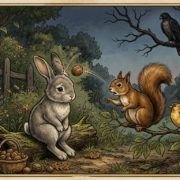
Hot oil popped from the orange pot. Then came the sizzle from the onions and peppers after they slid from the cutting board. Then sage and thyme. The earthy scent wafted from the window to the backyard like a snake’s slithering dance to a slow flute. The bunny rabbit and the squirrel sat with the two finches in the backyard, smelling the aroma of beef stew cooking.
“I wish I could be in that pot,” sighed the bunny rabbit. “It would give meaning to my life.”
“Are you an idiot?” the squirrel questioned, lobbing a nut at the rabbit and hitting his long ear.
“No,” said the rabbit, wiggling his ear. “I know some rabbits give their lives to nourish humans. It can help keep them alive.”
“He’s right,” affirmed the finch. “We’ve seen it, haven’t we?” The other finch nodded in agreement. “We fly around, and we see hunters trap and skin rabbits and cook them on a stick over the fire. It’s not pleasant to see, let me tell you. I wouldn’t want to be there, but I understand your desire to sacrifice. We’ve talked to deer about it.”
“Yes,” sang the quieter finch. “You’d look so pretty in her pot.” She lifted her wing toward the kitchen window. “We’ve looked inside, and it’s not very deep, so you can see what she’s cooking. The pot is the color of her marigolds, and she puts all the colors of her garden inside. And she is so kind. We’ve seen her come out to cut her herbs and pick the vegetables. She talks to them and pats the leaves. She tells them they are beautiful, and they make her food so flavorful.”
“Yeah, she’s really sweet until she lets out her stupid dog, who chases us,” the squirrel said.
“You’re just still upset because you were too slow that time and he caught you by the tail,” admonished the first finch. “But he listened when she called to him. That saved you.”
“I would have bit him,” the squirrel asserted.
“But you’re not that kind of rabbit,” said the first finch, reminding the others of their original conversation.
“I’m not?” the rabbit asked, concerned.
“No. You’re a bunny rabbit. You’re too cute,” the finch continued. “If you stay alive long enough, she might take your picture, or draw or paint you. Or sew your image onto a tea towel or something like that. But if you stay still that long, the predator will probably get you, and that’s not pretty, depending upon which one takes you: the hawk, owl, cat, or possum. They’re all brutal – just ask the chickens. But that’s probably what will happen to all of us in the end. And she can’t stop it. It’s the wild.
“It won’t happen to me,” asserted the squirrel.
“Yes, it could, even to you, you stupid squirrel,” said the first finch. “Look up in the tree. There’s the hawk now. He’s eyeing us, and you’d make a nice snack for him, filled with all those nuts that you eat.”
They all looked up, then quickly looked away. The hawk was watching them and waiting for the right moment.
“I don’t think I want to be dinner for that ugly beast,” the bunny rabbit said nervously.
“Unfortunately, you don’t have a choice,” the first finch said gently.
“Hah!” the squirrel mocked the rabbit. “So you’ll be food for a human who couldn’t care less about you, but you won’t be food for a hawk. I don’t see any difference.”
“Why do you all assume the hawk will come for me?” the bunny rabbit whined. “I agree with the finches. You’ll be mighty tasty with all those nuts in your tummy.”
They were all considering escape routes.
“I’m too fast for that monster,” the squirrel said nervously, getting ready to run. Just as he said that, they saw the shadow of the hawk’s wings cover them. Fur and feathers flew as the screen door opened quickly, then slammed shut. The lady ran into the yard, finding three running and one left behind.
©2026 by Mary McWilliams
Image generated by Mary McWilliams in Adobe Firefly Gemini 3.1 (with Nano Banana)
Edited by Paula V. Babadi