Tennessee’s Filipino-American community revives homemade Thanksgiving lunch for the hungry

“Rather, when you hold a banquet, invite the poor, the crippled, the lame, the blind;
blessed indeed will you be because of their inability to repay you. For you will be repaid at the resurrection of the righteous.” — Luke 14:13-14 (1)


Throughout November in the United States, the corporal work of mercy of feeding the hungry is performed in abundance. Countless people shop prescribed lists of cranberries, pumpkin, potatoes, gravy, stuffing and turkey so food pantries and churches can hand out bags and boxes brimming with enough food for economically strapped families in their community to have a traditional Thanksgiving dinner that they could not afford. But in the “Walking Horse Capital of the World,” Shelbyville, TN, less than two hours south of downtown Nashville and 90 minutes from the Alabama border, scores of people were treated to a special kind of Thanksgiving lunch lovingly prepared and joyfully served on a relatively clear and warm day Nov. 15.

As part of Project Give Back to God, Dr. Alex and Mrs. Merchie Fider, in a joint effort with the Filipino-American Association of Tennessee, Inc. (Fil-Am), serve “… the indigent Filipinos and Americans in dire need.” With an assist by officers and members of the Bedford County Sheriff’s Department, they geared up to serve at least 200 people — most of whom are patients and their families of the Fider’s clinic– their twist on a Thanksgiving meal.

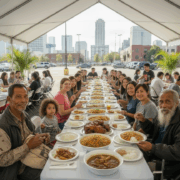
All hand-prepared by Mrs. Fider, the spread of Filipino fare included egg rolls, wings, ribs, rice, noodles, soup, and much more to fill the belly and feel the love. In addition to the patients, the invitation went out by flyer and word of mouth to “VIPS such as poor patients, physically disabled, mentally challenged patients, homeless people, including their children, and most of all, people in dire need.” Held outside in back of the Fider’s clinic, cooperative weather was a must.

“For the past weeks, cold spell brought with wind chill came to TN while snow in the East Coast,” Dr. Fider reported to his Facebook friends. “Merchie and I prayed the Rosary at St. Rose of Lima Church, Murfreesboro, and St. Williams Church, Shelbyville, last week to beg Our Lady of Fatima to grant us the Miracle of the Sun that happened on 1917 in Fatima, Portugal.” Even though the weather turned balmy, they were prepared regardless. In preparation that, to passersby, probably looked like a set-up for a wedding banquet, rented tents and tables were brought in, in addition to portable toilets so diners had facilities to wash before and after eating.

For the Fiders, who immigrated to this country from the Philippines in the early 1980s, it’s not only an opportunity to commemorate the first Thanksgiving in the land, but also an expression to give glory and thanks to God for many blessings and share their native culture with their adopted homeland.

The Thanksgiving lunch began in 2015, but when Covid hit, it stopped. Thanksgiving 2025 marks not only the tenth anniversary of the first lunch, but also its revival since Covid. This lunch was the first one outdoors, and the Fiders were grateful for the favorable weather. “Merchie and I thanked Our Lady of Fatima for the miracle of the Sun and for giving joy to all of them,” Dr. Fider said.

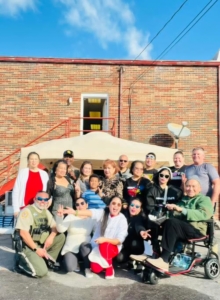
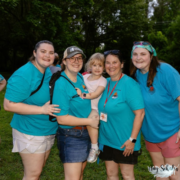
A group of volunteers gather in front of a tent for a group picture.

Volunteers of the Thanksgiving lunch enjoy the day.

For people charged with preparing Thanksgiving dinner for their families and who find it exhausting and stressful, can you imagine making more than 200 eggrolls? Mrs. Fider begins some of the dishes early, such as the eggrolls because they are hand-rolled. “The cutting is difficult because you have to cut it very fine to roll it,” she said. She wouldn’t consider eliminating the eggrolls, either. They are a favorite of their diners who anticipate having them. Some of the foods, such as rice, can only be made the day of the feast. She shops the ingredients when she can, normally after a long day of running the clinic.

In the end, about 150 people came. Diners included children, wheelchair-bound patients, and folks with canes and walkers. “I also invited homeless people that we met on the streets and hanging out in gas stations,” Dr. Fider said. Any leftover food was packed up for to-go orders. Nothing was wasted and everything was enjoyed – despite the intensive work.

“We can’t ask a caterer to do it … it’s different,” Mrs. Fider said.

No skimping, no compromising. The volunteers treat folks like family, or rather, Very
Important People.

“The VIP guests may be angels in disguise,” Dr. Fider posted. “Amen.”


AI Feature photo of Filipino banquet created in Adobe Firefly by Mary McWilliams
Inset photo contributed by Alex Fider and used with permission.
Scripture texts in this work are taken from the New American Bible, revised edition ©
2010, 1991, 1986, 1970 Confraternity of Christian Doctrine, Washington, D.C. and are
used by permission of the copyright owner. All Rights Reserved.

© Copyright 2025 by Mary McWilliams

Edited by Rietta Parker

I Learned What Home Could Be: Writing, Faith, and the Meantime Life

“I learned—at least—what Home could be—

How ignorant I had been…”—Emily Dickinson

Finding Peace in the Meantime

Life for me and my family has, up until this point, consisted of checking in and out of hotels and riding in a car packed with dirty laundry—and, of course, my son’s little blue scooter. At least he made the most of our situation. Both my husband and I were unemployed, living off a credit card, and looking for work and housing, but my son had his scooter. He’d zoom through hotel lobbies and circle playgrounds while we unpacked fast-food dinners on a park bench.

This transient life made it hard for me to be creative. When I tried to journal, it was messy. My notebooks soon became a mix of practice responses for job interviews, math problems for budgeting, and scattered reflections.

I had to find a way to bring peace into my life. First thing, the kids were going to summer camp. Not that I didn’t enjoy being in one room with two toddlers and a teen, but they needed summer memories, friends, and crafts. It also meant they could spend hours being kids instead of overhearing arguments between my husband and me about money or where we’d go once our hotel stay ended.

I made an effort to add normalcy and routine—morning walks, reading books for myself and to the kids at bedtime. I started Bible plans as a way to focus my prayer life, especially when my mind was stressed with money and marriage worries. Looking back now, I’m reminded of a workbook I cherished in high school: In the Meantime by Iyanla Vanzant. It’s a 40-day workbook structured to mirror sacred time in Scripture—the 40 years of Israel, the 40 days of Jesus. Christian workbooks and Bible plans can steady our faith when life feels unsettled.

Key practices that brought peace:

  • Summer camp for the kids
  • Morning walks and bedtime reading routines
  • Bible plans and focused prayer
  • Christian workbooks for spiritual grounding

The Power of Conversation and Community

When writing was hard for me, conversation came naturally. It was instinct to call my family and friends for support. Back in college, I attended women’s circles. Although that season of my life was steeped in new age philosophies, those circles gave women of different ages and walks of life a space to share struggles and dreams, and to lift each other with encouraging words. As women, we often lose ourselves serving our families, isolating from community.

Now, as a Catholic, I see the deeper truth behind that longing to gather. Conversation and community are part of our faith. Jesus didn’t write books; He spoke to people, told parables, and offered encouragement. The early Church grew from circles of believers who prayed, listened, and shared stories. For writers, it’s a reminder that conversation is just as important as writing; I know I sometimes forget this myself.

What conversation and community offer:

  • A space to share struggles and dreams
  • Encouragement from people at different life stages
  • Connection to our Faith tradition
  • A reminder that writing and speaking both matter

What Home Really Is

I recently moved into a home, although it’s a short-term lease, on Dickens Ave. The name makes me think of Emily Dickinson, who wrote so much about home. Her poems remind us that home is not simply an apartment number, but a pattern of life: morning walks, dinners (even if it is a combo number), and bedtime stories. During my months in hotels, I realized the same truth. Wherever we stayed, I hung a cross on the wall. It was my way of reminding myself and my children that our true home is not found in an address but in Christ.

Home is not a place, but:

  • A pattern of daily rhythms and routines
  • A spiritual anchor in faith
  • A reminder of what truly matters

Finding Your Way in the Meantime

So if you find yourself “in the meantime” of life, have faith that you can work with it and through it. The apostles wrote on the move; they didn’t have office space. They wrote from jail cells or while sitting on a rock. St. Paul didn’t have a content calendar, yet the Holy Spirit inspired him to write thoughtful letters and action plans for Christians. Don’t judge messy writing. Life doesn’t always fit neatly in the margins, and writing doesn’t have to either. Messy writing is authentic and raw. We don’t always see its value in the moment, but later it becomes a treasure, just like finding your middle school diary in your mom’s closet.

If you aren’t ready to write, create an action plan to stay grounded in prayer—adopt a Bible plan, pick up a Christian workbook. Or simply pick up the phone and talk to a good friend. The power of conversation is a tool for healing and evangelizing. Like the apostles, we are called to share the Gospel no matter what place in life we’re in. Like Dickinson, we search for what home could be. And like Christ, we discover that home is already within us.

If you’re in the meantime:

  • Embrace messy, authentic work—it becomes a treasure later
  • Consider a Bible plan or Christian workbook if writing feels impossible
  • Call a friend; conversation is healing and evangelizing
  • Remember: the Gospel spreads through your presence, wherever you are

A Day in Toledo,1933

A Day in Toledo, 1933


Hard times brought families together.

“Ew,” said Gertie.

“It’s God’s creature and he loves all his creatures,” said Agnes.

Agnes was goody-goody. Gertie was baddy-baddy.

“Good Lord,” said Mother. “What now?”  It was a large centipede that had crawled out of the drain.

“Eat it,” said Gertie. Agnes said, “You have to let him outside.”

It was the 1930s in Toledo, Ohio during the Great Depression. They lived in a house with a boarder, Andy. The father worked in a steel plant.

“My water’s cold,” yelled Andy.

“Coming,” said Mother. “I just have to heat it on the stove.”

“Hurry” said Andy. “What’s for dinner?”

“Fried chicken,” said Mother.

Andy always got the biggest piece of chicken, followed by Father. The rest of them got smaller pieces. The two girls, Gertie and Agnes, and the youngest two, Charles and the baby, Daisy.

When Father came home from the plant to eat his chicken and biscuits, he told a sad tale.

“The guy next to me fell into a vat and was vaporized.”  “The wife and kids are left.”

“At least they got his life insurance,” said Mother.

“No life insurance,” said Father. “The foreman told the wife he never came to work. They live nearby. Their name’s Mantellini.”

“Why don’t we make them some dinner?  They must be hungry,” said Mother. “They are Italian, right?  Let’s make them some spaghetti. What’s in spaghetti?  Tomatoes, peppers, and garlic?”

“And slugs,” added Gertie.

Mother told Agnes and Gertie to go to the store and get the dried pasta and the vegetables on credit.

When the Mantellinis came over they were wearing clothes made of the flour bags but no one laughed.

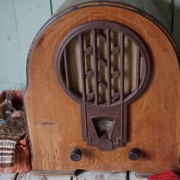
Gertie said by way of conversation, “I heard a funny song on the radio today, it was called, ‘Yes we have no bananas.’”

The mother of the other family said, “I brought some vegetables from the garden and some wine my husband made.”

“Oh we couldn’t,” Father said.

“It really means a lot to us that you have it with us,” Mrs. Mantellini told them.

Before dinner, they prayed.

“In nomine Patris et Filii et Spiritus Sancti” said the Italian mother. “Bless us, O Lord and these Thy gifts, which we are about to receive from Thy bounty, through Christ our Lord. Amen.”

Over dinner, Andy told stories of the Great War.

“It was a war in trenches. There was the mustard gas and bullets. You would run out between trenches in No Man’s Land and get shot. There were diseases like the Spanish flu.” Then he winked and said, “The only good thing was the French girls.”

“Stop that,” Mother said.

“What do you mean,”  Gertie asked.

“They made nice cheese,” said Mother.

“They lined them up and shot every third man to improve morale.”  Mother shot him a glance.

Andy continued. “But seriously, it was a terrible war. It was trench warfare. When we charged, we went over No Man’s Land where you got shot.  There was mustard gas and so we had to wear masks. Seeing my comrades suffer and die was the worst experience of my life.”

After dinner, they washed the dishes together. They joked around about Italian food versus American food and how rough the times were.

Mother said, “I heard on the radio that President Roosevelt said the only thing we have to fear is fear itself.  I sure hope so.”

They decided that the family would help the Mantellinis with food and watching the kids for awhile until they got back on their feet. The mother would work as a laundress. The kids would get jobs sweeping the streets and selling popcorn after school.

World War II came and, with it, jobs in factories and greater prosperity. They continued their friendship for many years.

© Copyright 2025 by Cecile Bianco

Image by Bernd Hildebrandt from Pixabay

Accepting Onions

Accepting Onions

by Paula Veloso Babadi

“For if their rejection is the reconciliation of the world, what will their acceptance be but life from the dead!” (Romans 11:15)

My husband and I recently celebrated our 50th wedding anniversary.  There was no big party or extravagant vacation, just a quiet dinner reminiscing about what a journey it had been. We were grateful to be where we are now through tears and laughter, peaks and valleys. Then, my husband reminded me proudly that after all these years he was still my onion!

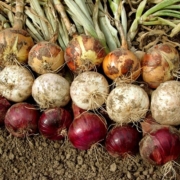
Something as simple as an onion contains contradictions. When it is pulled from the ground, it is at once intense, pungent, and strong, yet so easily torn by handling its delicate skin. It is sweet when sautéed, but causes us to cry in its raw state.  Scientists have tried to suppress the onion enzyme that brings on the tears, but in doing so, they discovered their engineering caused unwanted changes in the onion’s essence and compromised its health benefits.

Over the years, I learned that soaking an onion in water before you chop it can lessen tears, that the flavor becomes sweeter when sautéed gently on lower heat, and that when peeling, be careful because the best nutrition is preserved under that first skin. You could say the same about my own “onion.”  I decided long ago to accept onions (and my husband) as they are, without alteration— to endure raw tears and enjoy delectable taste.  My husband and I laugh over a poem I wrote about our relationship (below). We have been through raw, sweet, and savory times. You know what I mean: I love onions, but they still make me cry now and then. 


Accepting Onions

by Paula Veloso Babadi


I’m an onion through and through.

You like me when I’m in the stew, 

Flavor mingling with the rest

I think that’s when you like me best.

When you face me raw, I make you cry,

My taste too strong for you to try,

But persevere and you will find

The secrets in each layer of mine— 

For though my flavor is intense,

My benefits are quite immense.

Polyphenols, flavenoids,

Boost the heart, fill diet voids.

They reside in my first layer,

So peel me with the greatest care.

Anti-bacterial, good with liver,

Even helps with the blood sugar.

To get these benefits, you must commit

to take me daily and never quit.

Don’t like onions? Think again,

I give you paper from my skin.

Pungent taste enjoyed through time

I’m the star of feta, pita, herbs, and wine.


Those who’ve learned to appreciate me

Discovered there’s more than what they see.

I know I’m harsh and sometimes rotten, then

You throw me out, completely forgotten.

But I’m also tasty, savory, and sweet.

The choice is yours whether or not to eat.

And when my Panthial S-Oxide makes you cry

Remember my qualities that elicit a sigh.

I may be just your onion,

In some ways good and some not,

But without you to complete me,

I’m only food in the pot.

It’s when you accept me for what I am,

I become the finest pick in the land.


Copyright 2025 by Paula Veloso Babadi 

Edited by Gabriella Batel

Rocky Times

Rocky Times

Taxi drivers shook their fists at each other as I stared out the tour bus window. Blaring horns assaulted my ears. Sunset turned to twilight, and still we sat motionless in Tel Aviv traffic gridlock.
My heart was breaking for my fellow travelers. Although I’d been looking forward to visiting the Carmelite monastery’s public areas for a second time, I’d already been blessed with indelible memories of a daylight Mass in the gardens, followed by a tour that included rooftop views of the fertile valleys below. (See https://www.catholicwritersguild.org/2023/06/mount-carmel/). For the passengers with me on this trip, their visit here was meant to be the pinnacle of a once-in-a-lifetime pilgrimage to the Holy Land. The bus driver’s scowl mirrored my own frustration, but only an air of resigned disappointment filled the bus.
By the time we had navigated a winding road to the top of Mount Carmel, full darkness had descended. The harried greeter who’d waited for us outside made humble apologies. Unfortunately, no tour would be possible. The brothers had already prayed Vespers, and the vowed community was cloistered for the night. But our host said he’d given the lay oblates permission to reopen the gift shop. This announcement immediately cheered the ladies. At least they could still bring rosaries to their loved ones back home. They trooped off together toward the few still-lighted windows, smiling.
Dominick, a public elementary school principal, quietly pulled his carryon suitcase from the bin above his seat and got off the bus behind them. I’d learned that in his traditional Italian neighborhood, parishioners had sacrificed for years to buy a small triangular lot adjacent to their
church. Dominick was building there, a shrine for Our Lady of Mount Carmel. I watched him engage our greeter in animated conversation.
The other pilgrims eventually returned, with full souvenir bags in hand. But where was Dominick? Finally, he appeared again at the bus door, grinning. A middle-aged but muscular man from a contractor family, Dominick did not seem daunted by the weight he now carried. He climbed right up the bus stairs, and raised his suitcase with both hands, in a victory stance, as soon as he reached the aisle.
“That brother was so kind. He took me all the way back to the mountain!” Dominick’s voice resonated through the bus without benefit of the microphone. “He said I could have as many rocks as I wanted! He found me a spade, and held the flashlight while I pried the stones
free.”
Whoops, whistles, and cheers from every seat greeted his enthusiastic news.

***

I found myself behind Dominick in the El Al security lines for our departure flight back to the United States. He patted his suitcase, and whispered with a wink. “Don’t worry. I’ve got them all right here.”
I heard the uniformed Israeli guards ask, as Dominick slowly wheeled his suitcase to the counter, “What’s in there? Rocks?”
Uh, oh, I thought, looking around. Is this even legal? Archeological artifacts, and all that? Where’s our guide!  Dominick just nodded. “Gifts for Our Lady’s new grotto, from our Holy Land pilgrimage,” he said. Seeing the stern looks on their faces, he hastened to assure them.
“Everyone gave me permission. Those monks at Mount Carmel were really helpful.” Dominick pulled a paper from his vest pocket. Apparently, he’d somehow managed to wangle a document from the Carmelite brother who’d assisted with the excavation. Dominick handed his paper to one of the security men.
The first guard examined it and showed it to his partner. Then he refolded it carefully, and gave it back to Dominick. These officials, who now appeared a bit bemused, heaved Dominick’s suitcase up to the metal counter themselves. After looking inside, they exchanged a humorous glance, and waved our hero through, with his suitcase, to the gate. As I placed my own tote on the counter, I couldn’t help wondering how Dominick could have fit in all the stones I’d seen him collect, at the shore of the Sea of Galilee, and other sacred sites we’d visited.

But from the glimpse I’d just garnered, they did look– tightly packed.

***

Dominick engraved each stone from the Holy Land with its place of origin. He mortared them in where they fit, like puzzle pieces, among larger local boulders. Pilgrimage memories endure in a curved rock wall that shelters the consecrated granite altar in the new grotto dedicated to Our Lady of Mount Carmel.
Today, Mass can be celebrated at the grotto as well as the church, often in both English and Spanish. The parish maintains its long and faithful tradition of Corpus Christi processions with the Blessed Sacrament, visiting and blessing individual family homes throughout the old neighborhood. The parish school pioneered for our diocese the first cohort in an optional Spanish immersion curriculum for grades K-8.
Dominick’s spirit of humility, simplicity, and faith lives on.

May we all be blessed this Lent with trust and grace to find joy in whatever God sends.


© Copyright 2025 Margaret King Zacharias

Feature photo by Margaret King Zacharias. Used with Permission.


A Wonka Way of Life

A Wonka Way of Life

I love board games. I especially love them now that my kids have graduated from Candyland to (slightly) more advanced and strategic games. I find that playing board games with my kids is the easiest way for me to have them off screen time without them driving me insane or physically accosting each other. (Yes, my girls look adorable, but they’re feisty.)

Our current family favorite is Willy Wonka’s The Golden Ticket Game. Essentially, you play as one of the five children from the film, and collect Willy Wonka Bars through various actions. At the end of the game, when all the pretend candy bars have been collected, the players look inside their Wonka Bars to discover if they have won one of the coveted Golden Tickets. At least one player is left without a Golden Ticket, more if someone is lucky enough to have found more than one ticket in his or her own stock pile of candy bars.

Since they were itty bitty, I’ve never let my kids win at games. (Okay, maybe I skew the game a little bit, but I’ve never completely thrown one.) I believe that learning how to deal with losing is an absolutely fundamental skill that our kids need to learn as early as possible. We have a little song that the loser sings to the winner after a game, which goes, “You won, you won, but I had a lot of fun.” Then the winner has to clean up the game so there’s a tiny bit of retribution.

The original Willy Wonka and the Chocolate Factory movie from 1971 still gets regular viewing around our house too. (The anticipation is already growing for the Willy Wonka origins story releasing later this fall.) In the original film, we meet the eccentric Willy Wonka, who lives in a realm that seems contrary to the rest of the world. His jovial spirit and quirky mannerisms can seem enticing and confusing at the same time. He delivers countless iconic lines; my favorite one is when, after he says that they have so little to do with so much time, he exclaims, “Wait. Strike that. Reverse it.”

I feel like Jesus says that to me too in my call to Christianity. He says, “The world is doing X, but you need to strike that and reverse it.”

The American cancel-culture is infectious these days. When a person makes a single mistake, we are not only permitted but encouraged to cut them out of our lives permanently. This goes for celebrities and family members alike. If someone doesn’t agree with our religious or political views, we simply unfollow and block all communication. If someone hurts us, we self-medicate with booze instead of searching for true peace through forgiveness. We justify and excuse our actions because the rest of the world behaves that way too.

As Christians, we are called to live an upside-down, Willy-Wonka-type life. Where others refuse to forgive, we are called to love all the more deeply. Where others seek worldly recognition, we are called to work lovingly from the shadows. Where others seek riches, we are called to generously share all that we have been given. When the world says, “Do X,” we have to wait, strike that, and reverse it.

© Maria Riley 2023

Photo License: https://creativecommons.org/licenses/by-sa/2.0/deed.en

Five (Free!) Ways to Support an Author You Love

Five (Free!) Ways to Support an Author You Love

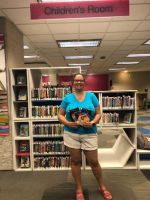
The other day I had an awesome milestone as an author: I found my books on the shelf in our public library! This might seem like a very little thing, but for me, it made my whole month. I brought my kids to the library for their weekly perusal and book check-outs, and there they were, on the New Books shelf in the children’s room.

I gushed and geeked out a bit, complete with pictures and a video for an Instagram reel, and I drew the attention of a fellow patron. She was thrilled to meet an author and excited to see good, Catholic books in the public library. After I took my pics, she eagerly added them to her own check-out pile (even more excitement for me!).

The process of getting my books in the public library was as simple as filling out a form on the library’s website. As a patron of the library, I can request titles for the library to purchase, and then they buy them. I’ve requested all sorts of books, and I’ve never had a title refused by my library.

This got me wondering if everyone knows about requesting books for your library to purchase. It is a free and tremendously helpful thing for authors, since you can only request books at your own library. Having my books at libraries is wonderful because not only can all readers have a chance to experience my books without the purchase price being a barrier, but also, some people who may otherwise not pick up my book may choose to do so since it won’t cost them a thing. My goal is to have as many kids as possible read my series, Adventures with the Saints, so having them in tons of libraries is a phenomenal way to do that!

While we’re talking about free ways to support your favorite authors (I hope that includes me!), leaving reviews is high on the list. Amazon is the biggest one, but reviews on Barnes and Noble, Goodreads, the author’s website, and anywhere else you buy the book (like local bookshops that sell online, etc.), have a huge impact and can make the difference when someone is thinking about purchasing the book. While you’re on there, be sure to “like” the other five-star reviews so they populate at the top of the list. The best reviews mention specific things that you loved and why you would recommend it, but even just taking 30 seconds on Amazon to click five-stars without writing anything helps! 

Another simple, fun, and free way to support authors is to engage with them on social media. Following your favorite authors and liking their posts is a great start, but the algorithms require engagement to boost a post. A reel or post that has a lot of comments will have more exposure, and one that has multiple shares will see the most traffic. Next time you’re scrolling, take that quick second to comment, tag your friends who would also enjoy the post, and share the content on your own feed. You can find me on Facebook and Instagram @mariarileyauthor if you want to engage with me there!

My next suggestion has less to do with increasing sales and everything to do with encouraging your favorite author: send fan mail. There is something profoundly uplifting and motivating about a reader who loved your book and wanted to let you know. Nothing brightens my day more than reading an email from a child who loved my books. Bonus points for the seven-year-old’s note that included a picture of her holding my book. Seriously, a three-minute email could be exactly the thing that an author needs to stay focused and determined when writing her next book. It might be the difference between her throwing in the towel or continuing writing. As authors, we put ourselves out there and hope that people will like and buy our books. It’s tough business. A few kind words really go a long way, and they won’t cost you a cent.

Finally, if you have a book and author that you love, tell everyone you know. There is no marketing like word of mouth, and personal recommendations are second to none. If you loved a book, chances are your friends will too. Make it a habit to spread the word about your favorite books and hopefully turn a new reader onto his new favorite author.

Of course, buying a copy of a book for yourself (and maybe two more for friends) is always the most direct way to support an author. But when the budget is tight (or you’ve already got the book), spend a little bit of time and no money at all to support us in this crazy craft of writing!

© Copyright 2023 Maria Riley

Three Things I’ve Learned from my Chickens

Three Things I’ve Learned from my Chickens

As writers, we know that one aspect of writing well is writing authentically. By that I mean we have to follow the rules of the reality we are writing about, whatever they may be. The rules governing Middle Earth are a little different than those in Narnia, for example.  If we are writing about our own world, here on planet Earth, 2023, one practice that can help us write authentically is the habit of being observant of the world around us, so that we can convey those small details in our stories. In fact, being observant might even lead to a new understanding.

What does any of this have to do with chickens, you might ask?  Doesn’t the title of this article signify something having to do with those small animals? Besides, I’m not saying anything new in that opening paragraph.

Let me begin, then, by saying that I never intended to become “the chicken lady” of my neighborhood. When my husband called from work one day, saying that a colleague had no further need of 4 unhatched baby chicks and did I think we could take them in for a while, I said “Sure” simply because I like animals and couldn’t stand the thought of those little chickies being – literally – thrown away. That was about the extent of my thinking.
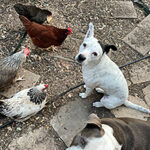
Fast forward a year and a half later, and we now have 5 stout ladies who take up a third of our backyard. And they are delightful. I have become thoroughly attached to them. Through observing them closely these past several months, I’ve also learned a few things. Here are 3 of them.

  1. Habits can produce happiness.

My hens follow the same routine every day. They wake up with the sunrise, then run out to munch on the food I give them. It is always the same food, but they are nevertheless excited to see it every morning. They spend the rest of the day alternating between scratching for bugs, chatting with each other and resting.  At 7pm each evening, they gather by their gate and call for their nightly visit. I bring them some rice or a little bread and we spend time together. After a few more sips of water, and a little extra scratching, they put themselves to bed at dusk.  They follow this same routine every day. They witness to the importance of good daily habits, of doing a little bit consistently over time, every day. I often wonder what I could get done if I was such a creature of routine.

2. Don’t be afraid to try.

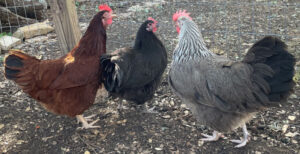
Even though my hens are quite content in their pen, that doesn’t mean they don’t look up and notice the green grass and fresh flowers blooming in other parts of the yard. They are always up for new ways to escape their yard to get to greener pastures. (In fact, I am convinced that whoever wrote the script for the movie Chicken Run really did have chickens.) Our Rhode Island Red, Cocoa, makes a point of pushing on the garden gate at least once an hour, just in case it has been left open. Our silver Welbar, Sandy, learned exactly where to stand so that she could fly up and just reach the tip of the fence, push off with her foot, and propel herself into the grass. They also know our habits, and often try to follow the dogs in and out.  I think they hope we won’t notice an extra pair of legs.  Even though they appreciate their home, they’re never afraid to push on the gate one more time or keep an eye out for another weak spot in the fence. They remind me not to get too complacent, but to keep looking up and trying.

3. Appreciate your community.

My little flock did not choose each other, but they’ve formed themselves into a community nevertheless. Although they are all different types of hens, they get along. Yes, there is certainly a pecking order (Sandy is at the top) but there is still room for everyone, despite their various temperaments. For example, Pebbles, our black Australorp, tends to get broody and take over the nesting box, while Pepper, a light Brahma and the smallest of the five chickens, likes to make up for her small size by being feisty and pecking everyone, including the dogs. Occasionally there are some ruffled feathers but most of the time there are contented, chatty clucks and check-ins, and at the end of the day they all go into the hen house and sleep peacefully together.  If I’ve had a hard day with a difficult person, I really notice their ability to not hold a grudge and to let bygones be bygones. It reminds me that I might not always want to spend a lot of time around a certain person or persons, but I don’t have to take everything personally and I don’t have to carry resentment with me every day. (And I’m always somewhat flabbergasted that the hens consider our two pitties part of their community!)

These are a few of the conclusions I’ve come to over the last few months, in the mornings with my coffee watching them greet the new day, and in the evenings as the sun is setting.  As I mentioned above, close observation of the world around us helps us to be better writers, and maybe even better people. These five little ladies are speaking to me all the time. Is there something that speaks to you in your life?  What do you closely observe? And is it changing you?

©Copyright 2023 by Sarah Pedrozo

Featured image from iStock-chicken (3)

Bottom two photos by Sarah Pedrozo ©Copyright 2023 by Sarah Pedrozo