

Elder is a Verb

Editor’s note: Technical issues are a nuisance, but in this case it is to our benefit because we revisit Margaret’s September column which disappeared into the ether, along with several other author’s works, due to website issues, now resolved, the latter part of the year.


“… It was not you who chose me, but I who chose you and appointed you to go and

bear fruit that will remain …”  — John 15:16

“Now is the season of the fruiting and the dying.”  — Mary Dingman, SSSF


Elder is a Verb

My long-time spiritual director, Sister Mary Dingman (1919-2017), a vowed member of the School Sisters of St. Francis, was the first person from whom I heard the words, “elder is a verb.”

Sister Mary served her order with distinction as novice mistress, postulancy mistress, Catholic high school teacher, provincial coordinator, and formation director in multiple settings, from the Archdiocese of Milwaukee to the Archdiocese of Omaha. (1)

An apocryphal story tells that while she was still a novice herself, Mary refused a demand to sit in the back seat, from her brother’s fellow seminarian who was giving her a ride back to the convent from their rural hometown.

He was afraid of being seen with a female in his automobile. Novice Mary climbed straight into the front passenger seat. She didn’t recognize any difference in moral responsibility among disciples of the Lord, only different roles to fulfill.

Sister Mary was already a recognized religious figure in her own right by the time her older brother, Bishop Maurice Dingman (1914-1992), called her back to their home state of Iowa.  He asked her to support and assist the Jesuit priests who served Emmaus Community prayer house, to extend opportunities for professional spiritual direction beyond the clergy and into the wider Des Moines lay community.

For more than twenty years, Mary Dingman, SSSF served as a spiritual director at Emmaus House, in a historic Victorian two-story home located close the inner city. She prepared daily lunches where everyone was welcomed to the feast in her beautifully set dining room, after liturgy and Eucharist were offered in the home’s cozy living room. Mass was celebrated there for many years by one of the Jesuit or diocesan priests, as simply and profoundly as the earliest Christians celebrated in the catacombs. Later, centering prayer groups and holy day dinners joined the schedule as the Emmaus community grew.

Sister Mary hosted Catholic and Protestant clergymen, vowed religious, and laypersons for private retreats in the small bedrooms upstairs, providing three excellent meals a day along with plenty of quiet time and peace to enjoy the gardens that surrounded her home. She was still driving, by herself, around the state to provide directed retreats at monasteries and convents, into her late eighties.

Sister Mary Dingman fulfilled her commission as an apostle proclaimed by Jesus in the Gospel of John: to bear fruit that would last.

Emmaus House maintains its commitment to Ignatian Spirituality and community fellowship in the Diocese of Des Moines, even to this very day; offering educational conferences, group and private retreats, as well as personal spiritual direction, now from a new home that is better-equipped to utilize modern technology. (2)

What about us?

As the Autumn Equinox arrives this Monday, September 22, where do we find ourselves? Probably most members of the Catholic Writers Guild are attending Mass regularly, and making strong efforts to educate their families in the faith.

We might not want to think too much about our own deaths, but are we still living our faith to its fullest?

According to the United States census, all members of the United States “Baby Boom” population, people who were born between 1946 and 1964, will not reach the current “retirement” age of 65 until 2030 (3).

“Independent living communities” for “senior citizens” have been popping up like mushrooms all over the country for decades, and many have long wait lists as well as hefty fees. Busy families with active young children and teenagers are too often forced to beg, in some places, to find a single bed available in a skilled nursing home with adequate facilities to help them care for aging parents.

How many devout and aging Catholics do we know, who are facing difficult choices for their final years?

The Oxford English Dictionary gives three parts of speech for the word “elder”:  noun, adjective, and verb – which is offered third in order, after the noun and the adjective, because it is the least common usage.

“1. verb trans. With it, to play the elder. rare. …”

“2. verb intrans. Become older, begin to show signs of age. colloq. and poet. …”

“3. verb trans. Make a request to or admonish a person …” (4)

But none of these were what my friend Sister Mary meant, nor how she lived her own life. She spoke with an active verb, and went about “eldering” with her whole self.

Are we thinking too much about the leaves falling and dreading winter? Are we approaching our own “autumns” as fates to “die” rather than to “fruit”?

Many older people in our society are struggling to afford food on limited social security payments. Children in schools often need surrogate grandparents to listen to their reading and tell them stories, when parents may be too busy or too overwhelmed.

Families, parishes, and dioceses offer plentiful opportunities to help with food pantries, assist the ill or handicapped, offer constructive personal attention to children.

Perhaps most important, “Baby Boomers” who have already retired and those who will retire over the next three decades are the last generation on earth who will remember a culture, and a quality of human life, before demands and consequences of administration by computer.

We can leave an imprint of real experiences in direct and human interaction with the generations that will follow us.

The saints in heaven watch over us as we drag ourselves out of bed, perhaps groaning with arthritic pain. They listen to and intercede for our prayers on behalf of our ancestors, neighbors, children, and grandchildren. They see us picking up our glasses, hearing aids, keys, canes, or walkers, putting on our coats and boots, going out to take care of our daily business.

No matter our circumstances, we can move forward into this autumn of 2025 — even as our earthly weather starts progressing towards winter – carrying the fruits of love, hope, and genuine encounters that endure.

 

© 2025 by Margaret King Zacharias

Feature photo: First Color in Iowa – Photo Credit Margaret Zacharias. Published with permission.

Inset photo: Autumn Rainbow to Heaven – Photo Credit Charles Zacharias.  Published with permission.


Notes

  1. https://www.barrmemorialchapel.com/obituary/4352175
  2. https://www.theemmaushouse.org/about-us
  3. https://www.census.gov/library/stories/2019/12/by-2030-all-baby-boomers-will-be-age-65-or-older.html
  4. Shorter Oxford English Dictionary, Fifth Edition, Volume I A-M, Oxford University Press, Great Clarendon Street, OX2 6DP, Published in the United States by Oxford University Press Inc, New York, 2002, p. 801.
A Wonka Way of Life

A Wonka Way of Life

I love board games. I especially love them now that my kids have graduated from Candyland to (slightly) more advanced and strategic games. I find that playing board games with my kids is the easiest way for me to have them off screen time without them driving me insane or physically accosting each other. (Yes, my girls look adorable, but they’re feisty.)

Our current family favorite is Willy Wonka’s The Golden Ticket Game. Essentially, you play as one of the five children from the film, and collect Willy Wonka Bars through various actions. At the end of the game, when all the pretend candy bars have been collected, the players look inside their Wonka Bars to discover if they have won one of the coveted Golden Tickets. At least one player is left without a Golden Ticket, more if someone is lucky enough to have found more than one ticket in his or her own stock pile of candy bars.

Since they were itty bitty, I’ve never let my kids win at games. (Okay, maybe I skew the game a little bit, but I’ve never completely thrown one.) I believe that learning how to deal with losing is an absolutely fundamental skill that our kids need to learn as early as possible. We have a little song that the loser sings to the winner after a game, which goes, “You won, you won, but I had a lot of fun.” Then the winner has to clean up the game so there’s a tiny bit of retribution.

The original Willy Wonka and the Chocolate Factory movie from 1971 still gets regular viewing around our house too. (The anticipation is already growing for the Willy Wonka origins story releasing later this fall.) In the original film, we meet the eccentric Willy Wonka, who lives in a realm that seems contrary to the rest of the world. His jovial spirit and quirky mannerisms can seem enticing and confusing at the same time. He delivers countless iconic lines; my favorite one is when, after he says that they have so little to do with so much time, he exclaims, “Wait. Strike that. Reverse it.”

I feel like Jesus says that to me too in my call to Christianity. He says, “The world is doing X, but you need to strike that and reverse it.”

The American cancel-culture is infectious these days. When a person makes a single mistake, we are not only permitted but encouraged to cut them out of our lives permanently. This goes for celebrities and family members alike. If someone doesn’t agree with our religious or political views, we simply unfollow and block all communication. If someone hurts us, we self-medicate with booze instead of searching for true peace through forgiveness. We justify and excuse our actions because the rest of the world behaves that way too.

As Christians, we are called to live an upside-down, Willy-Wonka-type life. Where others refuse to forgive, we are called to love all the more deeply. Where others seek worldly recognition, we are called to work lovingly from the shadows. Where others seek riches, we are called to generously share all that we have been given. When the world says, “Do X,” we have to wait, strike that, and reverse it.

© Maria Riley 2023

Photo License: https://creativecommons.org/licenses/by-sa/2.0/deed.en

Candy as Compassion

Candy as Compassion

Next Sunday, the Third Sunday of Lent, we see how God showed compassion on His people in the desert, giving them water from the rock, and the Samaritan woman giving Jesus a drink. So how do we know compassion? What does it look like? Sound like? Do we know when we see or show it?

I visited a person, while making my Diaconate rounds, on hospice in their early 40’s. They would ask for the same item of every doctor, nurse, and certified nursing assistant (CNA)—a bag of the Chewable Sweet Tarts from the candy machine down the hall.

As the person faded in and out, they told me they had two beautiful children who were unable to make the trip to say “goodbye.” Their condition was taking hold. Soon they wouldn’t wake again. The person had led a rough life. They’d stolen, been hooked on drugs, cheated, lied, and had prominent tattoos of “taking lives.”

I didn’t judge and asked, “What would make you happy before you leave this world?”

They smiled and said, “Just one thing, a bag of those Chewable Sweet Tarts.”

I had to chuckle. “What’s so special about a bag of candy?”

The person smiled, a tear leaking from their eye. They said, “I used to take my kids around the neighborhood for Halloween. We had the best time! We’d talk as we walked around. I found out I had really smart, funny, and good kids.” The person sat with the memory, then said, “After we got home, we’d dump all the candy onto the kitchen table and take a piece, share it, and judge it with a rating. ‘This one’s an 8.6, or 9.2, or 4.1!’ We’d have the best time.”

The person looked over at me and said, “The Chewable Sweet Tarts… we never had those. Somehow having them will bring me back to the one good time—the one good thing I had in my life—my kids.”

After going to the restroom, I saw the candy machine and came back to the room, gently laying the bag of Chewable Sweet Tarts on the bed table. The person looked up at me. Big tears and no ability to speak. I came to the bedside, and they clung to me for a solid five minutes—bawling and asking over and over, “Why? Why? Why would you show me any compassion? Why would you do this for me?”

We shared the candy. As the person across from me chewed slowly, smiling the entire time, I finally answered their question. “Because you’re worthy of compassion. We all are.”

We never know what another person needs. The nurses, doctors, and hospital staff all had been in that room. They saw the patient—but missed the person.

Look around you. Who are the persons around you? Not customers, not clients, not patients—persons. Remember, compassion is a sure sign that the Holy Spirit is alive in us—and is helping us see that person crossing our paths every day.

Copyright 2023 Ben Bongers

Even Scraps, Received in Faith, Bring Healing

The woman was a Greek, a Syrophoenician by birth, and she begged him to drive the demon out of her daughter. He said to her, “Let the children be fed first. For it is not right to take the food of the children and throw it to the dogs.” She replied and said to him, “Lord, even the dogs under the table eat the children’s scraps.” Then he said to her, “For saying this, you may go. The demon has gone out of your daughter.” When the woman went home, she found the child lying in bed and the demon gone. ~ Mark 7:26-30


How many demons do we need Jesus to drive out? Do you struggle with insecurity, anxiety, uncertainty, maybe addiction, a difficult relationship, or financial crisis? How remarkable that even the smallest grace from Jesus, the scraps, has the power to transform our life.  Imagine the possible freedom awaiting us if we embraced even a tiny bit of the blessings Jesus has to offer us.  The gifts available from heaven are abundant, meaning we do not need to settle for the crumbs, yet if that were all we allowed ourselves to dine upon we’d still be filled.

Our lives would not be perfect or free from those things that worry, concern, or pain us, but there would be a sense of inner peace and hope that can only come from heaven.  The woman came to Jesus prepared to be persistent, humble, and assured.  Persistent in her begging; humble enough to address Him as Lord and take whatever scraps He offered; and surely she believed what He said was done because she left for home at His command. When was the last time I approached Jesus in that way—begging for some assistance, humbled by His majesty and glory, and yet completely sure that I would, in some way, receive a blessing? Confident in Jesus’ answer to my prayer, regardless of what I sought, accepting the scraps falling from the heavenly banquet?

So, what holds us back from being fed by Jesus? Feeling, perhaps, unworthy of even the crumbs from His table? How can the Syrophoenician woman’s example encourage us to approach Jesus for assistance in whatever demons we are trying to eradicate from our lives?

Jesus, I believe that you have so much more to offer me than I am ever able to accept. Lord, I thank you for calling me to your banquet, and whether I put myself at the table for the feast or at your feet for the crumbs, help me to be always assured I will never be without your blessing and grace.

Lessons from the Ditch

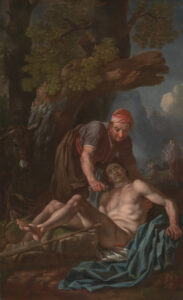
I’m glad I was paying attention years ago when our beloved pastor at the time gave his homily on the Good Samaritan – today’s Gospel reading. You’ve all heard the account of Jesus explaining what it means to be a good neighbor (Luke 10:25-37). On that Sunday, Father Thanh proposed an entirely new perspective: we are the man in the ditch, and God is our merciful Samaritan.


Do not let the flood sweep over me, or the deep swallow me up, or the Pit close its mouth over me. Answer me, O Lord, for your steadfast love is good; according to your abundant mercy, turn to me. Psalm 69:15-16


The psalmist knew many perils lurk to rob us of possessions, joy, comfort and conscious living. He also knew God’s love and mercy are boundless. But we easily forget as we let our worries and anxieties bury us in our own ditches.  I got caught up in thieves’ traps many times in my life, and this special sermon woke me up.

From a young age I was taught to follow the directive to be a good neighbor, be kind, lend a helping hand. And it’s an important lesson. But as an adult in my golden years, the equally great lesson – trust in the love and mercy of my ultimate Good Samaritan became clear. He hears my deepest cries even when I cannot speak and reaches into the pit to lift me up when I cannot even move.

Father Thanh from all those years ago at St. Joseph’s parish in Mandarin, Florida, is now Bishop Thanh Thai Nguyen, Auxiliary Bishop of the Diocese of Orange in California. He is a true shepherd in the footsteps of our Lord as his reach across the years pulled me back to the notes I took during his deeply insightful sermon. As Catholic writers let’s always be ready to capture movements of the Holy Spirit – even during sermons. My poem is the fruit of his words and a receptive heart.

The Good Samaritan

by Paula Veloso Babadi

Waylaid by circumstance,

cast down

to eat dust

on deserted roads,

stripped and stricken

but not annihilated,

others pass by

until your holy hand

and gentle heart

bear me to refuge.

Mercy none else dealt.

Blessed by your benevolence,

healed at your bidding,

I dared not hope –

yet I am whole again.

forever I will seek

to be the Good Samaritan

and

the stranger saved by he


Copyright 2022 by Paula Veloso Babadi

Considering a Come and See Discipleship

“What are you looking for?” Jesus asked, followed by an invitation to “come and see” in response to the disciples’ question as to where he is staying on the road to Emmaus. Jesus knew of course what they were seeking, it is what we all seek—peace, hope, salvation. In this encounter, Jesus calls them, and indeed us as well, to accept his invitation to find those things, and so much more. The invitation to see where he was staying calls to mind a moment later in John’s Gospel, where Jesus teaches in length the blessing of abiding with Him, how we can bear much fruit in our faith, receive what we ask in prayer, and most importantly, know the Father.

Jesus’ invitation begins first with an opportunity for the person to contemplate what they are looking for. Do you know what it is you seek in this world? Are you open to truly being a disciple of Jesus Christ? To leave behind all of your expectations, to trust the goodness of Jesus’ invitation, and to follow where God’s will for you leads?

Without waiting for the early disciples to respond, knowing their hearts and that the Kingdom of Heaven holds everything they seek, he likewise invites us to come and see. Some of Jesus’ disciples came and stayed with him because they had heard Jesus preach. They were moved by the promise, hope, mercy, and life he offered. Others, like Peter, came to see after his brother, Andrew, heard Jesus and extended an invitation for him to see for himself. It was Andrew’s evangelization that brought Peter to seek the Lord. Andrew’s love for Peter moved him to share what he had found. How blessed to have someone care enough to step out in faith, no matter how uncomfortable the situation may be, and share the life found only in Jesus!

Although we come to discover Jesus in a variety of ways, many experience similar encounters on our own road to discipleship. Myriad paths, but only one true destination. When we follow Jesus’ example and invite others to come and see, when we, like Andrew, tell our loved ones about finding the Messiah, we become part of the hope of discipleship present in John’s Gospel.

Jesus’ invitation was no different to the disciples than it is to us today. He still seeks to have us come and see. There will be obstacles, much like those the disciples themselves faced. Commitments to work and family, feeling too busy with pressing tasks to come and see. Jesus did not make arguments, trying to force what he knew was best for them. Instead, he merely extends his invitation again for them to come and see.

Those who believe inspire others to believe. Later in John’s Gospel, we are introduced to the Samaritan woman Jesus meet at the well. Her encounter with Christ spurs a conversion so dramatic that she cannot keep it to herself. Transformed by His love, mercy, and hope of a life where so no longer has to thirst for redemption, she leaves her past behind and becomes the most unlikely evangelist.

Moved by Jesus’ invitation to come and see, she goes immediately out to share the Good News, causing a ripple effect of discipleship. The lives of the people she encounters and invites are never the same once they too accept the invitation to follow and abide in the truth and love offered by Jesus. One of the most powerful lines in John’s Gospel comes from John 4:41-42, at the conclusion of the recounting of the Woman at the Well. “Many more believed because of His word; and they were saying to the woman, ‘It is no longer because of what you said that we believe, for we have heard for ourselves and know that this One truly is the Savior of the world.’”

Truth be told, this is the legacy I, too, desire to leave.


Copyright 2022 Allison Gingras

The Strange Paradox of COVID-19: Saving the lonely by making them lonelier

I have learned that loneliness has no boundaries. It reaches out for everyone and captures many of the unsuspecting, including the seemingly happy, satisfied, and successful. Yes, loneliness is capable of dragging the lonely into a world of hidden misery and often depression. It can attack anyone at any time, and it has become a social condition of almost epidemic proportions.

I have been widowed twice and know full well how loneliness can occupy a unique place in the widowed equation. Loneliness also reaches out and captures those who may have lost a child, a parent, a sibling, or even a dear friend. I carry the loneliness package from all of those.

Suddenly, loneliness has been gifted with a new victim to feast on: It can now extend its ravenous appetite into the pandemic known as COVID-19, AKA the coronavirus.  Loneliness is about to ravage the senior citizen in ways never imagined. One way will be to take away their chairs and sofas.

I have been bringing Holy Communion to the homebound on Sundays for over twenty years. It may be the most uplifting thing I do, and I know I have been spiritually rewarded many times over. One Sunday in early March, I confronted a new wrinkle in my visits. Virginia (age 98) resides in an independent living apartment. It is a reasonably long walk from the parking lot to the building entrance. Once there, you use a keypad to gain access. I scroll to Virginia’s name and get her on the speaker. She buzzes me in.

As the sliding doors open, I stop short. No one is there. Every Sunday, there are four or five, maybe six, people in the lobby sitting around chatting and just visiting with each other. They know my name, and I always get a friendly welcome from them. We exchange a few pleasantries (I usually joke about something), and then I go on my way.

But this Sunday no one is there. I just stood there because it took me a few seconds to realize that no one was there because the furniture was gone. The lobby was empty. There was no sofa, or chairs, or coffee table. They had been removed, and there was no place to sit and talk. This was done courtesy of the management “protecting” the residents against COVID-19 or coronavirus. We must keep the elderly SAFE. No problem; just keep them in their rooms — ALONE.

The situation impacted me deeply. I have been visiting the sick and homebound for a long time, and they do not ask for much. However, in their low-profile, quiet world, they look forward to sitting together (if possible) and just talking about whatever it is they talk about. My visit is a big deal for them. I see each of my folks for about ten minutes each, sometimes a bit longer.

I may be the only visitor they see all week. Yet my visit buoys them up for my next visit which is a week away. The folks who gather in the lobby every week are non-Catholic and do not receive. But I do get to say a short prayer with them, and they like my doing it. So do I.

But now, on that Sunday morning in March of the year 2020, it seems things had changed in a way no one could have ever imagined. The powers that be want us to be alone. They want us to avoid each other, not touch each other, and become individual entities. But we are social beings, and like it or not, we need each other. We need to touch and hold and shake hands and hug, especially among family and friends.

Nursing homes all over the country have been placed on “lockdown.” Patients in these places will be relegated to their beds. Family and friends will not be allowed to visit them. Independent living apartments will have empty lobbies and courtyards. There will be no place for the tenants to sit and congregate.

Will our country and maybe the world soon have billions of separate individuals with no one to talk to or visit with? It is such a strange paradox: saving the lonely by making them lonelier than they already are.

We had all better pray like we never prayed before that this coronavirus is vanquished quickly. We cannot live this way for very long.

Copyright©Larry Peterson 2020

Truly an extraordinary ministry: I am an EMHC and I am honored to be one

I wish to clarify something right away. I am NOT a Eucharistic Minister. I am an Extraordinary Minister of Holy Communion (EMHC). ‘Extraordinary Minister of Holy Communion” is the proper term for the people involved in this ministry. The term “Eucharist” is never to be in their title. That term is reserved for the priest alone (see Redemptionis Sacramentum).

I have been involved in many ministries over the years and have been an EMHC for 23 years. For me, nothing can compare to being an EMHC. It is all about Jesus, the person receiving Jesus, and you being the one who has brought them together. It does not get any better than that.

I rarely miss a visit to my homebound friends. As of this writing, I visit nine every Sunday. Five of them are in their nineties. Honestly, it makes my day. Ironically, it makes their day too, (and sometimeS their week) because they hardly see anyone during the week except home health aides and folks like that. All I come with is a smile, a church bulletin, maybe a prayer card and, of course, their BEST FRIEND.

I have a journaling book, and in the back, I have compiled names of people I have brought Holy Communion to over the years. I want to share a bit about a few of these folks with you. These are Catholic people who have lived their Catholic lives to the best of their ability. Many of them were children during the Great Depression and lived through World War II and into the 21st century — like my friend George B.

George was in the U.S. Navy and stationed in London in 1940 during the Blitzkrieg. He survived that, came home and wound up at Pearl Harbor. He was there on December 7, 1941, when the Japanese attacked. He and a Marine corporal manned a 50-caliber machine gun and shot down two Japanese Zeroes. The two of them then proceeded to pull men out of the burning water near the USS Arizona. After the war, he was in the circus for more than 20 years. George died several years ago at the age of 97. I loved his stories. He was a walking history book, and he would get veryanimated when he was telling you about his adventures. I brought him Communion every Sunday for more than two years. What an honor that was.

There was Anne S. She was 90 and would be dressed to the “T” every Sunday when I arrived. She would ask, “Why does God keep me here, Larry?”

“Anne,” I would say. “He needs Prayer Warriors. That’s what you are, and that’s why you are here. There are many souls in Purgatory. They need your help.”

She would always smile and point to her rosary and her prayer books on the table next to her. She would point to them and say, “Yes, I know. I do keep busy.” Recruiting “prayer warriors” is an important part of what I do. Anne has been gone for five years.

And my little pal, Scotty Walker. He was a St. Jude baby because of a tumor on his brain stem. That was in 1977 when he was only two years old. When he was 25, he was only 4 feet, 4 inches tall. He started his own lawn service when he was about 17. Scotty wore a big straw hat, and his nose would be just above the lawn-mower handle as he pushed it along. At the same time, he was studying for his GED. He worked his tail off until he could not do so any longer. I brought him Communion every Sunday during the last two years of his life. He died in 2002 when he was 27.

I have been blessed to be part of this ministry. Seven people have received their Viaticum from me. It was not planned that way — it just happened. I pray to each of them all the time. I have on my list over 40 people who have passed on, including both my wives (one died in 2003 and the other in 2017).

I would suggest you look into being part of this ministry. You get to leave the church with Jesus in your pocket and then just you and He get to go visiting His homebound or hospitalized people. It is a beautiful thing.


Copyright 2018 Larry Peterson

The Mercy We Are Called to Live

Eucharistic AdorationWhen introducing the corporal and spiritual works of mercy in her book, Blessed Are You, author Melanie Rigney writes, “Both types can come free and easy … or hard and challenging” (Franciscan Media, 2016, p. 66).  This immediately made me think of the healthy benefits of exercise. I can stroll around the park with the kids, or I can strap on the boxing gloves and go a round with the punching bag.

As I read in Melanie’s chapter on mercy, which included Sts. Teresa of Calcutta, Maria Karlowska, and Frances Xavier Cabrini, she brought an important question to mind. How do I approach the responsibility of showing mercy to others in my own life? She did not mean just the common decency we’re called to extend to each other in day to day living with others. But the “words into action, called to be a saint” kind of mercy.

The Works of Mercy remind us that mercy is much more than forgiveness.  In totality, these works encourage us to live beyond ourselves. Though we may not all be called to the streets of India, as Saint Teresa of Calcutta was, we are responsible to care for the poorest of the poor—spiritually and physically.

Take for instance praying for the living and the dead. There is a straightforward way to accomplish this work of mercy such as offering the intentions for others during prayer. One of my favorite “free and easy” praying for others actions involves Facebook and Adoration.  Before my Eucharistic Holy Hours, I will post on Facebook an image of the Eucharist in a Monstrance and the words “Can I pray for you?” The response this post garners humbles and amazes me. I typically receive 100 or more likes and/or comments indicating a request for prayer. Then, when I am sitting in the chapel before Jesus in the Eucharist, praying for each person and their intention by name, I am overcome with a profound sense of hope and peace. Though the requests often break my heart, I would still place this act in the easy act of mercy category.

A few years ago, after completing a novena to St. Ann for help with a serious financial matter, I felt a spiritual nudge to give back in charity for great blessings received in an answer to this prayer.  After a time of prayer, I was inspired to rejoin the ministry of bringing Holy Communion to the homebound. My pastor was happy to have my help—but it would require me to attend the 8 a.m. Mass and rearrange my work schedule.  Sacrifice?  I didn’t see that coming; I thought it would be at my leisure and on my time. These were inconvenient sacrifices but the “hard and challenging” was yet to come in a most unexpected way.

First, you have to know I am extremely germophobic. Just weeks into this new ministry, I arrived at my assigned assisted-living location and was greeted by a giant note taped to the door, “ENTER AT YOUR OWN RISK. STOMACH BUG EPIDEMIC.”

What?!

The situation was made more difficult because in my hand wasn’t regular Communion but Christmas Communion. How could I not bring them Jesus for Christmas?  Christmas was just days away when I was expected to host our family Christmas celebration.   It felt selfish to walk into the building and risk getting sick, or worse, exposing my entire family to the bug.  Yet, I was holding “Christmas Jesus” and I knew my new friends were looking forward to receiving Communion, which made it seem selfish to walk away.

As my spiritual director always says, “If you are going to trust God, then you need to trust God!” The hard and challenging aspect of this valuable work was trusting God regarding my health for the sake of serving others. When we step out in faith to serve God’s people, we, in essence, become Christ in the world.  Even the simplest of tasks can come with obstacles and difficulties; our spiritual muscles are strengthened when we forge through despite them. As in my exercise analogy, the workout that is harder takes more determination and effort. And let’s be honest, the harder workout will produce the greater benefit, too.

In case you are wondering, I did go into the building that morning, and I did not get sick. The smell of Lysol wafting heavily in the air gave me a bit of confidence, but the joy on the face of the first woman quickly told me I made the right choice.  I next visited a sweet couple, who had been married for over seventy years.  When I was preparing to leave, the wife said, “Jesus will bless you for your kindness.”

Reflecting on that special Christmas, regardless of whether I had become ill or not, the Lord had indeed abundantly blessed me.  Abandoning my fears and mustering up my courage to walk through those electronic doors that Christmas elevated my trust in God to a whole new level.  The reinforced trust generated in that experience would become the greatest gift I received that year.

It’s Perfect – Not!

By Janice Lane Palko

It was Father’s Day weekend thirty-one years ago. Married only a couple of years, my husband and I had moved into our first house that previous January. We’d spent that spring painting, wallpapering—the things you do to get a home into shape. On Saturday of that weekend, I’d cleaned the whole house while my husband had spent the day outside trimming hedges, weeding, and cutting grass in anticipation of a Father’s Day picnic for both sides of our family—the first event in our first home.

As we called it a day, I remember looking at our neatly manicured lawn and gleaming house and thinking, “Everything is perfect.”

Then the phone rang at 7:04 a.m. Who calls that early on a Sunday morning? I thought as my husband rolled over and answered it. When I saw the color drain from his face, I knew something was terribly wrong. He hung up and stared blankly at me, too stunned to show any emotion. “That was my mom. Tommy’s been killed in a motorcycle accident.” Tommy was his twenty-three-year-old little brother.

We’d anticipated a Father’s Day picnic filled with fun and laughter. Instead, we were now faced with death, identifying a body at the morgue, and making funeral arrangements.

So much for perfection.

Flash forward to June seven years later. I’m sitting in a counselor’s office after suffering for months with panic attacks. “From what I’ve observed,” the kind therapist said, “You are very hard on yourself. You need to allow yourself to be human. You think you have to be perfect.”

As you can see, my dance with perfection has been filled with missteps. From Tommy’s death, I learned that life is not perfect and never will be, and through my joust with anxiety, I learned that I am not perfect and never will be.

So, how does someone who’s had these types of reality checks with perfection square them with Jesus’s words in Matthew’s Gospel where He instructs us to “Be perfect just as your heavenly Father is perfect.”

To a perfectionist, His words area a recipe for disaster. You may have heard the adage “Perfection is the enemy of the good.” Well, when we perfectionists get rolling, we tend to discount anything, however good, that does not meet our level of perfection. We get tangled up in being immaculate. I’ve worked hard not to be a perfectionist, so when I came across that bit of scripture again recently, I, once again, reacted to it with disregard and confusion—not a good way to react to scripture.

I know perfection is impossible and shouldn’t even be pursued lest I become paralyzed in my quest to be flawless. There is no perfection on this side of eternity. I know I cannot be perfect, I made myself sick trying. Why would Jesus impose such an impossible directive on those He loves?

Ah, but I’ve also come to learn that when Jesus commands us to do something, He always promises to provide us with the grace to achieve it. His words in John’s Gospel provide the key. “Apart from me you can do nothing.” Apart from Him, I cannot reach perfection. Apart from Him, the world wallows in sin and destruction. Perfection in the way Jesus means is a work of transformation and something for me not to achieve but to surrender to. Through Jesus and His act of redemption, we reach perfection. Paul in his letter to Philippians gives us this assurance: “I am confident of this, that the one who began a good work in you will continue to complete it until the day of Christ Jesus.”

I’ve learned that Jesus is working on me, and that sounds absolutely perfect to me.

Stay in the Know

Join Our Newsletter

Members and supporters can get the latest on CWG news and events by signing up for our newsletter.

Please wait...

Thank you for signing up!

Catholic Writers Guild
P.O. Box 77
Eaton, IN 47338