

The Prison Cook

The Prison Cook


Aidelade, the prison cook, was tough customer for this missionary in Oklahoma.

Today I am working in the prison kitchen with Adelaide.  We are making macaroni and cheese. She has a job here as a cook. I am here doing missionary work for my church and so I am helping her make the pasta.

Adelaide has a sharp tongue. I try to put some water from the pot into the pan with the onion.

“Not so fast,” says Adelaide. “You haven’t boiled the pasta yet, so no use in putting it there now.”

“Ok!” I said.  It is her mac and cheese for the prisoners. She is going to boil some water and put some pasta in it and fry the onion in oil. Then some pasta water and some milk. She will melt the cheese on a very low temp so it doesn’t curdle before mixing it with the pasta mixture.

Another time when I went, I thought of bringing some steak for the prisoners since they don’t get much quality food.  “Not so fast,” she said. “They get soybean stuff, not steak.”  There were several cans of “soybean stuff” laying around the kitchen.

They also get some greens.

“Adelaide, do you have family?” I asked.

“No,” she snapped. “That’s why I am here.”

“Do you ever go to church or read the Bible?” I ventured.

“NO. This is a prison. Do you want to help me make some Nutraloaf?” This is a loaf of various foods that is so disgusting it’s used as punishment.

“Adelaide, what would make you happy?”

She paused for a while and spoke slowly.

“When I was young, I wanted to be a chef at a nice restaurant. But that didn’t happen. I needed a job so I got the job here.”

“Why don’t you make a nice dinner here?”

“Who’s going to pay?” she answered.

“We can find a donor at my church. Do you think they would like coq au vin?”

We got the funds for the dinner and we got the shopping done.

Now it was time to cook!

“I’ll need your help,” she said. “This will be a lot of work.”

This is the recipe we used for the dinner (adapted from allrecipes.com).

Chef John’s Coq au Vin

6 bone-in, skin-on chicken thighs

kosher salt and freshly ground black pepper to taste

8 ounces bacon, sliced crosswise into 1/2-inch pieces

10 large button mushrooms, quartered

½ large yellow onion, diced

2 shallots, sliced

2 teaspoons all-purpose flour

2 teaspoons butter

1½ cups red wine

6 sprigs fresh thyme

1 cup chicken broth

Directions

Preheat the oven to 375 degrees F. Season chicken with salt and black pepper.

Sauté bacon in an oven-proof skillet over medium-high heat, until evenly browned. Remove bacon.

Increase the heat to high and cook chicken thighs 2 to 4 minutes per side. Transfer chicken to a plate.

Sauté mushrooms, onion, and shallots with a pinch of salt in the hot skillet until golden and caramelized, 7 to 12 minutes.

Stir in flour and butter.

Pour red wine into the skillet and bring to a boil. Stir in bacon and thyme and simmer until wine is about 1/3 reduced, 3 to 5 minutes. Pour in chicken broth and return chicken thighs to the skillet; bring to a simmer.

Transfer the skillet to the preheated oven and cook for 60 minutes or until temperature is 165 degrees F. Transfer chicken to a platter.

Thicken sauce in skillet then spoon over chicken.


We decided to serve it over noodles.

We brought it out and the prisoners formed a line as they normally did. When we uncovered the pot the prisoners gasped. The aroma was amazing. We served the food and the prisoners enjoyed it thoroughly.

© Copyright 2026 by Cecile Bianco

Mitzewich, John. “Chef John’s Coq au Vin.” All Recipes, last modified February 3, 2025, https://www.allrecipes.com/recipe/239230/chef-johns-coq-au-vin/
Elder is a Verb

Editor’s note: Technical issues are a nuisance, but in this case it is to our benefit because we revisit Margaret’s September column which disappeared into the ether, along with several other author’s works, due to website issues, now resolved, the latter part of the year.


“… It was not you who chose me, but I who chose you and appointed you to go and

bear fruit that will remain …”  — John 15:16

“Now is the season of the fruiting and the dying.”  — Mary Dingman, SSSF


Elder is a Verb

My long-time spiritual director, Sister Mary Dingman (1919-2017), a vowed member of the School Sisters of St. Francis, was the first person from whom I heard the words, “elder is a verb.”

Sister Mary served her order with distinction as novice mistress, postulancy mistress, Catholic high school teacher, provincial coordinator, and formation director in multiple settings, from the Archdiocese of Milwaukee to the Archdiocese of Omaha. (1)

An apocryphal story tells that while she was still a novice herself, Mary refused a demand to sit in the back seat, from her brother’s fellow seminarian who was giving her a ride back to the convent from their rural hometown.

He was afraid of being seen with a female in his automobile. Novice Mary climbed straight into the front passenger seat. She didn’t recognize any difference in moral responsibility among disciples of the Lord, only different roles to fulfill.

Sister Mary was already a recognized religious figure in her own right by the time her older brother, Bishop Maurice Dingman (1914-1992), called her back to their home state of Iowa.  He asked her to support and assist the Jesuit priests who served Emmaus Community prayer house, to extend opportunities for professional spiritual direction beyond the clergy and into the wider Des Moines lay community.

For more than twenty years, Mary Dingman, SSSF served as a spiritual director at Emmaus House, in a historic Victorian two-story home located close the inner city. She prepared daily lunches where everyone was welcomed to the feast in her beautifully set dining room, after liturgy and Eucharist were offered in the home’s cozy living room. Mass was celebrated there for many years by one of the Jesuit or diocesan priests, as simply and profoundly as the earliest Christians celebrated in the catacombs. Later, centering prayer groups and holy day dinners joined the schedule as the Emmaus community grew.

Sister Mary hosted Catholic and Protestant clergymen, vowed religious, and laypersons for private retreats in the small bedrooms upstairs, providing three excellent meals a day along with plenty of quiet time and peace to enjoy the gardens that surrounded her home. She was still driving, by herself, around the state to provide directed retreats at monasteries and convents, into her late eighties.

Sister Mary Dingman fulfilled her commission as an apostle proclaimed by Jesus in the Gospel of John: to bear fruit that would last.

Emmaus House maintains its commitment to Ignatian Spirituality and community fellowship in the Diocese of Des Moines, even to this very day; offering educational conferences, group and private retreats, as well as personal spiritual direction, now from a new home that is better-equipped to utilize modern technology. (2)

What about us?

As the Autumn Equinox arrives this Monday, September 22, where do we find ourselves? Probably most members of the Catholic Writers Guild are attending Mass regularly, and making strong efforts to educate their families in the faith.

We might not want to think too much about our own deaths, but are we still living our faith to its fullest?

According to the United States census, all members of the United States “Baby Boom” population, people who were born between 1946 and 1964, will not reach the current “retirement” age of 65 until 2030 (3).

“Independent living communities” for “senior citizens” have been popping up like mushrooms all over the country for decades, and many have long wait lists as well as hefty fees. Busy families with active young children and teenagers are too often forced to beg, in some places, to find a single bed available in a skilled nursing home with adequate facilities to help them care for aging parents.

How many devout and aging Catholics do we know, who are facing difficult choices for their final years?

The Oxford English Dictionary gives three parts of speech for the word “elder”:  noun, adjective, and verb – which is offered third in order, after the noun and the adjective, because it is the least common usage.

“1. verb trans. With it, to play the elder. rare. …”

“2. verb intrans. Become older, begin to show signs of age. colloq. and poet. …”

“3. verb trans. Make a request to or admonish a person …” (4)

But none of these were what my friend Sister Mary meant, nor how she lived her own life. She spoke with an active verb, and went about “eldering” with her whole self.

Are we thinking too much about the leaves falling and dreading winter? Are we approaching our own “autumns” as fates to “die” rather than to “fruit”?

Many older people in our society are struggling to afford food on limited social security payments. Children in schools often need surrogate grandparents to listen to their reading and tell them stories, when parents may be too busy or too overwhelmed.

Families, parishes, and dioceses offer plentiful opportunities to help with food pantries, assist the ill or handicapped, offer constructive personal attention to children.

Perhaps most important, “Baby Boomers” who have already retired and those who will retire over the next three decades are the last generation on earth who will remember a culture, and a quality of human life, before demands and consequences of administration by computer.

We can leave an imprint of real experiences in direct and human interaction with the generations that will follow us.

The saints in heaven watch over us as we drag ourselves out of bed, perhaps groaning with arthritic pain. They listen to and intercede for our prayers on behalf of our ancestors, neighbors, children, and grandchildren. They see us picking up our glasses, hearing aids, keys, canes, or walkers, putting on our coats and boots, going out to take care of our daily business.

No matter our circumstances, we can move forward into this autumn of 2025 — even as our earthly weather starts progressing towards winter – carrying the fruits of love, hope, and genuine encounters that endure.


© 2025 by Margaret King Zacharias

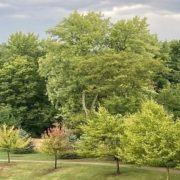
Feature photo: First Color in Iowa – Photo Credit Margaret Zacharias. Published with permission.

Inset photo: Autumn Rainbow to Heaven – Photo Credit Charles Zacharias.  Published with permission.


Notes

  1. https://www.barrmemorialchapel.com/obituary/4352175
  2. https://www.theemmaushouse.org/about-us
  3. https://www.census.gov/library/stories/2019/12/by-2030-all-baby-boomers-will-be-age-65-or-older.html
  4. Shorter Oxford English Dictionary, Fifth Edition, Volume I A-M, Oxford University Press, Great Clarendon Street, OX2 6DP, Published in the United States by Oxford University Press Inc, New York, 2002, p. 801.