Sacred Mysteries of the Rosary

Sacred Mysteries of the Rosary


The Joyful Mysteries

Not a man, this messenger announcing.

Not by man, but by God’s will, this opening.

You have been favored to be God’s mother.

So it will be, as I serve the Other.


Beautiful the feet, her journey complete.

God’s family with man; grains of new wheat.

Convey the Divine, bring forth His spirit.

Magnify and rejoice as you hear it.


Singular birth, most humble beginning.

A King in a manger, nothing stranger.

From above, afar, the fields, are coming;

Famished seekers, relieved of their hunger.


This truth can’t be known; it must be revealed;

Adored or rejected; thoughts unconcealed.

God, as a baby, our arms can enfold.

Piercing projected; such sorrow foretold.


“The son must obey the father,” He said.

Joyful reunion, such sorrowful dread;

“You see, I was at home. I was not lost.”

She ponders, says “Yes,” whatever the cost.


The Luminous Mysteries

Bathed in our sins and so bearing our cost.

Fulfilling by willing, saving the lost.

Present in sacrament, baptism first.

Trinity rising from water’s rebirth.


Now, Mother? Yes, time to let joy overflow.

Wedding and feasting, delights that will show.

You’ve come to bring joy, reveal His design.

Presence brings comfort, so share such as thine.


His Kingdom nears; the King appears.

Return from exile, cast off your stale fears.

Sown in seedlings, true harvest will ripen.

Remorse meets mercy, stony hearts open.


Please stop, I’m sorry to see this vision.

I don’t understand this fearful mission.

Fear not, I’m with you; I know what you need.

With time, you will see the new life I breed.


This bread is my body, for you given.

Forgive them again, seven times seven.

The cup is a promise, never broken.

Do as I do, you’ll not be forsaken.


The Sorrowful Mysteries

The consoling angel daubs beads of blood

As tears and sweat form into pools of mud.

Above their anguished groaning can be heard,

‘Be done to me according to your word.’


Beads and hooks arrayed along leather strips

Like birds of prey strike the flesh they assail.

How can it be that those wielding the whips

Are healed by this very one that they flail.


My pride and arrogance a mockery

Of you wearing that wicked crown for me.

Imitating your naked humbleness

Merits the cloak in which I hope to dress.


Too heavy, too great, too fearful for me.

Yet fear is tempered by pity for thee.

Who carries my guilt, pays my penalty

Through death on a cross to eternity.


Transfixed is my gaze, my hopes pinned on thee,

Hanging suspended on Calvary’s tree.

“I thirst,” you say, as you pour out your heart.

“Finished,” you say, creating a new start.


The Glorious Mysteries

Do dim tombs typically bloom with light?

Who once entombed wakes to a morning bright?

Do burial clothes often display their wearer?

Who bears wounds in a body now fairer?


Beyond sight to wider light, He rises.

Here now ever present, He surprises.

Beyond time to forever, He returns.

The path beyond history, He confirms.


Heavenly intruder in fire descends.

I am love; you shall love; love never ends.

God present for all, Church for a body.

Go tell it, go share it; for all, it’s free.


Bodies only went the way of all flesh,

From ashes to ashes until that day.

Lifted high for her maker to cherish.

She first, before all others, gone this way.


A Queen is in Heaven, mother love reigns.

Mercy, she offers, and prayer she explains.

Guide us through exile, in tears do we plead.

Return home, take shelter; hope will succeed.


copyright 2025 Tom Medlar

“Mary, Mother of Poets”

Mary, Mother of Poets


The poet is a cultural crime fighter,

A merchant of the timeless,

A calligrapher of gravestone inscriptions.


The poet wanders wasted lands, and

Ponders books of ancient lore.


The poet tosses runes skyward, and

Traces the descent of inscrutable phrases.


The poet leans into the cave of echoes,

Listening for words spoken before speech began.


Ancient poets are being found in melting glaciers,

Their names, long etched in ice,

Now melt into a crevasse of collective forgetfulness.


Yet, lo, the boldest poet is a banal figure, deaf and dumb,

Next to the singular lady who conversed with glorious Gabriel.

The chosen woman who bears

The body of God,

The scar of the sword,

And the mission of forgiving the crowd calling for the death of her son.


Her ever-silent, inwardly-listening husband heard

The dream-speech of divine messengers,

And used the sign language of lowered eyes, bent knees, and folded hands

To tell what he’d heard.


Happy the mother who magnifies the Lord,

Who rejoices in God the savior.


Happy are we to have a mother who hears the whispered dying wishes

Of the lowest and the highest.


Happy to have a blessed mother who shares

Her gravitational hearing,

Her galactic awareness,

Her celestial serenity and

The super nova intensity of her love.


Queen mother of Being,

Holy fountain of mercy.

Listening silently to each soul.

Every person’s prayer pondered in her eternal perspective.


© copyright 2025 Tom Medlar

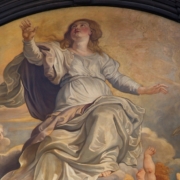
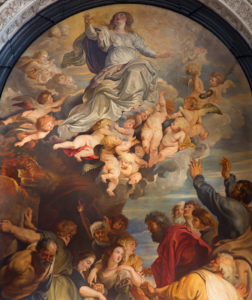
Antwerp – The Assumption of the Blessed Virgin Mary, a copy after Peter Paul Rubens (1613) in Lady Chapel in st. Charles Borromeo church on September 5, 2013 in Antwerp, Belgium

Rocky Times

Rocky Times

Taxi drivers shook their fists at each other as I stared out the tour bus window. Blaring horns assaulted my ears. Sunset turned to twilight, and still we sat motionless in Tel Aviv traffic gridlock.
My heart was breaking for my fellow travelers. Although I’d been looking forward to visiting the Carmelite monastery’s public areas for a second time, I’d already been blessed with indelible memories of a daylight Mass in the gardens, followed by a tour that included rooftop views of the fertile valleys below. (See https://www.catholicwritersguild.org/2023/06/mount-carmel/). For the passengers with me on this trip, their visit here was meant to be the pinnacle of a once-in-a-lifetime pilgrimage to the Holy Land. The bus driver’s scowl mirrored my own frustration, but only an air of resigned disappointment filled the bus.
By the time we had navigated a winding road to the top of Mount Carmel, full darkness had descended. The harried greeter who’d waited for us outside made humble apologies. Unfortunately, no tour would be possible. The brothers had already prayed Vespers, and the vowed community was cloistered for the night. But our host said he’d given the lay oblates permission to reopen the gift shop. This announcement immediately cheered the ladies. At least they could still bring rosaries to their loved ones back home. They trooped off together toward the few still-lighted windows, smiling.
Dominick, a public elementary school principal, quietly pulled his carryon suitcase from the bin above his seat and got off the bus behind them. I’d learned that in his traditional Italian neighborhood, parishioners had sacrificed for years to buy a small triangular lot adjacent to their
church. Dominick was building there, a shrine for Our Lady of Mount Carmel. I watched him engage our greeter in animated conversation.
The other pilgrims eventually returned, with full souvenir bags in hand. But where was Dominick? Finally, he appeared again at the bus door, grinning. A middle-aged but muscular man from a contractor family, Dominick did not seem daunted by the weight he now carried. He climbed right up the bus stairs, and raised his suitcase with both hands, in a victory stance, as soon as he reached the aisle.
“That brother was so kind. He took me all the way back to the mountain!” Dominick’s voice resonated through the bus without benefit of the microphone. “He said I could have as many rocks as I wanted! He found me a spade, and held the flashlight while I pried the stones
free.”
Whoops, whistles, and cheers from every seat greeted his enthusiastic news.

***

I found myself behind Dominick in the El Al security lines for our departure flight back to the United States. He patted his suitcase, and whispered with a wink. “Don’t worry. I’ve got them all right here.”
I heard the uniformed Israeli guards ask, as Dominick slowly wheeled his suitcase to the counter, “What’s in there? Rocks?”
Uh, oh, I thought, looking around. Is this even legal? Archeological artifacts, and all that? Where’s our guide!  Dominick just nodded. “Gifts for Our Lady’s new grotto, from our Holy Land pilgrimage,” he said. Seeing the stern looks on their faces, he hastened to assure them.
“Everyone gave me permission. Those monks at Mount Carmel were really helpful.” Dominick pulled a paper from his vest pocket. Apparently, he’d somehow managed to wangle a document from the Carmelite brother who’d assisted with the excavation. Dominick handed his paper to one of the security men.
The first guard examined it and showed it to his partner. Then he refolded it carefully, and gave it back to Dominick. These officials, who now appeared a bit bemused, heaved Dominick’s suitcase up to the metal counter themselves. After looking inside, they exchanged a humorous glance, and waved our hero through, with his suitcase, to the gate. As I placed my own tote on the counter, I couldn’t help wondering how Dominick could have fit in all the stones I’d seen him collect, at the shore of the Sea of Galilee, and other sacred sites we’d visited.

But from the glimpse I’d just garnered, they did look– tightly packed.

***

Dominick engraved each stone from the Holy Land with its place of origin. He mortared them in where they fit, like puzzle pieces, among larger local boulders. Pilgrimage memories endure in a curved rock wall that shelters the consecrated granite altar in the new grotto dedicated to Our Lady of Mount Carmel.
Today, Mass can be celebrated at the grotto as well as the church, often in both English and Spanish. The parish maintains its long and faithful tradition of Corpus Christi processions with the Blessed Sacrament, visiting and blessing individual family homes throughout the old neighborhood. The parish school pioneered for our diocese the first cohort in an optional Spanish immersion curriculum for grades K-8.
Dominick’s spirit of humility, simplicity, and faith lives on.

May we all be blessed this Lent with trust and grace to find joy in whatever God sends.


© Copyright 2025 Margaret King Zacharias

Feature photo by Margaret King Zacharias. Used with Permission.


My Proposal

My Proposal


Always one with the Divine dispatch
Never a thought for himself

Always a swift and selfless messenger
Never a pause to ponder his view

Now God asking to become a person
Never had this happened before

Great Gabriel approaching
This person
This question
This transition

God asking if this Mary might become His mother

Always he’d flown on the wings of the Lord
Never had he felt like a human, hesitant to be seen

Do not be afraid, Gabriel, for you have been chosen for this role

This is my proposal to her

Announce what I say to you

Gabriel turned and looked longer at Mary
He saw all that was pending
All heaven held its breath

I love God who wisely arranges all things
I love this Mary, so different from all other persons
I love Him who wants to be her son

Gabriel brightly and silently came before Mary.


copyright 2025 Tom Medlar

Survey Says: Mary, Powerhouse Intercessor!

Survey Says: Mary, Powerhouse Intercessor!

by Dennis Lambert

If we were playing Biblical Family Feud and the players were asked, “What was the greatest revelation of the Wedding at Cana?” my guess is that the number one answer would be a toss-up between two answers. It would be either that it is where Jesus performed his first miracle or that it was the beginning of his public ministry.

Now for the more serious Family Feud thrill seekers out there, what would take the next spot on the big Feud board? The answer to that is likely to be dependent on that player’s Christian affiliation. For myself, being Catholic, my response would be, “Mary the Intercessor.”

One thing I am certain of is that the role of Mary in our Christian faith is often misunderstood by Protestants, and also by many Catholics. Having spent a couple years in the non-denominational world, I can tell you that the number one misconception regarding Mary is that Catholics pray to Mary as we pray to God. (insert the Family Feud big Red X and obnoxious buzzer sound here!). It is, in fact, the story of Cana which demonstrates to the world one of Mary’s most treasured roles in our Christian faith.

Let’s take a look by putting ourselves into the story…

Now, wedding feasts during the time of Jesus were truly a celebration which lasted for days. So the party is in full swing when Mary, the intuitive mother she is, notices something is wrong.

Perhaps she notices the head waiter whispering something into the ear of the father of the bride and then sees a look of shock and dismay come across his face. Next, the father follows the head waiter into the kitchen, and Mary, who obviously knows the man, out of concern follows him to find out what has him so disheveled.

When Mary learns that he has run out of wine she immediately understands the social ramifications and embarrassment it would cause this man, his daughter the bride, and his family. You see, running short on wine at such a celebration would indeed been a major party foul and that error would have surely made that family the talk of the town for months to come, and not in a good way.

So I can envision Mary calmly talking to that father, telling him that everything is going to be all right, that she’s got it handled. Her next move is to her Son. She explains in detail what has happened, what was happening. After listening to his mother, Jesus says to her, “Women, how does your concern affect me? My hour has not yet come.” The reality is that back then, the term “Woman” was an endearing sign of affection. Using a little poetic license and placing myself into the scene, I can see Jesus’ response possibly coming off more like, “Mother, the woman I adore, it’s not my time quite yet. You understand, right?”  (And if I had more space in this article we could go into how biblical scholars describe this call of “Woman” by Jesus as his announcing of Mary as the new Eve.)

Now Mary’s response is interesting. Her eyes are on Jesus, listening to what he says one second, and then a split second later turning her head from her son to the server. Without saying a word to her son, she tells the server, “Do whatever he tells you.”  Now that’s authority! Now that’s a mother!

I can just imagine Jesus rolling his eyes after this, saying something like, “Ma, really?” But what does he do? He orders the servers to bring out six stone jars filled with water. According to the Gospel, that was between 120- and 180-gallons worth of water that Jesus then turns into wine!  In that instance, Jesus complies to his mother’s wishes, her “intentions.”

What this part of the story tells us, unequivocally, is that Mary indeed has the ear of her son and most importantly, that he listens to her.

And what are the implications for us? While they may be pretty clear to most, let me build up where I’m heading with this just a bit before I come out and state the obvious. Allow me ask a couple probing questions …

How many of you have ever prayed for someone else? How many been prayed for? My guess is that everyone reading this is saying an unequivocal “yes” to both questions. The fact that we all participate so fully in this thing we call prayer shows that there is something to it. That there is a real power to prayer. And if you’re like me, the holier the person you get to say a prayer on your behalf, the more efficacious we feel that prayer is going to be.

Which brings us back to Mary. The wedding feast at Cana introduces Mary as the best intercessor for our prayers. After all, whether a person is Catholic or Protestant, I’m confident we would all agree that no one who ever lived is holier than Mary. After all, God chose her to have his Son!

Clearly, as seen in the story of the Wedding at Cana, Jesus most especially listens to his mother! And this, my friends, is Mary’s role in our faith. We don’t pray to Mary as we pray to Jesus or the Father. Rather we ask her, as the holiest person who ever lived, to take our needs, our prayers, our intentions to the very foot of her son. For, as seen at Cana, Jesus most especially listens to his Mother!

So when you find yourself in need, be it one of the big things in life variety, or just a case of writer’s block you’re trying to clear away, may the forceful words of Steve Harvey ring within your ears, “Survey Says: Mary, Powerhouse Intercessor!”…. and then may you turn to our Champion of Cana and ask her for the gift of her influential prayers!

© Copyright 2025 by Dennis Lambert

Feature Photo by John Andrew Nolia Blazo: https://www.pexels.com/photo/painting-of-holy-mary-15111009/

Visitation

 “… Our birth is but a sleep and a forgetting:

The Soul that rises with us, our life’s Star,

Hath had elsewhere its setting,

And cometh from afar:

Not in entire forgetfulness,

And not in utter nakedness,

But trailing clouds of glory do we come

From God, who is our home:

Heaven lies about us in our infancy …


… The Clouds that gather round the setting sun

Do take a sober colouring from an eye

That hath kept watch o’er man’s mortality …”

William Wordsworth

Ode: Intimations of Immortality from

Recollections of Early Childhood (1)


Visitation

May is the month our church sets aside each year to honor the Blessed Virgin Mary. 

In 2024, May includes at least five significant liturgical celebrations:

  • Solemnity of the Ascension of the Lord, Thursday, May 9 (or Sunday, May 12);
  • Optional Memorial of Our Lady of Fatima, Monday, May 13;
  • Solemnity of Pentecost on May 19;
  • Memorial of the Blessed Virgin Mary, Mother of the Church, Monday, May 20;  
  • Feast of the Visitation of the Blessed Virgin Mary on Friday, May 31.

This month opens with the second Glorious Mystery of the Rosary, encompassing two additional Marian holy days as well as another Solemnity, the third Glorious Mystery, and concludes with the second Joyful Mystery — enough to make anyone’s head spin.

Decades ago, when our planet seemed safer and more civilized than it does today, I was blessed with opportunities to visit several Catholic shrines as a pilgrim.

It’s impossible to do justice to the full set of liturgical crescendos this month contains in a brief article for a first Saturday. But I offer a few reflections here about the opening solemnity and the closing feast from my pilgrimages to shrines in the Holy Land.

***

Christian Chapel of the Ascension on the Mount of Olives – Jerusalem, Israel
Fallaner, CC BY-SA 4.0 <https://creativecommons.org/licenses/by-sa/4.0>, via Wikimedia Commons


A small Christian monument called the Chapel of the Ascension stands on the Mount of Olives in Jerusalem, not to be confused with the larger mosque that looms nearby.

This probably does mark the place where Jesus proclaimed his majestic final commission to the apostles, the ‘go out into all the world’ speech we hear in the gospel reading for the Solemnity of the Ascension, Mark 16:15-20. (2)

But even though the chapel contains an ancient footprint in its rock floor that legend describes as made by Our Lord’s right foot when he departed, this holy place on the Mount of Olives may, or may not, be where Jesus actually ascended into heaven.

Some scholars, as well as many local Christians whose families have lived here for generations, believe the Ascension might have occurred elsewhere.

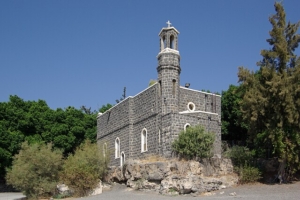
Church of the Primacy of Saint Peter – Tabgha, Israel
Berthold Werner, CC BY-SA 3.0 <https://creativecommons.org/licenses/by-sa/3.0>, via Wikimedia
Commons


Another possible location hosts the small Church of the Primacy of Peter, on the northwest banks of the Sea of Galilee, believed to be where Jesus fed his friends one last breakfast of freshly-caught fish, as described in John 21. (3)

That rocky shoreline is also visited by thousands of Christian pilgrims, both Catholic and Protestant. It’s an alternative place where some believe the Ascension might actually have taken place.

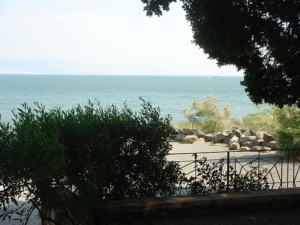
View of the Sea of Galilee – from the Church of the Primacy of Saint Peter, Tabgha, Israel
someone10x, CC BY 2.0 <https://creativecommons.org/licenses/by/2.0>, via Wikimedia Commons


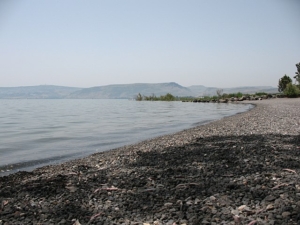
Shore beside the Church of the Primacy of Saint Peter – Tabgha, Galilee, Israel.
https://www.flickr.com/photos/emeryjl/, CC BY 2.0 <https://creativecommons.org/licenses/by/2.0>, via
Wikimedia Commons


Wherever it occurred, the description of the Ascension in Acts 1:6-12 (4) tells us that the gathered apostles received a visitation from ‘two men dressed in white,’ usually interpreted as angels.

These men appeared ‘suddenly,’ admonishing the disciples to stop looking ‘up at the sky,’ and promising that Jesus would ‘return the same way he departed.’

***

Two distinct Visitation shrines hold importance in the town of Ein Karem, once a small village in the Judean hills, now considered a ‘suburb’ of sprawling modern Jerusalem.

The first is the Church of St. John the Baptist, in downtown contemporary Ein Karem.

Courtyard and Entrance to Church of Saint John the Baptist, Ein Karem, Israel.
Chris06, CC BY-SA 4.0 <https://creativecommons.org/licenses/by-sa/4.0>, via Wikimedia Commons


By tradition dating back to Saint Helen, mother of the Byzantine emperor Constantine, and supported by archeological research through layers of Crusader construction, there is evidence to believe that John the Baptist was born in the now-underground cave on this site.

Birth Cave of Saint John the Baptist, Ein Karem, Israel
Pikiwiki Israel, CC BY 2.5 <https://creativecommons.org/licenses/by/2.5>, via Wikimedia Commons


A fountain in the courtyard appears to have been the original village water source, probably located on the temple property where Elizabeth’s husband Zacharias was serving as Jewish priest when an angel appeared to him to announce the news of his son. Their primary dwelling is believed to have been here, or very close by.

Higher into the foothills is a site traditionally identified as the family’s summer home, and many scholars believe that this would have been where young Mary went to visit her much older cousin.

A curving, terraced brick pathway with very wide steps winds around the steep mountain trail today, leading up from the main village to the Church of the Visitation.

This shrine is a much larger complex, a former monastery. In contrast to the lower church in Ein Karem, where John the Baptist’s family is highlighted, the Church of the Visitation contains imagery devoted almost exclusively to Mary.

Detail of Front Facade – Church of the Visitation – Ein Karem, Israel. Elizabeth is pictured at
upper left.
Berthold Werner, CC BY-SA 3.0 <https://creativecommons.org/licenses/by-sa/3.0>, via Wikimedia
Commons


The exception is a sculpture in strikingly contemporary style, portraying two pregnant women, facing each other.

***

Paradoxically, as liturgical time runs forward in May, divine time seems to spin backward, in earthly terms, to the moment when two unborn infants recognized each other from within their mothers’ wombs.

It was only after a very young woman — who had said “yes” to a divine act with consequences she could not possibly have fully understood — had received affirmation and confirmation from her wiser, more experienced cousin, that she burst into the Magnificat.

Sober sunset clouds will gather. One of these babies will be beheaded. One will die by crucifixion.

But these are the moments when Wordsworth’s “… eye that hath kept watch o’er man’s mortality …” is most deftly invoked by the poet.

Penance, Baptism, Resurrection, and Ascension will change the whole game.

“The ‘clouds of glory’ that these babies ‘trail’ contain Eternity for those who believe.”

May enduring faith, hope, and love guard your hearts this May.

Veni Sancte Spiritus.


Featured Photo: Panoramic View – Church of the Visitation – Ein Karem, Israel Attribution Tombah, CC0, via Wikimedia Commons

Notes:

  1. Quoted from https://www.poetryfoundation.org/poems/45536/ode-intimations-of-immortality-from-recollections-of-early-childhood.
  2. https://bible.usccb.org/bible/readings/050924-Ascension.cfm
  3. https://bible.usccb.org/bible/john/21
  4. https://bible.usccb.org/bible/acts/1

Stumble onto a Forgotten Priest’s Homilies, and Wind Up in a Successfully Reflective Lent

Ever feel like you’ve failed Lent? You enter the season ambitiously on Ash Wednesday, receiving the smudged cross on your forehead, determined to read through the New Testament or Exodus at a measured pace, only to get stuck on a confusing passage and give up … for now.

A local parish offers an evening Bible study, but when the day comes, you’re too exhausted from work. Maybe next week, you think, but then the six weeks go by and you’ve missed the whole thing. You try online reflections, but you just breeze through them over morning coffee. You chastise yourself for being undisciplined or for refusing to take your spiritual life seriously. But maybe you’re putting too much pressure on yourself. A more relaxed approach, such as leisurely readings by a forgotten, but once beloved priest could deepen your faith, self-reflection, and ultimately your relationship with God.

Fr. Ronald Knox is little known to 21st Century Americans in favor of other popular English converts such as St. John Henry Newman and GK Chesterton, but in his time, Fr. Knox was regarded as one of the most influential and prolific Catholics of the past century. He is a contemporary of Chesterton and an Oxford neighbor of CS Lewis, and February 17 marks the 136th anniversary of his birth. Raised in the Anglican tradition, even becoming an Anglican minister, the good father followed in his country’s stead, not because he believed it was the perfect way, but because he wanted to bring the Church of England back to Rome. When he realized his ambition was futile, he converted to Catholicism at the still tender age of 29.

Fr. Knox was much sought after as a speaker, preacher, and retreat facilitator for his way of bringing depth to simple concepts and simplicity to the profound. His self-deprecating humor, orthodox theology, and insight into the human condition found its way into countless published homilies, broadcasts on the BBC, and even detective novels. He is also highly respected for his English translation of the Bible, known as the Knox Bible.

One collection of his homilies that might elude a mainstream audience is his title, The Priestly Life. Originally published in 1958 and re-released in 2023 by Cluny Media, this compilation of 16 retreat talks addressed to priests could just as easily be called The Saintly Life because it speaks to the saintliness we are all called to live. With the wisdom of a compassionate confessor, Fr. Knox, who seems to know what’s inside the flawed heart that yearns to be whole, begins with the Alpha and Omega framed in Biblical history, then gently leads the reader (or listener, originally) to realize his sinful nature, bringing him to humility and repentance. Catholic theologian and author John Janaro quotes Evelyn Waugh’s in a 2021 essay, calling the priest and his ministry an “apostolate of laughter and the love of friends” (Janaro).

His chapters in The Priestly Life address so many of the “No, not me” sins: sloth, apathy, grumbling and complaining, blaming. In “Murmuring,” he engages the reader with a compelling story of the Israelites venting and complaining about Moses and God. You read along, nodding and chuckling, amazed how much they sound like your co-workers. He goes on to explain why the grumbling, a “very difficult sin to avoid,” is a three-fold sin against God, neighbor, and self and realize, “That’s me!” and feel an urgency to go to Confession.

“Part of the reason why God put you into the world was to exercise the patience of others by your defects; think of that sometimes when you are going to bed” (pg. 81).

He speaks to his brother priests in “Accidie” about a “tepidity” of spiritual life. “What I mind about is not so much that I seem to get so little out of my religion, but that I seem to put so little into it. Or perhaps I should put it this way: what I mind about is that I should mind so little” (pg. 90). He also addresses a type of malaise, of going through the motions. The scenarios sound much like ruts that most everyone, at some point and in honest moments, experiences in marriage, work, and life in general. “All of the savour has gone out of his priesthood; he sometimes thinks, even out of his religion. Was he, perhaps, not meant to be a priest … is it possible that he has made a mistake?” (pg. 89).

Fr. Knox, in other chapters, addresses perseverance, death and obedience. In his piece on the Blessed Mother, he eschews “Mariology” and sounds more like a loyal knight honoring his heroine queen. While each chapter serves as retreat on its own, they also impart an appreciation into a priest’s very human life by which we might gain more compassion and understanding of a demanding and sacrificial choice, Wouldn’t that help make a successful Lent?


Copyright 2024 Mary McWilliams

Knox, Ronald. The Priestly Life. 2023. Cluny Media. Providence, Rhode Island.
Janaro, John. Monsignor Ronald Knox. 2021. Magnificat. Catholic Education Resource Center.
Photo Credits: Keegan Houser and Eduardo Braga

Everyday Holiness

Everyday Holiness

When I received the news that my first published short story had not only been accepted, but also chosen as the opening gambit for a travel writing anthology that included pieces by several well-known authors, my first thought was, “I have to call Mom and tell her I got the lead. She’ll be so excited.”  And then I remembered.

The woman who nurtured my first crayon scribbles, and typed my long-procrastinated school term papers on an old manual typewriter, had already been absent for fifteen years by then. Even now, thirty-four years after her death, I still get the same urge to call and tell her, whenever there’s happy family news.

Anyone who has ever lost a beloved family member, or cherished friend, understands.

This past week we’ve celebrated two special liturgies that traditionally open the month of November. They encourage us to honor all the saints in heaven, and to remember our beloved dead.

The Roman Catholic liturgical calendar gives a rhythm to our lives, alternating ordinary days with special feasts and dramatic seasons: Advent, Christmas, Lent, Easter and Pentecost.

But we don’t just remember our lost loved ones on the Solemnity of All Saints or at a Commemoration of all the Faithful Departed.

The simplest things can suddenly trigger a memory: the smell of a favorite family meal simmering in the kitchen; a glimpse of the lamp burning late into the night while a parent stays up late to pay bills; a toddler’s smile greeting us in the morning over a crib rail; the precious small gift from a thoughtful friend who somehow always knew just what we needed, and when.

Amidst many speeches that marked my oldest son’s baccalaureate ceremonies, the university dean who spoke at his academic awards assembly made a particular point for the new graduates. His words held a wisdom that has remained with me.

“It’s not this ceremony that’s important,” he said. “Or that splendid certificate that you’re about to receive. We’re celebrating all the mornings over the past four years that you got out of bed and went to class, all the nights you studied in the library instead of partying, all the papers you wrote with extra care, everything you did that led up to this day. Yes, today you’ll be ascending the stage, you’ll hear lots of applause, and your families are gathered here to celebrate with you. But it’s those ordinary days, the good choices you made one after another, the habits you established, that are your most important awards. They’re what you’ll take with you wherever you go for the rest of your lives.” (1)

In our Mass readings this weekend both liturgies contrast humility and charity with arrogance and entitlement.

Today’s Memorial of St. Charles Borromeo incorporates an Alleluia verse that is also used to celebrate the Solemnity of the Most Sacred Heart of Jesus:

“Take my yoke upon you and learn from me, For I am meek and humble of heart.” Matthew 11:29ab. (2)

In the Gospel reading, our Lord advises us “. . . do not recline at table in the place of honor . . . when you are invited, go and take the lowest place . . .” Luke 14:1, 7-11. (3)

Readings for the Thirty-first Sunday in Ordinary Time contrast a mother’s affectionate care and a child’s implicit trust, in the Responsorial Psalm 131: 1,2,3, with Our Lord’s condemnation of arrogant scribes and Pharisees, in the Gospel from Matthew 23: 1-12. (4)

St. Charles Cares for the Plague Victims of Milan by Jacob Jordaens (1593-1678), St. James Church, Antwerp, Belgium, public domain via Wikimedia Commons

St. Charles Borromeo was born in a castle on the shores of Lake Maggiore. His father was a Count of Lombardy whose aristocratic family’s shield bore the motto, “humilitas.”

His mother was Margherita de Medici, whose younger brother became Pope Pius IV. (5).

The paintings featured here commemorate St. Charles Borromeo’s assistance to the poor during a famine in Milan; and his refusal to leave the city after an outbreak of the plague. He remained behind in his own episcopal see while many other bishops and clergy fled. He stayed to pray for his people as their archbishop, and administered the sacraments to plague victims.

Even while he was serving as a papal representative to the Council of Trent, and performing as a leading figure in the Counter-Reformation, St. Charles Borromeo never forgot his family motto, humility; or the Jesus who washed his own apostles’ filthy feet.

Both of these paintings, and many more found in museums and churches across Europe (6), document St. Charles Borromeo’s devotion to the humble Virgin Mary. Her vivid presence in so many of his portraits reveals the close relationship they shared in his charitable work, in his intercession for the people of Milan, and in his dedication to the universal Church.

This November — while we’re preparing for Thanksgiving and the Solemnity of Jesus Christ, King of the Universe — may we, too, remember to practice the extraordinary virtues of ordinary everyday holiness.

©Copyright 2023 by Margaret King Zacharias

Feature Photo: Intercession of Charles Borromeo Supported by the Virgin Mary by Johann Michael Rottmayr (1656-1730) in the collection of Karlskirche, Vienna Austria, public domain, via Wikimedia Commons

Notes:

  1. Personal communication.
  2. (https://bible.usccb.org/bible/readings/110423.cfm).
  3. (https://bible.usccb.org/bible/readings/110423.cfm).
  4. (https://bible.usccb.org/bible/readings/110523.cfm).
  5. (https://www.newadvent.org/cathen/03619a.htm)
  6. (https://www.christianiconography.info/charlesBorromeo.html).


What is the Rosary?

What is the Rosary?

October is the Month of the Rosary, and many authors have already written insightful and inspiring articles explaining and promoting it. We know the rosary is a tremendous tool, and that it also has many positive physiological benefits besides the more obvious spiritual ones.

But this October, I thought I’d try my hand at something a little different, namely a poem about the rosary.  Here it is, in three short verses.


What is the Rosary?

A rosary’s a ladder;

It goes up and down.

Connects us to Heaven,


Through Mary, on the ground.

Through the life of our Lord,

We travel anew.

By His death, we’re forgiven;

The covenant renewed.


By the work of the Church,

We two are made one.

Now our prayers are hers,

‘till God’s kingdom comes.


© Copyright 2023 by Sarah Pedrozo

Featured Image: iStock-Mary-statue-in-blue-with-rosary-formatted.jpg

A Beacon of Hope

A Beacon of Hope


And I say to thee: That thou art Peter; and upon this rock I will build my church, and the gates of hell shall not prevail against it.”

Matthew 16:18 (Douay-Rheims 1899 American Edition Imprimatur)

The idyllic seaside town of Lahaina on the island of Maui disappeared on August 8, 2023. 

An early morning brush fire, believed extinguished, suddenly erupted into a towering inferno that evening.

Fueled by hurricane winds, the wildfire roared down tinderbox slopes of the West Maui Mountains at more than a mile a minute (1), consuming eons of human history, dislocating thousands of people, and incinerating hundreds of human lives.

When the smoke cleared and helicopters were able to fly over the devastated site where Lahaina once stood, a lone white church spire still rose above the blackened rubble. Maria Lanakila Catholic Church stood alone, the only surviving structure for many blocks, and appeared undamaged.

Maria Lanakila means Our Lady of Victory in the Hawaiian language. It’s one of Most Reverend Larry Silva’s “cathedral churches” in the Diocese of Honolulu, which encompasses all of the islands of Hawaii (2).

Late in the evening on August 12, Bishop Silva flew to Maui. He toured the ruins on August 13, and celebrated a mass for the victims at Sacred Heart Chapel in Kapalua, about nine miles north of Lahaina (3).

“[Bishop Silva] …reported that the pastor, Father Kuriakose Nadooparambil, a priest of the Missionaries of Faith congregation, ‘was allowed to go in (to the church) with a police escort, and he reported that not even the flowers in the church were wilted or singed. There was only a covering of ash on the pews.'” (4)

Church officials acknowledge that there may be hidden structural damage that remains unknown until a full engineering inspection can take place. (5)

Bishop Silva also told Hawaii Catholic Herald that‘One of my friends, who often serves as my liturgical master of ceremonies when I am on Maui, told me that his uncle, uncle’s wife, their daughter and their grandson all were burned to death in their car, while they were trying to escape. My friend and his wife opened their home to other relatives who lost their home and suspects they will be living there for a couple of years.'”(6).

I also have close friendships in West Maui, nurtured through almost ten years of participation in the Maui Writers Foundation, and many family time-share vacations less than four miles from Lahaina.

I spent the first forty-eight hours frantically trying to reach my granddaughter’s hula teacher. She was dancing a starring role at Old Lahaina Luau late into the night, when we saw her last a few months ago. She got up early each morning to gather plumeria blossoms, and patiently teach a five-year-old girl authentic Hawaiian culture.

I finally received a text that with a new infant growing in her womb, she had managed to escape with her parents, her husband and her adolescent daughter. “It just happened so fast,” she said. They had traveled back roads to reach refuge with cousins on the south side of the island. They had lost everything they owned.

My husband and I worried for weeks about a couple who are also long-time friends. Their names kept appearing on ever-shorter lists of those “unaccounted for.” Their names were still there just two days ago and I was losing hope, when I received an email from them recounting how they had lost their business and had learned that their insurance will not cover any of their damages. But at least they’re still alive.

This morning, as I began to write this post, I received news that my treasured concierge, who had connected me with so many wonderful Lahaina people for almost 20 years, had been found by her brother, deceased in their Lahaina childhood home.

Their cousins, who also survived, had stopped by in the midst of the fire to hurry her along. She just wanted to run back into the house one more time, and said she’d be right behind them (7).

Where is Maria Lanakila in all of this? Who is Our Lady of Victory?

This was the sixteenth honorary title bestowed on Mary by a supreme pontiff or an ecumenical council. Declared by Pope Saint Pius V to commemorate the allied Christian victory over Ottoman Turks at Lepanto on October 7, 1571, the title reflects the success of a massive rosary prayer campaign (8).

Pope Gregory XIII changed the name of the October 7 liturgical celebration to Feast of the Holy Rosary in 1573 (9). That is the Marian mass we continue to celebrate, four-hundred-and-fifty years later.

We can offer our rosaries in days ahead to help the people of Lahaina.

Maria Lanakila, Our Lady of Victory, pray for us. Please succor the suffering souls of the victims, and comfort the sorrowful survivors of the Lahaina fires. May they all find hope, and strength for the future, through your motherly care.

Amen.


©Copyright 2023 by Margaret King Zacharias

Featured Image: Joel Bradshaw, Public domain, via Wikimedia Commons
Inset image: Howcheng, CC BY-SA 3.0 <https://creativecommons.org/licenses/by-sa/3.0>, via Wikimedia Commons
Notes:
  1. Official “gale force” windspeed of 67 mph at the time of Lahaina fire is documented here: https://www.nbcnews.com/science/science-news/drought-wind-mauis-wildfires-turned-historic-tragedy-rcna99196# and here: https://www.reuters.com/graphics/HAWAII-WILDFIRES/DRIVERS/gdvzwwgwrpw/
  2. https://en.wikipedia.org/wiki/List_of_parishes_of_the_Roman_Catholic_Diocese_of_Honolulu
  3. https://thedialog.org/national-news/maria-lanakila-catholic-church-survives-maui-wildfire-not-even-the-flowers-in-the-church-were-wilted-or-singed/ quoting Hawaii Catholic Herald
  4. https://www.thebostonpilot.com/article.php?ID=195341 and https://thedialog.org/national-news/maria-lanakila-catholic-church-survives-maui-wildfire-not-even-the-flowers-in-the-church-were-wilted-or-singed/ quoting Hawaii Catholic Herald
  5. https://www.staradvertiser.com/2023/08/11/hawaii-news/maria-lanakila-still-stands-but-waiola-church-is-gone/
  6. https://thedialog.org/national-news/maria-lanakila-catholic-church-survives-maui-wildfire-not-even-the-flowers-in-the-church-were-wilted-or-singed/ quoting Hawaii Catholic Herald
  7. https://www.staradvertiser.com/2023/08/25/hawaii-news/latest-lahaina-fire-victims-on-official-list-include-boy-7/am
  8. https://www.canticanova.com/articles/ot/artba1.htm
  9. https://en.wikipedia.org/wiki/Our_Lady_of_the_Rosary