
A Rainy-Day Remedy for the Soul

My kids have the flu, and I think I do too. It’s exhausting caring for sick children while feeling sick yourself. Yesterday was the first day of the spring semester back at the university where I adjunct teach. I wanted to call out, my body needed rest, and my kids needed a mother’s TLC. But since it was the first day of school, I didn’t want to set a bad example by calling out on day one, so I mustered what I had and showed up anyway.

My high school daughter took one for the team and stayed home to help watch the younger kids while I went to work. By the end of the day, she wasn’t feeling well either, and the house was a disaster. I don’t know if I made the right choice because after a full day at work, I came home exhausted. I got into bed and didn’t have the energy to get up and keep up with the Tylenol, Motrin, and cough medicine doses. Instead, my four-year-old son came to my bed with his silly blue plastic toy glasses, a doctor kit, and a jar of Flintstones vitamins to make me better. I didn’t even ask how he got them in the first place, yet I dreadfully knew, it involved climbing on top of the cabinet.

I find myself wishing for a retreat. A writing retreat. A spiritual retreat. Time away to rest, pray, and be alone. I think about Jesus. I wonder how He found the energy to speak to crowds, day after day. Did His voice grow hoarse? Did He feel tired and weary?

We know He sought solitude. We know He withdrew to pray, to the desert, to the sea, to quiet places away from the crowds. We know He also spent time with friends who restored Him, like Mary, Martha, and Lazarus.

Even wishing for a retreat shows how far I have to remove myself from my life and responsibilities to get rest. I don’t make rest part of my lifestyle, even on Sundays. The Sabbath is supposed to be part of our Christian way of living. And yet, who truly unplugs? Who really stops? On any given Sunday, you’ll find me doing laundry for the week, finally tackling the dishes, decluttering the house, grocery shopping, catching up on everything I didn’t get to during the week.

There are weekend things that lift my spirit: attending Mass, going to the library, and taking a walk. I used to volunteer at a Respect Life center and at a horse rescue ranch. I realize now that volunteering felt easier than resting because I was still doing something. It’s actually doing nothing that I need to work on.

So, what’s the problem? Why is rest so hard?

We feel guilty lying down when work remains undone. Doing nothing feels irresponsible, especially for mothers. Lying sick in bed reminds me of O. Henry’s short story, The Last Leaf. Johnsy is sick with pneumonia and convinced she will die, when the last leaf falls from the vine outside her window. Her friends come together to care for and encourage her, but Johnsy has already given up. She has decided that her life no longer has value. Could it be from her bedridden state? Does she feel useless, a burden to her friends?

An old artist named Behrman paints a leaf on the wall during a storm, which ultimately costs him his life. Johnsy never sees the sacrifice. She only sees the leaf that made it through the storm. That quiet sign of beauty and resilience restores her will to live.

Behrman’s sacrificial act is Christlike. His final masterpiece teaches Johnsy that the world around us is a gift from God, that we should seek the meaning of life in the beauty God gives us. He restores us with flowers, birds, a breeze, and love.

Today, my kids are in the living room watching Disney shows while I rest in bed. It’s raining outside. The house is a mess. The dishes need to be done. And yet, because we’re all sick, I’ve given myself permission to stop.

That’s the part that unsettles me.

Why does it take being incapacitated for me to rest? 

I still have far to go in trusting God with unfinished work, sick children, and a life that doesn’t always look productive. For now, I’ll accept this rainy day as a small gift from God, a remedy for my soul.

copyright 2026 Janet Tamez

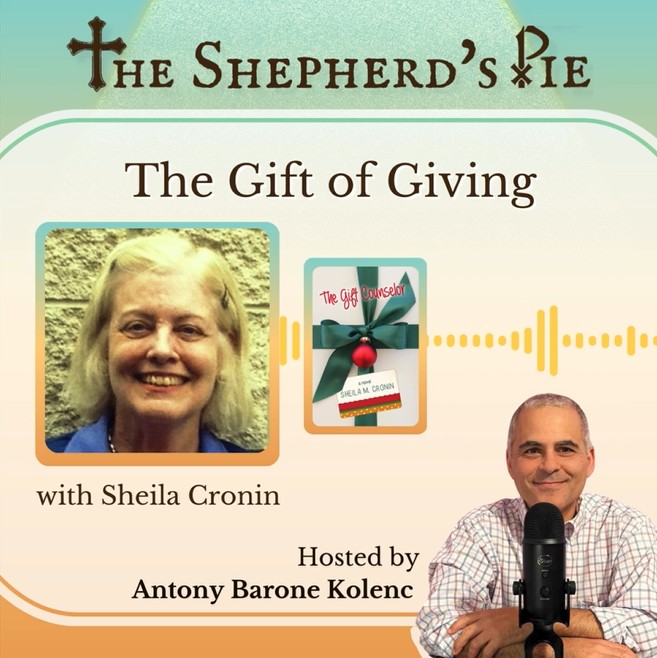
The Shepherd’s Pie: The Gift of Giving

The Shepherd’s Pie: The Gift of Giving

“A slice of hope to raise faithful kids.”

This uplifting, ecumenical show uses engaging conversations and fun entertainment reviews to offer positive insights and media resources for families and youth leaders. We discuss current issues that impact young people at home, in school, and in the world today.

In this episode of The Shepherd’s Pie, Antony Barone Kolenc speaks with Sheila Cronin about the importance of giving gifts, especially during
the upcoming holiday season, and we discuss her novel, The Gift Counselor.


Check out other episodes of The Shepherd’s Pie.


Copyright 2025 Antony Barone Kolenc

Caleb, A Shepherd of Bethlehem

Caleb brushed aside the dust with his fingers and, leaning closer to the stone, blew away more particles. Joseph handed him the smallest chisel, and Caleb gently hammered in the fine lettering to finish the inscription on the stone lintel above the door of the house.

Stepping down from the ladder, Caleb collected the tools and joked with Joseph about the likelihood that the high priest might not pay them for the job. One more day of work in the holy city of Jerusalem and then they would travel home with others, to Nazareth for Joseph, and Bethlehem for Caleb.

For twelve years now Caleb had worked with Joseph, first as his apprentice, and then as a friend and fellow craftsman. Caleb often reflected on the extraordinary night twelve years ago when he had first met Joseph:

the night Mary had given birth to Jesus,

the night Caleb had been working in the hills of Bethlehem as a shepherd,

the night that was his 13th birthday,

the night when heaven showed its face and Caleb and the other shepherds had heard the voices of angels,

the night they had come to the cave to see the child the angels said would be found in the manger,

that singular night when Caleb became a man, a new man, a man of God.

Joseph had taught Caleb carpentry, and masonry, and stone carving. He also taught him to pray, to work as a form of prayer, and to read, so that Caleb might read the holy scriptures.

Joseph had also taught Caleb to listen:

to the wind,

to meanings underneath the voices of men,

to the silent stirrings of his heart,

to the messages of God that come in unexpected ways.

Caleb had traveled with Joseph, Mary and Jesus and other villagers to Jerusalem, to festivals, to job sites, and to the hills for rest and quiet. He had also continued his work as a shepherd, to be close to his father and his friends. He sheared the sheep and brought the wool to Mary. She wove wool and linen into marvelous creations.

“What will you weave next, Mary?” Caleb asked.

“Oh, I’m thinking of some things for Jesus now, and for later,” she answered.

Caleb later taught Jesus many of the skills he had learned from Joseph, when he and Jesus started to work on jobs together. Jesus was now the age that Caleb had been when he first met him. Caleb, and then Jesus, took on new apprentices to train as the years progressed.

Caleb owned a grotto next to his home in Bethlehem. Inside the cave he had carved a burial tomb for Joseph, and he chiseled a small prayer on the stone that covered the narrow opening, showing it to Mary, before Jesus and Caleb carefully laid Joseph down for his rest.

When Jesus began his public ministry, Mary and a group of other women would sometimes travel with them. Caleb occasionally would travel from Bethlehem to Nazareth to watch over Mary’s home when she was away.

Mary had woven an ingenious tunic for Jesus that seamlessly wove about him and adapted to various kinds of wear. Caleb had been perplexed, though, by a piece of linen she created that was roughly 14 feet long, and more than 3 feet wide. He knew that it was something special, so he built a cedar box in which Mary carefully folded the cloth.

One day when he was alone at her home while Mary was away with Jesus and the others, Caleb opened the cedar box and stared at the mysterious cloth. Placing his hands on the cloth, he prayed that somehow God would give a glimpse of Himself through that cloth, so that others might have a glimpse of heaven, just as Caleb had on a hillside of Bethlehem on a cold and silent night so long ago.


copyright 2025 Tom Medlar

The Shepherd’s Pie: History and Christ’s Life

The Shepherd’s Pie: History and Christ’s Life

“A slice of hope to raise faithful kids.”

This uplifting, ecumenical show uses engaging conversations and fun entertainment reviews to offer positive insights and media resources for families and youth leaders. We discuss current issues that impact young people at home, in school, and in the world today.

In this episode of The Shepherd’s Pie, Antony Barone Kolenc speaks with Bill Kassel about the life of Christ as seen through the eyes of his family, and we discuss his historical fiction novel, My Brother’s Keeper.


Check out other episodes of The Shepherd’s Pie.


Copyright 2025 Antony Barone Kolenc

A Playground and a Carnival

A Playground and a Carnival


Violence affects everyone.  Love is the way to help our brothers and sisters affected.

I was raised in California to two middle class parents. I had a good childhood except for the playground. I would get up in the morning with a sick stomach. My father and mother would greet me cheerfully and bring me the breakfast they had made.

“Ok it’s time for school,” they would say optimistically. They knew I dreaded school but they did not know why. During their childhoods, playgrounds were made safe with playground monitors who didn’t tolerate nonsense.

There were three rules to the playground:

-Dress and act like everyone else.

-Don’t be too smart or too dumb.

-Don’t ever draw attention to yourself.

Those who did not follow the rules were going to see bullying and harassment.

One time there was a new boy who came. He didn’t obey the rules. He had on foreign clothes and had an accent. He drew plenty of attention.

I remember one day in particular in June as classes were getting out, he was being harassed. The children pulled out some of his hair and tore his clothes. Then they dragged him to the sandbox and buried him. They thought they could dig him up but he was dead.  I still remember it as if it were yesterday. I didn’t say anything to help him.

Today I am going into my office at the toy company I work at. We don’t seem to get anywhere with our products. Today is another product idea presentation. It is Lydia again and the bosses hate her. There are many reasons. She dresses sloppy and her shirt is buttoned eschew.  Sometimes she wears two different shoes. She is a genius and gets her work done early in the day. The rest of the time, she stares into the ceiling.

Her idea is to have balls that bounce up and down on the ceiling.  They will be multicolored balls: red, orange, yellow, and green. She can see them in her mind’s eye bouncing around.

The bosses say that will never work.

Her next idea was a system of arms and legs that danced with you. You could tune it to many different styles of dancing including waltz, disco, salsa, two step.

She tries it on and it dances her around to the tune of “You Should be Dancing” by the Bee Gees. It looks silly but she is laughing while she is dancing and moving all over the floor of the office. People are looking her way. Some of them look intrigued. Then the three people who like her the least are jealous. They start laughing at her and messing up her steps. I feel nervous and nauseated. The flashback comes of the boy I didn’t save. I am getting angry at the bullies. The world is swirling around me.

I glance at Bryan the ex-Marine. He too is struggling. He is thinking of the battles with the enemy and he’s clenching his fist.

I look at my friend Ming and she shakes her head at me. Violence is not the answer.

I remember the words of the great man, Rev. Dr. Martin Luther King, Jr.: “Darkness cannot drive out darkness, only light can do that. Hate cannot drive out hate, only love can do that.”

Then Sonia speaks up.  “I like it!” she exclaims. I want to try it!  She gets it and makes it play “La Vida es un Carnaval” by Celia Cruz.

“Anyone that thinks that life is unfair

They really need to know it’s not like that

Life is a beautiful thing, we have to live it

Anyone that thinks they are alone and that it’s wrong

They really need to know it’s not like that

In this life there’s no one alone, there’s always Someone

You see, life is a carnival, and singing though it is lovely

You see, life is a carnival, and those sorrows disappear singing

You see, life is a carnival, and singing though it is lovely

You see, life is a carnival, and those sorrows disappear singing”

— La Vida es un Carnaval*

© Copyright 2025 by Cecile Bianco

*Daniel, V. (1998). La vida es un carnaval [Recorded by Celia Cruz]. On Mi vida es cantar [CD]. N.Y., N.Y., United States: RMM Records.

Translation of “La vida es un carnaval” found on https://www.letras.com/celia-cruz/9256/english.html#google_vignette

Ferris Wheel Image by Image by Harut Movsisyan https://pixabay.com

People dancing Photo by RDNE Stock project: https://www.pexels.com/photo/group-of-people-smiling-and-dancing-6173868/

The Shepherd’s Pie: Forgiving Ourselves

The Shepherd’s Pie: Forgiving Ourselves

“A slice of hope to raise faithful kids.”

This uplifting, ecumenical show uses engaging conversations and fun entertainment reviews to offer positive insights and media resources for families and youth leaders. We discuss current issues that impact young people at home, in school, and in the world today.

In this episode of The Shepherd’s Pie, Antony Barone Kolenc speaks with Doralyn Moore about the importance of learning to forgive ourselves to progress in our own faith journeys, and we discuss her novel, Caused to Triumph.


Check out other episodes of The Shepherd’s Pie.


null


Copyright 2025 Antony Barone Kolenc

Book Review: A new Catholic Chapter Book Series

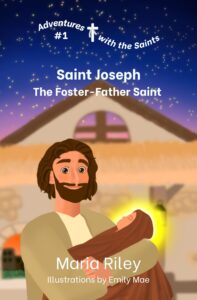
Saint Joseph, The Foster-Father Saint, is the first in the Adventures with the Saints Series. Maria Riley takes the young reader on a journey into God’s word. Using honest and factual situational instances, Maria eloquently describes the foster care process through adoption. Throughout the story, the genuine love of family is highlighted between Joshua, the foster child, and his soon-to-be forever family. How Maria guides the young reader into this family is endearing and easily understood, appealing to a third-grade reading level.

Aside from the feelings of comfort Joshua receives once he joins this family in foster care are gems of inspiration and events which educate and enhance the knowledge of God and His love.  Valuable lessons are woven throughout each chapter, which benefits not only Joshua but also his new siblings. These instances are portrayed in adventurous ways and have a powerful effect.

Many aspects of family life during the adoption process are depicted honestly and give the reader a look into the child’s heart. This is likely due to Maria’s deep love for all her children, even though they didn’t come to her the same way.  Maria and her husband were foster parents and adopted three of her four daughters through foster care.

“You are a gift from God, and I thank God every day for giving me the precious gift of you.”

As the “adventure” unfolds, Maria brings the reader into the biblical story just after the birth of Jesus. It is in this endearing moment when the importance of God’s love for all His children is brought to the forefront. The many educational opportunities within this story are perfect for the intended reading level and beyond. As an adult, reading the story with child-like faith brought me deeper into the loving relationship between St. Joseph and baby Jesus.

The effects the adventure has on the three children differ depending on their ages, and this compares wonderfully to how God’s word affects us all in different ways.  As a mom of three adult children, being reminded that my children are not only mine but belong to God was eye-opening. Children may outgrow the parent/child relationship; however, when a child is brought up in the love of God, spiritual growth is never-ending. This valuable lesson for parents is hidden within the creativity of Maria’s writing.

My favorite parent moment happens in the last chapter when Molly, their mom, enters the scene after the children have expressed their feelings to one another. Upon listening to the children honestly express what they had been up to that afternoon, Molly does not discount any of it. Instead, she responds with excitement, joy, and genuine interest in hearing about their conversations with the beloved saint.

As the first in the series, Saint Joseph, The Foster-Father Saint, is a blessing for all families, not only those involved in foster care!  St. Joseph, The Foster-Father Saint, releases in November 2022, with more series installments in a few months. 

You can purchase the book on Amazon or at MariaRileyAuthor.com.

Taking A Trip Down Memory Lane

Taking A Trip Down Memory Lane

Memories can be happy, sad, or very painful. They can also be nostalgic. Old books, toys, and movies trigger certain memories.

A happy memory

The Fellowship of The Ring 2001 film came out when I was thirteen years old. Fans of J.R.R. Tolkien’s original book trilogy swarmed the theaters. Stores sold collectable items with pictures of the characters on top of the packages.

I remember another time when my sister read the first book out loud to my family while we were riding in the car. I was eleven years old at the time. Back then I did not understand who Bilbo was or why the ring was evil.

The first movie certainly made me curious about Bilbo, Frodo, and Sam. It also made me a Lord of The Rings fanatic! Like the rest of the fans, I watched the other two films and gobbled up the plot.

I cheered for Sam when he carried Frodo on his back in The Return of The King. His famous line “I know I cannot carry it for you, but I can carry you,” was very emotional.

Carrying each other’s burdens

Sam’s response in The Return of The King reminded me that we often need to carry each other’s burdens. We need to set a good example for our friends and family members in both the good times and the hard times.

Praying for friends, neighbors, and family members, along with little acts of kindness, can go a long way. We won’t always see in this life how our actions affected them. Sometimes only God knows.

Last thought for the road

The Lord of The Rings movie and book trilogy had a huge impact on my life. They helped me to admire the author. J.R.R. Tolkien. At the time, I didn’t know that he was Catholic. I found that out later. I was not a Catholic when I was a teenager, but little by little, God used things like these books and films to inspire me to think more about Catholicism and the Catholic Faith.

“The Road goes ever on and on

down from the door where it began”

(Tolkien, 1955).

This well-known little song from The Fellowship of The Ring reminds us that if we are open, God will lead us into situations that surprise us. Sometimes our actions might be a little bit like Bilbo’s. We want to remain at home, quiet and hidden from the world. Sometimes we end up in completely different circumstances.

Are you willing to take a long step out of your hobbit hole?


article by Angela Lano, copyright 10-13-2022
image by Pexels from Pixabay, free for commercial use

Three Different Types of Editing (and why the title “Editor” is confusing!)


“I sent it to an editor and it came back with so many errors!” 

“My beta readers said I really need an editor, but I had it proofread,
so I don’t understand what they mean!”

“My manuscript is completely finished and now
I just have to get it into the hands of an editor who will publish it!”


Maybe you’ve heard writer-friends say things like the above? If you’re thinking that it sounds like these hypothetical authors all have different concepts of what an
editor is and does, you’re spot on, and if you are new to writing and publishing, it can be very confusing! Before I started working at a literary agency, I worked for an editing and design company, helping authors take the necessary steps to self-publish or find a publisher for their books. I received emails all day long from people who needed help sorting through their editing options.

I’m going to outline the primary types of editing for you below, but if you’d rather listen to me speak on this subject than read about it, you can also find a loose reproduction of the text here on my YouTube channel, The Book Barr.

THREE TYPES OF EDITING

  1.       Developmental Editing

Most manuscripts need to start here. Developmental editing can be formally done by an industry professional or informally by a critique group or beta readers. This type of editing looks at the big picture — plotting, organization, pacing, dialogue, character development, worldbuilding, etc.

Both fiction and non-fiction authors need developmental work, and they need it long before they are ready to move on to the other types of editing that focus on more minute details like spelling and grammar. So much can change in a manuscript during developmental editing! The goal is to take a step back and look at the work as objectively as possible to increase readability and maximize impact.

People often assume that when you “hire an editor,” you’ll get both high and low-level help, but commonly, you’ll find editors gifted in one or the other, but not both, types of editing. Most of us are either concept people or detail people, right-brain or left-brain thinkers, highly creative or highly meticulous. Editors are no different. I’m sure you can think through the wide range of personalities and giftings God has given us and see why some people are going to lean more toward proficiency in developmental editing than what comes next, which is…

  1.       Line Editing

This kind of editing is also sometimes called copyediting, though there are subtle differences between the two. Because these terms are used interchangeably, it’s very important to determine what exactly you’re paying for when you hire any editor.

Line editing looks at grammar and syntax, line-by-line. A line editor looks at each word used and whether it conveys the intended meaning, is redundant, or sometimes even whether or not it’s offensive or archaic. A line editor may make suggestions about the paragraph-level organization, but not usually on issues that span the whole chapter or manuscript.

If a line-level editor makes a distinction between line editing and copyediting, what they usually mean is that copyediting is where very specific mechanical rules are examined. This is especially important in non-fiction when academic style guides like MLA or the Chicago Manual of Style are used. Fiction authors have a lot more leeway, and a line editor will be the one to make sure house-style (the preferences of a particular publishing house) is followed and grammar rules are consistent—whether or not to use an Oxford comma, for instance. (The answer is yes, by the way.)

  1.       Proofreading

Proofreading is the very last (and usually the cheapest) step. A manuscript should be as “done” as an author can get it before it goes to proofreading. Proofreaders look for misspellings, repeated words, missing words, incorrect punctuation, and other things that are easy to pass over when you’ve read something many times.

Proofreading is not the discount version of line editing. Proofreaders can get justifiably frustrated when they are paid a lower rate to clean up a very messy manuscript. Most of us in this industry love words, and no one wants to see a book go out into the world unpolished. So be kind and hire the right kind of editor to ensure they are getting paid to do the job they signed up for.

PUBLISHING HOUSE EDITORS, BETA READERS, AND BEYOND

To further add to the confusion, the primary contact for authors at a publishing house is also called an Editor. These are not freelancers that you hire, though they may be talented as developmental or line editors and may even do some of that work on the side. These Editors are the professionals who see books through from acquisition to publication. They are the ones you have to impress with your polished manuscript – which very well may mean you need to hire an editor before you can approach an Editor (capitalization is mine, but useful for thinking about these roles).

And as I touched on before, there are other ways to approach editing. You may have a group of writer friends read and give you feedback or hire someone for a brief manuscript critique. Your literary agent (I wrote a post about who needs one here) may also act as an editor to get your project as ready as possible to land that book deal.

Writing is usually done in solitude, but really good writing almost always involves a team. Don’t be afraid to add editors to your roster!


Copyright 2022, Anjanette Barr

Cath-Lit Live: The Love We Vow

“Cath-Lit Live!” features brief interviews with Catholic authors who are releasing new books. Hosted by Catholic author and speaker Amy J. Cattapan, “Cath-Lit Live!” gives viewers a glimpse into the latest Catholic books while getting to know a bit about the author as well.

The Love We Vow


The Love We Vow by Victoria Everleigh

TV reporter Violet Rosati thought she’d be married with kids and living in the suburbs by now. Instead, she’s single, thirty-one, and starting a new job in Portland, Maine. Her move brings her closer to her boyfriend, Jude, who accepts everything about her – even her darkest secret. While in confession at her new church, she realizes the priest is her ex-boyfriend, Tristan. She hasn’t seen him in seven years and never told him about her pregnancy. He treated her terribly and now he’s a priest?

As she faces old wounds, she finds Father Tristan to be kind, empathetic, and apologetic. Old feelings reemerge. But he’s a priest, and she loves Jude. How can she be drawn to a priest when she has such a wonderful boyfriend? Can she find the life she wants with Jude? Or does she confront her feelings for Tristan and risk the lives they’ve both chosen?

Victoria_Everleigh

About the author:

Victoria Everleigh is an AP award-winning TV news producer-turned-financial coach who finally decided to pursue her dream of writing novels during the 2020 COVID-19 pandemic. While she wishes she could be a morning person, most of her writing gets done after 10 PM. Away from her laptop, she likes to dance, figure skate, and cuddle up with a good book. She lives in New England with her husband and daughter.

You can catch “Cath-Lit Live” live on A.J. Cattapan’s author Facebook page. Recorded versions of the show will also be available to watch later on her YouTube channel and Instagram.


Copyright 2022 Amy J. Cattapan