
Follow Me to Little Jesus: Part 2
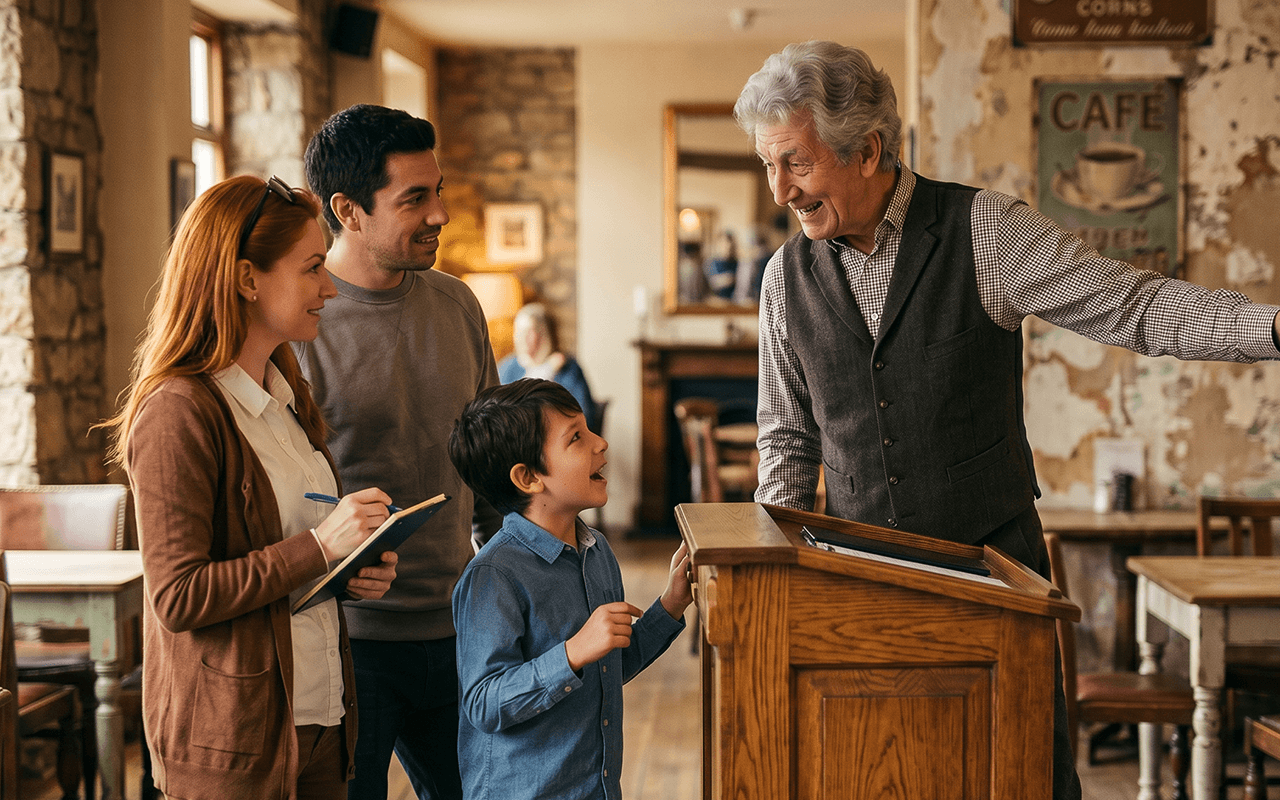
Twenty minutes later, Ross, Maeve, and Leo drove through a blinking red light at a four-way intersection and found a run-down roadside café with a dirt parking lot. A worn, hand-painted sign said, “Welcome to Little Jesus Pie Café and Gift Shop.” The family parked near the door and was happy for a chance to get out and stretch. Leo ran inside. Ross and Maeve hesitated, then entered to assure their son’s safety.
The couple paused inside and gazed in awe at the wall covered with framed sketches and paintings. Shelves brimmed with plastic statuettes, all of which appeared to be a rendition of a Jesus-like child in a tunic, his right arm outstretched in a beckoning motion. In the paintings, the boy was pictured standing on a foggy shoreline with people kneeling around him.
Leo was already speaking to a tall man, at least 6 feet 5, with thick, gray hair that made him look younger than his 70s. He bore an animated personality toward the boy. Briskly, he stepped out from behind a hostess podium and pointed to the wall, acknowledging Ross and Maeve with a “come along” gesture. Leo, meanwhile, busied himself studying one of the paintings at eye level.
“We call him Our Little Jesus of the Bayshore,” the man announced. AND our little church, built in 1933.”
“You have a church here called Our Little Jesus of the Bayshore?” Maeve deadpanned. “I’m a catechist for our church, and I’ve held positions over the years with our diocese, and I have never heard of a church by that name.”
“No, Miss, unfortunately, you wouldn’t,” the man admitted sadly. “I said that’s what we call it. The diocese calls it St. Bernadette.”
“Oh, I think I have heard of St. Bernadette’s. More like a little chapel,” Maeve admitted weakly.
“That’s the one. I guess it was named that because she had been newly canonized. My name’s Mel, by the way. I’m one of the owners here and nephew of Amie – Amie with an ‘ie’ — who first saw the vision of the Little Jesus.”
“The vision,” Maeve said flatly, already skeptical of Mel’s story.
“Yes, Miss,” he said respectfully and continued. “She was only about 13, but wise enough to record all the events back in 1932.”
“Is that so?” Ross said, a graphic artist, almost as fascinated by the pictures on the walls as his son. “Did she do all these pictures?”
“She did indeed,” Mel confirmed, “And at the time had no training —”
“Excuse me,” Maeve interrupted impatiently, waving her hand in the air as though she were erasing something. “Have you ever looked into mission status? Surely there is a larger church that would take you on as a mission church.”
“The nearest church is about 50 miles away, and that’s struggling a bit from what I hear, so that they wouldn’t want us,” Mel said.
Another man, who looked much like Mel but with white hair instead of gray, emerged from the dining room.
“That big donkey’s my twin brother, Bart,” Mel told them and then informed Bart that the family followed their sister Ami – with just an ‘i’ — here, thanks to that little fellow, Leo. Bart said that she had just gotten back from a shopping trip.
“She’ll be pleased to know the bumper sticker paid off. Were you telling them about Aunt Amie and the Little Jesus?” Bart said.
“I was just starting,” Mel said. “You can help me.” Maeve flashed Ross a glance, raising her eyebrows and exhaling deeply. They had come to the café for pie but were given a special tour and history lesson. Was she the only one who thought this was strange? Ross, a graphic artist, wanted to know more about the pictures and the story behind them. Leo had wandered off to the other end of the lobby, intrigued by the statues and the pictures of the boy Bart and Mel were calling “Little Jesus.”
The twins began telling Ross and Maeve the story of the vision of Our Little Jesus of the Bayshore. They followed a string of child-like, detailed sketches high on the wall behind the podium and cash register. They provided the backstory but let the pictures do the telling.
“Our Aunt Amie was only about 13 at the time in 1932,” Mel began. “Before the 1930s, this area was booming for clams, crabs, oysters, and mussels. But it was kind of a secret spot for the folks who lived here. They made good money back then by going into the city and selling fresh shellfish. They were very isolated, though.”
“No one wanted this area,” Bart started to explain. “People made up folktales over the years about half-man, half-animal demons running around at night, and babies being born with fangs and horns, so people stayed away, and this little stretch was largely unknown. Funny how some were so quick to believe that nonsense but thought the Little Jesus couldn’t be true. It wasn’t very Christian here, but some folks understood about Jesus Christ being our Savior. A few went the distance to a church, but most didn’t.”
“They could always find a bottle and some trouble, though,” Mel interjected.
Mel pointed out the first sketch of people along the shoreline digging for crabs. Some boats moored off in the distance. Another drawing showed a little girl with her mouth agape, pointing ahead.
“Now that’s our Aunt Amie,” Mel said.
Maeve looked away and sighed.
Another pencil drawing showed a boy walking along a foggy shoreline, reaching out with his right hand.
“That’s Our Little Jesus of the Bayshore,” Bart said proudly. “You’ll notice the same image in the paintings.”
The brothers told them that in September of 1932, he came back three Sundays in a row in the early morning fog. Each Sunday, he delivered a different message, but only Amie heard him. Then he disappeared into the fog.
Next month: The family learns the messages that Amie heard from the boy in the fog, and Leo makes a friend.
© 2026 Mary McWilliams
Featured AI image rendered through Adobe Firefly & Gemini 3.1 Nano Banana 2
Edited by Paula V. Babadi
- The Orange Caldero and the Bunny Rabbit - July 16, 2026
- Follow Me to Little Jesus: Part 3 - June 18, 2026
- Follow Me to Little Jesus: Part 2 - May 21, 2026


Leave a Reply
Want to join the discussion?Feel free to contribute!