
Two by Two

Jesus summoned the Twelve and began to send them out two by two. (Mark 6:7)


Two by two. Not alone. Not in a group. Jesus sent out the twelve two by two.

Jesus could have sent the disciples out on their own. After all, there would come a time when they would each go their own way — James to Spain, Thomas to present-day Iran, Andrew to Greece, John to Asia, Matthew to Africa, and so on. He could have told them that this first sending out was meant to prepare them for what was to come. He could have told them that there are times in life when they would feel and be alone, and they would have nobody to turn to or consult or just talk to.

Likewise, He could have sent them in two groups of six or three groups of four. There’s safety in numbers. Plus, groups of young men traveling around the globe attracting audiences have always been popular, right?


Two Are Better than One

Instead, Jesus sent them two by two. He knew that two is better than one, and often two work better than a group. In Ecclesiastes, we read,

Two are better than one … If the one falls, the other will help the fallen one. But woe to the solitary person! If that one should fall, there is no other to help. (Ecclesiastes 4:9-10)

C.S. Lewis takes it even farther. He tells us in the introduction to  Athanasius’ On The Incarnation, “Two heads are better than one, not because either is infallible, but because they are unlikely to go wrong in the same direction.” Two people are more accountable and hold each other accountable. They recognize when one is going off course and can steer each other to the right place, be it a safe harbor or a challenging cliff that can only be climbed together.


Finding A Second

For several years, I have thought about whether I need a spiritual advisor. Of course, being human and being the independent, forge ahead at all costs person I am, I’ve always laughed it off as something I don’t need and certainly don’t have time for! I never stopped to think that maybe I don’t have time for one because I’m not making the time or because I’m not where I’m meant to be and am too busy running around to see it.

More and more, this concept of having someone else in my spiritual corner — someone to help me when I’m falling, when I’m off course, when I need help — has been weighing more and more on my heart. I finally reached out to a friend who is a spiritual advisor and asked her opinion. As expected, she told me that “the Holy Spirit is a nudger worth listening to.”

In sending the Apostles out two by two, Jesus affirmed the view of two people working together to help each other out, to receive help when one falls, and direction when off-course, to further the Kingdom. If Jesus felt that this was the best way to go about our missions and bring His Word to the world, who am I to try to make the journey solo?
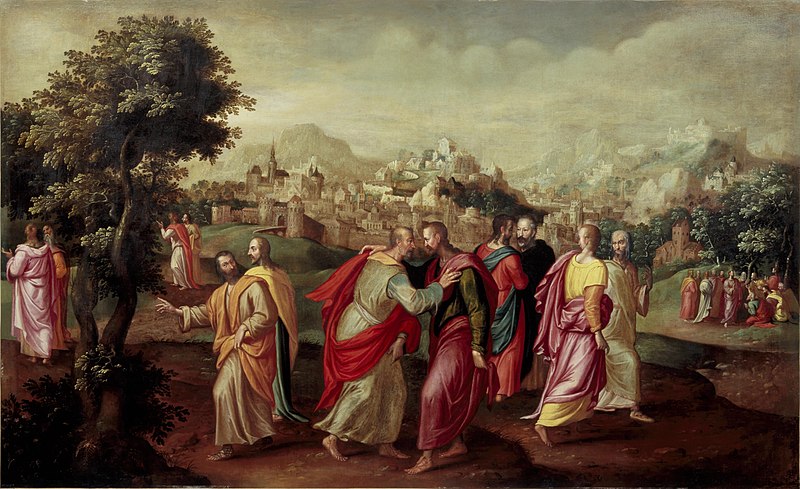
 

Christ Sends Apostles Out in Pairs Anonymous Dutch Painting, Public Domain

Christ Sends Apostles Out in Pairs Anonymous Dutch Painting, Public Domain


We Can’t Do It Alone

So they went off and preached repentance. The Twelve drove out many demons, and they anointed with oil many who were sick and cured them. (Mark 6:12-13)

As two together, the Apostles experienced the fruits of the Holy Spirit. They were successful, doing as Jesus told them, and healing may of their afflictions, both spiritual and physical. Perhaps they would not have been able to accomplish this on their own. Even after Jesus died, and they were to carry on the mission, they needed the Holy Spirit to descend upon them and grace them with confidence and ability. They couldn’t do it alone.

My brothers and sisters, if you are pondering where to turn for guidance and companionship on your spiritual journey, know that you are not alone and that you aren’t meant to be. If not a spiritual advisor, seek someone who will share the mission with you, be there when you fall, and steer you in the right direction. Two are better than one.

“For where two or three are gathered together in my name, there am I in the midst of them.” (Matthew 18:20)


Let us pray: Lord, I ask you to open my heart and my mind to the nudging of the Holy Spirit. I pray that you lead me to the person you have chosen as my spiritual partner. Help us to further Your Kingdom as we walk two by two. Amen.


Copyright 2025 Amy Schisler

Retreat and Discernment

Retreat and Discernment

Our gospel reading this weekend reports that “Jesus took Peter, James, and his brother, John, and led them up a high mountain by themselves.” (Matthew 17:1) (1)

Other passages in scripture also demonstrate how our Lord retired into the wilderness, alone or with spiritual companions, as an integral part of his spiritual rhythm. He used these respites to focus on prayer, and to replenish his energies during a demanding physical ministry of teaching, preaching, and healing.

Retreats and spiritual direction offer refreshment for our own lives as Catholics, too. Recently, I participated in a first formal one-day orientation to the teachings of St. Ignatius.

For many years, my primary resource for discernment has been Authenticity: A Biblical Theology of Discernment, written by Thomas Dubay, S.M. (2)

That reading provided a welcome foundation for what I experienced at “Image & Imagination in Prayer,” an Ignatian retreat sponsored by Emmaus House in Urbandale, Iowa on July 22.

Emmaus House was founded in the Diocese of Des Moines by Jesuit priests in 1973, at the invitation of then-Bishop Maurice Dingman. At first, Emmaus House served the diocese by providing spiritual direction and retreats exclusively for Catholic clergy. But it quickly expanded to offer these resources for members of the Catholic lay community as well as some Protestant clergy. (3)

I was intrigued by how original spiritual methods developed by St. Ignatius of Loyola in the 16th century anticipated several techniques employed by archetypal psychologists today.

Swiss physician C. G. Jung, the founder of archetypal psychology, studied Ignatius’ teachings in the early 20th century, and gave a series of lectures about their value in Zurich between 1933 and 1941. English translations of these lectures have been published only recently, in January of 2023.

Both approaches focus on events in ordinary daily life. Both are designed to bring forth the full flowering of human individuality. Both honor the integrity of images and feelings as they emerge from a person’s inner being, and use “active imagination” to help deepen relationship with the unique divine spark alive in each of us.

What Dubay calls outer verifications occurred throughout my one-day introduction to Ignatian method. I crossed paths with dear friends from different parts of the diocese as well as from different eras in my life; and encountered new acquaintances who wandered in my direction for a purpose we discovered together only as we met.

Under leadership of spiritual director Amy Hoover (4), we contemplated a series of readings and questions offered for private prayer and reflection. Then time was provided for optional sharing with individual retreat partners at our tables.

Reported movements of the Holy Spirit permeated the retreat throughout the day. These repeated, meaningful ‘coincidences’ — simultaneous events without any causal relationship — are what Jung called “synchronicities.”

In one humorous example, intending to excuse myself for a trip to the coffee table during a break, I commented to my companion, “I think I need some sugar.”

Snickers bars immediately dropped down from above our heads, right in front of our faces, like manna from heaven.

We both looked up to see the refreshment hostess making rounds with a bag of candy. But how did she manage to arrive at our table — one of more than twenty in a large parish hall — to be there at the exact moment I spoke?

Later, we were asked to write what we noticed about a picture postcard. While I had written about the display of creation — seasonal weather, contrasts in foliage, moss growing on ancient stones — one of my table mates had first noticed that “there’s no human being here.” She had placed herself and her husband taking a walk, right into the picture, as her focus for the scene.

Another companion among us had been seized first by curiosity about the path’s curve into a distance that lay behind bushes and trees. He had written with poetic insight about what might lie unseen around the bend.

Most dioceses in the United States publish a list of trained spiritual directors and local retreat opportunities, often right on their websites. If you haven’t yet experienced these gifts of our faith, it might be worth exploring what resources are available near you.

Scriptural readings for the Memorial of St. Ignatius of Loyola on July 31, and for the Feast of Transfiguration of the Lord on August 6, are rich with vivid images for further contemplation on your own, too.

I pray that each of us can experience a personal transfiguration this August. May we feel the awe and wonder that enlightened Peter, James, and John two thousand years ago, when they witnessed our Lord in earnest conversation with Moses and Elijah on Mount Tabor.

©Copyright 2023 by Margaret King Zacharias

Featured Photo: View frim summit of Mount Tabor ©Copyright 2023 by Margaret King Zacharias 

NOTES:

  1. https://bible.usccb.org/bible/readings/080623.cfm.
  2. San Francisco: Ignatius Press, 1977, originally published by Dimension Books.
  3. https://www.theemmaushouse.org/history.
  4. https://www.theemmaushouse.org/eighth-annual-ignatian-retreat

Stay in the Know

Join Our Newsletter

Members and supporters can get the latest on CWG news and events by signing up for our newsletter.

Please wait...

Thank you for signing up!

Catholic Writers Guild
P.O. Box 77
Eaton, IN 47338