Pilgrim Tales: Pilgrimage to L5

… Lucy and her mother aren’t just Catholic tourists. They’re seeking a new life after the death of Lucy’s father, and Lucy’s mom took them on this pilgrimage for help finding her new way forward. — “Pilgrimage to L5”


Churches were boring. And sad.

I’m tired of being bored and sad, she thought, casting her eyes upward. God, couldn’t something exciting happen?

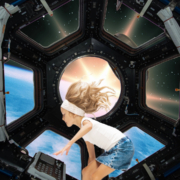
Not everybody thinks pilgrimages are exciting. Eight-year-old Lucy Granger sure didn’t. In Pilgrimage to the L5 Space Station, she gets the chance to go to the home of the founder of the famous Rescue Sisters—St. Gillian of L5—on the anniversary of her sainthood, even. But it’s a lot of listening, looking, and praying, and she’d rather be doing something more exciting.

When the station’s cat leads her to the escape pod, she’s in for more excitement than she expects!

When CWG decided to make an anthology based on pilgrimages, I admit I was a little stumped at first. I’ve been on a couple of pilgrimages myself, but I’m a sci-fi writer. How could I make a pilgrimage in space—and even more, make it exciting in the way people expect sci-fi to be exciting?

I have a standard Catholic SF universe I write in: The Rescue Sisters (https://www.amazon.com/dp/B09L59B69G). This is a group of intrepid women religious who do search and rescue operations, run orphanages and hospitals, and work in safety capacities—all in outer space. My husband and I came up with the idea and we have six short stories and two books in the series so far, three of which are for children.

So I wanted to do another Rescue Sisters story for the anthology. The pilgrimage part wasn’t too hard. I had my own built-in-saint, St. Gillian of L5, founder of Our Order of the Rescue (a.k.a. the Rescue Sisters). It would be fun to return to her old stomping grounds. I’d already done an L5 story, “These Three,” so it let me bring some favorite characters back.

Next, I had to set up the rescue. What could be more natural than a bored child wandering off and getting into trouble? Toss in a cat who’s only too glad to help, and some fun complications, and that part was taken care of.

But what makes a Rescue Sisters story really good is the secondary plot—something tying into their identity not just as rescuers but as Catholics. That’s when I came up with the idea that Lucy and her mother aren’t just Catholic tourists. They’re seeking a new life after the death of Lucy’s father, and Lucy’s mom took them on this pilgrimage for help finding her new way forward.

I think the most life-changing pilgrimages happen when someone comes seeking a new way — a new way to live, a new way to love, a new way to heal.

Jesus said, “I am the Way,” yet how he leads us can be very different. Lucy’s mom finds her way—but in the course of her adventure, so does Lucy—and discovers church isn’t so boring after all.

Read “Pilgrimage to L5” in Pilgrim Tales: a Catholic Writers Guild Short Story Anthology starting this December on Amazon.

© Copyright 2025 by Karina Fabian


Edited by Mary McWilliams

The Meaning of Life – Part 3 of 3, Being Fully Alive, Happily Ever After

 I will seize the occasions that present themselves every day; I will accomplish ordinary actions in an extraordinary way. (Cardinal Francis Xavier Nguyên Van Thuân, Five Loaves and Two Fish)

Life is a journey on which we grow, learn, discover, and become. We begin that journey with many questions. Who am I? What is my purpose? What should I do? Where should I go? Where will I end up? The questions are large, small, simple, and complex; and often, the answers we discover lead to more questions. We long for answers with tidy endings, but life is not a book with a happily ever after!

Or is it?

Discovering the Meaning of Life

Think about how many self-help books there are out there. How many articles and podcasts and Ted Talks are there about finding yourself, knowing your purpose, or discovering the meaning of life? We are surrounded by authors, psychologists, doctors, talk show hosts, podcasters, TikTokers, journalists, and more who purport to know what we’re seeking and where we can find it. They all claim to have the answers!

I’d like to propose that many of those books should be tossed out, articles ripped from the seams of the magazines, and recordings silenced! We all have inside of us what we need to discover the meanings of our lives and the directions in which we should be heading. All we need is to have faith, lead with mercy and compassion, and love one another. Through faith and prayer, we can discover how to follow our paths and live life abundantly, the way God intended us to.

We need to open our eyes to the gifts and talents God has given us and learn to use them, and use them well. We need to look deep inside ourselves and find what we are good at, what we are passionate about, and pray about what we are to do with that knowledge, those skills. We need to keep asking questions and keep looking for God to answer them.

We must seize upon the words of Cardinal Francis Xavier Nguyên Van Thuân: “I will seize the occasions that present themselves every day; I will accomplish ordinary actions in an extraordinary way.”

I will admit, this isn’t easy. It’s taken all my life—over fifty years—to find my path and discover answers to my questions. And I’m not alone. We live in a world in which we are surrounded by so much noise, we can’t hear God calling our names and don’t know which way to turn to find the right answers and the right path.

Finding Our Calling

The truth is, we can’t live our lives abundantly until we discover our callings, and we all have a calling. We all have a path that has been laid out for us. It has always been there, waiting for us to find it, to ask the right questions. It’s up to us to discover the path and up to us to choose to follow it. God will not force us to do anything we don’t want to, but He will lay the path and give us clue after clue, prompting upon prompting, and sign after sign. We can look for and acknowledge them, or pretend they don’t exist. There is always an answer to our question. We may not like the answer, or we may not be prepared to accept it, but it’s always there. Psalm 16 tells us, “You make known to me the path of life; you will fill me with joy in your presence, with eternal pleasures at your right hand” (Psalm 16:11).

Don’t get me wrong. Even when you find the path, you will still have questions and will continue to search for meaning. However, the longer you follow your path, the more answers you will receive. It won’t always be easy. Sometimes the path will be clear and obvious, paved and lighted. Other times, the path will disappear around a bend into the darkness, and we must find our way to the light. Those are the times the answers aren’t readily apparent. Those are also the times when staying on the path is the most rewarding. Those are the aha moments we have when we look back and see the answers so clearly, we can’t figure out how we missed them along the way. Pope Francis said, “If we wish to follow Christ closely, we cannot choose an easy, quiet life. It will be a demanding life, but full of joy” (The Spirit of St. Francis: Inspiring Words from Pope Francis, p.87).

Called by Name

So many throughout the Bible were called, some by name. God called out to Abraham, Jacob, and Moses, using their names twice to get their attention (Genesis 22:11-13; 46;1-4; Exodus 3:1-10), and I wonder how many times He has to call my name because I’m too busy to pay attention. I think of Samuel in 1 Samuel 3:4 who was called by God but didn’t recognize that it was the Lord calling him.

How often do we hear the call but don’t realize it’s the voice of God?

I lovingly recall Mary Magdalene weeping at the tomb, asking the “gardener” where Jesus’s body was. It was only when the man addressed her by name that she recognized it was the Lord (John 20:11-16). How often have I stood and looked at something without understanding that it was God trying to get me to see Him?

At some point, each of us is called by name, and at that point, we will know that we are fully alive, ready to answer God’s call. If we listen and turn toward the voice with an openness and readiness, we will see our paths illuminated before us, littered with the answers to our questions. Yes, there will be twists and turns and many crossroads as we continue to question the way, but the path is there, and so are the answers. All we need to do is be willing to follow the path wherever it leads us, and open ourselves up to living life in abundance. And that is how we will find our happily ever after.

To wrap up this series, let us reflect on these words of St. John of God:

If we look forward to receiving God’s mercy, we can never fail to do good so long as we have the strength. For if we share with the poor, out of love for God, whatever he has given to us, we shall receive according to his promise a hundredfold in eternal happiness. What a fine profit, what a blessed reward! With outstretched arms he begs us to turn toward him, to weep for our sins, and to become the servants of love, first for ourselves, then for our neighbors. Just as water extinguishes a fire, so love wipes away sin. (Cartas y Escritos 18)


Copyright 2025 Amy Schisler

Images copyright 2025 Amy Schisler, all rights reserved.

Meeting Bruder Klaus 

Meeting Bruder Klaus


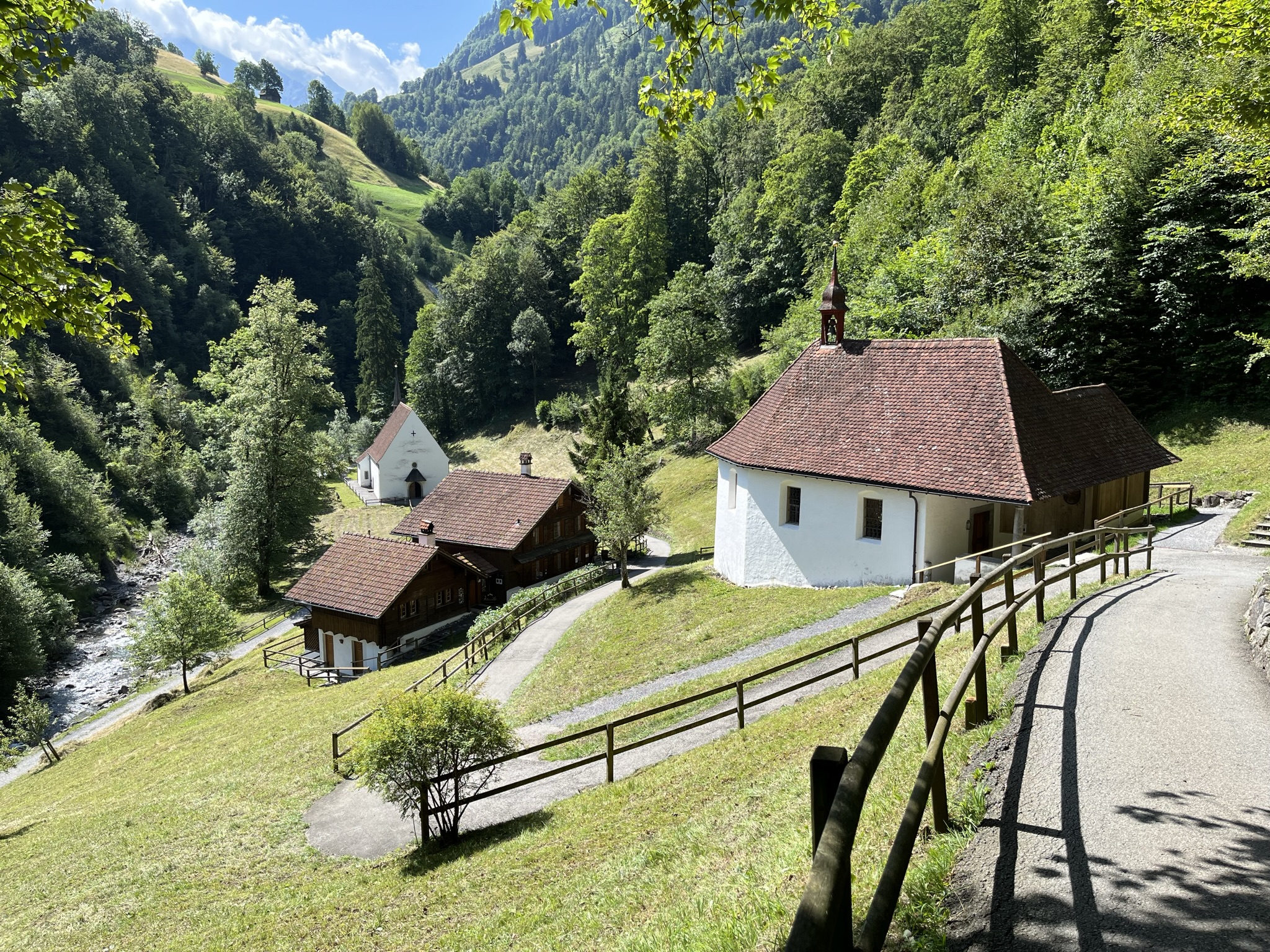
On our third day in Switzerland, guide and driver Tony … took us into the rural hamlet of Flüeli, near the town of Sachseln, to visit the home of St. Nicholas von Flüe. I had no idea who this man was. How had I never heard of him?


Part I

A mysterious experience, and perhaps the most meaningful pilgrimage of my life, began in January of 2006. An advertisement in the local diocesan newspaper jumped out to me with that feeling I’d come to associate with lectio Divina – highlighting words that seemed to be meant specifically for me, a request from the Holy Spirit to pay particular attention.

Miraculous Journeys, a group from Omaha, Nebraska under the direction of a woman named Leona Kavan, was planning a trip to Roman Catholic shrines in Switzerland, Germany, and Austria the following October.

I’d long dreamed about visiting this part of Europe because so many of my ancestors had come from that Alpine region. My mother’s four grandparents emigrated to the United States from the Swiss Cantons of Bern and Basel.

So, I called Leona to ask for more information. We both felt an instant affinity in that first telephone conversation, and I told her I wanted to pray about it. I’d get back to her if I was interested.

As I entered the Perpetual Adoration chapel in my parish, a lay Carmelite friend I often joined for First Friday and First Saturday vigils, was praying in the rear pew. She beckoned me over, and whispered, “I understand you’ve just been talking to my friend Leona in Omaha.”

The signs continued. After I formally registered, making my own airline reservations because I would be flying out of Des Moines on American Airlines rather than from Omaha on KLM with the group, it transpired that Leona had a request.

Sister Frances, an Oblate Sister of Mary Immaculate from the National Shrine of Our Lady of the Snows in Belleville, Illinois, had received a large donation of American Airline miles from a patron of the shrine, as a gift for her retirement. She wanted to use them for this trip.

Sister Juanita, a younger vowed sister of the same order, had been assigned by their superior to accompany and assist, because Sister Frances would still be in the latter phase of recovery from knee surgery at the time this pilgrimage would take place.

We were all using the same airline. Would I please meet the sisters at Zurich airport and help them find the group when we arrived?

My original itinerary on American had routed me through Chicago, and their international transfer hub was going to be Dallas-Fort Worth. I’d never flown to Zurich and had no idea what that airport even looked like. I decided to change my ticket and meet them in the Dallas-Fort Worth airport, where I had at least some experience.

We, too, found immediate fellowship when I met Sister Frances and Sister Juanita at our international departure gate. Once we landed in Zurich, it required two trains and my best Canadian French to find out where the Omaha group had arrived – as it turned out, in a completely different terminal, invisible to us, on the other side of major construction.

But fortunately, nuns stay together in one place when you ask them, and the Holy Spirit was looking after us all. Sister Frances and Sister Juanita were waiting patiently where I left them when I returned with a map showing the correct location, and a safe route around the construction zone.

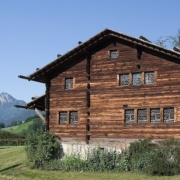
On our third day in Switzerland, guide and driver Tony, a former member of the Pontifical Swiss Guard, took us into the rural hamlet of Flüeli, near the town of Sachseln, to visit the home of St. Nicholas von Flüe.

I had no idea who this man was, and I had been a voracious reader about the saints since I joined the Church in 1989. How had I never heard of him?

Through our Omaha translator, who was fluent in German and carefully translated Tony’s exact words, it became apparent that he regarded this shrine as holier than even Engelberg Abbey, one of the greatest Benedictine houses of the high Middle Ages, and felt that our visit to Flüeli was the most sacred honor he could bestow on us during our visit.

Sister Frances, Sister Juanita, and I all looked at each other, and shook our heads. They’d never heard of this St. Nicholas, either.

The historic log chalet in front of us looked pretty rustic, and the pathway down to what our guide called “The Ranft,” on the banks of a rushing river, could only be described as treacherously steep. At least, we observed to each other, it was paved.

We composed ourselves with appropriate reverence and disembarked. Our driver pulled out Sister Frances’ foldable wheelchair from the belly of the bus, and Sister Juanita put on her game face.

We were about to learn how a 15th century farmer, soldier, hermit, and visionary became the patron saint of Switzerland, how he changed human history in his own time and for ours, and why his fellow countrymen call him simply Bruder Klaus, with great affection, to this very day.

Stay tuned for Part II next month.

Peace.


© Copyright 2025 by Margaret King Zacharias

Feature Photo: The Home of St. Nicholas von Flüe 

File URL https://upload.wikimedia.org/wikipedia/commons/e/e7/Flueli-Ranft_Wohnhaus_Bruder_Klaus.jpg

Page URL https://commons.wikimedia.org/wiki/File:Flueli-Ranft_Wohnhaus_Bruder_Klaus.jpg

Attribution Ikiwaner, CC BY-SA 3.0 <http://creativecommons.org/licenses/by-sa/3.0/>, via Wikimedia Commons

Inset photo The Ranft of St. Nicholas von Flüe, Hermit – Page 4

Page URL https://commons.wikimedia.org/wiki/File:Ranft,_Chapelles_sup%C3%A9rieure_et_inf%C3%A9rieure_de_Nicolas_de_Fl%C3%BCe.jpg

File URL https://upload.wikimedia.org/wikipedia/commons/d/d8/Ranft%2C_Chapelles_sup%C3%A9rieure_et_inf%C3%A9rieure_de_Nicolas_de_Fl%C3%BCe.jpg

Attribution Paul Bissegger, CC BY-SA 4.0 <https://creativecommons.org/licenses/by-sa/4.0>, via Wikimedia Commons

Jubilee: A Coming Out of the Wilderness

Jubilee: A Coming Out of the Wilderness

Years ago, when my dad was stationed in Italy, I was blessed to be able to take part in Italy’s jubilee in 2000. I didn’t think I would get the opportunity again. Jubilees only come along every 25 years and I live far away from Italy now.  When I stepped through St. Peter’s Holy Door in 2000, I never would have guessed that I would not only get to participate in Rome’s jubilee again, but that I would have a husband and three children in tow!

A jubilee is a time of forgiveness and spiritual renewal. The word jubilee means a time of celebration. We are celebrating God’s merciful love during a jubilee. Everyone is encouraged to participate, whether locally or through a pilgrimage to Rome and to receive the plenary indulgence. https://www.usccb.org/jubilee2025

When my husband first mentioned a possible trip to Italy for the Jubilee, I panicked. I’m a bit of an anxious person to put it lightly. All of the things that could possibly go wrong when bringing a family of five to Italy immediately filled my mind. I put our family on a strict “Don’t talk about the trip to Italy” notice in order to mentally avoid the inevitable. For the next several months, my husband quietly researched, planned, and bought tickets for our pilgrimage. I quietly brushed up on my Italian but stubbornly remained in denial.

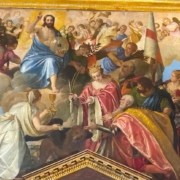
In March, we landed in Venice and made our way through cities such as Siena, Assisi, and Florence, visiting many holy sites and preparing ourselves for the final stop in our pilgrimage – Rome. Italy, like America, has grown farther and farther away from God. It is hard to imagine the existence of a world where political – and even church– governance was heavily influenced by faith in the one, true God. This, however, is what the elaborate paintings in their government houses depict. God first, high above mankind, and all those below searching the Heavens and sometimes even pointing above in the realization that true governance comes from God.

That is what jubilees are about. An opportunity for us as individuals and, hopefully, as a society to renew our focus on God, His teachings, and His boundless love for all of us. Now, more than ever, the world needs this awakening. We need this hope.

Without this hope, however, I would never have even made it to Italy. Remember, I was so worried about all that could go wrong on the pilgrimage to Italy that I secretly preferred not to go at all. This was a grievous lack of trust in God on my part. Instead of turning to Him, instead of surrendering to Him, I almost missed out on a beautiful opportunity to allow my family a trip to the Holy City! I needed to surrender my heart to Him and ask Him to enter under my roof before I could enter under His.

This year’s jubilee calls us to be Pilgrims of Hope. Before I could even depart on this pilgrimage – I needed hope. As soon as this realization dawned, I was able to see this huge trip we would be undertaking as a just what it was meant to be – a pilgrimage. Pilgrimages are not easy. The first jubilee was decreed after the Israelites made it through 40 years of wilderness. Only after their desolate pilgrimage and only when they finally surrendered their stubbornness and made it to the Promised Land did the people enjoy their jubilee. “Proclaim liberty throughout all the land to all its inhabitants. It shall be a jubilee for you.” (Leviticus 25:10)

Looking back, I find it poignant that the hardest challenges for my family came prior to us even leaving and these challenges seemed to be allayed only when I surrendered and trusted the Lord with abandon. All at once, the wilderness cleared and our path to the Holy City unfolded.

Any pilgrimage we take during this jubilee year, whether to Italy or within our hearts, must start very close to home. Though I’m home now, my pilgrimage of hope should not be over. I’m to be an example to those around me of God’s loving mercy, at home and at work. This pilgrimage of hope starts in our heart. What does it benefit us to walk through the Holy Door at St. Peter’s if our heart is not as beautifully decorated as the basilica’s walls? Will I carefully place jewels of patience, love, and mercy into the altar of my heart? Will I perfume the chamber with oils of humility and kindness? When the Holy Doors close and the jubilee ends, how much more radiant will my heart be?

No matter where we find ourselves this jubilee year, let’s start with the heart. I plan to take time during daily prayer to look within and check on the progress within the basilica of my heart. Hopefully, at the end of this jubilee, I will be able to hand our Lord a heart I’ve done something to improve. All hearts can be like an ugly, rough stone, but each heart is greater than a precious jewel in the eyes of the Lord. With careful refinement, our hearts can shine like the beacons of hope God meant them to be. Let us renew our hope in Him and take up the pilgrim’s staff. God speed on your journey!

Copyright by Emily Henson 2025

Edited by Maggie Rosario


Rocky Times

Rocky Times

Taxi drivers shook their fists at each other as I stared out the tour bus window. Blaring horns assaulted my ears. Sunset turned to twilight, and still we sat motionless in Tel Aviv traffic gridlock.
My heart was breaking for my fellow travelers. Although I’d been looking forward to visiting the Carmelite monastery’s public areas for a second time, I’d already been blessed with indelible memories of a daylight Mass in the gardens, followed by a tour that included rooftop views of the fertile valleys below. (See https://www.catholicwritersguild.org/2023/06/mount-carmel/). For the passengers with me on this trip, their visit here was meant to be the pinnacle of a once-in-a-lifetime pilgrimage to the Holy Land. The bus driver’s scowl mirrored my own frustration, but only an air of resigned disappointment filled the bus.
By the time we had navigated a winding road to the top of Mount Carmel, full darkness had descended. The harried greeter who’d waited for us outside made humble apologies. Unfortunately, no tour would be possible. The brothers had already prayed Vespers, and the vowed community was cloistered for the night. But our host said he’d given the lay oblates permission to reopen the gift shop. This announcement immediately cheered the ladies. At least they could still bring rosaries to their loved ones back home. They trooped off together toward the few still-lighted windows, smiling.
Dominick, a public elementary school principal, quietly pulled his carryon suitcase from the bin above his seat and got off the bus behind them. I’d learned that in his traditional Italian neighborhood, parishioners had sacrificed for years to buy a small triangular lot adjacent to their
church. Dominick was building there, a shrine for Our Lady of Mount Carmel. I watched him engage our greeter in animated conversation.
The other pilgrims eventually returned, with full souvenir bags in hand. But where was Dominick? Finally, he appeared again at the bus door, grinning. A middle-aged but muscular man from a contractor family, Dominick did not seem daunted by the weight he now carried. He climbed right up the bus stairs, and raised his suitcase with both hands, in a victory stance, as soon as he reached the aisle.
“That brother was so kind. He took me all the way back to the mountain!” Dominick’s voice resonated through the bus without benefit of the microphone. “He said I could have as many rocks as I wanted! He found me a spade, and held the flashlight while I pried the stones
free.”
Whoops, whistles, and cheers from every seat greeted his enthusiastic news.

***

I found myself behind Dominick in the El Al security lines for our departure flight back to the United States. He patted his suitcase, and whispered with a wink. “Don’t worry. I’ve got them all right here.”
I heard the uniformed Israeli guards ask, as Dominick slowly wheeled his suitcase to the counter, “What’s in there? Rocks?”
Uh, oh, I thought, looking around. Is this even legal? Archeological artifacts, and all that? Where’s our guide!  Dominick just nodded. “Gifts for Our Lady’s new grotto, from our Holy Land pilgrimage,” he said. Seeing the stern looks on their faces, he hastened to assure them.
“Everyone gave me permission. Those monks at Mount Carmel were really helpful.” Dominick pulled a paper from his vest pocket. Apparently, he’d somehow managed to wangle a document from the Carmelite brother who’d assisted with the excavation. Dominick handed his paper to one of the security men.
The first guard examined it and showed it to his partner. Then he refolded it carefully, and gave it back to Dominick. These officials, who now appeared a bit bemused, heaved Dominick’s suitcase up to the metal counter themselves. After looking inside, they exchanged a humorous glance, and waved our hero through, with his suitcase, to the gate. As I placed my own tote on the counter, I couldn’t help wondering how Dominick could have fit in all the stones I’d seen him collect, at the shore of the Sea of Galilee, and other sacred sites we’d visited.

But from the glimpse I’d just garnered, they did look– tightly packed.

***

Dominick engraved each stone from the Holy Land with its place of origin. He mortared them in where they fit, like puzzle pieces, among larger local boulders. Pilgrimage memories endure in a curved rock wall that shelters the consecrated granite altar in the new grotto dedicated to Our Lady of Mount Carmel.
Today, Mass can be celebrated at the grotto as well as the church, often in both English and Spanish. The parish maintains its long and faithful tradition of Corpus Christi processions with the Blessed Sacrament, visiting and blessing individual family homes throughout the old neighborhood. The parish school pioneered for our diocese the first cohort in an optional Spanish immersion curriculum for grades K-8.
Dominick’s spirit of humility, simplicity, and faith lives on.

May we all be blessed this Lent with trust and grace to find joy in whatever God sends.


© Copyright 2025 Margaret King Zacharias

Feature photo by Margaret King Zacharias. Used with Permission.


Visitation

 “… Our birth is but a sleep and a forgetting:

The Soul that rises with us, our life’s Star,

Hath had elsewhere its setting,

And cometh from afar:

Not in entire forgetfulness,

And not in utter nakedness,

But trailing clouds of glory do we come

From God, who is our home:

Heaven lies about us in our infancy …


… The Clouds that gather round the setting sun

Do take a sober colouring from an eye

That hath kept watch o’er man’s mortality …”

William Wordsworth

Ode: Intimations of Immortality from

Recollections of Early Childhood (1)


Visitation

May is the month our church sets aside each year to honor the Blessed Virgin Mary. 

In 2024, May includes at least five significant liturgical celebrations:

  • Solemnity of the Ascension of the Lord, Thursday, May 9 (or Sunday, May 12);
  • Optional Memorial of Our Lady of Fatima, Monday, May 13;
  • Solemnity of Pentecost on May 19;
  • Memorial of the Blessed Virgin Mary, Mother of the Church, Monday, May 20;  
  • Feast of the Visitation of the Blessed Virgin Mary on Friday, May 31.

This month opens with the second Glorious Mystery of the Rosary, encompassing two additional Marian holy days as well as another Solemnity, the third Glorious Mystery, and concludes with the second Joyful Mystery — enough to make anyone’s head spin.

Decades ago, when our planet seemed safer and more civilized than it does today, I was blessed with opportunities to visit several Catholic shrines as a pilgrim.

It’s impossible to do justice to the full set of liturgical crescendos this month contains in a brief article for a first Saturday. But I offer a few reflections here about the opening solemnity and the closing feast from my pilgrimages to shrines in the Holy Land.

***

Christian Chapel of the Ascension on the Mount of Olives – Jerusalem, Israel
Fallaner, CC BY-SA 4.0 <https://creativecommons.org/licenses/by-sa/4.0>, via Wikimedia Commons


A small Christian monument called the Chapel of the Ascension stands on the Mount of Olives in Jerusalem, not to be confused with the larger mosque that looms nearby.

This probably does mark the place where Jesus proclaimed his majestic final commission to the apostles, the ‘go out into all the world’ speech we hear in the gospel reading for the Solemnity of the Ascension, Mark 16:15-20. (2)

But even though the chapel contains an ancient footprint in its rock floor that legend describes as made by Our Lord’s right foot when he departed, this holy place on the Mount of Olives may, or may not, be where Jesus actually ascended into heaven.

Some scholars, as well as many local Christians whose families have lived here for generations, believe the Ascension might have occurred elsewhere.

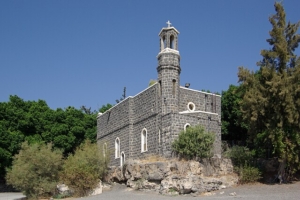
Church of the Primacy of Saint Peter – Tabgha, Israel
Berthold Werner, CC BY-SA 3.0 <https://creativecommons.org/licenses/by-sa/3.0>, via Wikimedia
Commons


Another possible location hosts the small Church of the Primacy of Peter, on the northwest banks of the Sea of Galilee, believed to be where Jesus fed his friends one last breakfast of freshly-caught fish, as described in John 21. (3)

That rocky shoreline is also visited by thousands of Christian pilgrims, both Catholic and Protestant. It’s an alternative place where some believe the Ascension might actually have taken place.

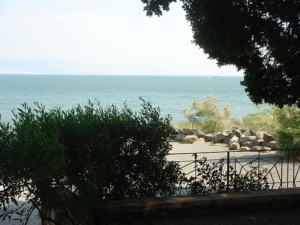
View of the Sea of Galilee – from the Church of the Primacy of Saint Peter, Tabgha, Israel
someone10x, CC BY 2.0 <https://creativecommons.org/licenses/by/2.0>, via Wikimedia Commons


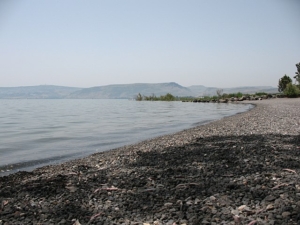
Shore beside the Church of the Primacy of Saint Peter – Tabgha, Galilee, Israel.
https://www.flickr.com/photos/emeryjl/, CC BY 2.0 <https://creativecommons.org/licenses/by/2.0>, via
Wikimedia Commons


Wherever it occurred, the description of the Ascension in Acts 1:6-12 (4) tells us that the gathered apostles received a visitation from ‘two men dressed in white,’ usually interpreted as angels.

These men appeared ‘suddenly,’ admonishing the disciples to stop looking ‘up at the sky,’ and promising that Jesus would ‘return the same way he departed.’

***

Two distinct Visitation shrines hold importance in the town of Ein Karem, once a small village in the Judean hills, now considered a ‘suburb’ of sprawling modern Jerusalem.

The first is the Church of St. John the Baptist, in downtown contemporary Ein Karem.

Courtyard and Entrance to Church of Saint John the Baptist, Ein Karem, Israel.
Chris06, CC BY-SA 4.0 <https://creativecommons.org/licenses/by-sa/4.0>, via Wikimedia Commons


By tradition dating back to Saint Helen, mother of the Byzantine emperor Constantine, and supported by archeological research through layers of Crusader construction, there is evidence to believe that John the Baptist was born in the now-underground cave on this site.

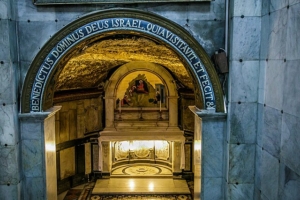
Birth Cave of Saint John the Baptist, Ein Karem, Israel
Pikiwiki Israel, CC BY 2.5 <https://creativecommons.org/licenses/by/2.5>, via Wikimedia Commons


A fountain in the courtyard appears to have been the original village water source, probably located on the temple property where Elizabeth’s husband Zacharias was serving as Jewish priest when an angel appeared to him to announce the news of his son. Their primary dwelling is believed to have been here, or very close by.

Higher into the foothills is a site traditionally identified as the family’s summer home, and many scholars believe that this would have been where young Mary went to visit her much older cousin.

A curving, terraced brick pathway with very wide steps winds around the steep mountain trail today, leading up from the main village to the Church of the Visitation.

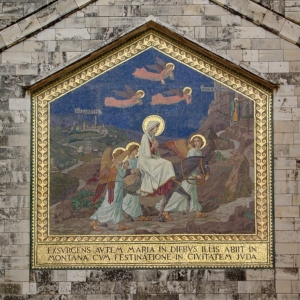
This shrine is a much larger complex, a former monastery. In contrast to the lower church in Ein Karem, where John the Baptist’s family is highlighted, the Church of the Visitation contains imagery devoted almost exclusively to Mary.

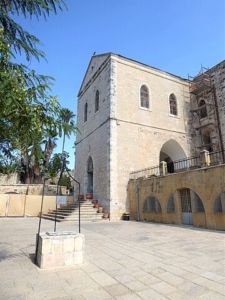
Detail of Front Facade – Church of the Visitation – Ein Karem, Israel. Elizabeth is pictured at
upper left.
Berthold Werner, CC BY-SA 3.0 <https://creativecommons.org/licenses/by-sa/3.0>, via Wikimedia
Commons


The exception is a sculpture in strikingly contemporary style, portraying two pregnant women, facing each other.

***

Paradoxically, as liturgical time runs forward in May, divine time seems to spin backward, in earthly terms, to the moment when two unborn infants recognized each other from within their mothers’ wombs.

It was only after a very young woman — who had said “yes” to a divine act with consequences she could not possibly have fully understood — had received affirmation and confirmation from her wiser, more experienced cousin, that she burst into the Magnificat.

Sober sunset clouds will gather. One of these babies will be beheaded. One will die by crucifixion.

But these are the moments when Wordsworth’s “… eye that hath kept watch o’er man’s mortality …” is most deftly invoked by the poet.

Penance, Baptism, Resurrection, and Ascension will change the whole game.

“The ‘clouds of glory’ that these babies ‘trail’ contain Eternity for those who believe.”

May enduring faith, hope, and love guard your hearts this May.

Veni Sancte Spiritus.


Featured Photo: Panoramic View – Church of the Visitation – Ein Karem, Israel Attribution Tombah, CC0, via Wikimedia Commons

Notes:

  1. Quoted from https://www.poetryfoundation.org/poems/45536/ode-intimations-of-immortality-from-recollections-of-early-childhood.
  2. https://bible.usccb.org/bible/readings/050924-Ascension.cfm
  3. https://bible.usccb.org/bible/john/21
  4. https://bible.usccb.org/bible/acts/1

Celebrate the dedication of the ‘mother and head’ of all churches on Nov. 9

Celebrate the dedication of the ‘mother and head’ of all churches on Nov. 9

The diesel engine of the American pilgrims’ tour bus couldn’t quiet the buzzing of questions concerning their next Roman site.

“Who’s St. John Lateran?”

“I’ve never heard of him.”

“What did he do to become a saint?”

Tucked away in southeast Rome and across the street from the Holy Steps (the stairway St. Helena excavated and believed Christ climbed to his meeting with Pilate), sits the historic archbasilica commonly known as “St. John Lateran.”

“There is no saint named John Lateran,” the tour guide announced as the pilgrims gathered at the front entrance of the oldest public church in Rome. It was built on a large campus that housed a palace, barracks, and other edifices owned by the wealthy and powerful Lateran family. The church was originally dedicated to the Most Holy Savior, then later to Sts. John the Baptist and John the Evangelist, giving it the official name of The Archbasilica of the Most Holy Savior and of Saints John the Baptist and the Evangelist. Most people simply refer to it as St. John Lateran. In a city of many ancient churches filled with art and history, this one has a special designation.

What would most Catholics say is the “pope’s church?” St. Peter’s Basilica? That’s the church most associated with the Holy See. In addition to other ceremonies and Masses at St. Peter’s Basilica, the pope celebrates Christmas Eve Mass there, installs new cardinals and, until recently, bestowed the lamb’s wool pallium on new archbishops.

But every year, on Nov. 9, the pope travels less than 15 minutes from St. Peter’s to celebrate the dedication of St. John Lateran. As the bishop of Rome, Lateran is the pope’s archbasilica. And, as Catholics, it’s our church too. The church of every Catholic everywhere in the world.

“Omnium urbis et orbis ecclesiarium mater et caput,” the tour guide read, pointing to the message in Latin. Translated in English, it is “The mother and head of all the churches in the city and the world.” Every Catholic has a parish home, the church they attend regularly and are probably registered. They also have their diocesan home, the cathedral in the diocese that is known as the “bishop’s church.” On an international level, they have St. John Lateran, the mother and head of all churches. Sojourners from around the world are welcomed at daily Masses and join in this universal place as a family. The pope celebrates Mass on many holy days, such as the feast of Corpus Christi and even Christmas Day. On a jubilee year, its holy doors are the first opened of four major basilicas in Rome. Between the 12th and 16th centuries, it hosted five ecclesiastical meetings, collectively known at the “Lateran Councils.” It housed popes until the 14th century. John Paul II journeyed to Lateran for the Rite of the Possession of the Chair of the Bishop of Rome after being elected pope in 1978, invoking Revelation 21:3 when he said, “I wish to kneel down in this place and kiss the threshold of this temple which has been for so many centuries ‘the dwelling of God with men.’” (1)


Yards from the basilica is a statue of St. Francis of Assisi, who ventured to Rome to request permission from Pope Innocent III, in residence at the Lateran palace, to begin his order. Larger than life statues of the 12 apostles surround the perimeter of the nave, each showing the symbols associated with them: Peter holding the keys; John the Evangelist with pen and eagle; Bartholomew, who was flayed alive, holding the skin of his face. Each one teaching us the glory of their entrance into heaven and reminding us that the art in churches was never meant simply as pretty decoration of some artist’s spiritual interpretation. Art was meant to help teach the Gospel, to both the illiterate and privileged. It is just as important today to keep that art public to help enlighten moderns to the Word.


The archbasilica has survived natural disasters and fires, a 1993 bombing, and more than 200 popes. It is a place of rich history that includes the fiendishness of Nero and the benevolence of Constantine who handed the property over to the church under the care of Pope Melchiades (2). Like countless other Catholic churches, it displays sumptuous art and has been a place of significant occasions, some of which have harbored tragedy and joy. It could be argued, however, that the most momentous event takes place daily and exponentially with the arrival of Catholic pilgrims from their native lands who come to the comforting revelation that this basilica is also their home. If you can’t attend a Mass there Nov. 9 to celebrate its dedication, make a virtual visit and get to know your home away from home.

Click here to take a virtual tour of St. John Lateran.


Copyright 2023 Mary McWilliams
Photos by Mary McWilliams:

Feature Image: The front of The Archbasilica of the Most Holy Savior and of Saints John the Baptist and the Evangelist, commonly known as “St. John Lateran.”
Image 2: Statue of St. Francis of Assisi and companions requesting permission from Pope Innocent to establish a new order.
Image 3: St. Peter, in the nave of St. John Lateran shown holding his symbol, the keys to the Kingdom of Heaven.

References:
(1) https://www.vatican.va/content/john-paul-ii/en/homilies/1978/documents/hf_jp-ii_hom_19781112_possesso-laterano.html
(2)https://www.vatican.va/various/basiliche/san_giovanni/it/basilica/storia.htm

Retreat and Discernment

Retreat and Discernment

Our gospel reading this weekend reports that “Jesus took Peter, James, and his brother, John, and led them up a high mountain by themselves.” (Matthew 17:1) (1)

Other passages in scripture also demonstrate how our Lord retired into the wilderness, alone or with spiritual companions, as an integral part of his spiritual rhythm. He used these respites to focus on prayer, and to replenish his energies during a demanding physical ministry of teaching, preaching, and healing.

Retreats and spiritual direction offer refreshment for our own lives as Catholics, too. Recently, I participated in a first formal one-day orientation to the teachings of St. Ignatius.

For many years, my primary resource for discernment has been Authenticity: A Biblical Theology of Discernment, written by Thomas Dubay, S.M. (2)

That reading provided a welcome foundation for what I experienced at “Image & Imagination in Prayer,” an Ignatian retreat sponsored by Emmaus House in Urbandale, Iowa on July 22.

Emmaus House was founded in the Diocese of Des Moines by Jesuit priests in 1973, at the invitation of then-Bishop Maurice Dingman. At first, Emmaus House served the diocese by providing spiritual direction and retreats exclusively for Catholic clergy. But it quickly expanded to offer these resources for members of the Catholic lay community as well as some Protestant clergy. (3)

I was intrigued by how original spiritual methods developed by St. Ignatius of Loyola in the 16th century anticipated several techniques employed by archetypal psychologists today.

Swiss physician C. G. Jung, the founder of archetypal psychology, studied Ignatius’ teachings in the early 20th century, and gave a series of lectures about their value in Zurich between 1933 and 1941. English translations of these lectures have been published only recently, in January of 2023.

Both approaches focus on events in ordinary daily life. Both are designed to bring forth the full flowering of human individuality. Both honor the integrity of images and feelings as they emerge from a person’s inner being, and use “active imagination” to help deepen relationship with the unique divine spark alive in each of us.

What Dubay calls outer verifications occurred throughout my one-day introduction to Ignatian method. I crossed paths with dear friends from different parts of the diocese as well as from different eras in my life; and encountered new acquaintances who wandered in my direction for a purpose we discovered together only as we met.

Under leadership of spiritual director Amy Hoover (4), we contemplated a series of readings and questions offered for private prayer and reflection. Then time was provided for optional sharing with individual retreat partners at our tables.

Reported movements of the Holy Spirit permeated the retreat throughout the day. These repeated, meaningful ‘coincidences’ — simultaneous events without any causal relationship — are what Jung called “synchronicities.”

In one humorous example, intending to excuse myself for a trip to the coffee table during a break, I commented to my companion, “I think I need some sugar.”

Snickers bars immediately dropped down from above our heads, right in front of our faces, like manna from heaven.

We both looked up to see the refreshment hostess making rounds with a bag of candy. But how did she manage to arrive at our table — one of more than twenty in a large parish hall — to be there at the exact moment I spoke?

Later, we were asked to write what we noticed about a picture postcard. While I had written about the display of creation — seasonal weather, contrasts in foliage, moss growing on ancient stones — one of my table mates had first noticed that “there’s no human being here.” She had placed herself and her husband taking a walk, right into the picture, as her focus for the scene.

Another companion among us had been seized first by curiosity about the path’s curve into a distance that lay behind bushes and trees. He had written with poetic insight about what might lie unseen around the bend.

Most dioceses in the United States publish a list of trained spiritual directors and local retreat opportunities, often right on their websites. If you haven’t yet experienced these gifts of our faith, it might be worth exploring what resources are available near you.

Scriptural readings for the Memorial of St. Ignatius of Loyola on July 31, and for the Feast of Transfiguration of the Lord on August 6, are rich with vivid images for further contemplation on your own, too.

I pray that each of us can experience a personal transfiguration this August. May we feel the awe and wonder that enlightened Peter, James, and John two thousand years ago, when they witnessed our Lord in earnest conversation with Moses and Elijah on Mount Tabor.

©Copyright 2023 by Margaret King Zacharias
Featured Photo: View frim summit of Mount Tabor ©Copyright 2023 by Margaret King Zacharias 

NOTES:

  1. https://bible.usccb.org/bible/readings/080623.cfm.
  2. San Francisco: Ignatius Press, 1977, originally published by Dimension Books.
  3. https://www.theemmaushouse.org/history.
  4. https://www.theemmaushouse.org/eighth-annual-ignatian-retreat

Just A Little Bit

Just A Little Bit

My default mode is all-or-nothing. Do I want to volunteer at church? I’m gonna sign up for everything and do it all. Do I feel overwhelmed about keeping memories for the kids? No one gets a baby book at all. Do I want to lose weight? I track every single calorie and work out for two hours, five days a week. Am I struggling to find time to write while the kids are home for the summer? I should just quit writing altogether.

What I love about the all-or-nothing mentality is that when I put it in writing like this, I can clearly see the absurdity of my logic. Yet, when I’m in my moments of being overwhelmed, quitting completely feels like not only a rational option, but the only viable one.

I’ve developed many different strategies for combating this all-or-nothing mentality, including prayer, taking deliberate personal time, and talking to a friend who is currently more rational than I am. But sometimes the best defense is a good offense, and I’ve been working on reminding myself that even if I can only accomplish a little bit, that still has value.

The reality for me is that during the summer, when my four daughters are home all day, I won’t be gifted with large blocks of time for writing. Thirty minutes, first thing in the morning may be all I get one day, and that is still better than not writing at all. I don’t have the luxury (nor endurance) for two-hour workouts anymore, yet twenty minutes on the elliptical still beats sitting on the couch all day.

Ever since I made a pilgrimage to Fatima in November of 2022, my heart has longed to move to Portugal. I’m telling y’all—all-or-nothing. I felt so much peace and so close to God while I was there that I want to uproot the whole family and move to a country where we don’t speak a single word of the native language.

One of my favorite heavenly friends, Saint Thérèse of Lisieux reminds me every day (through my garden flag) to bloom where I’m planted. It’s possible God wants me in Fatima one day, but I know that today is not that day. My kids are struggling enough with a move within the continental U.S., and I can’t imagine if we took them to a whole new country without explicit direction from God.

Yet my heart longs for that pilgrimage feeling, so in my growing attempt to do just a little bit, I planned something slightly smaller than a move to Portugal. This past weekend, my family went on our first ever mini-pilgrimage. We have visited churches while traveling before, but we’ve never set out with the sole purpose of growing closer to Christ through experiencing a holy site right here, close(ish) to home.

Now that we live in Kansas, we are only about two hours away from Gower, MO, the home of the Benedictines of Mary, Queen of the Apostles. This may sound familiar, as this is the place where the body of their foundress, Sister Wilhilmena Lancaster, has been discovered as “incorrupt.”

Her body was not embalmed, and she was laid in only a simple, wooden coffin. Yet after four years in the ground, her body and habit remain intact. A case for sainthood has not even been opened yet, since it hasn’t been five years since her death.  The nuns of the abbey excavated her remains to move her to the newly completed St. Joseph’s Shrine, fully expecting to find only bones to inter. I can only imagine the reactions of her fellow sisters when they made that discovery!

Since we were going to be in Missouri, we decided to also stop by the nearby town of Conception, which is the home of an abbey of Benedictine monks, a seminary, and the Basilica of the Immaculate Conception. We left home on Sunday afternoon after Mass with our regular parish and visited the stunning basilica (including cookies baked by monks!) before getting to the hotel. Then on Monday we went to the other abbey and celebrated the traditional Latin Mass with the Benedictines of Mary, Queen of the Apostles and saw the body of Sr. Wilhelmina.

And that was it (ok, then we stopped at Sam’s Club on the way home because, you know, real life). We were out of our house for barely more than 24 hours, and it was one of the best family trips we’ve ever taken. The mini-pilgrimage was long enough to feel spiritual and fulfilling, and gratifying that I’m doing right by these kids that God has entrusted to my care. The mini-pilgrimage was short enough that my kids weren’t biting each others’ heads off and completely sucking my joy dry.

A little bit was enough. A little bit was beautiful and rewarding. I’m gonna keep trying to do just a little bit each day.


Maria Riley 2023

Mount Carmel

Mount Carmel

By this Chronos time of our renewed baptism in the Holy Spirit at Pentecost, pleasant weather has finally arrived in most parts of the United States. Many of us as Catholics can look forward to outdoor liturgical celebrations with the beauty of nature surrounding us in this season.

The public witness of Corpus Christi processions; devotions to the Sacred Heart of Jesus and the Immaculate Heart of Mary; as well as the glory of sacramental ordination for well-formed young men to the sacred priesthood; all are spiritual highlights that await us in June.

Mount Carmel commonly refers to the promontory of a mountain range with the same name, located about thirty miles west of the Sea of Galilee, on a peninsula that penetrates into the Mediterranean Sea. Today it stands at the edge of a modern city, Haifa, Israel, near the ancient Crusader city of Acre.

Dedicated to the Blessed Virgin Mary as Our Lady of Mount Carmel, and stewarded by the Carmelite orders since the thirteenth century, this popular pilgrimage site is also called Stella Maris, Star of the Sea. This may be in part because the entire peninsula is surrounded by water, but the roots of the alternate title go back much further into history.

Scholars believe that the usage ‘Star of the Sea,’ as both a place name and as a title for Mary, began with St. Jerome. He translated Mary’s Hebrew name, according to its meaning in the annals of the Exodus from Egypt — Miriam, the sister of Moses and Aaron, bore the same name with the same spelling as Mary, the mother of Jesus.

The site on which the Mount Carmel monastery stands today has additional roots that go deep into the Old Testament.

Sign at the base of the statue of Elijah calling down fire from heaven to defeat the prophets of Baal, in the monastery gardens, Mount Carmel. Author’s personal photo, used with permission.

A sign engraved in Latin, Hebrew, and Arabic at the base of a statue of the prophet Elijah in the monastery gardens declares the understory grotto at Mount Carmel to be Elijah’s cave, and this mountain the site at which he defeated the prophets of Baal (I Kings, Chapter 18):

(17) When Ahab saw Elijah, he said to him, “Is it you, you disturber of Israel?”

(18) He answered, “It is not I who disturb Israel, but you and your father’s house, by forsaking the commands of the LORD and you by following the Baals.

(19) Now summon all Israel to me on Mount Carmel, as well as the four hundred and fifty prophets of Baal and the four hundred prophets of Asherah who eat at Jezebel’s table.”

(20) So Ahab summoned all the Israelites and had the prophets gather on Mount Carmel (I Kings, 18:17-20.). (https://bible.usccb.org/bible/1kings/18).

 Elijah’s activity on Mount Carmel did not stop there, either. In II Kings, Chapter 1, we read that:

(3) …the LORD said to Elijah the Tishbite: Go and meet the messengers of Samaria’s king, and tell them: “Is it because there is no God in Israel that you are going to inquire of Baalzebub, the god of Ekron?”

(4) For this, the LORD says: You shall not leave the bed upon which you lie; instead, you shall die … (II Kings, 1:3-4) (https://bible.usccb.org/bible/2kings/1)

 Elijah delivered the message as God had commanded. Then he raced with haste up to the top of Mount Carmel, so he could watch over the Jezreel Valley for this new king’s angry men, who had been sent to kill him.

Twice again Elijah was forced to call down fire that destroyed two commanders and two battalions of fifty men, before a third commander who had been sent with more men to capture him pleaded for mercy, and received it. (II Kings 1:1-18). (https://bible.usccb.org/bible/2kings/1)

Fr. Lawrence Hoffmann celebrates mass in the garden at Mount Carmel monastery, Haifa, Israel. Author’s personal photo, used with permission.

The holy mass that my pilgrimage group was privileged to experience in the garden at Mount Carmel was a peaceful and anointed celebration.

At the end of our liturgy, as the priest pronounced the final blessings, into the silence after each human response came a single gentle “caw,” in chorus from the birds in the trees.

Despite the many problems our human lives face today, and the impotent ‘baals’ that the misguided seek for answers, there is still ‘a God in Israel’ – as there always has been, and always will be.

Let’s live in Kairos time this June.

May you feel ‘amens’ resounding from God’s creation, and continue to bring your own witness into the world.

May you remember that Our beloved Lady, Star of the Sea, stands guard at Mount Carmel, where Elijah the Tishbite worked his miracles. They continue together, to watch over us all.

©Copyright 2023 by Margaret King Zacharias

Featured Photo: Welcome sign at Mt. Carmel. Author’s personal photo, used with permission.