Retreat and Discernment

Retreat and Discernment

Our gospel reading this weekend reports that “Jesus took Peter, James, and his brother, John, and led them up a high mountain by themselves.” (Matthew 17:1) (1)

Other passages in scripture also demonstrate how our Lord retired into the wilderness, alone or with spiritual companions, as an integral part of his spiritual rhythm. He used these respites to focus on prayer, and to replenish his energies during a demanding physical ministry of teaching, preaching, and healing.

Retreats and spiritual direction offer refreshment for our own lives as Catholics, too. Recently, I participated in a first formal one-day orientation to the teachings of St. Ignatius.

For many years, my primary resource for discernment has been Authenticity: A Biblical Theology of Discernment, written by Thomas Dubay, S.M. (2)

That reading provided a welcome foundation for what I experienced at “Image & Imagination in Prayer,” an Ignatian retreat sponsored by Emmaus House in Urbandale, Iowa on July 22.

Emmaus House was founded in the Diocese of Des Moines by Jesuit priests in 1973, at the invitation of then-Bishop Maurice Dingman. At first, Emmaus House served the diocese by providing spiritual direction and retreats exclusively for Catholic clergy. But it quickly expanded to offer these resources for members of the Catholic lay community as well as some Protestant clergy. (3)

I was intrigued by how original spiritual methods developed by St. Ignatius of Loyola in the 16th century anticipated several techniques employed by archetypal psychologists today.

Swiss physician C. G. Jung, the founder of archetypal psychology, studied Ignatius’ teachings in the early 20th century, and gave a series of lectures about their value in Zurich between 1933 and 1941. English translations of these lectures have been published only recently, in January of 2023.

Both approaches focus on events in ordinary daily life. Both are designed to bring forth the full flowering of human individuality. Both honor the integrity of images and feelings as they emerge from a person’s inner being, and use “active imagination” to help deepen relationship with the unique divine spark alive in each of us.

What Dubay calls outer verifications occurred throughout my one-day introduction to Ignatian method. I crossed paths with dear friends from different parts of the diocese as well as from different eras in my life; and encountered new acquaintances who wandered in my direction for a purpose we discovered together only as we met.

Under leadership of spiritual director Amy Hoover (4), we contemplated a series of readings and questions offered for private prayer and reflection. Then time was provided for optional sharing with individual retreat partners at our tables.

Reported movements of the Holy Spirit permeated the retreat throughout the day. These repeated, meaningful ‘coincidences’ — simultaneous events without any causal relationship — are what Jung called “synchronicities.”

In one humorous example, intending to excuse myself for a trip to the coffee table during a break, I commented to my companion, “I think I need some sugar.”

Snickers bars immediately dropped down from above our heads, right in front of our faces, like manna from heaven.

We both looked up to see the refreshment hostess making rounds with a bag of candy. But how did she manage to arrive at our table — one of more than twenty in a large parish hall — to be there at the exact moment I spoke?

Later, we were asked to write what we noticed about a picture postcard. While I had written about the display of creation — seasonal weather, contrasts in foliage, moss growing on ancient stones — one of my table mates had first noticed that “there’s no human being here.” She had placed herself and her husband taking a walk, right into the picture, as her focus for the scene.

Another companion among us had been seized first by curiosity about the path’s curve into a distance that lay behind bushes and trees. He had written with poetic insight about what might lie unseen around the bend.

Most dioceses in the United States publish a list of trained spiritual directors and local retreat opportunities, often right on their websites. If you haven’t yet experienced these gifts of our faith, it might be worth exploring what resources are available near you.

Scriptural readings for the Memorial of St. Ignatius of Loyola on July 31, and for the Feast of Transfiguration of the Lord on August 6, are rich with vivid images for further contemplation on your own, too.

I pray that each of us can experience a personal transfiguration this August. May we feel the awe and wonder that enlightened Peter, James, and John two thousand years ago, when they witnessed our Lord in earnest conversation with Moses and Elijah on Mount Tabor.

©Copyright 2023 by Margaret King Zacharias

Featured Photo: View frim summit of Mount Tabor ©Copyright 2023 by Margaret King Zacharias 

NOTES:

  1. https://bible.usccb.org/bible/readings/080623.cfm.
  2. San Francisco: Ignatius Press, 1977, originally published by Dimension Books.
  3. https://www.theemmaushouse.org/history.
  4. https://www.theemmaushouse.org/eighth-annual-ignatian-retreat

Just A Little Bit

Just A Little Bit

My default mode is all-or-nothing. Do I want to volunteer at church? I’m gonna sign up for everything and do it all. Do I feel overwhelmed about keeping memories for the kids? No one gets a baby book at all. Do I want to lose weight? I track every single calorie and work out for two hours, five days a week. Am I struggling to find time to write while the kids are home for the summer? I should just quit writing altogether.

What I love about the all-or-nothing mentality is that when I put it in writing like this, I can clearly see the absurdity of my logic. Yet, when I’m in my moments of being overwhelmed, quitting completely feels like not only a rational option, but the only viable one.

I’ve developed many different strategies for combating this all-or-nothing mentality, including prayer, taking deliberate personal time, and talking to a friend who is currently more rational than I am. But sometimes the best defense is a good offense, and I’ve been working on reminding myself that even if I can only accomplish a little bit, that still has value.

The reality for me is that during the summer, when my four daughters are home all day, I won’t be gifted with large blocks of time for writing. Thirty minutes, first thing in the morning may be all I get one day, and that is still better than not writing at all. I don’t have the luxury (nor endurance) for two-hour workouts anymore, yet twenty minutes on the elliptical still beats sitting on the couch all day.

Ever since I made a pilgrimage to Fatima in November of 2022, my heart has longed to move to Portugal. I’m telling y’all—all-or-nothing. I felt so much peace and so close to God while I was there that I want to uproot the whole family and move to a country where we don’t speak a single word of the native language.

One of my favorite heavenly friends, Saint Thérèse of Lisieux reminds me every day (through my garden flag) to bloom where I’m planted. It’s possible God wants me in Fatima one day, but I know that today is not that day. My kids are struggling enough with a move within the continental U.S., and I can’t imagine if we took them to a whole new country without explicit direction from God.

Yet my heart longs for that pilgrimage feeling, so in my growing attempt to do just a little bit, I planned something slightly smaller than a move to Portugal. This past weekend, my family went on our first ever mini-pilgrimage. We have visited churches while traveling before, but we’ve never set out with the sole purpose of growing closer to Christ through experiencing a holy site right here, close(ish) to home.

Now that we live in Kansas, we are only about two hours away from Gower, MO, the home of the Benedictines of Mary, Queen of the Apostles. This may sound familiar, as this is the place where the body of their foundress, Sister Wilhilmena Lancaster, has been discovered as “incorrupt.”

Her body was not embalmed, and she was laid in only a simple, wooden coffin. Yet after four years in the ground, her body and habit remain intact. A case for sainthood has not even been opened yet, since it hasn’t been five years since her death.  The nuns of the abbey excavated her remains to move her to the newly completed St. Joseph’s Shrine, fully expecting to find only bones to inter. I can only imagine the reactions of her fellow sisters when they made that discovery!

Since we were going to be in Missouri, we decided to also stop by the nearby town of Conception, which is the home of an abbey of Benedictine monks, a seminary, and the Basilica of the Immaculate Conception. We left home on Sunday afternoon after Mass with our regular parish and visited the stunning basilica (including cookies baked by monks!) before getting to the hotel. Then on Monday we went to the other abbey and celebrated the traditional Latin Mass with the Benedictines of Mary, Queen of the Apostles and saw the body of Sr. Wilhelmina.

And that was it (ok, then we stopped at Sam’s Club on the way home because, you know, real life). We were out of our house for barely more than 24 hours, and it was one of the best family trips we’ve ever taken. The mini-pilgrimage was long enough to feel spiritual and fulfilling, and gratifying that I’m doing right by these kids that God has entrusted to my care. The mini-pilgrimage was short enough that my kids weren’t biting each others’ heads off and completely sucking my joy dry.

A little bit was enough. A little bit was beautiful and rewarding. I’m gonna keep trying to do just a little bit each day.


Maria Riley 2023

Mount Carmel

Mount Carmel

By this Chronos time of our renewed baptism in the Holy Spirit at Pentecost, pleasant weather has finally arrived in most parts of the United States. Many of us as Catholics can look forward to outdoor liturgical celebrations with the beauty of nature surrounding us in this season.

The public witness of Corpus Christi processions; devotions to the Sacred Heart of Jesus and the Immaculate Heart of Mary; as well as the glory of sacramental ordination for well-formed young men to the sacred priesthood; all are spiritual highlights that await us in June.

Mount Carmel commonly refers to the promontory of a mountain range with the same name, located about thirty miles west of the Sea of Galilee, on a peninsula that penetrates into the Mediterranean Sea. Today it stands at the edge of a modern city, Haifa, Israel, near the ancient Crusader city of Acre.

Dedicated to the Blessed Virgin Mary as Our Lady of Mount Carmel, and stewarded by the Carmelite orders since the thirteenth century, this popular pilgrimage site is also called Stella Maris, Star of the Sea. This may be in part because the entire peninsula is surrounded by water, but the roots of the alternate title go back much further into history.

Scholars believe that the usage ‘Star of the Sea,’ as both a place name and as a title for Mary, began with St. Jerome. He translated Mary’s Hebrew name, according to its meaning in the annals of the Exodus from Egypt — Miriam, the sister of Moses and Aaron, bore the same name with the same spelling as Mary, the mother of Jesus.

The site on which the Mount Carmel monastery stands today has additional roots that go deep into the Old Testament.

Sign at the base of the statue of Elijah calling down fire from heaven to defeat the prophets of Baal, in the monastery gardens, Mount Carmel. Author’s personal photo, used with permission.

A sign engraved in Latin, Hebrew, and Arabic at the base of a statue of the prophet Elijah in the monastery gardens declares the understory grotto at Mount Carmel to be Elijah’s cave, and this mountain the site at which he defeated the prophets of Baal (I Kings, Chapter 18):

(17) When Ahab saw Elijah, he said to him, “Is it you, you disturber of Israel?”

(18) He answered, “It is not I who disturb Israel, but you and your father’s house, by forsaking the commands of the LORD and you by following the Baals.

(19) Now summon all Israel to me on Mount Carmel, as well as the four hundred and fifty prophets of Baal and the four hundred prophets of Asherah who eat at Jezebel’s table.”

(20) So Ahab summoned all the Israelites and had the prophets gather on Mount Carmel (I Kings, 18:17-20.). (https://bible.usccb.org/bible/1kings/18).

 Elijah’s activity on Mount Carmel did not stop there, either. In II Kings, Chapter 1, we read that:

(3) …the LORD said to Elijah the Tishbite: Go and meet the messengers of Samaria’s king, and tell them: “Is it because there is no God in Israel that you are going to inquire of Baalzebub, the god of Ekron?”

(4) For this, the LORD says: You shall not leave the bed upon which you lie; instead, you shall die … (II Kings, 1:3-4) (https://bible.usccb.org/bible/2kings/1)

 Elijah delivered the message as God had commanded. Then he raced with haste up to the top of Mount Carmel, so he could watch over the Jezreel Valley for this new king’s angry men, who had been sent to kill him.

Twice again Elijah was forced to call down fire that destroyed two commanders and two battalions of fifty men, before a third commander who had been sent with more men to capture him pleaded for mercy, and received it. (II Kings 1:1-18). (https://bible.usccb.org/bible/2kings/1)

Fr. Lawrence Hoffmann celebrates mass in the garden at Mount Carmel monastery, Haifa, Israel. Author’s personal photo, used with permission.

The holy mass that my pilgrimage group was privileged to experience in the garden at Mount Carmel was a peaceful and anointed celebration.

At the end of our liturgy, as the priest pronounced the final blessings, into the silence after each human response came a single gentle “caw,” in chorus from the birds in the trees.

Despite the many problems our human lives face today, and the impotent ‘baals’ that the misguided seek for answers, there is still ‘a God in Israel’ – as there always has been, and always will be.

Let’s live in Kairos time this June.

May you feel ‘amens’ resounding from God’s creation, and continue to bring your own witness into the world.

May you remember that Our beloved Lady, Star of the Sea, stands guard at Mount Carmel, where Elijah the Tishbite worked his miracles. They continue together, to watch over us all.

©Copyright 2023 by Margaret King Zacharias

Featured Photo: Welcome sign at Mt. Carmel. Author’s personal photo, used with permission.


Our Lady of a Thousand Names

Our Lady of a Thousand Names

Mary is our mother, and May is her special month. But who is Mary, really?

Mary of Nazareth was officially declared “Theotokos,” mother of God, at the Council of Ephesus in 431 A.D. This Greek-language title is still used in the Eastern Orthodox churches today. (1)

By the sixteenth century, popular devotion to the mother of Jesus in the Western church had multiplied into many titles. The traditional Litany of Loreto, approved by Pope Sixtus V in 1587, calls her mother, virgin, mirror, vessel, rose, tower, ark, house, gate, star, and queen. These vivid images are repeated, as diverse domains are placed into her care through one of only six litanies formally approved by the magisterium for public recitation. (2)

Those many queenships do not even to begin to exhaust her multitude of names.

All around the planet, there are shrines dedicated to Mary, often titled “Our Lady of …” with place names that have experienced church-approved apparitions and miracles, or with spiritual qualities like “peace, mercy, good hope.”

In their book, Marian Shrines of the United States: A Pilgrim’s Travel Guide, Theresa Santa Czarnopys and Thomas M. Santa, C.Ss.R. highlight more than fifty shrines dedicated to the Blessed Mother in the United States alone. (3)

With her parents, uncle, aunt, and husband Joseph, Mary was a historical human person. She is still remembered in Nazareth by contemporary villagers, whose ancestors have lived there continuously for thousands of years.

I heard one person say, sharing stories passed down in his family for generations, “We’re not sure it’s Joseph’s workshop, exactly. But all the carpenters worked right in this area, they always have, and so it probably looked a lot like this one.”

Those words were offered as a personal testimony when my group of pilgrims viewed an ancient builder’s studio in Nazareth that Israeli archeologists have managed to excavate with painstaking care. A similar tale was told about the ancient well where young Mary went to draw water.

Our faith considers the rosary a worthy meditation on the mysteries of Jesus’ human life; and also, about Mary’s life as his mother. Writings by a plethora of Saints who are formally recognized by the Roman Catholic Church often name the mother of Jesus as their guardian, guide, and friend.

At Our Lady of Lourdes, I was able to view a sign with Mary’s original words when she identified herself to St. Bernadette. By the letters engraved on that bronze plaque, she spoke in the local Pyrenees Mountain dialect, a combination of Spanish and French, probably the only language that Bernadette would have known. In 1858, when asked for her name, Mary said, “Yo soy Immaculata Conception.” “I am the Immaculate Conception.”

I was told, by an official guide there, that the poor young girl had no idea what those fancy words meant. But she memorized them. Only her parish priest, who had recently received the provincial distribution of papal bull Ineffabilis Deus from Pope Pius IX in Rome (4), was able to recognize the meaning of that particular message from Mary.

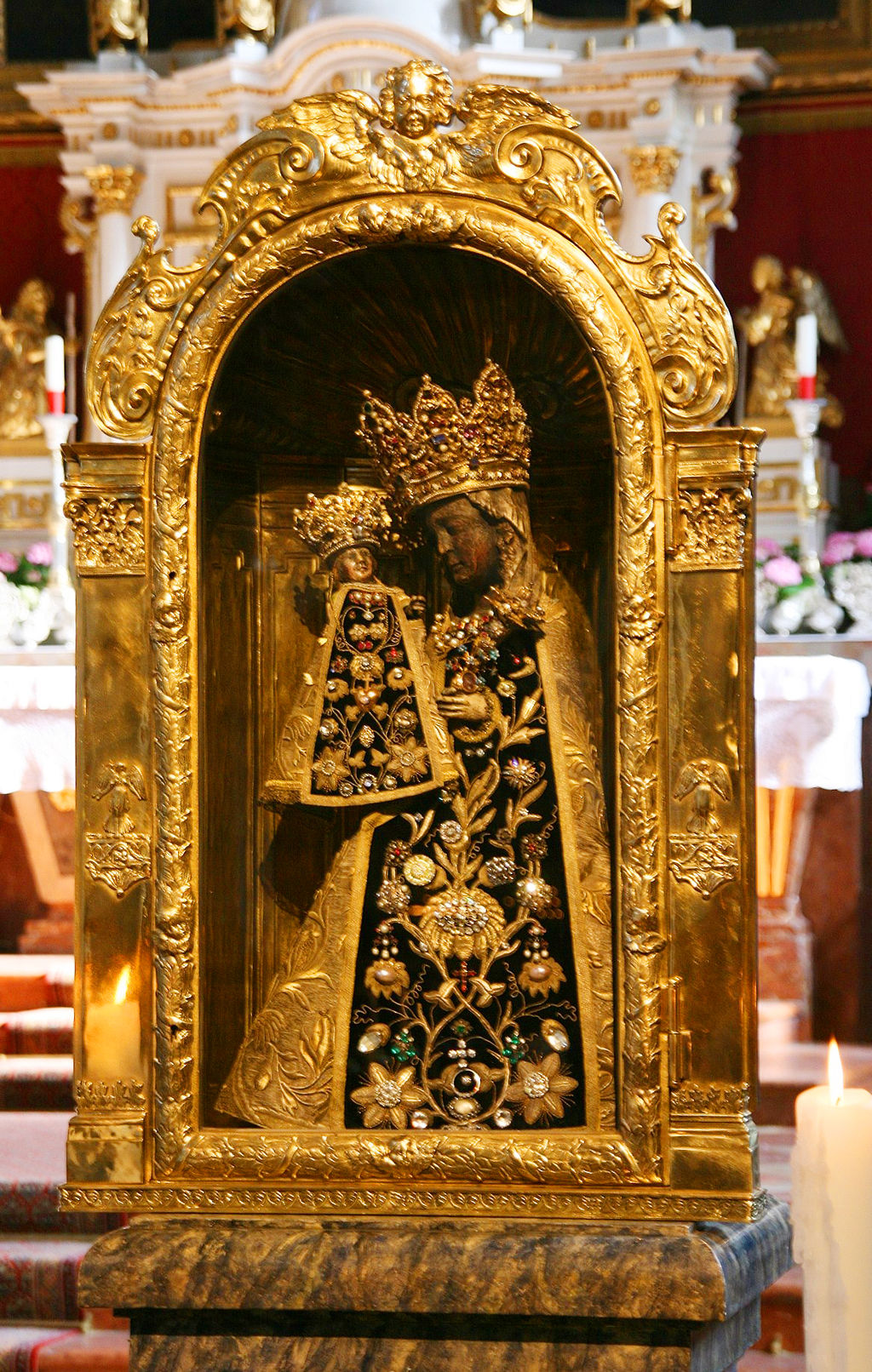
As Our Lady of Altötting, Germany Mary is said to have guided Joseph Ratzinger from birth to the papacy, through a childhood and young adulthood spent under the horrors of Germany’s Third Reich. His devotion to her has become legendary. Even now, when she temporarily resides in the parish church of St. Michael’s (pictured below) nearby while her ancient chapel is being restored, she carries in her scepter a custom-made sapphire ring. This ring was a gift to Fr. Ratzinger from his brother and sister, when he was appointed to be Archbishop of Munich. In 2006, after he was elected Pope Benedict XVI, Joseph returned to Altötting to give Mary his ring. (5)


Pope Benedict XVI had a great devotion to Our Lady of Altotting. It is said that she guided him throughout his life.

At the shrine of Our Lady of Knock in Ireland (pictured in banner), the shrine guide gave us this explanation about nineteenth century Marian apparitions there. (6)

“People always ask, ‘But what did Mary say?’ When we answer, ‘She was silent,’ everyone wonders how it could be, that Mary came among the garrulous Irish and didn’t say a word?

“Wherever she appears, Mary always asks for two things. She tells people to fast, and to pray. She didn’t ask us to fast because she knew we were already starving. She came with St. Joseph at her right, St. John on her left, with the angels and the Lamb on the altar, to show us that she had heard the constant prayers of her faithful Irish children.

“Everyone had lost so many members of their families to death from the Great Hunger, and then from the necessary emigration. The land had been decimated.

“We believe that Mary came just to hold us in her love, and to reassure us that there was a future. She came to bring us hope. She didn’t need to say anything. We all understood.”

© Copyright 2023 by Margaret King Zacharias, Ph.D.

Notes:

  1. https://en.wikipedia.org/wiki/Theotokos
  2. https://www.ourcatholicprayers.com/litany-of-the-blessed-virgin-mary.html#:~:text=The%20Litany%20of%20The%20Blessed%20Virgin%20Mary%2C%20also%20known%20as,1587%20by%20Pope%20Sixtus%20V.
  3. Liguori Publications, Liguori, Missouri, 1998.
  4. https://www.papalencyclicals.net/pius09/p9ineff.htm
  5. https://en.wikipedia.org/wiki/Shrine_of_Our_Lady_of_Altötting
  6. https://www.knockshrine.ie/history/

Photo credits:

Featured photo: Our Lady of Knock Interior Chapel Sculptures Attributions

Page URL: https://commons.wikimedia.org/wiki/File:Apparition_Chapel_with_Stained_Window.jpg

File URL: https://upload.wikimedia.org/wikipedia/commons/8/8a/Apparition_Chapel_with_Stained_Window.jpg

Attributions: KnockShrine, CC BY-SA 4.0 <https://creativecommons.org/licenses/by-sa/4.0>, via Wikimedia Commons

Inset Photo: Image of Our Lady of Altotting

Page URL: https://commons.wikimedia.org/wiki/File:Gnadenbild,_Gnadenkapelle_Alt%C3%B6tting.jpeg

File URL: https://upload.wikimedia.org/wikipedia/commons/e/ed/Gnadenbild%2C_Gnadenkapelle_Alt%C3%B6tting.jpeg

Attribution: Finner: Siddhartha Finner, Dipl.Ing.-Architektur, CC BY-SA 3.0 <https://creativecommons.org/licenses/by-sa/3.0>, via Wikimedia Commons

Licensure: https://creativecommons.org/licenses/by-sa/3.0/deed.en


Hope and Resilience

Hope and Resilience

Only Divine Providence could have woven such a tale. I can just offer you a sketchy map, and a few further clues. But we’re all a part of it. You’ll find your way.

This story opens in the mid-1800’s, with an English nobleman who collected American tree specimens to forest his Irish estate across the Atlantic Ocean. It encounters White Russians fleeing persecution following the communist revolution in 1917. It continues into the 1920’s, with an ambitious Irish diplomatic attaché in Paris; and a devastating family tragedy in Ireland.

Our tale emerged again in a small Swiss town in 1957, when a Protestant housewife received an indelible message in prayer from an Eastern Orthodox Catholic Saint.

But perhaps the most interesting plot twist occurred in the late 1940’s or early 1950’s, when a group of Irish schoolboys discovered dusty 15th-century religious icons while searching for treasure in a 19th-century reproduction-Gothic castle.

For me, it began on a recent March morning when a massive herd of glossy cattle crossed the road in front of our tour bus for more than fifteen minutes on their way to pasture. These cows dwell at Glenstal Abbey near Murroe, County Limerick, in the ancient Munster region of Ireland. (1)

Assisted by their dedicated local lay-oblate community, the Benedictine monks at Glenstal administer a substantial farm; a nationally-accredited Roman Catholic boarding school; and a conference center that offers retreats, spiritual consultations, and pilgrimages to individuals and groups of different faiths from around the world. A major inspiration for many pilgrimages to Glenstal Abbey is its unique collection of rare Eastern Orthodox prayer icons. These icons are displayed in a custom-built underground chapel beneath the main church.

In the Eastern Orthodox faith tradition, iconography is regarded as a particular kind of worship and a specific religious vocation. Although drawing and painting are involved, icons are always referred to as “written,” not made. The most important stages in their writing are the trained religious artists’ disciplines, fasting and prayer. Orthodox believers do not “look at” their icons; they present themselves before them, so that the saints can communicate with human beings on earth through the windows of their eyes.

The White Russians eventually found their way to Paris, France. Many families at that time were trapped in an economic depression that gripped continental Europe as well as North America. Too often, they were forced to part with their most precious possessions in order to support their families. For the Russian émigrés, that meant selling their family icons.

It seems that a diplomatic attaché for the Irish government, stationed in Paris, was happy to assist with the disposition of religious art works. The monks at Glenstal Abbey believe that this is how their Russian Orthodox icons were transferred to Roman Catholic Ireland.

At some point the icons landed at the castle forested with North American trees, once owned by the Barrington family. When their daughter was killed by Irish freedom fighters in 1921, the family returned to England. A local priest, Monsignor James Ryan, purchased Glenstal Castle in 1926 and donated it to the Benedictine Order, to found an abbey and school in the Archdiocese of Cashel. Glenstal Priory was inaugurated in January of 1928; the abbey boys’ school was established four years later in 1932. (2)

But following the turmoil of World War II, by the early 1950’s the Orthodox icons’ presence at Glenstal Abbey had been almost forgotten. Inquisitive schoolboys, digging through nooks and crannies, apparently came upon them stored somewhere in the castle. The Russian Orthodox saints traveled across a Roman Catholic campus in children’s hands, to decorate dorm room walls or to lie hidden under beds as secret prayer talismans.

Back on the continent, in 1957 the small-town wife of a Reformed Church pastor began to see saints and angels, including Mother Mary, beckoning to her from Roman Catholic churches in central Switzerland. Eventually, Joa Bolendas entered these churches to pray.

According to one of Bolendas’ accounts, St. Nicholas appeared to her and said, “This is the testimony of an early Saint of the Russian Orthodox Church.” In their encounters, St. Nicholas showed her images of icons that he said were “missing.” He told her that these icons were important for the future of the world and must be found. St. Nicholas thought that the icons he sought were somewhere in Ireland.

Bolendas’ nephew by marriage, John Hill, a graduate of Glenstal Abbey School, was in residence at that time in the C. G. Jung Institute of Zurich. Acting as a family member and not in his professional capacity, John began to accompany his wife’s aunt to church. He observed her in ecstatic prayer (3).

Joa Bolendas was described by all who knew her as “a strong woman,” and “a thoroughly practical person.” John himself watched her come out of prayer visions and briskly proceed to a nearby shop. There she would haggle with the butcher for his best cut of meat at the lowest price, to cook for her family’s dinner. John Hill deemed her fully grounded in reality.

He had a vague recollection of “those icons we used to play with at Glenstal as boys.” The matter seemed worthy of investigation. John called his old friend Mark Patrick Hederman, a monk, writer, teacher and administrator for the same abbey school where they both grew up.

In 1976, John and his wife Anne-Marie, with a photographer selected by Joa Bolendas, traveled back to Glenstal Abbey to examine whatever icons they might be able to find there.

Photographs of the icons they located in a thorough search of abbey and school were shown to Joa after they returned to Switzerland. She confirmed them as the same images St. Nicholas had revealed to her in visions. The saint then requested through Joa that the Benedictine brothers at Glenstal “build a chapel at their abbey to preserve them.”

All of the saints and angels who spoke with Joa over many years conveyed the same essential message. Whether explicitly or implicitly, the thrust of these revelations was always the importance of unity among mankind. If the chapel was built at Glenstal, St. Nicholas told her, “Unity will follow for Germany and Ireland.”

When Brother Patrick first presented a multi-million-dollar bid he’d received from a local contractor, the proposal to build a free-standing icon chapel on the abbey grounds was firmly rejected by the Glenstal monastic community.

Over time, however, the Benedictine brothers eventually developed a consensus. If Brother Patrick could find a way to build this chapel in the unused dirt cellar under the abbey church, they might be willing to help support it.

A third Glenstal Abbey School classmate, Jeremy Williams, had grown up to become one of Ireland’s leading architects. Patrick called Jeremy to the abbey for a consult. The aesthetic they both envisioned was a smaller version of the chapel at St. Sophia Church in Istanbul.

Their design was ultimately built in Glenstal Abbey’s church cellar to house the Russian icons, as well as an equally-precious donated collection of Greek Orthodox icons.

Their cement contractor in Cologne, Germany, who ground real stone for use in the colored-concrete chapel floor, provided the abbey with hefty discounts. In return the monastic community granted permission for the contractor to use an image of the finished chapel in promotional materials.

Before construction even began, while the abbey team was still examining the underground structure, a man no one had ever seen before walked in.

He said, “I know what you’re doing here! I know how to do it! No one else must touch it!”

With the monks’ permission, he spent the night alone, “inside the black box,” for inspiration. That ‘stranger’ turned out to be a local man, the brilliant and idiosyncratic Irish artist James Scanlon, who created luminous stained-glass medallions to anchor and illuminate a portion of the chapel ceiling vault.

Even the cows offered up their own fair share of the chapel costs, in cream and butter. Dairy sales from the farm help to support all of the spiritual and educational programs offered at Glenstal Abbey.

The finished icon chapel opened on April 10, 1988, with ancient musical tones and choral chants. These were researched as well as performed by Irish composer Michael O’Sullivan, with Rev. Nóirín Ní Riain, Ph.D. as liturgical cantor. (4)

Just nineteen months later, on November 9, 1989, the Berlin wall that had divided Germany for more than five decades fell to the ground. On 10 April, 1998, the tenth anniversary of the chapel’s consecration, Good Friday Agreements brought peace to Northern Ireland, putting an end to physical interreligious violence there.

This evidence is anecdotal, of course. Private devotions are treated as optional, not obligatory, in our Roman Catholic church. Still, the discerning monks of Glenstal Abbey visit their icon chapel every day, at the same time, to pray for healing in our world. This devotion is performed in addition to their traditional Benedictine charism, ora et labora, a daily rhythm of work and prayer in the Liturgy of the Hours.

If nothing else, the length and breadth of this history illustrate that dark times of many different kinds have always besieged humanity. The haunting eyes of early saints in the Glenstal Abbey chapel continue to regard contemporary pilgrims with eternal compassion.

Glenstal Abbey will celebrate the icon chapel’s 35th anniversary on April 10, 2023.

Should you, yourself, feel called to reflect on how a group of 1950’s Irish schoolboys ‘just happened’ to be in the right places, at the right times, prepared with the exact adult skills to provide every resource required to incarnate this chapel … Please join in prayers for unity and peace on Easter Monday.

 “Drive away the darkness that surrounds us,

Shed onto us the mantle of your light.

Help us to know your will,

And give us the courage to do it.” (5)

 Amen.
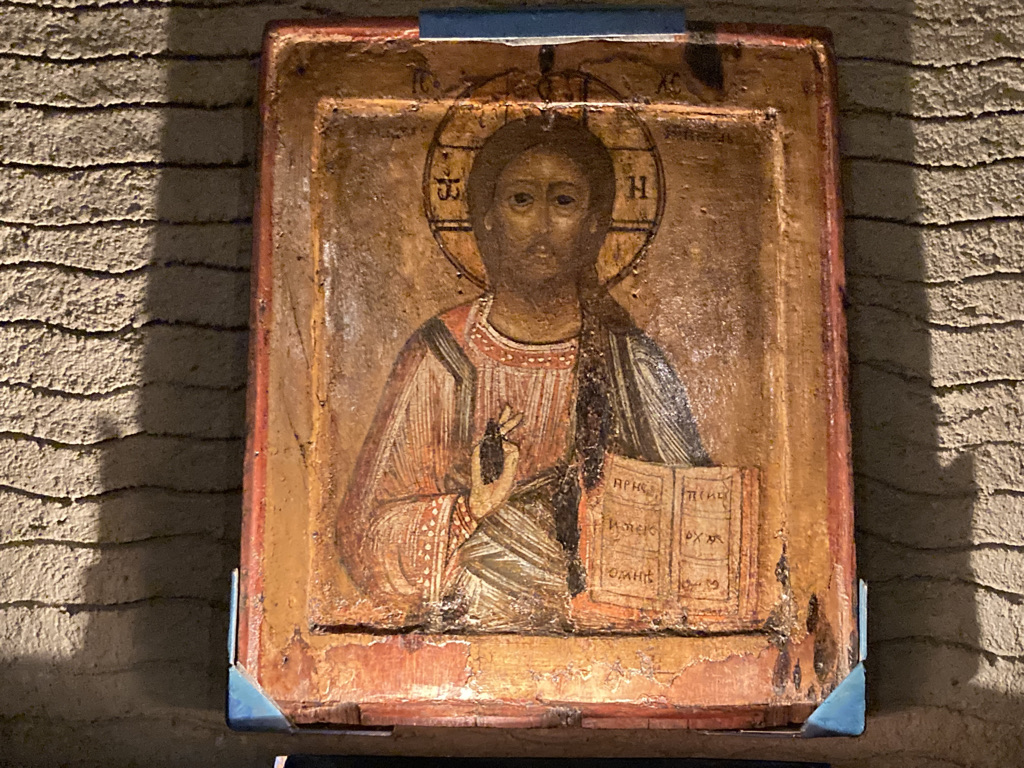
Original Russian Icon “The Healing Christ” in the Glenstal Abbey Icon Chapel Photo by Margaret Zacharias, taken with permission from Don Mark Patrick Hederman


Featured Image: Collection of Original Eastern Orthodox Icons in the Glenstal Abbey Chapel Photo by Margaret Zacharias, taken with permission from Don Mark Patrick Hederman The “Angel of Silence” can be seen at lower right.

Notes:

  1. https://glenstal.com/abbey/
  2. A more detailed history of Glenstal Abbey, and exposition about the educational philosophy of the secondary-level boy’s school, may be found in former Headmaster Mark Patrick Hederman’s book:

 The Boy in the Bubble: Education as Personal Relationship

 https://www.amazon.com/Boy-Bubble-Education-Personal-Relationship/dp/1847304052/ref=tmm_pap_swatch_0?_encoding=UTF8&qid=1680133263&sr=8-1

  1. The full story of Joa Bolendas’ visionary prayer experiences may be found in her books:

So That You May Be One

https://www.amazon.com/s?k=Joa+Bolendas+That+You+Be+One&crid=1RFFTDTLMZBLJ&sprefix=joa+bolendas+that+you+be+one%2Caps%2C155&ref=nb_sb_noss

Alive in God’s World

https://www.amazon.com/Alive-Gods-World-Described-Bolendas/dp/097010975X/ref=sr_1_1?crid=Q8W6BZWU4KAG&keywords=Joa+Bolendas+Alive+In+God%27s+World&qid=1679641031&sprefix=joa+bolendas+alive+in+god%27s+world%2Caps%2C144&sr=8-1.

  1. Recordings of the early Christian music that accompanied the consecration of Glenstal Abbey’s icon chapel may be found here:

 Vox De Nube

https://www.amazon.com/dp/B09S3F6YQ1/ref=sr_1_2?crid=3RR326YJQLC6A&keywords=vox+di+nube&qid=1679728636&sprefix=vox+de+nube%2Caps%2C142&sr=8-2

  1. One prayer given in a dream to Don Mark Patrick Hederman, now Abbot emeritus of Glenstal Abbey.

This article was prepared with help and permission from Don Mark Patrick Hederman and John Hill.

Any errors of fact or interpretation are the sole responsibility of the author. 

© Copyright 2023 by Margaret King Zacharias, Ph.D.

 

Mass on the Rock

Mass on the Rock

It was what the Irish call a ‘soft day.’ Drenching afternoon rain fell after a cold and misty morning. Some among us worried that it might not be worth the effort. It was difficult enough to walk when the ground was dry, never mind through a spooky meadow that rolled under your feet like a ship on the churning sea.

It looked to be quite a distance, too, at the end of what had already been an exhausting day. You’d understand if you yourself had a knee or a hip needing surgery. This group had eight or ten of them. Our hosts, who’d spent the whole wet day in the field preparing for our arrival, did understand. They kindly offered us the church in town to celebrate Mass for any of our pilgrims who felt they couldn’t make their way to the Rock.

Then somebody said, “The rain’s letting up!” Somebody said, “Let’s those of us who feel we can go, let’s give it a try?”

With Father’s encouragement, everyone managed to clamber off the bus and onto a gravel road. At the open fence gate, a young woman smiled and said, “You’re very welcome!” Just beyond her, the farmer took each hand into his own. He inspected our eyes, pilgrim by pilgrim, nodding his personal welcome as if it were a matter of life and death.

For over three hundred years, it was.

We set out across the fields, breathing in the thick green air. We shivered in our raincoats. Most of us had no idea where we were headed. If you knew what to look for, you might be able to recognize the place by an ancient grove of sacred Druid trees perched on the horizon. Eventually our guide pointed out an entrance, hidden among shrubs that grew beneath the trees. We pushed through a narrow opening to discover steep stone steps cut into a muddy hillside.

More than six feet below, the freshly-excavated chapel stretched out in an ell. Heavy cinder blocks were stacked along the sides; new boards were laid on top of the blocks for benches, and boards were laid below for walking across the mud. A pearly grey boulder held the corner. The air surged with aromas:  freshly-sawn lumber, damp peat and fertile earth. We felt humbled to see so much labor expended to provide for us.

“Why, they wouldn’t believe we’re Father Flanagan’s people,” someone said, “If we hadn’t had the courage to come!’

The Rock turned out to be a smooth, asymmetrical chunk of granite, nearly three feet tall, and almost five feet in diameter. It sparkled as if it had been scrubbed with rainbows. Atop the boulder stood pictures of our Lord and our Lady on either side of a simple Crucifix.

Father laid his communion kit directly onto this stone altar. He passed the scripture book to the lector and shook off his coat. He vested for Mass right there on the soil among us. He tried to light candles, but they kept blowing out. Worn over only a short-sleeved shirt, his surplice flew in the chilly gale. But the flame of the Holy Spirit glowed in all hearts as he made the sign of the cross to open our liturgy.

While Father distributed Eucharist, three of us together began to sing at the same moment, the same inspired song: “This is holy ground. We’re standing on holy ground, for the Lord is present and where He is, is holy.” Another woman mimed the words for each verse while everybody sang: “He’s given us holy hands. He’s given us holy lips.” Father maneuvered from plank to plank as if he’d never celebrated Mass in any other way.

Stalks of ripened grain in the fields above our heads swayed in the breeze, blessing us like banners. Though we knew we would be invisible from the road, we could almost hear the tramp of soldiers’ feet on the wind. We reflected on Father’s homily, thinking about how many generations of Irish people had gathered for Mass just like this, under penalty of death. They hid below crops they were forbidden to eat, celebrating Eucharist without the luxuries of raincoats, candles or songs.

All that nourished them was the Lord. They did not consider His Feast a meager meal.

When we returned to ordinary time and contemporary place, that luscious green labyrinth still shimmied under our feet. But this time the walk did not seem long.

Three-year-old Michael led the charge to the bus. He scampered across the landscape with a wild flower in his hand. He went spinning around the meadow, cavorting in tall grass under the wide sky.

Every single one of us danced along behind him, all the way back to Ballymoe.

© Copyright 2023 by Margaret Zacharias

Royalty-Free Stock Image Shutterstock_1719546454 Licensed to Pearlpledge82 User ID 289304735 Standard License February 19, 2023

*A previous version of this true story was published in Sunday Bulletin, St. Theresa of the Child Jesus Catholic Church, Diocese of Des Moines, Iowa, 2007; and appears in another form on the author’s website, www.animaviva.com.