
The Prison Cook

The Prison Cook


Aidelade, the prison cook, was tough customer for this missionary in Oklahoma.

Today I am working in the prison kitchen with Adelaide.  We are making macaroni and cheese. She has a job here as a cook. I am here doing missionary work for my church and so I am helping her make the pasta.

Adelaide has a sharp tongue. I try to put some water from the pot into the pan with the onion.

“Not so fast,” says Adelaide. “You haven’t boiled the pasta yet, so no use in putting it there now.”

“Ok!” I said.  It is her mac and cheese for the prisoners. She is going to boil some water and put some pasta in it and fry the onion in oil. Then some pasta water and some milk. She will melt the cheese on a very low temp so it doesn’t curdle before mixing it with the pasta mixture.

Another time when I went, I thought of bringing some steak for the prisoners since they don’t get much quality food.  “Not so fast,” she said. “They get soybean stuff, not steak.”  There were several cans of “soybean stuff” laying around the kitchen.

They also get some greens.

“Adelaide, do you have family?” I asked.

“No,” she snapped. “That’s why I am here.”

“Do you ever go to church or read the Bible?” I ventured.

“NO. This is a prison. Do you want to help me make some Nutraloaf?” This is a loaf of various foods that is so disgusting it’s used as punishment.

“Adelaide, what would make you happy?”

She paused for a while and spoke slowly.

“When I was young, I wanted to be a chef at a nice restaurant. But that didn’t happen. I needed a job so I got the job here.”

“Why don’t you make a nice dinner here?”

“Who’s going to pay?” she answered.

“We can find a donor at my church. Do you think they would like coq au vin?”

We got the funds for the dinner and we got the shopping done.

Now it was time to cook!

“I’ll need your help,” she said. “This will be a lot of work.”

This is the recipe we used for the dinner (adapted from allrecipes.com).

Chef John’s Coq au Vin

6 bone-in, skin-on chicken thighs

kosher salt and freshly ground black pepper to taste

8 ounces bacon, sliced crosswise into 1/2-inch pieces

10 large button mushrooms, quartered

½ large yellow onion, diced

2 shallots, sliced

2 teaspoons all-purpose flour

2 teaspoons butter

1½ cups red wine

6 sprigs fresh thyme

1 cup chicken broth

Directions

Preheat the oven to 375 degrees F. Season chicken with salt and black pepper.

Sauté bacon in an oven-proof skillet over medium-high heat, until evenly browned. Remove bacon.

Increase the heat to high and cook chicken thighs 2 to 4 minutes per side. Transfer chicken to a plate.

Sauté mushrooms, onion, and shallots with a pinch of salt in the hot skillet until golden and caramelized, 7 to 12 minutes.

Stir in flour and butter.

Pour red wine into the skillet and bring to a boil. Stir in bacon and thyme and simmer until wine is about 1/3 reduced, 3 to 5 minutes. Pour in chicken broth and return chicken thighs to the skillet; bring to a simmer.

Transfer the skillet to the preheated oven and cook for 60 minutes or until temperature is 165 degrees F. Transfer chicken to a platter.

Thicken sauce in skillet then spoon over chicken.


We decided to serve it over noodles.

We brought it out and the prisoners formed a line as they normally did. When we uncovered the pot the prisoners gasped. The aroma was amazing. We served the food and the prisoners enjoyed it thoroughly.

© Copyright 2026 by Cecile Bianco

Mitzewich, John. “Chef John’s Coq au Vin.” All Recipes, last modified February 3, 2025, https://www.allrecipes.com/recipe/239230/chef-johns-coq-au-vin/

Elder is a Verb

Editor’s note: Technical issues are a nuisance, but in this case it is to our benefit because we revisit Margaret’s September column which disappeared into the ether, along with several other author’s works, due to website issues, now resolved, the latter part of the year.


“… It was not you who chose me, but I who chose you and appointed you to go and

bear fruit that will remain …”  — John 15:16

“Now is the season of the fruiting and the dying.”  — Mary Dingman, SSSF


Elder is a Verb

My long-time spiritual director, Sister Mary Dingman (1919-2017), a vowed member of the School Sisters of St. Francis, was the first person from whom I heard the words, “elder is a verb.”

Sister Mary served her order with distinction as novice mistress, postulancy mistress, Catholic high school teacher, provincial coordinator, and formation director in multiple settings, from the Archdiocese of Milwaukee to the Archdiocese of Omaha. (1)

An apocryphal story tells that while she was still a novice herself, Mary refused a demand to sit in the back seat, from her brother’s fellow seminarian who was giving her a ride back to the convent from their rural hometown.

He was afraid of being seen with a female in his automobile. Novice Mary climbed straight into the front passenger seat. She didn’t recognize any difference in moral responsibility among disciples of the Lord, only different roles to fulfill.

Sister Mary was already a recognized religious figure in her own right by the time her older brother, Bishop Maurice Dingman (1914-1992), called her back to their home state of Iowa.  He asked her to support and assist the Jesuit priests who served Emmaus Community prayer house, to extend opportunities for professional spiritual direction beyond the clergy and into the wider Des Moines lay community.

For more than twenty years, Mary Dingman, SSSF served as a spiritual director at Emmaus House, in a historic Victorian two-story home located close the inner city. She prepared daily lunches where everyone was welcomed to the feast in her beautifully set dining room, after liturgy and Eucharist were offered in the home’s cozy living room. Mass was celebrated there for many years by one of the Jesuit or diocesan priests, as simply and profoundly as the earliest Christians celebrated in the catacombs. Later, centering prayer groups and holy day dinners joined the schedule as the Emmaus community grew.

Sister Mary hosted Catholic and Protestant clergymen, vowed religious, and laypersons for private retreats in the small bedrooms upstairs, providing three excellent meals a day along with plenty of quiet time and peace to enjoy the gardens that surrounded her home. She was still driving, by herself, around the state to provide directed retreats at monasteries and convents, into her late eighties.

Sister Mary Dingman fulfilled her commission as an apostle proclaimed by Jesus in the Gospel of John: to bear fruit that would last.

Emmaus House maintains its commitment to Ignatian Spirituality and community fellowship in the Diocese of Des Moines, even to this very day; offering educational conferences, group and private retreats, as well as personal spiritual direction, now from a new home that is better-equipped to utilize modern technology. (2)

What about us?

As the Autumn Equinox arrives this Monday, September 22, where do we find ourselves? Probably most members of the Catholic Writers Guild are attending Mass regularly, and making strong efforts to educate their families in the faith.

We might not want to think too much about our own deaths, but are we still living our faith to its fullest?

According to the United States census, all members of the United States “Baby Boom” population, people who were born between 1946 and 1964, will not reach the current “retirement” age of 65 until 2030 (3).

“Independent living communities” for “senior citizens” have been popping up like mushrooms all over the country for decades, and many have long wait lists as well as hefty fees. Busy families with active young children and teenagers are too often forced to beg, in some places, to find a single bed available in a skilled nursing home with adequate facilities to help them care for aging parents.

How many devout and aging Catholics do we know, who are facing difficult choices for their final years?

The Oxford English Dictionary gives three parts of speech for the word “elder”:  noun, adjective, and verb – which is offered third in order, after the noun and the adjective, because it is the least common usage.

“1. verb trans. With it, to play the elder. rare. …”

“2. verb intrans. Become older, begin to show signs of age. colloq. and poet. …”

“3. verb trans. Make a request to or admonish a person …” (4)

But none of these were what my friend Sister Mary meant, nor how she lived her own life. She spoke with an active verb, and went about “eldering” with her whole self.

Are we thinking too much about the leaves falling and dreading winter? Are we approaching our own “autumns” as fates to “die” rather than to “fruit”?

Many older people in our society are struggling to afford food on limited social security payments. Children in schools often need surrogate grandparents to listen to their reading and tell them stories, when parents may be too busy or too overwhelmed.

Families, parishes, and dioceses offer plentiful opportunities to help with food pantries, assist the ill or handicapped, offer constructive personal attention to children.

Perhaps most important, “Baby Boomers” who have already retired and those who will retire over the next three decades are the last generation on earth who will remember a culture, and a quality of human life, before demands and consequences of administration by computer.

We can leave an imprint of real experiences in direct and human interaction with the generations that will follow us.

The saints in heaven watch over us as we drag ourselves out of bed, perhaps groaning with arthritic pain. They listen to and intercede for our prayers on behalf of our ancestors, neighbors, children, and grandchildren. They see us picking up our glasses, hearing aids, keys, canes, or walkers, putting on our coats and boots, going out to take care of our daily business.

No matter our circumstances, we can move forward into this autumn of 2025 — even as our earthly weather starts progressing towards winter – carrying the fruits of love, hope, and genuine encounters that endure.


© 2025 by Margaret King Zacharias

Feature photo: First Color in Iowa – Photo Credit Margaret Zacharias. Published with permission.

Inset photo: Autumn Rainbow to Heaven – Photo Credit Charles Zacharias.  Published with permission.


Notes

  1. https://www.barrmemorialchapel.com/obituary/4352175
  2. https://www.theemmaushouse.org/about-us
  3. https://www.census.gov/library/stories/2019/12/by-2030-all-baby-boomers-will-be-age-65-or-older.html
  4. Shorter Oxford English Dictionary, Fifth Edition, Volume I A-M, Oxford University Press, Great Clarendon Street, OX2 6DP, Published in the United States by Oxford University Press Inc, New York, 2002, p. 801.

The Intermediate Steps

Editor’s Note: We lost Jane’s December reflection due to website issues — now resolved — but can enjoy once again reading about the inspiration for her story that appears in the Catholic Writers Guild’s first anthology, Pilgrim Tales. 

The Intermediate Steps

How do you send an angel on a pilgrimage?

That was my first thought on reading the subject of the Catholic Writers Guild anthology, and no answer presented itself. I love writing about angels (ten of my books feature angels as main characters) and I would have jumped at the chance to write another one here.

Being pure spirits, angels are understood to move between Point A and Point B without traversing the intermediate space. You’re at 83rd and Park but want to see the ducks at Choate Pond Park? There you are. A friend calls for help? You’re immediately on hand. (Well, not “on hand” if you’re a pure spirit, but I’m human, and, well …)

A pilgrimage for an angel would go something like, “Well, I’m here. Cool.” I wasn’t getting five thousand words out of that.

An angel would, however, have to traverse the intermediate space if he were accompanying someone else who had to, though. So … a guardian angel of a human.

Even so, pilgrimages imply a spiritual journey as well as a physical journey. We accept that angels aren’t perfect (Job 4:18), and since God is mysterious and beyond even an angel’s comprehension, of course an angel would always be delighted to learn more about Him. For a creature who’s existed for thousands of years, though, conditions would have to be extreme to reveal a new aspect of God, or to draw him closer to God in a way he’d never needed to before.

And that’s why I sent my angel to Purgatory.

“Way Stations” begins with a guardian who’s still shaken by his charge’s last hours and the stress of her judgment. She’s saved, but she’s in Purgatory. She’s also “secluded,” meaning she can’t sense her own guardian. The Purgatory angels assure him she’s safe, and he can leave, but he refuses. He’s not leaving her side until she enters Heaven.

Purgatory is a wasteland, and his charge starts walking.

The angel, who up until now was secure in his identity and his job and his work, walks with her. For the first time, he feels useless and stalled out, and it’s in that position that he sees how his charge’s soul begins to respond to the Holy Spirit. It’s not easy.

I say, “But I’m not the one in Purgatory.”

“Look around.” The other angel snickers. “Traveling? Struggling? You most definitely are in Purgatory.”

Of course an angel would never sin, nor want to sin, but I suspect it’s possible to get “stuck” in one way of relating to God. Everything can be “good enough.” Except God isn’t interested in “good enough.” He wants all of us, and sometimes, that may mean taking a journey you never intended, through all the intermediate steps — even for an angel.

© Copyright 2025 by Jane Lebak

Feature photo: https://docs.google.com/document/d/1RCk-dg0blH4Z1O0BOv1JSSVEYau71gvYTB2MqOR9Wr0/edit?usp=sharing

Waterfall Renew

Recently, my daughter and I were discussing goals, resolutions, and words for 2026. She seems a natural at this exercise, while I still struggle after decades. But with her gentle coaxing, I settled on my word for the year: replenish. 

Defined in Dictionary.com (British version), replenish is an action verb meaning 

  1. to make full or complete again by supplying what has been used up or is lacking
  2. to put fresh fuel on (a fire)

It wasn’t the first word that came to mind, but replenish aptly describes what I need to focus on right now. After an exacting year and a wonderfully hectic holiday season, many areas of my life need replenishing. It’s not a matter of determination, which was the first word I considered, but rather, a matter of identifying and prioritizing which stores need my attention—health, spiritual life, writing, family, financial, and personal development.

I remembered that on a hiking trip last year, my daughter and I were concerned that the storm and wind overnight might hamper our hiking plans for the next day. Fortunately, the rain stopped, and as we drove the road to Cadillac Mountain in Acadia National Park, we were amazed to see a couple of small waterfalls along the road where there had been none the day before. The chaos of the storm created rushing waters now flowing over the rock. What a sight to behold, especially since on the return trip down the mountain, the waterfalls were gone—spent, leaving only glistening rocks along the road.

If nature can provide such utter beauty after chaos and leave replenishing gifts like the renewal of a waterfall, even if only a temporary one, how much more trust should I have that my loving Creator will fill up my emptied stores with precisely what is needed? 

“[B]ut those who drink of the water that I will give them will never be thirsty. The water that I will give will become in them a spring of water gushing up to eternal life.”—John 4:14

After the effects of a draining year, I am confident that any droughts from 2025 will be washed away and replaced with new, cleansing waters. My first priority will focus on replenishing my spiritual store. I wrote the following haiku after considering God’s gift of renewal from those roadside waterfalls.


Waterfall Renew

After night’s rainfall

releases cleansing waters

old droughts wash away.


Copyright Paula Veloso Babadi 2026

Edited by Gabriella Batel

Photo taken by author on the road to Cadillac Mountain, Acadia National Park.

Generations and Journeys: A Lesson in Resolve and Encouragement

I thought about my granddaughter when I hesitated at the wooden planks in a section of Ship Harbor Trail. Traversing the granite rock mounds, gravelly paths, and knotted tree roots seemed less intimidating than the narrow strips keeping me from falling into the stones and underbrush. Marveling at my granddaughter’s courage and skill, I planned on telling her that I nearly failed my first “balance beam” attempt.

She consistently scores 9s and above on her gymnastics journey; I barely garnered a 4, if only for regaining my balance with the help of trekking poles. I was scared to keep hiking, but I imagined Suri, practicing with grit and determination. The thought of her encouraged me, and boards soon gave way to graveled paths again. As my hiking mentor, my daughter, spurred me on, I finished the trail with a sense of accomplishment. 

“Whoever walks with the wise becomes wise, but the companion of fools suffers harm.”—Proverbs 13:20

Every journey begins at some point. When Suri started her adventure as a gymnast, her balance beam was ground-level, not four feet above. Now, she flips and appears to glide effortlessly as she delivers her routine. What people don’t see as she performs are the countless hours she spent training with her coach, and the courage she mustered to continue gymnastics after enduring multiple falls and injuries. With the unwavering encouragement from her mom and dad, she now enjoys a well-earned view of cheering crowds.

I wouldn’t have known the thrill of views at Acadia National Park without the patience of my daughter, Sheila, as she taught me how to navigate varying terrains. Her support fostered my resolve and opened new horizons in nature for me. I like to think I cheered her on as enthusiastically when she was learning and growing. Sheila displayed the same determination and perseverance as her niece, Suri, especially when balancing her studies in music, software engineering, foreign languages, and finance, among myriad other accomplishments. Her success today results from years of unseen research, practice, and effort, and from overcoming all the hurdles on her journey.

We are three generations, connected by blood, strengthened by bonds of courage, determination, and love of learning. It all starts with having the guts to take the first step (on the balance beam, the trail, the studies, the career, the hobbies) and the fortitude to overcome challenges and hardship. I wholeheartedly believe that being surrounded by loving family, friends, and mentors empowers every generation to run that race and keep on going.

“Therefore, since we are surrounded by so great a cloud of witnesses, let us also lay aside every weight and the sin that clings so closely, and let us run with perseverance the race that is set before us… .”—Hebrews 12:1

Copyright 2025 Paula Veloso Babadi

Edited by Gabriella Batel

Picture Credits: Original photos in the collage, clockwise, taken by Jahan Babadi, Paula Babadi, and Sheila Babadi, and used with permission.

Pilgrim Tales: Pilgrimage to L5

… Lucy and her mother aren’t just Catholic tourists. They’re seeking a new life after the death of Lucy’s father, and Lucy’s mom took them on this pilgrimage for help finding her new way forward. — “Pilgrimage to L5”


Churches were boring. And sad.

I’m tired of being bored and sad, she thought, casting her eyes upward. God, couldn’t something exciting happen?

Not everybody thinks pilgrimages are exciting. Eight-year-old Lucy Granger sure didn’t. In Pilgrimage to the L5 Space Station, she gets the chance to go to the home of the founder of the famous Rescue Sisters—St. Gillian of L5—on the anniversary of her sainthood, even. But it’s a lot of listening, looking, and praying, and she’d rather be doing something more exciting.

When the station’s cat leads her to the escape pod, she’s in for more excitement than she expects!

When CWG decided to make an anthology based on pilgrimages, I admit I was a little stumped at first. I’ve been on a couple of pilgrimages myself, but I’m a sci-fi writer. How could I make a pilgrimage in space—and even more, make it exciting in the way people expect sci-fi to be exciting?

I have a standard Catholic SF universe I write in: The Rescue Sisters (https://www.amazon.com/dp/B09L59B69G). This is a group of intrepid women religious who do search and rescue operations, run orphanages and hospitals, and work in safety capacities—all in outer space. My husband and I came up with the idea and we have six short stories and two books in the series so far, three of which are for children.

So I wanted to do another Rescue Sisters story for the anthology. The pilgrimage part wasn’t too hard. I had my own built-in-saint, St. Gillian of L5, founder of Our Order of the Rescue (a.k.a. the Rescue Sisters). It would be fun to return to her old stomping grounds. I’d already done an L5 story, “These Three,” so it let me bring some favorite characters back.

Next, I had to set up the rescue. What could be more natural than a bored child wandering off and getting into trouble? Toss in a cat who’s only too glad to help, and some fun complications, and that part was taken care of.

But what makes a Rescue Sisters story really good is the secondary plot—something tying into their identity not just as rescuers but as Catholics. That’s when I came up with the idea that Lucy and her mother aren’t just Catholic tourists. They’re seeking a new life after the death of Lucy’s father, and Lucy’s mom took them on this pilgrimage for help finding her new way forward.

I think the most life-changing pilgrimages happen when someone comes seeking a new way — a new way to live, a new way to love, a new way to heal.

Jesus said, “I am the Way,” yet how he leads us can be very different. Lucy’s mom finds her way—but in the course of her adventure, so does Lucy—and discovers church isn’t so boring after all.

Read “Pilgrimage to L5” in Pilgrim Tales: a Catholic Writers Guild Short Story Anthology starting this December on Amazon.

© Copyright 2025 by Karina Fabian


Edited by Mary McWilliams

A House Built Upon Rock

A House Built Upon Rock

One thing I ask of the LORD; this I seek: To dwell in the house of the LORD all the days of my life. (Psalm 27:4)

I studied a bit of psychology in high school and college. That’s what one does when working toward a social sciences degree. Intro to Psych, Psychology of Elections, Behavior and Psychology were all classes that fit in with my political science and history studies. In several classes, we discussed Maslow’s Hierarchy of Needs, the five basic needs upon which all human motivation is based. These needs propel us to seek food, safety, shelter, companionship, self-esteem, and self-actualization (becoming the best versions of ourselves). These needs are depicted in a pyramid structure with our most basic physiological needs at the bottom, and self-actualization (the hardest and most often last to achieve — if ever) was the small point at the top.

The creator of this hierarchy of needs, Abraham Maslow, was an atheist, though he did come to believe that spiritual (what he called “peak”) experiences were very important and added meaning to human lives. He believed psychology was a replacement for religion, giving humans a way to discover their fears, desires, and the like through more empirical means than spiritual ones. Maslow’s hierarchy was meant to show the progression of humans not just in terms of what they needed, but in how they sought their needs.

The Shaky Foundation

It makes perfect sense to me that our most fundamental needs are those of survival — air, water, food, sleep, and shelter — and that the basis for these is purely physical. I also see the next level of need as a worldly concept. Maslow and society tell us that humans can only thrive and survive if they have personal safety, good health, financial security, and a sense of order. Though the psalmist would argue what we hear in today’s reading:

The Lord is my light and salvation; whom should I fear? The Lord is my life’s refuge; of whom should I be afraid? (Psalm 27:1)

Maslow didn’t get this. He didn’t understand that fear can be overcome by faith. The bottom of the hierarchy focuses on physical needs, and he’s not wrong. However, it’s in the higher levels, where our spiritual needs are much greater, that his argument falls short and leaves our pyramid on shaky ground.

The Building Block

Maslow labeled the third level of need — really, the third stage of personal growth — as Love and Belonging. This includes the desire for friendship, intimacy, family, and a connection to a group or community. It is beginning with this level where I feel Maslow, his hierarchy, and society have built their houses (or pyramid) on sand.

Every person has a need to belong. There is no argument about this. However, our need for belonging goes much deeper than Maslow’s assertion that humans desire friendship, family, and community. What humans need is true love, and not just familial love, sexual love, or “I like my Skechers, but I love my Prada backpack” love (Ten Things I Hate About You). This love doesn’t come from lovers, spouses, friends, parents, or objects, though one can experience deep, meaningful love through many of these ways. Humans find this love when they open themselves to Love Itself, to the all-loving Creator who cannot be defined by earthly means of affection and offers unconditional and unwavering love.

We are like little lost lambs, combing the valley for our master, not knowing where to turn or how to find him. We are so busy seeking worldly goods, societal approval, and physical affection without going deeper to find the love we truly need. It is not the verb we should be seeking—“to love”—but the very essence of love Itself, God, who is at the same time seeking us! And when we find that love — or when He finds us — it is God who calls out to everyone what we read in today’s Gospel, “Rejoice with me because I have found my lost sheep” (Luke 15:6).

The Rise of the Pyramid

Now we come to the fourth need: Self-Esteem. A person feels wonderful when a parent or teacher praises him or her for a job well done or recognizes a particular accomplishment. However, have you ever noticed that one achievement is never enough? Humans spend their lives trying to achieve more, training to go higher, running the extra mile, or redefining the goal. We can never reach our objectives because they are always being expanded, heightened, and pushed out of reach with each accomplishment. We spend our lives reaching for the stars without our feet planted firmly on the ground.

We cannot find true peace and self-esteem when we are always trying to be our own gods. We strive to be the best, the most perfect, an icon to be revered because we are looking for acceptance and meaning through the eyes of society and not through the eyes of the one, true God. Who are we trying to impress? To what heights do we feel the need to climb to reach perfection?

When Jesus says, in Matthew 5:48, “be perfect as your heavenly Father is perfect,” He doesn’t mean we need to be perfect in human terms. He’s asking us to transform ourselves into our truer nature — the image and likeness of God Himself. He wants us to love like He does, see the world as He sees it, and love ourselves the way He loves us.


"A House Built Upon Rock" by Amy Schisler (CatholicWritersGuild)

Reaching the Top

This brings us to the highest need, that of Self-Actualization. Maslow claimed most people will never obtain this in their lifetimes. It is here where we become the best possible versions of ourselves: that combination of all the qualities we accrue as we progress toward the pinnacle of the pyramid. Maslow didn’t believe most human beings could reach this because he was an obstacle to himself in “thinking not as God does, but as human beings do” (Matthew 16:23). The psalmist tells us,

I believe that I shall see the bounty of the Lord in the land of the living. Wait for the Lord with courage; be stouthearted, and wait for the Lord. (Psalm 27:13-14)

When we put our faith one hundred percent in the Lord, we do not need to worry about the physiological needs. When we love without fear, we can have faith that our safety needs will be taken care of. We must seek God’s love first and foremost above all other forms of love for that is how we discover real love here on earth. “We love because He loved us first” (1 John 4:19).

Through that love, we discover who we are, and we begin to love ourselves. “In this is love: not that we have loved God, but that He loved us” (1 John 4:10). We need to see in ourselves the love in the Gospel, which is so great that He would “leave the ninety-nine in the desert and go after the lost one until he finds it” (Luke 15:4). Once we feel that love, we can’t help but love ourselves through His eyes. In reaching that point, we are well on our way to being the best versions of ourselves. Once there, we will be able to sing as Paul does in our first reading:

For if we live, we live in the Lord, and if we die, we die in the Lord. (Romans 14:8)

The View From the Top

Everyone is seeking something. Each of us needs to feel sheltered, safe, loved, esteemed, and accomplished. Maslow had that correct. However, his lack of understanding about God and faith caused him to fall short of recognizing where we find all those things, how we satisfy all our needs, and what gives us the strength and confidence to achieve the greatest prize: “to dwell in the house of the Lord all the days of my life” (Psalm27:4). That is the tip of the pyramid we are all trying to build.


You have made us for yourself, O Lord, and our heart is restless until it rests in you. (St. Augustine, Confessions)


Copyright 2025 Amy Schisler

What happened to the Virgin Mary?

Once there was a church that had the happiest people. They all worshipped together in harmony, young and old. They had many statues and one was a wooden statue of the Virgin and Child. One day the Deacon noticed that it was gone. Everyone was tasked with looking for her, but she was nowhere to be found and they organized a team of youngsters to find out what happened. They were Connor, Paul, Meagan, Alicia, and Linda. The committee of children went out to look for her.

They scoured the neighborhood and found the guilty party: a band of hoodlums. Connor asked them to give it back.

“No way,” said the chief hoodlum. “Only if you give us a ransom.” Connor thought fast.

“If we tell you a good story, can we get her back for free?”

“Ok” said the boy.

Each child set out to find a piece of the story that would bring the Madonna and Child back to the church.

Connor went looking around the neighborhood. He came across some people that were celebrating a gender reveal. One arch of pink balloons in the sky. It was beautiful. The parents were so happy as they looked around at their friends.

Paul tried to leave home to help find the statue, but before he could, his mother said, “Aunt Cheri is having her baby shower today and I can’t go. I have too much to do. Could you go instead? Here is your gift.”

“Ok, sure,” said Paul. He walked to his aunt’s house.

“So happy to see you, Paul!” Cheri said. The guests enjoyed hors d’oeuvres, played games like Guess the Name of the Baby, and opened gifts of clothes, baby food and toys.

Meagan went to St Luke’s hospital because she thought someone might have taken the statue for their patients. She passed by the baby ward and looked at the babies. They were so cute. She thought to herself “What if one of these was the baby Jesus?” It was hard to think of. Maybe Jesus would have had a golden aura around him, or maybe he would just look like an ordinary baby. She decided to tell the team that all the babies had a magical aura around them.

Alicia went back to the church to scour for the statue. When she was there, a crowd of people processed in. They filed in and the last ones were some proud parents with a baby in their arms dressed in white. They gave the baby to the priest who held it over the basin and said, “I baptize you in the name of the Father, and of the Son, and of the Holy Spirit,” while pouring water over the child’s head. She was fascinated with the process: a white glow seemed to emanate from the child’s clothes.

Finally, there was Linda, the youngest. She got a ride from her sister to the police station because she thought someone might have turned it in there. She sat down in the waiting room and shortly there was a huge uproar as some people excitedly came in. There was a young child with them and then a burst of joy from some other people as she was brought in. “Thank God, you found her,” they cried. There was much hugging and rejoicing. Then her sister told her it was time to go.

Each team member told the hoodlums their part of the story. When they were done, the hoodlum said “So that’s it?”

Connor said, “It’s the Joyful Mysteries: the Annunciation, the Visitation, the Nativity, the Presentation and the Finding in the Temple.”

The other group conferred and decided it was a good story after all. So that is how they all found the Virgin Mary.


©Copyright 2025 by Cecile Bianco

Featured AI Image generated in Midjourney.com by Mary McWilliams

Shattered Rocks on Solid Ground

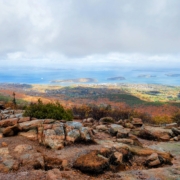
While hiking the North Ridge Trail on Cadillac Mountain at Acadia National Park, my daughter and I paused on a rock mound, breathing in the chill wind and the vibrant red, yellow, and green hues of Autumn. As we sat, Sheila commented on the solid, secure sensation emanating upward from the mountain depths. Peace flooded through me, and now I am reminded of the solid ground on which my faith was built. 

That one is like a man building a house, who dug deeply and laid the foundation on rock; when a flood arose, the river burst against that house but could not shake it, because it had been well built. Luke 6:48

“Mama, close your eyes and listen.” Sheila quietly instructed. When you are on the mountain, the wind moving through the trees sounds like the ocean waves rushing to shore. Except for the cold, with eyes closed, you could very well be at the beach where endless shells break under crushing surf.  But the mountain rock is immovable, its pink and gray and green granite boulders stand firm after countless millennia of glacial pounding. Solid as it is, the mountain harbors millions of shattered rocks along the trail, broken pieces huddled together beneath the massive outcrop where we sat.

I thought about a poem I wrote (see “Broken Shells” August 10, 2025 blog post https://www.catholicwritersguild.org/2025/08/broken-shells/) and the similarity of those shells and shattered rocks – so many pieces, each unique and beautiful despite their brokenness. Each forms a part of the whole. Each can fulfill its purpose on the canvas when there is a foundation in the Lord.  Whether at a beach or atop a mountain, whether we hear waves or wind, He is our solid ground.

“The Lord is near to the brokenhearted and saves the crushed in spirit.” Psalm 34:18

That day on the trail, I was overcome with the beauty of God’s creation and thankful for His love and care for us. The picture I took (above) is only a small glimpse of what I experienced, and my heart sings with the praise of Psalm 104:1-5:

“Bless the Lord, O my soul. O Lord my God, you are very great. You are clothed with honor and majesty, wrapped in light as with a garment. You stretch out the heavens like a tent, you set the beams of your chambers on the waters, you make the clouds your chariot, you ride on the wings of the wind, you make the winds your messengers, fire and flame your ministers. You set the earth on its foundations, so that it shall never be shaken.”


© Copyright 2025 by Paula Veloso Babadi

Feature Photo North Ridge Trail, Cadillac Mountain, Acadia Nati onal Park by Paula Veloso Babadi, used with permission.

Scripture texts in this work are taken from the New American Bible, revised edition © 2010, 1991, 1986, 1970 Confraternity of Christian Doctrine, Washington, D.C. and are used by permission of the copyright owner. All Rights Reserved.

The Shepherd’s Pie: ‘LGBT: A Return to Faith’

LGBT: A Return to Faith


“A slice of hope to raise faithful kids.”

This uplifting, ecumenical show uses engaging conversations and fun entertainment reviews to offer positive insights and media resources for families and youth leaders. We discuss current issues that impact young people at home, in school, and in the world today.

In this episode of The Shepherd’s Pie, Antony Barone Kolenc speaks with Jesús Canchola Sánchez about his journey back from the LGBT lifestyle to the Christian faith, and we discuss his novel, Escape from Natura Meta.


Check out other episodes of The Shepherd’s Pie.

"The Shepherd's Pie" LGBT: A Return to Faith


Copyright 2025 Antony Barone Kolenc