Accepting Onions

Accepting Onions

by Paula Veloso Babadi

“For if their rejection is the reconciliation of the world, what will their acceptance be but life from the dead!” (Romans 11:15)

My husband and I recently celebrated our 50th wedding anniversary.  There was no big party or extravagant vacation, just a quiet dinner reminiscing about what a journey it had been. We were grateful to be where we are now through tears and laughter, peaks and valleys. Then, my husband reminded me proudly that after all these years he was still my onion!

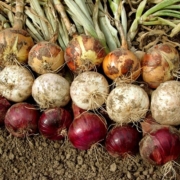
Something as simple as an onion contains contradictions. When it is pulled from the ground, it is at once intense, pungent, and strong, yet so easily torn by handling its delicate skin. It is sweet when sautéed, but causes us to cry in its raw state.  Scientists have tried to suppress the onion enzyme that brings on the tears, but in doing so, they discovered their engineering caused unwanted changes in the onion’s essence and compromised its health benefits.

Over the years, I learned that soaking an onion in water before you chop it can lessen tears, that the flavor becomes sweeter when sautéed gently on lower heat, and that when peeling, be careful because the best nutrition is preserved under that first skin. You could say the same about my own “onion.”  I decided long ago to accept onions (and my husband) as they are, without alteration— to endure raw tears and enjoy delectable taste.  My husband and I laugh over a poem I wrote about our relationship (below). We have been through raw, sweet, and savory times. You know what I mean: I love onions, but they still make me cry now and then. 


Accepting Onions

by Paula Veloso Babadi


I’m an onion through and through.

You like me when I’m in the stew, 

Flavor mingling with the rest

I think that’s when you like me best.

When you face me raw, I make you cry,

My taste too strong for you to try,

But persevere and you will find

The secrets in each layer of mine— 

For though my flavor is intense,

My benefits are quite immense.

Polyphenols, flavenoids,

Boost the heart, fill diet voids.

They reside in my first layer,

So peel me with the greatest care.

Anti-bacterial, good with liver,

Even helps with the blood sugar.

To get these benefits, you must commit

to take me daily and never quit.

Don’t like onions? Think again,

I give you paper from my skin.

Pungent taste enjoyed through time

I’m the star of feta, pita, herbs, and wine.


Those who’ve learned to appreciate me

Discovered there’s more than what they see.

I know I’m harsh and sometimes rotten, then

You throw me out, completely forgotten.

But I’m also tasty, savory, and sweet.

The choice is yours whether or not to eat.

And when my Panthial S-Oxide makes you cry

Remember my qualities that elicit a sigh.

I may be just your onion,

In some ways good and some not,

But without you to complete me,

I’m only food in the pot.

It’s when you accept me for what I am,

I become the finest pick in the land.


Copyright 2025 by Paula Veloso Babadi 

Edited by Gabriella Batel

The Lord is with you: A Scripture Meditation

The Lord is with thee: A Scripture Meditation

May is the month dedicated to Mary, and I thought it the perfect time to share a
common link between several key scripture passages that include the phrase “the Lord is with
thee.”

From the early passages in the bible where Mary is mentioned, she is immediately given
special significance. We see this in how the Angel Gabriel, God’s holy messenger, greets her. At
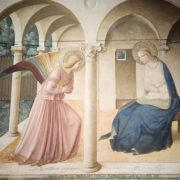
the annunciation to Mary, Gabriel said, Hail Mary, full of grace, the Lord is with thee. Recently, I
meditated on the words the Lord is with thee. I wanted to share my discoveries with you.

The words seem like a simple greeting. That was my first thought. This phrase may have
been used often in the time of Jesus to greet friends or relatives. To my surprise, I found that
the phrase is only used in the bible three distinct times. This means that the phrase was not
your run of the mill salutation such as “Greetings!,” “Good day”, or “Peace be with thee”. Otherwise,
we would encounter the words more frequently in scripture. Often, when a phrase or word is
used selectively in the bible, this means it is reserved; it is significant. This is especially true
when the instances of the phrase or word are connected in a meaningful way.

Let’s unpack the three times when the phrase The Lord is with thee is used in the bible.
There is a compelling connection between each instance.

The first time the phrase is used is in Judges 6:12 when an “angel of the Lord appeared
unto [Gideon], and said unto him, The Lord is with thee, thou mighty man of valor.” (Jdg 6:12)
Gideon is then asked by God to destroy the altar of Baal and build an altar to God in its place. In
his book, The Return of the Gods, Jonathan Cahn says of Baal:

He was the king of the gods, leader of the spirits. And he would become the chief enemy of the God of Israel… Baal was the embodiment of paganism and of all pagan gods. He was the epitome of all that was not God and all that warred against Him. Baal was the other god, the substitute god, the instead of God. He was Israel’s anti-God. (Cahn, The Return of the Gods, 39, 41)

You can understand, then, how deadly the forces of Baal were in ancient Israel and why God
would ask Gideon to destroy the profane altar. The true God wanted to send a message to the
people that He was supreme. By building an altar atop of the vanquished altar, God was
demonstrating for Israel His rightful throne.

The second time that “The Lord is with thee” is used is in 2 Samuel 7:3. King David has
shared with Nathan, one of his court prophets, that he feels the Ark of the Covenant should
have a dwelling more fit for God than a tent. Nathan responds, “Go, do all that is in your heart;
for the Lord is with you.” Later, Nathan is asked by God to share this message with David:

I have not dwelt in a house since the day I brought up the sons of Israel from Egypt … Moreover, the Lord declares to you that the Lord will make you a house. When your days are fulfilled and you lie down with your fathers, I will raise up your offspring after you, who shall come forth from your body and I will establish his kingdom. He shall build a house for my name, and I will establish the throne of his kingdom forever. (2 Samuel 7:6,11-13)

God reveals that David will be the ‘house’ of the Lord, for from him an offspring will arise or come
forth. While Gideon was asked to build an altar, a physical construct dedicated to God, the Lord
is revealing to David that, in reality, His proper place is not something man-made. His abode will
be mightier than anything man can create.

The final instance when “The Lord is with thee” is spoken is when the angel Gabriel
appears to Mary. In Luke 1:28, the angel Gabriel says, “Hail, full of grace, the Lord is with thee.”
To this, Mary was greatly troubled and “considered in her mind what sort of greeting this might
be.” (Luke 1:28) As a pious Jewish woman, Mary would have been very familiar with scripture.
Perhaps she would immediately understand the significance behind the expression The Lord is
with thee and be frightened at the deeper meaning. The angel goes on to say:

Do not be afraid, Mary, for you have found favor with God. And behold, you will
conceive in your womb and bear a son, and you shall call his name Jesus. He will be
great, and will be called the Son of the Most High; and the Lord God will give to him the throne of his father David and he will reign over the house of Jacob forever; and of his kingdom there will be no end. (Luke 1:30-33)

Mary is being asked to be a holding place for the Savior, the Lord of Lordsto be His tabernacle.
Again, no altar, no building can house God. He has ordained an entirely unique and special
dwelling place for Himself in the line of David: Mary’s womb.

Gabriel’s description of the destiny of Mary’s progeny, of the Savior, harkens back to
both Judges 6 and 2 Samuel 7. The Lord asked Gideon to tear down the altar of Baal, the vilest
of God’s enemies, and build an altar for the true God. Now Mary will become the new altar
where the most precious sacrifice is prepared. Jesus will be the ultimate destroyer of all false
gods and His sacrifice will abolish the need for any inferior sacrifices. King David desired to build
a house fit for God and now God has fulfilled His promise to create a house fit for David. Mary’s
immaculate abode will be the worthy home for David’s lineage.

The Lord was truly with Gideon, David, and Mary. He needed to be in order for them to
fulfill their august destinies. They were selected by God for marvelous deeds. Gideon, the
mighty man of valor; David, his heart full of the Lord; and Mary, full of grace, listened to the
word of the Lord and the Lord was with them. May we, not only in this month of Mary, but
always, listen to the word of God with as much faith and eagerness to serve. May we be
attentive to His calling and may the Lord be truly with us.


Copyright by Emily Henson 2025

Edited by Maggie Rosario

Meeting Bruder Klaus 

Meeting Bruder Klaus


On our third day in Switzerland, guide and driver Tony … took us into the rural hamlet of Flüeli, near the town of Sachseln, to visit the home of St. Nicholas von Flüe. I had no idea who this man was. How had I never heard of him?


Part I

A mysterious experience, and perhaps the most meaningful pilgrimage of my life, began in January of 2006. An advertisement in the local diocesan newspaper jumped out to me with that feeling I’d come to associate with lectio Divina – highlighting words that seemed to be meant specifically for me, a request from the Holy Spirit to pay particular attention.

Miraculous Journeys, a group from Omaha, Nebraska under the direction of a woman named Leona Kavan, was planning a trip to Roman Catholic shrines in Switzerland, Germany, and Austria the following October.

I’d long dreamed about visiting this part of Europe because so many of my ancestors had come from that Alpine region. My mother’s four grandparents emigrated to the United States from the Swiss Cantons of Bern and Basel.

So, I called Leona to ask for more information. We both felt an instant affinity in that first telephone conversation, and I told her I wanted to pray about it. I’d get back to her if I was interested.

As I entered the Perpetual Adoration chapel in my parish, a lay Carmelite friend I often joined for First Friday and First Saturday vigils, was praying in the rear pew. She beckoned me over, and whispered, “I understand you’ve just been talking to my friend Leona in Omaha.”

The signs continued. After I formally registered, making my own airline reservations because I would be flying out of Des Moines on American Airlines rather than from Omaha on KLM with the group, it transpired that Leona had a request.

Sister Frances, an Oblate Sister of Mary Immaculate from the National Shrine of Our Lady of the Snows in Belleville, Illinois, had received a large donation of American Airline miles from a patron of the shrine, as a gift for her retirement. She wanted to use them for this trip.

Sister Juanita, a younger vowed sister of the same order, had been assigned by their superior to accompany and assist, because Sister Frances would still be in the latter phase of recovery from knee surgery at the time this pilgrimage would take place.

We were all using the same airline. Would I please meet the sisters at Zurich airport and help them find the group when we arrived?

My original itinerary on American had routed me through Chicago, and their international transfer hub was going to be Dallas-Fort Worth. I’d never flown to Zurich and had no idea what that airport even looked like. I decided to change my ticket and meet them in the Dallas-Fort Worth airport, where I had at least some experience.

We, too, found immediate fellowship when I met Sister Frances and Sister Juanita at our international departure gate. Once we landed in Zurich, it required two trains and my best Canadian French to find out where the Omaha group had arrived – as it turned out, in a completely different terminal, invisible to us, on the other side of major construction.

But fortunately, nuns stay together in one place when you ask them, and the Holy Spirit was looking after us all. Sister Frances and Sister Juanita were waiting patiently where I left them when I returned with a map showing the correct location, and a safe route around the construction zone.

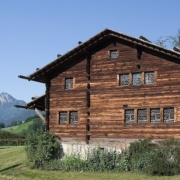
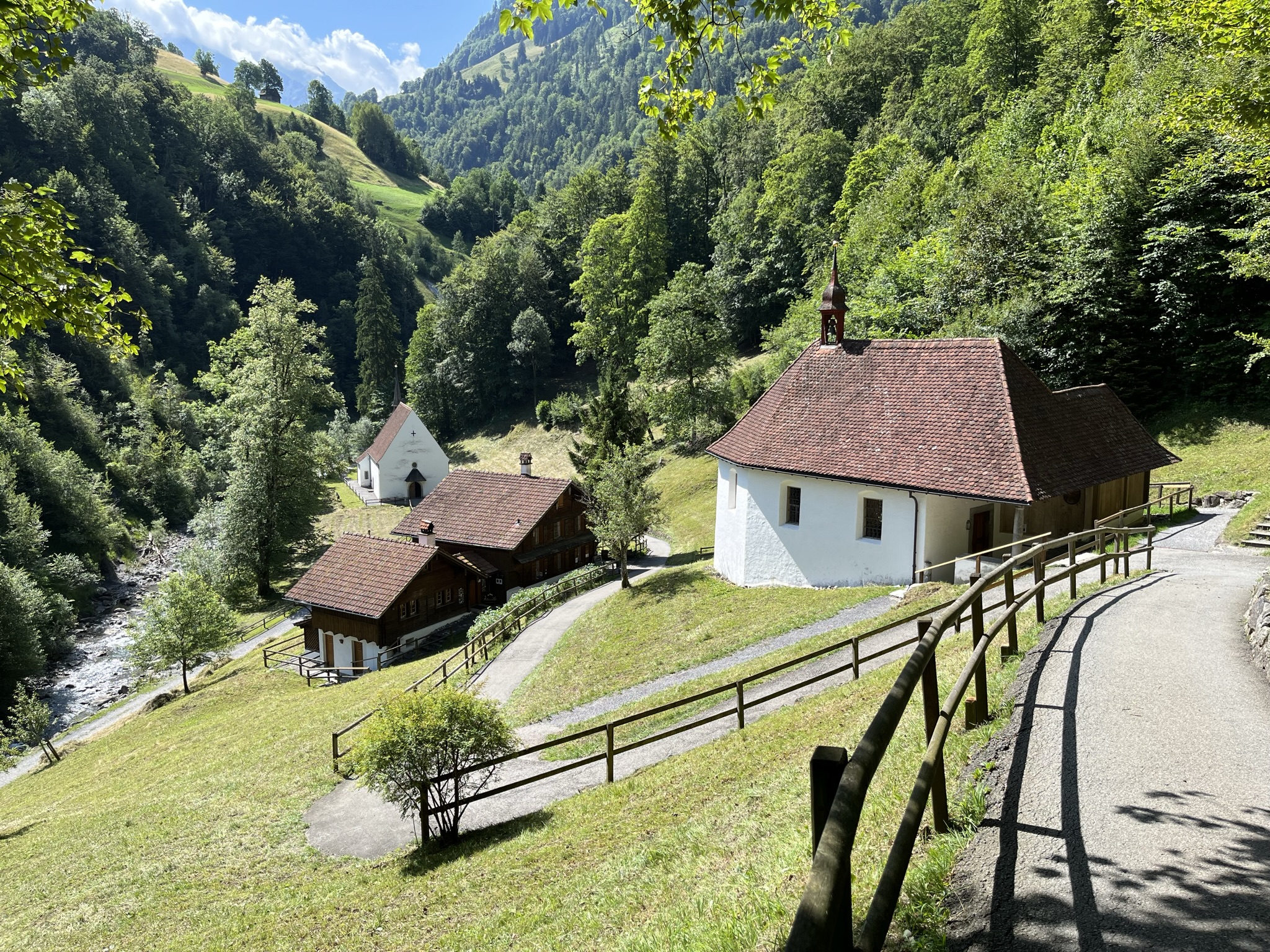
On our third day in Switzerland, guide and driver Tony, a former member of the Pontifical Swiss Guard, took us into the rural hamlet of Flüeli, near the town of Sachseln, to visit the home of St. Nicholas von Flüe.

I had no idea who this man was, and I had been a voracious reader about the saints since I joined the Church in 1989. How had I never heard of him?

Through our Omaha translator, who was fluent in German and carefully translated Tony’s exact words, it became apparent that he regarded this shrine as holier than even Engelberg Abbey, one of the greatest Benedictine houses of the high Middle Ages, and felt that our visit to Flüeli was the most sacred honor he could bestow on us during our visit.

Sister Frances, Sister Juanita, and I all looked at each other, and shook our heads. They’d never heard of this St. Nicholas, either.

The historic log chalet in front of us looked pretty rustic, and the pathway down to what our guide called “The Ranft,” on the banks of a rushing river, could only be described as treacherously steep. At least, we observed to each other, it was paved.

We composed ourselves with appropriate reverence and disembarked. Our driver pulled out Sister Frances’ foldable wheelchair from the belly of the bus, and Sister Juanita put on her game face.

We were about to learn how a 15th century farmer, soldier, hermit, and visionary became the patron saint of Switzerland, how he changed human history in his own time and for ours, and why his fellow countrymen call him simply Bruder Klaus, with great affection, to this very day.

Stay tuned for Part II next month.

Peace.


© Copyright 2025 by Margaret King Zacharias

Feature Photo: The Home of St. Nicholas von Flüe 

File URL https://upload.wikimedia.org/wikipedia/commons/e/e7/Flueli-Ranft_Wohnhaus_Bruder_Klaus.jpg

Page URL https://commons.wikimedia.org/wiki/File:Flueli-Ranft_Wohnhaus_Bruder_Klaus.jpg

Attribution Ikiwaner, CC BY-SA 3.0 <https://creativecommons.org/licenses/by-sa/3.0/>, via Wikimedia Commons

Inset photo The Ranft of St. Nicholas von Flüe, Hermit – Page 4

Page URL https://commons.wikimedia.org/wiki/File:Ranft,_Chapelles_sup%C3%A9rieure_et_inf%C3%A9rieure_de_Nicolas_de_Fl%C3%BCe.jpg

File URL https://upload.wikimedia.org/wikipedia/commons/d/d8/Ranft%2C_Chapelles_sup%C3%A9rieure_et_inf%C3%A9rieure_de_Nicolas_de_Fl%C3%BCe.jpg

Attribution Paul Bissegger, CC BY-SA 4.0 <https://creativecommons.org/licenses/by-sa/4.0>, via Wikimedia Commons

The four temperaments from a Catholic perspective: a review of Piety and Personality

The four temperaments from a Catholic perspective: a review of Piety and Personality

“The Almighty and All-merciful God … would not have created us with a temperament that was a stumbling block to our salvation. On the contrary, He gave us exactly the right temperament to help us gain Heaven.” — Rosemary McGuire Berry

The Lord has “counted the hairs” on our head (Mt. 10:30), just one passage often used to express how intimately He knows and cherishes His creations – from our hair to our thoughts, our actions, and our temperaments. Every quirk and strength, the Lord God made them all in us, although being humans, we are inclined to distort, ignore, and throw off balance the grace-filled characteristics he molded within us. Sinful, yes, but we are ultimately intended for His Kingdom and the tendencies toward laziness, brashness, hopelessness, and any traits we fight on a daily basis, are all under His continuous watch.

Even the saints, often depicted in beautiful, flower-adorned books and prayer cards as serene, other-worldly beings, battled their human weaknesses just like we do. Yet, they reached the Kingdom and so can we.

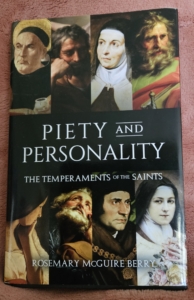
That’s the point of the Spring 2025 release of Piety and Personality: The Temperaments of the Saints (Tan Books), a first issue by Rosemary McGuire Berry. She offers a beginner examination, through the actions of 16 well-known and beloved saints, of the four temperaments, or humors, first established by Hippocrates: Choleric, Melancholic, Phlegmatic, and Sanguine. With this understanding, a dab of self-awareness, and significant persistence and prayer, we can begin to overcome our less desirable inclinations. If this sounds like another “self-help” book in an already saturated multibillion dollar industry, she cleverly enters through the specific niche of the Catholic audience, referring to Catholic practices such as praying the Rosary and going to Confession.

She states her purpose up front: that saints weren’t born holy; they worked at it and so can we, right now, in our difficult world.

“If we study our weaknesses, we can battle them more effectively,” she advises. “If we acknowledge our strengths, we can thank our Maker and work to develop those good tendencies” (p. 3), an angle takes it beyond the modern notion of “self-help.”

She quotes Father Joseph Massmann from his book, Nervousness, Temperament and the Soul, who contends we are duty-bound to understand our imperfections and strive to improve:

“‘The man who is not striving to become a better man resists the truth and keeps out of its way. For those who are striving after inward perfection – even for those who merely want to make a success of life – it is useful, indeed necessary, to examine these questions’” (pp.2-3, Berry).

Additionally, if we recognize the distinctive traits, people we don’t understand will begin to make more sense to us. The dominant, fearless, opinionated, “big picture” boss might have similarities with the Choleric St. Paul. The impulsive sister who always acts before she thinks might be a Sanguine, like St. Peter. That sullen boy could be a sympathetic Melancholic like the Little Flower.

“The Almighty and All-merciful God … would not have created us with a temperament that was a stumbling block to our salvation. On the contrary, He gave us exactly the right temperament to help us gain Heaven,” the author writes (p. 4).

She opens with brief paragraphs that generally describe each of the four. Then she jumps right into the saints and why she thinks a specific saint owns that particular temperament. This method of organization speaks to the point of the title, but at times, particularly in the chapters on St. Francis de Sales and St. Peter, while enjoyable, can be confusing and repetitive. In both, she moves on to address other saints of the same temperament, perhaps to give additional examples of the trait, but sometimes it sounds as though she is trying to force the saint to fit the trait. St. Francis de Sales is described as “Melancholic-Choleric” in the chapter title and she spends the first few pages talking about the Choleric disposition. She notes, however, that, upon studying his life and words, Choleric is the least of his traits. To her point, she impresses upon the reader that, ideally, we want to become a balance of the best of all four traits, which St. Francis de Sales achieved through a great deal of prayer, intention, and work.

Arguably, the most fascinating, tightly written and even poignant sections are on two Phlegmatic Thomases: Aquinas and More.

In the chapter on St. Thomas Aquinas, Mrs. Berry digs into his thorny family relations and the wreckage that is left when one strong personality dominates through its imbalanced state, essentially beating up on the meeker one. She reckons that his mother and brothers were ambitious Cholerics. The meditative and peaceful Thomas did not share their interests, and he was labeled slow and lazy. Often the “silent watchers,” Phlegmatics, she explains, “… do not have to battle their passions of anger, impatience, and dramatic tempestuous sorrow …. They are born calmer and more laid-back” (p. 139). The St. Thomas Aquinas chapter, more than any other in the book, shows the clashing of misunderstood personalities, particularly the child-parent relationship and sibling dynamics.

The piece on St. Thomas More demonstrates the Phlegmatic’s work ethic and eternal optimism, even in the most harrowing circumstances. His love of family radiates throughout the chapter. The author fills the section with writings of the martyred saint that show his peace, humor, diligence, and holiness.

Mrs. Berry offers helpful sidebar tips on each page to make the most of strong traits and help turn around the weaker ones. The author draws insightful distinctions between “good sadness” and “bad sadness,” and “meekness” versus “weakness”.

More than an offering an entertaining side of the saints, the book doles out information to give us another tool to help bring us closer to God and, perhaps, be more compassionate with one another. If Piety and Personality can give families more awareness of the misunderstood sides of one another to bring harmony and acceptance into the home, it’s worth the price.

© Copyright 2025 by Mary McWilliams

Feature Photo by Raka Miftah: https://www.pexels.com/photo/brown-eggs-on-a-concrete-surface-4216386/

Inset photo by Mary McWilliams

Massman, Joseph. Nervousness, Temperament and the Soul. Roman Catholic Books: Fort Collins, CO, 1941.


Vigil for Light

“St. Brendan asked: ‘How can an incorporeal light burn corporeally in a corporeal creature?’

The elder replied: ‘Have you not read of the bush burning at Mount Sinai? Yet that bush was unaffected by the fire.’

They kept vigil the whole night until morning.”

The Voyage of St. Brendan (1)


Vigil for Light


I have loved sunrise service on Easter Sunday morning since I was a small child. I always imagined myself as Mary of Magdala, grieving yet hopeful, excited by the possibility that I might soon see my friend, Jesus. And, of course, after church, there would be candy.

My appreciation for the nuanced events that led to Mary Magdalene’s first encounter with the risen Lord dawned much later, as I approached midlife, when I was confirmed a Roman Catholic in the Easter Vigil liturgy.

More than thirty years onward now, I have witnessed the paschal fire kindled outside in small, ethnic inner-city parishes, where a lone priest carried the new year’s candle through the church’s single aisle himself, crying out “Christ our Light” in a voice hoarse with a cold, like Moses exiled in the desert.

I have watched the Easter candle enter baroque, golden sanctuaries in processions worthy of Rome, where a chorus of trained clerical voices made the call, and “Thanks be to God” resounded from a host of balconies.

The setting doesn’t matter. For me, awe and wonder continue to well up each year, wherever I may be when we pass the candle flame from hand to hand, and an explosion of light fills the assembly with Alleluia.

This vigil of hope for light in the darkness is as ancient as humankind.

Scripture tells us:

“… The angel of God, who had been leading Israel’s army, now moved and went around behind them. And the column of cloud, moving from in front of them, took up its place behind them, so that it came between the Egyptian army and that of Israel. And when it became dark, the cloud illumined the night…” (2)


But full light of the Godhead can be painful to experience.

C.S. Lewis illustrates how difficult it is with vivid imagery, in his novel The Great Divorce, where the residents of Hell move farther and farther away from one another, until they become barely discernable sparks in an infinitely expanding darkness. (3)

Even the pilgrims who manage to tolerate each other long enough to board a bus for Refrigerium in the light of heaven (4), and arrive, cannot bear its intensity for long:

…I glanced round the bus. Though the windows were closed, and soon muffed, the bus was full of light. It was cruel light. I shrank from the faces and forms by which I was surrounded…One had a feeling that they might fall to pieces at any moment if the light grew much stronger. Then—there was a mirror on the end wall of the bus—I caught sight of my own.

And still the light grew.” (5)


Scripture, hagiography, and literature continue to transmit the mysteries of God’s infinite light through allegory and metaphor, to this very day.

But what about science? Aren’t many of our Catholic beliefs, however comforting, contrary to what modern science has demonstrated to be true?

No. Science continues to validate the truth of the Gospels.

Physicist Fr. Robert Spitzer, S. J., Ph.D. has dedicated much of his vocational and professional life to organizing international teams of highly trained doctors, biologists, and physicists, who have designed and implemented experiments with cutting edge technologies to test a variety of questions about articles of our faith.

A detailed and readable account of their rigorous laboratory protocols, and well-documented, peer-reviewed research findings, is found in Dr. Spitzer’s 2024 book, Christ, Science, and Reason: What We Can Know about Jesus, Mary, and Miracles. (6)

The PRH, Particle Radiation Hypothesis, with regards to the Shroud of Turin, deserves brief inclusion here. (7)

Just ten days after my husband, Dr. Charles Zacharias, a pioneer in the field diagnostic radiological imaging, died last September, I heard Dr. Spitzer speak about these quantum energy experiments at a Christ Our Life Conference held in Des Moines, Iowa.

Those multi-layered and repeatable experimental results strongly support a conclusion, that the images on Jesus’ burial cloth could only have been produced by simultaneous nuclear radiation of each of the billions of cells in Christ’s earthly body, all at exactly same millisecond of time.

My Charles knew his medicine, and his physics, and he also knew the kind of question I would first want answered from heaven.

I could almost hear him translating the science for me.

“Honey, it’s an X-Ray of the Resurrection.”

Come. Let us live in the Light. Together.

Happy Easter!

© Copyright 2025 by Margaret King Zacharias

Feature Photo: Connemara Coast to the Cliffs of Moher, Overlooking Galway Bay. Author’s personal photo, published with permission.

Notes:

  1. John J. O’Meara, translator from the Latin, The Voyage of St. Brendan: Journey to the Promised Land, Colin Smythe Limited, Gerrards Cross, Buckinghamshire, GB, 1976, 1978, 1991, p. 32.
  2. https://bible.usccb.org/bible/exodus/14
  3. S. Lewis, The Great Divorce, Macmillan 1946; Touchstone, Simon & Schuster, 1996, pp.10-11.
  4. Ibid., p. 66.
  5. Ibid., p. 26.
  6. Robert Spitzer, S. J., Ph.D, Christ, Science, and Reason: What We can Know about Jesus, Mary, and Miracles, San Francisco, Ignatius Press, 2024.
  7. Ibid., pp. 97-158.

Poll na Brone Portal Tomb, c. 4000 B.C. the Burren, County Clare, Ireland
Attribution: Kglavin on en. wikipedia, Public domain, via Wikimedia Commons

We Are All Pilgrims

Stand at the crossroads and look; ask for the ancient paths, ask where the good way is, and walk in it, and you will find rest for your souls. (Jeremiah 6:16)


In 2016, something amazing happened to me. I was able to get two spots on the Catholic Channel’s lottery for a pilgrimage to the Holy Land. I could hardly believe this dream might come true. My husband was reluctant at first, but one look at the itinerary and he was all in. “These are all real places that still exist?” he asked. My assurance they are was all he needed.

A Life-Changing Pilgrimage

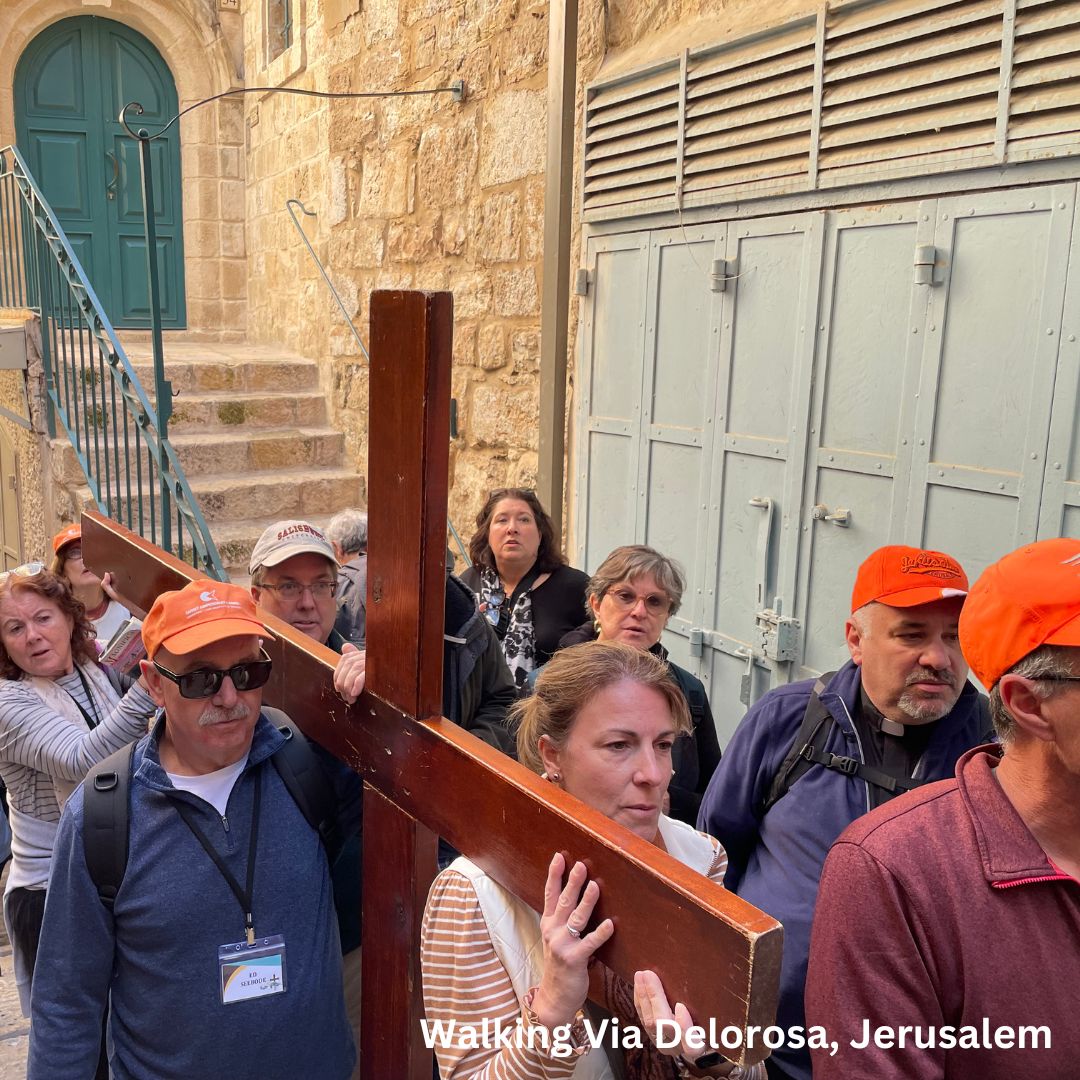
I always tell people that a pilgrimage, particularly to the Holy Land, is life-changing. For me, this journey facilitated multiple changes. From meeting a group of women who would become my closest friends, to discovering more about myself and God’s plan for me, to going from a writer to speaker and pilgrimage leader myself were things I never imagined would happen. Since that trip, I have gone on pilgrimage to the Holy Land once more as a pilgrim and once as a leader (my second and third chances at leading have been on hold since the October 6 massacre). I have organized and led two pilgrimages on El Camino (one for myself and two friends and one for thirty-three pilgrims), one pilgrimage to Italy, and several “local” pilgrimages. Next month, I’m taking 43 pilgrims to France!

Ever since that first pilgrimage, I have felt like a different person. No that’s not quite right. I have become a different person, someone whose life has been turned in the right direction. Where God always had a place in my life — one that was dictated by my own needs and schedule — He now occupies every space of my life, and I’m constantly turning to Him to make decisions about everything from what I eat to what I write.


We Are All Pilgrims

What a wonderful gift Pope Francis gave us in this Jubilee Year of 2025. He has proclaimed each and every one of us a Pilgrim of Hope. The Holy Father has declared this to be a year of hope and patience as we await our call home to Christ. “This interplay of hope and patience makes us see clearly that the Christian life is a journey calling for moments of greater intensity to encourage and sustain hope as the constant companion that guides our steps towards the goal of our encounter with the Lord Jesus” (Pope Francis, Bull Of Indiction Of The Ordinary Jubilee Of The Year 2025, emphasis original). We are all pilgrims on this journey from birth to Heaven.

The Holy Father goes on to say, “Pilgrimage is of course a fundamental element of every Jubilee event. Setting out on a journey is traditionally associated with our human quest for meaning in life.” Pope Francis recommends that pilgrims travel to Rome and other places to walk through the Holy Doors, which are only open during the Year of Jubilee. However, you don’t have to travel far from home to experience a true pilgrimage!


The Pilgrimage of Life

While I’d love to have all of you join me on a pilgrimage of a lifetime, I urge you to think both smaller and longer when you consider the number one pilgrimage we all make. Our entire life is a faith journey, a pilgrimage, at times as glorious as the Sistine Chapel and then as arduous as El Camino. We are to travel this lifelong pilgrimage in the same manner Pope Francis encourages a pilgrimage abroad: as pilgrims “contemplating the beauty of creation and masterpieces of art, we learn to treasure the richness of different experiences and cultures, and are inspired to lift up that beauty, in prayer, to God, in thanksgiving for his wondrous works.” We are to see the beauty and presence of God in everything and everyone we encounter.

Like any pilgrimage, we all approach this lifetime pilgrimage with a mix of trepidation, expectation, and jubilation. There is so much to discover at each turn, so much growing and maturing to do, not just in age but in faith. Just like on the walk through Rome, we can easily become lost, tempted to follow the crowd, overwhelmed by the sights and sounds around us, and exhausted at the end of each day. Life is a continuous passage with tunnels, bridges, alleyways, cobblestones, and dirt paths. We must follow the road map that Jesus and the Church have given us and walk through this life with prayer, humility, and hope.


Life as Pilgrimage

Pope Francis tells us that, in this Jubilee Year, we are to desire peace and look to the future with hope that “entails having enthusiasm for life and a readiness to share it” so that we may “be tangible signs of hope for those of our brothers and sisters.” To do this, we must be able to follow in the footsteps of Christ, walking not just our path, but His. We are to share the Good News with the world, expressing our hope in the Risen Lord and His teachings. This is not easy. Jesus told us, “Whoever wishes to come after me must deny himself, take up his cross, and follow me” (Matthew 16:25). He’s warning us that the walk is not always easy. There are hills to climb, rivers to cross, and heavy loads to carry, but those are what lead us to our final destination.

This year, allow yourself to fully realize what it means to be a pilgrim, but even more, a Pilgrim of Hope. Begin your journey today with small steps. Take a walk in the garden while you give praise to God for the bright green stems pushing through the earth. Walk through one of the Gospels, focusing on the times Jesus taught us to follow him, from the call of Peter to Jesus telling us, “you know the way” (John 14:4). Begin a new path of prayer at intervals throughout your day to give thanks and praise and asses your journey.

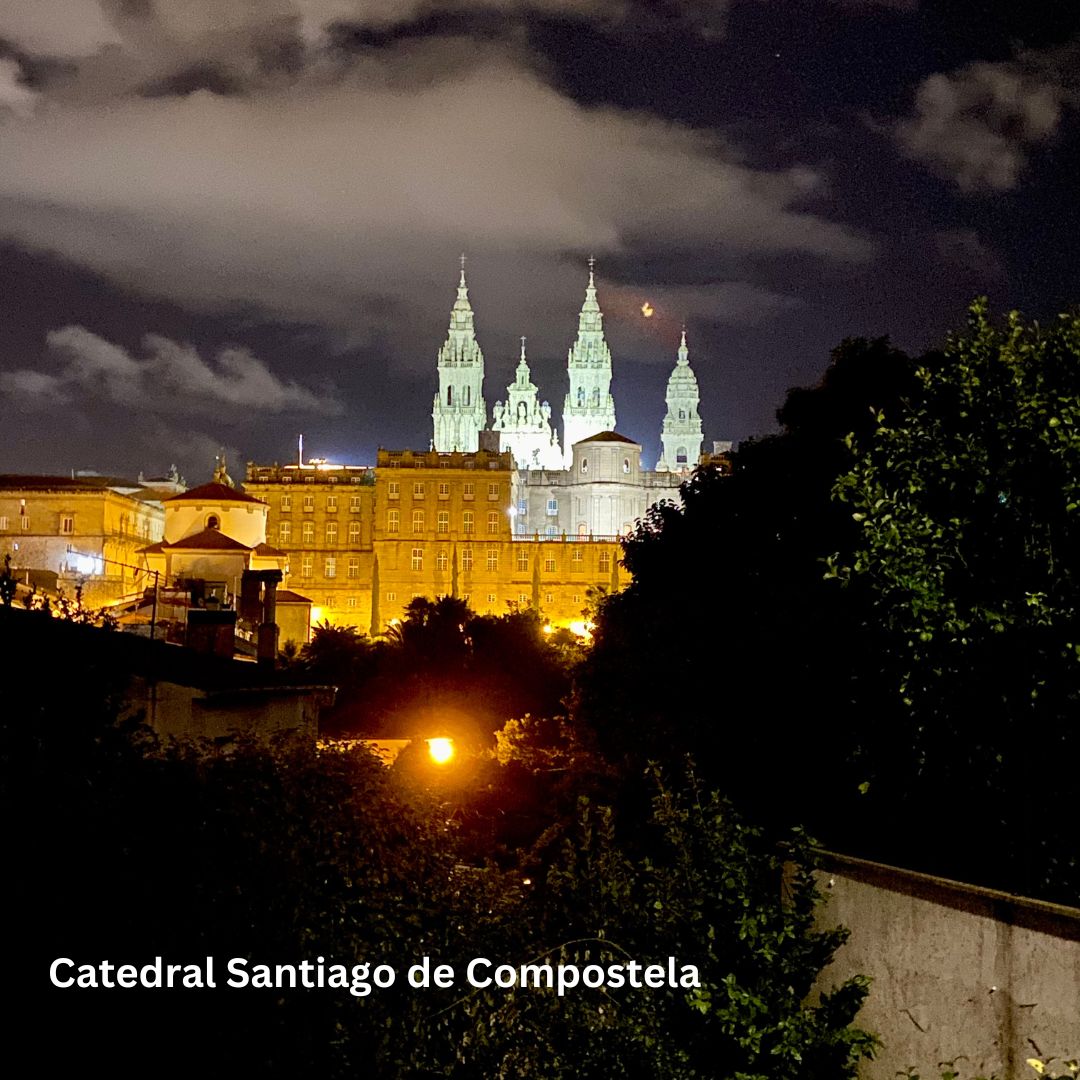
How ever you choose to walk your pilgrimage, allow yourself to be open to whatever happens along the way. I always tell my pilgrims that the number one rule to being a pilgrim is to be flexible and remain open to the Holy Spirit. Always keep your eye on the shining cathedral on the hill and your heart filled with hope.


We see in these swift and skillful travelers a symbol of our life, which seeks to be a pilgrimage and a passage on this earth for the way of heaven. – Pope Paul VI


Copyright 2025 Amy Schisler

Photos copyright 2025 Amy Schisler, all rights reserved.

Serendipitous Surrender

Serendipitous Surrender

By Lisa Livezey

It is the Lord who goes before you; He will be with you.
— Deuteronomy 31:8 (RSVCE)


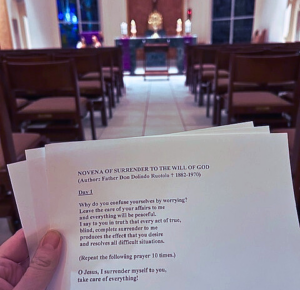
I slipped into the quiet Adoration Chapel, seeking blessed respite from the frenzied pace which now characterized my days. Tucked among the prayer cards in my Bible were some papers which, when unfolded, brought back a sudden memory. These had been handed to me in this very chapel by an older woman who often prayed there. It had been a month ago when she approached me as just the two of us were sitting in the chapel. Holding out some papers, she had whispered, “I feel like you’re supposed to have these.”


I accepted them with a quiet, “Thank you,” honored that this prayer warrior had singled me out. The title read Novena of Surrender to the Will of God and was followed by nine daily prayers, each ending with the words: “Jesus, I surrender myself to You. Please take care of everything.” I began the first prayer immediately and planned to continue for the next eight days.


(“The Surrender Novena” was handed to the author days before her father’s unexpected passing.)


When the weekend arrived, I forgot all about the Surrender Novena. Then came Monday afternoon—and then Dad was rushed to the hospital—and then he died—and then I became responsible for Mom.

In rediscovering these papers, I realized that the Holy Spirit had nudged this holy woman, causing her to give me the Surrender Novena just days before my life was about to radically change.

Jesus, I surrender myself to You. Please take care of everything.

Reflect: Focus on the Lord and purposefully repeat the above prayer ten times. If able, search online for the Novena of Surrender to the Will of God (Author: Father Don Dolindo Ruotolo 1882-1970) and pray it for the next nine days.


The above selection is Entry #12 in Part II: Weathering Winter of Minding Mom: A Caregiver’s Devotional Story by Lisa Livezey (© 2024, En Route Books and Media)

Minding Mom: A Caregiver’s Devotional Story by Lisa Livezey | En Route Books and Media

Consider The Flowers

By Kimberly Novak


     Sitting in my church and admiring the altar recently, I was struck by the beauty of the flowers placed purposefully on either side. The flowers were specifically chosen to adorn the altar as an offering of a sacrificial act. The gardener who raised and nurtured the flowers had to make sacrifices to have the time and energy to do such a task. Then there is the sacrifice of the flowers themselves. 

     In his book, The Hidden Power of Silence in the Mass, Father Bonificace Hicks paints a wonderful picture of this sacrificial act. In a chapter devoted to the silence of sacrificial offering, Father Hicks brings light into the purpose of cut flowers in the mass:

The cut flowers continue to pour out their beauty as they die near the altar. From the moment they are cut, they are already dying. They use the remnant of their life to worship, shine forth in beauty, and direct our attention to the beauty of the Lord’s Eucharistic sacrifice. This is a great sign of how we are to enter into the sacrificial silence of the Offertory. We, too, are dying, already a day closer to death than when we first believed. (Rom. 13:11). And yet each one of us is also beautiful, a living reflection of the face of Christ. We each have some beauty left to offer, and we can allow our lives to be silently with Christ and point to His beauty, the source of all beauty.”

     My parish does a wonderful job of “flowering” the altar. Many times the flower arrangements adorning the altar are donated following a wedding or funeral service. This in itself is a sacrificial act from the families willing to part with and gift the flowers to the sanctuary. Some parishes may have a flower or garden committee, which has sacrificed their time. There are two times in the liturgical year when you will not see flowers on the altar. Father Hicks, explains why during Advent and Lent, the flowers are absent: The flowers which decorate the altar as a form of solemnity and a sign of joy are not to be used in Advent or Lent, and their absence is intended to evoke a sense of loss and longing.”  Therefore, as we continue on our Lenten journey and anticipate the heartfelt joy in celebrating the resurrection of Jesus, we can look forward to the outward beauty when the flowers once again adorn the altar. 

     Before being placed on the altar, the flowers lived as best they could, offering beauty and joy as their gift to mankind. God invites us to do the same. We are halfway through the 40 days of Lent at the time of this writing. It might be a good time to reflect upon the first 20 days and consider how your sacrificial act will transform your life or relationship with Christ. Reflective points to ponder might be: Am I living up to God’s standards and expectations? Have my decisions of abstinence been easy ones or Have I gone all the way and chosen a sacrifice that will foster a major life change? 

     However, it’s important not to overthink your sacrifices. God knows every part of our hearts and lives. That means he knows that sometimes, even the smallest sacrifices might be big ones, especially if the surrender renews and strengthens the relationship with God. I’m sure that Jesus, as he carried his cross, never once wondered if his sacrifice was easy or worth the effort. 

      I now have a new view of cut flowers and will treat them as holy. Admiring a freshly cut bouquet on my table in the sunlight will make me more respectful of the sacrifices that allowed me to receive their gift. Jesus is the flower at the altar, a reminder of the offerings I must make to honor His commitment to my life. Father Hicks states that  we each have some beauty left to offer, and I say, there is nothing more beautiful than a flower, chosen specifically for you.


“… there is nothing more beautiful than a flower, chosen specifically for you.”


With this knowledge, consider the flowers, and accept their beauty into your heart, for this is a gift from Jesus to be with Him always. 


God Bless! 


Quotes sited from, The Hidden Power of Silence in the Mass, by Father Bonifiace Hicks, OSB

©️ Kimberly Novak 2025

Edited by Janet Tamez

Rocky Times

Rocky Times

Taxi drivers shook their fists at each other as I stared out the tour bus window. Blaring horns assaulted my ears. Sunset turned to twilight, and still we sat motionless in Tel Aviv traffic gridlock.
My heart was breaking for my fellow travelers. Although I’d been looking forward to visiting the Carmelite monastery’s public areas for a second time, I’d already been blessed with indelible memories of a daylight Mass in the gardens, followed by a tour that included rooftop views of the fertile valleys below. (See https://www.catholicwritersguild.org/2023/06/mount-carmel/). For the passengers with me on this trip, their visit here was meant to be the pinnacle of a once-in-a-lifetime pilgrimage to the Holy Land. The bus driver’s scowl mirrored my own frustration, but only an air of resigned disappointment filled the bus.
By the time we had navigated a winding road to the top of Mount Carmel, full darkness had descended. The harried greeter who’d waited for us outside made humble apologies. Unfortunately, no tour would be possible. The brothers had already prayed Vespers, and the vowed community was cloistered for the night. But our host said he’d given the lay oblates permission to reopen the gift shop. This announcement immediately cheered the ladies. At least they could still bring rosaries to their loved ones back home. They trooped off together toward the few still-lighted windows, smiling.
Dominick, a public elementary school principal, quietly pulled his carryon suitcase from the bin above his seat and got off the bus behind them. I’d learned that in his traditional Italian neighborhood, parishioners had sacrificed for years to buy a small triangular lot adjacent to their
church. Dominick was building there, a shrine for Our Lady of Mount Carmel. I watched him engage our greeter in animated conversation.
The other pilgrims eventually returned, with full souvenir bags in hand. But where was Dominick? Finally, he appeared again at the bus door, grinning. A middle-aged but muscular man from a contractor family, Dominick did not seem daunted by the weight he now carried. He climbed right up the bus stairs, and raised his suitcase with both hands, in a victory stance, as soon as he reached the aisle.
“That brother was so kind. He took me all the way back to the mountain!” Dominick’s voice resonated through the bus without benefit of the microphone. “He said I could have as many rocks as I wanted! He found me a spade, and held the flashlight while I pried the stones
free.”
Whoops, whistles, and cheers from every seat greeted his enthusiastic news.

***

I found myself behind Dominick in the El Al security lines for our departure flight back to the United States. He patted his suitcase, and whispered with a wink. “Don’t worry. I’ve got them all right here.”
I heard the uniformed Israeli guards ask, as Dominick slowly wheeled his suitcase to the counter, “What’s in there? Rocks?”
Uh, oh, I thought, looking around. Is this even legal? Archeological artifacts, and all that? Where’s our guide!  Dominick just nodded. “Gifts for Our Lady’s new grotto, from our Holy Land pilgrimage,” he said. Seeing the stern looks on their faces, he hastened to assure them.
“Everyone gave me permission. Those monks at Mount Carmel were really helpful.” Dominick pulled a paper from his vest pocket. Apparently, he’d somehow managed to wangle a document from the Carmelite brother who’d assisted with the excavation. Dominick handed his paper to one of the security men.
The first guard examined it and showed it to his partner. Then he refolded it carefully, and gave it back to Dominick. These officials, who now appeared a bit bemused, heaved Dominick’s suitcase up to the metal counter themselves. After looking inside, they exchanged a humorous glance, and waved our hero through, with his suitcase, to the gate. As I placed my own tote on the counter, I couldn’t help wondering how Dominick could have fit in all the stones I’d seen him collect, at the shore of the Sea of Galilee, and other sacred sites we’d visited.

But from the glimpse I’d just garnered, they did look– tightly packed.

***

Dominick engraved each stone from the Holy Land with its place of origin. He mortared them in where they fit, like puzzle pieces, among larger local boulders. Pilgrimage memories endure in a curved rock wall that shelters the consecrated granite altar in the new grotto dedicated to Our Lady of Mount Carmel.
Today, Mass can be celebrated at the grotto as well as the church, often in both English and Spanish. The parish maintains its long and faithful tradition of Corpus Christi processions with the Blessed Sacrament, visiting and blessing individual family homes throughout the old neighborhood. The parish school pioneered for our diocese the first cohort in an optional Spanish immersion curriculum for grades K-8.
Dominick’s spirit of humility, simplicity, and faith lives on.

May we all be blessed this Lent with trust and grace to find joy in whatever God sends.


© Copyright 2025 Margaret King Zacharias

Feature photo by Margaret King Zacharias. Used with Permission.


Survey Says: Mary, Powerhouse Intercessor!

Survey Says: Mary, Powerhouse Intercessor!

by Dennis Lambert

If we were playing Biblical Family Feud and the players were asked, “What was the greatest revelation of the Wedding at Cana?” my guess is that the number one answer would be a toss-up between two answers. It would be either that it is where Jesus performed his first miracle or that it was the beginning of his public ministry.

Now for the more serious Family Feud thrill seekers out there, what would take the next spot on the big Feud board? The answer to that is likely to be dependent on that player’s Christian affiliation. For myself, being Catholic, my response would be, “Mary the Intercessor.”

One thing I am certain of is that the role of Mary in our Christian faith is often misunderstood by Protestants, and also by many Catholics. Having spent a couple years in the non-denominational world, I can tell you that the number one misconception regarding Mary is that Catholics pray to Mary as we pray to God. (insert the Family Feud big Red X and obnoxious buzzer sound here!). It is, in fact, the story of Cana which demonstrates to the world one of Mary’s most treasured roles in our Christian faith.

Let’s take a look by putting ourselves into the story…

Now, wedding feasts during the time of Jesus were truly a celebration which lasted for days. So the party is in full swing when Mary, the intuitive mother she is, notices something is wrong.

Perhaps she notices the head waiter whispering something into the ear of the father of the bride and then sees a look of shock and dismay come across his face. Next, the father follows the head waiter into the kitchen, and Mary, who obviously knows the man, out of concern follows him to find out what has him so disheveled.

When Mary learns that he has run out of wine she immediately understands the social ramifications and embarrassment it would cause this man, his daughter the bride, and his family. You see, running short on wine at such a celebration would indeed been a major party foul and that error would have surely made that family the talk of the town for months to come, and not in a good way.

So I can envision Mary calmly talking to that father, telling him that everything is going to be all right, that she’s got it handled. Her next move is to her Son. She explains in detail what has happened, what was happening. After listening to his mother, Jesus says to her, “Women, how does your concern affect me? My hour has not yet come.” The reality is that back then, the term “Woman” was an endearing sign of affection. Using a little poetic license and placing myself into the scene, I can see Jesus’ response possibly coming off more like, “Mother, the woman I adore, it’s not my time quite yet. You understand, right?”  (And if I had more space in this article we could go into how biblical scholars describe this call of “Woman” by Jesus as his announcing of Mary as the new Eve.)

Now Mary’s response is interesting. Her eyes are on Jesus, listening to what he says one second, and then a split second later turning her head from her son to the server. Without saying a word to her son, she tells the server, “Do whatever he tells you.”  Now that’s authority! Now that’s a mother!

I can just imagine Jesus rolling his eyes after this, saying something like, “Ma, really?” But what does he do? He orders the servers to bring out six stone jars filled with water. According to the Gospel, that was between 120- and 180-gallons worth of water that Jesus then turns into wine!  In that instance, Jesus complies to his mother’s wishes, her “intentions.”

What this part of the story tells us, unequivocally, is that Mary indeed has the ear of her son and most importantly, that he listens to her.

And what are the implications for us? While they may be pretty clear to most, let me build up where I’m heading with this just a bit before I come out and state the obvious. Allow me ask a couple probing questions …

How many of you have ever prayed for someone else? How many been prayed for? My guess is that everyone reading this is saying an unequivocal “yes” to both questions. The fact that we all participate so fully in this thing we call prayer shows that there is something to it. That there is a real power to prayer. And if you’re like me, the holier the person you get to say a prayer on your behalf, the more efficacious we feel that prayer is going to be.

Which brings us back to Mary. The wedding feast at Cana introduces Mary as the best intercessor for our prayers. After all, whether a person is Catholic or Protestant, I’m confident we would all agree that no one who ever lived is holier than Mary. After all, God chose her to have his Son!

Clearly, as seen in the story of the Wedding at Cana, Jesus most especially listens to his mother! And this, my friends, is Mary’s role in our faith. We don’t pray to Mary as we pray to Jesus or the Father. Rather we ask her, as the holiest person who ever lived, to take our needs, our prayers, our intentions to the very foot of her son. For, as seen at Cana, Jesus most especially listens to his Mother!

So when you find yourself in need, be it one of the big things in life variety, or just a case of writer’s block you’re trying to clear away, may the forceful words of Steve Harvey ring within your ears, “Survey Says: Mary, Powerhouse Intercessor!”…. and then may you turn to our Champion of Cana and ask her for the gift of her influential prayers!

© Copyright 2025 by Dennis Lambert

Feature Photo by John Andrew Nolia Blazo: https://www.pexels.com/photo/painting-of-holy-mary-15111009/

Stay in the Know

Join Our Newsletter

Members and supporters can get the latest on CWG news and events by signing up for our newsletter.

Please wait...

Thank you for signing up!

Catholic Writers Guild
P.O. Box 77
Eaton, IN 47338