Shattered Rocks on Solid Ground

While hiking the North Ridge Trail on Cadillac Mountain at Acadia National Park, my daughter and I paused on a rock mound, breathing in the chill wind and the vibrant red, yellow, and green hues of Autumn. As we sat, Sheila commented on the solid, secure sensation emanating upward from the mountain depths. Peace flooded through me, and now I am reminded of the solid ground on which my faith was built. 

That one is like a man building a house, who dug deeply and laid the foundation on rock; when a flood arose, the river burst against that house but could not shake it, because it had been well built. Luke 6:48

“Mama, close your eyes and listen.” Sheila quietly instructed. When you are on the mountain, the wind moving through the trees sounds like the ocean waves rushing to shore. Except for the cold, with eyes closed, you could very well be at the beach where endless shells break under crushing surf.  But the mountain rock is immovable, its pink and gray and green granite boulders stand firm after countless millennia of glacial pounding. Solid as it is, the mountain harbors millions of shattered rocks along the trail, broken pieces huddled together beneath the massive outcrop where we sat.

I thought about a poem I wrote (see “Broken Shells” August 10, 2025 blog post https://www.catholicwritersguild.org/2025/08/broken-shells/) and the similarity of those shells and shattered rocks – so many pieces, each unique and beautiful despite their brokenness. Each forms a part of the whole. Each can fulfill its purpose on the canvas when there is a foundation in the Lord.  Whether at a beach or atop a mountain, whether we hear waves or wind, He is our solid ground.

“The Lord is near to the brokenhearted and saves the crushed in spirit.” Psalm 34:18

That day on the trail, I was overcome with the beauty of God’s creation and thankful for His love and care for us. The picture I took (above) is only a small glimpse of what I experienced, and my heart sings with the praise of Psalm 104:1-5:

“Bless the Lord, O my soul. O Lord my God, you are very great. You are clothed with honor and majesty, wrapped in light as with a garment. You stretch out the heavens like a tent, you set the beams of your chambers on the waters, you make the clouds your chariot, you ride on the wings of the wind, you make the winds your messengers, fire and flame your ministers. You set the earth on its foundations, so that it shall never be shaken.”


© Copyright 2025 by Paula Veloso Babadi

Feature Photo North Ridge Trail, Cadillac Mountain, Acadia Nati onal Park by Paula Veloso Babadi, used with permission.

Scripture texts in this work are taken from the New American Bible, revised edition © 2010, 1991, 1986, 1970 Confraternity of Christian Doctrine, Washington, D.C. and are used by permission of the copyright owner. All Rights Reserved.

The Shepherd’s Pie: ‘LGBT: A Return to Faith’

LGBT: A Return to Faith


“A slice of hope to raise faithful kids.”

This uplifting, ecumenical show uses engaging conversations and fun entertainment reviews to offer positive insights and media resources for families and youth leaders. We discuss current issues that impact young people at home, in school, and in the world today.

In this episode of The Shepherd’s Pie, Antony Barone Kolenc speaks with Jesús Canchola Sánchez about his journey back from the LGBT lifestyle to the Christian faith, and we discuss his novel, Escape from Natura Meta.


Check out other episodes of The Shepherd’s Pie.

"The Shepherd's Pie" LGBT: A Return to Faith


Copyright 2025 Antony Barone Kolenc

A Gift Granted Humanity

A Gift Granted Humanity

By Isabelle Wood

“…the Spirit of Christ within them indicated when it testified in advance to the sufferings destined for Christ and the subsequent glory. It was revealed to them that they were serving not themselves but you, in regard to the things that have now been announced to you through those who brought you good news by the Holy Spirit sent from heaven—things into which angels long to look!”—1 Peter:11b-12 (NRSVCE)

Most of us like to avoid suffering at all costs. But I propose that, beneath the surface, suffering may be a gift granted uniquely to humanity.

God created us in His own image, with both a body and a soul. Ever since sin entered the world, we experience all suffering, save the spiritual suffering of separation from God, through our bodies. But God didn’t leave us there.

He came down from Heaven and took on a human body in order to share in our suffering and—through suffering—to restore our relationship with God and relieve us of the suffering of separation from Him. To redeem suffering.

Jesus’ willingness to suffer on our behalf reveals one of the deepest truths of Who God is: God is love. But not just any love. God is sacrificial love. The kind of love that keeps on loving no matter what it costs or has to endure. Even—especially—suffering.

It is this sacrificial love of God that Saint Peter tells us amazes the angels. He calls it that “into which angels long to look” (1 Peter:12b). Angels, as pure spirits with no bodies, can never offer up sacrificial love through suffering in the same way Jesus did.

But we can.

Because of God’s gift to humanity of both spirit and body, made in His image and likeness with the freedom to make choices, we have the potential to choose to suffer for the good of another in a beautiful reflection of God’s love for us.

In this way, we can join our sufferings and sacrifices to Jesus’ ultimate suffering and sacrifice on the Cross to help save souls—because our destination is Heaven, where suffering will finally be no more.

We don’t have an endless number of chances to offer sacrifices to God for others. One day, we’ll run out of chances to show sacrificial love. So, don’t waste God’s gift of redemptive suffering.

Accept it from God’s hands with wonder and thanksgiving.


© Isabelle Wood 2025

Edited by Gabriella Batel

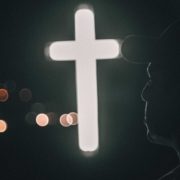
Photo copyright Canva

Why the Green Fish is Green

The Little Green Fish

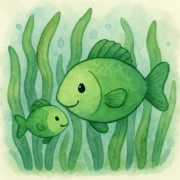
In the murky depths of the ocean, among the green seaweed, lived a mother fish and her young fish. One day, as they scooted among the swaying plants the little fish caught sight of a darting red fish as it passed their home.

“Oh, mother!” exclaimed the young fish, “Look at that beautiful red fish! If I were red like that red fish, I would be daring and everyone would stare at me as I swam quickly by. Why can’t I be red instead of green like the seaweed?”

“Don’t worry yourself,” the mother returned, “That’s just how God made us.”

They continued on their way, staying among the cool shadows of the seaweed. Suddenly, the young fish spied a yellow fish flash along on its way among the coral.

“Oh, mother!” cried the young fish, “Just see that golden fish! If I were yellow like that yellow fish, I would be fun and everyone would enjoy my company. Why can’t I be yellow instead of green like the seaweed?”

“Don’t worry yourself,” the mother returned, “That’s just how God made us.”

The mother fish and young fish floated lazily along stopping every once in a while to nibble some lunch in the jungle of ocean plants. All at once, the young fish spotted the flash of an orange fish scoot by where they swam.

“Oh, mother!” gasped the young fish, “Look at that fiery orange fish! If I were orange like that orange fish, I would be the most beautiful fish in the ocean and all the other fish would tell me so! Why can’t I be orange instead of green like the seaweed?”

“Don’t worry yourself,” the mother returned, “That’s just how God made us.”

Abruptly, out of the shadows of the deep, a fierce shark charged among the smaller fish. Before every fish could scatter, he gobbled the red fish, then the yellow fish, and then the orange fish among others who became his lunch. As suddenly as he had come, he was gone again. The green mother fish and her young fish sighed in relief among their home in the green seaweed.

“Mother,” the young fish whispered softly, “I know why we are green like the green seaweed now …”

“Yes, dear, that’s how God made us. Remember to be thankful for His blessings and be who you
are meant to be.”


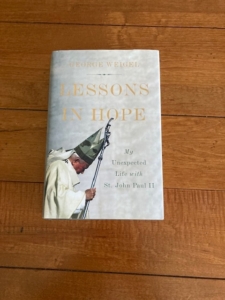
Commentary and Book Review George Weigel, Lessons in Hope: My Unexpected Life with St. John Paul II

New York: Basic Books, 2017

Polish athlete, actor, and youth resistance leader Karol Jozef Wojtyla looms as a charismatic presence over the 20th Century, and beyond, with a personal and spiritual influence few before him ever accomplished. His life story exhibits the numinous arc of a genuine archetypal hero. Whether admirer or critic, almost no one on our planet could deny the depth or breadth of his impact on the world.

Elected supreme pontiff of the Roman Catholic Church in 1978, at the young age of 58, he was regarded by the College of Cardinals as an “outsider,” a “compromise” candidate. He was the first non-Italian pope in 455 years and the third longest servant of that office in history (1).

He took the Church to the world with his own two feet, visiting an unprecedented number of new countries that had never before even dreamed they might experience a pope’s physical presence and blessing in their own midst.

John Paul II was the second pope to visit the United States and he covered new territory even here on his first visit in 1979.

We all have our stories. Mine include intense negotiations in my Rand McNally office to determine who could take the day off to attend the papal mass in Chicago’s Grant Park on October 5, 1979.

When our family moved to Iowa in 1985, the very air still vibrated with the energy of 350,000 people who attended the papal mass at Living History Farms just outside of Des Moines on the Feast of St. Francis, October 4, 1979. At the time, it was the largest crowd ever present for a single event in Iowa history (2).

The atmosphere still shimmers today as the stories are told — about one farmer in a tiny Iowa hamlet, who believed he could just write to the pope with an invitation and the Holy Father would come.

Cherished memories of that glorious day continue to pass from one person to another, especially at this season of year when we celebrate the harvest with the Iowa State Fair.

People recall a stormy morning, full of thunder, lightning, and drenching rain – until the clouds broke, and the sun reappeared just as John Paul II’s helicopter came into view for a landing on the fertile fields. They remember his reverent words of appreciation for people who toil on the soil in stewardship, to feed us all.

I remember a French rail strike, an Italian train robbery, a powerful homily presented in four languages in 1995 by a man who still possessed the physical stamina to stand in St. Peter’s Square with a hot Roman sun beating down on his heavy vestments; a man who spoke long enough – more than an hour without respite — to make sure every person there heard his words from his own voice in a language they could understand.

My memories include a bittersweet final United States mass in St. Louis, Missouri just four years later, in 1999, when a pope by then crippled with Parkinson’s disease modeled humility, standing by and offering up his painful suffering while readers and translators presented the homily he had written — for the same reason, so everyone present could hear, and understand.

Many biographies of John Paul II have been published. So why do I want to tell you about this particular book, Lessons in Hope?

George Weigel is a Distinguished Fellow of the Ethics and Public Policy Center in Washington, D. C., where he holds the William E. Simon Chair in Catholic Studies (3). He’s a prolific author of many books on a wide variety of Catholic topics (including several more recently published), and a regular contributor of thoughtful, incisive articles to the literary journal First Things.

Lessons in Hope is a unique hybrid. It’s a biography of John Paul II as well as an autobiography of George Weigel; it’s a memoir of a relationship that begins in Maryland in 1960, and concludes in Poland in 2012.

Organized chronologically and geographically, Lessons in Hope is a collection of vivid, digestible vignettes about how Divine Providence interwove the lives of two men who chose to spend their talents serving God and the Catholic Faith, each in their own different ways.

For more than 62 years, from Baltimore to Krakow — in Rome, Vienna, Moscow, Cuba, Portugal, Australia, Canada, Germany, and more – shuttling in and out of the weft, warp threads keep weaving together in their profound encounters.

What emerges is a tapestry that illustrates how the truths of our faith resonate most powerfully through our surprising interconnections with one another.

At this moment in 2025 when hope may seem for many of us quite difficult to maintain, Weigel’s book about his “unexpected life with St. John Paul II” offers timeless nourishment for each of our own life journeys.

May Christ’s peace that passes all understanding be with us now, and forever. Amen.

© Copyright 2025 by Margaret King Zacharias

Notes

  1. https://en.wikipedia.org/wiki/Pope_John_Paul_II
  2. https://www.lhf.org/aboutus-2/saint-pope-john-paul-ii-visit/#:~:text=On%20October%204%2C%201979%20Saint,cold%20and%20rainy%20autumn%20day.
  3. Book cover copy, George Weigel, Lessons in Hope: My Unexpected Life with St. John Paul II, New York: Basic Books, 2017.

Feature Image:

Author photo, used with permission

Inset photo: Cover of Lessons in Hope: My Unexpected life with St. John Paul II. Author photo, used with permission

Rest and Celebration

Rest and Celebration

By Isabelle Wood

“And on the seventh day God finished the work that He had done, and He rested on the seventh day from all the work that He had done. So God blessed the seventh day and hallowed it, because on it God rested from all the work that He had done in creation.”—Genesis 2:2–3

“These are the appointed festivals of the Lord, the holy convocations, which you shall celebrate at the time appointed for them.”—Leviticus 23:4 (NRSVCE)

We live in a busy world.

We have to make it to that class or this meeting, go to this family event, drop one kid off at practice, go watch another’s band concert, and get that work presentation done before Monday, all while trying to make sure we get the laundry done, get food made, and keep the house clean… and so on and so forth.

So, it’s no surprise that our culture naturally assumes that all the “rules” of Catholicism merely add to the never-ending to-do list.

But while the rules and following God’s commandments are part of it, they’re not the foundation. The world sees the rules and gives the verdict of “miserable” without digging deeper to the why behind the rules. But the saints—those who lived Catholicism to the fullest—weren’t miserable; they were the happiest people who ever lived because they knew the point:

God’s love for us, and our love for Him in response.

God doesn’t want us to be miserable. He loves us. What faith other than Catholicism mandates rest so we can be refreshed and rejuvenated? And did you know that the root of the word holiday is holy day because it’s Catholicism that’s given us so many of our holidays?

Yes, we’re expected to put in the work and follow God’s commandments, but God is also a loving Father Who doesn’t expect us to burn ourselves out. He wants us to have the rest we need and to be able to celebrate and enjoy life.

So maybe, this Sunday, try to take some time to rest and celebrate the good news of the Gospel. Because Catholicism truly is the best way to live.


© Isabelle Wood 2025

Edited by Gabriella Batel

Photo copyright Canva

A Day in Toledo,1933

A Day in Toledo, 1933


Hard times brought families together.

“Ew,” said Gertie.

“It’s God’s creature and he loves all his creatures,” said Agnes.

Agnes was goody-goody. Gertie was baddy-baddy.

“Good Lord,” said Mother. “What now?”  It was a large centipede that had crawled out of the drain.

“Eat it,” said Gertie. Agnes said, “You have to let him outside.”

It was the 1930s in Toledo, Ohio during the Great Depression. They lived in a house with a boarder, Andy. The father worked in a steel plant.

“My water’s cold,” yelled Andy.

“Coming,” said Mother. “I just have to heat it on the stove.”

“Hurry” said Andy. “What’s for dinner?”

“Fried chicken,” said Mother.

Andy always got the biggest piece of chicken, followed by Father. The rest of them got smaller pieces. The two girls, Gertie and Agnes, and the youngest two, Charles and the baby, Daisy.

When Father came home from the plant to eat his chicken and biscuits, he told a sad tale.

“The guy next to me fell into a vat and was vaporized.”  “The wife and kids are left.”

“At least they got his life insurance,” said Mother.

“No life insurance,” said Father. “The foreman told the wife he never came to work. They live nearby. Their name’s Mantellini.”

“Why don’t we make them some dinner?  They must be hungry,” said Mother. “They are Italian, right?  Let’s make them some spaghetti. What’s in spaghetti?  Tomatoes, peppers, and garlic?”

“And slugs,” added Gertie.

Mother told Agnes and Gertie to go to the store and get the dried pasta and the vegetables on credit.

When the Mantellinis came over they were wearing clothes made of the flour bags but no one laughed.

Gertie said by way of conversation, “I heard a funny song on the radio today, it was called, ‘Yes we have no bananas.’”

The mother of the other family said, “I brought some vegetables from the garden and some wine my husband made.”

“Oh we couldn’t,” Father said.

“It really means a lot to us that you have it with us,” Mrs. Mantellini told them.

Before dinner, they prayed.

“In nomine Patris et Filii et Spiritus Sancti” said the Italian mother. “Bless us, O Lord and these Thy gifts, which we are about to receive from Thy bounty, through Christ our Lord. Amen.”

Over dinner, Andy told stories of the Great War.

“It was a war in trenches. There was the mustard gas and bullets. You would run out between trenches in No Man’s Land and get shot. There were diseases like the Spanish flu.” Then he winked and said, “The only good thing was the French girls.”

“Stop that,” Mother said.

“What do you mean,”  Gertie asked.

“They made nice cheese,” said Mother.

“They lined them up and shot every third man to improve morale.”  Mother shot him a glance.

Andy continued. “But seriously, it was a terrible war. It was trench warfare. When we charged, we went over No Man’s Land where you got shot.  There was mustard gas and so we had to wear masks. Seeing my comrades suffer and die was the worst experience of my life.”

After dinner, they washed the dishes together. They joked around about Italian food versus American food and how rough the times were.

Mother said, “I heard on the radio that President Roosevelt said the only thing we have to fear is fear itself.  I sure hope so.”

They decided that the family would help the Mantellinis with food and watching the kids for awhile until they got back on their feet. The mother would work as a laundress. The kids would get jobs sweeping the streets and selling popcorn after school.

World War II came and, with it, jobs in factories and greater prosperity. They continued their friendship for many years.

© Copyright 2025 by Cecile Bianco

Image by Bernd Hildebrandt from Pixabay

Do Books Have a Soul—and Can They Save Us?

Do Books Have a Soul—and Can They Save Us?

The Power of Books to Pull Us Out of Isolation

I recently finished reading the book The Cat Who Saved Books by Sosuke Natsukawa. In the novel, we meet Rintaro, a high school student who refers to himself as a hikikomori. A hikikomori is a Japanese term for adolescents or young adults, mostly males, who stop going to school and retreat from society. The book translator left a note at the end of the book for readers about why she kept the original term in Japanese and did not translate it. And how the number of hikikomoris in Japan skyrocketed after COVID-19. The book acts as a PSA for hikikomoris and how books can pull them out of their dark hole. 

Rintaro is grieving the loss of his grandfather and preparing to shut himself from the world when he is visited by a talking cat who prompts him on a hero’s journey through four labyrinths that magically appear at the back of his grandfather’s used book store. 

Tiger the cat asks for Rintaro’s help in saving books from being mistreated. Each labyrinth teaches Rintaro a lesson about how readers should enjoy books. Ironically, the answer that pulls Rintaro back to his community is in the power of books. 

What Makes a Healthy Relationship with Reading?

The first labyrinth warns readers of rushing through a book and not savoring it. Readers need to read sentences twice and let the book sit with them to get to the heart of its message. The second labyrinth criticizes abridged versions of books and challenges readers to persevere through tough books. The message is that difficult books make us think and learn something new. It is equated to climbing a mountain: 

“Reading can be grueling… Of course, it’s good to enjoy reading. But the views you can see hiking on a light, pleasant walking trail are limited. Don’t condemn the mountain because its trails are steep…”

“If you’re going to climb, make it a tall mountain. The view will be so much better.”

“Reading isn’t only for pleasure or entertainment. Sometimes you need to examine the same lines deeply, read the same sentences over again. Sometimes you sit there, head in hands, only progressing at a painstakingly slow pace. And the result of all this hard work and careful study is that suddenly you’re there, and your field of vision expands. It’s like finding a great view at the end of a long climbing trail.”

Building Community and a Culture of Reading Through Books

Throughout the novel, Rintaro recalls his grandfather’s wisdom. The third labyrinth warns publishers and readers about chasing after bestsellers. It warns publishers of the dangers of making profit the main criterion for publishing books: 

My grandpa used to say, once you got thinking about money, there was no end to it. If you have one million yen, then you want two. If you have one hundred million, then you want two hundred. So better to stop talking about money and better instead to talk about the book we read today.

 Readers shouldn’t base their reading choices on the latest or trending book. There are great books out there that aren’t bestsellers.

Also, society should make it a habit of talking about books; that’s how to solve the problem of declining reading rates. 

People have become so preoccupied with worries that they find it difficult to sit and read a book. Or even consider it worthwhile. Countries that face poverty function like this. When I moved to Mexico, all I wanted to do was find a library or local bookstore. Then I realized that there were no public libraries in Mexico. The only libraries they have access to are school libraries. I discovered it was a culture that didn’t read much. Bookstores are few and far between. I mentioned this to my hairdresser as I sat in her chair, and I asked her if she read a lot and if my observation was accurate. She confirmed and confessed that she wanted to read more, but that she found it hard to read because her mind was always filled with concerns, bills that needed to be paid, and that she couldn’t slow her mind to concentrate on what she was reading. 

When Books Take on a Soul of Their Own

The novel culminates with a message that books have a soul:

A book that sits on a shelf is nothing but a bundle of paper. Unless it is opened, a book possessing great power or an epic story is mere scraps of paper. But a book that has been cherished and loved, filled with human thoughts, has been endowed with a soul.”

Rintaro realizes that the tabby cat is actually a character from a beloved children’s book his mom used to read to him when he was a child. The cat tells him, A cherished book will always have a soul. It will come to its reader’s aid in times of crisis.” Rintaro’s beloved children’s book character arrived in a time when he was at his lowest. Rintaro was set to move in with his aunt after his grandfather died. He doesn’t object and goes through life passively, not caring about his life or anyone. The cat teaches him to be courageous and take control of his life.

Characters and quotes in a book, in this sense, do become friends that help us get through trials. For example, I remember how Esperanza from The House on Mango Street by Sandra Cisneros helped me deal with the emotions of feeling ashamed of growing up in poverty and wanting to escape. 

Books and Empathy 

On Christmas Eve, on his last journey, Rintaro has an epiphany that the true power of books is empathy and states:

“Books are filled with human thoughts and feelings. People suffering, people who are sad or happy, laughing with joy. By reading their words and their stories, by experiencing them together, we learn about the hearts and minds of other people besides ourselves. Thanks to books, it’s possible to learn not only about the people around us every day, but people living in totally different worlds.”

“I think the power of books is that—that they teach us to care about others. It’s a power that gives people courage and also supports them in turn.”

If Rintaro hadn’t learned the lesson of compassion, he would have remained a hikikomori, stuck in the bookshop with his nose in a book, still ditching school. Instead, he embraced his friendship with Sayo and his classmates. For book lovers, it can be easy to shut yourself away with a good book. But the novel’s message is about experiencing life and connecting with our community.

 “It’s not true that the more you read, the more you see of the world. No matter how much knowledge you cram into your head, unless you think with your own mind, walk with your own feet, the knowledge you acquire will never be anything more than empty and borrowed.”

“Books can’t live your life for you. The reader who forgets to walk on his own two feet is like an old encyclopedia, his head stuffed with out-of-date information. Unless someone else opens it up, it’s nothing but a useless antique.”

Conclusion: How Books Save Us

In a digital world where it’s easy to retreat from the real world and interaction with people, reading, ironically, can bring you out of isolation and into the arms of a true friend.

Communities should talk about what they’re reading. Especially in a world where worries, like money, so often occupy our minds, discussing books is a healthy pastime. If you haven’t joined a book club, consider it. And if you can’t find one, start your own. That’s been a dream of mine for a while, and this novel has only encouraged me to go for it.

We should also challenge ourselves with deep, thought-provoking works that stretch our minds and perspectives. But, it’s the simplest stories—like a beloved children’s book—that stay with us forever and somehow take on a soul of their own. Characters and quotes live on in our hearts, becoming companions through life’s trials. However, in the end, it’s real-life companions that matter most. Books help us channel compassion and call us to reach out to others and the community around us. Ultimately, that’s how books save us.


Copyright 2025 Janet Tamez

Edited by Gabriella Batel

Lawrence, Lorenzo, and Lorcán

Lawrence, Lorenzo, and Lorcán


The Roman Catholic Church has canonized at least three very different holy men who are all known, in English, as St. Lawrence.

The name that they share is derived from a Latin word, Laurentium, and goes back even further in history to an Old Greek name, Lavrenti (1).  The Latin place name is thought to refer to a grove of Laurel trees.

Both Greek and Roman mythologies document that groves of laurel trees were regarded as sacred in these cultures, where a crown of laurel leaves was bestowed on the victors of various competitions in sports, dance, music, and poetry (2).

Mother Church has determined through her process of discernment for canonization that all of these three St. Lawrences have indeed won their crowns of eternal life.

They were born with unique gifts, into different cultures and historical circumstances, and each of them served different roles during their lives on earth.

St. Lawrence of Rome, 225-258, Deacon, Canonized “pre-Congregation”

The Martyrdom of St. Lawrence of Rome, Peter Paul Rubens, 1614

American Catholics might most readily recognize as “St. Lawrence” the Roman Deacon made famous in hagiographic stories about his humor while outwitting an emperor, and while undergoing martyrdom on a roasting grill.

The stories of St. Lawrence’s distribution of Church valuables to the indigent of Rome, and his presentation of the Christian people to Emperor Valerian as “the wealth of the Church,” are believed to be reliable (3).

But one historian has challenged the roasting story, claiming that it stemmed from a transcription error in the written records, and suggesting that St. Lawrence, the Deacon of Rome, was more likely beheaded in 258, soon after his friend, Pope Sixtus II experienced the same martyrdom. (4)

Deacon Lawrence’s bountiful service to the poorest people of his time, and his saintly courage in the face of martyrdom (by whatever means), are undisputed. These heroic qualities are recognized in his Feast celebrated on the United States liturgical calendar each August 10. (5)


San Lorenzo de Brindisi, Order of Friars Minor Capuchin, 1559-1619, Canonized 1881, Doctor of the Church, 1959
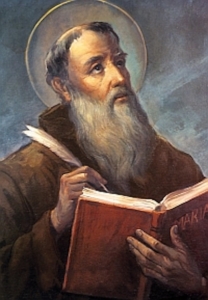
St. Lorenzo of Brindisi, Doctor of the Church.

Our easier recollection of the earliest “St. Lawrence,” above, may in part be due to the fact that the saintly incandescence of August, while still blinding, appears to be slightly less overwhelming than it is in this month of July.

From St. Junipero Serra, patron saint of Serra International, the Vatican apostolate for vocations, who began the month on July 1, to St. Ignatius of Loyola, creator of the Spiritual Exercises and founder of the Society of Jesus, who completes it on July 31, the list of Roman Catholic Saints who are liturgically honored in July is replete with luminaries (6).

It would be so easy to overlook the Optional Memorial for San Lorenzo de Brindisi, who also is known in English as St. Lawrence, on July 21.

Father Butler’s Lives of the Saints reports the historical date of his death as July 22. His Feast Day in the pre-Vatican II liturgical calendar, was also celebrated on July 22. Butler describes San Lorenzo as a “Confessor” (7). The 2025 USCCB liturgical calendar now describes St. Lawrence of Brindisi as “Priest and Doctor of the Church.” (8)

Born Guglielmo (or Guilio) de Rossi (or Russi) in the Kingdom of Naples, to a Venetian merchant family, he was gifted by God with an exceptional abundance of talents. (9)

Documented as a prodigy from early childhood, he presented popular narratives about Baby Jesus during the Christmas festivities in Venice, and was already recognized for his oratorical gifts. He began his formal studies at St. Mark’s college when he was 12 years old.

He was called to preach the Venetian Lenten sermons while still a deacon, and completed his advanced studies at the University of Padua. He was ordained a priest at the age of 23. He joined the Franciscan Capuchins as Brother Lorenzo, and was elected a provincial superior by the time he was 31. (9)

A genuine linguistic polymath, St. Lawrence of Brindisi read, wrote, and fluently spoke in Hebrew, Greek, Latin, and all of the European languages of his time. He memorized the entirety of the Bible. (9)

His lifetime production of written works numbered eight volumes of sermons, two treatises on oratory, a commentary on Genesis, a commentary on Ezekiel, and three volumes of religious polemics. (9)

He served as chaplain of the Imperial army in the immediate aftermath of Christian victory at the Battle of Lepanto. Victories against the Turks that defied all odds in the subsequent land battles were attributed to his intercession. (9)

San Lorenzo was sent throughout the known world of his time as an evangelizer, and as a diplomat to settle constant disputes among princes, during one of Europe’s most turbulent centuries. (9)

Despite his retirement to a respite of welcome spiritual contemplation at the end of his life, he did not refuse one last request to undertake yet another arduous sailing voyage to Spain. His death resulted from the fatigue caused by that final diplomatic mission. (9)

Lorcán Ua Tuathail, 1128-1180, Canonized 1225

Most of us in the United States might not even recognize this name in Irish Gaelic, and only a few might have heard of him as St. Lawrence O’Toole. Unless I failed to find it, his memorial does not appear in the USCCB liturgical calendar for the United States.

But the November 14 Feast of this influential twelfth-century Archbishop of Dublin, and that city’s enduring patron saint, is still celebrated with great affection in Ireland today. (10).

He was born in County Kildare, where his father was chief of Hy Murray. According to the custom of the time, Irish politics required that Lorcán, as the chief’s son, be sent as a “guarantee hostage” to the King of Leinster. (11)

Leinster’s monarch treated the child with such abuse that “…his father obliged the King to turn him over to the Bishop of Glendalough…” (11)

St. Lawrence O’Toole was elected the new Abbot of lake-and-forest monastery Glendalough, founded by hermit St. Kevin, by the youthful age of 25. (12)

He served the monastery as Abbot until he was called to the See of Dublin  in 1161, to become its second Archbishop (11) at a time when cultural conflicts between the indigenous Irish and newly arriving Norman settlers had become particularly contentious (12).

The story is told that St. Lawrence O’Toole was attacked by a terrorist while approaching the altar at the court of King Henry II of England. He asked for water, blessed it, and applied it to what all the witnesses present had believed was a mortal wound. The bleeding stopped immediately and the Archbishop carried on to celebrate mass (11).

On November 14, 2019, Archbishop Diarmuid Martin, in his address celebrating two retiring Bishops in the Archdiocese of Dublin, recalled the many accomplishments of this great Irish saint. (12)

Archbishop Martin also noted that St. Lawrence O’Toole had “…attended the Third Lateran Council in Rome in 1179, at a time when travel across Europe was perilous…” (12)

St. Lawrence O’Toole died in France just one year later, on another diplomatic journey, to attempt yet again a lasting peace with the Normans. (12)

He is the only St. Lawrence who speaks directly to readers in Ronda de Sola Chervin’s 20th century book, Quotable Saints.

 “My Will! What are you talking about? Thank God, I haven’t a penny left in the world.” (13)

St. Lawrence of Rome, San Lorenzo de Brindisi, St. Lawrence O’Toole,

Pray for us.


© Copyright 2025 by Margaret King Zacharias

Notes and Sources

  1. https://en.wikipedia.org/wiki/Lawrence_(given_name)#:~:text=Meaning,Lawrie%2C%20Laurie%2C%20Larold%2C%20Law
  1. https://en.wikipedia.org/wiki/Laurel_wreath
  1. https://en.wikipedia.org/wiki/Saint_Lawrence#Gallery
  1. https://en.wikipedia.org/wiki/Saint_Lawrence#cite_note-Healy-11
  2. https://bible.usccb.org/bible/readings/081024.cfm
  1. https://www.ewtn.com/catholicism/library/saints-of-the-roman-calendar-5801
  1. Butler, Rev. Alban, Lives of The Saints: With Reflections for Every Day in the Year, New Edition, New York, Boston, Cincinnati, Chicago, San Francisco: Benziger Brothers, Inc., “Printers to the Holy Apostolic See”, 1955, pp. 408-409
  1. https://bible.usccb.org/bible/readings/072125.cfm
  2. This information is based on its primary source https://en.wikisource.org/wiki/Catholic_Encyclopedia_(1913)/St._Lorenzo_da_Brindisi

And

https://en.wikipedia.org/wiki/Lawrence_of_Brindisi#:~:text=(22%20July%201559%20–%2022%20July,%2C%20Spanish%2C%20and%20French%20fluently

  1. https://anastpaul.com/2018/11/14/saint-of-the-day-14-november-st-laurence-otoole-c-1128-1180/,

and

https://www.catholicireland.net/retirement-two-bishops-ordination-deacon-mass-dublins-patron-saint/

  1. https://www.catholicnewsagency.com/saint/st-lawrence-otoole-53
  2. https://www.catholicireland.net/retirement-two-bishops-ordination-deacon-mass-dublins-patron-saint/
  3. Chervin, Ronda De Sola, Quotable Saints, Ann Arbor, MI, Servant Publications, 1992, p. 106.

Image credits:

Feature Photo: Glendalough, Early-Medieval Monastic Complex, Wicklow, Ireland

Attribution: Joe King, CC BY-SA 3.0 <https://creativecommons.org/licenses/by-sa/3.0>, via Wikimedia Commons

The Martyrdom of St. Lawrence of Rome, Peter Paul Rubens, 1614

Attribution © José Luiz Bernardes Ribeiro

This file is licensed under the Creative Commons Attribution-Share Alike 4.0 International license.

St. Lorenzo of Brindisi, Doctor of the Church

Attribution: https://www.cappuccinivenezia.org/spirito.htm, Public domain, via Wikimedia Commons



Achieving health, well-being and stronger faith one day at a time

Achieving health, well-being and stronger faith one day at a time


“I promised myself and God that if I found the answers to my struggles with my weight and health, I’d be bold and brave and share what I’ve learned with others. The tribulations that have caused me the most pain in my life – my mess – becomes my message.” — Shemane Nugent


Oftentimes, the promises on book covers are more the crafting of marketing departments than the authors: be the best parent in one hour; 21-days to real health; financial independence and a rich, free life. Anyone looking at them realistically would admit that, while the techniques may be effective, achieving the authors’ intentions would be slower and more gradual.

The cover of Shemane Nugent’s 2025 release, Abundantly Well (Good Books), also makes such a cover claim. Situated within a ribbon vector image, it promises, “40 days to a slimmer, healthier you.” From a sales perspective, it’s a sexier enticement for the writer’s audience, most likely women ages 40 and up. If that’s the grabber, it does a disservice to the book and Mrs. Nugent’s comforting, faith-infused style because the whole intention of this book is more than losing weight. The subtitle, “Bible-based wisdom for weight loss, increased energy, and vibrant health” says more about what’s inside. Rather than a crash course for temporary results, Abundantly Well offers ways for women to sincerely regard themselves as “temples of the Lord,” and not just in body but in mind and spirit. While written in a topic a day, 40-day format, Abundantly Well is unique from other health and fitness books because it is prayer and God-centered with the author’s recurrent reminder of taking “small steps” that work for the reader’s life.

Each day’s topic begins with a Bible verse that fits the chapter contents. After the main content, supported not just with her own opinions and experiences, but other Bible verses and scientific articles, is the “Move Forward” portion, where the author asks, out of the information just presented, what one or two parts could be added to your life today? The day’s readings and motivations are capped with prayer.

Cover of Abundantly Well by Shemane Nugent

She ventures between the days addressing fitness and weight loss, with writings on healing trauma, detoxifying your home, aging, prayer, service to others, and spiritual warfare. While she doesn’t go in-depth on the topics — they are meant to be easy to digest daily, she provides insightful information and resources to learn more later. On Day 12, she begins to demystify cravings and on Day 17 managing “Hormonal Havoc.” Day 14, “Detoxify Your House,” she addresses many small ways we add poisons to our lives through the gasses and chemicals in things as plastic bottles and scented trash bags.

When Mrs. Nugent writes about nutrition and fitness, she differentiates it from typical approaches by grounding them in a Biblical framework and a mindset of moving forward. Day 7, “God Food Verses Man Food” is a realistic reflection of the mass-produced food industry compared to the often-vilified individual hunting practices.

“Some people say they could never kill an animal, but even if you’re a vegan, you are responsible for killing millions of birds, geese, rabbits, possums, and deer. The roads you drive on, the shopping mall you frequent, your house — these were all once wildlife habitat. Your vegetable garden too! By making way for those areas to be habitat-free, you have to kill every squirrel, rabbit, chipmunk, pheasant, dove, turkey, and deer. We are all complicit (pg. 25).”

Within these pages, she speaks of what she knows and lives.

“I promised myself and God that if I found the answers to my struggles with my weight and health, I’d be bold and brave and share what I’ve learned with others. The tribulations that have caused me the most pain in my life – my mess – becomes my message,” she writes (p. X).

Mrs. Nugent is co-author with her husband of more than 30 years, Ted Nugent (yes, that actual rock star, Ted Nugent) of the 2016 release, Kill It and Grill It, about preparing and cooking wild game. She also authored, Killer House, her story of surviving illness from toxic mold found in her home. She has been in the fitness industry for 40 years as an instructor and program developer, and is host of the Sunday morning show, “Faith and Freedom” on Real America’s Voice network. It could be easy to look at Shemane Nugent, who maintains her figure and beauty past the age of 60 and dismiss her as a celebrity author and wife of a mega star who can buy whatever she needs to achieve happiness. But don’t be so quick to judge. She has endured major surgery, forgiven marital infidelity and beaten a life-threatening illness. She regrets spending too much of her life being a “doormat,” stuffing down deep grief, and lacking confidence, without a note of self-pity. She also admits to eyelash extensions, trying botox, and indulging in chocolate chip cookies and cupcakes. She shares with her Christian sisters that she learned to take the difficulties in life and use them to grow stronger and develop her prayer life and reliance on God and she wants the same for them.

How we think, how we feel, how often we move, what we breathe into our bodies and ingest, our perspective of God, prayer, gratitude, and service to others, all play a part in our health. You may not live a rock star life, but Shemane Nugent maintains that you do not need to; you just need to take baby steps every day, accompanied with prayer and gratitude, toward achieving your goals.

© Copyright 2025 by Mary McWilliams

Feature Image by Pexels from pixabay.com

Inset by Mary Mcwilliams