
Survey Says: Mary, Powerhouse Intercessor!

Survey Says: Mary, Powerhouse Intercessor!

by Dennis Lambert

If we were playing Biblical Family Feud and the players were asked, “What was the greatest revelation of the Wedding at Cana?” my guess is that the number one answer would be a toss-up between two answers. It would be either that it is where Jesus performed his first miracle or that it was the beginning of his public ministry.

Now for the more serious Family Feud thrill seekers out there, what would take the next spot on the big Feud board? The answer to that is likely to be dependent on that player’s Christian affiliation. For myself, being Catholic, my response would be, “Mary the Intercessor.”

One thing I am certain of is that the role of Mary in our Christian faith is often misunderstood by Protestants, and also by many Catholics. Having spent a couple years in the non-denominational world, I can tell you that the number one misconception regarding Mary is that Catholics pray to Mary as we pray to God. (insert the Family Feud big Red X and obnoxious buzzer sound here!). It is, in fact, the story of Cana which demonstrates to the world one of Mary’s most treasured roles in our Christian faith.

Let’s take a look by putting ourselves into the story…

Now, wedding feasts during the time of Jesus were truly a celebration which lasted for days. So the party is in full swing when Mary, the intuitive mother she is, notices something is wrong.

Perhaps she notices the head waiter whispering something into the ear of the father of the bride and then sees a look of shock and dismay come across his face. Next, the father follows the head waiter into the kitchen, and Mary, who obviously knows the man, out of concern follows him to find out what has him so disheveled.

When Mary learns that he has run out of wine she immediately understands the social ramifications and embarrassment it would cause this man, his daughter the bride, and his family. You see, running short on wine at such a celebration would indeed been a major party foul and that error would have surely made that family the talk of the town for months to come, and not in a good way.

So I can envision Mary calmly talking to that father, telling him that everything is going to be all right, that she’s got it handled. Her next move is to her Son. She explains in detail what has happened, what was happening. After listening to his mother, Jesus says to her, “Women, how does your concern affect me? My hour has not yet come.” The reality is that back then, the term “Woman” was an endearing sign of affection. Using a little poetic license and placing myself into the scene, I can see Jesus’ response possibly coming off more like, “Mother, the woman I adore, it’s not my time quite yet. You understand, right?”  (And if I had more space in this article we could go into how biblical scholars describe this call of “Woman” by Jesus as his announcing of Mary as the new Eve.)

Now Mary’s response is interesting. Her eyes are on Jesus, listening to what he says one second, and then a split second later turning her head from her son to the server. Without saying a word to her son, she tells the server, “Do whatever he tells you.”  Now that’s authority! Now that’s a mother!

I can just imagine Jesus rolling his eyes after this, saying something like, “Ma, really?” But what does he do? He orders the servers to bring out six stone jars filled with water. According to the Gospel, that was between 120- and 180-gallons worth of water that Jesus then turns into wine!  In that instance, Jesus complies to his mother’s wishes, her “intentions.”

What this part of the story tells us, unequivocally, is that Mary indeed has the ear of her son and most importantly, that he listens to her.

And what are the implications for us? While they may be pretty clear to most, let me build up where I’m heading with this just a bit before I come out and state the obvious. Allow me ask a couple probing questions …

How many of you have ever prayed for someone else? How many been prayed for? My guess is that everyone reading this is saying an unequivocal “yes” to both questions. The fact that we all participate so fully in this thing we call prayer shows that there is something to it. That there is a real power to prayer. And if you’re like me, the holier the person you get to say a prayer on your behalf, the more efficacious we feel that prayer is going to be.

Which brings us back to Mary. The wedding feast at Cana introduces Mary as the best intercessor for our prayers. After all, whether a person is Catholic or Protestant, I’m confident we would all agree that no one who ever lived is holier than Mary. After all, God chose her to have his Son!

Clearly, as seen in the story of the Wedding at Cana, Jesus most especially listens to his mother! And this, my friends, is Mary’s role in our faith. We don’t pray to Mary as we pray to Jesus or the Father. Rather we ask her, as the holiest person who ever lived, to take our needs, our prayers, our intentions to the very foot of her son. For, as seen at Cana, Jesus most especially listens to his Mother!

So when you find yourself in need, be it one of the big things in life variety, or just a case of writer’s block you’re trying to clear away, may the forceful words of Steve Harvey ring within your ears, “Survey Says: Mary, Powerhouse Intercessor!”…. and then may you turn to our Champion of Cana and ask her for the gift of her influential prayers!

© Copyright 2025 by Dennis Lambert

Feature Photo by John Andrew Nolia Blazo: https://www.pexels.com/photo/painting-of-holy-mary-15111009/

Love Among the Saints

Love Among the Saints

Do we think of saints being married? Among the most popular — St. Therese, St. Francis, St. Pio of Pietrelcina, St. Teresa of Calcutta were wed to Christ and the church. Yet Catholic history proclaims saintly husbands and wives who lived lives much like the rest of us. Who could ever imagine that the father of one of the most scholarly popes would have crafted a newspaper ad to find his wife? Or that a couple, now on their way to sainthood, would have a story that rivals Romeo and Juliet in family drama? Only one husband lived not just to testify to his wife’s saintliness but also to be present at her canonization. Another saint married twice. And one husband literally tried the patience of a saint.

Patrick O’Hearn’s Courtship of the Saints: How the Saints Met their Spouses, offers lively, loved-filled accounts of couples from Biblical times into the 21st Century. They shaped the church in some way through their sacrifice and devotion to one another and to their families by making the prayer their foundation and God the center of their lives.

Mr. O’Hearn, also the author of Parents of the Saints: The Hidden Heroes Behind Our Favorite Saints, and former acquisitions editor with Tan Books, clearly strives to provide an antidote to the decades old “hookup culture” that has degraded marriage, women, and men. He does this with inspirational examples of a proven formula for meeting one’s true love. People have, over the centuries, continued to seek love, but the ways of going about it have failed. He promises that the contents lying beyond the beckoning cover of the intimate painting, “The Meeting of Joachim and Anne outside the Golden Gate of Jerusalem,” by Fillipino Lippi (1497) are “… better than any romantic novel because they return to the source of love: God Himself” (p. 5), and Mr. O’Hearn is as eager as any evangelist to share the news.

He doesn’t begin there, however, because without the proper framework, the stories would only be pretty romance tales. Mr. O’Hearn commences by defining courtship and its significance, offering historical and contemporary perspectives. He explains how it is different from modern “dating” and urges those called to marriage to pursue it. “Our culture will only be renewed when the family is strong … when marriages reflect Christ’s radical love for His church; when couples love each other madly through the good times and bad, and are open to the number of children God wants to provide them.” (pp. 5-6). He peppers the narrative with quotes from Ven. Fulton Sheen, St. Thomas Aquinas, and other well-known and favored theologians.

“Courtship looks to the future – to eternity,” he explains. “Courtship asks the following questions: Does this person have virtue? Is this the best person to lead me — and, God willing, my future children — to heaven?” (p. 11). He moves into betrothal: “…a time for a couple to intensify their prayer life as they prepare for marriage” (p. 19). Introspective questions give further substance to the book and to Mr. O’Hearn’s premise of returning to a prayer-filled, God-invited relationship. Part Two “Courtship Counsel and Prayers” is a kind of action plan that offers contemplative questions such as: How do I pray daily for my future spouse? Where should I look for a future spouse? It also advises how to choose a spouse, discern marriage as a vocation, and offers prayers and saintly inspirational quotes.  A section for married couples opens with this guidance: “Rediscover why you fell in love in the first place and continue to fall in love. Don’t let the fire burn out.” Mr. O’Hearn then suggests practical applications for doing so.

Sandwiched between the practical is the romantic with the couple’s entertaining encounters. The 23- year union between Karol and Emilia Wojtyla so influenced their young son that it helped to shape his perception of the love between a man and a woman that the author asserts it “… provided the first education concerning the splendor of marital love” contained in Pope St. John Paul II’s “Theology of the Body.” His parents are now Servants of God. Accounts like the Wojtylas will melt hearts. Others might drop jaws, such as the meeting of Josef and Maria Ratzinger that occurred when she responded to a newspaper ad he wrote to find a wife. St. Thomas More transitions from the martyr who dared to defy King Henry VII to the guy down the street who is widowed prematurely and, out of concern for his young children, begins looking for a wife. No doubt readers will chuckle – because they know a couple just like this — when they read about Bl. Anna-Maria Taigi and her husband, Dominic, who possessed “rough” manners.

Others will bring tears. Arguably, no other romance is as beautiful as that between Pietro Molla and Gianna Beretta and the family life they created. The author devotes nearly 20 pages to them. Anyone who has read Journey of Our Love: The Letters of Saint Gianna Beretta and Pietro Molla, which the author cites, will marvel at how he was able to keep it to 20.

Among the 25 couples, readers will have many favorites because, regardless of the time, all have uniqueness and relatability. Each one also has the commonality of fervent prayer and love of God. Anyone willing to put their love life into God’s hand will be able to find joy, endure hardships, and withstand suffering, proving that but no one can write a love story better than the Father Himself.

© Copyright 2025 by Mary McWilliams

Feature Photo by Eugenia Remark: https://www.pexels.com/photo/decorated-cards-golden-plate-and-ring-in-box-14784845/
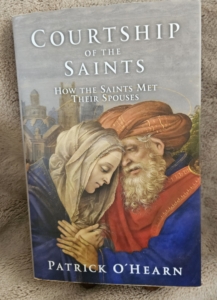
Inset photo by Mary McWilliams

God’s Got Our Back

God’s Got Our Back

I went to Confession hungry—hungry for something I couldn’t articulate at the time, but God knew and satisfied that unnamed gnawing through one of His kind priests.  Monsignor Ignacio gave me the penance of learning Psalm 139.  He told me how much God loved me and that, if I prayed this psalm, I would know absolutely just how deeply God knows, accepts, and loves me. I think I cried all the way home, realizing that, despite my faults, imperfections, and self-doubts, someone—God—could love me so completely.

I went on to memorize excerpts from that psalm and prayed it every morning for a while. I shared copies with friends and family.  I even wrote it down on scratch paper during a plane ride to visit my daughter and gave it to a misty-eyed young man sitting next to me. He cried.

Eventually, I stopped the daily morning recitation and drifted into a rhythm of aimless newly retired life. But I was hungry again. I was preparing to offer a workshop at our local Catholic Writers Guild meeting. “Writing with Intent” aimed at sharing tips and tools to kick-start or rejuvenate the writing life. At that time, chapter members ranged from new writers to seasoned authors. What could I possibly offer that would appeal to and encompass such a range of needs?  I began to worry and stress over the presentation.

That’s when Psalm 139 surfaced again. When we are hungry, God’s words speak to our hearts. Whether new to the pen and unsure of intent or seasoned with countless pages and seeking fresh perspectives, as Catholic writers, we need to know, without a doubt, that God loves us and has got our back. It is He Who guides our writing and satiates our hunger when we ask.

“Probe me, God, know my heart;

try me, know my concern.

See if my way is crooked,

then lead me in the ancient paths.”—Psalm 139: 23–24

The reading and meditation on excerpts from Psalm 139 set the introductory tone for the workshop, which was well received by all.  God was right there for me and them. Then and now.

Excerpts from Psalm 139


Lord, You have probed me, You know me:

You know when I sit and stand;

You understand my thoughts from afar.

My travels and my rest You mark;

with all my ways You are familiar.

Even before a word is on my tongue,

Lord, You know it all.

Behind and before, You encircle me

and rest Your hand upon me.

. . . 

If I fly with the wings of dawn

and alight beyond the sea,

even there Your hand will guide me,

Your right hand hold me fast.

. . .

You formed my inmost being;

You knit me in my mother’s womb.

I praise You, so wonderfully You made me;

wonderful are Your works!

. . .

How precious to me are Your designs, O God;

how vast the sum of them!

Were I to count, they would outnumber the sands;

to finish, I would need eternity.

. . .

Probe me, God, know my heart;

try me, know my concern.

See if my way is crooked,

then lead me in the ancient paths.


—Psalm 139: 1–5, 9–10, 13–14, 17–18, 23–24

St. Joseph Edition of The New American Bible


© Paula Veloso Babadi 2025

Edited by Gabriella Batel

When not playing pickleball or “Nana,” Paula Veloso Babadi cooks, gardens, and writes poetry and short personal essays. You can find her first book-length collection, Everywhere Hope, at amazon.com.

A Christmas Wish

A Christmas Wish

I am writing to tell you about a story about an old veteran that I knew. He was a Vietnam veteran. I was assigned to the VA to be a counselor to these old warriors. There was one in particular that I remember that had it really hard. He had gone to jail under strange circumstances, and had some psychotic breaks, so I took an interest in him. This was about Christmastime.

I interviewed him one day about his life. He was born in Portland, OR. He had an uneventful childhood but his parents were middle class. He enlisted and was sent to Vietnam. He believed in the cause and wanted to prove himself.

When he went to combat it was nothing he expected.

“All the bombs, all the bullets, the Agent Orange, and the other chemical warfare,” he recalled.

“Are those memories troubling you?”

“No. That’s not all of it,” he said. “I ran. I was a coward.”

“So then,” I said, “how is it that you got convicted of aggravated assault?”

He said, “Well, when I got back home, I got a job as a mailman, but I drank heavily to cope. Maybe 5-6 drinks at night. One night I had the worst dream I was running away from the Viet Cong. And I heard my commander say, ‘Attack!’ and I didn’t want to fail again. So I went to my bar with my gun and I was going to shoot the Viet Cong. Well, it ended up I shot up the bar and injured some people.”

“Did you mean to kill anyone,” I asked.

He said, “I don’t remember because I blacked out. But I am a good shot, so if I meant to kill anyone, I would have done it. After that, I got sent to Oklahoma for jail for 6 years. It was the worst time of my life. I was there with people who meant to do harm and I was worried I might turn out like them.”

I said, “Well, it’s Christmastime, so I imagine if you had a Christmas wish, it would be you didn’t run from the Viet Cong.”

He said, “No, I wish I could meet my granddaughter. I had a brief relationship in Oregon, and in jail I found out she got pregnant with a girl and then recently she told me her daughter had a daughter. So that’s my Christmas wish to meet her.”

I asked permission to try to contact his daughter and he said yes. I was able to find her and asked if she would like to contact him and she did. After a few months I arranged a meeting but I found out our veteran was in the hospital with liver disease, so I thought about a short meeting and showing the child some military pictures and got one of Vietnam. The woman and her daughter came to the hospital.

“What’s your name,” he asked the little girl.

“Melanie,” she told him.

“What grade are you in?”

“Fifth.”  They talked about his life and her time in school and friends for a while. Then it was time to go.

Later, I got an email from the mother saying the child wanted to know what her grandfather did in the war. I emailed back the picture I had found. She asked if it was her grandad in the picture.

“Yes,” I said, “I’m sure it was him.”

Copyright 2025 Cecile Bianco

Edited by Mary McWilliams

Image by Rozbooy from Pixabay

Starting the New Year

Starting the New Year

2024 is here! It is time to work towards accomplishing our New Year’s resolutions lists! What is on your list? Do you have a dream? A goal? Something that you have always been wanting to do?

It is okay to plan out our lives. Writing things down on a piece of paper helps us to think about our futures. But once in a while, one or two of our plans change. We might not understand at the time why God allows something else to happen that would affect our wishlist.

Some of our dreams and desires are not always realistic. When you plan for the new year, think about some of the things that you want to do. Are they practical? Are they realistic? Are these things pleasing to God?

Ask God for guidance while you make your “to-do” list. Think about the things that encourage you in your walk with the Lord. Do you want to grow more in contemplation? What about your friends or family members? Are your new goals going to affect them?

Are you thinking about jumping into something that is going to be very important? Something that is going to affect you financially? Write down the pros and cons of your dreams.

Is there something that is keeping you from your new goal? Are you afraid to make this dream come to life? How is it going to help you in the long run? Sometimes, our dreams can be short-lived. We might think about something for only a little while and forget about it the next day.

Sometimes, people try very hard to make the items on their New Year’s resolution lists happen. But for some reason or another, they postpone their actions and forget about their plans completely.

If a goal stays on your mind, perhaps that is a sign for you to stick with your plan. Anyway, no matter what choices you make, have a happy 2024! God bless you.

Copyright 2023 Angela Lano

Learning A New Language Part 2

 Learning A New Language Part 2


I wrote an article about learning a language. In my previous article, I gave some advice about how to get started with learning another language. It takes a while for beginners like me to build good habits while learning another language.

The language that I’m seriously studying right now is French. Why did I choose French? Good question. I think part of the reason why I’m currently studying French is because I have, over time, developed an interest in France.

That is because three of my favorite saints lived in France. St. Therese the Little Flower, is the first saint that comes to my mind, and St. Joan of Arc. The third saint is St. Bernadette.

I wanted to learn more about the French language partly because of the interests that I have right now relating to the Catholic Faith. For example, one of my favorite Catholic devotions came from France.

I’m trying to speak French and write down new words in a notebook. It is good to develop habits like this. Even though some of the words and pronunciations are very difficult for me.

Learning a language is a fun challenge. It encourages you to continue with the language even though it is difficult. I’m also learning how to read very basic words and sentences in French.

I know that “Je suis” means “I’m” in French. And that “sont” means “are” in French. I have also been trying to look up some of the other words in my French dictionary. But if a word is not included in the dictionary, then I look it up on the internet. The internet is pretty accurate when it comes to certain French words or phrases.

Don’t give up on learning a language right away! Spend some time with it. If for some reason you are frustrated with it, and this frustration stays with you, then move on to another language.

Practice writing the language that you are studying. Just like what I’m doing. This helps to reinforce certain words in your mind. Have fun with the language! Ask God to help you and to give you wisdom in this area.

Copyright 2023 Angela Lano


Hello world!

Welcome to WordPress. This is your first post. Edit or delete it, then start writing!

Stepping Into Another World

Don’t you wish that you could pop into another world, help the good characters win over the bad guys, and forget the cares and troubles of this world?

Fantasy stories have this effect on people’s minds.  When I was a teenager, I was completely fascinated with the genre. The Chronicles Of Narnia and Lord Of The Rings seem very real to me. I wished that I could step into the wardrobe and have tea with Mr. Tumnus or have an interesting conversation with one of the hobbits? Sometimes I looked at the words on the pages of these books, and sigh, “why can’t I be on a wonderful adventure?”


This is a sign of good writing. Good writing helps the readers identify with the characters and scenery. The characters persuade us to care for them. We cry when something bad happens to them. We cheer them onto victory as they succeed. They become friends.  This is why Narnia and Middle Earth are still household names. They stand the test of time, among their loyal fans. 


Looking for another fantasy book to read this summer?

If you’ve already read the Chronicles of Narnia and the Lord of the Rings trilogy, I recommend the 100 Cupboards written by N. D. Wilson. I read this book when I was in my early 20s and really enjoyed it. It’s a little bit like the Chronicles Of Narnia. A boy named Henry lives with his Aunt, Uncle, and cousins.  Mysterious things suddenly began to happen to him and his relatives.

Sit back and relax. Pick up your feet and enjoy the fantasy world. Come back whenever you are ready.


Sharing fantasy books with others

Do you have some favorite fantasy books that you want to share with others? Grab the titles that capture your interest. Give them away to friends or loved ones. 

Write a fantasy story

Is there a fantasy story bursting in your brain? Write it down before you forget! Ask God for help. He will guide you with your manuscript. 

"Christmas Spirits" and Food for the Poor

by Karina Fabian

Dear friends and readers,

This winter, I have two things in my heart and on my mind: caring for those less fortunate than me (or indeed, much of the world) and my DragonEye, PI stories. For Christmas, I’m combining them and would like to share them with you.

Those of you who are “Vern Fans,” know about my dragon who works in our world as a private investigator, and his partner, Sister Grace, a mage and nun in the Faerie Catholic Church. They’ve saved the worlds and their friends in numerous stories and novels. Last year, I wrote a story for Flagship about their first Christmas together. Not only is Grace struggling with the Mundane idea of Christmas, but their home is threatened by a land developer who wants to tear down the entire neighborhood and make a mall. When the Ghosts of Christmas come to visit him, however, Vern and Grace have to solve the mystery before the Christmas Spirits become Angels of Death.

I have revised and am publishing “Christmas Spirits” as a serial story to raise funds for Food for the Poor. This is a wonderful charity that helps people in impoverished nations help themselves. It allows donators to choose their gifts–whether rice for a family for a month, school supplies, livestock, tools or even houses.

I’m asking that you please check out the story, and, if you enjoy it and want to see more, that you donate even a dollar to the cause. Also, if you enjoy the story, let your friends know. I’ll post every Tuesday and Thursday as the donations come in. Right now, we have raised enough to send a family a goat, but the donations have stopped, and we are holding at Episode Four until more come in. Vern would like to send them a cow (he is a dragon, after all), but Sister Grace and I are dreaming of raising enough to buy someone a home. Can you imagine giving a HOUSE for Christmas? Will you help?

Find the story at https://christmasspirits.karinafabian.com. You can also get to it via my website, https://fabianspace.com. Look under the Christmas dragon for the link. You can learn more about Food for the Poor at https://www.foodforthepoor.org.

Stay in the Know

Join Our Newsletter

Members and supporters can get the latest on CWG news and events by signing up for our newsletter.

Please wait...

Thank you for signing up!

Catholic Writers Guild
P.O. Box 77
Eaton, IN 47338