 Emily Henson
Graveyard of the Atlantic: A Ghostly Encounter
Graveyard of the Atlantic: A Ghostly Encounter
Ghost stories tend to be relegated to October or similarly dark nights with a crisp edge to the air that makes you want to curl up safely in a blanket. But, just like ghosts remain transient, their stories don’t have to be fixed to a particular month. My family’s encounter with a spirit was on a warm June night off the coast of North Carolina, near the Graveyard of the Atlantic. I want to be careful and remain respectful as I tell you about my family’s recent encounter.
With any topic concerning what “lays beyond” I believe one should tread lightly. First, if whatever is haunting an area is truly a lost soul, they deserve certain considerations. The first step in any encounter is to pray for the happy repose of the soul who may not be able to be at rest until they receive intercessory prayer on their behalf. If, on the other hand, the haunting is of an evil origin, i.e. – a demonic spirit, the laity must use extreme caution as the demon’s only
desire would be the ultimate destruction of human souls. A priest of the Roman Catholic Church would provide the best guidance in those situations.
On a recent trip out to Hatteras Island in North Carolina, my family and I met up with dear friends at a beach house we had rented for a week. Hatteras Island is at North Carolina’s Outer Banks. Due to the thousands of shipwrecks and the unknown number of human lives lost in the area, the Outer Banks are referred to as The Graveyard of the Atlantic. The shallow sand banks along the coast are hard to see on a brilliant day. Add dark and formidable weather without high tech navigation systems and you have a recipe for disaster. Near our beach house, for
instance, lay the graves of a young couple. Captain Stephen Barnett and his wife Rebecca who, along with their baby boy, lost their lives when Captain Barnett’s schooner ran aground off of Ocracoke Island. It is a tragic story you can find here: https://www.ncgenweb.us/dare/cemeteries/index_barnettstephend.html
Several days into our trip, a squall hit the island as night closed in. The wind slammed against the outside walls and thunder boomed on both sides of the island. Being around 30 miles from the coast of North Carolina, storms feel ominous on an island. After talking late into the night with my friend, I finally headed to bed. Before settling in, I went down to the lowest level of the house to make sure the door was locked. As I turned from the door, I felt a presence very near to me. Deciding I was being silly and chalking up my prickling skin to the billowing storm
outside, I rushed up the couple flights of stairs to my bedroom.
Thunder continued to crash and the wind roared throughout the night.
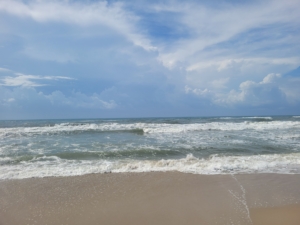
The next morning dawned crystal clear. The island appeared freshly bathed and brighter after the torrential shower. Our family was the first awake. We headed to the topmost story of the house where the kitchen was located to make breakfast. My nine-year-old son greeted me with a hug and asked why I had been in his room the night before. The conversation went like this:
“Do you mean when I checked on you before I went to bed?”
“Never mind,” he responded, too sleepy to want to explain.
“No, I want to hear about it,” I encouraged. My skin was prickling again. “I gave you and your sisters a quick kiss and headed out of your room before going to my room. Is that what you mean?”
“You were standing by our door. Why were you standing there?”
My stomach felt suddenly heavy. I remembered the presence I had sensed in the downstairs entryway the night before and now my son had seen a form in his room. I kept my face blank and remained outwardly calm. I needed coffee before I could process what my son was asking me.
Mistaking my lack of response for disinterest, my son grew bored of the conversation. “Never mind,” he said, shaking his head and running off to play.
After we had eaten our breakfast and our friends were up and about, the two husbands took off with the children to explore the island’s shoals. My friend and I stayed at the house.
My friend asked, “Was anyone up last night during the storm?”
I froze. “What?”
“We saw someone at our door. I thought it was a child scared during the storm. When we called out, they didn’t come in. We got up to check but no one was there. Our kids said they stayed in bed.”
All I could do was stare. She had not heard my conversation with my son. Now two people had seen a presence. I told her I’d check with my children to see if they’d been up during the storm. When I asked my children later, none of them had left their beds.
Later, I approached my son again. “Can you tell me what the shadow looked like that you saw by your door last night?”
“Tall, short hair, very straight shoulders.”
His oldest sister chimed in, “That doesn’t sound like a description of Mommy. Why did you think it was Mommy?”
A thought struck me. Hesitantly, I asked, “Did the form look like what you’d expect a soldier or a sea captain to be like? The way it was standing so straight?”
“Yeah,” he nodded.
Looking nervous, my daughter broke in again, “Why, Mommy?”
I had one more question to ask my son, “Did you feel like the presence was nice and kind of watching over you during the storm or did you feel scared?”
“I wasn’t scared,” he responded with a shrug. “I think it was like someone was protecting me.”
When my husband and I discussed what my friend and our son had witnessed in the night, my husband reflected that there were gravestones speckled throughout the surrounding yards around the house. He wondered if the house had been built on a graveyard. A quick internet search showed us that, sure enough, the house may have been built on the site of the Zora Gaskins graveyard.
It seemed clear to me that whatever presence was seen during the storm could have been someone who died during a shipwreck, potentially during a storm, and meant no harm. As a Catholic, I believe that some souls are in need of intercessory prayer in order to be at rest. After explaining to our children what we might have experienced in the night and reminding them about the importance of praying for Holy Souls, we traveled to the local Catholic Church and obtained a bottle of holy water. Returning to the house, we offered prayers for the Holy Souls not only in the area but for all those who met their demise in the Graveyard of the Atlantic. We sprinkled holy water in each bedroom and at every threshold.
Even though we had a couple more stormy nights, we did not experience any more ghostly encounters. I pray our friendly ship captain is now at peace.
*One more note of caution: Do NOT seek encounters with spirits. Often, demons will pretend to be those that have gone beyond in order to trick us. The hatred demons have for humans is very real and they will do anything to lead souls astray. If you do experience an encounter, immediately pray something like the following and if the encounter does not cease, it’s time to call in a Catholic priest.
Eternal rest grant unto them, O Lord, and let perpetual light shine upon them. May their souls and the souls of all the faithful departed, through the mercy of God, rest in peace. Amen.
*Previously posted on my blog at www.eahensonbooks.com*
Copyright 2025 by Emily Henson
Edited by Maggie Rosario






 She opens with brief paragraphs that generally describe each of the four. Then she jumps right into the saints and why she thinks a specific saint owns that particular temperament. This method of organization speaks to the point of the title, but at times, particularly in the chapters on St. Francis de Sales and St. Peter, while enjoyable, can be confusing and repetitive. In both, she moves on to address other saints of the same temperament, perhaps to give additional examples of the trait, but sometimes it sounds as though she is trying to force the saint to fit the trait. St. Francis de Sales is described as “Melancholic-Choleric” in the chapter title and she spends the first few pages talking about the Choleric disposition. She notes, however, that, upon studying his life and words, Choleric is the least of his traits. To her point, she impresses upon the reader that, ideally, we want to become a balance of the best of all four traits, which St. Francis de Sales achieved through a great deal of prayer, intention, and work.