
When Picking up Your Pen Is Picking up Your Cross

By Janice Lane Palko

How do you regard your writing career? Perhaps you’re like me. I’ve been putting words on paper for more than 20 years, and I’ve always regarded my propensity to write as a being a blessing and as a calling of sorts. I wrote last month how God and, to a lesser extent, we humans can take something meant for harm and turn it into good. My writing has been a blessing wrought from misery.

I’m a natural-born worrier. Some families seem to pass on the proclivity to become addicted to alcohol, drugs, or gambling while others seem to be prone to divorce or commit suicide, but my family’s fatal foible is to fret. We are world-class worriers. After my third and last child was born, now nearly 25 years ago, I began to experience panic attacks. At first, I didn’t know what was happening to me, but as a worrier, I, of course, assumed it had to be something catastrophic like a brain tumor. After consulting my family doctor and a visit to a therapist, it became apparent that I was under too much stress—a lot of which I was putting upon myself. In addition to having three small children at the time and getting no sleep and experiencing several family health crises, I have a vivid imagination. As such, I realized through some introspection and prayer, that I was using my God-given imagination to terrorize myself. For instance, if I saw a carjacking on the news, I would cast myself as a victim and play out the scenario in detail in my mind of what it would be like to be taken captive and held by brutal criminals.

Through prayer, reprioritizing my things in my life, and discovering that I could terrorize people on the page through writing instead of myself, I found a happier, more peaceful, and more productive life. That’s why I’ve always viewed my writing career as a blessing in my life. It refocused my mind on more productive things.

During this Lent, however, I’ve come to another perspective–one that seems contradictory since I love writing so much. I’ve become aware that writing may also be my cross. Not to trivialize Jesus’s passion and death by comparing it to the life of a writer, but when you are a writer, life is not all sunshine and roses. There is suffering. How many of us could paper the walls with rejection slips? How many of us have had a piece you’ve sweated over fall flat? How many of us have looked at a paltry royalty check and wondered if it’s all worth it? How many of us have watched as books like Fifty Shades of Grey soar to the top of the bestseller’s list while our writing attempts to edify and inspire bump along the bottom of the Amazon charts? How many of us have put in a full day’s work or spent all day taking care of a home and children only to use what little “me time” there is to eke out some writing?

In writing this piece, I did some research on what it means for Catholics to “take up their cross.” It seems that passage of scripture is often difficult to define, but I like this thought on it that Saint Pope John Paul II gave during World Youth Day in 2001.

“As the cross can be reduced to being an ornament, ‘to carry the cross’ can become just a manner of speaking. In the teaching of Jesus, however, it does not imply the pre-eminence of mortification and denial. It does not refer primarily to the need to endure patiently the great and small tribulations of life, or, even less, to the exaltation of pain as a means of pleasing God. It is not suffering for its own sake that a Christian seeks, but love. When the cross is embraced, it becomes a sign of love and of total self-giving. To carry it behind Christ means to be united with him in offering the greatest proof of love.”

Like the proverbial double-edge sword, I’ve come to see my writing as both a blessing and a cross much as Jesus’s cross is both a curse as it spelled suffering and death and yet, at the same time, was the greatest sign of His love for us. Suffering and love are always intertwined.

Therefore, as we come to another Easter, I’m going to dwell less on the suffering endured as a writer and strive to be more like Jesus and take up my cross and offer everything I put on the page as a great proof of love.

The Extraordinary Powers of the Catholic Priest–Imparting the Apostolic Pardon

My wife, Marty, passed away on March 27. Some of you may have seen my posts over the past few years about her ongoing battle with cancer and then Alzheimer’s Disease. No matter; what killed her was an infection called sepsis. It went to her heart and that was that.

There was, however, a spiritual beauty and inspirational moment that occurred during her journey to the end of her life. It happened soon after she was on life support. It showed me clearly why God had brought Marty and me together to begin with and how the power given to a priest through Holy Orders is so awe-inspiring. The following story, published at Aleteia, describes what happened.

I was standing next to an unconscious body that was being kept alive through the use of mechanical means and medications. Somewhere inside that body was my wife, Marty. She was on life support and my work of many years as her caregiver was either on hold or would soon be ended.

Marty has had Alzheimer’s for several years already, but as 2017 arrived, things had spiraled downward. Over these last three months, the disease has been markedly advancing and has affected her walking. Several times, she has even forgotten who I am.

One day a week or so ago, I wanted to give her the afternoon meds. She refused to take them. She said she could not let a stranger give her poison. I am accustomed to her unpredictability but this was a first.

I resorted to having a close friend come over to “identify” me to Marty. My wife was unflappable and refused to give in. After about a half-hour of cajoling, she finally, yet haltingly, relented and took her pills.

Last Thursday, Marty spent most of the day sleeping. She ate nothing. I attributed it to new meds she had been prescribed. Friday the sleeping intensified and again she did not eat. Saturday was worse and late in the afternoon, when I checked her vitals, her oxygen level was at 82.

I called 911.

The paramedics oxygenated her and took her to the ER. She was freezing cold and they discovered her core temperature was down to 93 degrees. Sepsis was suspected and later on validated.

By 4 a.m., she was in ICU and on life support. She had become “unresponsive” and needed to be intubated.

Through my jumbled thoughts in the midst of the commotion, one thought came crystal clear. Call the priest.

Read the rest at Aleteia.org.


Please keep both Marty and me in your prayers.

Copyright 2017 Larry Peterson

The Other Side of Trust

knot-1110536__480[1]Shortly before beginning the process to adopt a little girl from China, I stumbled across this scripture  verse; “For you have not received a spirit of slavery leading to fear again, but you have received a spirit of adoption as sons by which we cry out, “Abba! Father!” The Spirit Himself testifies with our spirit that we are children of God, and if children, heirs also, heirs of God and fellow heirs with Christ, if indeed we suffer with Him so that we may also be glorified with Him” (Romans 8: 15-17).  These encouraging words from the scriptures were significant on so many levels; touching on my concerns of becoming a family through adoption, to my anxiety of traveling half way around the world.  What I did not yet know would be how God would use my own adoption as his daughter, to help me bond with mine.
The entire adoption journey would test my trust in God like nothing I’d experienced before.  It was this verse however that I would turn to again and again throughout the two-plus year adoption journey. “Trust in the Lord and do good; Dwell in the land and cultivate faithfulness. Delight yourself in the Lord; And He will give you the desires of your heart. Commit your way to the Lord, Trust also in Him, and He will do it” (Psalm 34:3-5).   The desire of my heart was to adopt, and I was fully committed – as obstacles and issues arouse, all I could do is trust that God would bring us through.

SUFFERING THROUGH REJECTION

The first weeks with my daughter, Faith, was more difficult than I ever imagined because she completely rejected me. She and I could not even be left alone without her crying herself into a frenzy and become physically ill. I was heartbroken, especially after nearly two years of waiting, including six agonizing months of having her adorable picture, knowing she was joining our family but not being able to get clearance from China to travel there and bring her home. Here I was finally able to be with her and start to build the mother/daughter bond I’d been dreaming about, but she wanted absolutely nothing to do with me. Exasperated, I turned to Our Blessed Mother, in earnest prayer for consolation and guidance.

THE TRUST CYCLE

As an early educator for over 15 years, I knew that trust bonds were built by recognizing a child’s need, meeting it quickly and efficiently, and repeating that cycle – again and again until trust was established. Determined to win my daughter over, I told my husband that for the remainder of our time in China, I would be in charge of every possible need Faith might have.  These acts of love were even more important for building a relationship with my daughter, because she is deaf, and had not yet acquired any communication skills. So for nearly two weeks every bath, potty break, tooth brushing and morsel of food came exclusively from me. The doctor on the trip assured us the rejection of one of the two parents was completely normal (and actually expected); to be persistent and she’d come around.

SEEING THE OTHER SIDE

One particularly difficult morning, as I literally cried out to God in my distress, He gently reminded me of how distant I had been from him for so any years. How I, like my daughter, had completely spurned him. Yet God had continued to watch over me and generously provided in my needs. My rejection of His tender mercy and love was really no different than from what I was experiencing with Faithy. Just as He had faithfully cared for me, showing me again and again his trustworthiness until I was ready to accept him in my life; I would do the same for her.

And I did dutifully and lovingly for over three heartbreaking weeks, until one day something stirred in  Faith’s heart.  She was sitting on my husband’s lap; she looked up at him and then at me; then she ran across the room and crawled up into my lap and cuddled up against my chest. How grateful I was that the Father had blessed me with a far shorter wait to have my loved returned than I had given Him!

BONDING WITH GOD

The trust cycle God created for bonding his children (man to woman; parent to child; friend to friend), also builds our bond with Him. Where can you see God providing for you or your family and not just in your basic needs but in delighting to give you the desires of your heart?  Anxiety and plans go awry have a way of testing our trust in God, especially when you feel you are following his will.  As ‘Abba, Father’, we may expect him to spoil us – providing all that we ask and protecting us from heartbreak.  Trusting is recognizing he does all that and more, but only insofar as it is in our best interest.  Do not be afraid, commit to his ways, and watch what he will do.

All Rights Reserved,  Allison Gingras 2017


What Was Intended for Harm

By Janice Lane Palko

Several years ago, my family and I were seated in lawn chairs in a shopping center parking lot that overlooked Pittsburgh’s skyline. As darkness descended, we gazed at the sky awaiting the city’s Fourth of July fireworks when my soon-to-be son-in-law bolted from his chair and made a beeline to a store.

“Where’s he going?” I asked my daughter, wondering why her fiancé suddenly had a need to go to the dollar store, which was about to close.

“Remember when he was in high school and he worked for that mean store owner? How that guy was always calling him an idiot and telling him that he would never amount to anything?” I nodded. “The guy in that dollar store is that mean owner. He’s going to go tell him that he was wrong, that he’d graduated with an engineering degree, and that he was now working for a defense contractor designing technology that would keep his miserable butt safe.”

My son-in-law is a quiet, gentle, hard-working person, and since this was now eight years after he had spent a summer unpacking boxes at this man’s dollar store, I knew that the store owner’s unfair and demoralizing criticism of my son-in-law must have really lodged in his psyche.

Each year when my daughter was in grade school, the school participated in a reading competition sponsored by Pizza Hut. Students were required to read a certain number of books to get a free pan pizza. When she was in fourth grade, she was required to read ten books. One of my favorite books as a young girl was Louisa Mae Alcott’s Little Women, and I couldn’t wait for her to be able to read it and discover what a delight it was. A good reader, she asked her teacher if instead of reading ten smaller books, could she read Little Women.

Her teacher vehemently refused to even consider it. “No. You cannot read it. That book is too advanced for a fourth-grader. You’ll never be able to read that large of a book by the deadline. Read Ramona or Babysitters Club books,” said the teacher. My daughter relayed that conversation to me, and then set her jaw. “I’ll show her,” she said. “I’ll read Little Women and the ten stupid Babysitters Club books!” And she did, much to her teacher’s dismay.

I’m sure you’ve had an experience like those of my daughter and son-in-law sometime in your life. I have. More than twenty years ago, I began writing, and after having had several articles published (for pay!) and writing a column for a local newspaper, I was encouraged to join a writing organization. This statewide organization billed itself as a group that encouraged writers and worked on their behalf. I had to submit proof that I was a professional writer to be considered for membership. Imagine my surprise when I received this message from the man in charge of recruiting members: “I congratulate you on your moderate success and welcome you to the organization. Moderate success? I had no illusions that I was Nora Roberts or James Patterson, but who purports to encourage by diminishing? I shook my head and laughed. I’ll fix you, I thought. I’ll keep on writing.

We all know the value of encouragement. It warms the soul to dish it out, and it is even more palatable to consume. Humanity seems to gravitate to the negative, and ironically, it’s often the “discouragers” that make an even greater impression on our hopes and dreams than the “encouragers.” When faced with this kind of slap in the face, you have two options: You can either let the discouragers crush you, or you can hitch your pants higher and get to work disproving them. Sometimes, I think God allows these negative Nancy’s into our lives because they are exceptionally powerful motivators.

How do you rise above your detractors whether in regard to your writing, your goals, or any other aspect of your life? Here are some things to keep in mind. First, know God. If God has put this dream on your heart or endowed you with a certain talent, remember, there is nothing that will stop His will. Only you can thwart it by using your own free will to resist it. Second, know yourself. Had I been wobbly in my confidence of my dream or my abilities, I would have been devastated by that backhanded compliment from that writing organization. Deep down, however, I knew writing was for me, and there was nothing he or anyone could have said to discourage me from pursuing it.

One of the most wonderful aspects of God is his power to transform the negative into a positive. We see it in the story of Joseph in the Old Testament. He takes a boy sold into slavery and transforms him into a leader who will come to rescue his people. We see a young carpenter nailed to a cross transform that suffering into salvation. Through grace, God gives us that power to transform bad into good too.

In conclusion, if you are in God’s will for you, whenever you come up against a discourager, keep in mind this: With God’s help, you have the power to change what was intended for harm into something for good.

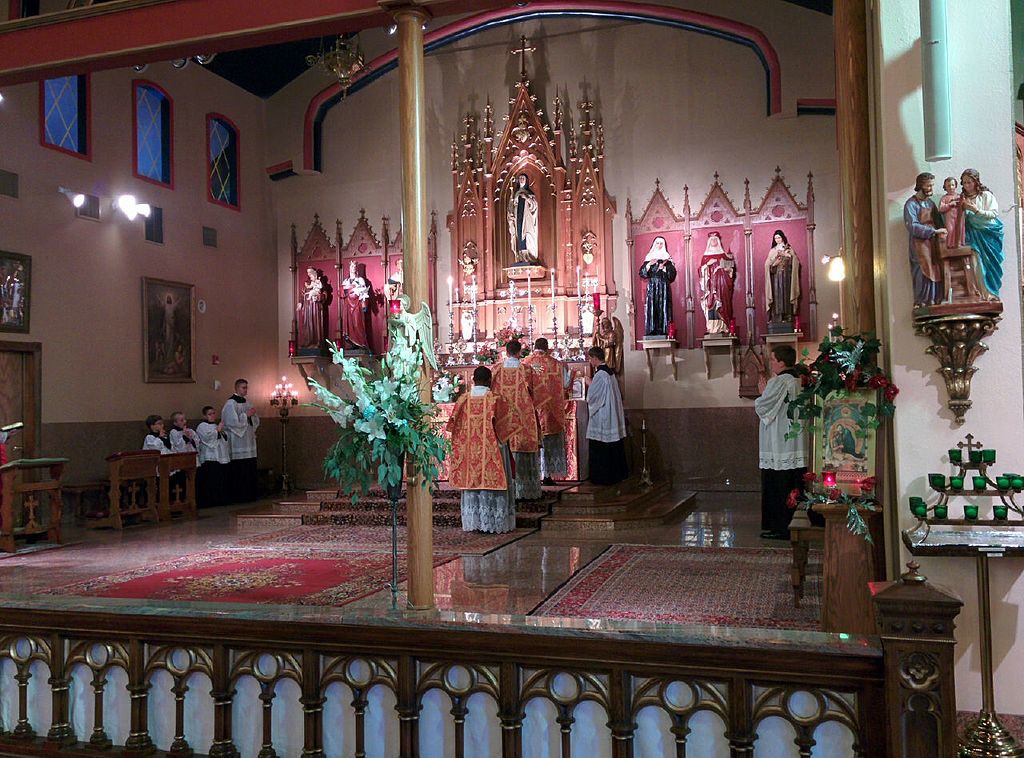
“Ad Orientem”—the Symbolism is Truly Beautiful

“Ad Orientem”—the Symbolism is Truly Beautiful (by Larry Peterson; Catholic Writers Guild)

By Mariapanhagia (Own work) [CC BY-SA 3.0], via Wikimedia Commons

Long ago, in a Church somewhat different, I was an altar boy (it was pre-Vatican II and we never used the term altar server.) It was a time when the Mass was said in Latin and the priest always faced ad orientem. (This actually means “toward the East” but, since so many churches do not have their altars facing east, it also refers to the priest offering the Holy Sacrifice with his back to the people.)

When offering Mass ad orientem the priest has no distractions that are facing him. The congregation behind him is, in effect, present at the Last Supper. The altar boy rings the bells to bring attention to this miraculous moment taking place before our very eyes. The people have just witnessed the most profound mystery of our faith and it all took place in only a few minutes. The reason for this symbolism is profound and beautiful. The sun rises in the East and we are coming out of the darkness to see the sun. The priest, who will stand in the shoes of Christ during the Consecration, is facing the newly-risen sun, ergo, God. At that moment, the priest, upon elevating the consecrated host toward the EAST, is actually Jesus saying to God, “This is MY body which will be given for you.” Then the consecrated wine is also elevated to the Father.

And there we kneel, the faithful, some watching and adoring the Body and Blood of Christ while many others are looking around, fidgeting, checking their watches, yawning, skimming through the church bulletin they should wait to read when they get home, not having a clue as to what is going on at the Mass they are attending. But that’s okay because at least they made it to Mass and are not home “sleeping in.” What has just happened is beyond description and the very answer to life itself. Yet it all presents to many as a grand paradox.

A friend of mine was injured in an accident years ago. He has a pronounced limp and uses a cane. Every week he comes to Sunday Mass and sits in the exact same seat. Every Sunday, without fail, he gets up at the beginning of the Consecration and slowly limps off to the bathroom. He always comes back after the wine is consecrated. He receives Holy Communion and, at a slightly accelerated pace, leaves Church before Communion is even finished being distributed. There are several others who, without fail, come every Sunday and miss the Consecration. They must not have a clue as to what is going on yet there they are, week after week.

Of course we all just had are influx of the C & E Catholics for Christmas. Although not “packed,” my church was definitely crowded. Interestingly, most every person at Mass received Holy Communion. Am I getting paradoxical yet? Is this why we have the phrase “cafeteria Catholics” in our 21st-century Catholic jargon?

Back in 1966, when Pope Benedict XVI was still Joseph Ratzinger, he said,

“Is it actually that important to see the priest in the face or is it not truly healing to think that he is also another Christian like all the others and that he is turning with them towards God and to say with everyone ‘Our Father’?”

Pope Benedict XVI showed his love of ad orientem 50 years ago. On October 12, 2016, (while meeting with Ecumenical Patriarch of Constantinople, Bartholomew I, he reiterated his preferences in a reflection letter published in L’osservatore Romano:

“In the liturgy’s orientation to the East, we see that Christians, together with the Lord, want to progress toward the salvation of creation in its entirety. Christ, the crucified and risen Lord, is at the same time also the “sun” that illumines the world. Faith is also always directed toward the totality of creation. Therefore, Patriarch Bartholomew fulfills an essential aspect of his priestly mission precisely with his commitment to creation.”

© 2017 Larry Peterson

Who Do You Say That I Am?

By Janice Lane Palko

You’ve seen those Ancestry commercials about people who believe they are one race or nationality and then take a DNA test and find out they are not who they thought they were. My husband could be featured in one of those commercials.

This past Christmas, I bought him a DNA test because my parents had had their DNA tested as a gift for me and my siblings. Hence, I thought testing my husband would give our children a clearer picture of their genetic heritage.

My parents’ tests confirmed what my great-grandparents and grandparents had always told me—that I was predominantly Irish, with a splash of English, Welsh, and German. My hubby has always believed that he is half Italian and half Slovak. Imagine our surprise then when I opened the Ancestry email two days after Christmas and learned that he was 29 percent Italian, 25 percent Slovak, and, faith and begorrah, 19 percent Irish! Where did his green roots come from? We still have no idea.

My mother, whose maiden name is Hughes, registered 11 percent Irish and 50 percent Great Britain. Technically, my husband was more Irish than my Irish mother. The target of good-natured jokes from my family over the decades for not being Irish, my hubby now is one of the clan. He has taken great delight in his newly found heritage, lording it over my family, prompting him to don his “Who’s Your Paddy?” T-shirt reserved only for St. Patrick’s Day wear. The axis of our world has shifted a bit, and now I will have to throw away the “Honorary Irishman” button I gave him 36 years ago when we were first dating.

Accompanying the DNA test came a free month’s subscription to the Ancestry website, and I took full advantage of it. I discovered some things along the way. I learned that one paternal great-grandfather, James Lane, had a mother named Mary, a sister named Mary, two wives named Mary as well as a daughter named Mary, which made keeping all the Marys straight very difficult. I learned that a maternal great-great grandfather, who the family had been told had died when my great-grandmother was very young, most likely skipped town to take up with another woman in Colorado. I also learned that my English great-great grandmother who owned a bar, smoked a pipe, had a tattoo, and a pet parrot (I must have descended from sea captains.) and had 13 children was not widowed as had been reported by my late grandfather. She had divorced her husband as her marriage license to her second husband, my great-great-grandfather, stated because of “cruelty and barbaric abuse.” She went on to have a set of twins, one of whom was my great-grandmother. While Catholics dominated my heritage (hence the myriad Marys), I did find some Welsh Baptists and Cornish Methodists among the lot.

However, the most stunning discovery was that I had a fifth great-grandfather, Martin Short, (not to be confused with the comedian and actor), who came from Dublin in 1750 to the U.S. and fought at the battles of Bunker Hill and Yorktown and crossed the Delaware with General George Washington.

In addition, I learned some other, more important things. First, life matters. Although in this day and age, we treat it rather cavalierly, why, if life were not so important, would our ancestors have taken such pains to record births and deaths and chronicle who we have descended from?

Second, as writers, we provide a link to the past. I taught memoir writing for a number of years, and I always urge everyone to write their life story. What we put on paper today may one day offer clues, insights, or inspiration to someone yet to be born.

Third, you are dead for a very long time. My searches revealed a few relatives who died days after birth or as young children and one centenarian. However, no matter how long any of them lived, most have now been dead longer than they were alive, and with each passing day, they are even “deader.”

We will all eventually be dead longer than we have been alive. Therefore, plan accordingly. Make the most of your time on stage. Dream big, write beautifully, love with passion, leave a legacy. And all the while, prepare for your eternity. What you do now will determine where you will be later.

Finally, whether you think you are one nationality or ethnicity and you find out that you are not, or whether you find heroes or scoundrels or just common housekeepers, coal miners, railroad laborers, or shopkeepers in your background or not, it really doesn’t matter. Jesus posed this question of his disciples: Who do you say that I am? We should also ponder the converse. Who does He say that we are? What is our real identity? What He tells us is that we are His fallen creation, who He reclaimed for Himself on the cross so that we could become His beloved children and live with Him in eternity.

While it is interesting to know where you’ve come from, it’s more important to know where you’re going. That supersedes any knowledge of our earthly identity. Cling to your heavenly heritage because it’s the only one that truly lasts.

Pick up the Orange

By Janice Lane Palko

Some people receive profound promptings from the Holy Spirit. Me? I get messages like “pick up the orange.”

A few weeks ago, I walked into my local grocery store and saw a woman select some oranges and put them in a plastic bag. As she walked away out of the corner of my eye, I saw an orange fall from the display and roll across the floor.

You should pick up the orange, said that still small voice.

Instantly, I began rationalizing. I didn’t dislodge the orange. Why should I pick it up? They have stock boys to do that. I’ll look stupid, like I have OCD or something, if I pick it up and put it back where it belongs. Let somebody else do it.

Then my better nature joined the debate. Will it kill you to pick up an orange? Geez, Mother Teresa picked up dying people from the streets, and you’re freaking out over an orange. How shallow are you? Who cares what people think? Someone may trip over it. You will be doing a good deed, no matter how insignificant.

So, I pushed my grocery cart over, picked up the orange, and put it back in the display. But then something else happened.

As I was about to press on with my grocery shopping, I caught a glimpse of a woman to my side bend and pick up another orange, one that I hadn’t even noticed had escaped with the other orange, and replace it in the display.

I was astounded. This woman was following my example.

That little interlude set me to thinking about life, and for those of us who write, about what our toils to turn a phrase may mean in the big scheme of things.

Several months ago, fellow CWG member Cathy Gilmore posted an article from the Catholic News Agency titled The Catholic Church Desperately Needs Artists by Mary Rezac. It detailed how the world so sorely needs creative people who can bring beauty and truth to the culture.

I don’t know about you, but I’ve been writing for more than twenty years, and the monetary return on my artistic endeavors has yet to land me a summer home at the beach, a six-figure deal, or a stint on Oprah.

I attend a weekly Bible study, and shortly after the orange incident, our leader asked us to share our all-time favorite inspirational books. One woman recommended He and I by Gabrielle Bossis, a French, Catholic woman who lived from 1874-1950. He and I chronicles the interior conversation she and God shared. When she was putting these conversations on paper, Bossis didn’t know that after her death, they would be published, translated into many languages, and cherished by so many readers.

At times, it may be frustrating when we think of how much time and effort we put into our literary endeavors compared to the remuneration we receive in turn. However, I don’t, and I’m sure many of you don’t, write solely for financial gain. Then, take heart, fellow creatives. Though we may never know the extent of our influence, like Bossis, our work may do good long after we are gone.

I don’t know if God intends for me to be a best-selling author or not. But what I do know is that I’ll be fine with whatever magnitude of success I achieve. I’ll continue to write and strive to bring beauty and truth to the world through my work with the hope of glorifying God.

I may be only a stepping stone for someone who comes after me, a toehold for another writer on their climb to achieving loftier success in reviving what has been a hallmark of the Catholic Church throughout its existence: excellence in artistic expression for the glory of God.

Therefore, as this new year begins, I’m going to pick up that orange and keep on writing. I urge you to do the same. You never know who is watching us or reading works or being inspired by our example. We don’t know who may decide to follow us, who may bend down to pick up that orange we didn’t even realize had also rolled away.

Christmas is a Time for Miracles: Our Family Experienced One

Christmas Season is still with us, so I thought I would share this true story about a Christmas miracle.

During the Christmas season I believe God’s loving hand sweeps down and touches many of us with a little extra something when we might need it most. Haven’t you ever, after having something unexpected and wonderful happen, blurted out, “I can’t believe it; it’s a miracle!”

Sometimes what happens to you or someone close to you is inexplicable, mystifying and mysterious and you just know in your heart that God had His hand in the mix. The following is true and it happened to my family during the Christmas season of 1960. I can remember it as if it happened today. There is no logical explanation, save God intervened and gave us an unexpected Christmas gift.

Our Mom had just turned forty and suddenly was going back and forth to the hospital for two or three days at a time. I had just turned 16 and was more or less oblivious to most everything except Barbara McMahon, who lived around the corner. Every time Mom came home she looked worse. My sister, Carolyn, 13, told me the black and blue marks on Mom’s arms were from IV needles. I figured she knew what was up, especially since she wanted to be a nurse.

Dad just kept telling us it was the “grippe” (today we call it the flu). “Don’t worry,” he’d say, “It’s just a real bad grippe.” Grandma, who lived with us, embraced that concept without question. Today, the psychology experts call that Denial. Grandma proved to be really good at it.

Mom was home for Thanksgiving but Grandma was doing most of the work, using my poor sister as her trainee. I know that it was sometime after Thanksgiving that Mom went back into the hospital. Then came December 18. That was the day Dad, Grandma, Carolyn and myself, took the subway down to Lenox Hill Hospital in Manhattan for a simple Sunday visit with the woman who was the wife, mother and daughter in our lives. Christmas was one week away, and that visit turned out to be anything but simple.

Mom was on the third floor and when we got to her room a several doctors and nurses were standing around her bed. Mom was on the bed, her head on the pillow and turned to one side. Her eyes were closed. I remember how still she was. I was instantly frightened. Carolyn and I looked at each other, and she too was filled with fear. It is amazing how fast fear can embrace you.

Grandma placed her hand over her mouth and started to cry. One of the doctors pulled our dad to the side and quietly talked to him. I watched him shake his head ever so slightly. Then he came over to me and (this is a direct quote from him on that day), “Please take your sister and Grandma to the chapel and say a rosary together. Your Mom needs all the prayers she can get right now.”

Trying to grow into a man in a matter of seconds, I put my arm around Grandma’s shoulder and said, “C’mon Grandma, let’s do what Dad asked.” She was so distraught she simply complied and followed my lead. As we headed to the inter-denominational chapel a priest hurried towards Mom’s room.

I have no idea how long we were in that little chapel but I do know we had prayed two rosaries when a nurse came in and asked us to come back to the room. We were a bit shocked because the nurse was smiling. Grandma, with her worn out arthritic knees, jumped up and broke into the funkiest sprint I have ever seen. She had erased thirty years just like that.

When we walked into that room we were confronted with a sight to behold. Mom was sitting up in bed, smiling. Dad was next to her with his arm around her shoulder. He was sporting a grin that spread across his entire face and tears were streaming down his cheeks. Standing on the other side of the bed was the priest we had seen in the hallway. He was standing there with his hands clasped together with a look on his face I cannot describe. For me, it was a moment etched indelibly in my mind and I can see it as clearly as I did back then.

Our Mom, who we thought was dead, extended her arms and said, “Well, don’t I get a hug from you two? C’mon, get over here.”

Mom was not only better, she was ALL better. Her arms were clear, her face had color and her eyes were bright and cheerful. Several doctors were outside huddled together in disbelief. They had no explanation for her sudden recovery. We finally learned that Mom had leukemia, and in 1960, your chances with that disease were virtually non-existent. We also learned that Dad had asked us to go to the chapel because the doctor had told him she only had moments left. He did not want us to see her pass on.

My father and the priest believed they had witnessed a miracle. Grandma, Carolyn and I witnessed the results of that miracle. Mom came home the next afternoon.

Christmas of 1960 was spiritual and fabulous. What had happened filled us all with an awe-inspired sense of what Christmas means….New Life. As for Mom, she was fine until the end of January. She enjoyed Johnny’s second birthday and Danny’s eleventh birthday. In early February she was back in the hospital. She died on February 18, 1961. God gave her back to us for one last Christmas, and it was the best Christmas ever.

So please, trust me when I tell you: Christmas is really a time for miracles.

©Copyright Larry Peterson 2016
(An edited version of this ran in Aleteia on December 23)

Visiting Homebound Elder-Catholics—A Privilege and Sometimes, an Unexpected Challenge

I have been an EMHC (Extraordinary Minister of Holy Communion) for over twenty years. I have had the honor and privilege of bringing Holy Communion to many people in many places: hospitals, nursing homes, hospice centers, assisted living facilities,and, of course, to the homebound. I love being part of this ministry and it has brought me in touch with some amazing people who have lived their Catholic lives quietly, faithfully and without fanfare or notoriety.

Most of those I visit are Elder-Catholics.These are the Catholic faithful who have, throughout their lives, supported their church, been active in various ministries and carried on the faith that was and still is, part of their very being. Some were born into the Faith and it was nurtured in them by their parents and oftentimes by nuns, brothers, priests and Catholic laypersons.  They in turn have passed it on to their own children. Some found the faith as adults and converted. (I so admire those people.) And so, as is the way of things, the Church continues.

I would like to share a story about one of these people. His name is John. I have been bringing  Holy Communion to John every Sunday for a little more than a year. He is ninety years old, an Army veteran who spent almost thirty years in the Far East and was married for sixty years. His wife, Mary, passed away several years ago. He loved her dearly and misses her greatly. John is not delusional, or suffering from dementia or anything like that. His mind is sharp and clear. Physically, John is  deaf (hearing aids help a tiny bit) and wheelchair bound.

When I arrive at his front door, I push the doorbell. I hear a chime; he does not. Inside, several strobe lights begin to flash, notifying him someone is at the door. He is expecting me and the front door is unlocked. I walk in and he gives out a big, “Hey, hey, good morning.”

I more or less holler back, “Hey John, how you doing today?”

He is always wearing  a smile. He says, “Well, I’m still here.” We both laugh.

John is facing a dilemma. He picks up the newspaper from a few days before and points to a story. “Have you gotten any feedback on this?” I look at the paper he has opened to an article dealing with the church’s newly revised guidelines on cremation. I shrug and tell him I have not. He says, “I have a problem and maybe you can help me out. I need some guidance.”

I am not “Father Larry” or “Deacon Larry”…I’m just Larry. I immediately feel a bit insecure because I do not like telling folks what they should or should not do when it comes to their personal faith issues. I quietly ask the Holy Spirit to quickly help me out. Then I say, “I’ll try, John. But I may not be able to. I will go to Father Anthony and ask him if necessary.”

Being part of this ministry can have unexpected rewards. God was about to bless me with a glimpse into the hearts of two Catholics, a man and a woman, people of faith who married in the faith and lived it and who shared a love that did not die upon the death of one–rather, it simply continued and still existed. John says to me, “You know, I am upset about this article. It says we Catholics must bury the ashes of loved ones in sacred ground.”

I said, “That isn’t anything new. Some folks are scattering ashes over the Gulf of Mexico or off mountaintops or sharing them among family members. Those kinds of things are not approved of.”

“Look”, he says. “I have Mary’s ashes here with me. I talk to her every day. I’m all alone and I feel she never really left and I get such comfort from that. Do I have to get her over to the cemetery?”

I’m looking at him and tears are filling his eyes. He wants to be a GOOD Catholic man and he loves his wife and wants to be loyal to her. He will give her up if the Church requires it even though the pain he will feel is unimaginable. It did not matter. He would be true to his faith no matter what. I was looking at a man who would have gladly embraced a martyr’s crown if he had been called upon to do so.

I knew that cremated remains are supposed to be kept intact and placed in a proper vessel. Nervously I began to answer but he continued. “I have a spot down at the VA for both of us. I made arrangements with the funeral home and when I pass they are going to take us together down to the VA and bury us next to each other.”

I breathed a sigh of great relief. Casting doubt to the wind, I told him, “John, that is great. She can stay here with you. She is encased in a vessel and is scheduled for burial. You will make the trip to the VA together. Don’t worry about a thing.”

I will never forget the smile that broke out across his face. I’m not sure if I gave him  proper “guidance.” No matter; in this case I am sure the Holy Spirit helped me out. I will check with the priest when I see him.

©Copyright Larry Peterson 2016. All Rights Reserved

My Yearly Faith Challenge: The Annual Prostate Exam

October was Breast Cancer Awareness Month across the nation. This is a good and noble fight and I am glad that “pink” is everywhere down to the shoes and wrist bands the NFL players wear to the pink bats MLB players use. But I would like to share about a cancer that is not talked about very much. I would like to share about the  second leading cancer killer among men–prostate cancer. (Lung cancer is the leading killer of both men and women in the USA). The following is personal aka”about me.”

I remember it like it was yesterday. The doctor waltzed into the exam room and matter of factly said, “Well, you have a cancer in the prostate.”

As he stood there flipping through and staring at the sheets on his clipboard, I was thinking—Huh? What? Wait a minute—Huh? Then came the frightened stare as I looked at this guy who in the briefest of moments had changed my life with unexpected news about ME. Cancer? No way!

It had not been a knockout punch but I had surely been sly-rapped and dazed. He calmed me down and, as I slowly cleared my head, he said, “Don’t worry, Larry. We did twelve cuts when we biopsied and there was cancer only in one. I think we found it early. I recommend you get it out now and you will most likely be finished with it.”

That was in March of 2007. On May 10 of that year I underwent a radical prostatectomy. Robotic surgery was brand new and unavailable to me so I had it done the “old-fashioned” way, by hand. They took it out. All of it. I have been cancer free ever since, with some residual side effects (another story for another day).  So what is my faith challenge?

My annual checkup is every September. Every year, as the day approaches, the anxiety  in me builds. I cannot help it. I have never forgotten that initial announcement about my having “a” cancer. Anyway, the protocol is that I go for a PSA one week week and the following week I see the Doc for the results.

The results  have to be .003, yes, ZERO, and then I can breathe easy and go home for another year. So far, the results have been ZERO, nine years in a row. That is considered ‘probably’ cured. Praise the Lord, right?

That is my challenge. I like to consider myself a man of faith. “Trust in the Lord with all of your heart,” right? I have this illusion that I do, but when it comes to this damn yearly test I get weak in the knees. I can’t shake it. Maybe I am a “man of faith” only when everything is hunky-dory. In other words, my “faith” is not nearly as strong as I may think it is. Am I a faith wuss?

I don’t know. I just want to go to the doctor like I’m going for a haircut and not give it a second thought. I tell myself God has my back. I think I believe that no matter what happens, it fits into God’s plan. Jesus loves me, I’m sure of it. So whatever is my problem? Is my faith journey all smoke and mirrors?

Here are a few numbers. One in seven American men will have prostate cancer during his lifetime. It is the second leading cause of cancer death among American men. Every 20 minutes another American man dies of prostate cancer, which factors out to 71 deaths per day. That means 26,120 men will die this year from this type of cancer. Early detection is the key to survival.

Next March I will be ten years out from my diagnosis. I should be kicking my heels and jumping for joy. Don’t get me wrong; I do thank God every day for my good health and cancer-free existence. I just think that I should be able to ignore the possible downside to my test results.

Maybe it is all part of the human equation. We just can’t help recoiling when confronted with our own mortality. My faith has, without a doubt, carried me through this and all aspects of my life. I have been blessed and I hope the Good Lord has patience for a faith wuss such as me.

There is one glaring fact that is as obvious to me as the sun shining on a clear summer day. Until I draw my last breath, my faith journey will always be a work in progress and I shall never take it for granted.

By the way–the color for prostate cancer awareness is pale blue or powder blue. Not many people know that.

© Larry Peterson 2016. All Rights Reserved

Stay in the Know

Join Our Newsletter

Members and supporters can get the latest on CWG news and events by signing up for our newsletter.

Please wait...

Thank you for signing up!

Catholic Writers Guild
P.O. Box 77
Eaton, IN 47338