
The Gift of Red

2008-11-16 021Advent and Christmas were always bright and happy times in my childhood home.  While focus was on preparing for the coming of Christ, mixed in with that anticipation was the fun of decorating.  Red was everywhere and in every room.  My mother made sure our home reflected the joy heralded by the angels of peace on earth and goodwill to all men, with the manger scene a focal point.  We had red plaid table cloths in the dining room and playful elves hanging from every conceivable perch. I came to love the significance of all these bright red and green decorating traditions.

Several years ago, a cardinal perched outside my window one morning. He was a magnificent contrast against the small oak tree in my backyard, and reminded me of my father who faithfully put out black sunflower seeds (the best kind) for the cardinals gracing our home. My mother has kept a stained-glass cardinal on her bedroom window along with a myriad of colored-glass crucifixes, chalices, and other professions of her enduring faith.  She believes that my dad, long gone, signals to her when the cardinals come and visit.

So, my mind wandered the trail of how much the color red permeates our world and how God created so many variations for our delight.  Do you know how many names there are for this color called red?  I didn’t, and so I looked it up and daydreamed about the marvelous range of reds in existence.  But it was the deep scarlet of the cardinal that led me on a path to remember our Savior, not at His birth but at His redemptive sacrifice – and through my father – His teachings from the Sermon on the Mount.  At the end of the trail, one thing was crystal clear to me, one realization that I needed at the time; Jesus loves me , all of us, beyond our imagining, beyond all else in this created world.  I marvel at God’s wisdom in creating a small bird with such power to move the human heart, to lift our spirits toward heaven, and to give me memories of my devout parents.

The following poem was born from the gift of red given to me through inspiring parents.  What memories bring  warmth and comfort to you?  Feel free to share special holiday memories or traditions.

Cardinal Red

More than poinsettias and red curly-ribboned Christmas gifts,
more than glossy lacquered lines of red candy apples in the window,
more than clumsy Crayola-red shapes on a toddler’s first piece of art,
more than sumptuous strawberry-red berries begging to be tasted,
more than the competent clarity of fire engine reds racing to rescue,
the deep scarlet cardinal captures me
in the fleeting seconds of his landing,
in the sound of his song,
in the almost imperceptible rising and falling of his splendid chest.
He breathes life and bleeds red,
as red as the drops of blood2008-11-16 022

falling from our Savior’s wounds
and causes me to remember my father
quoting Matthew 6:26 from his red Douay-Rheims
“ Behold the birds of the air, for they neither sow,
nor do they reap, nor gather into barns;
and your heavenly Father feedeth them.
Are not you of much more value than they?”
In this cardinal red moment,
the two hundred and eighty four other shades
referenced in books
cannot compare.


Were we supposed to learn a specific lesson from Irma and Harvey?*

“Speak to Him often of your business, your plans, your troubles, your fears — of everything that concerns you.” — St. Alphonsus Liguori

Officially, the annual hurricane season begins June 1 and ends on November 30, and every year we Floridians receive our annual Hurricane Preparedness Newsletter

The fact is, most of us who live here are usually prepared and ready for these storms. We know the drill.

By the morning of September 10, Hurricane Irma’s journey was predicted to go from the Florida Keys up to the Florida Panhandle and points north. People the world over had been informed that Irma was the biggest, fiercest, mightiest hurricane in the history of the Atlantic Ocean.

I’d like to say millions of Floridians simply boarded up their houses and waited with élan, but truthfully, most everyone was afraid this time. I know I was. There is not one thing you can do about these storms except get into a secure facility or evacuate; otherwise you do NOT stand a chance. All the models suggested our area would take a direct hit from a Category 4 storm with sustained winds from 130 -156 mph, and that the flooding would be catastrophic.

Amid all the dire predictions, however, there is one thing print and broadcast media fail to mention, that Catholic media does: the powerful and important weapon of prayer that so many of us bring to these storms. For the millions of Americans who have faith, no matter their religious preference, prayer was a key weapon against Irma.

Here’s what happened in my parish, located in Pinellas Park, adjacent to the City of St. Petersburg. Bishop Gregory L. Parkes canceled all Masses for September 10, which was a Sunday. The only Mass available before the storm was projected to move in was the 4 p.m. Vigil Mass on Saturday. With the winds already starting up, the church was packed.

The Mass was quite beautiful. There was a sense of anxiety that filled the church prior to Mass, but once the liturgy began, you could feel it begin to evaporate. Father Anthony’s homily confronted the impending danger we all were facing and calmed us by inviting us to embrace the fact that Christ was, and always is, with us.

At the Mass’s end, he blessed boxes filled with tea candles, and each household took one. There was a sense of comfort and solidarity in the know that while sitting before the lit candle in your own home and praying, you were connected to all those other folks who also had the blessed tea candles in their homes. During the early morning hours of Monday, 9/11, Hurricane Irma became a Category 1 Hurricane and began moving away from Pinellas County. Aside from power outages, the damage was minimal.

I cannot explain nor do I understand why our area was spared. Much damage and destruction and death have occurred in other places — some communities have been upended — yet I know people were praying everywhere, not just in our parish. The Florida Keys, Miami, Jacksonville, Houston and many other places will be weeks and months putting themselves to rights, and in the Caribbean, entire islands must rebuild. It is a mystery and a humbling one. To paraphrase St. Paul, “Who can know the mind of God; who can tell him what to do?” (Romans 11:34).

All we can do is pray for strength, and then reach out to give aid where needed.

Maybe God lets us see and feel his presence in ways we sometimes do not understand. Maybe these storms are permitted to teach us something about how his handiwork requires our hands. Perhaps the brutality of some storms are meant as a relief from the vitriol, contempt, nastiness, and hatred that has consumed our society recently, and are meant to remind us who we are.

Read more: “Now you are his arms”: Our forgotten role in a ‘godforsaken’ world

We’re only halfway through the hurricane season. Is it possible that these storms, Irma and Harvey (and perhaps others down the line), are being permitted to make refugees of some of us, in order to instruct us about the reality of suffering and loss that refugees encounter, everywhere?

Could it be possible? “Who has known the mind of God …”

Perhaps we are meant to remember the lessons of Job, who said, “Naked I came from my mother’s womb, and naked shall I return. The LORD gave, and the LORD has taken away; blessed be the name of the LORD.”

Is it possible we actually needed these storms? Is it possible that one day people will believe that these storms were actually God’s gift to us? Has the Holy Spirit been helping us to see beyond all the divisive daily ranting — to see each other again as simply people, loved sinners all, who need to help one another?

I guess that is for each of us to decide for ourselves. I have decided.

Copyright 2017 Larry Peterson

*An edited version of this  article also appeared in Aleteia on Septemeber 19, 2017

Women are More Expensive than Men and Other Language Lessons

language-758589__480[1]A Funny Lesson

Everyone laughed. I was trying to say in Farsi, the Persian language, “Women are stronger than men”, and unfortunately, it came out otherwise.  “Geruntar” meaning “more expensive”, innocently rolled off my lips instead of “gavidtar”, or “stronger”.

While chuckling along with everyone else, I hastened to explain in English that I meant women have great endurance. Years later, the incident reminded me that the language of the heart is always generously received by others.  You see, I was just learning Farsi and trying hard in a room full of Persians to speak with them in their own language.  Since then, with imperfect grammar and pronunciation, I have spoken with relatives and friends in broken words but a whole heart. They never seem to mind my mistakes.

Some of the First Lessons

As a young child, I wanted to learn Tagalog, so I could speak with my Filipino grandmother when she visited.  I only managed to say “good morning” and “good night”– it was hard to learn from a book with so many consonants in each word and a dad who was out at sea most of the time and unable to help.  When my grandmother did visit, she was pleased with my effort and gently corrected my inexperienced pronunciation.

When our family moved to the United States from England, I had a strong British accent amidst a deeply southern school community.  I had to learn that “ya’ll” meant “all of you” and that “kids” were children and not baby goats.  In the language of math, I had trouble remembering that a dime was ten cents and not the same as a schilling which was fourteen cents—carrying over 14 cents in a money problem leads to wrong answers.

My mother and father always believed in learning the language and customs of the country in which they lived.  And Daddy always said “When in Rome, do as the Romans do, except in sin, of course.” thus, my mother learned French while we were stationed in Villefranche, just outside Nice. When my parents didn’t want my sisters and I to know what they were saying at the dinner table, they spoke in French—of course.

At Barry University in Miami, my friends from Central America patiently listened while I practiced my high school Spanish. It was often frustrating being unable to follow their rapid conversation.  When I married my Iranian husband, I made extra efforts to speak slowly and clearly when around his friends.  And they were only too happy to translate common words into their language, so I could learn.

Idioms and Accents

Words are not the only difficulty when confronted with a foreign language—accents and idioms present their own challenges.  One evening while having dinner with another Iranian/American newlywed couple, some rice fell into the shag carpet.  Mansour, Leslie’s husband asked her to go and get the…the…the “rug sucker” when he couldn’t remember “vacuum cleaner”.  We all laughed.  When my husband still calls his “toes”, “fingers”,  I just smile knowingly, as he says “What do you expect from a foreigner”, and gently remind him he is no longer a foreigner after being in this country forty seven years. And thanks to my Dad, I understood that sometimes non-native English speakers mix up “he” and “she”; some countries have no “v” sound, so “adventure” becomes “adwenture”;—you get the idea.

Today, I listen hard to people of many languages and accents around me, seeking to understand and respond with interest and love.  My parish has been blessed with priests from Ireland, India, Kenya, Vietnam, Poland and Brazil—each with their wonderful, unique ways of speaking.  The key is they all speak that language of the heart.  Their love of God, reverence for the Eucharist, and compassion for their parishioners always spoke more loudly than any mispronounced words in a sermon.

“Beloved, since God loved us so much, we also ought to love one another.  No one has ever seen God; if we love one another, God lives in us, and his love is perfected in us.” 1 John 4:11-12

The Language that Matters

People everywhere understand the language of love. In the effort, in the trying to reach out to speak and to understand, we connect with others in a way that is beyond words. God speaks to us in a language beyond the written page in scripture. He infuses his spirit of understanding into those who have ears to hear, just as his spirit guides those who proclaim his good news.  “Then how does each of us hear them in his own native language?” Acts 2:8

We may not ever experience the magnificent fire of Pentecost or the miraculous courage and comprehension that occurred that day, but we can experience the same spirit. We can reach out with compassion and kindness as we recognize language challenges for those of different heritage than our own.  I am convinced that love matters and the heart speaks and hears perfectly.  God is love and when we speak his language to others, they understand.

“But blessed are your eyes, for they see, and your ears, for they hear.”  Matthew 13:16

Language Fun

If you are interested in languages, try this exercise based on words from 1 John 4:8.  See if you can identify the languages listed below for this famous scripture excerpt, “…for God is love.”  If you want the answers, I’d be glad to email them to you.  Just contact me at [email protected] and put “God is Love” in the subject line.  If you have language stories of your own you’d like to share, feel free to leave your comment.

From 1 John 4:8
·         for God is love – English


·         denn Gott ist Liebe


·         car Dieu est amour


·         vì Thượng Đế là tình yêu thương


·         for Gud er kjærlighet?


·         waayo, Ilaah waa jacayl


·         pentru că Dumnezeu este dragoste


·         sapagkat ang Diyos ay pag-ibig


·         sepse Perëndia është dashuri


·         pues Dios es amor


·         he aroha hoki te Atua


·         mert Isten maga a szeretet


·         gdyż Bóg jest miłością


·         quoniam Deus caritas est


Where Daniel Prayed

painting-754831_1280Paula Veloso Babadi
The Example
Standing at the tomb of Daniel the Prophet in the ancient, dusty town of Shushtar, Iran, I had a profound experience. Across the street from the ornate, blue-mosaic, silver-gilded mausoleum and plaza stood the ruins of King Cyrus’ winter palace. Weathered stone lions caught my eye in the distance–whether or not they represented the lions to which King Darius sent Daniel is irrelevant. I was humbled and awestruck at the thought of Daniel, thousands of years ago, walking on the same ground. Daniel’s trust in God amidst danger and persecution remains an inspiration. God answered his prayers, rewarded his faith and was pleased with the fruit. King Darius, Cyrus’ predecessor wrote to the nations:
“All peace to you! I decree that throughout my royal domain the God of Daniel is to be reverenced and feared: For he is the living God, enduring forever; His kingdom shall not be destroyed, and his dominion shall be without end. He is a deliverer and savior, working signs and wonders in heaven and on earth, and he delivered Daniel from the lions’ power. So Daniel fared well during the reign of Darius and the reign of Cyrus the Persian.” Daniel 6:26-29
The Suffering
A rich spiritual heritage lies in that part of the world foreign to so many Christians today– Iraq, home to the Tigris and Euphrates rivers and often thought to have been near the Garden of Eden; modern day Turkey where the Blessed Mother lived out her life in Ephesus; and Syria where St. Paul encountered Jesus on the road to Damascus. I mention places where the apostles spread our faith among the nations because our Catholic/Christian brothers and sisters are suffering so severely.  “Simply because these Christians make the Sign of the Cross, there is a price on their heads. “says Cardinal Timothy Dolan.
Martyrdom is as real now as it has been through the millennia, not just in the Middle East, but throughout the modern world. I am confident God hears the cries of his persecuted people destined for great reward in heaven, just as he heard the prayers of Daniel facing ravenous lions.
At the tomb, among other devout women cloaked in their chadors, it dawned on me we were united in our reverence and awe—a far cry from the disturbing reality of persecution.  It all seems so distant from the safety and comfort of my daily life. Would I be as brave if my parish was being burned? Would I be unwavering? I only hope to stay the course, to unite now with the suffering body of Christ in prayer and sacrifice, to stand firm should that day come for me.  Until then, hope ever rises in the words of Jesus at the Sermon on the Mount,
Blessed are you when people revile you and persecute you and utter all kinds of evil against you falsely on my account. Rejoice and be glad, for your reward is great in heaven, for in the same way they persecuted the prophets who were before you. Matthew 5: 11-12
The Call
I believe we are called to stand fast in our faith in both small and large ways, no matter where we live. Who knows what seeds are planted as people see Catholics praying the rosary on street corners during Forty Days for Life, or handing out food to the homeless, or sheltering unwed mothers with no place to go?
The fruit blossoming from Daniel’s deep faith pierced the heart of a mighty king, a non-believer moved to acknowledge our living God. Might not God’s children who are unbelievers or persecutors today be also moved?  Father Werenfried van Straaten, founder of Aid to the Church in Need once said, “The suffering are being tested in faith…but we are being tested in love.  Will you respond?”  Let us love and pray then, unceasingly.
Where Daniel Prayed
~ Paula Veloso Babadi
Where Daniel prayed I stood in awe-
holy ground,  ancient dust,
reverent air, silent prayer.
Where Daniel prayed I only saw
heads bowed, pilgrim vows,
hearts raised in God’s praise.
Where Daniel prayed there was no war.
Palace ruins, ancient museum,
God and me and history.
Today my brothers hide in rubble-
holy ground, ancient dust,
acrid air, desperate prayer.
Aleppo and Damascus roads
once walked by Paul as faith spread,
now bear the dead
as bullets raze Christian ways.
Body of Christ wracked in pain,
trust there’s reward;
deliverance claimed,
rich fruit,
the same as when Daniel prayed.
If you or someone you know is suffering, this article does not give easy answers, but may be helpful: “Why Does God Allow Us to Suffer?” by Father Hugh Barbour Article on suffering

Remembering Alzheimer’s Patients and their Caregivers

"Alzheimer's Patient" by Gelonida (Own work) [GFDL or CC BY 3.0], via Wikimedia Commons

“Alzheimer’s Patient” by Gelonida (Own work) [GFDL or CC BY 3.0], via Wikimedia Commons

Remembering Alzheimer’s Patients
and their Caregivers

The poem below is NOT from an unknown author, as the graphic indicates. The writer of the poem is Owen Darnell. I am certainly not looking to NOT give credit where credit is due. Thank you, Mr. Darnell–your poem was a great comfort to me and others who have lived with Alzheimer’s patients on a 24/7 basis.

Image may contain: text

 Copyright 2017 Larry Peterson

Beyond the Fear

heart-81207__480[1]“But if we acknowledge our sins, he who is just can be trusted to forgive our sins and cleanse us from every wrong.” 1 John 1:9

Most of my life, I viewed confession as a burdensome part of being Catholic. I used to be afraid of going.  Mainly I felt dread. Facing the priest with the same sins over and over again, or giving voice to any sin at all felt awful. But a simple incident reminded me of a key life lesson–we fear what we don’t truly know or understand, and Jesus always removes that fear.

When one of my sons moved back home with his American Pit Bull Terrier, I was mildly fearful around her. Dallas had an imposing frame and thickly-muscled broad head.  One day as I came through the front door tired from a long work day, Dallas greeted me with bared teeth and heavy breathing back and forth through her menacing canines.  Unsure I stood near the door calling for my son. He laughed when he saw me standing, briefcase still in hand, with Dallas “smiling” and eager for me to greet her.  My son explained she was not baring her teeth to scare me; she was smiling because I was part of her pack and she was happy to see me.

With my son close by, I stooped down and grinned back at Dallas, pushing air back and forth through my teeth following her enthusiastic example.  Her tail gyrated at hurricane force. I never feared Dallas again and now that I understand her intent we “smiled” at each other on a regular basis. We are friends and family.

I do not tell the story of a menacing dog with bared teeth to mean it is the same as facing a priest in the confessional. Rather, I share this to illustrate a point. Once I understood what was really going on with Dallas, my fear of her left me.

Understanding confession made a difference in my life too. Growing up I knew confession was good for me, but I was fearful. I knew it provided sacramental grace by lifting the burden of guilt from my soul, yet the dread persisted. But through a parish presented retreat program, Hearts Afire, fear really left me. At last I understood confession and was aware of Jesus’ intent; his intense longing for friendship and union with us – his body, the branches of his vine.  Jesus is rooted and waiting at the threshold to embrace, forgive, love, console, and commune with us–with me!

“Hence, declare your sins to one another, and pray for one another, that you may find healing.”   James 5:16

Its been a journey to embrace confession and appreciate Our Lord’s wisdom in this sacramental gift.

Early in the retreat materials Father Michael Gaitley so beautifully writes,

Wonder of wonders”  Jesus remains truly with us, not just in our minds through his Word, not just in our souls through faith and grace, but also bodily present with us in his Sacraments, where he continues to bless, forgive, cleanse, unite, heal, strengthen and make all things new. (The One Thing is Three “ How the Most Holy Trinity Explains Everything; Fr. Michael E. Gaitley, MIC).

Just as understanding Dallas’ intense greeting allayed my fears, understanding Jesus’ intention for us through the miraculous sacrament of Confession changed me. While I don’t pretend to understand it all, I know in my heart that Jesus gave us confession as a means for us to grow closer to him, to keep getting up from the depths of the fall, and continue reaching upward toward his light.

Confession is still a bit uncomfortable for me. But I know Jesus’ ocean of mercy covers all. And for the repentant heart, then comes intimate communion through Jesus with God by the loving bond of the Holy Spirit.

Confession

~ Paula Veloso Babadi

In sunless depths, my wreckage

In darkness lies

In cold silence

In repressed screams

Scattered below the sandy floor.

.

Metal hull

Hides from sonar waves

Skeletal remnants,

Sins buried beneath

Photosynthesis reach.


I have evaded anchor’s curves

Trolling lines

Rescue from tumult

Light’s warmth

Long enough.

.

“Bless me father, for I have sinned,”

It seems an eternity since my last confession

“And these are my sins.”

His mercy is an ocean.

His light pierces darkness

His love reaches down,

Pulls me to his arms

Where I rest inside his heart

“O my God, I am heartily sorry for having offended thee.”

.

His mercy is an ocean

Offering respite on glassy surfaces

Reflecting sky of balmy summer days

Beckoning upward a true and steady course

Back to the sun

Promising purity

Breathing spirit and life that

Once I knew.

“Little Nellie of Holy God”–The Toddler Who Inspired a Pope*

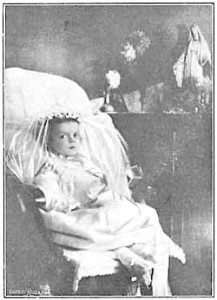
Ellen Organ was born on August 24, 1903 in what was known as the “married quarters” of the Royal Infantry Barracks in Waterford, Ireland. Her dad, William, was a soldier in the British army. Shortly after Ellen’s birth she was baptized into the faith at the Church of the Trinity. No one knows why, but from that point on Ellen Organ was called “Nellie.”

By William Organ - Own work, CC BY-SA 3.0, Link

By William Organ – Own work, CC BY-SA 3.0, Link

By the age of two, Nellie displayed a pronounced spirituality rarely seen in a child, especially one so young. While walking to Mass holding her dad’s hand she would constantly talk about seeing “Holy God.” This was something she began saying without having heard such an expression. Even her dad admitted years later he had no idea why his daughter began saying “Holy God.” Nellie’s parents were both devout Catholics and her mom, Mary, had an especially deep devotion to the Blessed Mother. She would take walks with Nellie, always talking about Jesus and Mary. She and her husband also made it a family custom to pray the family Rosary every day. Nellie, doing as her mom showed her,  always kissed the Crucifix and the large beads between decades. The first words she learned were “Jesus” and “Mary.”

Nellie’s life and the lives of her brothers, Thomas, David and their sister, Mary, were about to change dramatically. Their mom became very ill with tuberculosis. Nellie, the youngest of her siblings, was by her side constantly and was actually hugging her mom when she died in January of 1907. Nellie was three years old.

The children’s dad could not provide proper care for them. Consequently, he turned to his parish priest for help. Thomas, who was the oldest at age nine,  was sent to the Christian Brothers and David to the Sisters of Mercy. Mary and Nellie were taken in by the Good Shepherd Sisters in Cork City. They arrived there on May 11, 1907. The sisters treated them kindly and were very good to the girls. Nellie was happy to call all of the sisters, “Mothers.”

Nellie was three years and nine months old when she arrived at the Good Shepherd Sisters home. A young girl named Mary Long slept next to Nellie. Nellie never complained but Mary heard her crying and coughing during he night. She told the sisters and Nellie was moved to the school infirmary.

Upon examination it was discovered that Nellie had a crooked spine (the result of a serious fall) that required special care.  Sitting up was very painful for the child and sitting still for any length of time caused her great pain. Her hip and her back were out of joint. She was only three and she tried to hide her pain. But she could not “fake” feeling well. All the sisters could do was make the child as comfortable as possible.

Nellie astonished the nuns with her insight and knowledge of the Catholic faith. The sisters and others that cared for Nellie Organ believed without reservation that the child was spiritually gifted. Nellie loved to visit the chapel which she called “the House of Holy God.” She referred to the tabernacle as “Holy God’s lockdown.”  And she embraced the Stations of the Cross. Upon being carried to each station she would burst into tears seeing how Holy God suffered for us. She also developed an acute perception of the Blessed Sacrament.

One day Nellie was given a box of beads and some string. Being a three-year-old she put some in her mouth and inadvertently swallowed them. People saw her gagging and choking and rushed her into the infirmary. The doctor present was able to remove the beads from Nellie’s throat.

They were all amazed how brave the little girl remained as the doctor probed  into her throat, removing the objects. She never made a sound. At this time it was discovered that, just like her mom,  she had advanced tuberculosis. The doctor told the sisters there was no hope for recovery and gave Nellie only a few months to live.

Nellie loved the Holy Eucharist deeply. She would ask the sisters to kiss her when they were coming back from Communion so she could share their Holy Communion. She desperately wanted to receive her First Communion. But the rule of the Church was a minimum age of 12. Nellie was only three.

Nellie told of visions she was having of “Holy God” as a child and the Blessed Mother standing nearby. Her faith was so pronounced that the Bishop agreed (since she was close to death) to confirm her. She received her Confirmation on October 8, 1907. Then, on December 6, 1907, after considering all the facts, the local bishop, in consult with the priests, allowed Nellie Organ to receive her First Holy Communion. Nellie Organ died on February 2, 1908.

Nellie Organ’s story spread throughout Europe and reached the Vatican. It was presented to Pope Pius X by his Secretary of State, Cardinal Merry del Val. It was providential because the Holy Father had been looking for a reason to lower the age of receiving First Communion to the age of seven but was not sure about doing it.

When Pius X read the documents about “Little Nellie of Holy God,” he immediately took this as a sign to lower the age. The Pope immediately issued a Papal Decree called Quam Singulari, changing the age of receiving First Holy Communion from 12 years old to age seven.

Pope Pius X, who would become St. Pius X, after issuing Quam Singulari, took up his pen and wrote, “May God enrich with every blessing — all those who recommend frequent Communion to little boys and girls, proposing Nellie as their model. –Pope Pius X. June 4th, 1912.”

*edited version published in Aleteia on March 3, 2017

©Copyright Larry Peterson 2017 All Right Reserved

It’s Perfect – Not!

By Janice Lane Palko

It was Father’s Day weekend thirty-one years ago. Married only a couple of years, my husband and I had moved into our first house that previous January. We’d spent that spring painting, wallpapering—the things you do to get a home into shape. On Saturday of that weekend, I’d cleaned the whole house while my husband had spent the day outside trimming hedges, weeding, and cutting grass in anticipation of a Father’s Day picnic for both sides of our family—the first event in our first home.

As we called it a day, I remember looking at our neatly manicured lawn and gleaming house and thinking, “Everything is perfect.”

Then the phone rang at 7:04 a.m. Who calls that early on a Sunday morning? I thought as my husband rolled over and answered it. When I saw the color drain from his face, I knew something was terribly wrong. He hung up and stared blankly at me, too stunned to show any emotion. “That was my mom. Tommy’s been killed in a motorcycle accident.” Tommy was his twenty-three-year-old little brother.

We’d anticipated a Father’s Day picnic filled with fun and laughter. Instead, we were now faced with death, identifying a body at the morgue, and making funeral arrangements.

So much for perfection.

Flash forward to June seven years later. I’m sitting in a counselor’s office after suffering for months with panic attacks. “From what I’ve observed,” the kind therapist said, “You are very hard on yourself. You need to allow yourself to be human. You think you have to be perfect.”

As you can see, my dance with perfection has been filled with missteps. From Tommy’s death, I learned that life is not perfect and never will be, and through my joust with anxiety, I learned that I am not perfect and never will be.

So, how does someone who’s had these types of reality checks with perfection square them with Jesus’s words in Matthew’s Gospel where He instructs us to “Be perfect just as your heavenly Father is perfect.”

To a perfectionist, His words area a recipe for disaster. You may have heard the adage “Perfection is the enemy of the good.” Well, when we perfectionists get rolling, we tend to discount anything, however good, that does not meet our level of perfection. We get tangled up in being immaculate. I’ve worked hard not to be a perfectionist, so when I came across that bit of scripture again recently, I, once again, reacted to it with disregard and confusion—not a good way to react to scripture.

I know perfection is impossible and shouldn’t even be pursued lest I become paralyzed in my quest to be flawless. There is no perfection on this side of eternity. I know I cannot be perfect, I made myself sick trying. Why would Jesus impose such an impossible directive on those He loves?

Ah, but I’ve also come to learn that when Jesus commands us to do something, He always promises to provide us with the grace to achieve it. His words in John’s Gospel provide the key. “Apart from me you can do nothing.” Apart from Him, I cannot reach perfection. Apart from Him, the world wallows in sin and destruction. Perfection in the way Jesus means is a work of transformation and something for me not to achieve but to surrender to. Through Jesus and His act of redemption, we reach perfection. Paul in his letter to Philippians gives us this assurance: “I am confident of this, that the one who began a good work in you will continue to complete it until the day of Christ Jesus.”

I’ve learned that Jesus is working on me, and that sounds absolutely perfect to me.

Rejecting “Common Sense” has caused the Rejection of the Golden Rule

It seems that the fear of litigation has triggered the ongoing evaporation of common sense.  What triggered my need to defend common sense are three separate incidents that I experienced over the past month. As you will see, each of these incidents, though simple and uneventful,  not only rejected the use of common sense, but the collateral damage from these rejections was the trashing of the Golden Rule.

Incident 1:

My wife was in the hospital during the middle of March. She had been taken off life-support and was in a room breathing on her own but unconscious. I was there with her and her head was bent over onto her shoulder. I thought I might try to lift her head and make her more comfortable. However, I was unable to do it by myself as she had a large CPAP mask strapped on.

Just then a young lady came into the room, gave me a big smile and asked, “Is there anything I can do to help you?”

I was thrilled at her timing and I explained how I just needed a bit of help repositioning my wife to make her more comfortable. The young lady shrugs and sheepishly says, “Oh, sir, I’m sorry. I’m a volunteer and we are not allowed to touch the patients.”

I quickly found out that the volunteers could not feed anyone, touch anyone and can basically do nothing more than be a “gopher” for the nurses or get me a cup of coffee. As far as helping the woman in the bed, NOT allowed.

Incident 2:

I am an EMHC and I bring Holy Communion to about a half dozen seniors in an assisted living facility on Sundays. One of my communicants had five or six newspapers in front of his door. I picked them up and headed to the main desk where a security guard was stationed. I dumped the papers on the countertop and said, “Hey Tony, what’s going on down in 103? There is no answer and all his newspapers are outside his door.”

“Oh yeah, Mr. A is in the hospital. They took him earlier this week.”

Tony refused to tell me what hospital. So I asked, “How come no one picks up all these newspapers?”

He shook his head and shrugged, “We are not allowed to touch anyone, including their stuff. In fact, if someone falls right in front of my desk I am not allowed to help them up or touch them. I have to call 911. If I touch them I will lose my job.”

In my standard inbred NYC manner I say, “C’mon, Tony. Gimme a break–whaddaya mean you can’t help them? That’s ridiculous.”

He reached under the countertop and pulled out a sheet of paper. It was the rules and regulations from the facility. “Here, you think I’m making this up?”

Everything he told me was on that sheet of paper.

Incident 3:

I have been getting three to four calls a day from a number in area code 954. I have no idea where that might be and I do not care. In addition, the caller(s) never spoke. They just disconnected. I never answer the phone unless the caller identifies themselves but the relentless pursuit from area code 954 eventually beat me into submission.  I caved and answered the phone. A pleasant, melodic voice floats into my ear saying, “Is this Mr. Peterson?”

My immediate response (I love to get a bit flippy) was, “Ya think. You have been calling me over and over and over never leaving a message and now you want to know who I am? Who are YOU?”

“Heather” introduced herself and told me she was calling to see if I wanted to renew my newspaper subscription. “Heather, are you telling me that different phone solicitors from your paper have been calling me three to four times a day and not one of you left a message? Do I have that right?”

“Uh, yes, I’m sorry Mr. Peterson. We are not allowed to leave a message.”

There is nothing I can add to that. These professional people will call folks up all day long and never leave a message. They are not allowed. Whew! That, to me, that is harassment. Yet, it is justified because it is a rule or policy of an invisible entity called a company.

Natural Law, present  in the heart of each man and established by reason, is universal in its precepts and its authority extends to all men. It expresses the dignity of the person and determines the basis for his fundamental rights and duties.” CCC1956


I don’t know about you but if I see someone fall I will (if possible) help them up. If I lose my job because of my actions–so be it. If I call someone and I hear a recorded response, I will leave a message.  The Golden Rule and common sense go hand in hand. This other stuff is madness.

Copyright 2017 Larry Peterson

Running for the End Zone

By Janice Lane Palko

I recently celebrated my birthday. Now that I’m past the fifty-yard line of life and heading to the end zone, I can no longer deny that I am aging. When I was in my twenties and thirties, I could ignore the subtle signs of the advancing clock, and in my forties, platitudes like “forty is the new thirty” provided a flimsy veil of denial that I was growing older. However, when you hit your fifties, your children are grown, you are now called grandma, and conversations with friends gravitate toward aging parents, physical ailments, and possible retirement dates, there is no denying the obvious: I am getting older.

Many of us take a passive approach to our advancing years, believing that how one ages is out of one’s control–that it’s something that just happens to you. Others go into warrior mode and fight the “dying of the light” with hair plugs, Botox, and sundry other remedies in an attempt to vanquish the inevitable. This birthday spurred me to examine how I wanted to age. I decided I didn’t want to take the “curl up and die” approach and surrender to Father Time, but I also decided that I didn’t want to take the “aging rock star” approach and look foolish trying to cling to my youth at all cost. So how to approach this process of growing older? The second chapter of Luke’s Gospel provides the prescription. This last line jumped out at me as this chapter concludes: And Jesus increased in wisdom, and age, and grace with God and men.

It may seem odd talking about growing older when considering the immortality of Jesus. Though human and divine at the same time, Jesus, nevertheless, did age in body as is evident from his progression from birth as an infant to his culmination as an adult man in his thirties. Therefore, Jesus knew what it was to grow older, and as in all things, He provides the example for all humanity. This verse from Luke is His prescriptive on aging, and it implies that it should be an active, deliberative process that includes three aspects.

The first aspect is to grow in wisdom. To age following Jesus’s example, we must actively pursue wisdom. What exactly is wisdom? Proverbs 9: 10 tells us that “The fear of the Lord is the beginning of wisdom.” Fear in this sense does not mean wariness of God, but of a healthy knowledge of His magnificence and our place and God’s place in His grand design. To acquire wisdom is not to gain knowledge but to be always persevering to know God and know ourselves in relation to Him.

The second aspect is to grow in age. While we know that Jesus advanced in years, many commentaries say that this phrase actually means to mature. Not only did Jesus grow in wisdom, but he flourished into our Savoir. What does it mean to mature? It means to become what God intended you to be, to embrace and fulfill your mission on earth. So, we are not only to gain knowledge of God and ourselves, but we are also to channel that wisdom into serving God by becoming exactly who He intended us to be.

Finally, we must grow in grace. Now, if Jesus is perfect, he could not have grown in grace as we usually think of it. Most biblical scholars take this passage to mean that Jesus performed greater and greater works for men and for God. Therefore, to follow in Jesus’s example, we must continue to acquire knowledge of God and ourselves and strive to fulfill our mission on earth. However, unlike Christ we are not perfected in grace. As such, we must rely on God to help us do greater and greater works in His name.

So, our golden years are designed not to be a passive time of acceptance of the elapsing years or an unreasonable attachment to bodily youth, but to enjoy a dynamic time of continued growth and development. We are to continue our run all the way to the end zone—perhaps with flagging physical strength and failing breath—but, nevertheless, with a vibrant spirit filled with wisdom, maturity, and grace.

Stay in the Know

Join Our Newsletter

Members and supporters can get the latest on CWG news and events by signing up for our newsletter.

Please wait...

Thank you for signing up!

Catholic Writers Guild
Archdiocese of Indianapolis
1400 N. Meridian Street
Indianapolis, IN 46202

EIN: 26-4150820

© 2026 The Catholic Writers Guild. All Rights Reserved.