Three Things I’ve Learned from my Chickens

Three Things I’ve Learned from my Chickens

As writers, we know that one aspect of writing well is writing authentically. By that I mean we have to follow the rules of the reality we are writing about, whatever they may be. The rules governing Middle Earth are a little different than those in Narnia, for example.  If we are writing about our own world, here on planet Earth, 2023, one practice that can help us write authentically is the habit of being observant of the world around us, so that we can convey those small details in our stories. In fact, being observant might even lead to a new understanding.

What does any of this have to do with chickens, you might ask?  Doesn’t the title of this article signify something having to do with those small animals? Besides, I’m not saying anything new in that opening paragraph.

Let me begin, then, by saying that I never intended to become “the chicken lady” of my neighborhood. When my husband called from work one day, saying that a colleague had no further need of 4 unhatched baby chicks and did I think we could take them in for a while, I said “Sure” simply because I like animals and couldn’t stand the thought of those little chickies being – literally – thrown away. That was about the extent of my thinking.
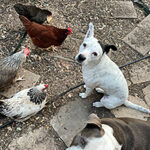
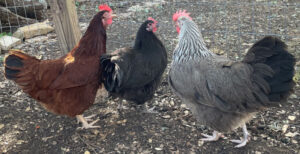
Fast forward a year and a half later, and we now have 5 stout ladies who take up a third of our backyard. And they are delightful. I have become thoroughly attached to them. Through observing them closely these past several months, I’ve also learned a few things. Here are 3 of them.

  1. Habits can produce happiness.

My hens follow the same routine every day. They wake up with the sunrise, then run out to munch on the food I give them. It is always the same food, but they are nevertheless excited to see it every morning. They spend the rest of the day alternating between scratching for bugs, chatting with each other and resting.  At 7pm each evening, they gather by their gate and call for their nightly visit. I bring them some rice or a little bread and we spend time together. After a few more sips of water, and a little extra scratching, they put themselves to bed at dusk.  They follow this same routine every day. They witness to the importance of good daily habits, of doing a little bit consistently over time, every day. I often wonder what I could get done if I was such a creature of routine.

2. Don’t be afraid to try.

Even though my hens are quite content in their pen, that doesn’t mean they don’t look up and notice the green grass and fresh flowers blooming in other parts of the yard. They are always up for new ways to escape their yard to get to greener pastures. (In fact, I am convinced that whoever wrote the script for the movie Chicken Run really did have chickens.) Our Rhode Island Red, Cocoa, makes a point of pushing on the garden gate at least once an hour, just in case it has been left open. Our silver Welbar, Sandy, learned exactly where to stand so that she could fly up and just reach the tip of the fence, push off with her foot, and propel herself into the grass. They also know our habits, and often try to follow the dogs in and out.  I think they hope we won’t notice an extra pair of legs.  Even though they appreciate their home, they’re never afraid to push on the gate one more time or keep an eye out for another weak spot in the fence. They remind me not to get too complacent, but to keep looking up and trying.

3. Appreciate your community.

My little flock did not choose each other, but they’ve formed themselves into a community nevertheless. Although they are all different types of hens, they get along. Yes, there is certainly a pecking order (Sandy is at the top) but there is still room for everyone, despite their various temperaments. For example, Pebbles, our black Australorp, tends to get broody and take over the nesting box, while Pepper, a light Brahma and the smallest of the five chickens, likes to make up for her small size by being feisty and pecking everyone, including the dogs. Occasionally there are some ruffled feathers but most of the time there are contented, chatty clucks and check-ins, and at the end of the day they all go into the hen house and sleep peacefully together.  If I’ve had a hard day with a difficult person, I really notice their ability to not hold a grudge and to let bygones be bygones. It reminds me that I might not always want to spend a lot of time around a certain person or persons, but I don’t have to take everything personally and I don’t have to carry resentment with me every day. (And I’m always somewhat flabbergasted that the hens consider our two pitties part of their community!)
These are a few of the conclusions I’ve come to over the last few months, in the mornings with my coffee watching them greet the new day, and in the evenings as the sun is setting.  As I mentioned above, close observation of the world around us helps us to be better writers, and maybe even better people. These five little ladies are speaking to me all the time. Is there something that speaks to you in your life?  What do you closely observe? And is it changing you?

©Copyright 2023 by Sarah Pedrozo

Featured image from iStock-chicken (3)

Bottom two photos by Sarah Pedrozo ©Copyright 2023 by Sarah Pedrozo


A Writer’s Vision

A Writer’s Vision

I watch a robin nestled upon the branch of my backyard tree singing. As it flies away, I feel wonderment. Perhaps the robin is seeking a better view or its next meal. The breeze picks up ever so lightly and I am transported to the wings of a butterfly.

Most would not give a second thought to these events. As a writer, it is these simple, everyday moments that spur my creativity.

There were times in my writing journey when I turned a simple lawn weed into a complete book chapter. Most would view the yellow dandelion as an irritant and nuisance. In contrast, I saw it as something friendly and a great jumping-off point in my story. Many things feed my creativity, especially in nature. However, over the years, I have learned that my imagination goes into overdrive when I add God to the mix.

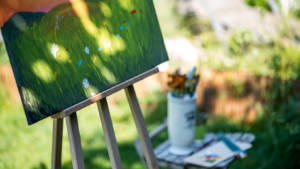
Every summer for the past four years, I have attended a retreat focused on painting. It is important to note that I have no talent in that realm, yet that particular retreat has been a favorite of mine. I was a bit intimidated, to say the least, when I first attended, but God quickly showed me why He had sent me there.

Something happens in my brain when I focus on things with a crafty nature. I believe God uses this medium to draw things out of me for His greater purpose. Over the years, the masterpieces I have created in this retreat have looked fabulous in my eyes but not so much to anyone else. I see the exhibits through the eyes of the Spirit, who fed me during each brush stroke.

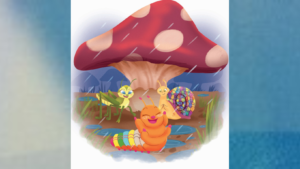
I’ve learned a lot and have had many inspirations through this faith-based activity. Mostly, I have been able to break through barriers that may have kept me from doing something to which God has called me. Using the skills taught during this retreat, I have brought a creative depth to my writing. I drew inspiration from a mushroom while walking the dog that turned into a colorful, giant umbrella for a snail and caterpillar in my book, Bella’s Beautiful Miracle: A Caterpillar’s Journey.

Due to other events this summer, I was forced to miss the art retreat, and I thirsted for a flicker of creativity. This topic arose in a recent conversation, and I quickly realized why I longed for such a spark. As a writer, I see the beauty and majesty in everyday things that most people take for granted. In the hustle and bustle of the summer and planned and unplanned life activities, I had not allowed myself to bathe in God’s beauty in this way.

It is not only the art retreat that fuels creativity. The combination of nature and faith life are significant components. To rejuvenate my creative side, I ventured outside with my laptop and noticed the little robin in minutes. As I looked upon the little bird, all I had to do was place my hands on the keyboard, close my eyes, and allow the Spirit to lead.

By basking in God’s glory of nature, colors, and the physical action of creating, I become fed creatively and spiritually. This summer, I ask you to consider in what ways your spirituality provides your creativity or vice versa. Then, spend time prayerfully considering how God wants you to work that into your lifestyle.

Don’t miss out on your opportunity to shine in ways you may have felt fearful about. I love that I have no talent as a painter, yet I can participate in that action and create something beautiful in another medium. Art, as a spiritual gift or just for fun, is a lovely way to express God’s light and love! Step out of your comfort zone and go for it!


Copyright 2023 Kimberly Novak
Images Copyright Canva

Just A Little Bit

Just A Little Bit

My default mode is all-or-nothing. Do I want to volunteer at church? I’m gonna sign up for everything and do it all. Do I feel overwhelmed about keeping memories for the kids? No one gets a baby book at all. Do I want to lose weight? I track every single calorie and work out for two hours, five days a week. Am I struggling to find time to write while the kids are home for the summer? I should just quit writing altogether.

What I love about the all-or-nothing mentality is that when I put it in writing like this, I can clearly see the absurdity of my logic. Yet, when I’m in my moments of being overwhelmed, quitting completely feels like not only a rational option, but the only viable one.

I’ve developed many different strategies for combating this all-or-nothing mentality, including prayer, taking deliberate personal time, and talking to a friend who is currently more rational than I am. But sometimes the best defense is a good offense, and I’ve been working on reminding myself that even if I can only accomplish a little bit, that still has value.

The reality for me is that during the summer, when my four daughters are home all day, I won’t be gifted with large blocks of time for writing. Thirty minutes, first thing in the morning may be all I get one day, and that is still better than not writing at all. I don’t have the luxury (nor endurance) for two-hour workouts anymore, yet twenty minutes on the elliptical still beats sitting on the couch all day.

Ever since I made a pilgrimage to Fatima in November of 2022, my heart has longed to move to Portugal. I’m telling y’all—all-or-nothing. I felt so much peace and so close to God while I was there that I want to uproot the whole family and move to a country where we don’t speak a single word of the native language.

One of my favorite heavenly friends, Saint Thérèse of Lisieux reminds me every day (through my garden flag) to bloom where I’m planted. It’s possible God wants me in Fatima one day, but I know that today is not that day. My kids are struggling enough with a move within the continental U.S., and I can’t imagine if we took them to a whole new country without explicit direction from God.

Yet my heart longs for that pilgrimage feeling, so in my growing attempt to do just a little bit, I planned something slightly smaller than a move to Portugal. This past weekend, my family went on our first ever mini-pilgrimage. We have visited churches while traveling before, but we’ve never set out with the sole purpose of growing closer to Christ through experiencing a holy site right here, close(ish) to home.

Now that we live in Kansas, we are only about two hours away from Gower, MO, the home of the Benedictines of Mary, Queen of the Apostles. This may sound familiar, as this is the place where the body of their foundress, Sister Wilhilmena Lancaster, has been discovered as “incorrupt.”

Her body was not embalmed, and she was laid in only a simple, wooden coffin. Yet after four years in the ground, her body and habit remain intact. A case for sainthood has not even been opened yet, since it hasn’t been five years since her death.  The nuns of the abbey excavated her remains to move her to the newly completed St. Joseph’s Shrine, fully expecting to find only bones to inter. I can only imagine the reactions of her fellow sisters when they made that discovery!

Since we were going to be in Missouri, we decided to also stop by the nearby town of Conception, which is the home of an abbey of Benedictine monks, a seminary, and the Basilica of the Immaculate Conception. We left home on Sunday afternoon after Mass with our regular parish and visited the stunning basilica (including cookies baked by monks!) before getting to the hotel. Then on Monday we went to the other abbey and celebrated the traditional Latin Mass with the Benedictines of Mary, Queen of the Apostles and saw the body of Sr. Wilhelmina.

And that was it (ok, then we stopped at Sam’s Club on the way home because, you know, real life). We were out of our house for barely more than 24 hours, and it was one of the best family trips we’ve ever taken. The mini-pilgrimage was long enough to feel spiritual and fulfilling, and gratifying that I’m doing right by these kids that God has entrusted to my care. The mini-pilgrimage was short enough that my kids weren’t biting each others’ heads off and completely sucking my joy dry.

A little bit was enough. A little bit was beautiful and rewarding. I’m gonna keep trying to do just a little bit each day.


Maria Riley 2023

A Place at the Table

A Place at The Table

Our Italian/Irish family get togethers are large. Typically, at least ten or fifteen gather for dinner, even when it’s only immediate family. I have always loved how we celebrate birthdays and holidays, but how do we look to outsiders?

Though full of love, our often loud and borderline obnoxious group probably looks like a three-ring circus at times. Possibly we are more normal than I give us credit for. In either case, bringing family together is very important to me. The family unit, however, does not only apply to those related to you but also to the body of Christ. God unites us all as the body of the Church, which is cause for celebration as well.

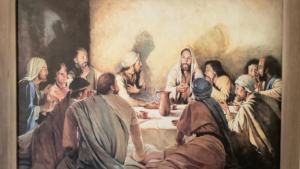
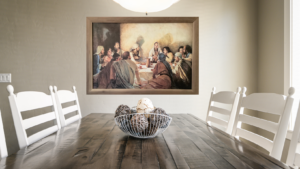
Recently I hosted my family for a holiday, and as the hostess, I kept busy cooking and ensuring my guests had an enjoyable time. I love having my family and friends over to our home. Over the years, we have invested in many updates that make the space more inviting and comfortable. One of those new additions which I am particularly proud of is a portrait of the Last Supper.

Jesus celebrated with his disciples at the last supper by reclining at the table and sharing bread and wine. The warmth of the picture I chose to display is very inviting. The faces of those in the room appear captivated by Jesus. The scene draws my faithful heart in, and even a non-believer would find it compelling.

Since the scene is Jesus having a meal with the disciples, I knew the dining room was our only option when deciding where to hang it. Wall space was an issue because of a couple of windows in that room. Because of the space limitations, the picture appears larger than life. I don’t think that’s all bad. It brings Jesus right to our table.

On the afternoon of our holiday, as my Dad rose from his seat, he commented on one area of the painting, bringing a sense of intrigue to those of us present. The disciples and Jesus are all seated around the table. In one area between Jesus and another disciple is a large gap. The lighting in the picture has a beautiful shadow on the wall behind Jesus and the others. No shadow is in this area, suggesting an open space. A place at the table, so to speak. 

I cannot recall Dad’s exact wording, but his comment was beautiful. He wondered if the area of space alongside Jesus was for us. Remembering it now as I put these words to the page fills me with love. I grew excited and thanked him for giving me a topic to write about. It wasn’t until later that I focused on inserting myself in that spot.

I studied the disciples’ expressions and thought about what mine would look like. Would I look surprised by Jesus’ words or have the appearance of peace and comfort? Upon another glance, I noticed that one of the disciples had his face against his folded hands. Does this represent sadness or concern? After contemplating the scene, I concluded that my facial expression would be as it is now, joyfully expressing God’s light and love. 

A relationship with Jesus brings pure joy, which looks different for everyone. Some may appear calm and peaceful, and others are joyful when they rest within praying hands. Dad has given me a new glimpse into this part of my journey with Christ, and for that, I am grateful. God has invited me to the table through the conversation that day. An invitation that I choose to accept every day, and I pray the same for you. God Bless.


Copyright 2023 Kimberly Novak
Images copyright Kimberly Novak and Canva

Mount Carmel

Mount Carmel

By this Chronos time of our renewed baptism in the Holy Spirit at Pentecost, pleasant weather has finally arrived in most parts of the United States. Many of us as Catholics can look forward to outdoor liturgical celebrations with the beauty of nature surrounding us in this season.

The public witness of Corpus Christi processions; devotions to the Sacred Heart of Jesus and the Immaculate Heart of Mary; as well as the glory of sacramental ordination for well-formed young men to the sacred priesthood; all are spiritual highlights that await us in June.

Mount Carmel commonly refers to the promontory of a mountain range with the same name, located about thirty miles west of the Sea of Galilee, on a peninsula that penetrates into the Mediterranean Sea. Today it stands at the edge of a modern city, Haifa, Israel, near the ancient Crusader city of Acre.

Dedicated to the Blessed Virgin Mary as Our Lady of Mount Carmel, and stewarded by the Carmelite orders since the thirteenth century, this popular pilgrimage site is also called Stella Maris, Star of the Sea. This may be in part because the entire peninsula is surrounded by water, but the roots of the alternate title go back much further into history.

Scholars believe that the usage ‘Star of the Sea,’ as both a place name and as a title for Mary, began with St. Jerome. He translated Mary’s Hebrew name, according to its meaning in the annals of the Exodus from Egypt — Miriam, the sister of Moses and Aaron, bore the same name with the same spelling as Mary, the mother of Jesus.

The site on which the Mount Carmel monastery stands today has additional roots that go deep into the Old Testament.

Sign at the base of the statue of Elijah calling down fire from heaven to defeat the prophets of Baal, in the monastery gardens, Mount Carmel. Author’s personal photo, used with permission.

A sign engraved in Latin, Hebrew, and Arabic at the base of a statue of the prophet Elijah in the monastery gardens declares the understory grotto at Mount Carmel to be Elijah’s cave, and this mountain the site at which he defeated the prophets of Baal (I Kings, Chapter 18):

(17) When Ahab saw Elijah, he said to him, “Is it you, you disturber of Israel?”

(18) He answered, “It is not I who disturb Israel, but you and your father’s house, by forsaking the commands of the LORD and you by following the Baals.

(19) Now summon all Israel to me on Mount Carmel, as well as the four hundred and fifty prophets of Baal and the four hundred prophets of Asherah who eat at Jezebel’s table.”

(20) So Ahab summoned all the Israelites and had the prophets gather on Mount Carmel (I Kings, 18:17-20.). (https://bible.usccb.org/bible/1kings/18).

 Elijah’s activity on Mount Carmel did not stop there, either. In II Kings, Chapter 1, we read that:

(3) …the LORD said to Elijah the Tishbite: Go and meet the messengers of Samaria’s king, and tell them: “Is it because there is no God in Israel that you are going to inquire of Baalzebub, the god of Ekron?”

(4) For this, the LORD says: You shall not leave the bed upon which you lie; instead, you shall die … (II Kings, 1:3-4) (https://bible.usccb.org/bible/2kings/1)

 Elijah delivered the message as God had commanded. Then he raced with haste up to the top of Mount Carmel, so he could watch over the Jezreel Valley for this new king’s angry men, who had been sent to kill him.

Twice again Elijah was forced to call down fire that destroyed two commanders and two battalions of fifty men, before a third commander who had been sent with more men to capture him pleaded for mercy, and received it. (II Kings 1:1-18). (https://bible.usccb.org/bible/2kings/1)

Fr. Lawrence Hoffmann celebrates mass in the garden at Mount Carmel monastery, Haifa, Israel. Author’s personal photo, used with permission.

The holy mass that my pilgrimage group was privileged to experience in the garden at Mount Carmel was a peaceful and anointed celebration.

At the end of our liturgy, as the priest pronounced the final blessings, into the silence after each human response came a single gentle “caw,” in chorus from the birds in the trees.

Despite the many problems our human lives face today, and the impotent ‘baals’ that the misguided seek for answers, there is still ‘a God in Israel’ – as there always has been, and always will be.

Let’s live in Kairos time this June.

May you feel ‘amens’ resounding from God’s creation, and continue to bring your own witness into the world.

May you remember that Our beloved Lady, Star of the Sea, stands guard at Mount Carmel, where Elijah the Tishbite worked his miracles. They continue together, to watch over us all.

©Copyright 2023 by Margaret King Zacharias

Featured Photo: Welcome sign at Mt. Carmel. Author’s personal photo, used with permission.


Maria Riley shares tips for combating writer’s block.

As a Catholic writer, I am blessed and challenged by the knowledge that what I am writing is not really my own words. My goal every time I sit down at the keyboard is to write the words God wants from me. For this reason, I have learned that I don’t suffer from a traditional writer’s block, but rather a spiritual block when the words don’t come.

I’ve often joked that I wish God would send me an email outlining exactly what he wants me to do. I am not known for my patience. When I feel lost without inspiration, I want a quick fix and immediate answer to what I should be writing that day. The reality is that God doesn’t work on our timeline. His inspiration isn’t a tap we can turn on and off when we are ready for it.

The tricks for overcoming a spiritual block are simple in theory, but the practice can be challenging. The more we talk to God through reading scripture, spending quiet time in prayer, and pursuing faith-based activities and friendships, the more we will hear God communicating with us throughout the day. The more we hear directly from God, the easier it is to sit and write with confidence and ease.

Unfortunately, our daily lives are inundated with noise and distractions that prevent us from hearing the quiet words God is trying to speak into our hearts. It has been my experience that God rarely yells. He is always reaching out and seeking us, yet he waits patiently for us to respond to him.

Finding time to sit quietly seems counterintuitive when a deadline is looming, yet it may be the only way to fully open the channel to God. Nathaniel Hawthorn penned one of my favorite quotes: “Happiness is like a butterfly, which when pursued, is always just beyond your grasp, but which, if you will sit down quietly, may alight upon you.”

I have found this to be true for writing inspiration. So long as I am using my own strength and resources to actively pursue the right subject matter, I will always fail. If I can force myself to sit down, be still, and listen, that is when the creative juices flow freely.

Another method for combatting Catholic writer’s block is to not wait until you are at the computer to gather your inspiration. I keep a running note on my phone in which I can jot notes whenever I feel divine inspiration. I frequently get ideas while listening to a sermon, chatting in a conversation, or while hearing God’s word on a podcast. Since I practically always have my phone with me, the notes app is a perfect go-to place to gather these ideas.

By prioritizing quiet, contemplative prayer time, I feel close to God, even though I don’t always pray with the consistency that I’d like. Like everyone, my hectic schedule and constant disruptions get the best of me. Throughout my day I try to offer up my work and sufferings as prayer, and I pray for others when they pop into my mind. I struggle, though, to find significant blocks of time to sit silently and listen to God.

Every night before I fall asleep, I speak to God. I discovered that consistently I felt inspired and motivated each night. I realized that this was my contemplative prayer time. The house is quiet, everyone else is asleep, and I turn my thoughts to God. I first give thanks for my blessings, then ask for forgiveness for my shortcomings, and then I let my mind wander with the help of the Holy Spirit. Now I recognize that some of my best ideas are developed in those quiet moments.

When all else fails to combat your writer’s block, I recommend writing what you know. For me, I know writer’s block today. As I write, I pray that I can inspire another writer to continue on a mission from God to share his word with the world in that writer’s own unique way.

Maria Riley 2023

Our Lady of a Thousand Names

Our Lady of a Thousand Names

Mary is our mother, and May is her special month. But who is Mary, really?

Mary of Nazareth was officially declared “Theotokos,” mother of God, at the Council of Ephesus in 431 A.D. This Greek-language title is still used in the Eastern Orthodox churches today. (1)

By the sixteenth century, popular devotion to the mother of Jesus in the Western church had multiplied into many titles. The traditional Litany of Loreto, approved by Pope Sixtus V in 1587, calls her mother, virgin, mirror, vessel, rose, tower, ark, house, gate, star, and queen. These vivid images are repeated, as diverse domains are placed into her care through one of only six litanies formally approved by the magisterium for public recitation. (2)

Those many queenships do not even to begin to exhaust her multitude of names.

All around the planet, there are shrines dedicated to Mary, often titled “Our Lady of …” with place names that have experienced church-approved apparitions and miracles, or with spiritual qualities like “peace, mercy, good hope.”

In their book, Marian Shrines of the United States: A Pilgrim’s Travel Guide, Theresa Santa Czarnopys and Thomas M. Santa, C.Ss.R. highlight more than fifty shrines dedicated to the Blessed Mother in the United States alone. (3)

With her parents, uncle, aunt, and husband Joseph, Mary was a historical human person. She is still remembered in Nazareth by contemporary villagers, whose ancestors have lived there continuously for thousands of years.

I heard one person say, sharing stories passed down in his family for generations, “We’re not sure it’s Joseph’s workshop, exactly. But all the carpenters worked right in this area, they always have, and so it probably looked a lot like this one.”

Those words were offered as a personal testimony when my group of pilgrims viewed an ancient builder’s studio in Nazareth that Israeli archeologists have managed to excavate with painstaking care. A similar tale was told about the ancient well where young Mary went to draw water.

Our faith considers the rosary a worthy meditation on the mysteries of Jesus’ human life; and also, about Mary’s life as his mother. Writings by a plethora of Saints who are formally recognized by the Roman Catholic Church often name the mother of Jesus as their guardian, guide, and friend.

At Our Lady of Lourdes, I was able to view a sign with Mary’s original words when she identified herself to St. Bernadette. By the letters engraved on that bronze plaque, she spoke in the local Pyrenees Mountain dialect, a combination of Spanish and French, probably the only language that Bernadette would have known. In 1858, when asked for her name, Mary said, “Yo soy Immaculata Conception.” “I am the Immaculate Conception.”

I was told, by an official guide there, that the poor young girl had no idea what those fancy words meant. But she memorized them. Only her parish priest, who had recently received the provincial distribution of papal bull Ineffabilis Deus from Pope Pius IX in Rome (4), was able to recognize the meaning of that particular message from Mary.

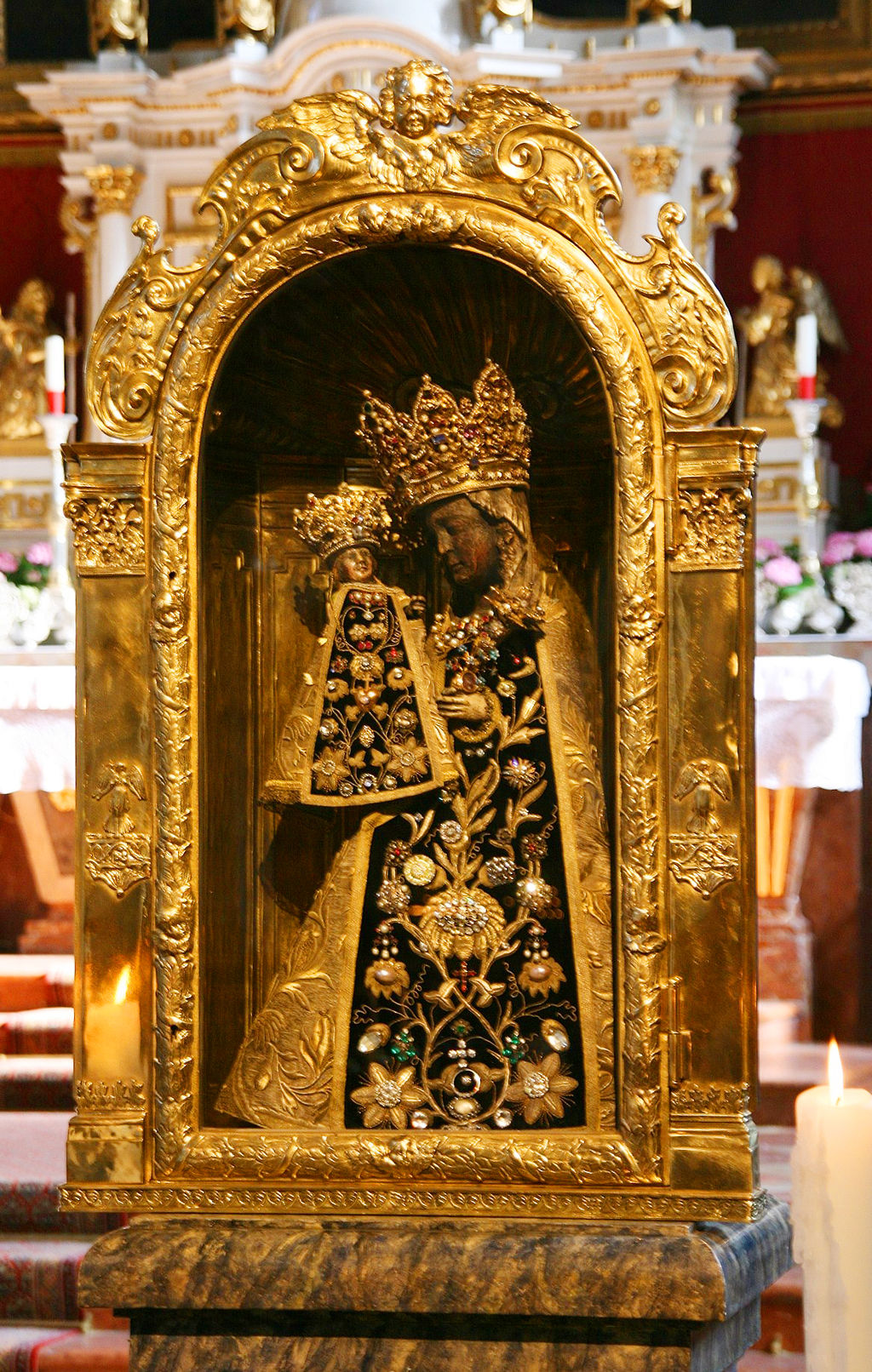
As Our Lady of Altötting, Germany Mary is said to have guided Joseph Ratzinger from birth to the papacy, through a childhood and young adulthood spent under the horrors of Germany’s Third Reich. His devotion to her has become legendary. Even now, when she temporarily resides in the parish church of St. Michael’s (pictured below) nearby while her ancient chapel is being restored, she carries in her scepter a custom-made sapphire ring. This ring was a gift to Fr. Ratzinger from his brother and sister, when he was appointed to be Archbishop of Munich. In 2006, after he was elected Pope Benedict XVI, Joseph returned to Altötting to give Mary his ring. (5)


Pope Benedict XVI had a great devotion to Our Lady of Altotting. It is said that she guided him throughout his life.

At the shrine of Our Lady of Knock in Ireland (pictured in banner), the shrine guide gave us this explanation about nineteenth century Marian apparitions there. (6)

“People always ask, ‘But what did Mary say?’ When we answer, ‘She was silent,’ everyone wonders how it could be, that Mary came among the garrulous Irish and didn’t say a word?

“Wherever she appears, Mary always asks for two things. She tells people to fast, and to pray. She didn’t ask us to fast because she knew we were already starving. She came with St. Joseph at her right, St. John on her left, with the angels and the Lamb on the altar, to show us that she had heard the constant prayers of her faithful Irish children.

“Everyone had lost so many members of their families to death from the Great Hunger, and then from the necessary emigration. The land had been decimated.

“We believe that Mary came just to hold us in her love, and to reassure us that there was a future. She came to bring us hope. She didn’t need to say anything. We all understood.”

© Copyright 2023 by Margaret King Zacharias, Ph.D.

Notes:

  1. https://en.wikipedia.org/wiki/Theotokos
  2. https://www.ourcatholicprayers.com/litany-of-the-blessed-virgin-mary.html#:~:text=The%20Litany%20of%20The%20Blessed%20Virgin%20Mary%2C%20also%20known%20as,1587%20by%20Pope%20Sixtus%20V.
  3. Liguori Publications, Liguori, Missouri, 1998.
  4. https://www.papalencyclicals.net/pius09/p9ineff.htm
  5. https://en.wikipedia.org/wiki/Shrine_of_Our_Lady_of_Altötting
  6. https://www.knockshrine.ie/history/

Photo credits:

Featured photo: Our Lady of Knock Interior Chapel Sculptures Attributions

Page URL: https://commons.wikimedia.org/wiki/File:Apparition_Chapel_with_Stained_Window.jpg

File URL: https://upload.wikimedia.org/wikipedia/commons/8/8a/Apparition_Chapel_with_Stained_Window.jpg

Attributions: KnockShrine, CC BY-SA 4.0 <https://creativecommons.org/licenses/by-sa/4.0>, via Wikimedia Commons

Inset Photo: Image of Our Lady of Altotting

Page URL: https://commons.wikimedia.org/wiki/File:Gnadenbild,_Gnadenkapelle_Alt%C3%B6tting.jpeg

File URL: https://upload.wikimedia.org/wikipedia/commons/e/ed/Gnadenbild%2C_Gnadenkapelle_Alt%C3%B6tting.jpeg

Attribution: Finner: Siddhartha Finner, Dipl.Ing.-Architektur, CC BY-SA 3.0 <https://creativecommons.org/licenses/by-sa/3.0>, via Wikimedia Commons

Licensure: https://creativecommons.org/licenses/by-sa/3.0/deed.en


We ALL Teach, So Be Careful of What and How!

We ALL Teach, So Be Careful of What and How!

Many years ago, I taught at a local Catholic elementary and high school. It was my first professional teaching job, and I was excited to pass along the knowledge I’d garnered over my years in college. As a Catholic school music teacher, I taught science, math, English, history… and sometimes music. I had one student in my history class who was NOT going to pass and, furthermore, didn’t care. When I approached him with this information, he kept saying, “I don’t care! I’m going into my family’s business. I don’t care if I pass or not.”

Exasperated, I asked, “What’s your ‘family’s’ business?’” Imagine my surprise when the young man told me his family’s business was something VERY illegal!

My teaching training kicked in, and I said, “Well, even in your dad’s business, history plays a large part! He needs to research, plan, and know the history of the situation he will be walking into.” The student gave me a wary look, smirked, and walked away.

At a parents’ evening at school, the student’s father asked to see me alone. Needless to say, I was nervous. I suddenly wished I’d become a banker instead of a teacher. Soon a mountain of a man ambled into my classroom scowling, “I’m [so-and-so’s] pappa.” I swallowed hard and stuck out my hand for him to shake. In an instant, he had his bear-paw-sized hands and arms around me—giving me a hug and beginning to sob.

All I could do was stand there and say, “It’s okay, it’s okay, whatever it is, it’ll be alright…”

After the man composed himself, he told me his son had told him about our exchange. He was shocked into reality. He said, “I had no idea he even knew what I did for a living, let alone planned on going into it.” The father had been preaching one thing to his son, “Be a good boy. Always do the right thing. Listen to your elders…” Meanwhile, his actions were teaching him to do something different.

For the sixth Sunday of Easter, we’ll hear of Phillip converting an entire community, then James and Peter coming to “confirm” what Phillip had done and laying hands on them to confer the Holy Spirit to them, making sure the people honestly knew who the Christ was. Then we hear Peter telling us we need to embrace holiness and be able to explain why we believe what we believe. And furthermore, we need to “show-and-tell” in a way that is not confrontational. Finally, we have Jesus telling us that IF we fully integrate what he taught into our lives, he will send the Holy Spirit to fill us and help us in every decision.

What we teach matters, but so does how.

If you were wondering what happened to the student, I am very happy to report he went on to business school and owns a local business that is considered a jewel of the community.

Copyright 2023 Ben Bongers

The Poetry and Praise of Nature

The Poetry and Praise of Nature

Here we are in the middle of Eastertide. One of the things I have always loved about the Easter season is that it seems as though all of nature is celebrating the Resurrection of Christ along with us.  In my part of the world, Central Texas, this is the time for our annual display of wildflowers, a riot of colors that starts with deep blue bluebonnets, paired with light pink evening primroses that eventually fade into red, yellow and brown sunflowers as the weeks progress and the temperature warms up.

I was on a morning walk last week and stopped to take a photo of a patch of wildflowers. I was happy to see that there were others who were also pleased to see the wildflowers. Darting in and out of the blooms were butterflies and bees, and overhead birds were busy building nests while squirrels waved their bushy tails at me, peering from behind branches, daring me to notice them. The scene reminded me of a passage from one of my favorite children’s books, The Alligator and his Uncle Tooth, by Geoffrey Hayes.  This book tells the tale of a small alligator, named Corduroy, who loved to wander through the hills surrounding his home. He especially loved to meander through the pine forest, always “standing strong and silent through every season. When the trees were hung with snow or covered by fog or moved by wind, Corduroy watched them, and it was like seeing poetry.”

Later in the story Corduroy goes to live with his Auntie Hick, who runs a small stationery shop in a village by the seaside. The little alligator is overwhelmed at his first glimpse of the mighty sea.

“The sea roared as it swept onto the beach, sending up showers of salty mist that tingled Corduroy’s nose. He breathed in the ocean smell. How untamed it was! How alive!

“As he sat there watching it, the sea foam rolling on the waves looked like delicate clouds; and the clouds in the sky looked like flower blossoms; and the sky moved like a song. ‘Poetry!’ thought Corduroy.”

Ah, poetry. That literary form with the ability to teach, communicate and elevate through images and a minimum of syllables, to strip away the familiar and help us see it once again with fresh, new eyes. As I stood in the wildflower patch that morning, watching all the pollinators busy at their work, I felt as though I were watching a living embodiment of poetry, just like Corduroy.

Feeling the warm sun, knowing winter was finally slipping away for another year, I felt the promise of Easter joy rising again; the newness, the light, the victory, the hope. I thought “Someone should write something.” Then I thought “I bet someone already has.”

Upon returning home I opened my Bible and went to the Psalms, that book of precious poetry. Sure enough, I found Psalm 8:

O Lord, our Sovereign,

How majestic is your name in all the earth.

You have set your glory above the heavens.

Out of the mouths of babes and infants

You have founded a bulwark because of your foes,

To silence the enemy and the avenger.

When I look at your heavens, the work of your fingers,

The moon and the stars that you have established;

What are human beings that you are mindful of them,

Mortals that you care for them?

Yet you have made them a little lower than God,

And crowned them with glory and honor.

You have given them dominion over the works of your hands;

You have put all things under their feet,

All sheep and oxen

And also the beasts of the field,

The birds of the air, and the fish of the sea,

Whatever passes along the paths of the sea.

O Lord, our Sovereign,

How majestic is your name in all the earth!

(NRSV Bible, Psalm 8)

 It is such a tremendous truth that all of nature worships God, just by doing what it was created to do. From the orange winged monarch butterfly to the mighty oak tree to the towering, silent mountains, all of creation offers its praise. May you, too, find yourself amid ample opportunities of living praise – and poetry – this Easter season!

© Copyright 2023 by Sarah Pedrozo

Featured photo Eastertide Wildflower Field © Copyright 2023 by Sarah Pedrozo

Spring and the Stubborn Cardinal

Spring and The Stubborn Cardinal

Spring has arrived in my neck of the woods, and with it comes the hustle and bustle of God’s fantastic flying creatures around the flowers in bloom. This time of the year, I try to take every opportunity to visit outdoor places of interest. Recently, my husband and I walked the grounds of Our Lady of Lourdes Shrine, taking in all that nature had to offer. Scattered across the walking paths were sticks and small branches which had fallen in storms earlier that week. However, the beauty of the outdoor chapel, statues, and illumined candles surrounding the altar remained. Off in the distance was the whistling call of a cardinal announcing its presence, bringing happiness to my heart. 

As we approached a building that housed a gift shop, the little red cardinal made its existence known, flying from its edge to a nearby tree. It wasn’t until we were inside the shop that we became aware of the cardinal’s intent. We listened to the shopkeeper’s story explaining that the cardinal was either confused or stubborn. 

A sister of the Most Holy Trinity told us the cardinal had been visiting for many months. Daily attempts were made at flying directly into the shop window. These occurred so often that decals were affixed to the window to deter the bird from attempting to enter. It is common for a bird to see its reflection in a window, provoking it to go after what it thinks it sees—ultimately resulting in either an injured bird or complete surrender to the situation.  

In this case, it appears the Shrine has a stubborn cardinal on its hands, and it prompted some thoughts as my husband and I recalled the activity of the bird that afternoon. Could it be that the bird was refusing to leave? What was it looking for? Had it lost a mate? Did the bird know it wasn’t getting anywhere by continuing its current behavior? 

I am not alone when I share that there have been countless times when God has called me toward something, and I have run the other way. Or instances when I continued to go “my way” only to hit the same roadblock repeatedly, never realizing that the road I was trying to travel was not God’s plan. Like the cardinal at the gift shop, we spend too much time looking for something that isn’t there instead of listening to God’s voice as our guide. 

Our moment of surrendering to the situation comes when we realize that our plan may not necessarily be God’s will. Like the bird flying into a window repeatedly, we are injuring ourselves when we repeat a pattern that has us, in essence, stuck. The decals in our lives that help us to see come in many forms—spiritual guides, faithful friends, parents, siblings, a spouse, and our children. Let’s not discount the stranger or good Samaritan who will help us to visualize what is ahead through teachable moments. 

We can only hope that the cardinal visiting the sisters at the Shrine stops long enough for God to provide enlightenment or perhaps send another bird to provoke a different activity. You and I both know that if it continues on the path it is now, the bird will eventually suffer hurt beyond repair.  The same is true for you and me. If we continue on the wrong track and fight the direction of God, our circumstances may result in a chaotic life.

The cardinal has as many choices as you and I. We can continue flying into the window, never getting anywhere, or set our sights on a path for God to light and guide us. Discernment becomes clear through consistent prayer and prayerful conversations with a spiritual director or parish Priest. Take advantage of the freshness and new beginning spring offers, open the windows of your heart, and fly. 


Copyright 2023 Kimberly Novak
Images Copyright Canva

Stay in the Know

Join Our Newsletter

Members and supporters can get the latest on CWG news and events by signing up for our newsletter.

Please wait...

Thank you for signing up!

Catholic Writers Guild
P.O. Box 77
Eaton, IN 47338