Hope and Resilience

Hope and Resilience

Only Divine Providence could have woven such a tale. I can just offer you a sketchy map, and a few further clues. But we’re all a part of it. You’ll find your way.

This story opens in the mid-1800’s, with an English nobleman who collected American tree specimens to forest his Irish estate across the Atlantic Ocean. It encounters White Russians fleeing persecution following the communist revolution in 1917. It continues into the 1920’s, with an ambitious Irish diplomatic attaché in Paris; and a devastating family tragedy in Ireland.

Our tale emerged again in a small Swiss town in 1957, when a Protestant housewife received an indelible message in prayer from an Eastern Orthodox Catholic Saint.

But perhaps the most interesting plot twist occurred in the late 1940’s or early 1950’s, when a group of Irish schoolboys discovered dusty 15th-century religious icons while searching for treasure in a 19th-century reproduction-Gothic castle.

For me, it began on a recent March morning when a massive herd of glossy cattle crossed the road in front of our tour bus for more than fifteen minutes on their way to pasture. These cows dwell at Glenstal Abbey near Murroe, County Limerick, in the ancient Munster region of Ireland. (1)

Assisted by their dedicated local lay-oblate community, the Benedictine monks at Glenstal administer a substantial farm; a nationally-accredited Roman Catholic boarding school; and a conference center that offers retreats, spiritual consultations, and pilgrimages to individuals and groups of different faiths from around the world. A major inspiration for many pilgrimages to Glenstal Abbey is its unique collection of rare Eastern Orthodox prayer icons. These icons are displayed in a custom-built underground chapel beneath the main church.

In the Eastern Orthodox faith tradition, iconography is regarded as a particular kind of worship and a specific religious vocation. Although drawing and painting are involved, icons are always referred to as “written,” not made. The most important stages in their writing are the trained religious artists’ disciplines, fasting and prayer. Orthodox believers do not “look at” their icons; they present themselves before them, so that the saints can communicate with human beings on earth through the windows of their eyes.

The White Russians eventually found their way to Paris, France. Many families at that time were trapped in an economic depression that gripped continental Europe as well as North America. Too often, they were forced to part with their most precious possessions in order to support their families. For the Russian émigrés, that meant selling their family icons.

It seems that a diplomatic attaché for the Irish government, stationed in Paris, was happy to assist with the disposition of religious art works. The monks at Glenstal Abbey believe that this is how their Russian Orthodox icons were transferred to Roman Catholic Ireland.

At some point the icons landed at the castle forested with North American trees, once owned by the Barrington family. When their daughter was killed by Irish freedom fighters in 1921, the family returned to England. A local priest, Monsignor James Ryan, purchased Glenstal Castle in 1926 and donated it to the Benedictine Order, to found an abbey and school in the Archdiocese of Cashel. Glenstal Priory was inaugurated in January of 1928; the abbey boys’ school was established four years later in 1932. (2)

But following the turmoil of World War II, by the early 1950’s the Orthodox icons’ presence at Glenstal Abbey had been almost forgotten. Inquisitive schoolboys, digging through nooks and crannies, apparently came upon them stored somewhere in the castle. The Russian Orthodox saints traveled across a Roman Catholic campus in children’s hands, to decorate dorm room walls or to lie hidden under beds as secret prayer talismans.

Back on the continent, in 1957 the small-town wife of a Reformed Church pastor began to see saints and angels, including Mother Mary, beckoning to her from Roman Catholic churches in central Switzerland. Eventually, Joa Bolendas entered these churches to pray.

According to one of Bolendas’ accounts, St. Nicholas appeared to her and said, “This is the testimony of an early Saint of the Russian Orthodox Church.” In their encounters, St. Nicholas showed her images of icons that he said were “missing.” He told her that these icons were important for the future of the world and must be found. St. Nicholas thought that the icons he sought were somewhere in Ireland.

Bolendas’ nephew by marriage, John Hill, a graduate of Glenstal Abbey School, was in residence at that time in the C. G. Jung Institute of Zurich. Acting as a family member and not in his professional capacity, John began to accompany his wife’s aunt to church. He observed her in ecstatic prayer (3).

Joa Bolendas was described by all who knew her as “a strong woman,” and “a thoroughly practical person.” John himself watched her come out of prayer visions and briskly proceed to a nearby shop. There she would haggle with the butcher for his best cut of meat at the lowest price, to cook for her family’s dinner. John Hill deemed her fully grounded in reality.

He had a vague recollection of “those icons we used to play with at Glenstal as boys.” The matter seemed worthy of investigation. John called his old friend Mark Patrick Hederman, a monk, writer, teacher and administrator for the same abbey school where they both grew up.

In 1976, John and his wife Anne-Marie, with a photographer selected by Joa Bolendas, traveled back to Glenstal Abbey to examine whatever icons they might be able to find there.

Photographs of the icons they located in a thorough search of abbey and school were shown to Joa after they returned to Switzerland. She confirmed them as the same images St. Nicholas had revealed to her in visions. The saint then requested through Joa that the Benedictine brothers at Glenstal “build a chapel at their abbey to preserve them.”

All of the saints and angels who spoke with Joa over many years conveyed the same essential message. Whether explicitly or implicitly, the thrust of these revelations was always the importance of unity among mankind. If the chapel was built at Glenstal, St. Nicholas told her, “Unity will follow for Germany and Ireland.”

When Brother Patrick first presented a multi-million-dollar bid he’d received from a local contractor, the proposal to build a free-standing icon chapel on the abbey grounds was firmly rejected by the Glenstal monastic community.

Over time, however, the Benedictine brothers eventually developed a consensus. If Brother Patrick could find a way to build this chapel in the unused dirt cellar under the abbey church, they might be willing to help support it.

A third Glenstal Abbey School classmate, Jeremy Williams, had grown up to become one of Ireland’s leading architects. Patrick called Jeremy to the abbey for a consult. The aesthetic they both envisioned was a smaller version of the chapel at St. Sophia Church in Istanbul.

Their design was ultimately built in Glenstal Abbey’s church cellar to house the Russian icons, as well as an equally-precious donated collection of Greek Orthodox icons.

Their cement contractor in Cologne, Germany, who ground real stone for use in the colored-concrete chapel floor, provided the abbey with hefty discounts. In return the monastic community granted permission for the contractor to use an image of the finished chapel in promotional materials.

Before construction even began, while the abbey team was still examining the underground structure, a man no one had ever seen before walked in.

He said, “I know what you’re doing here! I know how to do it! No one else must touch it!”

With the monks’ permission, he spent the night alone, “inside the black box,” for inspiration. That ‘stranger’ turned out to be a local man, the brilliant and idiosyncratic Irish artist James Scanlon, who created luminous stained-glass medallions to anchor and illuminate a portion of the chapel ceiling vault.

Even the cows offered up their own fair share of the chapel costs, in cream and butter. Dairy sales from the farm help to support all of the spiritual and educational programs offered at Glenstal Abbey.

The finished icon chapel opened on April 10, 1988, with ancient musical tones and choral chants. These were researched as well as performed by Irish composer Michael O’Sullivan, with Rev. Nóirín Ní Riain, Ph.D. as liturgical cantor. (4)

Just nineteen months later, on November 9, 1989, the Berlin wall that had divided Germany for more than five decades fell to the ground. On 10 April, 1998, the tenth anniversary of the chapel’s consecration, Good Friday Agreements brought peace to Northern Ireland, putting an end to physical interreligious violence there.

This evidence is anecdotal, of course. Private devotions are treated as optional, not obligatory, in our Roman Catholic church. Still, the discerning monks of Glenstal Abbey visit their icon chapel every day, at the same time, to pray for healing in our world. This devotion is performed in addition to their traditional Benedictine charism, ora et labora, a daily rhythm of work and prayer in the Liturgy of the Hours.

If nothing else, the length and breadth of this history illustrate that dark times of many different kinds have always besieged humanity. The haunting eyes of early saints in the Glenstal Abbey chapel continue to regard contemporary pilgrims with eternal compassion.

Glenstal Abbey will celebrate the icon chapel’s 35th anniversary on April 10, 2023.

Should you, yourself, feel called to reflect on how a group of 1950’s Irish schoolboys ‘just happened’ to be in the right places, at the right times, prepared with the exact adult skills to provide every resource required to incarnate this chapel … Please join in prayers for unity and peace on Easter Monday.

 “Drive away the darkness that surrounds us,

Shed onto us the mantle of your light.

Help us to know your will,

And give us the courage to do it.” (5)

 Amen.
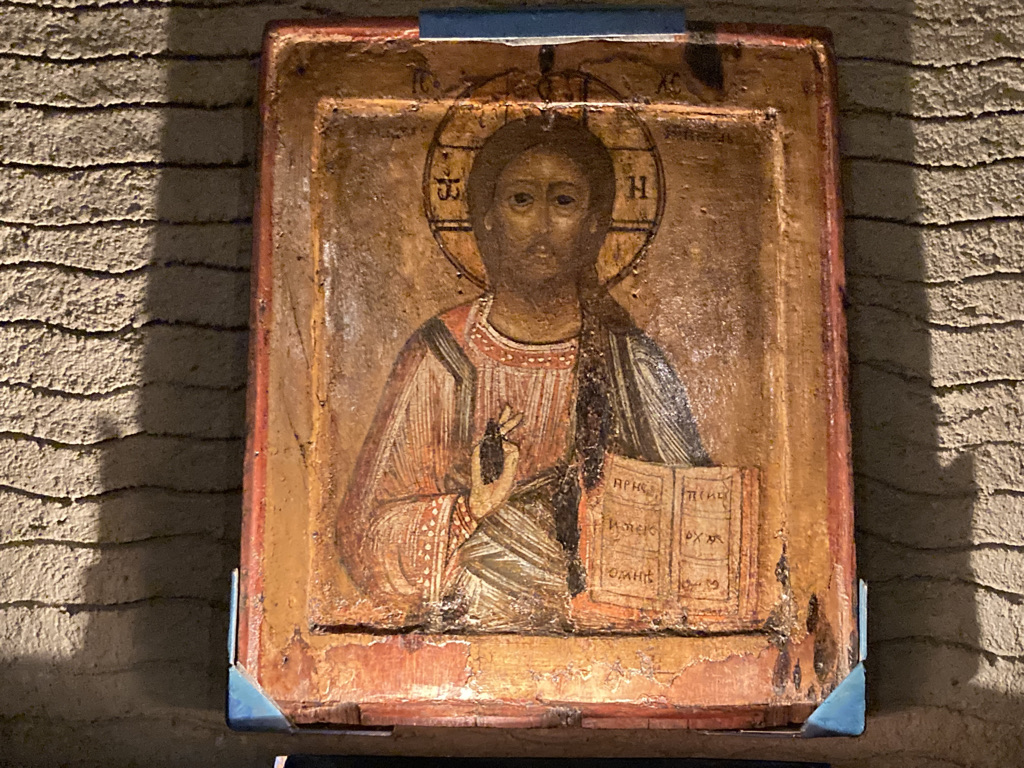
Original Russian Icon “The Healing Christ” in the Glenstal Abbey Icon Chapel Photo by Margaret Zacharias, taken with permission from Don Mark Patrick Hederman


Featured Image: Collection of Original Eastern Orthodox Icons in the Glenstal Abbey Chapel Photo by Margaret Zacharias, taken with permission from Don Mark Patrick Hederman The “Angel of Silence” can be seen at lower right.

Notes:

  1. https://glenstal.com/abbey/
  2. A more detailed history of Glenstal Abbey, and exposition about the educational philosophy of the secondary-level boy’s school, may be found in former Headmaster Mark Patrick Hederman’s book:

 The Boy in the Bubble: Education as Personal Relationship

 https://www.amazon.com/Boy-Bubble-Education-Personal-Relationship/dp/1847304052/ref=tmm_pap_swatch_0?_encoding=UTF8&qid=1680133263&sr=8-1

  1. The full story of Joa Bolendas’ visionary prayer experiences may be found in her books:

So That You May Be One

https://www.amazon.com/s?k=Joa+Bolendas+That+You+Be+One&crid=1RFFTDTLMZBLJ&sprefix=joa+bolendas+that+you+be+one%2Caps%2C155&ref=nb_sb_noss

Alive in God’s World

https://www.amazon.com/Alive-Gods-World-Described-Bolendas/dp/097010975X/ref=sr_1_1?crid=Q8W6BZWU4KAG&keywords=Joa+Bolendas+Alive+In+God%27s+World&qid=1679641031&sprefix=joa+bolendas+alive+in+god%27s+world%2Caps%2C144&sr=8-1.

  1. Recordings of the early Christian music that accompanied the consecration of Glenstal Abbey’s icon chapel may be found here:

 Vox De Nube

https://www.amazon.com/dp/B09S3F6YQ1/ref=sr_1_2?crid=3RR326YJQLC6A&keywords=vox+di+nube&qid=1679728636&sprefix=vox+de+nube%2Caps%2C142&sr=8-2

  1. One prayer given in a dream to Don Mark Patrick Hederman, now Abbot emeritus of Glenstal Abbey.

This article was prepared with help and permission from Don Mark Patrick Hederman and John Hill.

Any errors of fact or interpretation are the sole responsibility of the author. 

© Copyright 2023 by Margaret King Zacharias, Ph.D.

 

Journey ad Amorem

Journey ad Amorem

We’re all here to learn how to love. Life is a school of love. The things that happen to you in life are meant to help you learn how to love. The people who cross your path in life are meant to help you learn how to love, and you’re meant to help them learn how to love, too.

We’re all on a journey back to God, a journey ad Deum. It’s just that some of us don’t realize that yet, or have forgotten it, or else don’t want to believe it. But we are. We all came from God, and we’re all intended to return to God. Only in God will we find the ultimate happiness, freedom, purpose, and peace that we so desperately desire.

The little three-word phrase “God is love” (1 John 4:16) is the most profound statement ever uttered by a human being. For some people, however, the phrase “God is love” has become so familiar as to have become almost trite. They may acknowledge that it is true in the abstract, but it is not a truth that they allow to impact their daily lives in any significant way: “‘God is love’ sounds nice, but it doesn’t pay the bills”—this seems to be the attitude of some people. Other people reject the claim that “God is love” entirely.

Many of us need to consider (or reconsider) the profound meaning and implications of the claim that “God is love.” This little phrase not only claims that God exists; it also makes a startling claim about what God is. The claim is not just that God has love, but rather that God is love. Love is what God is. God’s essence, the core of who and what God is, is love. Not thought, or power, or freedom, or knowledge, or any of the other things that we human beings might have expected or predicted to be the essence of God, but love.

But “God is love” is not just a statement about God. It’s also a statement about the nature of existence, the nature of life itself. God is not just one more being among many. God is not some “super-being” with superhuman powers. Some atheists seem to derive pleasure from attacking such images of God, but that’s not the God in whom we Christians believe. No, God is not just one more being among many; God is Being itself (Exodus 3:14; John 8:58). God is the Mind behind all that exists, the Mind that gave rise to all that exists and that sustains everything in existence from moment to moment, the Source and Ground of all that exists, the uncaused Cause of all that exists. So if God is Being itself, and the essence of God is love, then the essence of Being itself is love. Love is what Being is, so love is what being is meant to be. To love is to be, and to love more fully is to be more fully. The more fully we join in the dynamic of love, the more fully we share in Being, and the more fully alive we are.

Some of the ancients described human life as a process of exitus and reditus: a going out from God when we are born into this life so that we might then freely choose whether or not we want to return to God forever. Our life is intended to be a journey back to God, a journey back to Love. We were born for love. We were made from and for love. We were created to dwell forever in the divine Love, but whether we end up there or not depends on whether we accept God’s offer of a share in the divine life.

Life is a beautiful and profound and mysterious drama in which our ultimate destiny, our eternal destiny, hinges on our choice of whether to say Yes or No to Love and to love. The stakes couldn’t be higher. So why does God leave the choice up to us? Again, it’s because love, to be genuine, has to be both freely offered and freely accepted. God doesn’t work by force, but rather by persuasion. God freely offers us the gift of a share in the divine life and love, but it’s up to each of us to choose whether to accept the gift or not. We’re all enrolled in the school of love, but it’s up to each of us whether we make the most of the opportunity or choose to drop out.

* This article is an excerpt from Rick’s recently released book, The Book of Love: Brief Meditations. https://enroutebooksandmedia.com/thebookoflove/

Rick Clements, 2023

(Photo by Patrick Fore on Unsplash)

May I Have This Dance?

May I Have This Dance?

I recently spent the day waiting for a family member undergoing a medical procedure. As we hunkered down in the lobby, a gentleman played the piano, filling the open atrium with melodies. We enjoyed reminiscing on some songs from the past, and I noticed how those conversations put our worried minds at ease. A hospital employee arrived at our table asking if we liked the piano music and if we would dance.

How lovely it was to see her go from table to table, bringing smiles to worried families looking for anything to occupy their minds while they waited. I never saw anyone accept the dance offer in the hours we spent in that space. However, moods were lifted, achieving the ultimate goal. I thought how wonderful it was for the hospital to provide this type of service and how nice of the employee to present it so joyfully. Little niceties like this are heaven-sent moments where God joins us in the dance.

Over the last several years, music therapy has become a staple in healthcare, and I am a big fan. Not long ago, I spent time with my uncle, who had suffered a stroke. Uncle Boo, I called him, had been a wedding singer for many years, and music meant the world to him.  When the nurses on his floor learned of his passion, they quickly ordered music therapy at his bedside. I was blessed to have been visiting him on a day when the therapist arrived. The stroke left his voice weak, but that did not slow him down.

Singing his favorite songs with the therapist brought tears, laughter, and an unforgettable smile to his face. The connection the therapist made with my uncle was like watching two old friends dancing cheek-to-cheek. Setting aside my emotions, I managed to record a voice memo on my phone as my uncle softly sang the lyrics, “All my lovin’, I will send to you,” and “Don’t you look back.” I relish the gift God gave me that day—an opportunity to play the recordings back, close my eyes, and dance.  Reflecting on that memory today, I realize how blessed I was to have chosen that particular moment to pop in for a visit, not to mention that this was God filling His dance card.

In both instances, music was a gift presented by God through a person who was trained and highly qualified, not to mention motivated to share their gift. That does not mean that only trained professionals can present gifts of this sort. For instance, before we were married, my husband asked me to dance in the middle of a candle store. It ultimately led to a dance with the same song on our wedding day—when God filled his and my dance cards. 

It makes me wonder how many other events, not only in my life but for everyone, are times when God asks us to dance. More obvious moments might be when the trees sway in a soft breeze inviting us to swing side to side as we watch the leaves dance. Or, perhaps, the joy on a child’s face as they ride on the playground. 

I can go on and on with different scenarios, and I’m sure there are many you can think of, also. God is with us in all things, big, small, medium, and large, especially in the twinkling of a dance. Embrace these joy-filled moments of glee and savor them with prayers of gratitude, a note in your journal, or sharing with a friend. My prayer for you, the reader, is that you tune into the little niceties as gifts from God. Consider them precious moments when God shows up with His dance card.  Like a little girl with her daddy, learning to dance, except this time, God is leading the steps. 


Copyright 2023 Kimberly Novak
Images Copyright Canva

Mass on the Rock

Mass on the Rock

It was what the Irish call a ‘soft day.’ Drenching afternoon rain fell after a cold and misty morning. Some among us worried that it might not be worth the effort. It was difficult enough to walk when the ground was dry, never mind through a spooky meadow that rolled under your feet like a ship on the churning sea.

It looked to be quite a distance, too, at the end of what had already been an exhausting day. You’d understand if you yourself had a knee or a hip needing surgery. This group had eight or ten of them. Our hosts, who’d spent the whole wet day in the field preparing for our arrival, did understand. They kindly offered us the church in town to celebrate Mass for any of our pilgrims who felt they couldn’t make their way to the Rock.

Then somebody said, “The rain’s letting up!” Somebody said, “Let’s those of us who feel we can go, let’s give it a try?”

With Father’s encouragement, everyone managed to clamber off the bus and onto a gravel road. At the open fence gate, a young woman smiled and said, “You’re very welcome!” Just beyond her, the farmer took each hand into his own. He inspected our eyes, pilgrim by pilgrim, nodding his personal welcome as if it were a matter of life and death.

For over three hundred years, it was.

We set out across the fields, breathing in the thick green air. We shivered in our raincoats. Most of us had no idea where we were headed. If you knew what to look for, you might be able to recognize the place by an ancient grove of sacred Druid trees perched on the horizon. Eventually our guide pointed out an entrance, hidden among shrubs that grew beneath the trees. We pushed through a narrow opening to discover steep stone steps cut into a muddy hillside.

More than six feet below, the freshly-excavated chapel stretched out in an ell. Heavy cinder blocks were stacked along the sides; new boards were laid on top of the blocks for benches, and boards were laid below for walking across the mud. A pearly grey boulder held the corner. The air surged with aromas:  freshly-sawn lumber, damp peat and fertile earth. We felt humbled to see so much labor expended to provide for us.

“Why, they wouldn’t believe we’re Father Flanagan’s people,” someone said, “If we hadn’t had the courage to come!’

The Rock turned out to be a smooth, asymmetrical chunk of granite, nearly three feet tall, and almost five feet in diameter. It sparkled as if it had been scrubbed with rainbows. Atop the boulder stood pictures of our Lord and our Lady on either side of a simple Crucifix.

Father laid his communion kit directly onto this stone altar. He passed the scripture book to the lector and shook off his coat. He vested for Mass right there on the soil among us. He tried to light candles, but they kept blowing out. Worn over only a short-sleeved shirt, his surplice flew in the chilly gale. But the flame of the Holy Spirit glowed in all hearts as he made the sign of the cross to open our liturgy.

While Father distributed Eucharist, three of us together began to sing at the same moment, the same inspired song: “This is holy ground. We’re standing on holy ground, for the Lord is present and where He is, is holy.” Another woman mimed the words for each verse while everybody sang: “He’s given us holy hands. He’s given us holy lips.” Father maneuvered from plank to plank as if he’d never celebrated Mass in any other way.

Stalks of ripened grain in the fields above our heads swayed in the breeze, blessing us like banners. Though we knew we would be invisible from the road, we could almost hear the tramp of soldiers’ feet on the wind. We reflected on Father’s homily, thinking about how many generations of Irish people had gathered for Mass just like this, under penalty of death. They hid below crops they were forbidden to eat, celebrating Eucharist without the luxuries of raincoats, candles or songs.

All that nourished them was the Lord. They did not consider His Feast a meager meal.

When we returned to ordinary time and contemporary place, that luscious green labyrinth still shimmied under our feet. But this time the walk did not seem long.

Three-year-old Michael led the charge to the bus. He scampered across the landscape with a wild flower in his hand. He went spinning around the meadow, cavorting in tall grass under the wide sky.

Every single one of us danced along behind him, all the way back to Ballymoe.

© Copyright 2023 by Margaret Zacharias

Royalty-Free Stock Image Shutterstock_1719546454 Licensed to Pearlpledge82 User ID 289304735 Standard License February 19, 2023

*A previous version of this true story was published in Sunday Bulletin, St. Theresa of the Child Jesus Catholic Church, Diocese of Des Moines, Iowa, 2007; and appears in another form on the author’s website, www.animaviva.com.

Candy as Compassion

Candy as Compassion

Next Sunday, the Third Sunday of Lent, we see how God showed compassion on His people in the desert, giving them water from the rock, and the Samaritan woman giving Jesus a drink. So how do we know compassion? What does it look like? Sound like? Do we know when we see or show it?

I visited a person, while making my Diaconate rounds, on hospice in their early 40’s. They would ask for the same item of every doctor, nurse, and certified nursing assistant (CNA)—a bag of the Chewable Sweet Tarts from the candy machine down the hall.

As the person faded in and out, they told me they had two beautiful children who were unable to make the trip to say “goodbye.” Their condition was taking hold. Soon they wouldn’t wake again. The person had led a rough life. They’d stolen, been hooked on drugs, cheated, lied, and had prominent tattoos of “taking lives.”

I didn’t judge and asked, “What would make you happy before you leave this world?”

They smiled and said, “Just one thing, a bag of those Chewable Sweet Tarts.”

I had to chuckle. “What’s so special about a bag of candy?”

The person smiled, a tear leaking from their eye. They said, “I used to take my kids around the neighborhood for Halloween. We had the best time! We’d talk as we walked around. I found out I had really smart, funny, and good kids.” The person sat with the memory, then said, “After we got home, we’d dump all the candy onto the kitchen table and take a piece, share it, and judge it with a rating. ‘This one’s an 8.6, or 9.2, or 4.1!’ We’d have the best time.”

The person looked over at me and said, “The Chewable Sweet Tarts… we never had those. Somehow having them will bring me back to the one good time—the one good thing I had in my life—my kids.”

After going to the restroom, I saw the candy machine and came back to the room, gently laying the bag of Chewable Sweet Tarts on the bed table. The person looked up at me. Big tears and no ability to speak. I came to the bedside, and they clung to me for a solid five minutes—bawling and asking over and over, “Why? Why? Why would you show me any compassion? Why would you do this for me?”

We shared the candy. As the person across from me chewed slowly, smiling the entire time, I finally answered their question. “Because you’re worthy of compassion. We all are.”

We never know what another person needs. The nurses, doctors, and hospital staff all had been in that room. They saw the patient—but missed the person.

Look around you. Who are the persons around you? Not customers, not clients, not patients—persons. Remember, compassion is a sure sign that the Holy Spirit is alive in us—and is helping us see that person crossing our paths every day.

Copyright 2023 Ben Bongers

For I know the Plans I Have for You

For I know the Plans I Have for You (Jer. 29:11)

Greetings, fellow travelers. I am (probably) the newest contributor to the CWG blog. In an attempt to introduce myself, I decided to offer the following recollections that I wrote for a smaller audience. This is a deeply personal account, but it’s how I roll.

I was widowed two years ago, and it significantly altered my perception of marriage, God and our eternal trajectory. Retrospect is the critical viewpoint in this narrative, since my husband and I did not convert to Catholicism until we were in our mid-thirties. Hence, God’s plan for our lives was not immediately intuited, although we eventually recognized the critical nature of the Catholic faith in our marriage. It was this faith that would provide continuity and structure to the sacrament we shared. We were married for 42 years, and this is our story:

My husband, Steve, was a risk-taker.

I was not.

Our third date I found him cheerfully explaining the constellations of scars on his head and chin—which he identified as wounds from embedded gravel—the result of a tire blowout during a high-speed motorcycle ride on a gravel road. Apparently, he went airborne before the force of gravity did what gravity tends to do—and it sucked him into the hard, graveled surface below him.

I watched, horrified, as he retold the story, complete with sound effects, and enthusiastic arm-flapping.

“You’re lucky to be alive!” I gasped. He smiled.

“Yeah,” he said. His grin grew even wider.

“Weren’t you scared?” I exclaimed.

“Nah,” he said casually, “I was too busy trying to keep the bike from falling on top of me and killing me.”

I remember being incredulous, as I tried to comprehend his explanation. I did not understand this attitude toward life. I risked nothing. I gambled on nothing, and I kept everything in my world ordered and safe. We could not have been more different. Who is this guy? I thought.

Eventually, and against my better judgment, Steve managed to talk me onto the back of his dirt bike—after assuring me that he wouldn’t go too fast. I believed him (mostly) even when we were sailing over huge hills with considerable hang time, before landing on the other side of the hill. I remember clutching my arms around his waist and screaming into his back, while he yelled reassurances that everything was fine. (I think he really enjoyed that part.)

Steve frequently challenged the forces of nature with every ounce of his seemingly immortal body. If he wasn’t defying gravity, he was water skiing without skis, or driving snowmobiles across frozen ponds. It always seemed to me that he was like one of those giant grasshoppers that flies erratically into oncoming cars—barely missing the windshield with an artful dodge.

Alternatively, the laws of physics and the general nature of risk, did nothing to inspire intestinal fortitude within. My formative years had been painful, and I trusted no one. Night after night, I remember begging a distant God for deliverance—a deliverance that always seemed elusive—rendering my nominal faith into shadows.

Despite my spiritual quagmire, I gradually began to appreciate Steve’s attitude toward life. Scientific laws can be harnessed if you have the right tools, and the world is approachable if you are comfortable with who you are. Steve was all those things—and slowly, patiently (sometimes) he taught me to take risks: with others, with myself, and of course … his motorcycle.

Initially, I did not realize that God had finally offered me deliverance in the form of a young man with an irrepressible temperament—but it seems rather obvious now. It would have required someone with that kind of fortitude to wage battle with the seen and unseen forces around me.

It turns out that God had been listening all along.

It should come as no surprise that Steve went on to have a successful career in law enforcement before retiring due to injuries he sustained in the line of duty. Those injuries are what ultimately caused his death, but he would have settled for nothing less. That’s just how HE rolled.

January marked the second anniversary of Steve’s death, and if I could tell him anything right now, I think it would be this: Thank you for taking a chance on this wisp of a soul. You are proof that God answers prayer on the most elemental level. I am forever grateful to you—and most importantly—to God, who is ever-merciful, and actively involved in the most intimate details of our lives.

This knowledge fills me with child-like trust–secure in the knowledge that God always has a plan.


©Copyright 2023 by Sarah Torbeck

The Consecrated Pen

The Consecrated Pen

As a Christian writer, I am always looking for even a glimpse of motivation. Whether in the form of a blessing, hymn, or homily, I cling to joyful words in the hopes of brilliant inspiration as my fingers lay upon the keyboard.  Sometimes, I am graced with inspiration in the strangest places, one of which was in a little store in Amish Country.

While on an overnight trip to visit the shops and farms of the Ohio Amish Valley, I stumbled upon a hidden gem. The Consecrated Pen: Inspiration for the Christian Writer by Susannah Rose Dorfsmith, sat in the most inconspicuous place, on a shelf beneath a row of candles.  I would expect to find a book of this type, or any type for that matter, nestled between other books or magazines.  Luckily for me, I was in a candle-sniffing mood that day.

It wasn’t the title that got my attention, but rather the simplicity of the visual, a writer’s grip, pen in hand, resting comfortably on a notepad. Amish towns offer a simplistic charm that entices me, and the cover of this book did the same. I knew I would purchase the book even before I picked it up, just because of the way it made me feel in that graced moment.  However, to appease my inquiring mind, I quickly peered at the contents and instantly received confirmation that this was God-sent.

At the time of this trip, I was on the verge of sending off my first manuscript to various publishers, so it was no surprise that I opened the section, “Season of Suspense.” The first two lines read, “So your manuscript is finally on its way to a publisher. What once consumed your time and filled your hands to overflowing is completed.” This line spoke to my exact season.

Another incredible find in the book was a picture of butterflies on the adjacent page which validated my certainty that God sent me this book. I have a special love of butterflies, and my first book, Bella’s Beautiful Miracle: A Caterpillar’s Story, is the story of a caterpillar who learns of God’s transformative power. Along with fluttering butterflies on the page, my eyes beheld a simple yet powerful poem.

A HOLY PURPOSE
No longer, Lord, a thing of mine
Is this, “my work.”
I give it up to be
In its entirety
A thing forevermore all Thine.
Though small and weak and poor, it will
Belong to Thee.
Oh, send it forth, I pray,
And use it in Thy way –
A holy purpose to fulfill.

In that instant, the line that struck me most was the first one. “No longer, Lord, a thing of mine.” Something calming and inviting happened within me as I realized that I had given over my project to God simply by reciting that poem. As a Christian Writer, my vision from the beginning was that my writings are to be a resource others would use to strengthen their relationship with God and fall in love with their faith. The Consecrated Pen, and Dorfsmith’s inspirational moments, have done the very same in me.

Dorfsmith gives the reader brief but meaningful inspirational quotes, scripture references, poems, and reflections in this beautiful writer’s resource. The back cover blurb promises that the writer is sure to find themselves renewed with zeal and eagerness and ready to use their talent for the glory of God, and I can attest to that!

This book gives the appearance of being simple, yet it is packed with brilliance. It is best left up to the individual writer regarding how to use this valuable resource. As for me, I have it on my writing desk at all times. I have picked out a few of my favorite scripture passages and poems to pray over my work. I have even combined a few of them and adapted specific prayers. There are those I pray with when sending my work for review, and others simply for God’s Glory to be revealed within the words on the page.

Dorfsmith also gifts the author with poems and quotes from other writers. Making this resource a one-stop shop for writer’s prompts, musings, and heartfelt inspirations.

“…The more we sit at His feet and watch to see what He has to say to ourselves,
 the more we shall have to tell others.”
Frances Ridley Havergal

The Carlisle Press published the Consecrated Pen in 2014, and I have found limited quantities available.  However, I found it at Kingdomwriting.com for $3.99, and I suggest you get your copy today!  


Copyright 2023 Kimberly Novak
Image Copyright Carlisle Press

Faithful Expectations

Faithful Expectations

 As a new author, it is sometimes difficult to know what I should expect or what is expected of me. I recently faced this in a casual conversation when I was told I sounded calm, confident, and optimistic. My faith is the backbone of how I respond to situations in my life. Even so, I face times when I am overwhelmed with an experience or result.

I firmly believe that God places us exactly where He wants us to be. These moments might be fleeting, life-changing, or teachable. Like everyone else, life has thrown a myriad of events at me, some of which I knew exactly what to expect and others a mystery. I smile knowing that the recent conversation was not only teachable but also a way to complete my task. In struggling with a writing topic and hearing what I was saying in the throes of that conversation, God turned the light on!

Expectation packs a big punch as it often creates a significant emotional response. Some types of expectations are joyful, while others can generate an emotion of fear. Looking back on events in my life, I can see a circumstance that I believe God used to groom me for the role of an author who faces expectations with a heart of faith.  It was during a time when I was a “stage mom,” which, to most, sounds exciting, and at times it was. However, there were honest moments when all I wanted to do was wait in fear rather than hope.

The journey through auditions, learning lines, and prep sessions were quite the experience. I knew my son and I would need a positive mindset to thrive. We treated each day and audition as one moment, releasing it from our headspace at completion. Some were harder than others, but we did an excellent job of living in a way that allowed us to expect happiness.

Another instance I recall is physical. I was “voluntold” through a persistent friend to participate in a healthy weight program. The journey consisted of several months of intense training and proper eating habits. I was reluctant about what the outcome would look like and had no clear expectations. In a nutshell, the journey strengthened me, not only physically but emotionally as well. The expectations I felt along the way were nowhere near the positive outcome, and for that, I can see the blessings.

Both of these examples impacted where I am today, serving as a preparatory phase in which I can draw strength and wisdom.  Learning to be patient with God’s timing and enjoy where He is taking me is the fruit of where He placed me in the past. I consider both of these events equally life-changing and educational.

Fleeting moments of the audition process and the pains of exercise are reminders that moments in our life go by quickly. As painful as they may seem in the moment, there is light to look forward. The skills I use today as an author, secretary, and spiritual director are directly inherent in the teachable moments through God’s Grace. My life changes by faithfully understanding God knows my heart and will work all things for my good.

Preparation plays a vital role in a mindset of faithful expectation and should be focused and balanced. Consider preparing for a job interview or the possibility of authoring successfully. There are many ways to go about it, some will over-prepare to expect the worst, and others will do the bare minimum. Looking at an outcome with faithful expectations will generate positive and heartfelt responses. These emotional considerations will bring about mindful preparatory phases, culminating in joyful experiences. The overarching goal is an outcome that is God-centered, realistic, and built on the foundation of faith.

I can’t think of a better time than right now to fully embrace the practice of faithful expectation. At the beginning of a new year, a gift in itself is another opportunity placed into our hands to go big or go home! Jump in wherever God has placed you armed with a heart of faithfully expecting God is doing beautiful things for you and through you.  I know the next time I am up against a deadline or struggle, God is right there with His finger on the switch, and the light will shine at just the right moment!


Copyright 2023 Kimberly Novak
Image Copyright Canva

Do Whatever He Tells You by Maria Riley

I love meditating on the Wedding at Cana. Attending a wedding seems like such an ordinary event for Jesus and his friends to attend. I imagine them laughing and enjoying themselves, much the way I do when I attend weddings, which helps me remember that Jesus was fully human too.

Another reason that I love the Wedding at Cana is that Jesus, as an adult, remained obedient to His mother. As a mom myself, I love this. His obedience also is a significant part of our understanding of Mary as the great mediator. She brings each of us closer to Christ by bridging the gap between us and Him. She tells Jesus that the wine has run out, and despite Him telling her it’s not yet His hour, Jesus obeys His mother (cf. John 2:3-4). Jesus’s first public miracle happened through the intercession of Mary.

Recently, while I meditated on this mystery, my mind didn’t focus on Jesus, His friends, nor His mother. Instead, my thoughts lingered on the servants, those who assisted Jesus in His first miracle. These servants aren’t even named in the scripture, yet by following the advice of Mary and obeying Jesus’s command, they partook in a beautiful miracle that all Christians know about.

They did whatever He told them (cf. John 2:5). And here’s the amazing thing—all He asked them to do was fill some pitchers with water. That was it! Jesus basically said, “Just go grab some water, and then leave the rest to me.” Because of the servants’ obedience, a miracle ensued.

Sometimes I think I’m not doing enough to live out my faith. I think I need to live in more drastic poverty or pray for hours every day. But maybe, just like the servants, Jesus is actually asking me to do something simple and well within my abilities, training, and current life situation.

When I stop to listen, this is what I hear Jesus say to me: “Fill this cup of milk, then graciously clean the spilled milk for the eighth time today. Write this story. Feed this family I have given you. Read aloud with this child.”

These commands, doing whatever He tells me, may not be as complicated as I think. Easy? Not always. Almost every day He reminds me, “Love your husband, and forgive him for not being perfect. In all things, selflessly love the way that I love you.”

If I humble myself and accept these charges from Him, then I open the door for the miracle to happen. If I do my small part, no matter how insignificant it may seem, I am honoring the will of God.

I’m not in the business of turning water into wine. But filling pitchers with water? I can do that.

Who Do You Say That I Am?

I felt it rising in successive waves, even before the crowd leapt to its feet and the cries of “Il Papa!” began. Love. I had sensed it before, of course, with family, during Mass, in Adoration. But it had never washed through me carrying such purity, such humility, such simple joy.

The passenger, in a white automobile that weaved its way through St. Peter’s Plaza on that cold but clear late-April day in 2005, beamed his smile and waved like a provincial child enjoying his first ride at an amusement park he never expected to visit.

Those of us in attendance rode his surges of love like experienced surfers. But I asked myself, “Who is this man?” He presented quite a contrast to the impression I had gleaned from some of the Benedictine monks at the Iowa basilica where I served as an informal oblate.

I had heard about a stern taskmaster, a strict enforcer of magisterial teaching, an incisive theologian, a very different portrait from the palpable sweetness I felt emanating from the person who descended from his car and ascended to the dais.

In recent weeks, my son had described him as “a good choice to bat cleanup for the pope whose act no one wants to follow.”

We were there that day solely by the workings of Divine Providence. Our travel plans had solidified almost two years before, when my son and his fiancée expressed a desire to see Europe, once he passed Part I of his medical-school boards. When I offered to take them if they would make it a pilgrimage, my husband decided to come along. None of us knew then that our beloved, majestic world missionary pope, now Saint John Paul II, would return to his heavenly home before we undertook our journey.

As we packed our bags for the trip, we had been following daily proceedings in the Sistine Chapel for more than two weeks, and were still uncertain whether there would be a new pope in the Chair of Saint Peter when we reached Rome.

Only the day before this audience, when we arrived at Da Vinci airport, we had learned from our Roman guide that her brother who worked at the Vatican would be able to get us tickets for Pope Benedict XVI’s first outdoor public audience in Saint Peter’s Square.

I have a vivid recollection of every word that Pope John Paul II spoke at my first papal audience in 1995. He was dynamic then, in full vigor. He stood at the microphone for hours. He presented his homily himself, four times, speaking fluently in four different languages.

I recall not a word of the brilliant theologian Pope Benedict XVI’s first papal address to a crowd of pilgrims in St. Peter’s Square in 2005. I just remember the overwhelming force of his love.

In September 2022, I had the opportunity to develop a few more insights about who Pope Benedict XVI—a reticent man, a highly influential intellectual, the humble confidant of his charismatic predecessor—really was.


null

Birthplace of Joseph Ratzinger, Pope Benedict XVI, in Marktl am Inn, Germany


Just after dawn on a frigid German morning with a blustery wind, my group of Oberammergau pilgrims walked through the few narrow streets of Marktl am Inn into its central platz, to view Joseph Ratzinger’s birthplace. We toured the small, charming Saint Oswald’s church where he was baptized on the same day he was born: Holy Saturday, April 16, 1927.


null

Sign outside St. Oswald Church, Marktl am Inn, Germany: Baptismal Church of Pope Benedict XVI


This is where it all began, the overflowing well, the place where his cup of love was first filled.

I hoped I might find some answers to how a sensitive child and brilliant adult lived through so many decades of ministering to the same human frailties; and through so much social change. How did he preserve his deep faith in God’s love, and his radiant transmission of that love, throughout his entire lifetime?

How did he accept the murder of his cousin with Down’s syndrome, by the Third Reich? How did a sensitive teenager who was already deeply aware of his vocation live through repeated encounters with Nazi evil—beginning with his first, but not last, conscription into their military forces at the tender age of 14?

On the left wall of Saint Oswald’s church, as one enters the tiny entryway, is hung a glass case clad in steel. It displays new parish “arrivals” for the current month, baby pictures of the infants most recently baptized into the parish. On the right wall hangs a sturdy matching case that features funeral program photos of recent “departures.”

Joseph Ratzinger’s own last words complete the circle: “Jesus, I love you.”

May perpetual light shine upon His Holiness Pope Benedict XVI, and may his lifelong lessons about the healing power of love continue to enlighten our troubled world.


null

Scale model of St. Oswald Church, inside the church, Marktl am Inn, Germany: Baptismal Church of Pope Benedict XVI


Copyright 2023 Margaret Zacharias
Photos copyright 2022 Margaret Zacharias, all rights reserved.

Stay in the Know

Join Our Newsletter

Members and supporters can get the latest on CWG news and events by signing up for our newsletter.

Please wait...

Thank you for signing up!

Catholic Writers Guild
P.O. Box 77
Eaton, IN 47338