
Believing and Rejoicing

Believing and Rejoicing

A poignant moment of faith comes in John’s Gospel with the meeting between Jesus and Thomas the Apostle after the Resurrection. Eight days earlier, Jesus appeared to the disciples, but Thomas, who had gone away to mourn alone, was not with them. Now, when Jesus appeared for the second time, with Thomas among the Apostles, Thomas was unable to comprehend what his eyes were seeing. Offering proof of His triumphant return, Jesus invites Thomas to place his hands in the nail marks in Jesus’ hands and the wound in His side.

We read the exchange between Jesus and Thomas in John 20:26-29.

Jesus said to Thomas, “Put your finger here, and see my hands; and put out your hand, and place it in my side; do not be faithless, but believing.”

Thomas answered him, “My Lord and my God!”

Jesus said to him, “Have you believed because you have seen me? Blessed are those who have not seen and yet believe.”

As we face trials and uncertainties, we might relate to Thomas and his desire for proof, but another moment in Scripture points to a better response. St. Elizabeth’s words to Mary in the Visitation illustrate the faithful response to God’s promises and the markings of true faith.

Elizabeth says of Mary, “Blessed are you who believed that what was spoken to you by the Lord would be fulfilled” (Luke 1:45).

Jesus will echo those words in His exchange with Thomas 30-plus years later.

Mary believed in God’s promise of a Messiah before experiencing the miraculous Resurrection—she was truly blessed by not needing physical evidence in order to accept the truth. She trusted in the prophecies and the promises of God, recognizing that He is our ultimate salvation. Mary did not allow any obstacles to hinder her faith, and for that, she was blessed and rejoiced.

How easily we can fail to believe, looking for signs and wonders as caveats of believing. If we fail to view the world through the eyes of faith, with a heart willing to see God at work, obstacles can mount daily. Rather, let us see and accept the truth of God’s promises fulfilled and embrace Jesus’ glorious victory over sin, death, and the troubles of this world.

Mary allowed grace to fill every ounce of her being—strengthening her to give a daily “yes” to follow and believe. Before Jesus even explained to the disciples that the work of God is to believe in the One sent by God, Mary believed. As she stood before Elizabeth with the Fulfillment incubating within her, her Magnificat burst forth:

“My soul proclaims the greatness of the Lord; my spirit rejoices in God my Savior” (Luke 1:46,47).

We receive the same promises through the Eucharist; we see these Mysteries unfold with Jesus literally within us every time we receive the Eucharist. The grace that filled every ounce of Mary’s being is available to us abundantly; we merely need to ask, accept, and cooperate with it.

“Ask, and it will be given you; seek, and you will find; knock, and it will be opened to you” (Matthew 7:7).

What keeps us from asking? Although Thomas is credited as doubting, Jesus did not withhold from St. Thomas what he asked for to help him believe.

Mary reminds us that God “has mercy on those who fear him in every generation” (Luke 1:50). Believing without seeing, however difficult, is not impossible. God would never ask the impossible. He is a loving God who works the impossible within us through cooperation with grace. No one exemplifies the powerful result of allowing oneself to be filled with the grace of God more than the Blessed Virgin Mary. May we turn to her and trust her intercession so we too may be counted among the blessed who have not seen and yet believe.

Copyright 2025 by Allison Gingras

Edited by Theresa Linden

Live in the Moment

Live in the Moment

By Isabelle Wood

“No one who puts a hand to the plow and looks back is fit for the kingdom of God.”—Luke 9:62 (NRSVCE)

“Do not worry about tomorrow; tomorrow will take care of itself. Sufficient for a day is its own evil.”—Matthew 6:34 (NABRE)

It’s really hard to live in the present. Let’s face it. Most of us spend more time in the past or the future.

Sometimes, all we can think about is the past. Our past failures, our past wounds, those scars that haven’t yet fully healed. Or, on the flip side of the same coin, we live in the memory of the “good ol’ days” and pine for the times that are already past.

Other times, the future occupies all our thinking. We either look forward with worry about what’s ahead because we do or don’t know what’s coming, or we spend so much time looking forward to our plans for the future that we miss all the blessings God wants to give us in the current moment.

Actually, that last point is true for all of them. When we spend too much time in the past or the future, we miss all the little gifts God is handing us right now.

Jesus tells us that if we occupy all our energy looking back with longing or regret, we’re not fit for the kingdom—we’re not “all in” for the incredible adventure that living our Faith is. Likewise, Jesus tells us not to worry about tomorrow. When we spend all our time looking ahead and plotting out all our own “perfect” plans, we’re not putting our trust in the amazing, unimaginable plan God has in store for us, and we’ll be overcome with worry when things don’t work out the way we wanted.

Granted, the past and the future are both gifts God has given us. It’s good to look back with gratitude for the ways God has worked in our lives and the lessons we’ve learned, and it’s good to be responsible with the time God has given us by making plans and looking to the future with hope.

But let’s make it a goal to live in the gift of this moment God has given us right now—in the present.


© Isabelle Wood 2025

How to Pray All the Time

How to Pray All the Time

Rejoice always, pray without ceasing, give thanks in all circumstances; for this is the will of God in Christ Jesus for you. ~ 1 Thessalonians 5:16-18

St. Paul’s exhortation to “pray without ceasing” once baffled me. How can I have a life filled with work, chores, family care, and even leisure time, all while praying? After nearly twenty years of trying to remain connected to Christ throughout my day, I’ve figured out a few ways to integrate prayer into the day. I may not yet be praying without ceasing, but I am definitely moving in the right direction.

Five suggestions to encourage unceasing prayer:

Pray Your Newsfeed

How often do we encounter requests for prayers when perusing our social media feeds? How about the many situations and persons we read about that could surely use our prayers? I don’t stop at every post to pray. Instead, I pray unceasingly by keeping God at the forefront of my thoughts as I read through my social media outlets and offer a “Lord, hear my prayer” or “Lord, have mercy” as I scroll. For more serious situations, I will pause and pray a Hail Mary or Memorare.

Pray Your Neighborhood

This one came to me quite unintentionally. I was scooting about town running errands, when I passed the house where a dear friend’s husband had passed away from brain cancer just a few days earlier. My heart was so moved with compassion for the family, I could not help but offer a prayer for the repose of his soul and for the family that was grieving his loss. As I continued my drive, I passed many homes that invoked memories and thoughts that moved my heart again to prayer. This practice soon became a habit when I drive anywhere. In addition, I include special prayers as I pass police/fire stations, schools, churches, and cemeteries.

Instead of whistling while you work, try prayer!

When my children were little, it felt like my entire life was folding laundry, changing diapers, and walking the grocery store aisles. Since I barely have a domestic bone in my body, these things were torturous some days. Instead of allowing myself to be defeated by these tasks, I turned them into prayer. While folding laundry, I would pray specifically for the owner of whichever article I happen to be handling at the time. I offered up the stench of the stinky bottoms, looking instead into the eyes of the precious gift who had created it for me and praising God that I had a baby with poop to wipe. Today, my kids have long been out of diapers, but I still find plenty of reminders to pray as I wash dishes, wipe crumbs from the table, or take out the trash.

This can also be adapted for work done outside the home. Whatever your occupation, there is always someone to pray for. Process mortgages? Pray for the family purchasing the home. A teacher? Pray for the student failing your math class or holding the lead in the school play. Throughout your day, lift your co-workers or boss in prayer as you answer an email from them or complete assigned tasks.

Take prayer requests on social media

One of my greatest inspirations from the Holy Spirit came one day when I was getting ready to head to Adoration. The idea was to ask for prayer requests on my Facebook page for my upcoming time in Eucharistic Adoration.  I simply place an image of Jesus in the Monstrance (either one I have taken or a royalty-free one from the internet) with the status update, “Going to spend some time with Jesus. Can I bring Him your prayer requests?” I’ve always been amazed at the exuberant response I receive, with sometimes hundreds of requests!

Consider transforming your inner voice to one in open dialogue with the heavens

Talking is just kinda my thing. Though I may only have a few things I know I have a knack for, I am fairly confident chatting is definitely one of them! Since I constantly have a running conversation underway with myself, I decided in 2007 to transform that to an open discussion with heaven. I know that sounds odd initially, but it is truly the most spiritually beneficial thing I have done for myself. I have running conversations all day with whoever will listen to me: God, Jesus, the Holy Spirit, the Blessed Mother, and my Guardian Angel. I reach out to the many awesome members of my Saint Posse, which fluctuates depending on my current needs or circumstances, and my special friends, the Holy Souls in Purgatory.

Those conversations with myself are fruitful and purposeful. I am not just spinning on the hamster wheel in my head; quite the contrary, now I often get answers, inspirations, and spiritual insights, unexplained feelings of peace, and so much more!

Your turn: how will you pray without ceasing? Share your thoughts in the comments below!


Copyright 2025 by Allison Gingras

Edited by Theresa Linden

The Meaning of Life, Part 2 of 3: Living Life Abundantly

Read Part 1 of this series.

I set the LORD ever before me;
with him at my right hand I shall not be disturbed.
Therefore my heart is glad and my soul rejoices,
my body, too, abides in confidence;
Because you will not abandon my soul to the nether world,
nor will you suffer your faithful one to undergo corruption.
You will show me the path to life,
fullness of joys in your presence,
the delights at your right hand forever. (Psalm 16:8-11)

How fitting that our Responsorial Psalm in today’s Mass reminds us that God will show us the path to life and give us fullness of joy. As discussed last time (May 1, 2025), joy is what we obtain when we live life abundantly. This path to a full life and the act of being fully alive, of obtaining true joy, is the meaning of life.

Once, at daily Mass in our church, our associate pastor, Father Michael Angeloni, said something that truly struck me. He said that everyone always says that life is short but in reality, life is the longest thing we will ever do.

Think about that. Life is the longest thing you will ever do.

Even if you work at the same job for 20 years, even if you are married to the same person for 50 years, whether you go to school for 12 years, 16 years, or 20 years, none of those will last as long as the entirety of your life.


You Only LIVE Once

Why do we dwell on how short life is when it’s literally the longest event we will ever experience? Life is the one thing we have a literal lifetime to perfect, to achieve, to become. We have our entire lives to live life in abundance, to discover its meaning for ourselves.

We should put more energy into thinking about what we are to do with our lives in the long run, not just today. This is what will bring us the joy of being fully alive.

There is something about the mantra, YOLO (You only live once) that has always bothered me. People use it as an excuse to do crazy things, to take unnecessary risks, and to throw away stability on a whim. Instead, shouldn’t we be putting all our efforts into perfecting the life we have been given? Shouldn’t we be looking for ways to be a better person, to fully use our talents, and to make this life the very best life it can be? Shouldn’t we be living our life abundantly with a bold passion, our eyes always on making our life and the lives of others better, richer, more meaningful?

There is a difference between having a passion for life and passionately living life. We can have a passion for life and strive to live to the fullest, being kind to others, exploring and using our gifts and talents, and growing into the person we are meant to be. We can also live life passionately, jumping from one thing to another, flying blindly without noticing where we are or who we are, and throwing caution to the wind. These two ways of living life with passion are very different.

This doesn’t mean we shouldn’t climb mountains and sky dive and fulfill our wildest dreams. It just means that we should know why we are doing it. Are we running from life, abandoning the life we’ve made, or living dangerously for unhealthy reasons?

Or are we truly taking advantage of all the opportunities that God has given us to live abundantly in this longest thing we’ll ever do? These are questions we must ask, among other, loftier questions.


A Successful Life

Why are you here?

Why has God given you the gift of life?

Who do you want to be?

What do you want your life to represent?

What will the meaning of your life be?

St. Gianna Molla is credited with saying, “The secret of happiness is to live moment by moment and to thank God for all that He, in His goodness, sends to us day after day” (SaintGianna.org).

A successful life is lived moment by moment. Finding joy in each of these moments can be difficult, but we’re only given one life, and we need to enjoy it. This doesn’t mean we should live so passionately that we become reckless, but we should live with a passion for life. We should live with the knowledge that life is a gift we’ve been given, and we will have it as long as we’re on this earth. It’s meant to be cherished, shared, matured, and most importantly, lived. And we are meant to thank God for the life we have.

Unlike your time in school, your work career, your friendships, even your marriage, life is the one constant that is with you from the day you are born until the day you begin your eternal life. It’s the longest thing you will ever do, and you are meant to make the most of it.

As you work to achieve your dreams, make the most of each day and do your best to let each moment brim with love. (Pope Francis, Christ is Alive, 25 March 2019)


What are some ways we can make the most of life? We will explore this in Part 3, July 3, 2025.


Copyright 2025 Amy Schisler
Photos copyright 2025 Amy Schisler, all rights reserved.

God Circles Back

By Kimberly Novak

I first heard the term “circle back” five or six years ago. I’ll admit that I was not immediately a fan of the phrase, probably because of its overuse. Merriam-Webster lists the term as an idiom, defining it simply as “to return.” It is described as returning to a conversation or discussion later in business. I will confess that I have occasionally used the term as an afterthought. Such as cooking dinner and realizing I never put the laundry in the dryer. Or making the bed and remembering I never had breakfast. 

In both scenarios, I do not fill the space in between; rather, the only thing at the forefront of my mind is circling back to complete whatever I was absent-minded about. Otherwise, I risk forgetting the task at hand. God circles back as well,  but never as an afterthought or forgetfulness;  He plans for all the time in between. 

Now that we know its meaning and use, let’s examine how it relates to spirituality and our relationship with God. I’ve offered some examples and noted scripture references that align with each point.


God circles back by:

  • God brings us back to places we may have avoided and blesses us in that exact place, the place of the desert.
  • Hosea 2:14 (NASB) – “Therefore, behold, I am going to persuade her, bring her into the wilderness, and speak kindly to her.” 
  • God is drawing you back into your desert, not as punishment, but as a place of intimacy and restoration.
  • When we feel the Holy Spirit’s nudges in areas of our lives we try to avoid, God calls us to do something we may not be totally on board with. God will keep nudging until we answer that call. We must let go of our fear and allow God to share His vision with us, trusting and knowing that conquering our worries with God is worth it, and we will grow in our relationship with God through acceptance.
  •  Joshua 1:9 (NASB) – “Have I not commanded you? Be strong and courageous! Do not be terrified nor dismayed, for the LORD your God is with you wherever you go.”
  •  God’s Word in this verse reminds us that God is with us in everything we do, even the things that make us fearful. He will never leave us alone in those frightening moments. I have found it helpful to imagine an empty chair where Jesus will sit and accompany you on the fearful journeys.
  •  God never lets us go; He keeps returning to us, calling us toward Himself.
  • 1 Peter 5:7 (NASB) – “having cast all your anxiety on Him, because He cares about you.”
  • This verse captures God’s support in everything we do, and it is a wonderful verse to pray when we feel lost and alone.


We circle back in our relationship with God both positively and negatively by:

  • By repeatedly confessing the same sin without the intent of repentance, we close ourselves off from bearing good fruit. Instead of repeatedly circling back to the same sin, wait until your heart, mind, and soul are ready for full repentance.
  • Matthew 3:8 (NASB) – “Therefore, produce fruit consistent with repentance.”
  • This verse from John the Baptist instructs us that repentance is a change in words, actions, and behavior, demonstrating a genuine transformation. Without it, the fruit we bear will not seed and grow.
  • We can positively circle back with God by praying without ceasing.  God loves to hear our prayers, even the ones we pray over and over again. 
  • 1 Thessalonians 5:16-18 (NASB) – “Rejoice always, pray without ceasing, in everything give thanks; for this is the will of God for you in Christ Jesus.”
  • This verse is a good reminder that we need to be happy with God’s will for our lives, and when we are confused or unsure, prayer will help us to get through anything.
  • Making promises to God with no intention of seeing them through will eventually bring you into spiritual desolation and take you away from God’s will for your life. Spiritual desolation also opens an opportunity for the devil to make a move, pulling you further away from God.
  • James 4:7 (NASB) – “Submit therefore to God. But resist the devil, and he will flee from you.”
  • Praying with this verse can help you to submit to God and, in doing so, resist the devil’s influence.

Even to the faithful, all of this may seem overwhelming, but we all have moments in our lives when prayer falls off our list, connection to God begins to dwindle, and our thirst for Jesus dries up. The good news is that God gives us the option to circle back when we fall out of prayer. God’s invitation for a relationship is open-ended, and you can rest assured that God will circle back to you when you struggle to return to Him. 

God’s love and care for us cannot be measured, and no matter how many times you stray or fall off the prayer wagon, God will come back for you.  It might be in moments that you least expect, maybe the smile of a stranger in a place you hold a special memory. Perhaps, God might find you through a text message from a friend, or even while doing chores.  God’s love is given to us freely; all we have to do is accept it. We surrender our will to God simply by living with open hearts and minds, ready to align with His Holy Spirit.


©️  Kimberly Novak 2025

Edited by Janet Tamez

The Worthy Writer


“I’m learning that God doesn’t wait on perfection. He works with the writer who is writing through the distraction —the kids fighting, the sticky floors, the dishes piling up.”


I don’t know what it is, but whenever I write for a Catholic audience, I freeze up. I play it safe. I choose a neutral, educational topic. The teacher in me justifies it — after all, don’t readers want useful information? That works in a classroom or with children. But most of the time, I want to speak to women like me.

For years, I felt like I couldn’t write in Catholic spaces because I didn’t have my life in order.

How could a single mom, never married, talk about being Catholic? People wanted to hear from the wholesome Catholic mom blog, where the mom is homeschooling ten kids and has a cute Catholic craft for every feast day. That wasn’t me.

I was a Latina mom living in income-based housing. Eventually, I got married—maybe to prove I had the “credentials” to run a Catholic mom blog. I had a husband, a yard, and a house. Still, my life didn’t magically become blog-worthy. My husband lived abroad with our eldest son to support his soccer dreams, and I was left trying to manage everything alone, including a lawn I couldn’t keep up with. How could I write now?

But God kept calling.

Like Samuel, I didn’t know how to respond. Me? Really? Let me get my life in order first, then I’ll start the blog. But life doesn’t wait to be sorted out. The years passed. My circumstances didn’t improve, and I wasn’t getting any younger. Eventually, I got tired of waiting to become a “worthy” writer.

I’m learning that God doesn’t wait on perfection. He works with the writer who is writing through the distraction —the kids fighting, the sticky floors, the dishes piling up.

What do I have to say to others? I don’t have a perfect marriage, but I still show up. I don’t get my kids to Mass every Sunday, but we make daily prayer a habit. I do novenas even when I’ve done them before. Even when prayers aren’t answered. I’ll reach for God in a phone app, fitting faith in my life however I can.

When my kids were younger, we prayed the rosary together. Now that they’re teens, it’s not so easy—and I don’t want to force them. So we say Grace before meals and thank God for our blessings. We pray for the 14-year-old soccer teammate who lost his mom before Mother’s Day, for my five-year-old who suffers from daily tummy aches, for my sister who lost her job.

Even the things that aren’t too visibly Catholic count too. Like making sacrifices as a family to help one another live out our dreams. The biggest one? Leaving behind American comforts to support my son’s soccer career in Mexico. Still, the small sacrifices are just as good, like the parable of the Widow’s offering. I see this when my 13-year-old takes her younger siblings to the park for two hours so I can write—even though she’d rather be lying in bed, scrolling on TikTok.

Or how my husband puts up with Mexican traffic and crooked cops every time he drives two blocks for Domino’s pizza.

Mexico is broken with corruption, crime, and drugs, but it’s a country that wears its faith like a tattoo sleeve. You can find a statue of Mother Mary drilled on the concrete walls of crumbling homes, makeshift altars on dirt roads, and a cross hanging on the doorway of the 7-Eleven.

Here, you don’t have to be perfect to be Catholic. I used to compare myself to the ideal American Catholic family. It’s what we do in the U.S., asking others: What school do your kids go to? Where do you live? What Mass do you go to? Secretly sizing them up, and almost always falling short. Now, I see things through a global perspective. My two-bedroom apartment could have easily been a dream for someone living in another part of the world—like Mexico. Faith isn’t bigger in bigger homes. It’s in the homes with addresses scratched on with a rock, in churches that have no air conditioning, but are so packed that they have to bring out the baby stools for extra seating. This is Jesus’s story, and I kept missing the message.

Mexico consistently ranks among the world’s happiest countries, despite widespread poverty.

On any Sunday at 10 p.m., families are still out getting ice cream. They make dinnertime a special event by eating outside on their patio. They set up a large table and chairs, bring out their big screen TV, tune in for the soccer match, and grill. It’s not about what you have but what you make out of life.

The same goes for writing.

You don’t have to be perfect to be a Catholic writer. Catholicism can be scary, you can feel judged, and it can be hard to live up to. The good news is that God doesn’t measure your worthiness by worldly success. I used to think I needed a theology degree, too.

God needs you …  from … (insert your name and rep your block). Look, he just made a pope out of someone from Chi-town! So if God is calling you to write, trust and believe. Or as my  older sister would say, “Did I stutter?” or better yet, “You got something in your ears?” He wants you and your story-worthy story in all its grit and glory.

© Copyright 2025 by Janet Tamez

Feature Photo by Angel Rkaoz: https://www.pexels.com/photo/nun-in-habit-writing-in-book-20535450/

God Speaks to the Self We don’t yet Know

God Speaks to the Self We don’t yet Know

Who are you?

What is your true identity, and your role in God’s great design?

To start with, you are not who you think you are, at least, you are not only who you think you are.

It is difficult enough to learn to see yourself as other people see you. Others see so many things that we do not see about ourselves, and how much better off would we be if we could know how we are seen by other people?

But can you learn to see yourself as God sees you?

Only quite partially, now, on earth. That awareness will come fully when you meet God face to face for your particular judgment. It won’t happen on a certain day, because you will have slipped beyond time and this life when you arrive at your judgment before God

Some who are skeptical about God might say, “Oh, you don’t really know if there is a life after death. You might not face God for judgment, because there might just be nothing.”

But they partially know that isn’t true. They might notice that the judgment of each of us is already underway – within us. They might know (perhaps subconsciously), because there is something dwelling within each of us that we refer to by the word conscience.

Our conscience speaks to us

There is something inside of us that we did not create or design, and that we can partially ignore, yet, willing or not, it will trouble each one of us. Conscience will speak to us – most strongly when not bidden. It points beyond our subjective understanding and our personal values or judgments, and it speaks objectively to us about who we actually are, when seen in the full light.

God speaks to who we are, not who we think we are, or wish others might think of us. Our inaccurate image of self is usually a catalog of illusions we’d like the world to believe about us. When God speaks to us, He is not simply addressing our inadequate and incomplete image of ourselves. He is speaking to the fullness of our self, to that which may be outside of our conscious awareness yet is essential to our complete being.

God changes us by His communications to us

When God first called young Samuel in the temple (1 Samuel 3:1-10), awakening him from his sleep, or when God spoke to Joseph in his dreams (Matthew 1:20-21), His first direct approach came from beyond the conscious limits of their sense of who or what they were. His messages informed them of who they were called to be.

When God (Jesus) first spoke face to face in this world to Simon (John 1:42), He referred to who Simon knew himself to be – his name and his parentage – but then God pointed to his greater self, to the self who was known to God – Peter, the rock. God changes us by His communications to us. He points us towards the fullness of who He made us to be, and to the purpose of our part in His greater plan.

God knows us in ways we cannot understand or imagine. He seeks now to address us in ways that are, to us, both conscious and unconscious. We might experience His speaking to us in ways deeper than our conscious understanding without our recognizing it. For example, through piercingly pertinent scripture passages, or one might notice patterns in nighttime dreams, or in the events of one’s life, or prompts that come in subtle ways and surprise us. We might reflect on the persons and situations in our past or present, and come to recognize ways God has been at work.

His message, though, might be misperceived, such as when we feel frustrated by an annoying obstacle to a path or goal we pursue, one which He knows is not right for us. Yet His communications can also be most intimate, direct, and personal.

But there’s more that He already does communicate, and that He wants to communicate to us. There’s always more, because He is always More.

God is always actively engaging and communicating Himself to us, and ourselves to us, as well.

He is guiding us towards the fullness of our true self, so we might meet the fullness of Him, and join in His eternal joy.


© Copyright 2025 Tom Medlar

Jubilee: A Coming Out of the Wilderness

Jubilee: A Coming Out of the Wilderness

Years ago, when my dad was stationed in Italy, I was blessed to be able to take part in Italy’s jubilee in 2000. I didn’t think I would get the opportunity again. Jubilees only come along every 25 years and I live far away from Italy now.  When I stepped through St. Peter’s Holy Door in 2000, I never would have guessed that I would not only get to participate in Rome’s jubilee again, but that I would have a husband and three children in tow!

A jubilee is a time of forgiveness and spiritual renewal. The word jubilee means a time of celebration. We are celebrating God’s merciful love during a jubilee. Everyone is encouraged to participate, whether locally or through a pilgrimage to Rome and to receive the plenary indulgence. https://www.usccb.org/jubilee2025

When my husband first mentioned a possible trip to Italy for the Jubilee, I panicked. I’m a bit of an anxious person to put it lightly. All of the things that could possibly go wrong when bringing a family of five to Italy immediately filled my mind. I put our family on a strict “Don’t talk about the trip to Italy” notice in order to mentally avoid the inevitable. For the next several months, my husband quietly researched, planned, and bought tickets for our pilgrimage. I quietly brushed up on my Italian but stubbornly remained in denial.

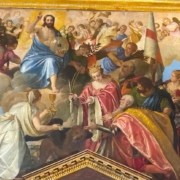
In March, we landed in Venice and made our way through cities such as Siena, Assisi, and Florence, visiting many holy sites and preparing ourselves for the final stop in our pilgrimage – Rome. Italy, like America, has grown farther and farther away from God. It is hard to imagine the existence of a world where political – and even church– governance was heavily influenced by faith in the one, true God. This, however, is what the elaborate paintings in their government houses depict. God first, high above mankind, and all those below searching the Heavens and sometimes even pointing above in the realization that true governance comes from God.

That is what jubilees are about. An opportunity for us as individuals and, hopefully, as a society to renew our focus on God, His teachings, and His boundless love for all of us. Now, more than ever, the world needs this awakening. We need this hope.

Without this hope, however, I would never have even made it to Italy. Remember, I was so worried about all that could go wrong on the pilgrimage to Italy that I secretly preferred not to go at all. This was a grievous lack of trust in God on my part. Instead of turning to Him, instead of surrendering to Him, I almost missed out on a beautiful opportunity to allow my family a trip to the Holy City! I needed to surrender my heart to Him and ask Him to enter under my roof before I could enter under His.

This year’s jubilee calls us to be Pilgrims of Hope. Before I could even depart on this pilgrimage – I needed hope. As soon as this realization dawned, I was able to see this huge trip we would be undertaking as a just what it was meant to be – a pilgrimage. Pilgrimages are not easy. The first jubilee was decreed after the Israelites made it through 40 years of wilderness. Only after their desolate pilgrimage and only when they finally surrendered their stubbornness and made it to the Promised Land did the people enjoy their jubilee. “Proclaim liberty throughout all the land to all its inhabitants. It shall be a jubilee for you.” (Leviticus 25:10)

Looking back, I find it poignant that the hardest challenges for my family came prior to us even leaving and these challenges seemed to be allayed only when I surrendered and trusted the Lord with abandon. All at once, the wilderness cleared and our path to the Holy City unfolded.

Any pilgrimage we take during this jubilee year, whether to Italy or within our hearts, must start very close to home. Though I’m home now, my pilgrimage of hope should not be over. I’m to be an example to those around me of God’s loving mercy, at home and at work. This pilgrimage of hope starts in our heart. What does it benefit us to walk through the Holy Door at St. Peter’s if our heart is not as beautifully decorated as the basilica’s walls? Will I carefully place jewels of patience, love, and mercy into the altar of my heart? Will I perfume the chamber with oils of humility and kindness? When the Holy Doors close and the jubilee ends, how much more radiant will my heart be?

No matter where we find ourselves this jubilee year, let’s start with the heart. I plan to take time during daily prayer to look within and check on the progress within the basilica of my heart. Hopefully, at the end of this jubilee, I will be able to hand our Lord a heart I’ve done something to improve. All hearts can be like an ugly, rough stone, but each heart is greater than a precious jewel in the eyes of the Lord. With careful refinement, our hearts can shine like the beacons of hope God meant them to be. Let us renew our hope in Him and take up the pilgrim’s staff. God speed on your journey!

Copyright by Emily Henson 2025

Edited by Maggie Rosario


Return to the Lord with Thanksgiving

Return to the Lord with Thanksgiving

Naaman’s New Song

After dipping seven times in the Jordan River, according to the prophet Elisha’s instructions, Naaman was cured of leprosy. Recognizing the miraculous movement of God in that moment, he returned to Elisha and proclaimed,

“Now I know that there is no God in all the earth, except in Israel.”

Naaman experienced a profound conversion as the power of God transformed him from the outside—in. He knew he had received a supernatural healing from heaven. He vowed to offer worship to no other god than the one true God.

In Psalm 98, we read,

“Sing to the LORD a new song, for he has done wondrous deeds.”

Church Father Origen of Alexandria (c. 185 – c. 253) interpreted the “new song” as a prophecy of the death and resurrection of Christ. Naaman’s cleansing from leprosy and his encounter with the one true God put a new song in his heart long before the Passion of our Lord. Two millennia later, we should continue to sing this new song.

The Thankful Leper

In Luke’s Gospel (17:11-19), Jesus cleanses ten lepers, yet only one returns in gratitude with thanksgiving. He, too, having been profoundly moved by the grace of God, cannot help but make a return to the Lord, throw himself at Jesus’ feet, and offer thanksgiving. Jesus’ response may have surprised him:

“Stand up and go; your faith has saved you.”

It’s easier to remain faithful when God answers our prayers and heals us or removes suffering. But what about when illness, pain, or dilemma remains? Can we stay faithful even then, steadfast in love and trust in the Lord?

Steadfast Even in Chains

In 2 Timothy 2:12-13, St. Paul addresses this while jailed and suffering for the Gospel.

“If we persevere, we shall also reign with him. But if we deny him, he will deny us. If we are unfaithful, he remains faithful, for he cannot deny himself.”

St. Paul offers a remarkable example of uniting our crosses with the Lord’s and presenting them as intercessory prayer for the conversion of souls:

“[bearing] with everything for the sake of those who are chosen, so that they too may obtain the salvation that is in Christ Jesus” (2 Tim 2:10).

Lessons in Suffering

I have suffered from Dyshidrotic Eczema for years. It is characterized by blistering and peeling of the skin on one’s hands and feet. During one of my most significant flares, I referred to myself as a leper. Once the disease rendered my hands useless, I found myself begging for the Lord to heal me. It took three years for those prayers to be answered. However, while I waited on the Lord, I learned many beautiful lessons. My condition presented numerous opportunities to embrace the virtues of patience, humility, and fortitude.

Once the disease left my hands, it attacked my feet, and it remains to this day. Thanks be to God, I can now accept this suffering, seeing the blessings instead of wallowing in self-pity and disappointment with how the Lord chooses to answer my prayers. I choose to focus on how my suffering can be united to intercessory prayer for others, just as St. Paul taught, especially for my loved ones who are away from the faith. I am grateful for His mercy, for allowing me to regain full use of my hands so I may live my vocation as wife, mother, Catholic writer, and social media evangelist to the fullest.

Now It’s Your Turn

How do we make a show of thanks to the Lord? Do we remain a few minutes after Mass, having just received the Eucharist—whose very meaning is thanksgiving—and offer a prayer to the Lord? When was the last time we went “glorifying God in a loud voice” and falling at the feet of Jesus to thank Him, even if only in our hearts and upon our knees? Does our behavior reflect, like Naaman’s, our faith in our good and mighty God, besides whom there is no other?

I can’t be the only one to experience these moments of seeking healing (and of the grace of prayers answered); I’d love to hear how you thank God for answered prayers or struggle with unanswered ones.

Copyright 2025 by Allison Gingras

Edited by Theresa Linden

Rocky Times

Rocky Times

Taxi drivers shook their fists at each other as I stared out the tour bus window. Blaring horns assaulted my ears. Sunset turned to twilight, and still we sat motionless in Tel Aviv traffic gridlock.
My heart was breaking for my fellow travelers. Although I’d been looking forward to visiting the Carmelite monastery’s public areas for a second time, I’d already been blessed with indelible memories of a daylight Mass in the gardens, followed by a tour that included rooftop views of the fertile valleys below. (See https://www.catholicwritersguild.org/2023/06/mount-carmel/). For the passengers with me on this trip, their visit here was meant to be the pinnacle of a once-in-a-lifetime pilgrimage to the Holy Land. The bus driver’s scowl mirrored my own frustration, but only an air of resigned disappointment filled the bus.
By the time we had navigated a winding road to the top of Mount Carmel, full darkness had descended. The harried greeter who’d waited for us outside made humble apologies. Unfortunately, no tour would be possible. The brothers had already prayed Vespers, and the vowed community was cloistered for the night. But our host said he’d given the lay oblates permission to reopen the gift shop. This announcement immediately cheered the ladies. At least they could still bring rosaries to their loved ones back home. They trooped off together toward the few still-lighted windows, smiling.
Dominick, a public elementary school principal, quietly pulled his carryon suitcase from the bin above his seat and got off the bus behind them. I’d learned that in his traditional Italian neighborhood, parishioners had sacrificed for years to buy a small triangular lot adjacent to their
church. Dominick was building there, a shrine for Our Lady of Mount Carmel. I watched him engage our greeter in animated conversation.
The other pilgrims eventually returned, with full souvenir bags in hand. But where was Dominick? Finally, he appeared again at the bus door, grinning. A middle-aged but muscular man from a contractor family, Dominick did not seem daunted by the weight he now carried. He climbed right up the bus stairs, and raised his suitcase with both hands, in a victory stance, as soon as he reached the aisle.
“That brother was so kind. He took me all the way back to the mountain!” Dominick’s voice resonated through the bus without benefit of the microphone. “He said I could have as many rocks as I wanted! He found me a spade, and held the flashlight while I pried the stones
free.”
Whoops, whistles, and cheers from every seat greeted his enthusiastic news.

***

I found myself behind Dominick in the El Al security lines for our departure flight back to the United States. He patted his suitcase, and whispered with a wink. “Don’t worry. I’ve got them all right here.”
I heard the uniformed Israeli guards ask, as Dominick slowly wheeled his suitcase to the counter, “What’s in there? Rocks?”
Uh, oh, I thought, looking around. Is this even legal? Archeological artifacts, and all that? Where’s our guide!  Dominick just nodded. “Gifts for Our Lady’s new grotto, from our Holy Land pilgrimage,” he said. Seeing the stern looks on their faces, he hastened to assure them.
“Everyone gave me permission. Those monks at Mount Carmel were really helpful.” Dominick pulled a paper from his vest pocket. Apparently, he’d somehow managed to wangle a document from the Carmelite brother who’d assisted with the excavation. Dominick handed his paper to one of the security men.
The first guard examined it and showed it to his partner. Then he refolded it carefully, and gave it back to Dominick. These officials, who now appeared a bit bemused, heaved Dominick’s suitcase up to the metal counter themselves. After looking inside, they exchanged a humorous glance, and waved our hero through, with his suitcase, to the gate. As I placed my own tote on the counter, I couldn’t help wondering how Dominick could have fit in all the stones I’d seen him collect, at the shore of the Sea of Galilee, and other sacred sites we’d visited.

But from the glimpse I’d just garnered, they did look– tightly packed.

***

Dominick engraved each stone from the Holy Land with its place of origin. He mortared them in where they fit, like puzzle pieces, among larger local boulders. Pilgrimage memories endure in a curved rock wall that shelters the consecrated granite altar in the new grotto dedicated to Our Lady of Mount Carmel.
Today, Mass can be celebrated at the grotto as well as the church, often in both English and Spanish. The parish maintains its long and faithful tradition of Corpus Christi processions with the Blessed Sacrament, visiting and blessing individual family homes throughout the old neighborhood. The parish school pioneered for our diocese the first cohort in an optional Spanish immersion curriculum for grades K-8.
Dominick’s spirit of humility, simplicity, and faith lives on.

May we all be blessed this Lent with trust and grace to find joy in whatever God sends.


© Copyright 2025 Margaret King Zacharias

Feature photo by Margaret King Zacharias. Used with Permission.