
Elder is a Verb

Editor’s note: Technical issues are a nuisance, but in this case it is to our benefit because we revisit Margaret’s September column which disappeared into the ether, along with several other author’s works, due to website issues, now resolved, the latter part of the year.


“… It was not you who chose me, but I who chose you and appointed you to go and

bear fruit that will remain …”  — John 15:16

“Now is the season of the fruiting and the dying.”  — Mary Dingman, SSSF


Elder is a Verb

My long-time spiritual director, Sister Mary Dingman (1919-2017), a vowed member of the School Sisters of St. Francis, was the first person from whom I heard the words, “elder is a verb.”

Sister Mary served her order with distinction as novice mistress, postulancy mistress, Catholic high school teacher, provincial coordinator, and formation director in multiple settings, from the Archdiocese of Milwaukee to the Archdiocese of Omaha. (1)

An apocryphal story tells that while she was still a novice herself, Mary refused a demand to sit in the back seat, from her brother’s fellow seminarian who was giving her a ride back to the convent from their rural hometown.

He was afraid of being seen with a female in his automobile. Novice Mary climbed straight into the front passenger seat. She didn’t recognize any difference in moral responsibility among disciples of the Lord, only different roles to fulfill.

Sister Mary was already a recognized religious figure in her own right by the time her older brother, Bishop Maurice Dingman (1914-1992), called her back to their home state of Iowa.  He asked her to support and assist the Jesuit priests who served Emmaus Community prayer house, to extend opportunities for professional spiritual direction beyond the clergy and into the wider Des Moines lay community.

For more than twenty years, Mary Dingman, SSSF served as a spiritual director at Emmaus House, in a historic Victorian two-story home located close the inner city. She prepared daily lunches where everyone was welcomed to the feast in her beautifully set dining room, after liturgy and Eucharist were offered in the home’s cozy living room. Mass was celebrated there for many years by one of the Jesuit or diocesan priests, as simply and profoundly as the earliest Christians celebrated in the catacombs. Later, centering prayer groups and holy day dinners joined the schedule as the Emmaus community grew.

Sister Mary hosted Catholic and Protestant clergymen, vowed religious, and laypersons for private retreats in the small bedrooms upstairs, providing three excellent meals a day along with plenty of quiet time and peace to enjoy the gardens that surrounded her home. She was still driving, by herself, around the state to provide directed retreats at monasteries and convents, into her late eighties.

Sister Mary Dingman fulfilled her commission as an apostle proclaimed by Jesus in the Gospel of John: to bear fruit that would last.

Emmaus House maintains its commitment to Ignatian Spirituality and community fellowship in the Diocese of Des Moines, even to this very day; offering educational conferences, group and private retreats, as well as personal spiritual direction, now from a new home that is better-equipped to utilize modern technology. (2)

What about us?

As the Autumn Equinox arrives this Monday, September 22, where do we find ourselves? Probably most members of the Catholic Writers Guild are attending Mass regularly, and making strong efforts to educate their families in the faith.

We might not want to think too much about our own deaths, but are we still living our faith to its fullest?

According to the United States census, all members of the United States “Baby Boom” population, people who were born between 1946 and 1964, will not reach the current “retirement” age of 65 until 2030 (3).

“Independent living communities” for “senior citizens” have been popping up like mushrooms all over the country for decades, and many have long wait lists as well as hefty fees. Busy families with active young children and teenagers are too often forced to beg, in some places, to find a single bed available in a skilled nursing home with adequate facilities to help them care for aging parents.

How many devout and aging Catholics do we know, who are facing difficult choices for their final years?

The Oxford English Dictionary gives three parts of speech for the word “elder”:  noun, adjective, and verb – which is offered third in order, after the noun and the adjective, because it is the least common usage.

“1. verb trans. With it, to play the elder. rare. …”

“2. verb intrans. Become older, begin to show signs of age. colloq. and poet. …”

“3. verb trans. Make a request to or admonish a person …” (4)

But none of these were what my friend Sister Mary meant, nor how she lived her own life. She spoke with an active verb, and went about “eldering” with her whole self.

Are we thinking too much about the leaves falling and dreading winter? Are we approaching our own “autumns” as fates to “die” rather than to “fruit”?

Many older people in our society are struggling to afford food on limited social security payments. Children in schools often need surrogate grandparents to listen to their reading and tell them stories, when parents may be too busy or too overwhelmed.

Families, parishes, and dioceses offer plentiful opportunities to help with food pantries, assist the ill or handicapped, offer constructive personal attention to children.

Perhaps most important, “Baby Boomers” who have already retired and those who will retire over the next three decades are the last generation on earth who will remember a culture, and a quality of human life, before demands and consequences of administration by computer.

We can leave an imprint of real experiences in direct and human interaction with the generations that will follow us.

The saints in heaven watch over us as we drag ourselves out of bed, perhaps groaning with arthritic pain. They listen to and intercede for our prayers on behalf of our ancestors, neighbors, children, and grandchildren. They see us picking up our glasses, hearing aids, keys, canes, or walkers, putting on our coats and boots, going out to take care of our daily business.

No matter our circumstances, we can move forward into this autumn of 2025 — even as our earthly weather starts progressing towards winter – carrying the fruits of love, hope, and genuine encounters that endure.

 

© 2025 by Margaret King Zacharias

Feature photo: First Color in Iowa – Photo Credit Margaret Zacharias. Published with permission.

Inset photo: Autumn Rainbow to Heaven – Photo Credit Charles Zacharias.  Published with permission.


Notes

  1. https://www.barrmemorialchapel.com/obituary/4352175
  2. https://www.theemmaushouse.org/about-us
  3. https://www.census.gov/library/stories/2019/12/by-2030-all-baby-boomers-will-be-age-65-or-older.html
  4. Shorter Oxford English Dictionary, Fifth Edition, Volume I A-M, Oxford University Press, Great Clarendon Street, OX2 6DP, Published in the United States by Oxford University Press Inc, New York, 2002, p. 801.

Live in the Moment

Live in the Moment

By Isabelle Wood

“No one who puts a hand to the plow and looks back is fit for the kingdom of God.”—Luke 9:62 (NRSVCE)

“Do not worry about tomorrow; tomorrow will take care of itself. Sufficient for a day is its own evil.”—Matthew 6:34 (NABRE)

It’s really hard to live in the present. Let’s face it. Most of us spend more time in the past or the future.

Sometimes, all we can think about is the past. Our past failures, our past wounds, those scars that haven’t yet fully healed. Or, on the flip side of the same coin, we live in the memory of the “good ol’ days” and pine for the times that are already past.

Other times, the future occupies all our thinking. We either look forward with worry about what’s ahead because we do or don’t know what’s coming, or we spend so much time looking forward to our plans for the future that we miss all the blessings God wants to give us in the current moment.

Actually, that last point is true for all of them. When we spend too much time in the past or the future, we miss all the little gifts God is handing us right now.

Jesus tells us that if we occupy all our energy looking back with longing or regret, we’re not fit for the kingdom—we’re not “all in” for the incredible adventure that living our Faith is. Likewise, Jesus tells us not to worry about tomorrow. When we spend all our time looking ahead and plotting out all our own “perfect” plans, we’re not putting our trust in the amazing, unimaginable plan God has in store for us, and we’ll be overcome with worry when things don’t work out the way we wanted.

Granted, the past and the future are both gifts God has given us. It’s good to look back with gratitude for the ways God has worked in our lives and the lessons we’ve learned, and it’s good to be responsible with the time God has given us by making plans and looking to the future with hope.

But let’s make it a goal to live in the gift of this moment God has given us right now—in the present.


© Isabelle Wood 2025

A Poem, an Ornament, and a Choice

A Poem, an Ornament, and a Choice

Even though it is now a few weeks since the official end of the Christmas season (with the exception of those who close out Christmas with the celebration of Candlemas), I still have one ornament up. This particular ornament, called “Snowy Woods,” is always the last one to be packed away, and every year it makes the short journey from the Christmas tree downstairs to the family prayer space, upstairs. It hangs in silence until the end of the month, inviting reflection, contemplation, and most importantly, it asks a single question as we begin the liturgical cycle again: Which path will we choose to follow this year?

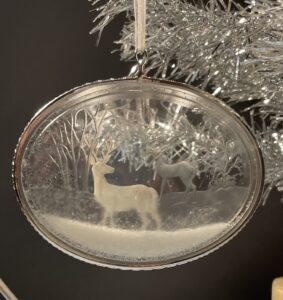
The ornament is quite simple and is made of glass, surrounded by a metal frame. A snowy scene is etched on both sides of the glass; two deer walking apart yet aware of each other, in a wintery wood. Every time I look at it, Robert Frost’s poem “The Road Not Taken,” springs to mind.

The Road Not Taken by Robert Frost (1915)

(1) Two roads diverged in a yellow woods

And sorry I could not travel both

And be one traveler, long I stood

And looked down one as far as I could

(2) To where it bent in the undergrowth;

Then took the other, as just as fair

And having perhaps the better claim,

Because it was grassy and wanted wear;

Though as for that the passing there

Had worn them really about the same,

(3) And both that morning equally lay

In leaves no step had trodden black,

Oh, I kept the first for another day!

Yet knowing how way leads on to way,

I doubted if I should ever come back.

(4) I shall be telling this with a sigh

Somewhere ages and ages hence:

Two roads diverged in a wood, and I —

I took the one less traveled by,

And that has made all the difference.

This “Snowy Woods” ornament is a snapshot of the meaning the poem is getting at – how our choices affect our lives. In the ornament, the adult deer is looking back, pausing in mid-step. Has he heard a noise that caused fear? Or is he just taking a breather before continuing the way? Is the fawn following or leading? It all has to do with perspective.

 A snowy scene is etched on both sides of the glass; two deer walking apart yet aware of each other, in a wintery wood. 

When the ornament is held with the adult deer facing you, it seems as if the deer is looking back, over his shoulder. The shadowy fawn in the background appears to be watching and waiting for the adult deer to make a decision. But turn the ornament around and the positions are reversed. The adult is no longer looking over his shoulder but is gazing into the shadowy world at the small fawn. His steps and his gaze are very much focused on the small deer. The fawn, on the other hand, is looking out, away towards something outside of our vision. Both positions are telling. The fawn waits for the adult deer to make his decision, to take the path “less traveled by,” even though the path that the deer will take is set out by the fawn. The paradox of Christianity.

The adult deer is a perfect example of a Christian. He is solid. He is not shadowy or vague, but entirely painted in. His hooves are firmly rooted on the ground, even being entirely covered by the heavy snow. He is part of the physical, visible world we all live in. He is concerned with the daily struggles of life, poised to flee or fight, while wrestling with the heavy snowfall, the daily crosses of his world. While he is engaged, he is being watched by a small, shadowy figure, a guiding spirit who assists and guides his steps. This spirit might be an angel or even a figure of Jesus himself, always just out of sight, but somehow his presence is felt. The fawn, not the adult, knows the way through the snowy woods. It’s eyes are on something else, something higher and distant, away out of time and space. Unlike the solid white adult deer, the fawn is almost transparent, pointing to a spiritual, unseen aspect.

The two deer in this ornament are in a profound relationship, despite the fact that they are on two different levels. They remind us that no matter what path is chosen, the traveler will not remain in the crossroads. A choice, consciously or not, is always made. St. Catherine of Siena talks about this in her book Dialogue. She writes that “as long as you are pilgrims in this life you are capable of growing and should grow. Those who are not growing are by that very fact going backward.”

Each year, this simple little ornament strikes a chord with me. After all the decorations are done and we are looking forward, preparing to set out again, it beckons and asks, “What path will you follow this year? And will you walk it with Me?”

Photos courtesy of Sarah Pedrozo.

*This ornament was designed by Hallmark artist Robert Hurlburt and is part of the Elegant Ornaments Collection, a group of ornaments often based on archived Hallmark greeting cards.


I Wasn’t Prepared

I Wasn’t Prepared

Image by lisa runnels from Pixabay

A few weeks ago in church, I listened to the sermon about the parable of the ten virgins, five of which were wise and the other five of which were foolish.  All went out carrying lamps to wait for and greet the coming Bridegroom. The five wise virgins brought oil with their lamps, whereas the five foolish ones did not. The five foolish ones took it upon themselves to wait until the Bridegroom came, at which point they would ask their wise counterparts for some of their oil. However, the wise ones told them that they could not share their oil with them, lest there would not be enough. The foolish virgins’ only other alternative was to go out and buy their own, but by the time they arrived at the scene of the Bridegroom’s arrival, they could not attend the wedding banquet with Him. The five wise virgins, on the other hand, were prepared, and hence, they were admitted.

My ears perked up when I heard this. When you think about it, it can be scary. It can feel pressurizing to be prepared for the coming of Jesus, lest we miss out on eternal bliss and peace. Nothing is worse than that, although when I heard this sermon, it reminded me of a similar experience of my own in which I was not prepared. No, I didn’t miss out on getting to heaven (at least not yet), but I missed out on something that could have been very good for me. It has been a hard lesson, and I’m still in the process of forgiving myself for this foolish mistake, which I will describe.

I was preparing to make a “leap of faith” and abandon my current temp job to start a freelance case study copywriting career. Saying goodbye to bosses, commutes, deadlines, pointless meetings, and office politics seemed almost within my grasp. I wanted to create a dream job scenario for myself which would allow me the flexibility to work from home doing something I loved, all while making my own hours, deciding what days I wanted to take off, being able to attend to my children’s upcoming issues at school or at home, et al. Being in job transition had allowed me that flexibility, and it had also allowed me to nurture my faith journey and my prayer life, and I got very attached to that routine.  The last thing I wanted was to stay in my current temp job or even to take on another job – temporary or permanent. 

The time had come for me, I had decided, to be in charge of myself, but when I received the phone call about a job interview in civil service, I should have been ecstatic. Here was a chance for me to work in an environment which is known for being accommodating to people who have children with special needs, for being generous with paid holidays, sick time, and time off in general, job security, solid benefits, and interesting work with good pay. My stupidity got in the way, and my emotions got the better of me because I thought that “my way” with the freelance copywriting career was the ticket to my financial success and my ability to be available for myself and my kids. As a result, I did not take preparing for the interview seriously. I went in with the attitude that I did not care whether I got the job, but that was before I got there and realized that this could be a great thing. 

As soon as I got to the office building in Ridgewood, Queens, I gaped. The surroundings were breathtaking. I looked around and realized that I could be happy making this trip into work every day. Then I went in for the interview. There was a panel of three people, all wonderful, warm, and friendly. They made me feel at home, and the questions they asked were pretty straightforward. Still, I did not feel as though I had done my job of preparing, and I’m almost sure that I blew it. I walked out of there wondering how I could have been so careless as to not prepare myself for this good thing. Had I taken it seriously, I could have gotten into the “banquet,” but I was like those five foolish virgins, and now for the rest of my life, I have to live with the consequences of my attitude. My only consolation in all of this is twofold – I learned a lesson, and I have not yet blown my chances of making it into the “banquet” of heaven.  At least with that, there’s still time to prepare.

© Copyright 2023 by Michael Vassallo

Featured image Image by Aksel Lian from Pixabay

Everyday Holiness

Everyday Holiness

When I received the news that my first published short story had not only been accepted, but also chosen as the opening gambit for a travel writing anthology that included pieces by several well-known authors, my first thought was, “I have to call Mom and tell her I got the lead. She’ll be so excited.”  And then I remembered.

The woman who nurtured my first crayon scribbles, and typed my long-procrastinated school term papers on an old manual typewriter, had already been absent for fifteen years by then. Even now, thirty-four years after her death, I still get the same urge to call and tell her, whenever there’s happy family news.

Anyone who has ever lost a beloved family member, or cherished friend, understands.

This past week we’ve celebrated two special liturgies that traditionally open the month of November. They encourage us to honor all the saints in heaven, and to remember our beloved dead.

The Roman Catholic liturgical calendar gives a rhythm to our lives, alternating ordinary days with special feasts and dramatic seasons: Advent, Christmas, Lent, Easter and Pentecost.

But we don’t just remember our lost loved ones on the Solemnity of All Saints or at a Commemoration of all the Faithful Departed.

The simplest things can suddenly trigger a memory: the smell of a favorite family meal simmering in the kitchen; a glimpse of the lamp burning late into the night while a parent stays up late to pay bills; a toddler’s smile greeting us in the morning over a crib rail; the precious small gift from a thoughtful friend who somehow always knew just what we needed, and when.

Amidst many speeches that marked my oldest son’s baccalaureate ceremonies, the university dean who spoke at his academic awards assembly made a particular point for the new graduates. His words held a wisdom that has remained with me.

“It’s not this ceremony that’s important,” he said. “Or that splendid certificate that you’re about to receive. We’re celebrating all the mornings over the past four years that you got out of bed and went to class, all the nights you studied in the library instead of partying, all the papers you wrote with extra care, everything you did that led up to this day. Yes, today you’ll be ascending the stage, you’ll hear lots of applause, and your families are gathered here to celebrate with you. But it’s those ordinary days, the good choices you made one after another, the habits you established, that are your most important awards. They’re what you’ll take with you wherever you go for the rest of your lives.” (1)

In our Mass readings this weekend both liturgies contrast humility and charity with arrogance and entitlement.

Today’s Memorial of St. Charles Borromeo incorporates an Alleluia verse that is also used to celebrate the Solemnity of the Most Sacred Heart of Jesus:

“Take my yoke upon you and learn from me, For I am meek and humble of heart.” Matthew 11:29ab. (2)

In the Gospel reading, our Lord advises us “. . . do not recline at table in the place of honor . . . when you are invited, go and take the lowest place . . .” Luke 14:1, 7-11. (3)

Readings for the Thirty-first Sunday in Ordinary Time contrast a mother’s affectionate care and a child’s implicit trust, in the Responsorial Psalm 131: 1,2,3, with Our Lord’s condemnation of arrogant scribes and Pharisees, in the Gospel from Matthew 23: 1-12. (4)

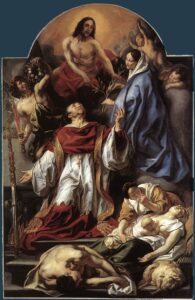
St. Charles Cares for the Plague Victims of Milan by Jacob Jordaens (1593-1678), St. James Church, Antwerp, Belgium, public domain via Wikimedia Commons

St. Charles Borromeo was born in a castle on the shores of Lake Maggiore. His father was a Count of Lombardy whose aristocratic family’s shield bore the motto, “humilitas.”

His mother was Margherita de Medici, whose younger brother became Pope Pius IV. (5).

The paintings featured here commemorate St. Charles Borromeo’s assistance to the poor during a famine in Milan; and his refusal to leave the city after an outbreak of the plague. He remained behind in his own episcopal see while many other bishops and clergy fled. He stayed to pray for his people as their archbishop, and administered the sacraments to plague victims.

Even while he was serving as a papal representative to the Council of Trent, and performing as a leading figure in the Counter-Reformation, St. Charles Borromeo never forgot his family motto, humility; or the Jesus who washed his own apostles’ filthy feet.

Both of these paintings, and many more found in museums and churches across Europe (6), document St. Charles Borromeo’s devotion to the humble Virgin Mary. Her vivid presence in so many of his portraits reveals the close relationship they shared in his charitable work, in his intercession for the people of Milan, and in his dedication to the universal Church.

This November — while we’re preparing for Thanksgiving and the Solemnity of Jesus Christ, King of the Universe — may we, too, remember to practice the extraordinary virtues of ordinary everyday holiness.

©Copyright 2023 by Margaret King Zacharias

Feature Photo: Intercession of Charles Borromeo Supported by the Virgin Mary by Johann Michael Rottmayr (1656-1730) in the collection of Karlskirche, Vienna Austria, public domain, via Wikimedia Commons

Notes:

  1. Personal communication.
  2. (https://bible.usccb.org/bible/readings/110423.cfm).
  3. (https://bible.usccb.org/bible/readings/110423.cfm).
  4. (https://bible.usccb.org/bible/readings/110523.cfm).
  5. (https://www.newadvent.org/cathen/03619a.htm)
  6. (https://www.christianiconography.info/charlesBorromeo.html).