For I know the Plans I Have for You

For I know the Plans I Have for You (Jer. 29:11)

Greetings, fellow travelers. I am (probably) the newest contributor to the CWG blog. In an attempt to introduce myself, I decided to offer the following recollections that I wrote for a smaller audience. This is a deeply personal account, but it’s how I roll.

I was widowed two years ago, and it significantly altered my perception of marriage, God and our eternal trajectory. Retrospect is the critical viewpoint in this narrative, since my husband and I did not convert to Catholicism until we were in our mid-thirties. Hence, God’s plan for our lives was not immediately intuited, although we eventually recognized the critical nature of the Catholic faith in our marriage. It was this faith that would provide continuity and structure to the sacrament we shared. We were married for 42 years, and this is our story:

My husband, Steve, was a risk-taker.

I was not.

Our third date I found him cheerfully explaining the constellations of scars on his head and chin—which he identified as wounds from embedded gravel—the result of a tire blowout during a high-speed motorcycle ride on a gravel road. Apparently, he went airborne before the force of gravity did what gravity tends to do—and it sucked him into the hard, graveled surface below him.

I watched, horrified, as he retold the story, complete with sound effects, and enthusiastic arm-flapping.

“You’re lucky to be alive!” I gasped. He smiled.

“Yeah,” he said. His grin grew even wider.

“Weren’t you scared?” I exclaimed.

“Nah,” he said casually, “I was too busy trying to keep the bike from falling on top of me and killing me.”

I remember being incredulous, as I tried to comprehend his explanation. I did not understand this attitude toward life. I risked nothing. I gambled on nothing, and I kept everything in my world ordered and safe. We could not have been more different. Who is this guy? I thought.

Eventually, and against my better judgment, Steve managed to talk me onto the back of his dirt bike—after assuring me that he wouldn’t go too fast. I believed him (mostly) even when we were sailing over huge hills with considerable hang time, before landing on the other side of the hill. I remember clutching my arms around his waist and screaming into his back, while he yelled reassurances that everything was fine. (I think he really enjoyed that part.)

Steve frequently challenged the forces of nature with every ounce of his seemingly immortal body. If he wasn’t defying gravity, he was water skiing without skis, or driving snowmobiles across frozen ponds. It always seemed to me that he was like one of those giant grasshoppers that flies erratically into oncoming cars—barely missing the windshield with an artful dodge.

Alternatively, the laws of physics and the general nature of risk, did nothing to inspire intestinal fortitude within. My formative years had been painful, and I trusted no one. Night after night, I remember begging a distant God for deliverance—a deliverance that always seemed elusive—rendering my nominal faith into shadows.

Despite my spiritual quagmire, I gradually began to appreciate Steve’s attitude toward life. Scientific laws can be harnessed if you have the right tools, and the world is approachable if you are comfortable with who you are. Steve was all those things—and slowly, patiently (sometimes) he taught me to take risks: with others, with myself, and of course … his motorcycle.

Initially, I did not realize that God had finally offered me deliverance in the form of a young man with an irrepressible temperament—but it seems rather obvious now. It would have required someone with that kind of fortitude to wage battle with the seen and unseen forces around me.

It turns out that God had been listening all along.

It should come as no surprise that Steve went on to have a successful career in law enforcement before retiring due to injuries he sustained in the line of duty. Those injuries are what ultimately caused his death, but he would have settled for nothing less. That’s just how HE rolled.

January marked the second anniversary of Steve’s death, and if I could tell him anything right now, I think it would be this: Thank you for taking a chance on this wisp of a soul. You are proof that God answers prayer on the most elemental level. I am forever grateful to you—and most importantly—to God, who is ever-merciful, and actively involved in the most intimate details of our lives.

This knowledge fills me with child-like trust–secure in the knowledge that God always has a plan.


©Copyright 2023 by Sarah Torbeck

Faithful Expectations

Faithful Expectations

 As a new author, it is sometimes difficult to know what I should expect or what is expected of me. I recently faced this in a casual conversation when I was told I sounded calm, confident, and optimistic. My faith is the backbone of how I respond to situations in my life. Even so, I face times when I am overwhelmed with an experience or result.

I firmly believe that God places us exactly where He wants us to be. These moments might be fleeting, life-changing, or teachable. Like everyone else, life has thrown a myriad of events at me, some of which I knew exactly what to expect and others a mystery. I smile knowing that the recent conversation was not only teachable but also a way to complete my task. In struggling with a writing topic and hearing what I was saying in the throes of that conversation, God turned the light on!

Expectation packs a big punch as it often creates a significant emotional response. Some types of expectations are joyful, while others can generate an emotion of fear. Looking back on events in my life, I can see a circumstance that I believe God used to groom me for the role of an author who faces expectations with a heart of faith.  It was during a time when I was a “stage mom,” which, to most, sounds exciting, and at times it was. However, there were honest moments when all I wanted to do was wait in fear rather than hope.

The journey through auditions, learning lines, and prep sessions were quite the experience. I knew my son and I would need a positive mindset to thrive. We treated each day and audition as one moment, releasing it from our headspace at completion. Some were harder than others, but we did an excellent job of living in a way that allowed us to expect happiness.

Another instance I recall is physical. I was “voluntold” through a persistent friend to participate in a healthy weight program. The journey consisted of several months of intense training and proper eating habits. I was reluctant about what the outcome would look like and had no clear expectations. In a nutshell, the journey strengthened me, not only physically but emotionally as well. The expectations I felt along the way were nowhere near the positive outcome, and for that, I can see the blessings.

Both of these examples impacted where I am today, serving as a preparatory phase in which I can draw strength and wisdom.  Learning to be patient with God’s timing and enjoy where He is taking me is the fruit of where He placed me in the past. I consider both of these events equally life-changing and educational.

Fleeting moments of the audition process and the pains of exercise are reminders that moments in our life go by quickly. As painful as they may seem in the moment, there is light to look forward. The skills I use today as an author, secretary, and spiritual director are directly inherent in the teachable moments through God’s Grace. My life changes by faithfully understanding God knows my heart and will work all things for my good.

Preparation plays a vital role in a mindset of faithful expectation and should be focused and balanced. Consider preparing for a job interview or the possibility of authoring successfully. There are many ways to go about it, some will over-prepare to expect the worst, and others will do the bare minimum. Looking at an outcome with faithful expectations will generate positive and heartfelt responses. These emotional considerations will bring about mindful preparatory phases, culminating in joyful experiences. The overarching goal is an outcome that is God-centered, realistic, and built on the foundation of faith.

I can’t think of a better time than right now to fully embrace the practice of faithful expectation. At the beginning of a new year, a gift in itself is another opportunity placed into our hands to go big or go home! Jump in wherever God has placed you armed with a heart of faithfully expecting God is doing beautiful things for you and through you.  I know the next time I am up against a deadline or struggle, God is right there with His finger on the switch, and the light will shine at just the right moment!


Copyright 2023 Kimberly Novak
Image Copyright Canva

Do Whatever He Tells You by Maria Riley

I love meditating on the Wedding at Cana. Attending a wedding seems like such an ordinary event for Jesus and his friends to attend. I imagine them laughing and enjoying themselves, much the way I do when I attend weddings, which helps me remember that Jesus was fully human too.

Another reason that I love the Wedding at Cana is that Jesus, as an adult, remained obedient to His mother. As a mom myself, I love this. His obedience also is a significant part of our understanding of Mary as the great mediator. She brings each of us closer to Christ by bridging the gap between us and Him. She tells Jesus that the wine has run out, and despite Him telling her it’s not yet His hour, Jesus obeys His mother (cf. John 2:3-4). Jesus’s first public miracle happened through the intercession of Mary.

Recently, while I meditated on this mystery, my mind didn’t focus on Jesus, His friends, nor His mother. Instead, my thoughts lingered on the servants, those who assisted Jesus in His first miracle. These servants aren’t even named in the scripture, yet by following the advice of Mary and obeying Jesus’s command, they partook in a beautiful miracle that all Christians know about.

They did whatever He told them (cf. John 2:5). And here’s the amazing thing—all He asked them to do was fill some pitchers with water. That was it! Jesus basically said, “Just go grab some water, and then leave the rest to me.” Because of the servants’ obedience, a miracle ensued.

Sometimes I think I’m not doing enough to live out my faith. I think I need to live in more drastic poverty or pray for hours every day. But maybe, just like the servants, Jesus is actually asking me to do something simple and well within my abilities, training, and current life situation.

When I stop to listen, this is what I hear Jesus say to me: “Fill this cup of milk, then graciously clean the spilled milk for the eighth time today. Write this story. Feed this family I have given you. Read aloud with this child.”

These commands, doing whatever He tells me, may not be as complicated as I think. Easy? Not always. Almost every day He reminds me, “Love your husband, and forgive him for not being perfect. In all things, selflessly love the way that I love you.”

If I humble myself and accept these charges from Him, then I open the door for the miracle to happen. If I do my small part, no matter how insignificant it may seem, I am honoring the will of God.

I’m not in the business of turning water into wine. But filling pitchers with water? I can do that.

Who Do You Say That I Am?

I felt it rising in successive waves, even before the crowd leapt to its feet and the cries of “Il Papa!” began. Love. I had sensed it before, of course, with family, during Mass, in Adoration. But it had never washed through me carrying such purity, such humility, such simple joy.

The passenger, in a white automobile that weaved its way through St. Peter’s Plaza on that cold but clear late-April day in 2005, beamed his smile and waved like a provincial child enjoying his first ride at an amusement park he never expected to visit.

Those of us in attendance rode his surges of love like experienced surfers. But I asked myself, “Who is this man?” He presented quite a contrast to the impression I had gleaned from some of the Benedictine monks at the Iowa basilica where I served as an informal oblate.

I had heard about a stern taskmaster, a strict enforcer of magisterial teaching, an incisive theologian, a very different portrait from the palpable sweetness I felt emanating from the person who descended from his car and ascended to the dais.

In recent weeks, my son had described him as “a good choice to bat cleanup for the pope whose act no one wants to follow.”

We were there that day solely by the workings of Divine Providence. Our travel plans had solidified almost two years before, when my son and his fiancée expressed a desire to see Europe, once he passed Part I of his medical-school boards. When I offered to take them if they would make it a pilgrimage, my husband decided to come along. None of us knew then that our beloved, majestic world missionary pope, now Saint John Paul II, would return to his heavenly home before we undertook our journey.

As we packed our bags for the trip, we had been following daily proceedings in the Sistine Chapel for more than two weeks, and were still uncertain whether there would be a new pope in the Chair of Saint Peter when we reached Rome.

Only the day before this audience, when we arrived at Da Vinci airport, we had learned from our Roman guide that her brother who worked at the Vatican would be able to get us tickets for Pope Benedict XVI’s first outdoor public audience in Saint Peter’s Square.

I have a vivid recollection of every word that Pope John Paul II spoke at my first papal audience in 1995. He was dynamic then, in full vigor. He stood at the microphone for hours. He presented his homily himself, four times, speaking fluently in four different languages.

I recall not a word of the brilliant theologian Pope Benedict XVI’s first papal address to a crowd of pilgrims in St. Peter’s Square in 2005. I just remember the overwhelming force of his love.

In September 2022, I had the opportunity to develop a few more insights about who Pope Benedict XVI—a reticent man, a highly influential intellectual, the humble confidant of his charismatic predecessor—really was.


null

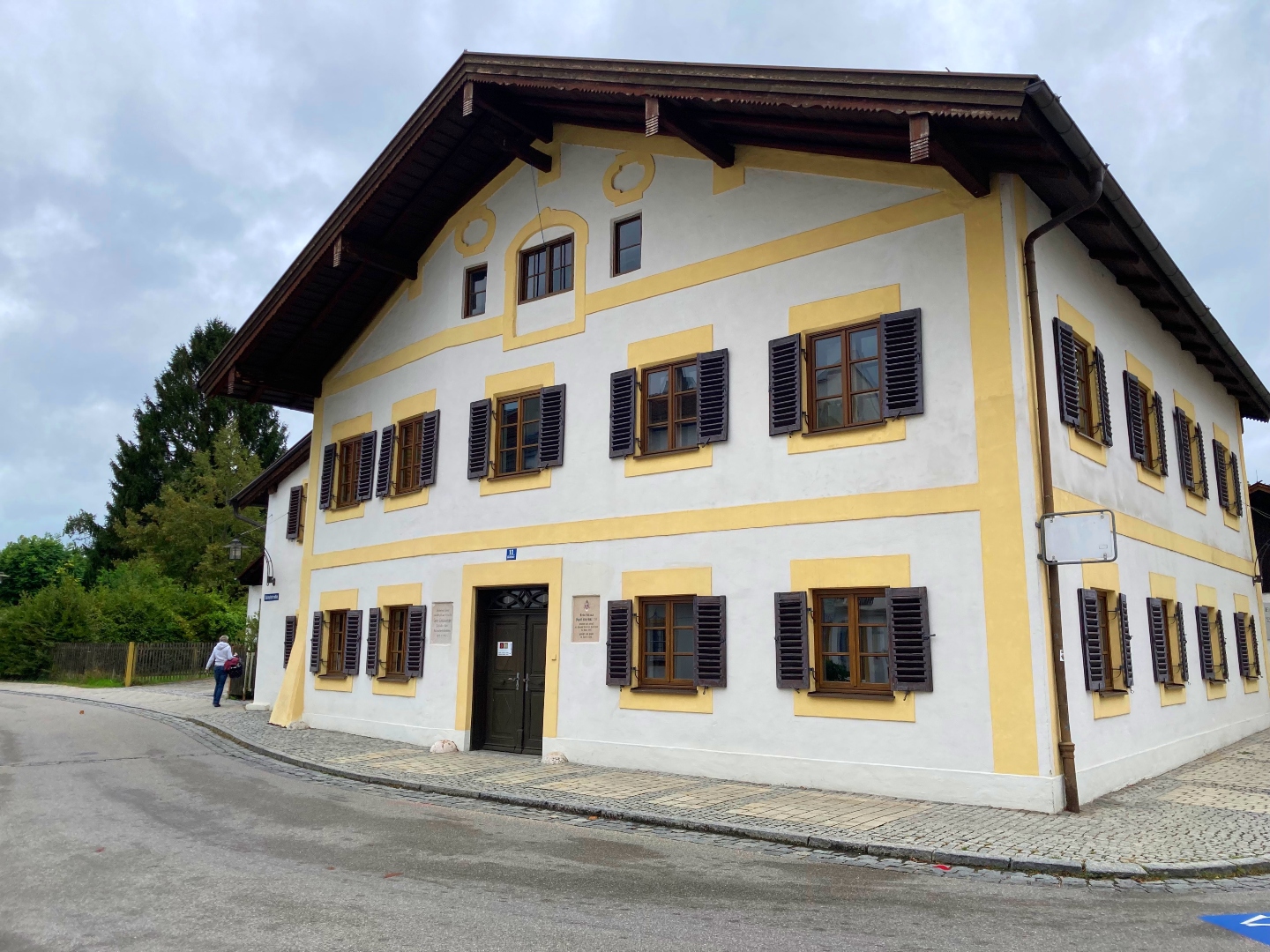
Birthplace of Joseph Ratzinger, Pope Benedict XVI, in Marktl am Inn, Germany


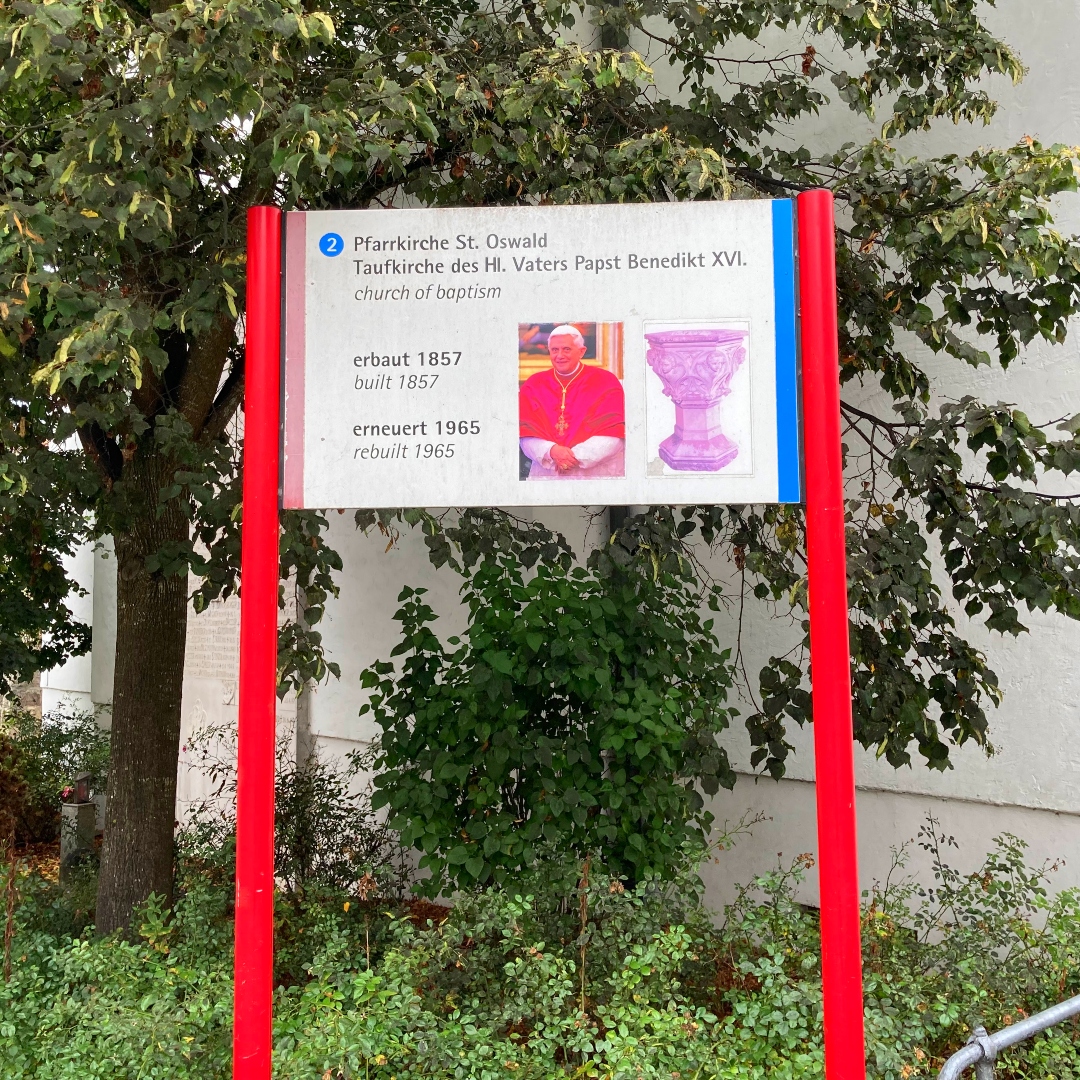
Just after dawn on a frigid German morning with a blustery wind, my group of Oberammergau pilgrims walked through the few narrow streets of Marktl am Inn into its central platz, to view Joseph Ratzinger’s birthplace. We toured the small, charming Saint Oswald’s church where he was baptized on the same day he was born: Holy Saturday, April 16, 1927.


null

Sign outside St. Oswald Church, Marktl am Inn, Germany: Baptismal Church of Pope Benedict XVI


This is where it all began, the overflowing well, the place where his cup of love was first filled.

I hoped I might find some answers to how a sensitive child and brilliant adult lived through so many decades of ministering to the same human frailties; and through so much social change. How did he preserve his deep faith in God’s love, and his radiant transmission of that love, throughout his entire lifetime?

How did he accept the murder of his cousin with Down’s syndrome, by the Third Reich? How did a sensitive teenager who was already deeply aware of his vocation live through repeated encounters with Nazi evil—beginning with his first, but not last, conscription into their military forces at the tender age of 14?

On the left wall of Saint Oswald’s church, as one enters the tiny entryway, is hung a glass case clad in steel. It displays new parish “arrivals” for the current month, baby pictures of the infants most recently baptized into the parish. On the right wall hangs a sturdy matching case that features funeral program photos of recent “departures.”

Joseph Ratzinger’s own last words complete the circle: “Jesus, I love you.”

May perpetual light shine upon His Holiness Pope Benedict XVI, and may his lifelong lessons about the healing power of love continue to enlighten our troubled world.


null

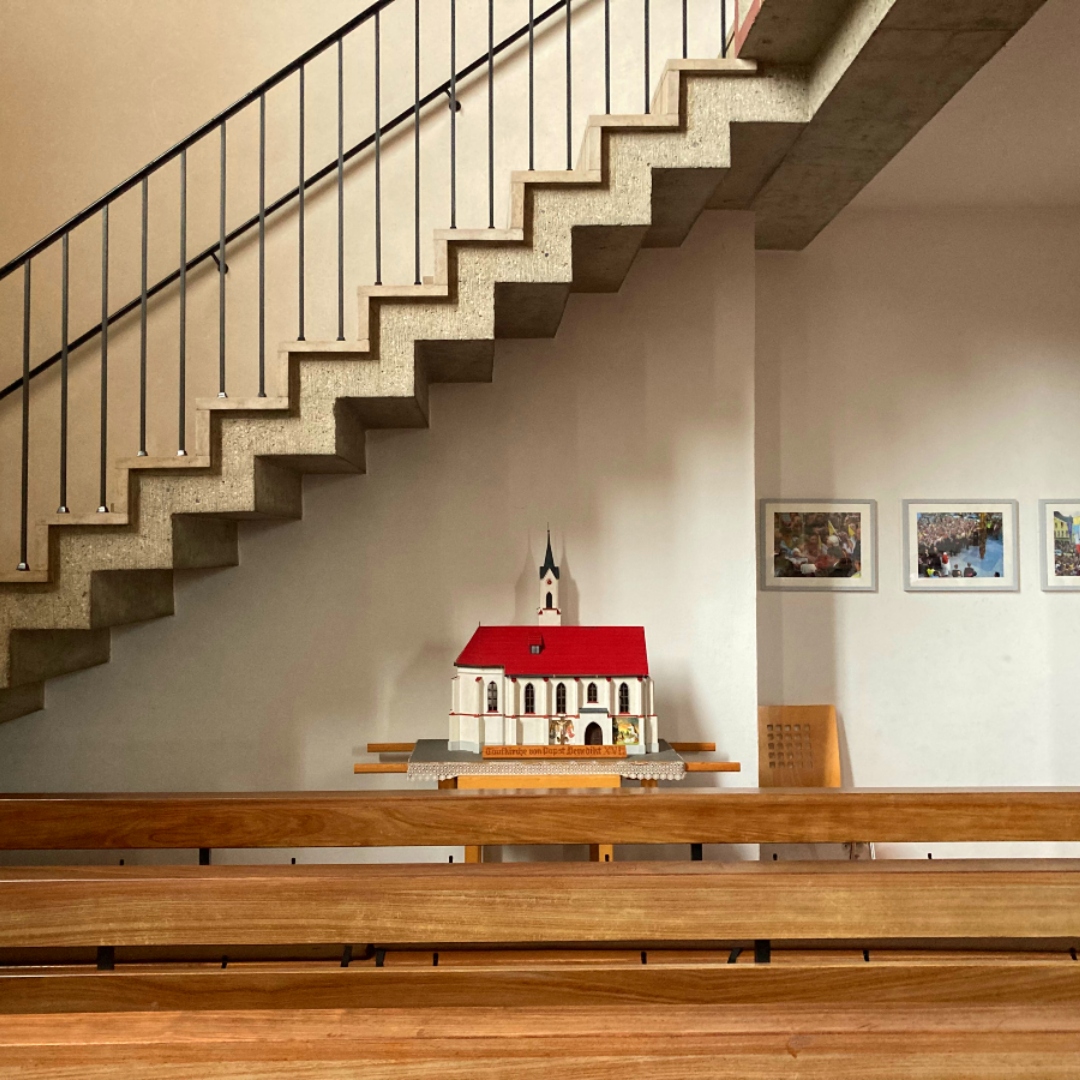
Scale model of St. Oswald Church, inside the church, Marktl am Inn, Germany: Baptismal Church of Pope Benedict XVI


Copyright 2023 Margaret Zacharias
Photos copyright 2022 Margaret Zacharias, all rights reserved.

Journey to Bethlehem

Scripture and our imaginations give us an image of Joseph and a pregnant Mary setting out on foot from Nazareth to travel to Bethlehem. Perhaps they brought a donkey along for Mary to ride as the road became more treacherous.

In fact, that road winds for considerable distance around dusty mountains as it ascends into the Judean highlands, where the town of Bethlehem stands perched on a cliffside. (I sure hope Mary did have that donkey.)

Today pilgrims ride the bus. In 1997, when I made my first visit to the Church of the Nativity, we traveled urban highways without obstacle, straight to an underground parking garage in Bethlehem.

In 2012, when I made my last visit, we were stopped at a passport checkpoint for almost an hour, while armed soldiers determined whether we should be permitted to pass into Palestine. This ritual was repeated as we returned to Jerusalem in Israel.

The journey to Bethlehem has never been easy.

Consider the Three Kings who traveled for months to pay their homage to the Christ Child. They did have animal transport, of course: camels, creatures that are reputed to be even more stubborn than donkeys.

Perhaps the most important journey to Bethlehem involves a sometimes-frightening walk down a church aisle with “everybody watching.” This trip is performed annually by small children dressed in outlandish costumes; a few of them might manage to enjoy the experience, but I suspect those are probably the exceptions. No, it’s us, their parents and grandparents who relish—in fact, insist upon—this yearly spectacle.

For more than a decade my fellow catechists and I joined forces to organize a typical extravaganza specifically for our public-school religious education children. Our students were not going to suffer because, for a variety of reasons, they did not attend Catholic schools! We would present our own Christmas pageant for the parish, no matter what it required.

In Matthew’s Nativity story, there is little mention of Mary; his focus is on Joseph. Aside from speaking to Joseph in his dreams, angels don’t appear, either (certainly not to shepherds in the fields). Joseph’s vital decisions, and important conversations the Three Kings hold with King Herod, drive the action in Matthew’s Gospel.

We know the angelic chorus and the shepherds from Luke’s Gospel, written much later in historical time. The Annunciation, the Visitation, a heavenly host of angels, and shepherds who keep watch over their flocks appear only in the Gospel of Luke. In Luke’s narrative, the Three Kings are notably absent. Neither Mark nor John offers a comparable birth narrative.

But the tradition endures.

At the Church of the Nativity, they tell pilgrims that there were once pictures of the Three Kings painted on its exterior walls. When Ottoman Turks swept through the Holy Land destroying Christian holy sites, this birthplace of Jesus was not razed. The invaders recognized their own faces in those mural portraits and spared the shrine.

For that reason, the precise site of Jesus’ birth is relatively more certain than many other Christian monuments in the Holy Land.

We often were told, “This may not be the exact spot where it happened. But it was somewhere very close by. These stories have been handed down, generation after generation, by families who still live right here today.” That’s the reason we love our Christmas pageants, too. They’ve been passed down in our families as part of our religious heritage. They may mingle different gospel stories; they may create a lot of extra work; they may drive sensitive elderly pastors crazy with their noise and chaos; but they are metaphors for something sacred that we all cherish.

One Advent, several years ago, I stood in a crowded church with a long line of people. We were all waiting to see a popular confessor when, ahead of me, I noticed three energetic teenage boys. They bounced on their feet as they waited and traded playful punches in the shoulder. Behind them, right in front of me, stood a teenage girl who had brought the boys with her into the church. I had watched her organize them into their current semblance of order with a charming personality that matched her physical beauty.

I kept thinking, “She looks so familiar.”

Finally, I touched her arm. “Forgive me. I think I might know you, but I don’t remember your name.”

She gave me a sweet smile and said, “I remember you. I’ll never forget the person who gave me my first Rosary. You cast me as Mary for the Christmas pageant in second grade.”

It matters how we travel.

May your journey to Bethlehem this Advent be blessed.


Copyright 2022, Margaret Zacharias

A Heart Story

A Heart Story

Remember the blessings

I had heart surgery when I was four years old. The only things that I remember about this event are going to the hospital and taking a sip of the anesthesia. My parents have a better memory about my heart surgery. It was a scary time for them.

My heart surgery was thirty years ago, around Halloween. My parents kept track of this event. Each year they read the story aloud, reliving the emotions and touching memories. The main things that stuck in their minds were the blessings.

They remember how God strengthened us during this emotional roller coaster. They remember the people who encouraged us, comforted us, giving me gifts, and making meals. These simple blessings helped us in a variety of ways.

Acts of thanksgiving

Thanksgiving is coming! As we gather around the table and eat a nice piece of pumpkin pie (with cool whip on top), remember the graces God has bestowed on us this year.

Remember your blessings out loud together as a family. Write them down in your journal, or on a piece of paper. Put the thankful list in a place so that you can glance at it every day.

Being thankful helps us forget the hardships in life.

Psalms of praise

The book of Psalms is a wonderful example of gratitude! King David reminds us again and again to be thankful. To give praise to God, putting our hope and trust in him. To sing his blessings day after day.

Examples

Here are a couple of Psalms that mention praise and blessings.

Psalm 18: 1-3. I love you O Lord, my strength. The Lord is my rock, and my fortress, and my deliver, my God, my rock, in whom I take refuge, my shield, and horn of my salvation, my stronghold. I call upon the Lord, who is worthy to be praised, and I am saved from my enemies.

Psalm 21: 3. For you meet him with goodly blessings; you set a crown of fine gold on his head.

These verses remind us that God is with us. He protects us in times of temptation. He guides us each day. He helps us in every situation. He loves us.

Are you struggling with something today?

God understands. He is nearby, taking care of you. He knows your fears, hopes, joys, and sorrows. He is waiting for you to come to him. You are his precious child.

Concluding thought:

As we prepare our Thanksgiving meals, remind yourself of the blessings and favors that you have received this year. The friends and family members who encouraged you, and those who helped you in both the good and bad times.

Tell God thank you for bringing these people into your life.


Copyright 2022 Angela Lano

The Path Late Taken

The Path Late Taken

Thy word is a lamp to my feet and a light to my path.”  Psalm 119:105

I am one of those people who let life happen to me rather than setting an intentional course for my life.  But it is never too late to learn. As I look back over the years, I now see where turning to God for guidance through prayer and scripture at a young age might have led me to different destinations. No regrets. I wandered where I did and in the process of getting lost and finding my way back, I learned ask for and seek God’s light on all my paths. He is the lamp by which I write.

I have been writing since childhood. When high school rolled around, like most kids, I considered what I might want to do with my life. Journalism sounded appealing as I joined the school newspaper, but so did Library Science – a means to be immersed in a world of books. I thought about majoring in English.

It turned out; I became a nurse. My parents advised I’d always be able to find work. The manager at my first job said I would make a great nurse. I had two partial scholarships: one to Rosary College in Chicago where there was a library science program and one to Barry College in Miami where I had every intention on majoring in English. When an uncle told me Chicago was so cold in the winter, students walked through underground tunnels to get to classes, I swayed toward staying in Florida with the sun and beaches. The safe path.

At orientation, along with the crowd of freshmen being directed to meeting rooms, “English majors over here,” “Nursing majors, this way.”  I heard the voices of people I loved and respected and headed in the direction for Nursing.  It was the early seventies when there was a glut of teachers and jobs were hard to find.  The hasty detour.

In that split second decision, at age seventeen, I set the course for my life over the next twenty or so years. I lost sight of a few important road signs.  Number one, I loved words. Would I love tending to the human body and its maladies as much? I forgot about an impressionable moment in senior advanced English creative writing class with the editor of The Liguorian, a popular Catholic magazine.

The priest who talked with our class about writing, did so with a smelly brown cigar, wafting smoke into my brain pushing out any ability to hear or comprehend what he was saying.  I vividly remember after more than fifty years the growing ash at the tip of his cigar, teetering, clearly close to dropping on the linoleum floor.  Did he not notice? Didn’t anyone notice?  Were they so engrossed in his lecture or so not bothered by the odor that they ignored the possibility of a soon-to-be- scorched floor or possibly even a fire?

Behind him the jalousie windows were closed.  I couldn’t wait any longer and politely got up and turned the handle on the glass louvers, pointing out that now he could tap his cigar outside.  Oh, the fresh air! I forgave his odorous affront when he promptly told the class, “Now there is a good writer.”  Why did I not remember his statement during freshman orientation day? Again, no regrets, just a reminder to myself to look for the lamp to light my way.

So here I am more than fifty years later, writing. The path between college and retirement included stops as a Navy nurse and a long stint in the insurance industry with small detours down the creative writing alley. As retirement draws near, I’m paying closer attention to the road signs leading me to my dream of being a writer. As for that priest, I don’t remember anymore the smell of his cigar or even one word of his lecture, but I cling tightly to his singular statement, “Now there’s a good writer.” I’ll leave it to you to decide if I’m a good one or not. It’s never too late.

Copyright 2022 by Paula Veloso Babadi

Who Are the “Scribes and Pharisees?”

Who Are the “Scribes and Pharisees?”

By the grace of God, I was able to travel to Germany and attend the 2022 Oberammergau Passion Play. I learned why most people blessed with this opportunity can afterwards only murmur, “It was a privilege.”

The experience was truly beyond words. Try, for example, to describe what you feel at the moment of Eucharistic consecration?

But there are a few insights that I think I can articulate. I’ll pass over the incredible chill of an outdoor theater high in the Alps. I won’t waste words to confirm that every villager in Oberammergau, from babes in arms to tottering elders, has indeed been focused on this reenactment of the Passion of Christ, as their personal act of worship, for the past 388 years.

It was like stepping into a time travel machine. In the audience, we felt almost a part of the action, 2,000 years ago on the surging streets of Jerusalem.

But who were “the scribes and the pharisees?”

When we hear this phrase read from scripture at mass, it’s all too easy to think, “Jesus, good. Scribes and pharisees, bad.”

At the 2022 performance, these gentlemen were portrayed as dignified representatives of an ancient religious tradition, caught in an impossible trap by politics of the Roman Empire.

Yes, a few simply dismissed Jesus’ words. But many tried to listen and understand. They stood in groups gathered all across the stage, discussing the new ideas with one another, getting angry, shrugging, stomping away, and returning to debate some more. I couldn’t help but feel that’s really the way it must have been.

Jesus was a 33-year-old man, trying to articulate a new revelation in human language. The scribes and pharisees, who were attempting to take it in, did not share one understanding, nor were they of one mind about what they should do.

The brilliant actor who portrayed Jesus also found the fine edge. I was fully aware of him as our Divine Savior, and that he knew exactly what the consequences of his words and actions would be. But he was also a young man debating theology with his elders in exactly the tempestuous manner that impassioned young human adults tend to use. As our faith teaches us, he was God and human, at the same time in one person.

We live in an era when we are called to raise our consciousness about the different ways we assign people into categories, and then speak as though a category label describes every individual.

This was my third trip to the country of Germany. I’ve admired their religious monuments in cities, villages, and fields; prayed with the people at mass; felt awe and wonder at their abiding faith. That faith has sustained generation after generation of German Catholics through all that they have endured.

We speak too easily in North America about “Germans” as synonymous with “Nazis.”

What if fate had placed you in 20th century Germany, to live the most important stages of your life through two world wars, and under the sway of the Third Reich? How would you have faced the moral challenges? What destiny would you have chosen within a fate you could not escape?

We’ve forgotten that Adolph Hitler hated Catholics as much as he hated the Jewish people; forgotten the martyrs who died terrible deaths to defend their vision of Germany.

Contemporary literary fiction is replete with tales of Nazi-resistance movements in France, England, Denmark, Italy, and Holland.

But the full depth and breadth of Nazi-resistance movements within Germany itself – encompassing laborers, mothers, altar boys, laundresses, aristocrats, Protestant clergy, Catholic priests, members of religious orders, and even rebel German Air Force officers — have been brought forward only in the 21st century.

On this first Saturday of November, I offer a short list of good books about the German resistance to the Third Reich.

  • Von Moltke, Helmuth and Freya, translated by Shelley Frisch, Last Letters: The Prison Correspondence, September 1944-January 1945, New York: New York Review of Books, 2019; Editors’ Introduction copyright 2019 by Helmuth Caspar von Moltke, Dorothea von Moltke, and Johannes von Moltke.
  • Utrecht, Daniel of the Oratory, The Lion of Munster: The Bishop Who Roared Against Hitler, Charlotte, N.C.: Tan Books, 2016.
  • Riebling, Mark, Church of Spies: The Pope’s Secret War Against Hitler, New York: Basic Books, 2015.
  • Zeller, Guillaume, translated by Michael J. Miller, The Priest Barracks: Dachau, 1938-1945,San Francisco: Ignatius Press, 2015
  • Rychlak, Ronald J., Hitler, the War, and the Pope, Huntington, IN: Our Sunday Visitor Publishing Division, 2010.
  • Rabbi David G. Dalin, The Myth of Hitler’s Pope: How Pope Pius XII Rescued Jews from the Nazis, Washington, D.C.: Regnery Press, 2005.
  • Lapomarda, Vincent A., The Jesuits and the Third Reich, Second Edition, Lampeter, Ceredigion, Wales, United Kingdom: The Edwin Mellen Press, Ltd, 2005.
  • Anonymous, The Persecution of the Catholic Church in the Third Reich: Facts and Documents, Gretna, LA: Pelican Publishing Company, 2003.
  • Coady, Mary Frances, With Bound Hands, A Jesuit in Nazi Germany: The Life and Prison Letters of Alfred Delp, Chicago: Loyola Press, 2003.
  • Goldmann, O.F.M., Gereon Karl, The Shadow of His Wings, translated by Benedict Leutenegger, San Francisco: Ignatius Press, 2000.
  • Koerbling, Anton, Father Rupert Mayer: Modern Priest and Witness for Christ, Munich, Germany: Schnell & Steiner, 1950.

Copyright 2022 by Margaret Zacharias

Taking A Trip Down Memory Lane

Taking A Trip Down Memory Lane

Memories can be happy, sad, or very painful. They can also be nostalgic. Old books, toys, and movies trigger certain memories.

A happy memory

The Fellowship of The Ring 2001 film came out when I was thirteen years old. Fans of J.R.R. Tolkien’s original book trilogy swarmed the theaters. Stores sold collectable items with pictures of the characters on top of the packages.

I remember another time when my sister read the first book out loud to my family while we were riding in the car. I was eleven years old at the time. Back then I did not understand who Bilbo was or why the ring was evil.

The first movie certainly made me curious about Bilbo, Frodo, and Sam. It also made me a Lord of The Rings fanatic! Like the rest of the fans, I watched the other two films and gobbled up the plot.

I cheered for Sam when he carried Frodo on his back in The Return of The King. His famous line “I know I cannot carry it for you, but I can carry you,” was very emotional.

Carrying each other’s burdens

Sam’s response in The Return of The King reminded me that we often need to carry each other’s burdens. We need to set a good example for our friends and family members in both the good times and the hard times.

Praying for friends, neighbors, and family members, along with little acts of kindness, can go a long way. We won’t always see in this life how our actions affected them. Sometimes only God knows.

Last thought for the road

The Lord of The Rings movie and book trilogy had a huge impact on my life. They helped me to admire the author. J.R.R. Tolkien. At the time, I didn’t know that he was Catholic. I found that out later. I was not a Catholic when I was a teenager, but little by little, God used things like these books and films to inspire me to think more about Catholicism and the Catholic Faith.

“The Road goes ever on and on

down from the door where it began”

(Tolkien, 1955).

This well-known little song from The Fellowship of The Ring reminds us that if we are open, God will lead us into situations that surprise us. Sometimes our actions might be a little bit like Bilbo’s. We want to remain at home, quiet and hidden from the world. Sometimes we end up in completely different circumstances.

Are you willing to take a long step out of your hobbit hole?


article by Angela Lano, copyright 10-13-2022
image by Pexels from Pixabay, free for commercial use

Plaster and Soul

Plaster and Soul

It’s October 1st, and the feast day of our dear St. Therese of Lisieux is upon us. As I sat down to compose my small contribution to the illustrious works that have already been written about her, I felt confident that I could write the obligatory words, but could I find a perspective that had not been written? I searched my heart for a glimmer of inspiration.

There was, of course her famous “Little Way.” But many writers more talented than I had plumbed those depths. I thought about her childhood and her short time here on earth—where she served our Lord as a Carmelite nun. But of course, those biographies had been written as well, not to mention her own autobiography, The Story of a Soul.

I needed something else; something that belonged to me; something that was as yet … unwritten. And suddenly, I recalled a story about St. Therese that was actually covered by our local Catholic newspaper; but the entire story has never been fully explored … until now.

I was the RCIA Director for our Parish for several years. In that capacity, I liked to prepare for my incoming classes with different or unique Catholic artifacts; hence, I found myself in the basement of our church one hazy August morning, hunting for antique rosaries or old paintings.

I was in luck; there were several usable copies of St. Augustine’s City of God, hidden between some dusty candlesticks, and old chunks of marble. In fact, I discovered several pieces of fragmented marble in the recesses of the basement. Intrigued, I began to wander through the crypt-like room searching for … what? I wasn’t sure, but I had the peculiar feeling that I was searching for something important.

I finally found my way to the back of the basement. It was quite dark there, so I decided to retrace my steps, when my forward movement was suddenly arrested. Startled, I stopped and stared at the offending object. At first, I thought it was a person, but it was perfectly motionless. I smiled to myself. I had discovered a life-sized statue.

Intrigued, I reached up and tried to make out the features of the statue. It was badly damaged. Huge portions of plaster were missing, and the face and clothing had long since faded. Still, I had an intense desire to know who this was. I maneuvered the front of the statue toward a faint beam of light, to see if I could identify the owner. Recognition dawned, and I smiled to myself. I had unearthed an image of St. Therese. I don’t think I could have identified her if I hadn’t noticed the plaster roses she was holding.

I felt a touch of melancholy as I wondered about the events that had brought her to this uninspired resting place. I instinctively knelt before the statue and impulsively whispered: “St. Therese, I need to get you out of here!” Then I offered a small prayer for my future RCIA class.

I left the basement in deep thought, and nearly collided with Judy (an RCIA team member) who had come to look for me. We both laughed at the minor infraction, before I quickly divulged my discovery.  “If only I knew someone who restores statues!” I cried. But Judy seemed suddenly energized.

“I know someone who could probably do it,” she grinned. “It’s my son, Michael; he’s a gifted artist. Only … I should probably tell you that he’s not Catholic, although we have been praying for his conversion.”

Undaunted by this fact, I quickly made arrangements with Judy to contact her son. Michael agreed to the restoration project without reservation, and everyone sensed a touch of the miraculous in the atmosphere.

One year later, we re-dedicated—the now—pristine statue of St. Therese on her feast day, October 1st.

Michael entered the Catholic Church that same year.

He told me that he had gradually developed a devotion to St. Therese as he worked with her day after day in his studio, repairing the sacred image.

The broken and faded image of St. Therese had been perfectly restored; but the true restoration had taken place in the soul of a young artist—who had willingly taken on an unknown, only to be overcome with the truth and beauty of the Catholic Church.

Of course, all of us realized that it was St. Therese herself, who quietly interceded for Michael as he worked with her, day after day. There were no voices from heaven, or angelic visitations; it was simply the gracious supplications of a little nun—as she prayed for her own personal artist—before the Throne of Grace and Mercy.

St. Therese, pray for us, too!

Copyright 2022 by Sarah Torbeck