An unexpected Evangelization Moment—Distributing Ashes on Ash Wednesday in Walmart

The USCCB states that evangelizing means bringing the Good News of Jesus into every human situation. So how can we everyday Catholics always be prepared to evangelize?

Our behavior and our actions and the words we use are tools for evangelizing. They show that we are Christian. Saying grace before meals while in a restaurant with family or friends, or simply having an “I Love Jesus” bumper sticker on your car, gives a powerful message. You get the idea.

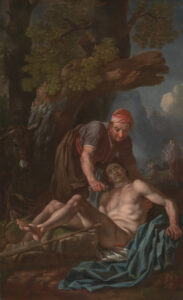
Many times things happen that are “in our face,” and we have only a moment or so to decide what to do: Should we stay and help or keep on walking? It is very easy to ignore a situation, but that is not what the Good Samaritan did, is it? What follows is an example of one of those unexpected moments.

I am an Extraordinary Minister of Holy Communion (EMHC), and on Ash Wednesday, on my way home after distributing ashes and Holy Communion, I decided to make an unplanned stop at Walmart. I did not have to go there; there was nothing specific I needed, but there was the store and the next thing I knew, the car was parked. As I walked toward the entrance I decided I needed double-A batteries. I did not truly need them, but I guess I had to validate my being there.

As I walked into the store, the express lanes were ahead and to the right. Ahead and to my left was McDonald’s. Outside McDonald’s was a bench, and sitting in it was Rachel, an elderly lady I knew from church. We have been friends for a long time. I walked over to her to say “hi,” and she looked at my forehead and said, “Oh, Larry, it’s you. We forgot today was Ash Wednesday. We didn’t get ashes.”

Let the unplanned evangelizing begin.

Rachel weighs about 70 pounds soaking wet and she is in her late eighties. Her husband, Jim, has Parkinson’s disease and is about the same age. They had both been widowed, met in church, and have been married for about fifteen years. I was still in my shirt and tie and wearing my EMHC cross. Next thing you know I was sitting next to Rachel, praying with her and placing ashes on her forehead. When I finished, I asked her, “Where is Jim?”

Jim was on the line in McDonald’s. The entrance was about fifty feet from where we were sitting. As I got up to find Jim, I noticed there were about a half-dozen people standing there watching us. It dawned on me that there were some people wondering why I was smearing dirt on an old lady’s forehead. I simply looked at them all and said, “Hi folks, today is Ash Wednesday. You can Google it.”

I turned and headed into the restaurant. There stood Jim, about eighth in line with about ten more people behind him. The place was packed and the poor guy was standing there with his left forearm and hand trembling unmercifully. I walked up to him and he was stunned to see me. I said as quietly as I could, “Jim, I just gave Rachel ashes. Would you like to have them too?”

As I stood praying softly with Jim, our audience began to grow. By the time I placed ashes on his forehead more people were coming over to see what was going on. I did hear some people mention, “Ash Wednesday.”

That was my impromptu cue. I turned and faced the gathering crowd and raised my hands in the air. “Hey everyone, today is Ash Wednesday. I am Catholic, as are my friends here, whom I just happened to bump into. They were unable to get to Mass today so they are receiving ashes which remind us to ‘remember that we are dust and into dust we shall return’.”

I actually gave several more people ashes, but then I had none left. I know a lot of people, religious and non-religious alike, watched the unscripted distribution of the ashes. It was an evangelization moment for sure, and it all happened in less than fifteen minutes. I also know it had to be my guardian angel who helped me pull that steering wheel to the right, leading me into Walmart.

I never did get the batteries.


Copyright 2019 Larry Peterson 

When it Comes to Life and Death, the Paradox that is Humanity is Inexplicable

On January 22, 2019, New York’s governor, Andrew Cuomo, signed into law the Reproductive Health Act. This was also the anniversary of Roe v.Wade.

When the governor finished signing this bill, a suffocating wind exploded from the halls of the capitol, caused by the cheers and screams of those upstanding lawmakers who had voted to legalize infanticide. Indeed, the wind has moved like a tsunami across our land, leaving behind a foul and repugnant odor.

There is an inexplicable paradox that engulfs humanity. I believe there is a far greater number of women and men who are willing to lay down their very lives for their child, even if it is still unborn, than those people who rejoice in the death and destruction of the most innocent and helpless of all God’s creations. I have no answers for this human phenomena.

The signing of this bill and the cheering that followed brought me back to a day 40 years earlier: September 6, 1978. For my young family, that was also a day about the life and death of a baby. Mostly, it is about how one woman would go to any lengths to save her unborn child.

Loretta had entered her sixth month of pregnancy, and in the days preceding September 6, there had been little movement from the baby. On September 5, the doctor had appeared concerned but had only said that the heartbeat “could be a bit stronger.” He wanted her to return in a week.

The rest of that day there was no movement. We had gone to bed and fallen asleep. I was on my right side, and Loretta was lying against my back. Suddenly something jabbed me in the back. It was hard enough to wake me. I sat up and said, “The baby just kicked me.”

She said softly, “Yes, I know.”

It was 2 a.m., and all was dark and peaceful, but we did not fall back asleep. We just lay quietly, side by side, holding hands and waiting. A second kick never came.

The next morning, after I had gone to work, Loretta began to hemorrhage. Her mom had been staying with us for a few days — and thank God she was there. She called 911 and then called and left a message for me at work. My first stop was only ten minutes from the hospital, and I arrived there before the ambulance.

When they pulled the gurney out, I was stunned at what I saw. My wife had lost so much blood that her hair was smeared with it. Her eyes were closed and she was not moving. I stood by helplessly as they rushed her into the ER.

For those who reject and scoff at the wonder of God’s human creations, here is an example of how one woman did not. As I was standing there not knowing what to do or where to go, a priest came in and asked me if I was Larry Peterson. I just nodded, and he told me that my mother-in-law had called his parish. As Loretta was being wheeled out of the house, she made her mother promise to have a priest waiting to baptize her child. Her mom kept that promise.

There was a hospital ten minutes from our house. I was told that the paramedics wanted to go there but that  Loretta demanded they take her to the Catholic hospital a half-hour away. They told her it was way too risky because of the amount of blood she was losing. She would not relent, and they did as she asked. She was determined to have her child baptized. She had knowingly and willingly put her life on the line for her baby.

Loretta survived and the baby did not. She was baptized. A few days later, the remains of  Theresa Mary Peterson left the funeral home in a tiny white casket. The casket was placed on the front seat of a limousine. We followed it to Gate of Heaven Cemetery in Valhalla, N.Y. She was buried with my parents, and her name is on the tombstone. She did exist and will always be remembered.

As the great Pope, St. John Paul II said, “A nation that kills its own children is a nation without hope.”

Lest evil prevails, we must pray like never before that our nation overcomes this onslaught against the very image of God Himself.

© 2019 Larry Peterson 

The Roman Canon (Eucharistic Prayer I) Take a peek inside the Love that is the Holy Trinity

I attended Christmas Day Mass at 8 a.m. in my church: Sacred Heart in Pinellas Park, Florida. We have a Mercedarian priest, Father Mike Donovan, who has been with us for several months and he was the celebrant. Father used the Roman Canon in this Mass. (Canon is the word used that refers to the fundamental part of the Mass that occurs after the Sanctus and before Communion.)

Before 1970, the only canon used during the Mass was the Roman Canon. Today’s standard missalettes carry six canons; Eucharistic Prayers I thru IV and two Eucharistic Prayers for Reconciliation. The altar missal used by the priest has nine: the ones mentioned and there are three for children’s Masses. It seems the one most commonly used today is Eucharistic Prayer II.

The Roman Canon (Eucharistic Prayer I) was put in place by St. Gregory I in the seventh century. It remains virtually unchanged to this day. However, since the new versions of the Eucharistic Prayers were included in the Novus Ordo Mass, it seems that Eucharistic Prayer I is rarely used. I do not know why this is, but the Roman Canon certainly has withstood the test of time.

In the Roman Canon, there is a rare beauty captured by the words written, and these words create visuals that can carry us to a different place. If you focus, listen, and read quietly along with the priest, you may actually get a tiny glimpse into heaven itself. Just let yourself feel the words grab you and transport you to a different realm.

When you “arrive” you may be able to peel back the veil and take a peek behind it. You might watch as the greatest love story ever told or imagined is taking place. It is the story of the perfect LOVE that exists within God and among the Father, the Son, and the Holy Spirit Who is God. This is about the most profound mystery of our faith and how this perfect LOVE is about to be shared with us. It is the greatest of gifts imaginable, and all of us who choose to accept it are about to receive it. But how does the Canon of the Mass take us there?

I have before me a copy of the Breaking Bread Missalette for 2018. I also have a copy of the St. Joseph Daily Missal from 1956. One is post-Vatican II; the other is pre-Vatican II.  The Roman Canon is the same in both. So let me share just one of the visuals I have mentioned. First, we should all be aware that all of the canons are directed to God the Father.

We believe that through the consecrated hands of the ordained priest, Jesus is going to sacrifice Himself to His Father for us. The Father will accept this Gift of His Son’s human life and return His Risen Son back to us in Holy Communion. This is the Great Mystery of our Faith.

I will only mention a few words from this magnificent seventh-century document that I believe capture it all. After the words of consecration are said, and the Body and Blood of Jesus are on the altar, we all recite the mystery of faith. Then the priest continues:

Therefore, O Lord [referring to the Father] as we celebrate the memorial of the blessed Passion, and the glorious Ascension into heaven of Christ, your Son, our Lord, WE, your servants and your holy people, offer to your glorious majesty from the gifts that you have given us, this pure victim, this holy victim, this spotless victim, the holy Bread of eternal life and the Chalice of everlasting salvation [emphasis mine].

We move down and read of Abel the just, the sacrifice of Abraham, and the offering of the priest, Melchizedek. So try to picture what happens next when God the Father hears our prayer:

In humble prayer we ask you, Almighty God; Command that these gifts be borne by the hands of your holy Angel to your altar on high in the sight of your divine majesty, so that all of us, who through this participation at the altar, receive the most holy Body and Blood of your Son, and may be filled with every grace and blessing …

(Through Christ our Lord. Amen).

As we watch the angel take our gifts up to heaven and then return them to us from our Father, we finish with the following words (how many of us really think about them) before the Communion Rite begins:

Through Him, and with Him, and in Him, O God, almighty Father, in the unity of the Holy Spirit, all glory and honor is yours, for ever and ever. AMEN.

All the Eucharistic Prayers are beautiful, but I must admit I do love #1 the most.

©Larry Peterson 2019

Humility—What is it? Where is it? Who has it? How do we attain it? Let’s ask St. Benedict

What is humility? The dictionary defines it as: (noun) “modest opinion or estimate of one’s own importance, rank, etc.”

The opposite of humility is pride. Pride is defined as: (noun) “a high or inordinate opinion of one’s own dignity, importance, merit, or superiority, whether as cherished in the mind or as displayed in bearing, conduct, etc.”  

Apparently, in this modern, self-absorbed world the pride factor has taken over. There used to be a slogan that said, “Sticks and stones can break your bones, but names can never hurt you.” It seems that slogan has been thrown into the dustbin of antiquity. The new slogan seems to be, “That was offensive. I demand an apology.” (or something like that).

It seems that more than half of the human race smothers itself to death with self-absorption. This condition may warrant a journey back in time to visit one of the greatest of Catholic saints; his name is St. Benedict of Nursia. Benedict’s work was so important in the evangelization of most of Europe that in 1964 Pope (now Saint) Paul VI proclaimed St. Benedict the Patron Saint of Europe.

Benedict authored the Benedictine Rule. Included in these rules are the Twelve Steps of Humility. Let us see what this saint has to say about humility. Since Benedict wrote in detail about each step, what follows will be a brief synopsis of each one.

Benedict introduced his Twelve Steps with this preface: 

“Whoever exalts himself shall be humbled, and whoever humbles himself shall be exalted.” (Luke 14:11)

How to be Humble:

  • Step one: The Fear of God. Man must keep the fear of God always before his eyes and never forget His commandments. The fear of God means reverence for God, and by offending God, we offend ourselves.
  • Step 2: Not My Will, but Yours, O Lord (John 6:38). This means to be humble we must avoid taking pleasure in our own wants and desires but always strive to do God’s will before all else.
  • Step 3: He was obedient even unto death (Philippians 2:8). Humility requires us to be obedient to authority which includes our parents, our priest, lawful authority, etc.
  • Step 4: Embrace Suffering Patiently and Obediently.For he that will save his life shall lose it: and he that shall lose his life for my sake, shall find it.” (Matthew 16:24-25)
  • Step 5: Confess our sins and faults. This means we should regularly confess our sins to a priest through the Sacrament of Reconciliation.
  • Step 6: Be content with lowliness. We should accept that we are sinful and frail and when left to ourselves we are not much, but to God we are of precious value — so much so that he suffered and died for us.
  • Step 7: Understand our Interior Mediocrity. It is a blessing that you have humbled me so that I can learn Your commandments” (Psalm 119:71, 73).
  • Step 8: To Keep the Rule. This is to remind the Benedictines to keep the Rule of their Order. It reminds us to keep the rules of Holy Mother Church.
  • Step 9: Silence and Solitude. We should always avoid speaking ill of others and try to embrace silence and solitude whenever God provides it for us.
  • Step 10: Keep Your Peace in Times of Laughter. This pertains to us laughing and making fun of others, something we should never do.
  • Step 11: Speak Calmly and Modestly. We should train our tongue so that the words we speak are foremost, pleasing to God and never
  • Step 12: Everlasting Humility and Meekness. We should strive to live our lives, day and night, by bearing whatever problems or adversities we are experiencing thereby allowing God’s kindness and gentleness to shine through us.

Cardinal Rafael Merry del Val was Secretary of State to Pope (now Saint) Pius X. He wrote the famous Litany of Humility. We might pray that more people embrace the gift of humility. We certainly need more of it.

© 2018 Larry Peterson

Make NO Mistake and Never Forget: Mothers are Women and Female is their Gender

I found myself writing this around Mother’s Day because the legal definition of “gender” has become controversial. I begin with a quote from Cardinal Giovanni Ravasi; President of the Pontifical Council of Culture:

“The love of man and woman, capable of generating life, is a sign that points to God.”

The following comes from personal experience. My youngest brother, Johnny, had just turned two when Mom died. The previous six months she had been, for the most part, in the hospital. Johnny grew up without ever knowing his mom and her hugs or her voice or her caress. His “shrink” told him his problems with relationships were due to the fact he had lost his mom as a baby. Johnny took his own life three years ago.

Bobby was six years old when  Mom died. He always had an anger in him that could expose itself to perceived provocations. He passed away suddenly, eleven years ago. His killer was congestive heart failure. I still think his heart had been irreparably broken at age six and it just took another forty years to give out.

Danny was ten. He is still fine, and we are in frequent contact. I was the oldest, and my sister was second. Dad died a few years after Mom, and we tried to be a mom and a dad to our three brothers. We did our best, but we were in way over our heads. We did survive as a family but, as you can see, having no mom had profound consequences (the dad part I will leave for another day).

I move ahead 16 years to the birth of my daughter. Times were changing, and when Mary came along, I was present, and all decked out in my scrubs and sterile gloves (prior to that time, dads were not allowed into the delivery room).

I was sitting at the end of the delivery room table with my right hand holding the top of my wife’s head. I was looking up into a mirror watching the birth take place. And then, Doctor Butler began to lift his arms and in his hands was a baby. Our baby — a girl.

It seemed that almost instantly the nurse was next to me handing me, my daughter. Her face was still gooey, and her eyes were wide open. She was not crying; rather, she kept staring at me. Her eyes were as blue as the sky and as big as saucers. That was my moment, etched within my mind forever. A more profound moment was on the way.

Within moments baby Mary was being lifted from my hands and taken to her waiting mom. Still lying on the delivery table, Loretta reached out for her baby. That was the moment I understood the power and intrinsic importance of a mom. A mother and her child are forever bound by an unbreakable bond that can only be felt between them. I also believe that dynamic is similar to every child that a mom gives birth to.

Courtesy of Larry Peterson. All rights reserved.

Courtesy of Larry Peterson. All rights reserved.

There are many moms who have, because of whatever circumstance and oftentimes out of love and humility, given their child up for adoption. In my heart of hearts, I do not believe any woman “happily” gives away her own child. Interestingly, the adoptive parents will generally love that child as if she or he was their very own and the children would assuredly love them back.

But, at some point in time, the children have a need arise within themselves to ‘find” their birth mom and/or birth dad. That is because an unbreakable bond is always there. No one can remove it or take it away or replace it. It is what it is.

For some, gender neutrality may be the “feel-good” movement for the present moment. But it is a premise built on quicksand and defies all of the Natural Law. Pope St. John Paul II summed it up best:

“God has assigned a duty to every man, the dignity of every woman.” 

Within those words are the inspiration for both men and women to defend what God has created.

Please say a prayer for all those folks who cannot remember what having a mom was like.

Copyright©Larry Peterson 2018

Truly an extraordinary ministry: I am an EMHC and I am honored to be one

I wish to clarify something right away. I am NOT a Eucharistic Minister. I am an Extraordinary Minister of Holy Communion (EMHC). ‘Extraordinary Minister of Holy Communion” is the proper term for the people involved in this ministry. The term “Eucharist” is never to be in their title. That term is reserved for the priest alone (see Redemptionis Sacramentum).

I have been involved in many ministries over the years and have been an EMHC for 23 years. For me, nothing can compare to being an EMHC. It is all about Jesus, the person receiving Jesus, and you being the one who has brought them together. It does not get any better than that.

I rarely miss a visit to my homebound friends. As of this writing, I visit nine every Sunday. Five of them are in their nineties. Honestly, it makes my day. Ironically, it makes their day too, (and sometimeS their week) because they hardly see anyone during the week except home health aides and folks like that. All I come with is a smile, a church bulletin, maybe a prayer card and, of course, their BEST FRIEND.

I have a journaling book, and in the back, I have compiled names of people I have brought Holy Communion to over the years. I want to share a bit about a few of these folks with you. These are Catholic people who have lived their Catholic lives to the best of their ability. Many of them were children during the Great Depression and lived through World War II and into the 21st century — like my friend George B.

George was in the U.S. Navy and stationed in London in 1940 during the Blitzkrieg. He survived that, came home and wound up at Pearl Harbor. He was there on December 7, 1941, when the Japanese attacked. He and a Marine corporal manned a 50-caliber machine gun and shot down two Japanese Zeroes. The two of them then proceeded to pull men out of the burning water near the USS Arizona. After the war, he was in the circus for more than 20 years. George died several years ago at the age of 97. I loved his stories. He was a walking history book, and he would get veryanimated when he was telling you about his adventures. I brought him Communion every Sunday for more than two years. What an honor that was.

There was Anne S. She was 90 and would be dressed to the “T” every Sunday when I arrived. She would ask, “Why does God keep me here, Larry?”

“Anne,” I would say. “He needs Prayer Warriors. That’s what you are, and that’s why you are here. There are many souls in Purgatory. They need your help.”

She would always smile and point to her rosary and her prayer books on the table next to her. She would point to them and say, “Yes, I know. I do keep busy.” Recruiting “prayer warriors” is an important part of what I do. Anne has been gone for five years.

And my little pal, Scotty Walker. He was a St. Jude baby because of a tumor on his brain stem. That was in 1977 when he was only two years old. When he was 25, he was only 4 feet, 4 inches tall. He started his own lawn service when he was about 17. Scotty wore a big straw hat, and his nose would be just above the lawn-mower handle as he pushed it along. At the same time, he was studying for his GED. He worked his tail off until he could not do so any longer. I brought him Communion every Sunday during the last two years of his life. He died in 2002 when he was 27.

I have been blessed to be part of this ministry. Seven people have received their Viaticum from me. It was not planned that way — it just happened. I pray to each of them all the time. I have on my list over 40 people who have passed on, including both my wives (one died in 2003 and the other in 2017).

I would suggest you look into being part of this ministry. You get to leave the church with Jesus in your pocket and then just you and He get to go visiting His homebound or hospitalized people. It is a beautiful thing.


Copyright 2018 Larry Peterson

Did Jesus Appear to His Mom after He Rose from the Dead? The Gospels never mention it.

Easter was two days ago, and on that glorious morning we heard from the Gospel of John.

Mary of Magdala came to the tomb early in the morning, while it was still dark, and saw the stone removed from the tomb. So she ran and went to Simon Peter and the other disciples He loved and told them, “They have taken the Lord from the tomb and we do not know where they have put Him.” (John 20:1-9)

The gospel read at the Easter Vigil is from Mark 16: 1-7. In this gospel, Mary Magdalene and Salome have gone to the tomb to anoint Him. This is when the angel appears to them, and tells them He has risen and to go and tell His  disciples.

The following week, on the Second Sunday of Easter ( Divine Mercy Sunday), the gospel is once again from John, this time John 20:19-31. This is when, with the doors locked, Jesus appears to all of them (except “doubting”  Thomas). Interestingly,  someone is never mentioned in any of these gospel readings. That someone is Jesus’s mom, the Blessed Virgin Mary.

So where was she when Jesus rose from the dead? She was His mother. She was nearby throughout the Passion and watched Him carry His cross. She watched as they drove the nails through His hands and his feet. She stood agonizingly and helplessly by as He was raised on the cross. For three hours she stood there watching every drop of blood leave her boy’s body. She was at the foot of the cross when He died.

No mom should ever have to witness such cruelty heaped upon her own child. Who could have loved him more than she? Doesn’t it seem absolutely unquestionable that the first person who Jesus appeared to after He rose was His Mother? Yet there is not a single mention of the Blessed Virgin in the Resurrection narratives.

In 1931, Pope Pius XI, rooted in findings from the Council of Ephesus in 431, instituted the Feast of the Divine Maternity. Although somewhat obscured by the dogmatic teaching of Mary’s Perpetual Virginity, it is tied tightly to it. The Divine Maternity explains to us that the greatness and majesty that was bestowed on Our Lady was wrapped into a bundle of pure Love from God. For He was the Father of her child. She was the mom. Every drop of Jesus’s DNA comes from His mom. The Father and Son are God. Jesus Christ is truly Human and Divine, separate yet one.

From the Catechism 496: Mary’s Virginity:

From the first formulations of her faith, the Church has confessed that Jesus was conceived solely by the power of the Holy Spirit in the womb of the Virgin Mary, affirming also the corporeal aspect of this event: Jesus was conceived “by the Holy Spirit without human seed.” The Fathers see in the virginal conception the sign that it truly was the Son of God who came in a humanity like our own …

Back to the Resurrection. As a simple man of faith, I have to believe that Jesus immediately went to see His mom upon leaving the tomb where he was, moments earlier, dead. I shall end this with the following:

VATICAN CITY, MAY 21, 1997 (VIS) –The Holy Father focused the catechesis of today’s general audience in St. Peter’s Square. Pope John Paul II said, “The unique and special nature of the presence of the Virgin at Calvary,” added the Pope, “and her perfect union with the Son in his suffering on the Cross, seem to postulate a very particular participation on her part in the mystery of the Resurrection.” 

The Blessed Virgin, who was present at Calvary and at the Cenacle, “was probably also a privileged witness to the Resurrection of Christ, in this way completing her participation in all the essential moments of the paschal mystery. Embracing the risen Jesus, Mary is, in addition, a sign and anticipation of humanity, which hopes to reach its fulfillment in the resurrection of the dead.”

If St. John Paul II says it must be so, that is good enough for me.

Copyright 2018 Larry Peterson

The Mercy We Are Called to Live

Eucharistic AdorationWhen introducing the corporal and spiritual works of mercy in her book, Blessed Are You, author Melanie Rigney writes, “Both types can come free and easy … or hard and challenging” (Franciscan Media, 2016, p. 66).  This immediately made me think of the healthy benefits of exercise. I can stroll around the park with the kids, or I can strap on the boxing gloves and go a round with the punching bag.

As I read in Melanie’s chapter on mercy, which included Sts. Teresa of Calcutta, Maria Karlowska, and Frances Xavier Cabrini, she brought an important question to mind. How do I approach the responsibility of showing mercy to others in my own life? She did not mean just the common decency we’re called to extend to each other in day to day living with others. But the “words into action, called to be a saint” kind of mercy.

The Works of Mercy remind us that mercy is much more than forgiveness.  In totality, these works encourage us to live beyond ourselves. Though we may not all be called to the streets of India, as Saint Teresa of Calcutta was, we are responsible to care for the poorest of the poor—spiritually and physically.

Take for instance praying for the living and the dead. There is a straightforward way to accomplish this work of mercy such as offering the intentions for others during prayer. One of my favorite “free and easy” praying for others actions involves Facebook and Adoration.  Before my Eucharistic Holy Hours, I will post on Facebook an image of the Eucharist in a Monstrance and the words “Can I pray for you?” The response this post garners humbles and amazes me. I typically receive 100 or more likes and/or comments indicating a request for prayer. Then, when I am sitting in the chapel before Jesus in the Eucharist, praying for each person and their intention by name, I am overcome with a profound sense of hope and peace. Though the requests often break my heart, I would still place this act in the easy act of mercy category.

A few years ago, after completing a novena to St. Ann for help with a serious financial matter, I felt a spiritual nudge to give back in charity for great blessings received in an answer to this prayer.  After a time of prayer, I was inspired to rejoin the ministry of bringing Holy Communion to the homebound. My pastor was happy to have my help—but it would require me to attend the 8 a.m. Mass and rearrange my work schedule.  Sacrifice?  I didn’t see that coming; I thought it would be at my leisure and on my time. These were inconvenient sacrifices but the “hard and challenging” was yet to come in a most unexpected way.

First, you have to know I am extremely germophobic. Just weeks into this new ministry, I arrived at my assigned assisted-living location and was greeted by a giant note taped to the door, “ENTER AT YOUR OWN RISK. STOMACH BUG EPIDEMIC.”

What?!

The situation was made more difficult because in my hand wasn’t regular Communion but Christmas Communion. How could I not bring them Jesus for Christmas?  Christmas was just days away when I was expected to host our family Christmas celebration.   It felt selfish to walk into the building and risk getting sick, or worse, exposing my entire family to the bug.  Yet, I was holding “Christmas Jesus” and I knew my new friends were looking forward to receiving Communion, which made it seem selfish to walk away.

As my spiritual director always says, “If you are going to trust God, then you need to trust God!” The hard and challenging aspect of this valuable work was trusting God regarding my health for the sake of serving others. When we step out in faith to serve God’s people, we, in essence, become Christ in the world.  Even the simplest of tasks can come with obstacles and difficulties; our spiritual muscles are strengthened when we forge through despite them. As in my exercise analogy, the workout that is harder takes more determination and effort. And let’s be honest, the harder workout will produce the greater benefit, too.

In case you are wondering, I did go into the building that morning, and I did not get sick. The smell of Lysol wafting heavily in the air gave me a bit of confidence, but the joy on the face of the first woman quickly told me I made the right choice.  I next visited a sweet couple, who had been married for over seventy years.  When I was preparing to leave, the wife said, “Jesus will bless you for your kindness.”

Reflecting on that special Christmas, regardless of whether I had become ill or not, the Lord had indeed abundantly blessed me.  Abandoning my fears and mustering up my courage to walk through those electronic doors that Christmas elevated my trust in God to a whole new level.  The reinforced trust generated in that experience would become the greatest gift I received that year.

Greeting the New Year—the Catholic Way

According to Georgetown University , as of October 2017, there are 1.28 billion Catholics in the world. 70.4 million of them are in the United States. The USA has a population of approximately 330,000,000 people. That works out to about 22% of the American population being Catholic.

From the Pope down to the vagrant, each of us is an individual creation made by God. We are all unique. Incredibly, we will all be judged individually. And, as Catholics, we will be held to a higher standard. After all, we proclaim to be part of the Mystical Body of Christ which is filled with the deposit of faith. No matter how we lived our lives, the common denominator for all of us will be: How much we loved each other and our neighbor.

Based on that, here are some points to consider if we focus on, before all else, pleasing God in the New Year, the Catholic Way:

  • Never forget that you are God’s individual creation and therefore a gift He has bestowed on the world. Be humbled by the fact that He does have you in the palm of His hand. Without Him you are nothing.
  • Be happy with who and what you are. God made you and loves If you feel you need to change to please Him, you can do it. Just ask for His help.
  • The choices you make are your responsibility. Sometimes our choices hurt us. Embrace them and learn from them and move on. Thank God for the experience.
  • Sometimes NOT getting what you want or what you think you need is a gift. If you trust God, you will thank Him. When “one door closes another opens.”
  • Always count your blessings — not your troubles.
  • Always do your best. The “best” is all God expects from each of us.
  • You can make it through whatever comes along.
  • Prayer is the most powerful of weapons and can be your greatest ally in all diversity.
  • Don’t take things too seriously — especially yourself.
  • The key to happiness is to give of yourself, not to “get” for yourself.
  • Miracles happen; you are one — I am one — we all are one.
  • Temptation is everywhere. It is okay to say “NO.”
  • Finally, never fail to help a neighbor, whoever it may be — even a stranger.

We all will experience “highs and lows” during the coming year. As Catholics, we have the armor of the Church to shield us and the angels and saints to help us fight our battles with the evil one.

St. Michael the Archangel will always ‘defend us in battle.” St. Anthony will help us find lost items. St. Jude will help us through seemingly impossible barricades. Good St. Joseph is ready to help all men be good fathers and husbands. St. Monica will help moms and St. Dymphna will help those with experiencing emotional difficulties or suffering from Alzheimer’s disease. And, of course, the Blessed Virgin Mary is always there for all of us.

Virtually every day of the calendar year honors a particular saint, and that saint has been assigned a special task, such as St. Padre Pio, who is the patron of adolescents and volunteers, or St. Maximilian Kolbe, martyred in the Holocaust, who is the patron of drug addicts. Help is always available when you are Catholic.

Lastly, we have in place for our salvation the most beautiful thing this side of heaven; the Holy Sacrifice of the Mass. We can actually be at the foot of the Cross and then witness the resurrection. It is there for all of us every day if we so CHOOSE. Then there are the sacraments, always available to build us up and restore us to where we should be.

Yes—being Catholic is very cool. We even have the Rosary.

HAPPY NEW YEAR, 2018 –“No Fear”

Copyright 2018 Larry Peterson

When You Think You Think You Have Nothing to Give, Bring Your Drum…

At least that is what a young boy did thousands of years ago when he wanted to honor a new king. You probably can hear the drum beating as he asks “Shall I play for you? On my drum?”  You know the rest. tribal-1215118_1920

Most of my life, I’ve felt I had nothing worthy to put at the feet of the King of the Universe.  Instead, I often ran away from him. But in his wisdom and love, he carried me to the point where I am today.

It was in my parish family during a small group retreat by Father Michael Gaitley, the study on “Consoling the Heart of Jesus” gave me a whole new insight into the love and longing Jesus has for us. Early in the book, Father Gaitley shares a simple message he perceived from Jesus:

“All I want is for you to be my friend. All I want is for you not to be afraid of me and to come to me.” (Page 71)

Loving and Consoling Jesus through His Living Body the Church

 I found great joy in meeting with like-minded souls to talk about our growing love for Jesus and the resulting desire to put faith into action.  It was nothing short of miraculous. God bears his light to us, first through his son and then through others.

They come heeding the call of the Holy Spirit to be in the right place at the right time. We all know people who are beacons – radiating goodness, kindness, love and action. Sometimes, we are the steadying signal, but I never forget who is at the origin.

Therefore let us be grateful for receiving a kingdom that cannot be shaken, and thus let us offer to God acceptable worship, with reverence and awe;  Hebrews 12:28 

Jesus is the burning heart, the center of this wonderful body of Christ and in loving others, we love him.  In consoling others, we console him. We truly are branches nourished by his living vine.

Bringing Our Drums

heart-2862156_1920So we come back to the little shepherd boy. I hear his drums, “pa rum pa pum pum” a physical declaration of his heart beating with love for the king, a testimony to all that is required of us–offering our own hearts without reserve.

I once thought I had nothing to give, but I was wrong.  Jesus smiled at the drummer boy and his gift while Mary nodded and the ox and lamb kept time. I am certain he smiles at each of us too; we just need to bring him our drum.


What Christmas songs stir your heart?  Bring loving memories to mind?  Feel free to share in the comments section.