
The Prison Cook

The Prison Cook


Aidelade, the prison cook, was tough customer for this missionary in Oklahoma.

Today I am working in the prison kitchen with Adelaide.  We are making macaroni and cheese. She has a job here as a cook. I am here doing missionary work for my church and so I am helping her make the pasta.

Adelaide has a sharp tongue. I try to put some water from the pot into the pan with the onion.

“Not so fast,” says Adelaide. “You haven’t boiled the pasta yet, so no use in putting it there now.”

“Ok!” I said.  It is her mac and cheese for the prisoners. She is going to boil some water and put some pasta in it and fry the onion in oil. Then some pasta water and some milk. She will melt the cheese on a very low temp so it doesn’t curdle before mixing it with the pasta mixture.

Another time when I went, I thought of bringing some steak for the prisoners since they don’t get much quality food.  “Not so fast,” she said. “They get soybean stuff, not steak.”  There were several cans of “soybean stuff” laying around the kitchen.

They also get some greens.

“Adelaide, do you have family?” I asked.

“No,” she snapped. “That’s why I am here.”

“Do you ever go to church or read the Bible?” I ventured.

“NO. This is a prison. Do you want to help me make some Nutraloaf?” This is a loaf of various foods that is so disgusting it’s used as punishment.

“Adelaide, what would make you happy?”

She paused for a while and spoke slowly.

“When I was young, I wanted to be a chef at a nice restaurant. But that didn’t happen. I needed a job so I got the job here.”

“Why don’t you make a nice dinner here?”

“Who’s going to pay?” she answered.

“We can find a donor at my church. Do you think they would like coq au vin?”

We got the funds for the dinner and we got the shopping done.

Now it was time to cook!

“I’ll need your help,” she said. “This will be a lot of work.”

This is the recipe we used for the dinner (adapted from allrecipes.com).

Chef John’s Coq au Vin

6 bone-in, skin-on chicken thighs

kosher salt and freshly ground black pepper to taste

8 ounces bacon, sliced crosswise into 1/2-inch pieces

10 large button mushrooms, quartered

½ large yellow onion, diced

2 shallots, sliced

2 teaspoons all-purpose flour

2 teaspoons butter

1½ cups red wine

6 sprigs fresh thyme

1 cup chicken broth

Directions

Preheat the oven to 375 degrees F. Season chicken with salt and black pepper.

Sauté bacon in an oven-proof skillet over medium-high heat, until evenly browned. Remove bacon.

Increase the heat to high and cook chicken thighs 2 to 4 minutes per side. Transfer chicken to a plate.

Sauté mushrooms, onion, and shallots with a pinch of salt in the hot skillet until golden and caramelized, 7 to 12 minutes.

Stir in flour and butter.

Pour red wine into the skillet and bring to a boil. Stir in bacon and thyme and simmer until wine is about 1/3 reduced, 3 to 5 minutes. Pour in chicken broth and return chicken thighs to the skillet; bring to a simmer.

Transfer the skillet to the preheated oven and cook for 60 minutes or until temperature is 165 degrees F. Transfer chicken to a platter.

Thicken sauce in skillet then spoon over chicken.


We decided to serve it over noodles.

We brought it out and the prisoners formed a line as they normally did. When we uncovered the pot the prisoners gasped. The aroma was amazing. We served the food and the prisoners enjoyed it thoroughly.

© Copyright 2026 by Cecile Bianco

Mitzewich, John. “Chef John’s Coq au Vin.” All Recipes, last modified February 3, 2025, https://www.allrecipes.com/recipe/239230/chef-johns-coq-au-vin/

Elder is a Verb

Editor’s note: Technical issues are a nuisance, but in this case it is to our benefit because we revisit Margaret’s September column which disappeared into the ether, along with several other author’s works, due to website issues, now resolved, the latter part of the year.


“… It was not you who chose me, but I who chose you and appointed you to go and

bear fruit that will remain …”  — John 15:16

“Now is the season of the fruiting and the dying.”  — Mary Dingman, SSSF


Elder is a Verb

My long-time spiritual director, Sister Mary Dingman (1919-2017), a vowed member of the School Sisters of St. Francis, was the first person from whom I heard the words, “elder is a verb.”

Sister Mary served her order with distinction as novice mistress, postulancy mistress, Catholic high school teacher, provincial coordinator, and formation director in multiple settings, from the Archdiocese of Milwaukee to the Archdiocese of Omaha. (1)

An apocryphal story tells that while she was still a novice herself, Mary refused a demand to sit in the back seat, from her brother’s fellow seminarian who was giving her a ride back to the convent from their rural hometown.

He was afraid of being seen with a female in his automobile. Novice Mary climbed straight into the front passenger seat. She didn’t recognize any difference in moral responsibility among disciples of the Lord, only different roles to fulfill.

Sister Mary was already a recognized religious figure in her own right by the time her older brother, Bishop Maurice Dingman (1914-1992), called her back to their home state of Iowa.  He asked her to support and assist the Jesuit priests who served Emmaus Community prayer house, to extend opportunities for professional spiritual direction beyond the clergy and into the wider Des Moines lay community.

For more than twenty years, Mary Dingman, SSSF served as a spiritual director at Emmaus House, in a historic Victorian two-story home located close the inner city. She prepared daily lunches where everyone was welcomed to the feast in her beautifully set dining room, after liturgy and Eucharist were offered in the home’s cozy living room. Mass was celebrated there for many years by one of the Jesuit or diocesan priests, as simply and profoundly as the earliest Christians celebrated in the catacombs. Later, centering prayer groups and holy day dinners joined the schedule as the Emmaus community grew.

Sister Mary hosted Catholic and Protestant clergymen, vowed religious, and laypersons for private retreats in the small bedrooms upstairs, providing three excellent meals a day along with plenty of quiet time and peace to enjoy the gardens that surrounded her home. She was still driving, by herself, around the state to provide directed retreats at monasteries and convents, into her late eighties.

Sister Mary Dingman fulfilled her commission as an apostle proclaimed by Jesus in the Gospel of John: to bear fruit that would last.

Emmaus House maintains its commitment to Ignatian Spirituality and community fellowship in the Diocese of Des Moines, even to this very day; offering educational conferences, group and private retreats, as well as personal spiritual direction, now from a new home that is better-equipped to utilize modern technology. (2)

What about us?

As the Autumn Equinox arrives this Monday, September 22, where do we find ourselves? Probably most members of the Catholic Writers Guild are attending Mass regularly, and making strong efforts to educate their families in the faith.

We might not want to think too much about our own deaths, but are we still living our faith to its fullest?

According to the United States census, all members of the United States “Baby Boom” population, people who were born between 1946 and 1964, will not reach the current “retirement” age of 65 until 2030 (3).

“Independent living communities” for “senior citizens” have been popping up like mushrooms all over the country for decades, and many have long wait lists as well as hefty fees. Busy families with active young children and teenagers are too often forced to beg, in some places, to find a single bed available in a skilled nursing home with adequate facilities to help them care for aging parents.

How many devout and aging Catholics do we know, who are facing difficult choices for their final years?

The Oxford English Dictionary gives three parts of speech for the word “elder”:  noun, adjective, and verb – which is offered third in order, after the noun and the adjective, because it is the least common usage.

“1. verb trans. With it, to play the elder. rare. …”

“2. verb intrans. Become older, begin to show signs of age. colloq. and poet. …”

“3. verb trans. Make a request to or admonish a person …” (4)

But none of these were what my friend Sister Mary meant, nor how she lived her own life. She spoke with an active verb, and went about “eldering” with her whole self.

Are we thinking too much about the leaves falling and dreading winter? Are we approaching our own “autumns” as fates to “die” rather than to “fruit”?

Many older people in our society are struggling to afford food on limited social security payments. Children in schools often need surrogate grandparents to listen to their reading and tell them stories, when parents may be too busy or too overwhelmed.

Families, parishes, and dioceses offer plentiful opportunities to help with food pantries, assist the ill or handicapped, offer constructive personal attention to children.

Perhaps most important, “Baby Boomers” who have already retired and those who will retire over the next three decades are the last generation on earth who will remember a culture, and a quality of human life, before demands and consequences of administration by computer.

We can leave an imprint of real experiences in direct and human interaction with the generations that will follow us.

The saints in heaven watch over us as we drag ourselves out of bed, perhaps groaning with arthritic pain. They listen to and intercede for our prayers on behalf of our ancestors, neighbors, children, and grandchildren. They see us picking up our glasses, hearing aids, keys, canes, or walkers, putting on our coats and boots, going out to take care of our daily business.

No matter our circumstances, we can move forward into this autumn of 2025 — even as our earthly weather starts progressing towards winter – carrying the fruits of love, hope, and genuine encounters that endure.


© 2025 by Margaret King Zacharias

Feature photo: First Color in Iowa – Photo Credit Margaret Zacharias. Published with permission.

Inset photo: Autumn Rainbow to Heaven – Photo Credit Charles Zacharias.  Published with permission.


Notes

  1. https://www.barrmemorialchapel.com/obituary/4352175
  2. https://www.theemmaushouse.org/about-us
  3. https://www.census.gov/library/stories/2019/12/by-2030-all-baby-boomers-will-be-age-65-or-older.html
  4. Shorter Oxford English Dictionary, Fifth Edition, Volume I A-M, Oxford University Press, Great Clarendon Street, OX2 6DP, Published in the United States by Oxford University Press Inc, New York, 2002, p. 801.

Worth It

He was spurned and avoided by men, a man of suffering, knowing pain, like one from whom you turn your face, spurned, and we held him in no esteem.”—Isaiah 53:3 (NABRE)

“Whatever you do, do from the heart, as for the Lord and not for others.”—Colossians 3:23 (ESV)

I’ve never handled being interrupted very well. Anyone else relate?

I usually get disproportionately annoyed whenever someone wants me to stop whatever work I’m doing and asks me to do something else. I always used to think it was because of my tenacity—I want to get one task checked off my list or finish my train of thought before starting something else. But while that is certainly part of it, and taking being interrupted with grace is certainly something I need to work on, I recently realized a deeper reason: appreciation.

I want to feel appreciated for the work I choose to spend my time on and want to know people think it’s important and worthwhile. Not that it’s dispensable and I should be doing anything else. If we’re honest, I think most if not all of us can relate to that. Jesus certainly could.

In His visions to Saint Faustina, Jesus revealed which type of souls caused Him the most pain in the Garden of Gethsemane: lukewarm souls. In other words, souls who don’t care. Souls who don’t appreciate the sacrifice He was about to make for them.

But Jesus loves us all so much, He did it anyway. Regardless of whether we’ll accept it or not.

He traded glory for suffering. Honor for humiliation. Acceptance for rejection.

Appreciation for sacrificial love.

Jesus knows how it feels to be spurned. But He also shows us that resolve to do God’s work and follow His Will should be our reaction, not bitterness and resentment and self-degradation. He shows us how to remember that we don’t work to earn the praise of others.

Rather, all our work should be done for God alone. His smile alone makes everything worth it.


© Isabelle Wood 2025

Photo copyright Canva

Edited by Gabriella Batel

Touched by an Angel

“See that you do not despise one of these little ones, for I say to you that their angels in heaven always look upon the face of my heavenly Father.” (Matthew 18:10)

As you read this, I’m either anxiously awaiting the birth of my second grandchild (and first grandson) or am helping my daughter and her husband with their two littles ones. What joy fills me that my daughter has received these blessed babies from our Lord. What fear I feel for their futures in this world full of uncertainty.

When my three girls were growing up, each one of them had a print hanging in their rooms of guardian angels. They learned and recited the Guardian Angel Prayer at school and knew their angels were watching over them. Sometimes, I wonder if we outgrow our angels. Are they able to keep up with us on those days we can barely keep up with ourselves?

Angels in the Outfield

I watch what young people do today, what they are faced with, how they live, and who they worship, and I can’t help but wonder how their guardian angels feel. Do they shake their heads in disbelief at the values of today’s society? Do they cry over the ones they’ve lost to darker powers? Do they continue to watch over their charges even if they stop believing in angels or demons or God?

There’s a lot more to Matthew’s passage that is not part of today’s reading. Jesus tells the Apostles, “Whoever causes one of these little ones who believe in me to sin, it would be better for him to have a great millstone hung around his neck and to be drowned in the depths of the sea” (Matthew 18:6). He then says, “Woe to the world because of things that cause sin! Such things must come, but woe to the one through whom they come! (Matthew 18:7). He tells them to cut off hand or foot, tear out eyes, if one of those causes the person to sin.

What must the angels think of the world today so full of sin at every turn?

Angels Among Us

Though we tend to think of guardian angels watching over children, I believe they are nearby throughout our lives. How else can I continue to go one when I have loved ones who have left the Church and have no desire to pray or worship? I have to believe their angels are still out there fighting for them, praying for their return, watching over them like a shepherd watches his sheep, coaxing them to find their way back to the flock.

Once our little one and his mom are back home, the preparation for Baptism will begin. I know his guardian angel will be on the altar with Mom, Dad, and godparents, smiling at this child through the eyes of the Heavenly Father. I pray that all our angels continue to smile upon us, especially on those who don’t feel their presence but need them desperately even if they don’t realize it.

How great is the dignity of souls, that each person has from birth received an angel to protect it. Saint Jerome


The Guardian Angel Prayer:

Angel of God, my guardian dear, to whom God’s love commits me here, ever this day be at my side, to light and guard, to rule and guide. Amen.


Copyright 2025 Amy Schisler
Photos copyright 2025 Amy Schisler, all rights reserved.

A Man of My Own Heart

“Get behind me, Satan!  You are an obstacle to me. You are thinking not as God does, but as human beings do.” (Matthew 16:23)

Peter, Peter, Peter. What can I say, other than, “I feel your pain and your regret and your embarrassment. I have walked in your shoes.”

A Bold Declaration

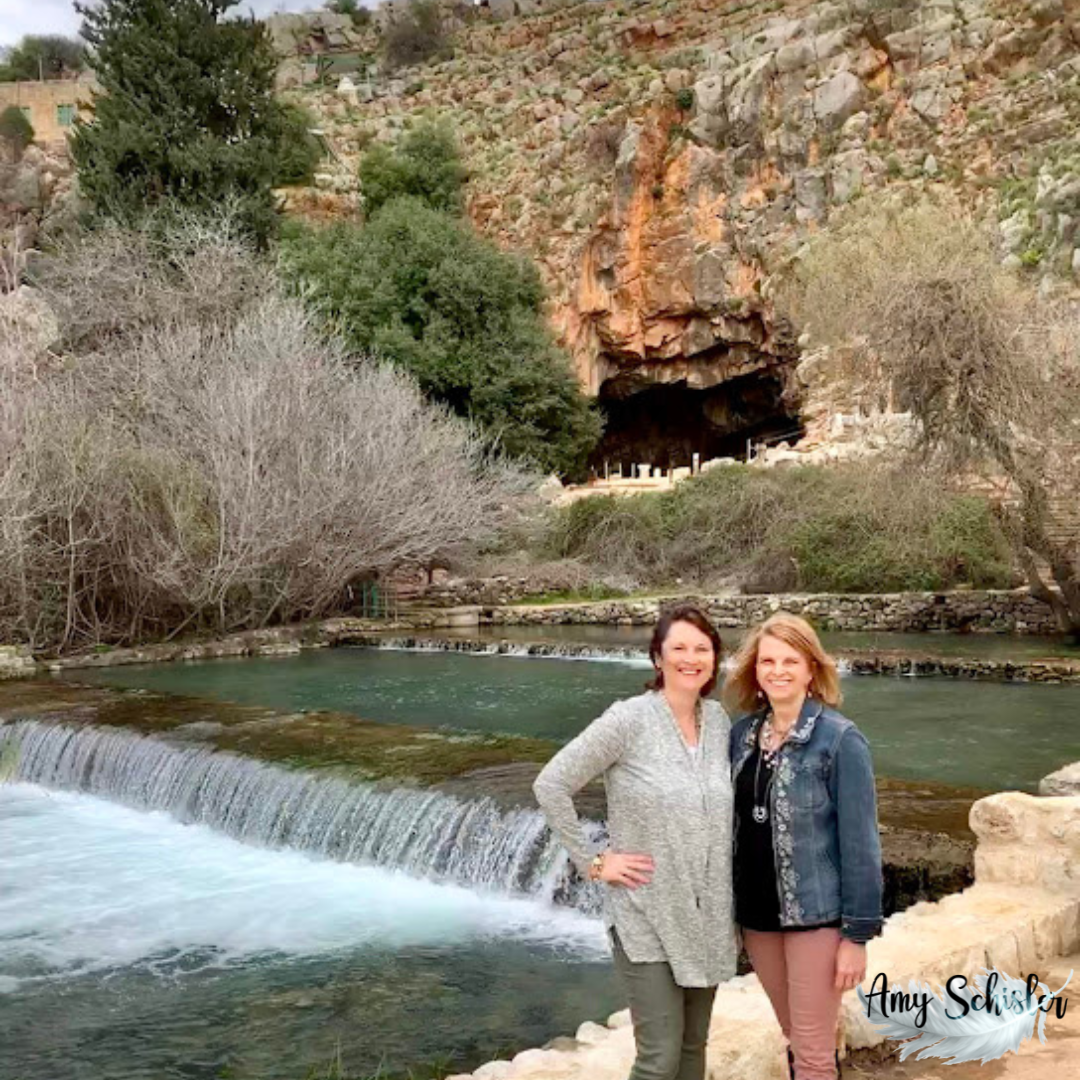
Caesarea Philippi is one of the most beautiful places in the Holy Land. A colossal rock wall on the border with Syria towers above the clear, gentle waters that are the source of the Jordan River. I’ve reproclaimed my Baptismal Vows here, which is fitting for it’s where Jesus asked the question, “Who do you say that I am?” and where Peter proclaimed, “You are the Messiah, the Son of the living God” (Matthew 16:15, 16).

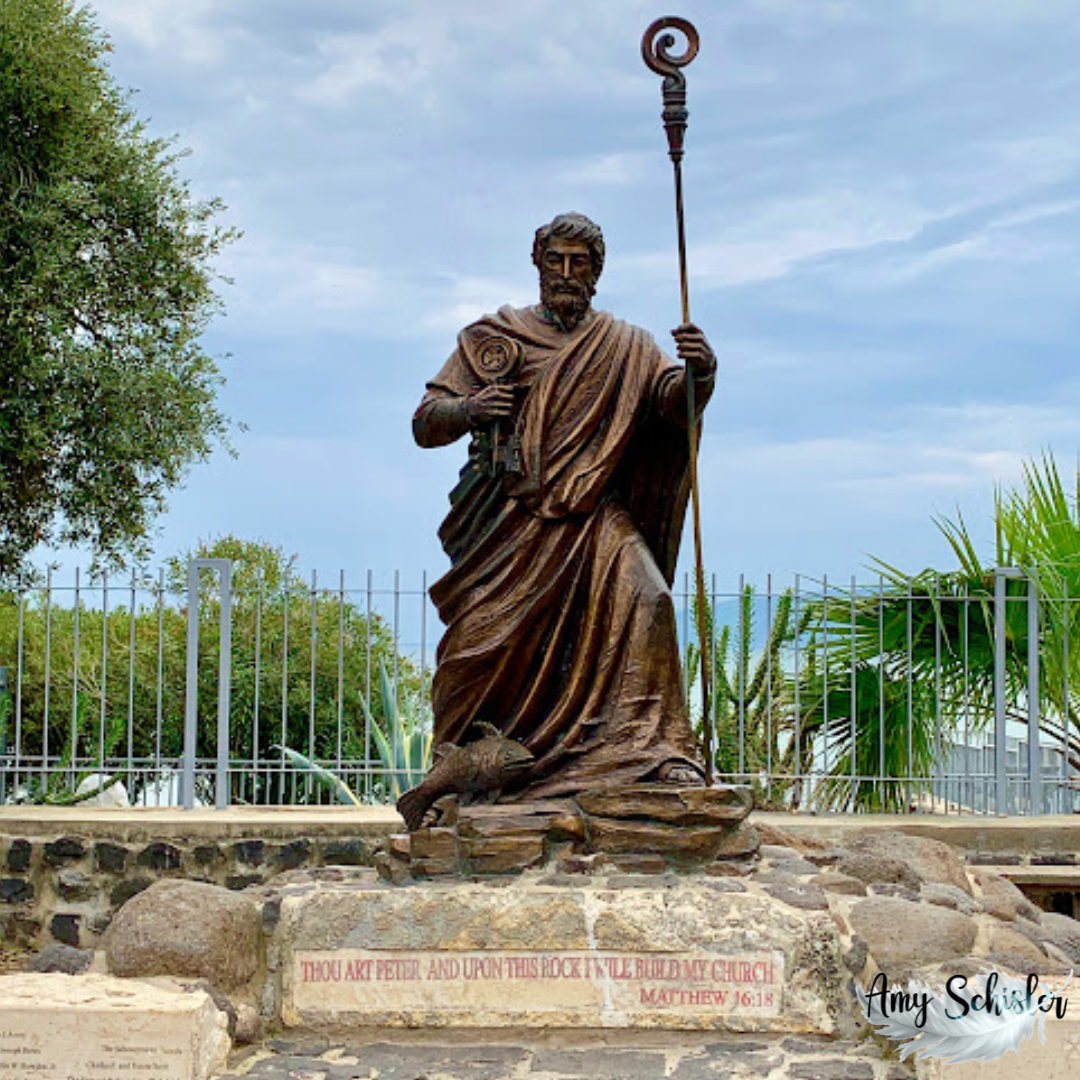
Peter alone made this bold declaration, and Jesus rewarded him with the keys to the kingdom, appointing Peter the chief steward (what we would call a prime minister today) over the Church, as Eliakim once was over Israel. In 2 Kings 19:2 and Isaish 36:22, we read that Eliakim was the chief steward, the keeper of the keys, the one who led the kingdom, guided the people, and maintained order whenever the king was away. His jurisdiction as the chief steward extended not only over the house of David, but “to the inhabitants of Jerusalem and to the house of Judah” (Isaiah 22:21).

This is why we say Peter was the first Pope. The Pope is the chief steward over the house of God here on earth—the leader, guide, and order keeper of the Church. Many other passages in scripture confirm this, yet Peter was still just a human being, and a flawed one at that.

Thinking as a Human Being

The very next scene tells us that Jesus next revealed to the Apostles that He would be killed and would rise again on the third day. Peter protested, saying:

“God forbid, Lord! No such thing shall ever happen to you.” He turned and said to Peter, “Get behind me, Satan! You are an obstacle to me. You are thinking not as God does, but as human beings do” (Matthew 16:22-23).

Poor Peter. First the head of the Church on earth, and then, likened to Satan. It took a long time for Peter to stop thinking as a human being and start thinking like God. Even after Peter’s denial, the Crucifixion, and the Resurrection, when Jesus asked Peter, “Do you love me” (John 21:15-17), Peter could only assure Jesus that he loved Him like a brother. In the original Greek text, Jesus asks Peter twice if he loved Him with the all-encompassing, self-sacrificing agape love, and then Jesus met Peter where he was and accepted his philio, brotherly love. Oh, how I can relate to that.

Imitating the Lord

I want so much to declare my trust and faith in Christ, the Messiah, the Son of the Living God. So often, however, I find myself thinking too much like a human being, doubting God’s power and might in this fallen world. I forget that He sees and knows everything, that He has everything handled, that everything is going to be okay. I want to step in and prevent anything bad from happening with my own human strength when I should be relying on God’s strength and omnipotence.

Luckily for me, Peter continued to give us his own example. On Pentecost, he stepped up and gave a speech so powerful, more than 5000 were converted that one day. Then, in 64 AD, Peter put his full trust in God and was crucified upside down, saying he was not worthy to follow His Lord’s example. Yet that’s exactly what he did. He imitated Jesus by accepting his death and being hung on the cross. He didn’t back down from his teachings, and he didn’t deny the Lord like he did that horrible night in the courtyard of Caiaphas.

Peter the Rock

At any point during his years of mission, Peter could have surrendered. He could have gone home and let the Church fail. He could have stopped talking of the Resurrection and gone back to being a fisherman, but he didn’t. He continued to speak the truth, to spread the Gospel, and to grow in his ministry, his wisdom, and his ability to think like God.

This is what we are tasked with. We all sin. We all lose sight of the Living God. At times, we all fail and falter and lose faith. We allow ourselves to think like humans and not like God. And that’s understandable because we aren’t God! However, we need to imitate Peter in growing our faith, become wise in the ways of God, and spreading the Gospel until death.

Humble yourselves, therefore, under the mighty hand of God so that at the proper time he may exalt you, casting all your anxieties on him, because he cares for you. Be sober-minded; be watchful. Your adversary the devil prowls around like a roaring lion, seeking someone to devour. (1 Peter 5:6-8)


Copyright 2025 Amy Schisler

Photos copyright 2025 Amy Schisler, all rights reserved.

Meeting Bruder Klaus

Meeting Bruder Klaus

Part II

Niklaus von Flüe was born to a successful and well-respected Swiss farming family in the Flüeli-Ranft region near Sachseln, Canton Obwalden, Switzerland, in 1417. At the age of 30, he married a local teenager named Dorothy, and together they brought forth ten children, while Klaus maintained and extended his family’s position in his community. He served his community as a soldier, councilor, and judge. He was known for his strong moral conscience, practical prudence, and thoughtful wisdom. Then he received a call from God that changed everything.

Biographers, theologians and, most recently, psychologists have translated and interpreted in different ways the historical resources about mystical visions Bruder Klaus experienced throughout his life. These visions began while he was still in the womb. But all commentators have come away with deep respect for his genuine holiness.
The first biography was written by the Abbot of Einsiedeln Abbey while Niklaus was still alive (1). Bruder Klaus recognized both the places and people at his infant baptism, because he had seen them before he was born, and his adult spiritual director, Heiny am Grund of Lucerne, authenticated these recollections (2).

Bruder Klaus gave wise counsel that prevented a civil war from arising in a conflict between urban and rural cantons, at the Tagsatzung of Stans in 1481.

His direct and powerful experiences of God eventually led him to become a hermit in the Ranft, with his wife Dorothy’s full support. She continued to raise their family in their original family home, while his older sons worked the farm.

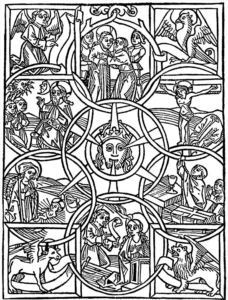
Bruder Klaus himself was illiterate. He drew maps of his encounters with a living God, and shared his drawings with trusted priests and monks as well as his loyal wife and children. As a man of the people and a man of his time, Bruder Klaus lived by the sacraments and prayer. He used images to communicate the ineffable.

His invincible moral character has continued to inspire pilgrimages to his simple home, and awe for his holiness, for more than six hundred years. He lived in a time of polarization, greed, and the violence of war – a time not unlike our own — through a century when even the Church was electing three conflicting popes.

And his legacy of faith has endured. He was beatified in 1669, and canonized in 1947 by Pope Pius XII.

I could go on and on myself, trying to tell you about Bruder Klaus.

What I really want to do today is to show you. Here’s an opportunity for a virtual pilgrimage of your own. I think you’ll find the film and images that follow worthy of meditation, should you feel inclined to experience the spirit of St. Niklaus, and his lasting impact, through traditional sounds and scenery of Switzerland that still resonate today. Film: https://www.youtube.com/watch?app=desktop&v=sm2Wjjs3-f0

Peace be with you.

Bruder Klaus Prayer

“My Lord and my God, take from me everything that distances me from you.
My Lord and my God, give me everything that brings me closer to you.
My Lord and my God, detach me from myself to give my all to you.”

Source, with attribution to the Catechism of the Catholic Church,

https://en.wikipedia.org/wiki/Nicholas_of_Flüe


© Copyright 2025 by Margaret King Zacharias

Sources

  1. https://en.wikipedia.org/wiki/Nicholas_of_Flüe
  2. Von Franz, Marie-Louise, Niklaus von Flüe and Saint Perpetua: A Psychological Interpretation of Their Visions, Asheville, N.C., 2022, pp. 10-11, IP 15, fn. 13-24. This work is cited here for scholarly translation of original German biographical sources and summary of historical facts about Bruder Klaus, originally written in German and only recently translated; without endorsing all interpretations made in this volume, per the caveat offered in the book below.
  3. Ulanov, Anne Belford, and Dueck, Alvin, The Living God and Our Living Psyche: What Christians Can Learn from Carl Jung, B. Eerdmans Publishing Co., 2008. The authors warn that, although theology and psychology can each offer valuable insights to the other, they are not the same, and not all of their different perspectives always overlap or agree.

Images:

Featured Image: Main room of the home where St. Niklaus von Flüe lived with his wife Dorothy and ten children during the first half of his life. Attribution: A Pakeha, CC BY-SA 4.0 <https://creativecommons.org/licenses/by-sa/4.0>, via Wikimedia Commons. File URL

Painting after the prayer wheel visions hand-drawn by St. Nicholas of Flüe. Attribution: Public domain, via Wikimedia Commons.

Woodcut after the map of his visions, hand-drawn by St. Niklaus von Flüe. He called the original scrap he used for prayer in the humble Ranft hermitage, his “book.” Attribution: Public domain, via Wikimedia Commons.


Achieving health, well-being and stronger faith one day at a time

Achieving health, well-being and stronger faith one day at a time


“I promised myself and God that if I found the answers to my struggles with my weight and health, I’d be bold and brave and share what I’ve learned with others. The tribulations that have caused me the most pain in my life – my mess – becomes my message.” — Shemane Nugent


Oftentimes, the promises on book covers are more the crafting of marketing departments than the authors: be the best parent in one hour; 21-days to real health; financial independence and a rich, free life. Anyone looking at them realistically would admit that, while the techniques may be effective, achieving the authors’ intentions would be slower and more gradual.

The cover of Shemane Nugent’s 2025 release, Abundantly Well (Good Books), also makes such a cover claim. Situated within a ribbon vector image, it promises, “40 days to a slimmer, healthier you.” From a sales perspective, it’s a sexier enticement for the writer’s audience, most likely women ages 40 and up. If that’s the grabber, it does a disservice to the book and Mrs. Nugent’s comforting, faith-infused style because the whole intention of this book is more than losing weight. The subtitle, “Bible-based wisdom for weight loss, increased energy, and vibrant health” says more about what’s inside. Rather than a crash course for temporary results, Abundantly Well offers ways for women to sincerely regard themselves as “temples of the Lord,” and not just in body but in mind and spirit. While written in a topic a day, 40-day format, Abundantly Well is unique from other health and fitness books because it is prayer and God-centered with the author’s recurrent reminder of taking “small steps” that work for the reader’s life.

Each day’s topic begins with a Bible verse that fits the chapter contents. After the main content, supported not just with her own opinions and experiences, but other Bible verses and scientific articles, is the “Move Forward” portion, where the author asks, out of the information just presented, what one or two parts could be added to your life today? The day’s readings and motivations are capped with prayer.

Cover of Abundantly Well by Shemane Nugent

She ventures between the days addressing fitness and weight loss, with writings on healing trauma, detoxifying your home, aging, prayer, service to others, and spiritual warfare. While she doesn’t go in-depth on the topics — they are meant to be easy to digest daily, she provides insightful information and resources to learn more later. On Day 12, she begins to demystify cravings and on Day 17 managing “Hormonal Havoc.” Day 14, “Detoxify Your House,” she addresses many small ways we add poisons to our lives through the gasses and chemicals in things as plastic bottles and scented trash bags.

When Mrs. Nugent writes about nutrition and fitness, she differentiates it from typical approaches by grounding them in a Biblical framework and a mindset of moving forward. Day 7, “God Food Verses Man Food” is a realistic reflection of the mass-produced food industry compared to the often-vilified individual hunting practices.

“Some people say they could never kill an animal, but even if you’re a vegan, you are responsible for killing millions of birds, geese, rabbits, possums, and deer. The roads you drive on, the shopping mall you frequent, your house — these were all once wildlife habitat. Your vegetable garden too! By making way for those areas to be habitat-free, you have to kill every squirrel, rabbit, chipmunk, pheasant, dove, turkey, and deer. We are all complicit (pg. 25).”

Within these pages, she speaks of what she knows and lives.

“I promised myself and God that if I found the answers to my struggles with my weight and health, I’d be bold and brave and share what I’ve learned with others. The tribulations that have caused me the most pain in my life – my mess – becomes my message,” she writes (p. X).

Mrs. Nugent is co-author with her husband of more than 30 years, Ted Nugent (yes, that actual rock star, Ted Nugent) of the 2016 release, Kill It and Grill It, about preparing and cooking wild game. She also authored, Killer House, her story of surviving illness from toxic mold found in her home. She has been in the fitness industry for 40 years as an instructor and program developer, and is host of the Sunday morning show, “Faith and Freedom” on Real America’s Voice network. It could be easy to look at Shemane Nugent, who maintains her figure and beauty past the age of 60 and dismiss her as a celebrity author and wife of a mega star who can buy whatever she needs to achieve happiness. But don’t be so quick to judge. She has endured major surgery, forgiven marital infidelity and beaten a life-threatening illness. She regrets spending too much of her life being a “doormat,” stuffing down deep grief, and lacking confidence, without a note of self-pity. She also admits to eyelash extensions, trying botox, and indulging in chocolate chip cookies and cupcakes. She shares with her Christian sisters that she learned to take the difficulties in life and use them to grow stronger and develop her prayer life and reliance on God and she wants the same for them.

How we think, how we feel, how often we move, what we breathe into our bodies and ingest, our perspective of God, prayer, gratitude, and service to others, all play a part in our health. You may not live a rock star life, but Shemane Nugent maintains that you do not need to; you just need to take baby steps every day, accompanied with prayer and gratitude, toward achieving your goals.

© Copyright 2025 by Mary McWilliams

Feature Image by Pexels from pixabay.com

Inset by Mary Mcwilliams

The Worthy Writer


“I’m learning that God doesn’t wait on perfection. He works with the writer who is writing through the distraction —the kids fighting, the sticky floors, the dishes piling up.”


I don’t know what it is, but whenever I write for a Catholic audience, I freeze up. I play it safe. I choose a neutral, educational topic. The teacher in me justifies it — after all, don’t readers want useful information? That works in a classroom or with children. But most of the time, I want to speak to women like me.

For years, I felt like I couldn’t write in Catholic spaces because I didn’t have my life in order.

How could a single mom, never married, talk about being Catholic? People wanted to hear from the wholesome Catholic mom blog, where the mom is homeschooling ten kids and has a cute Catholic craft for every feast day. That wasn’t me.

I was a Latina mom living in income-based housing. Eventually, I got married—maybe to prove I had the “credentials” to run a Catholic mom blog. I had a husband, a yard, and a house. Still, my life didn’t magically become blog-worthy. My husband lived abroad with our eldest son to support his soccer dreams, and I was left trying to manage everything alone, including a lawn I couldn’t keep up with. How could I write now?

But God kept calling.

Like Samuel, I didn’t know how to respond. Me? Really? Let me get my life in order first, then I’ll start the blog. But life doesn’t wait to be sorted out. The years passed. My circumstances didn’t improve, and I wasn’t getting any younger. Eventually, I got tired of waiting to become a “worthy” writer.

I’m learning that God doesn’t wait on perfection. He works with the writer who is writing through the distraction —the kids fighting, the sticky floors, the dishes piling up.

What do I have to say to others? I don’t have a perfect marriage, but I still show up. I don’t get my kids to Mass every Sunday, but we make daily prayer a habit. I do novenas even when I’ve done them before. Even when prayers aren’t answered. I’ll reach for God in a phone app, fitting faith in my life however I can.

When my kids were younger, we prayed the rosary together. Now that they’re teens, it’s not so easy—and I don’t want to force them. So we say Grace before meals and thank God for our blessings. We pray for the 14-year-old soccer teammate who lost his mom before Mother’s Day, for my five-year-old who suffers from daily tummy aches, for my sister who lost her job.

Even the things that aren’t too visibly Catholic count too. Like making sacrifices as a family to help one another live out our dreams. The biggest one? Leaving behind American comforts to support my son’s soccer career in Mexico. Still, the small sacrifices are just as good, like the parable of the Widow’s offering. I see this when my 13-year-old takes her younger siblings to the park for two hours so I can write—even though she’d rather be lying in bed, scrolling on TikTok.

Or how my husband puts up with Mexican traffic and crooked cops every time he drives two blocks for Domino’s pizza.

Mexico is broken with corruption, crime, and drugs, but it’s a country that wears its faith like a tattoo sleeve. You can find a statue of Mother Mary drilled on the concrete walls of crumbling homes, makeshift altars on dirt roads, and a cross hanging on the doorway of the 7-Eleven.

Here, you don’t have to be perfect to be Catholic. I used to compare myself to the ideal American Catholic family. It’s what we do in the U.S., asking others: What school do your kids go to? Where do you live? What Mass do you go to? Secretly sizing them up, and almost always falling short. Now, I see things through a global perspective. My two-bedroom apartment could have easily been a dream for someone living in another part of the world—like Mexico. Faith isn’t bigger in bigger homes. It’s in the homes with addresses scratched on with a rock, in churches that have no air conditioning, but are so packed that they have to bring out the baby stools for extra seating. This is Jesus’s story, and I kept missing the message.

Mexico consistently ranks among the world’s happiest countries, despite widespread poverty.

On any Sunday at 10 p.m., families are still out getting ice cream. They make dinnertime a special event by eating outside on their patio. They set up a large table and chairs, bring out their big screen TV, tune in for the soccer match, and grill. It’s not about what you have but what you make out of life.

The same goes for writing.

You don’t have to be perfect to be a Catholic writer. Catholicism can be scary, you can feel judged, and it can be hard to live up to. The good news is that God doesn’t measure your worthiness by worldly success. I used to think I needed a theology degree, too.

God needs you …  from … (insert your name and rep your block). Look, he just made a pope out of someone from Chi-town! So if God is calling you to write, trust and believe. Or as my  older sister would say, “Did I stutter?” or better yet, “You got something in your ears?” He wants you and your story-worthy story in all its grit and glory.

© Copyright 2025 by Janet Tamez

Feature Photo by Angel Rkaoz: https://www.pexels.com/photo/nun-in-habit-writing-in-book-20535450/

God Speaks to the Self We don’t yet Know

God Speaks to the Self We don’t yet Know

Who are you?

What is your true identity, and your role in God’s great design?

To start with, you are not who you think you are, at least, you are not only who you think you are.

It is difficult enough to learn to see yourself as other people see you. Others see so many things that we do not see about ourselves, and how much better off would we be if we could know how we are seen by other people?

But can you learn to see yourself as God sees you?

Only quite partially, now, on earth. That awareness will come fully when you meet God face to face for your particular judgment. It won’t happen on a certain day, because you will have slipped beyond time and this life when you arrive at your judgment before God

Some who are skeptical about God might say, “Oh, you don’t really know if there is a life after death. You might not face God for judgment, because there might just be nothing.”

But they partially know that isn’t true. They might notice that the judgment of each of us is already underway – within us. They might know (perhaps subconsciously), because there is something dwelling within each of us that we refer to by the word conscience.

Our conscience speaks to us

There is something inside of us that we did not create or design, and that we can partially ignore, yet, willing or not, it will trouble each one of us. Conscience will speak to us – most strongly when not bidden. It points beyond our subjective understanding and our personal values or judgments, and it speaks objectively to us about who we actually are, when seen in the full light.

God speaks to who we are, not who we think we are, or wish others might think of us. Our inaccurate image of self is usually a catalog of illusions we’d like the world to believe about us. When God speaks to us, He is not simply addressing our inadequate and incomplete image of ourselves. He is speaking to the fullness of our self, to that which may be outside of our conscious awareness yet is essential to our complete being.

God changes us by His communications to us

When God first called young Samuel in the temple (1 Samuel 3:1-10), awakening him from his sleep, or when God spoke to Joseph in his dreams (Matthew 1:20-21), His first direct approach came from beyond the conscious limits of their sense of who or what they were. His messages informed them of who they were called to be.

When God (Jesus) first spoke face to face in this world to Simon (John 1:42), He referred to who Simon knew himself to be – his name and his parentage – but then God pointed to his greater self, to the self who was known to God – Peter, the rock. God changes us by His communications to us. He points us towards the fullness of who He made us to be, and to the purpose of our part in His greater plan.

God knows us in ways we cannot understand or imagine. He seeks now to address us in ways that are, to us, both conscious and unconscious. We might experience His speaking to us in ways deeper than our conscious understanding without our recognizing it. For example, through piercingly pertinent scripture passages, or one might notice patterns in nighttime dreams, or in the events of one’s life, or prompts that come in subtle ways and surprise us. We might reflect on the persons and situations in our past or present, and come to recognize ways God has been at work.

His message, though, might be misperceived, such as when we feel frustrated by an annoying obstacle to a path or goal we pursue, one which He knows is not right for us. Yet His communications can also be most intimate, direct, and personal.

But there’s more that He already does communicate, and that He wants to communicate to us. There’s always more, because He is always More.

God is always actively engaging and communicating Himself to us, and ourselves to us, as well.

He is guiding us towards the fullness of our true self, so we might meet the fullness of Him, and join in His eternal joy.


© Copyright 2025 Tom Medlar

Jubilee: A Coming Out of the Wilderness

Jubilee: A Coming Out of the Wilderness

Years ago, when my dad was stationed in Italy, I was blessed to be able to take part in Italy’s jubilee in 2000. I didn’t think I would get the opportunity again. Jubilees only come along every 25 years and I live far away from Italy now.  When I stepped through St. Peter’s Holy Door in 2000, I never would have guessed that I would not only get to participate in Rome’s jubilee again, but that I would have a husband and three children in tow!

A jubilee is a time of forgiveness and spiritual renewal. The word jubilee means a time of celebration. We are celebrating God’s merciful love during a jubilee. Everyone is encouraged to participate, whether locally or through a pilgrimage to Rome and to receive the plenary indulgence. https://www.usccb.org/jubilee2025

When my husband first mentioned a possible trip to Italy for the Jubilee, I panicked. I’m a bit of an anxious person to put it lightly. All of the things that could possibly go wrong when bringing a family of five to Italy immediately filled my mind. I put our family on a strict “Don’t talk about the trip to Italy” notice in order to mentally avoid the inevitable. For the next several months, my husband quietly researched, planned, and bought tickets for our pilgrimage. I quietly brushed up on my Italian but stubbornly remained in denial.

In March, we landed in Venice and made our way through cities such as Siena, Assisi, and Florence, visiting many holy sites and preparing ourselves for the final stop in our pilgrimage – Rome. Italy, like America, has grown farther and farther away from God. It is hard to imagine the existence of a world where political – and even church– governance was heavily influenced by faith in the one, true God. This, however, is what the elaborate paintings in their government houses depict. God first, high above mankind, and all those below searching the Heavens and sometimes even pointing above in the realization that true governance comes from God.

That is what jubilees are about. An opportunity for us as individuals and, hopefully, as a society to renew our focus on God, His teachings, and His boundless love for all of us. Now, more than ever, the world needs this awakening. We need this hope.

Without this hope, however, I would never have even made it to Italy. Remember, I was so worried about all that could go wrong on the pilgrimage to Italy that I secretly preferred not to go at all. This was a grievous lack of trust in God on my part. Instead of turning to Him, instead of surrendering to Him, I almost missed out on a beautiful opportunity to allow my family a trip to the Holy City! I needed to surrender my heart to Him and ask Him to enter under my roof before I could enter under His.

This year’s jubilee calls us to be Pilgrims of Hope. Before I could even depart on this pilgrimage – I needed hope. As soon as this realization dawned, I was able to see this huge trip we would be undertaking as a just what it was meant to be – a pilgrimage. Pilgrimages are not easy. The first jubilee was decreed after the Israelites made it through 40 years of wilderness. Only after their desolate pilgrimage and only when they finally surrendered their stubbornness and made it to the Promised Land did the people enjoy their jubilee. “Proclaim liberty throughout all the land to all its inhabitants. It shall be a jubilee for you.” (Leviticus 25:10)

Looking back, I find it poignant that the hardest challenges for my family came prior to us even leaving and these challenges seemed to be allayed only when I surrendered and trusted the Lord with abandon. All at once, the wilderness cleared and our path to the Holy City unfolded.

Any pilgrimage we take during this jubilee year, whether to Italy or within our hearts, must start very close to home. Though I’m home now, my pilgrimage of hope should not be over. I’m to be an example to those around me of God’s loving mercy, at home and at work. This pilgrimage of hope starts in our heart. What does it benefit us to walk through the Holy Door at St. Peter’s if our heart is not as beautifully decorated as the basilica’s walls? Will I carefully place jewels of patience, love, and mercy into the altar of my heart? Will I perfume the chamber with oils of humility and kindness? When the Holy Doors close and the jubilee ends, how much more radiant will my heart be?

No matter where we find ourselves this jubilee year, let’s start with the heart. I plan to take time during daily prayer to look within and check on the progress within the basilica of my heart. Hopefully, at the end of this jubilee, I will be able to hand our Lord a heart I’ve done something to improve. All hearts can be like an ugly, rough stone, but each heart is greater than a precious jewel in the eyes of the Lord. With careful refinement, our hearts can shine like the beacons of hope God meant them to be. Let us renew our hope in Him and take up the pilgrim’s staff. God speed on your journey!

Copyright by Emily Henson 2025

Edited by Maggie Rosario