
A Gangbanger’s Journey to Sainthood: Meet Peter Armengol

A Gangbanger’s Journey to Sainthood: Meet Peter Armengol


Please turn on your imagination

Imagine being a dad with a teenage son who has seemingly turned his back on you. He has rejected the values you have worked so hard to instill in him, and he does not seem to care about anything but his own selfish wants. You wonder how this could be. He is 19 years old, and you have not seen him in over a year. A sense of despair has gripped you. You are alone in your living room. You fall to your knees and begin to pray for your boy.

Besides your wife and 14-year-old daughter, you have other things on your mind. You are a respected police chief in a city of two million people where a major political convention will take place in two days. You have been asked by the police commissioner to coordinate the security forces on the convention center’s perimeter. You have a job to do, and right now, it takes precedence over other things.

At 6 p.m. on the convention’s first night, protesters begin gathering on the center’s east side. You can see that they are well-organized and plan to create mayhem. At 9 p.m., the crowd numbers several thousand, and the screaming and yelling is getting intense. Suddenly the crowd, urged on by several masked protesters, surges forward and then breaks into a charge.


One man stops and falls to his knees

Dressed in riot gear, you are standing at the forefront of your men, and in your hand is a taser. One man is charging right at you when suddenly he stops short, falls to his knees, and drops his hands to his sides. You hurry up to him and yank off his mask. You are stunned because you are looking down at your son. He is crying and telling you he is sorry. You lift him up and you hug each other. The surging crowd, witnessing this unexpected turn of events, stops and becomes quiet.

 

null


Dial your imagination back in time

Does that sound far-fetched? If so, let us now travel back more than 700 years to a day when something like this really did happen. Even though it may be 700 years ago, people then were like people now when it comes to their wants, needs, and emotions. It especially held true when it came to family.

Arnold Armengol was a member of the Spanish hierarchy. Despite receiving the finest education and upbringing, his son, Peter, rejected that and fell into the secular trap of self-centeredness, self-gratification, and outright depravity. He even joined a band of criminals that preyed on people traveling up the mountains. Peter was so good at this work that he eventually became the gang leader.

King James of Aragon asked Arnold to lead him on a journey to Montpellier so he might meet with the King of France. The King had heard of the brigands that preyed on mountain travelers and wanted his royal guard prepared for any attack.


The crime was punishable by death

As Arnold Armengol led the King’s entourage through the mountain passes, they were attacked by a band of highwaymen. As the robbers charged toward them, Armengol led his men in a counter-attack. With his sword drawn, he headed directly for the pack’s leader. They were about to engage each other when the robber fell to his knees. He recognized his father and, with tears streaming down his face, prostrated himself at his dad’s feet and handed over his sword. The penalty for his crimes was death.

Peter Armengol, repentant and seeking mercy, appealed to King James I and received a pardon. He was filled with shame and, heeding the graces God offered him, entered a Mercedarian Monastery in Barcelona. The Mercedarian’s mission was to use available funds to ransom Catholics captured by the Muslims. Peter excelled at this task and, over a period of eight years, managed to negotiate the freedom of many hostages from the Saracens.


From gang leader to Mercedarian friar

Friar Peter then headed to Africa with Friar William Florentino. His goal was to ransom Christians. On arrival in Bugia, he heard about 18 Christian children held hostage by the Mohammedans. They were under the threat of death if they did not renounce Christianity. Friar Peter offered himself in exchange for the hostages. The captors agreed but warned Peter that he would suffer brutal torture and death if the ransom were not paid on time.


Sentenced to be hanged

The arrival of the agreed ransom and Friar Peter’s release was scheduled for a particular day. The ransom never arrived. Peter was immediately put to torture and endured this for a full day. Tired of Friar Peter being alive, the Moors accused him of blaspheming Mohammad. He was sentenced to be hanged.

Friar Peter was hanged from a tree about a half-mile from the prison walls. His body was left there for the birds of prey to feed on. Six days later, Friar William arrived with the ransom. The Moors refused it and told Friar William that Peter had already been dead for six days and his rotted corpse was still hanging from the tree. Distraught, William went to recover his brother Mercedarian’s body.


The dead man began to speak

William left and headed to the execution site. As he approached, he noticed that Peter’s body seemed to be intact. There was also the fragrance of flowers in the air. William slowly approached the body of Peter. The man who was supposedly dead for six days began to speak. He explained how the Blessed Virgin had come to him and held him up with her precious hands the entire time so his body would not hang on the rope.


The HAPPIEST six days of his life

When recalling the miracle of his hanging, Peter Armengol told his Mercedarian brothers that the happiest days of his life were those six days he hung from the gallows supported by the Blessed Virgin Mary. Peter’s neck, broken from the hanging, remained twisted for the rest of his life, and he always had a sickly complexion. Seven documented miracles were attributed to him while he was still alive.

Peter was 28 years old when he was hanged. He died in 1304 at the age of 66, having lived 38 years after being saved by the Blessed Virgin Mary from death by execution. Pope Innocent XI canonized Peter Armengol on April 8, 1687.

We ask Saint Peter Armengol, O. de M. to pray for us all.


Copyright©Larry Peterson 2023
Image: Pexels
 

Everyday Holiness

Everyday Holiness

When I received the news that my first published short story had not only been accepted, but also chosen as the opening gambit for a travel writing anthology that included pieces by several well-known authors, my first thought was, “I have to call Mom and tell her I got the lead. She’ll be so excited.”  And then I remembered.

The woman who nurtured my first crayon scribbles, and typed my long-procrastinated school term papers on an old manual typewriter, had already been absent for fifteen years by then. Even now, thirty-four years after her death, I still get the same urge to call and tell her, whenever there’s happy family news.

Anyone who has ever lost a beloved family member, or cherished friend, understands.

This past week we’ve celebrated two special liturgies that traditionally open the month of November. They encourage us to honor all the saints in heaven, and to remember our beloved dead.

The Roman Catholic liturgical calendar gives a rhythm to our lives, alternating ordinary days with special feasts and dramatic seasons: Advent, Christmas, Lent, Easter and Pentecost.

But we don’t just remember our lost loved ones on the Solemnity of All Saints or at a Commemoration of all the Faithful Departed.

The simplest things can suddenly trigger a memory: the smell of a favorite family meal simmering in the kitchen; a glimpse of the lamp burning late into the night while a parent stays up late to pay bills; a toddler’s smile greeting us in the morning over a crib rail; the precious small gift from a thoughtful friend who somehow always knew just what we needed, and when.

Amidst many speeches that marked my oldest son’s baccalaureate ceremonies, the university dean who spoke at his academic awards assembly made a particular point for the new graduates. His words held a wisdom that has remained with me.

“It’s not this ceremony that’s important,” he said. “Or that splendid certificate that you’re about to receive. We’re celebrating all the mornings over the past four years that you got out of bed and went to class, all the nights you studied in the library instead of partying, all the papers you wrote with extra care, everything you did that led up to this day. Yes, today you’ll be ascending the stage, you’ll hear lots of applause, and your families are gathered here to celebrate with you. But it’s those ordinary days, the good choices you made one after another, the habits you established, that are your most important awards. They’re what you’ll take with you wherever you go for the rest of your lives.” (1)

In our Mass readings this weekend both liturgies contrast humility and charity with arrogance and entitlement.

Today’s Memorial of St. Charles Borromeo incorporates an Alleluia verse that is also used to celebrate the Solemnity of the Most Sacred Heart of Jesus:

“Take my yoke upon you and learn from me, For I am meek and humble of heart.” Matthew 11:29ab. (2)

In the Gospel reading, our Lord advises us “. . . do not recline at table in the place of honor . . . when you are invited, go and take the lowest place . . .” Luke 14:1, 7-11. (3)

Readings for the Thirty-first Sunday in Ordinary Time contrast a mother’s affectionate care and a child’s implicit trust, in the Responsorial Psalm 131: 1,2,3, with Our Lord’s condemnation of arrogant scribes and Pharisees, in the Gospel from Matthew 23: 1-12. (4)

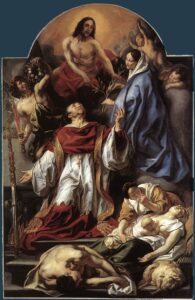
St. Charles Cares for the Plague Victims of Milan by Jacob Jordaens (1593-1678), St. James Church, Antwerp, Belgium, public domain via Wikimedia Commons

St. Charles Borromeo was born in a castle on the shores of Lake Maggiore. His father was a Count of Lombardy whose aristocratic family’s shield bore the motto, “humilitas.”

His mother was Margherita de Medici, whose younger brother became Pope Pius IV. (5).

The paintings featured here commemorate St. Charles Borromeo’s assistance to the poor during a famine in Milan; and his refusal to leave the city after an outbreak of the plague. He remained behind in his own episcopal see while many other bishops and clergy fled. He stayed to pray for his people as their archbishop, and administered the sacraments to plague victims.

Even while he was serving as a papal representative to the Council of Trent, and performing as a leading figure in the Counter-Reformation, St. Charles Borromeo never forgot his family motto, humility; or the Jesus who washed his own apostles’ filthy feet.

Both of these paintings, and many more found in museums and churches across Europe (6), document St. Charles Borromeo’s devotion to the humble Virgin Mary. Her vivid presence in so many of his portraits reveals the close relationship they shared in his charitable work, in his intercession for the people of Milan, and in his dedication to the universal Church.

This November — while we’re preparing for Thanksgiving and the Solemnity of Jesus Christ, King of the Universe — may we, too, remember to practice the extraordinary virtues of ordinary everyday holiness.

©Copyright 2023 by Margaret King Zacharias

Feature Photo: Intercession of Charles Borromeo Supported by the Virgin Mary by Johann Michael Rottmayr (1656-1730) in the collection of Karlskirche, Vienna Austria, public domain, via Wikimedia Commons

Notes:

  1. Personal communication.
  2. (https://bible.usccb.org/bible/readings/110423.cfm).
  3. (https://bible.usccb.org/bible/readings/110423.cfm).
  4. (https://bible.usccb.org/bible/readings/110523.cfm).
  5. (https://www.newadvent.org/cathen/03619a.htm)
  6. (https://www.christianiconography.info/charlesBorromeo.html).


Love Is Life that Pours Itself Forth

Love Is Life that Pours Itself Forth1

Why must the path of self-giving love also be the path of the cross? Can’t we be loving people without having to travel the way of the cross? No, we can’t. At least, we can’t be the deeply loving people that God has called us to be (Mt 16:24; Mk 8:34; Lk 9:23). Because we were created to share in the divine love, we’re called to learn to love as God loves. And that means being willing to break ourselves open and pour ourselves out in love for God and our fellow human beings, just as Jesus did on the cross. And that requires busting some holes in the walls that we have all built around our egos, the walls that get in the way of love: walls of pride, and self-protection, and self-pity, and fear, and prejudice, and hatred, and anger, and . . . the list goes on and on.

Sacrifices made for the sake of the beloved and suffering undergone for the sake of the beloved help to punch holes in those walls we’ve built around our egos, holes that allow the divine love to flow into us more freely and to then flow back out of us to God and neighbor. Self-sacrifice and suffering for the sake of others help us break out of the self-imposed dungeons of our egos and join more fully in the eternal circulation of love. That’s why sacrifice and suffering turn out to be required courses in the school of love. That’s why we all have to be willing to walk the way of the cross. Yes, it can be painful (sometimes, very painful) to open ourselves up to love, to open ourselves up to self-sacrifice and suffering for the sake of love. But doing so also turns out to be immensely fulfilling, even joyful. We are most fully alive when we are most fully breaking ourselves open and pouring ourselves out in loving self-gift to God and neighbor, for it is precisely then that we participate most fully in the superabundant, overflowing love and life of God.

[i] Hans Urs von Balthasar, Heart of the World. San Francisco: Ignatius Press, 1979, p 25.

This article is an excerpt from Rick’s latest book, The Book of Love: Brief Meditations.

Photo by Henrique Jacob on Unsplash

Copyright 2023 Rick Clements

What is the Rosary?

What is the Rosary?

October is the Month of the Rosary, and many authors have already written insightful and inspiring articles explaining and promoting it. We know the rosary is a tremendous tool, and that it also has many positive physiological benefits besides the more obvious spiritual ones.

But this October, I thought I’d try my hand at something a little different, namely a poem about the rosary.  Here it is, in three short verses.


What is the Rosary?

A rosary’s a ladder;

It goes up and down.

Connects us to Heaven,


Through Mary, on the ground.

Through the life of our Lord,

We travel anew.

By His death, we’re forgiven;

The covenant renewed.


By the work of the Church,

We two are made one.

Now our prayers are hers,

‘till God’s kingdom comes.


© Copyright 2023 by Sarah Pedrozo

Featured Image: iStock-Mary-statue-in-blue-with-rosary-formatted.jpg

With God, You Can Handle Anything

With God, You Can Handle Anything


I had the gift of an extra-fruitful spiritual direction session not too long ago. I usually keep the details of the conversations between me, the director, and God. However, there are moments where sharing my experience may benefit others, and this is one of those times.
I cannot recall the topic we were discussing when my director began to share a story about a three-handled coffee mug. She told me when she presented this thought exercise to others in the past, they became overwhelmed and anxious at the thought of how to hold it or use it. As I began to imagine it in my mind, I was intrigued and excited all at the same time. When my spiritual director asked how the three handled mug made me feel, I couldn’t help but share that I saw the persons of the Trinity—a handle for Father, Son, and Holy Spirit.
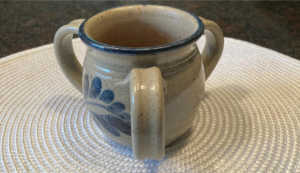
While imagining this mug, the emotions of anxiety and stress never entered my mind. I felt peace knowing I was in good company. I had actually hoped there might be a fourth handle on which to place my own hand. I began to consider all of the times in my life when I needed the power of God to move mountains. That handy coffee mug would be a reminder that both all things are possible with God and that I am not alone.

I also related to why having a cup with that many handles would confuse some. I considered times when I felt pulled in multiple directions and how difficult it is to anchor myself in one place. I believe that worry is the thief of joy, and I consider anxiety the brother of worry. Don’t get me wrong, there are many times when my mind wants to let fear win, but my prayer experience reminds me that I am not supposed to tackle life alone. God is in it with me.

Thinking back on that session, I laugh at how surprised my director was by my response. I was the only person she had encountered who wanted a three-handled mug and the strength it would give me.

In their book called Personal Prayer: A Guide for Receiving the Father’s Love, Fr. Boniface Hicks, OSB and Fr. Thomas Acklin, OSB brought up the topic of anxiety as a gift from God. When we experience anxiety, it comes in the form of a felt emotion. Usually, it sends off an alarm that something needs to be corrected. We can take this signal and consider it a direct alert from God, letting us know that we want to take control. Then we can bring it to God and surrender the situation to Him. How wonderful it is that we can go to God for help, and what a powerful image it is to imagine our hand, with the Trinity, banding together as one to accomplish anything.

A month after this session, I still could not get the image of the three-handled cup from my mind. I had an unquenchable longing to hold one and imagine God’s hands along with mine, having a conversation over a cup of coffee. I finally allowed the urge to win out, consulted the internet, landed on eBay, and a week later I clutched my three-handled mug. The cup is hand-made pottery, with a bumpy texture. The sentimental type I am, I can imagine the hands of the person who created it. I slide my fingertip across the initials scratched into the bottom, too blurred to make out. A reminder of my imperfections and the faithfulness of God. The space where the handles joined the cup reveals finger swipes, merging the clay. A prayerful moment brings me peace in connecting with another person who loved that cup while combining myself with the persons of the Trinity.



I’ve prayed with the cup only a couple of times, and depending on what I fill it with, there may be a heaviness to it, or it remains light. I have also filled it with feelings, concerns, and prayers. Imaginative prayer is not for everyone, but if it connects you to God, go for it. In my days, when life gets so heavy I need to unload, I place my hands alongside the persons of the Trinity and lift my cup to the heavens. I may not be able to handle things independently, but I can do all things with God.


Copyright 2023 Kimberly Novak
Images Copyright Canva

Cath-Lit Live: Royal & Ancient

Cath-Lit Live: Royal & Ancient

“Cath-Lit Live!” features brief interviews with Catholic authors who are releasing new books. Hosted by Catholic author and speaker Amy J. Cattapan, “Cath-Lit Live!” gives viewers a glimpse into the latest Catholic books while getting to know a bit about the author as well.


null


Royal & Ancient by Amanda Lauer

Bronwyn Campbell’s end-of-summer plans were simple: wrap up her job at Saint Andrews Country Club, meet her friends one last time at the virtual reality arcade, and move across the country—again—with her father. But when lightning strikes while she’s working the club’s Saint Andrews Heritage Day, she’s transported from an American fairway to the home of golf, The Links at St. Andrews, in Scotland—and in the year 1691, no less.

When Iain MacDonald discovers Bronwyn knocked out cold on the seventeenth green, little does he know their meeting would change not only the course of their lives but the course of history. The son of the chieftain of Clan MacDonald, Iain bears the weight of responsibility for his family and his clan’s survival on his shoulders. Family drama and the growing discord over religion in Scotland add to the heavy load he carries daily while stepping further into his role as future chieftain.

As political events between England and Scotland heighten the conflict surrounding the MacDonald lands, Bronwyn and Iain rely upon their shared faith and growing feelings toward each other for survival. Amid the questions that plague both of them, though, one stands out: How can you be with the one you love if your choice ultimately influences history?


About the author:

An avid reader and history buff since childhood, Amanda Lauer is the author of the award-winning Heaven Intended Civil War series. In addition, Amanda has written two time-travel novels Anything But Groovy and Royal & Ancient, she contributed short stories to the anthologies Treasures: Visible & Invisible and Ashes: Visible & Invisible. Amanda and her husband John have been married 42 years, have four grown children, a daughter-in-law, three sons-in-law, and eight precious grandchildren.


You can catch “Cath-Lit Live” live on A.J. Cattapan’s author Facebook page. Recorded versions of the show will also be available to watch later on her YouTube channel and Instagram.


null


Copyright 2023 Amy J. Cattapan
Banner image via Pexels

Marketing: Why Is it Important for Writers?

Marketing: Why Is it Important for Writers?

Marketing is a very big word. It is used by traditional publishers, literary agents, and self-published authors. It is very important in both publishing industries. But why is this word so important?

If you want any of your self-published books to sell at all, no matter if it is on Amazon, IngramSpark, Lulu, or another self-publishing platform, you have to spread the word! If you don’t have any type of promotion, then your books are probably not going to sell.

One nice thing about Amazon’s free 90-day enrollment program is that once your new book gets enrolled on their platform, within just a few days, you are going to see the amount of copies sold of your self-published books go up.

I just figured out how to use this free tool, and I’m so glad that I enrolled my books in Amazon’s enrollment program.

The main reason why traditional publishers and literary agents talk about marketing on their websites is that if a book sells really well, they are going to take that writer seriously. If a book does not sell, then they are not going to take the writer seriously.

Here’s one example: Eragon. This book was originally self-published. Apparently, it must have sold extremely well because, later on, I saw it as a book at a local bookstore and as a movie at the theater.

Now, don’t get your hopes up about this kind of thing happening to you.

If you do, then you are going to be disappointed. Just be thankful that someone at least is paying attention to your book during a free promotion or marketing sale.

If your book does sell a lot of copies, write the numbers down in a notebook to keep track of them. That way, if a publisher does express interest in it, then they might take you seriously.

I used to be put off by the “marketing” word. Now I understand why it is very important in both traditional and self-publishing.

Don’t be scared about promoting your book! Use whatever social media account that you use and talk about your book. Some writers enjoy doing this instead of talking to people face to face.

What is your experience with marketing? How do you promote your books?

Copyright 2023 Angela Lano

Five (Free!) Ways to Support an Author You Love

Five (Free!) Ways to Support an Author You Love

The other day I had an awesome milestone as an author: I found my books on the shelf in our public library! This might seem like a very little thing, but for me, it made my whole month. I brought my kids to the library for their weekly perusal and book check-outs, and there they were, on the New Books shelf in the children’s room.

I gushed and geeked out a bit, complete with pictures and a video for an Instagram reel, and I drew the attention of a fellow patron. She was thrilled to meet an author and excited to see good, Catholic books in the public library. After I took my pics, she eagerly added them to her own check-out pile (even more excitement for me!).

The process of getting my books in the public library was as simple as filling out a form on the library’s website. As a patron of the library, I can request titles for the library to purchase, and then they buy them. I’ve requested all sorts of books, and I’ve never had a title refused by my library.

This got me wondering if everyone knows about requesting books for your library to purchase. It is a free and tremendously helpful thing for authors, since you can only request books at your own library. Having my books at libraries is wonderful because not only can all readers have a chance to experience my books without the purchase price being a barrier, but also, some people who may otherwise not pick up my book may choose to do so since it won’t cost them a thing. My goal is to have as many kids as possible read my series, Adventures with the Saints, so having them in tons of libraries is a phenomenal way to do that!

While we’re talking about free ways to support your favorite authors (I hope that includes me!), leaving reviews is high on the list. Amazon is the biggest one, but reviews on Barnes and Noble, Goodreads, the author’s website, and anywhere else you buy the book (like local bookshops that sell online, etc.), have a huge impact and can make the difference when someone is thinking about purchasing the book. While you’re on there, be sure to “like” the other five-star reviews so they populate at the top of the list. The best reviews mention specific things that you loved and why you would recommend it, but even just taking 30 seconds on Amazon to click five-stars without writing anything helps! 

Another simple, fun, and free way to support authors is to engage with them on social media. Following your favorite authors and liking their posts is a great start, but the algorithms require engagement to boost a post. A reel or post that has a lot of comments will have more exposure, and one that has multiple shares will see the most traffic. Next time you’re scrolling, take that quick second to comment, tag your friends who would also enjoy the post, and share the content on your own feed. You can find me on Facebook and Instagram @mariarileyauthor if you want to engage with me there!

My next suggestion has less to do with increasing sales and everything to do with encouraging your favorite author: send fan mail. There is something profoundly uplifting and motivating about a reader who loved your book and wanted to let you know. Nothing brightens my day more than reading an email from a child who loved my books. Bonus points for the seven-year-old’s note that included a picture of her holding my book. Seriously, a three-minute email could be exactly the thing that an author needs to stay focused and determined when writing her next book. It might be the difference between her throwing in the towel or continuing writing. As authors, we put ourselves out there and hope that people will like and buy our books. It’s tough business. A few kind words really go a long way, and they won’t cost you a cent.

Finally, if you have a book and author that you love, tell everyone you know. There is no marketing like word of mouth, and personal recommendations are second to none. If you loved a book, chances are your friends will too. Make it a habit to spread the word about your favorite books and hopefully turn a new reader onto his new favorite author.

Of course, buying a copy of a book for yourself (and maybe two more for friends) is always the most direct way to support an author. But when the budget is tight (or you’ve already got the book), spend a little bit of time and no money at all to support us in this crazy craft of writing!

© Copyright 2023 Maria Riley

Trees of Knowledge, and the Tree of Life

Trees of Knowledge, and the Tree of Life

Recently, as the new managing editor for a small literary journal, I’ve been forced stop ignoring all the hoo-ha, and actually research burgeoning capabilities of Artificial Intelligence. I’ve experienced growing unease as I learn more about the Large Language Models (LLM) and Generative Pre-Trained Transformers (GPT) that are currently flooding the writing tool market.

I’ve come to believe that how we choose to use, and not to use, these new AI tools is a vital matter for personal reflection and discernment by Catholic writers.

I keep hearing new resonances in an old story:

“The LORD God took the man and put him in the garden of Eden to till it and keep it.
And the LORD God commanded the man, ‘You may freely eat of every tree of the garden;
but of the tree of the knowledge of good and evil you shall not eat, for in the day that you eat of it you shall die.'” Genesis 2:15-17 (1)

What if our loving Father God wasn’t just warning Adam about his own personal death? What if He meant the wholesale death of a species, the only species created in the image of God, who can directly connect, converse with and praise our divine maker?

Robert Hugh Benson’s dystopian novel, Lord of the World, published in 1907, offers a chilling vision of how that could happen. Christian Classics Reprint Edition (February 5, 2016) carries a quote from Pope Francis on its cover: “I advise you to read it.” (2)

Human use of mechanical intelligence probably began when the first caveman picked up a piece of metal to mark a rock. Tools that provide information have been employed by human intelligence to guide us across oceans, and into outer space.

But computers are now so much a part of our mentality that we rarely stop to think, before embarking on the next learning curve to take advantage of the latest innovation.

We’ve forgotten warnings by early 20th-century writers like Benson, E.M. Forster, and Isaac Asimov. Contemporary Canadian Catholic novelist Michael D. O’Brien continues to explore the dangers of Artificial Intelligence, among other threats, in his dystopian novels today.

Many of the tools we use routinely as authors incorporate limited versions of AI, for example, Word document formatting, Google searches, and editing tools like ProWritingAid. But the explosion of LLM and GPT technology that has erupted into publishing over the past twelve months represents a seismic shift. We ignore that reconfiguration of tectonic plates at our own peril.

 To foster personal discernment and community reflection, I offer a few important points for Catholic authors to consider.

I. There are significant risks of unintentional and unrecognized plagiarism in the use of GPT-generated content. On September 20, 2023, The Authors Guild, America’s “oldest and largest professional organization for published writers,” and seventeen individually-named best-selling authors, filed a lawsuit against OpenAI for violation of copyright, by use of their published work to ‘train’ its LLM data base without permission or licensure (3).

II. Several of my colleagues in another Christian writer’s organization, who publish primarily in traditional paper-and-board format, are insisting that their Christian publishers insert new language into their publishing contracts, stating that their original content “may not be used to ‘train’ Artificial Intelligence.”(4)

III. Amazon Publishing recently established new rules requiring disclosure of AI-generated content in all of its formats (5).

IV. Use of new tools to estimate the percentages of AI-generated content in submissions is rapidly becoming ‘standard industry practice’ in higher education, scientific journals, and major publishing houses. AI-produced work cannot be copyrighted. (6)

V. In a marketing pitch to authors, DDIY (“Don’t Do It Yourself”) — just one in a multitude of GPT-generated-content tool suppliers — claims that 66% of bloggers and social media posters do use AI-generated content (7).

VI. If you choose to use AI-generated content in work you publish under your own name, a pre-emptive check with detection tools could offer a valuable heads-up. You might decide to think a little longer, edit a lot more thoroughly, or maybe even examine your conscience.

VII. But beware. Many plagiarism and GPT-generated-content detection tools are also AI-based. Your original content that you put into testing software might be Saved by default. Then it can be used to ‘train’ future LLM data bases, unless you know how to use, and trust, the program’s method for removing it immediately after analysis.

The constant bleat from AI tool merchants is, “This will save you so much time!

What’s the hurry? We are built for eternity.

Sooner or later, an efficiency-obsessed Artificial Intelligence may decide that human writers are too slow to tolerate, and remove us from the process altogether, except as consumers for their endless recycling.  

After all, we do need to eat and sleep, pray and love, too.

But we received our Kairos instructions from the very beginning of Chronos time. We’ve even been granted fruit from the Tree of Life, through Jesus Christ in the Eucharist, to sustain us along the way.

May the Holy Spirit guide you, as you write.

© Copyright 2023 by Margaret King Zacharias

Featured Image: Cloister forest path, Glenstal Benedictine Abbey, Murroe, County Limerick, Ireland. Author’s personal photo, March 2023.

Notes:

  1. https://www.vatican.va/archive/bible/genesis/documents/bible_genesis_en.html#:~:text=%5B2%3A15%5D%20The%20LORD,of%20it%20you%20shall%20die.%22
  2. https://www.amazon.com/Lord-World-Robert-Hugh-Benson/dp/0870612980/ref=sr_1_4?crid=104NVIC6RDOZV&keywords=robert+hugh+benson+lord+of+the+world&qid=1695840448&sprefix=robert+hugh+benson+lord+of+the+world%2Caps%2C108&sr=8-4
  3. https://authorsguild.org/news/ag-and-authors-file-class-action-suit-against-openai/
  4. Personal communications.
  5. https://kdp.amazon.com/en_US/help/topic/G200672390#:~:text=Artificial%20intelligence%20(AI)%20content%20(,and%20interior%20images%20and%20artwork.
  6. Personal communications, and
    https://lunch.publishersmarketplace.com/2023/09/publishers-test-ai-tools-for-in-house-processe
  7. https://ddiy.co/ai-writing-tips/

Will You Pray for Me?

Will You Pray for Me?

To be one of the best at what you do is very good. No . . . check that . . . it is GREAT! And it can be devastating when that’s taken from you.

Once, there was a performer who worked on the world stage. He sang and acted in some of the best theaters on the globe. Europe, the Americas, China . . . he would jet from city to city and country to country.

One day, at a dental visit, he found out he had life-threatening cancer. He and his family’s lives were about to change. First, his career was over; the treatment he would go through would be drastic. He would have a large part of an organ removed and reconstructive surgery over 12 hours. Then, he would undergo very large doses of chemo and over a month’s worth of daily pin-point radiation. As his oncologist put it, “We are going to take you to the brink of death—actually, just past—to kill the cancer, then help you to come back. But I’m not going to lie: you’re going to go through hell. It’ll be up to you and God to come out the other side.”

How would you react to a situation like this?

Well, he stopped everything and called friends, family, and organizations he was in—giving them the news. Then, he did something that had the greatest effect. He asked for prayers. He knew that he wouldn’t have the strength, endurance, or ability to make it through without.

The surgery happened, the chemo happened, and the radiation began. There were many, many hiccups along the way. A feeding tube became dislodged; a trach-tube reinsert was botched, causing him to mentally pray as he was fading away to unconsciousness, “Into Your hands, I commend my spirit.”

He was burnt beyond belief. He was sleeping 18 hours a day, and . . . he was ready to give up. With six excruciating days of radiation to go, he mentally said, “That’s it. I’m done. Lord, I can’t pray for myself anymore. I’ll pray for others, but I’m done. Do with me what you want.”

That’s when it happened. As soon as his heart and mind fully realized what he’d prayed, all the weight was lifted. He had an actual feeling of being “lifted.” To many people, the phrase “lifted in prayer” is just an old cliché. But to him, it was very real, physical, visceral. He could feel the prayers from friends, family, parishes, abbeys, monasteries, and convents from around the world—literally lifting him up! He still felt every open sore, every burn mark, every blister. But he was now able to bear it all—with a smile.

As his case progressed, doctors—not two or three but five—all declared they had never seen anything like his progress. They declared (in his file), “something supernatural . . . it’s a miracle.” It all came down to giving over to prayer. Not just any prayer but prayer from others, specifically intercessory prayer.

Fast forward: Today is day 1497 since I had over ½ of my tongue removed and a part of my wrist put in its place. In the four years and one month since my surgery, I have sung the Ave Maria in the Grotto at Lourdes, France, twice. I’ve had three award-winning books published by a great publishing house, and I’ve restarted my path in the Permanent Diaconate in the Kansas City–St. Joseph Diocese.

I now KNOW, beyond a shadow of a doubt, that the effects of prayer … are real.

Copyright 2023 Ben Bongers

Stay in the Know

Join Our Newsletter

Members and supporters can get the latest on CWG news and events by signing up for our newsletter.

Please wait...

Thank you for signing up!

Catholic Writers Guild
P.O. Box 77
Eaton, IN 47338