Giving Back to the Giver

Giving Back to the Giver

We tend to think of our lives as entirely our own, to do with completely as we please, but they’re not. Our lives are a total gift from God, given to us out of God’s love for us, out of God’s desire to share his life with us. “Already to exist is a work of love!”[1] The fact that you’re here, that you’re alive, is, in itself, a sign of God’s love for you. You didn’t have to exist; innumerable others could have existed in your place. But God chose you. God chose to give you the gift of life, to offer you a share in the divine life. God chose you for a unique place within the Body of Christ. God chose you for a unique mission of love within the Body of Christ, a mission that no one else can fulfill.

Surrendering your life to God is then, in reality, merely offering back to God, in gratitude, the gift that you have already been given. Surrendering your life to God is an acknowledgment of that gift, and an offer to allow God to use your life in whatever way God wills for the good of the rest of the Body of Christ. To surrender your life to God is to offer yourself as a channel, a conduit, for the divine love.

Surrendering your life and your heart to God can begin right now, today, with a simple prayer. Maybe something like the following, or something similar, expressed in your own words:

Thank you, Lord, for the gift of my life. I give my life back to you in love and gratitude for that gift. Do with my life as you will. Use me as your instrument in the world. Help me to see and fulfill the mission of love you have planned for me.

Learning to completely surrender our lives and our hearts to God is actually a lifelong process. We may sometimes feel the gravitational pull of our egos, seeking to draw us back into our old self-centered ways, away from God and our mission of love. That’s why it’s good to pray some version of this prayer of surrender on a regular basis: as a repeated expression of our love for God, as an ongoing request for God’s guidance and grace, and as a reminder to ourselves of the commitment that we have made to God and to our God-given mission.

[1] Hans Urs von Balthasar, Heart of the World. Translated by Erasmo S. Leiva. San Francisco: Ignatius, 1979, 26-27.

* This article is an excerpt from Rick’s latest book, The Book of Love: Brief Meditations (https://www.amazon.com/dp/B0BVSXX6P9/)

Photo by Priscilla Du Preez on Unsplash

Copyright 2023 Rick Clements

A Move Yet Still Home

A Move Yet Still Home

Last spring, I moved with my family to Kansas, which is my ninth lifetime state (I also studied abroad and lived in London for four months, so if you count that, I’m in the double digits). Only recently did I begin to appreciate the blessing that being Catholic truly is.

Like most cradle Catholics, I’ve always had God in my life. Growing up, weekly Mass and CCD were omnipresent. As we’ve grown our own family, those same traditions have persisted. Regardless which state or city we moved to, a Catholic parish and the True Presence of Jesus in the Eucharist was always available.

Prior to this move, we lived in Florida, and our parish there was something special. Not only were we close enough to walk or bike ride to Mass, but that parish felt alive in a special way. The list of ministries was lengthy, and there were always events or service projects we could be a part of. I volunteered with faith formation, participated in the moms’ ministry, Walking with Purpose, and Bible study. There were monthly socials after a daily Mass, quarterly family events after the Youth and Family Mass (where kids served as ushers and lectors), and no shortage of friendly conversations in the parking lot. To say we loved this family-friendly parish would be an understatement.

When the news came that we were moving to Kansas for my husband’s new job, my heart sank knowing we had to leave our parish. It really had become a second home for us. I knew we wouldn’t find a parish like that in Kansas. I had lived in seven other states in my life, and that parish is unique.

My husband and I traveled to Kansas for a weekend to get to know the area and do some house hunting, and we visited the local Catholic Church for Sunday Mass. My heart was hardened before I walked into the sanctuary. I simply knew it wouldn’t be as good as our old parish.

I looked around and proceeded to judge everything. The tabernacle wasn’t prominent enough. The crucifix was too small. The choir performed instead of inviting us to participate. The priest was old and unenthusiastic. Everything I saw I disliked, and I wanted to be back in Florida.

Then the homily began. I don’t remember the readings for that Sunday, nor do I remember the beginning of the homily. What I do know is that God spoke directly to me that day through his faithful servant’s words.

He reminded us that we don’t come to Mass every week because of the priest or the social time. We come because Jesus meets us here, body, blood, soul, and divinity in the Eucharist. No matter which church we are in, he comes to us there.

Bam. My hardened heart softened. I was struck, and instantly humbled at my own arrogance and pride. Tears flowed down my face as I really let Jesus into my heart. Jesus reminded me that I’m there for him. Not the priest, not the building, and not the socialization. It doesn’t matter which parish I belong to, because Jesus is there for me, and I come to meet him. That’s all that matters.

I looked back on all the states and all the parishes and finally fully appreciated the gift I have in the Catholic Church. While I do still miss my old friends and the community of the parish in Florida, my heart remains grateful for his presence that I’m able to receive, regardless of where I live.

Maria Riley 2023

To sin, or NOT to Sin. That Is the Question.

To Sin, or NOT to Sin. That Is the Question.

The philosophy Jesus gives us in Matthew 18 is, “Three strikes—you’re out!” (That is until you’re ready to reconcile.) If someone sins against you, you should 1) speak with them alone, 2) then with another from the church (community), and finally 3) with the whole church.

So, what is “sin”?

Sin comes from the Greek word Hamartia, which means “to miss the mark or target,” as in missing a target in archery. So, how do we come back from “missing the mark”? By seeing you missed, admitting you need to practice the shot, then changing your technique until you get it right. The key here is 1) seeing, 2) admitting, and 3) changing. This is reconciliation. Reconciling or doing what it takes to hit the mark and be reunited into a community.

We humans have a terrible habit of glossing over or not wanting to admit seeing the lead-up to the evil act, then jumping on the sin as if it came out of nowhere. We justify, “It’s okay if I do it just this once …” or “Maybe it’s time to walk on the wild side?” or “If I don’t admit the problem, maybe it’ll go away.” That’s like refusing to train your puppy to give a sign when it needs to go outside, then being upset when the poor pooch does its business on your carpet!

So, is sin only a personal issue, or can groups or communities sin?

I’ll admit it: I admire some practices of the other Abrahamic religions—Judaism and Islam. The Jews have Yom Kippur, or the “Day of Atonement,” where they as a people quite literally beg God for atonement and reconciliation from sin as a people for their collective sin. And Muslims have Ramadan, where they detach from worldly pleasures and focus on one’s inner self, performing good deeds to atone for any collective sin they, as a people, have committed.

In contrast, we Catholics have a personal sacrament—Reconciliation—but not a communal one, one that would allow us to atone and reconcile as a Faith or community.

Am I my brother’s (or sister’s) keeper?

Sin doesn’t just happen! There are signs that lead up to the big sin event—signs we need to become aware. Paul essentially tells us in Romans 13 that sin is any action that doesn’t show love for another—putting your own good first.

We ARE responsible for helping others do the right thing, keeping them on the right path, helping them to grow their conscience, according to Ezekiel 33. In this case, WE are the “Watchmen” for doing the right thing. Who wouldn’t correct a child if they were going to touch a hot stove or throw a rock through the neighbor’s window? How is it any different when we see people in our community, our city, or our nation not doing the loving thing for another?

Is pointing out sinful acts scary? It can be. Is it risky? It can be. Remember, Jesus never promised it would be easy! So, is it my job to be “my brother’s or sister’s keeper”?

Well, I think you know the answer to that.

Copyright 2023 Ben Bongers

Hand It Over

Hand It Over

To give the gift of self to God in love is to entrust our lives to God, to hand our lives completely over to God. Unfortunately, many of us find this to be rather difficult to do. If God has given us the gift of himself, the gift of his heart, in Jesus Christ, why are we so reluctant to respond with our own gift of self in return? There can, of course, be many reasons, but one of the main reasons is control. We want to be in control of our lives. But to give the gift of self in love requires that we give up some of that control. In fact, we have to be willing to surrender ourselves to the beloved.

Admittedly, the concept of “surrender” often carries with it some negative connotations—connotations like defeat, failure, weakness, etc. But nothing could be further from the truth when it comes to “surrender” in the context of love. Loving self-surrender is a sign of strength, not weakness. Loving self-surrender is actually the ultimate exercise of one’s power over one’s own life. Which requires more strength: to cling to one’s ego throughout a life lived in the self-centered pursuit of pleasure, power, status, etc., or to give one’s self away in love? As André Gide once observed, “Complete possession is proved only by giving. All you are unable to give possesses you.” To cling to one’s self is to be enslaved to the self, to be at the mercy of the self’s whims and desires, to be imprisoned within the walls of one’s ego. In contrast, to give one’s self away in love is, paradoxically, to be in full possession of one’s self, breaking out of the dungeon of the ego and into the infinite spaces of the divine love.

Still, the prospect of giving oneself away in love to another, even to God (and for some of us, especially to God), can be frightening for many of us. What would God do with my heart? What would God demand of me? What would my life be like if I handed myself over to God?

Well, in a word…better. Surrendering your heart to God makes your life better because surrendering your heart to God aligns you with the purpose for which you were made. You were made for union with God and your fellow human beings. You were made to share in the divine life of love forever. But to be able to flow within the Body of Christ, you have to be willing to let go of some control over your life. You have to be willing to let go and love. You have to be willing to hand your life over to God.

Copyright 2023 Rick Clements

* This article is an excerpt from Rick’s latest book, The Book of Love: Brief Meditations

Photo by Jon Tyson on Unsplash

The Power of a Heartfelt Prayer

The Power of a Heartfelt Prayer

As a spiritual director, I know the power a prayer can harness.  All types of prayer, ranging from prayers of the heart, spontaneous prayers, and those prayed over a group, when prayed with a heart of faith, pack the same punch.

Shortly after becoming a spiritual director, a woman diagnosed with a terminal illness reached out for assistance. At the time, she wanted to rekindle her walk with God and face the imminent future with a heart of faith. During the looming diagnosis, we talked about her relationship with God through the years and how important it was at this particular time. Our sessions were sometimes difficult for both of us, especially as the diagnosis timeframe was ticking away. When we first met, I wondered why God had given me such a difficult assignment so quickly after graduation. I didn’t feel confident enough in what I was doing. However, I was more than willing to allow the Spirit to take over all of my senses in the hopes of being guided. When the words became difficult, we prayed silently in the company of one another. On days when panic, fear, and anger were present, we went against one of the rules of how a spiritual director should behave, and allowed the occasional hug to comfort us both.

In preparation for one of our sessions, I began to write a prayer specifically for this woman. I intended to share it with some prayer warriors and give a copy to the woman so she could share it with friends, family, and those at church. To write this prayer, I researched other prayers that contained scripture for healing and miracles.  Once I had a handful of ideas, I placed them all together and moved them around until I felt like I had the perfect structure. On the first read-through, the prayer felt right. It flowed gently and got right to the point.

I wanted to help this woman in any way I could, and being a strong proponent that you can pray away anything in life, I was determined to do just that. After all, I had nothing to lose and the power of God’s love to gain.

Not long after I presented the prayer and began lifting the need daily to God, I received a note that her recent tests showed all evidence of the illness gone. I firmly believe that the power in this prayer offered in true faith “prayed away” the sickness. I offered gratitude to our Heavenly Physician and tucked the prayer into my bible for safekeeping.

Years passed before another situation surfaced, requiring powerful prayer for a friend’s spouse. I shared the prayer with the family and began praying daily. It was not two weeks before I received news that the fatal diagnosis was an error. Perhaps, aligned with God’s Will, we prayed it away.

In more recent months, a family member received news of an illness and without hesitation, I began the healing prayer.

As I reflected on these instances, I wondered why I was keeping this powerful prayer a secret all this time. I had offered it to those involved who needed the healing work of our Father, but past that, the prayer remained in my bible. Today, I know in my heart that the prayer was written with the leading of the Spirit, and I am called to share it with as many as I can.
I offer this healing prayer so you can enlist your prayer army and in the hopes of aligning with God’s Will, pray away the difficulties life sometimes dishes out. As you pray, replace N. with the name of the person for whom you are praying.

God’s word says the prayer of faith shall heal the sick. I come to you, God, in faith and ask that You heal N. from sickness. Jesus, I want Your word to penetrate the depths of ­­­­N.’s heart. Thank you that Your word brings life and healing to ­­­­N.’s whole body. Jesus, I ask that you open N. up today to Your blessings, healing, and miracles. Let all worries leave his/her heart. I know you are a God who cares, who loves N. deeply, and will never let him/her go.  In Jesus’ name, I pray, Amen.


Copyright 2023 Kimberly Novak
Images: Canva

Fall into Pieces or Peace in a Storm?

Fall into Pieces or Peace in a Storm?

When you face the storms of life, which do you cling to—pieces or peace? We’re all going to face adversity—life’s storms and earthquakes: illness, being “the other,” not fitting in… But how are you going to react? Fall to pieces? Or slide into peace?

Two stories come to mind.

Elijah was on the run. He’d wiped out all the false prophets of Jezebel, the queen of the land, and she was out for blood—his blood. Elijah realized he was doomed and ran for the desert. No one on earth could save him, so he laid down and prayed for death.

Fast forward.

Forty days later, Elijah was in a cave when God asked him, “What are you doing here? Go stand on the mountain [don’t hide in a cave] and watch me pass by.” Elijah saw all the worst things of life go by: wind, tornadoes, lightning, storms, earthquakes, fires. But God wasn’t in them. No. It wasn’t until Elijah heard the quiet, peace-filled, almost inner whisper and focused on it, that he realized he was in the presence of God.

Jump to the New Testament and Jesus walking on water. Jesus had faced a very long day. He had preached to thousands, fed them with only five loaves and two fish, healed them, expelled demons, and was pooped by the end of it! He sent his followers across the water to the next port of call while he recharged his batteries by praying alone. The disciples, like Elijah, grumpily faced great winds, storms, and lightning. Then, they saw Jesus, as if a ghost, walking perfectly calm on the water toward them, saying, “Don’t be afraid.”

Peter, pure reactionist, challenges Jesus and asks to join Him. Jesus calmly says, “Come.” Peter, now focused on Jesus, does exactly that. He hops out of the boat, not thinking, just reacting to Jesus’s call, and begins to walk on the water. When Peter’s focus on Jesus wanes, the storm, the lightning, the wind, and the inconceivable fact that he was walking on water overtake Peter, and he begins to sink back into his perceived reality, the crashing waves of unimportant things.

These stories are perfect for you and me today! What wind, storms, lightning, earthquakes, and fires do we face every day? Deadlines, family drama, self-made situations that eat our brains and spirits? People who “have it in for us.” Knowing “I should do this and that, but I just don’t feel like it.” Noticing a lump, discoloration on your skin, or little aches and pains you didn’t have before. These are the things we allow to take away our focus on what’s important. Listening to God’s whisper, listening to Jesus’s “Come.”

What did Elijah and Jesus do? They found time alone. They took time to pray, be quiet, and be alone with God. What did God do? He replied, “Be not afraid. I’m here. I got you. Now get outta the boat, focus on me… and walk on water!”

So, what will you choose? To fall to pieces or to find peace? The choice is yours.

Copyright 2023 Ben Bongers

The Greatest Gift

The Greatest Gift

We live in an age when there are a lot of misconceptions about love. Some people seem to think that love is primarily about emotion, about warm feelings toward another person. And it’s no wonder that they think that, when so many contemporary novels, songs, movies, and TV shows tend to portray love in this way. In contrast to these popular depictions of love, Hans Urs von Balthasar, the brilliant Roman Catholic theologian from Switzerland, offers us a far more demanding (but also far more fulfilling) definition of love: Love is the selfless gift of self, given and received.

The gift of self: if you’re married, that’s what your spouse wants from you: your spouse wants you; your self; your heart. Ideally, your spouse reciprocates your gift of self with his or her own gift of self to you. If that’s not where your relationship is at right now, make a change. No, don’t change spouses. Change the way you’re treating your spouse, and watch how those changes can improve and strengthen your marriage. Make a genuine effort to be more giving, more generous, more sacrificial, for your spouse’s sake. Hopefully, sooner or later (hang in there if it takes a while), they’ll notice the change in you, and they’ll become more willing to reciprocate with their own sacrificial gift of self. Be the change you want to see in your marriage instead of just wishing for a better relationship, and you can help bring about that change.

The gift of self: if you have children, that’s what your children want from you, too: you; your self; your heart. Of course, your children want and need many other things from you: food, clothing, shelter, education, etc. But what your children most need from you is…you. That’s why it’s so important that you spend as much time as possible with your kids while they’re growing up. It’s a cliché, but it’s true: you never get the years of their childhood back, so make the most of them while you can. Your kids need as much of your time and attention as you can give them. They want to get to know you (at least until they’re teenagers, when they may think they have you all figured out already anyway), and they want you to get to know them. When your young child excitedly asks you to look at the picture he or she just drew, they’re not just looking to share a picture; they’re trying to share themselves – their talents, their interests, etc. They’re not looking for just a nod and a perfunctory “That’s nice”. Yes, they’re looking for your affirmation and your approval, but they’re also looking to connect with you. They want you to take a genuine interest in their work, and thereby, an interest in them. Put the cell phone down and really look at the drawing (and at your child!). Give them the chance to talk about what they drew, why they drew it, etc., because that gives them the chance to tell you about themselves, to share themselves with you. It’s one of the ways they’re trying to tell you they love you. By giving them your undivided attention and by taking a real interest in the picture they’re trying to share with you, you’re not only opening yourself up to receive the gift of self your child is offering you; you’re also giving them the gift of your own self in return.

The gift of self: if you’re a human being, that’s what God wants from you. God wants you; your self; your heart. And God doesn’t ask for anything that he hasn’t already given. Jesus Christ is God’s self-gift to the world. God wants to be united with each of us forever. We were created for union, union with God and our fellow human beings. The Son of God became one of us to make that union possible. Jesus is God’s gift of his heart to the world, the gift of his heart to each and every one of us. And God’s hope is that we will respond to his gift of self with our own gift of self in return.

* This article is an excerpt from Rick’s latest book, The Book of Love: Brief Meditations (https://enroutebooksandmedia.com/thebookoflove/)

Photo by Lina Trochez on Unsplash

Copyright 2023 Rick Clements
A Writer’s Vision

A Writer’s Vision

I watch a robin nestled upon the branch of my backyard tree singing. As it flies away, I feel wonderment. Perhaps the robin is seeking a better view or its next meal. The breeze picks up ever so lightly and I am transported to the wings of a butterfly.

Most would not give a second thought to these events. As a writer, it is these simple, everyday moments that spur my creativity.

There were times in my writing journey when I turned a simple lawn weed into a complete book chapter. Most would view the yellow dandelion as an irritant and nuisance. In contrast, I saw it as something friendly and a great jumping-off point in my story. Many things feed my creativity, especially in nature. However, over the years, I have learned that my imagination goes into overdrive when I add God to the mix.

Every summer for the past four years, I have attended a retreat focused on painting. It is important to note that I have no talent in that realm, yet that particular retreat has been a favorite of mine. I was a bit intimidated, to say the least, when I first attended, but God quickly showed me why He had sent me there.

Something happens in my brain when I focus on things with a crafty nature. I believe God uses this medium to draw things out of me for His greater purpose. Over the years, the masterpieces I have created in this retreat have looked fabulous in my eyes but not so much to anyone else. I see the exhibits through the eyes of the Spirit, who fed me during each brush stroke.

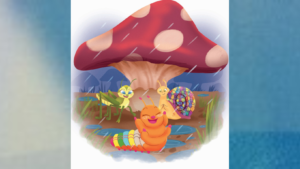
I’ve learned a lot and have had many inspirations through this faith-based activity. Mostly, I have been able to break through barriers that may have kept me from doing something to which God has called me. Using the skills taught during this retreat, I have brought a creative depth to my writing. I drew inspiration from a mushroom while walking the dog that turned into a colorful, giant umbrella for a snail and caterpillar in my book, Bella’s Beautiful Miracle: A Caterpillar’s Journey.

Due to other events this summer, I was forced to miss the art retreat, and I thirsted for a flicker of creativity. This topic arose in a recent conversation, and I quickly realized why I longed for such a spark. As a writer, I see the beauty and majesty in everyday things that most people take for granted. In the hustle and bustle of the summer and planned and unplanned life activities, I had not allowed myself to bathe in God’s beauty in this way.

It is not only the art retreat that fuels creativity. The combination of nature and faith life are significant components. To rejuvenate my creative side, I ventured outside with my laptop and noticed the little robin in minutes. As I looked upon the little bird, all I had to do was place my hands on the keyboard, close my eyes, and allow the Spirit to lead.

By basking in God’s glory of nature, colors, and the physical action of creating, I become fed creatively and spiritually. This summer, I ask you to consider in what ways your spirituality provides your creativity or vice versa. Then, spend time prayerfully considering how God wants you to work that into your lifestyle.

Don’t miss out on your opportunity to shine in ways you may have felt fearful about. I love that I have no talent as a painter, yet I can participate in that action and create something beautiful in another medium. Art, as a spiritual gift or just for fun, is a lovely way to express God’s light and love! Step out of your comfort zone and go for it!


Copyright 2023 Kimberly Novak
Images Copyright Canva

Red Blood Cell or Glob of Plaque?

Red Blood Cell or Glob of Plaque?

God has entrusted to each of us a unique role, a unique mission of love, within the Body of Christ. That may seem hard to believe at first: God has given me a special mission of love to carry out in life? But it’s true. Each of us is given the great privilege, and the solemn responsibility, of helping to pass on the divine love to other members (and prospective members) of the Body of Christ. Which includes everyone, because God wants everyone to share in his divine life and love forever (Matt 18:14; 1 Tim 2:4). You have been given a unique mission to share the divine love with others. The unique meaning and purpose of your life lies in your mission of love. Your mission is irreplaceable. No one else can fulfill your mission for you. No one else’s life will touch the exact combination of people that your life will touch. No one else can make the contribution to the eternal circulation of love flowing within the Body of Christ that you were born to make. What is the mission of love with which God has entrusted you?

For most of us, the mission of love that God has in mind isn’t some dramatic, world-changing mission, something that will have a huge impact on the world as a whole or draw a lot of attention to us. Instead, most of us are called to local missions of love. There’s a saying that goes something like “Strive to make your little corner of the world a better place.” It’s a good saying. If we all did that, the whole world would be a much better place.

The absolutely best way to make your “little corner” of the world a better place is to spread some of the divine love to that little corner. Start at home. How can you be more loving to your spouse? How can you be more loving to your children? Then extend yourself further: how could you be more loving to your friends? Your neighbors? Your co-workers? The people you perceive to be your “enemies”?

We all have a choice in life: we can be red blood cells flowing within the Body of Christ, helping to carry life-giving oxygen (the divine love) to other members and prospective members of that Body, or we can choose to be globs of plaque, clogging the arteries of that Body and obstructing the flow of divine love. Most of us are a little bit of both. Resolve to be more of a red blood cell and less of a glob of plaque.


* This article is an excerpt from Rick’s latest book, The Book of Love: Brief Meditations (https://enroutebooksandmedia.com/thebookoflove/)

Photo by ANIRUDH on Unsplash

Copyright 2023 Rick Clements

Blood Circulating in the Body of the Cosmic Christ

Blood Circulating in the Body of the Cosmic Christ

All human beings are born to share forever in the eternal circulation of love that is the divine life. But to participate as fully as possible in the divine life, we have to learn to selflessly give and receive the gift of self in love. That’s what we’re here to learn how to do. And the more fully we learn to do that, the more fully we can share in the divine love and life and bliss.

But how could we humans possibly share in the divine life of God? How could we, who are finite beings, be united with the infinite God? There is an infinite chasm between us finite human beings and God. We cannot leap over the abyss separating the finite from the infinite. We need a lifeline of some kind to be thrown across to us from the shores of infinity, a bridge of some sort that will span the abyss and enable us to cross over into the divine realm. Jesus Christ is that lifeline; Jesus Christ is that “vaulting bridge” who spans the abyss separating us finite beings from the infinite God. Jesus has forever united the human with the divine in himself, thereby making space for all human beings (indeed, the entire cosmos!) within the divine life of God.

Think about it: God and humanity, the infinite and the finite, united in the one person of Jesus Christ, in such a way that the path for us to transcend our finitude and participate in the infinity of Being, to share in the divine life of God forever, has been opened up to all human beings and to the entire cosmos. Seemingly impossible; seemingly incredible. But if it is true (which it is), then this one person would be the answer to the riddle of human existence. That is why our individual destinies are determined by our answer to the single most important question confronting us in life: Yes or No to Jesus Christ, which is a Yes or No to love and therefore a Yes or No to God and to our ultimate fulfillment as human beings. We were all born to be “blood circulating in the Body of the cosmic Christ,” in Balthasar’s beautiful phrase. By uniting ourselves to the Body of Christ, we are united with God and with all the other members of that Body. By uniting ourselves to the Body of Christ, we join in the eternal circulation of love that is the divine life and find therein our ultimate fulfillment.

* This article is an excerpt from Rick’s latest book, The Book of Love: Brief Meditations (https://enroutebooksandmedia.com/thebookoflove/)

Copyright 2023 Rick Clements

Photo by Alexandru Acea on Unsplash