
From Grief Through Mourning

Last year, I could not do it. This year I did.

In the Catholic Church, the month of November begins with two consecutive liturgies that honor our beloved dead, The Solemnity of All Saints and the Commemoration of All Souls.

We always hope that departed family members and friends might be celebrating the first feast with us, already among the saints in heaven. We trust that our prayers will help to console and sustain any loved ones who might, this year, still remain in purgatory.

It takes most people a long time to establish their ‘new normal’ after a family member’s or close friend’s death.

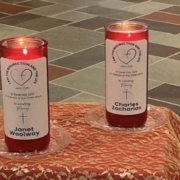
In my parish, one of these opportunities is a Mass of Remembrance offered each year on the Saturday morning before All Saints Day. A candle is provided for each family to place around the altar when their loved one’s name is proclaimed, and these candles are lit for each mass through the month of November

Last year, the 2024 Mass of Remembrance was scheduled just ten days after my husband’s funeral. With a sincere intention, I had placed his name on the list.

But when that Saturday morning arrived, I found myself still too exhausted from his sudden, unexpected death, the need to transport his remains from another state, and managing to stay functional — with help from close family and friends — for the funeral.

Last year, another dear friend stepped up to carry Charles’ Mass of Remembrance candle for me. This year I was able to carry it myself.

***

Beyond Catholic parishes’ roles in helping to organize funeral liturgies and hospitality, many also offer valuable longer-term support options, to help families survive devastating grief and manage the psychological challenges that always accompany any great loss.

We are all unique creations of God, and every person’s grief process is unique. So, I want to briefly share two more long-term support options offered by the grief ministry in my parish.

What has served me best might not be right for you. Likewise, parts of these programs that did not most resonate with me, might be just right for you.

I include them here because I believe they offer a range of valuable options to meet a variety of needs for different mourners.

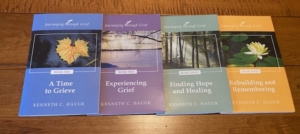
The first is a year-long series of booklets, +/- 40 pp. each, written by Kenneth C. Hauck and published by Stephen Ministries in 2004. Entitled  A Time to Grieve, Experiencing Grief, Finding Hope and Healing, and Rebuilding and Remembering. These were mailed to me quarterly after my late husband’s funeral, as gifts from my parish.

Because I am an introverted person who normally reads and writes alone, I appreciated the freedom to digest these words of wisdom privately, and on my own schedule. The quarterly mailing time frame felt just right, too.

For those who feel more enthusiastic than I do about watching videos and participating in weekly discussion groups, another excellent support option offered by my parish is titled Grieving with Great Hope.

Meditation Journal written by John O’Shaughnessy, Sandy O’Shaughnessy, and Fr. John Riccardo,
part of the Grieving with Great Hope parish program, published by Good Mourning Ministry, Inc.

This program includes a series of videos, and small discussion groups with fellow mourners from your own parish. Ordinarily, those who join this program are in closely similar time periods after a loss.

The program includes a journal published by John and Sandy O’Shaughnessy, with Contributing Writer Fr. John Riccardo, as part of Good Mourning Ministry, Inc.

Of the resources offered by this ministry, I’ve personally found silent meditation and private writing, with the suggested journal

reflections, to be the most helpful. But I have also witnessed the benefits gleaned by others, from watching the videos and participating in discussion groups.

***

At the Mass of Remembrance on October 25, 2025, my deceased husband’s date of passing was the longest elapsed. I had been prepared beforehand, by our deacon’s gentle and compassionate wife, to hear his name called first and to face the empty altar alone.

As I bowed before the altar I tried to discern, among all the candle holders so lovingly arranged, where might be Charles’ place. The Holy Spirit led me to a place on the side by my accustomed pew, when I sing with the funeral choir, near the altar and close under the crucifix.

While a total of almost forty names were called, I prayed for each soul, and watched each family approach the deacon to receive their candles.

Charles’ light had to hold his mountain alone, for a long time. I began to wonder, who will God send, to occupy that spot beside him?

About three-quarters of the way through the list, I heard the name of a dear friend, mentor, and fellow funeral choir member. She and her late husband had coordinated our county-wide nursing home citizen-visitor ministry throughout their long retirement years. I had been a part of that ministry.

I watched Janet’s four children — none of whom I had ever met — come up to receive their candle, and bow. I could feel them doing their own discernment.

When they came over, to place Janet’s candle next to Charles, I could almost hear her saying, “Don’t worry, Margaret. I’ll look after him myself.”

***

Wherever any of you may be in your own grief journeys, no matter who you might be mourning this November, please know that I am

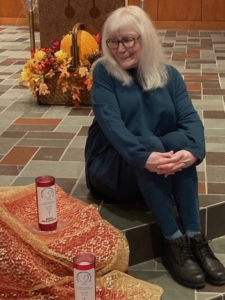
Author meditating on the candles, after Mass of Remembrance at St. Theresa of the Child Jesus Catholic Church, Des Moines, Iowa, October 25, 2025.

praying for you.

I ask your continuing prayers for me, too.

This will be my last CWG column for a while. I need a brief sabbatical; to continue dealing with the massive changes I’ve experienced

over the past fourteen months, and to discern where my own ‘new normal’ life will lead.

May the compassion of Our Lord’s most Sacred Heart, the love of Mary’s Immaculate Heart, and the wisdom of the Holy Spirit remain with you, as well.

Blessings, always,

Margaret


© Copyright 2025  by Margaret King Zacharias

All photos from author’s personal collection; used with permission by the author

Featured photo: Candles lit for Mass of Remembrance, St. Theresa of the Child Jesus Parish, Des Moines, Iowa, on
October 25, 2025. Author’s personal photo, published with permission.


When I Behold Your Heavens: Hope

“ For I know the plans I have for you…”—Jeremiah 29:11

My writing life might have continued like a lost balloon soaring aimlessly into the evening sky, but the 2019 Florida Eucharistic Congress in Jacksonville changed its course. Thanks are long overdue to the Most Reverend Felipe J. Estevez, S.T.D., retired Bishop of St. Augustine. Back then, during his busy tenure, he took the time to read my newly published book, Everywhere Hope, and penned a treasured letter about it shortly after the Congress, of which the theme was “Hope.” 

Bishop Estevez’s warm encouragement spurred me to continue writing, but with a clearer purpose.  I went on to define my author mission—“to be God’s instrument in building up the Body of Christ”—and was content to define my audience as primarily Catholic. My desire changed from pursuing publication to simply encouraging the faithful, even if only one person benefited from my words.  

In an excerpt from his letter, Bishop Estevez wrote, “The last chapter on Language was deeply Catholic in a profound acceptance of cultures as John Paul II envisioned it—diversity enriching unity… [W]hat a contrast to the threats of nativism and White Supremacy movements affecting us these days… Paula, your book is so rich for it integrates poetry and spirituality, lived experience and wisdom, deep Catholic practice and real human experience, a genius of feminine perception… .”  

I can’t express enough how grateful I am to have been in a diocese under the shepherding of Felipe J. Estevez, S.T.D.  He truly imitated Jesus and always showed reverence, love, devotion, and kindness to his flock.  My deepest personal thanks for his unexpected letter in response to the book I gifted him on behalf of our local Catholic Writers Guild years ago is not enough to thank this holy and humble man of God. 

“O Lord, our Lord, how glorious is your name over all the earth! …When I behold your heavens, the work of your fingers, the moon and the stars which you set in place—what is man that you should be mindful of him, or the son of man that you should care for him?”—Psalm 8: 1,3–4

Bishop Estevez especially liked the photo above and the poem “Sweet Light” (about marriage) that accompanied the picture.  Here is the poem:


Sweet Light

by Paula Veloso Babadi


No shadows here when light is

L’Heure Bleue” to artist eyes

Or “sweet” to camera canvas.


One side of Earth

Basks in your sunlight

While I rest shadowed

On the other side.


You are brilliant day—

Burning, tumultuous, blinding, busy, wide awake.

I am subdued night—

Serene, quiescent, muted, dreaming, slumbering.


You own most phases of the Earth’s turning as

Your searing light often blinds onlookers

To the pale beauty behind your blaze.

My light reflects gently on the quieter side where,

When you’re gone, the stars become visible.


Our co-existence is casually questionable,

And yet, for all our differences,

We twice share Twilight

When Earth succumbs to neither night nor day.

In the blue hour of this sweet light, we are one.

It is enough for me.


Copyright 2025 Paula Veloso Babadi

Photo license purchased from Shutterstock

Edited by Gabriella Batel

A Nod from God

I would give a million dollars for a crystal ball that revealed the path God has planned for me. It would be thrilling to get a glimpse of the future, to know all the hurdles I will have to overcome, and even identify things I could avoid entirely. I chuckle at this thought, realizing how silly God must think I am for even entertaining the idea. But what if God did give us small hints to show that we are moving in the direction of His will? How could we identify them? How would we respond?

Several terms can help us recognize God’s communication in our lives, such as “God moments,” “God winks,” and “God incidences.” I would like to introduce another term: “God nods.”

A nod from God is just as it sounds; I envision Him looking down with an approving expression, signaling that I am on the right track with whatever task or decision I am engaged in. Receiving God’s approval can deepen our faith and affirm the work we are doing on His behalf.

An example of a God nod might be something as simple as a room filling with your favorite scent—a scent that reminds you of a happy moment in your life. Another example could be the sight of a butterfly landing on your mom’s favorite flower at a time when that sighting is exactly what you need to feel her closeness. I don’t want to describe too many scenarios because a true nod from God will be an experience unique to each individual. I have had many moments where God showed up in unexpected ways, revealing that He was with me and that we were working together toward a common goal.

Recently, while I was on vacation, I felt a strong nod from God. He revealed to me that the decisions I made regarding our accommodations, event planning, and even dinner locations were all part of the path He intended for us. During our trip, I received a very unexpected nod from God in the form of a monetary gift. An affirmation that our vacation was truly inspired by divine guidance! I found myself asking, “Who does this? Who goes on vacation and connects with a total stranger on such a deep level, to the point that my ministry is blessed?” The answer is simple: it’s a nod from God, confirming that I am following His will. It’s a nod indicating that my ministry is alive and thriving. It’s a confirmation that God sees what I am doing and has given His stamp of approval.

Once you have answered the call and recognized the nod, it’s time to respond. I didn’t hesitate to praise God for His kindness in showing me His approval in such a wonderful way. It is a true blessing to be in alignment with God and to receive His acknowledgment. God desires our excitement just as much as He expects our praise. The act of praising God brings us closer to faith, prayer, and God Himself. It also ignites our passion to continue sharing God in the ways He has called us to.

My experience ignited a passion in me, prompting me to donate my books to local Christian bookstores before I left the town we were visiting. I never would have had the courage to do something like that before. With God’s approval, I felt determined to continue spreading the message.

Although we may not have a crystal ball, staying attuned to the spirit working in our lives and maintaining a consistent prayer life allows us to notice God’s gentle signs of approval. This is something to be cherished, developed, and shared with others.


Copyright 2025 Kimberly Novak

Edited by Janet Tamez

Praying for the We in Me

As a psychotherapist, I have worked with thousands of clients over more than forty years. Most of them have resided in nursing homes. In those settings, I have helped individuals with all sorts of medical, and disability, psychiatric, and substance use conditions or disorders.

One Saturday I was sitting in church getting ready for the 4:00p.m. vigil Mass. In my mind, I saw dozens of my clients, past and present, enter the church and sit in the pews, but they were not as I have known them. They were fully healed in mind and body, and they were glorious.

This imaginary experience has lingered with me. When I meet a new client for the first time, or if I am speaking with a client I have known for years, I can evoke a mental image of the person thoroughly healed and notice the difference between what is and what might be. That perception gives me hints about things I might be able to help with or influence. But it also clarifies things over which I have no control or influence.

One might look to a therapist for help in coping with difficult circumstances, but psychotherapy is not curative, and sorry, but no, it is not transformative. In hope of complete restoration and abundance of life that never ends, one should look to the ‘Wonder-Counselor,’ (Isaiah 9:5) not to a wounded one. The therapist might support and guide one’s struggle towards improvement, yet the Eucharistic table is where one seeks the life that extends beyond sickness and death.

We have many roles and many relationships in our lives. Others become important in our lives, and dwell in our souls in a variety of ways, some obvious, and some by rather surprising paths. People we know or have known dwell within us in myriad ways, and prayer occurs in many ways, as well.

Our reflections on persons in our lives can become a form of prayer when thoughtfully linked with the awareness of God in our shared lives.

Just as no one is an island, no one lives for herself alone, or belongs to himself only. We live with and for others, our lives also belong to others, and those others also live within us. A crowd of companions live in us.

Family members tend to occupy especially significant roles in our inner life. Naturally, we reminisce about our great grandparents, grandparents, and our parents, aunts and uncles; loved ones who may have completed their earthly journey and dwell now beyond us, while still within us. From them we gained not only our DNA, but also our spiritual ‘on-the-way.’ In God’s plan, the teleological arrow of our life was first influenced by those vital life figures. We often focus our particular thoughts and hopes on our spouse, children, grandchildren, siblings, relatives, the cherished ones we live among daily.
Our human lives intersect also with spiritual persons. We might gratefully consider our guardian angel, the silent and always present one who guides our soul with timely prompts, as well as the communion of saints – blessed spiritual persons who long to assist our burdened journey on earth.

Prayer can be viewed, in part, as our considered and composed attentiveness to the range of those others within us. Our attentive contemplations can include memories, reflections, and speculations about things we’ve never known about individuals we love, and wishes for their comfort, safety, guidance, and salvation. We might make mental requests for things we know them to need, and for things they need that we don’t know about. Our intentions should include thankfulness for their part in our lives, and for the known and unknown ways they pray for us. And we pray to almighty God that our actions, physical and spiritual, may be fruitful in the lives of others within whom we are dwelling.

Post Script: One day recently I woke up from a surprising dream. I was at a nursing home, yet it was not one of my usual places. I turned and saw a client I had actually met with earlier in the week. In waking life, she is small and uses a wheelchair and oxygen. Yet in the dream she was standing up and smiling. We embraced and I asked, “How is this possible? And look at you – you’re as tall as me. This is a miracle!” I remarked, as we laughed and hugged. We started dancing and I said, “I’m dancing with a miracle!”

Was this dream another preview of things to come?

Casting the Net

“Master, we have worked hard all night and have caught nothing, but at your command I will lower the nets.” (Luke 5:5)

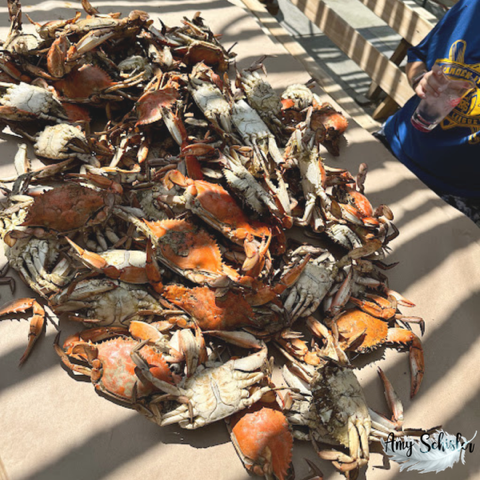
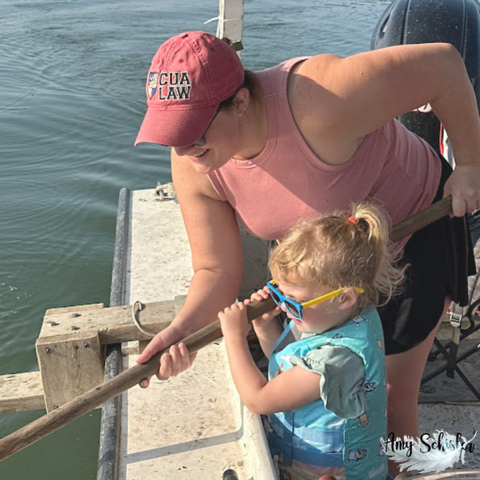
I come from a long line of watermen. Many of the men in my mother’s family were fishers, oystermen, crabbers, boat builders, or a combination of all of four. My husband began his career as a commercial crabber at the age of eleven, as an apprentice on his uncle’s boat. Though his ultimate full-time career became the law, he still has his commercial license and crabs multiple times a week during the season. This allows us a little spending money, family vacations, and this year, a new freezer and woodstove!

One of our favorite things to do in the entire world is invite friends and family to go crabbing and then feast on our catch. Most of the time, we’re able to haul in enough crabs to feed everyone. Some weeks, we know that won’t be possible. This year, crabs didn’t really start running in our area until a few weeks ago. That meant, July 4th week, Ken was out every morning just in case our group didn’t catch enough on the Fourth.

Casting Even When in Doubt

Sometimes the crabs are biting, and sometimes they aren’t. We can say the same about our family’s experiences with fishing. Sometimes the fish bite, and sometimes they don’t. However, Ken is the expert, and if we aren’t doing well in one creek, he pulls up the lines and moves everything to another. Usually, this changes our luck, but not always.

I can’t imagine anyone, especially a stranger to crabbing, coming into our boat and telling Ken to move his lines to another spot and try again. How dare they? Ken’s been crabbing these creeks for almost fifty years. Nobody would ever question his knowledge.

So I can imagine how Peter felt when Jesus told him to go deeper and cast his nets, yet Peter didn’t argue. Perhaps he was listening to Jesus as he was washing his nets. Maybe he heard something trustworthy in what this stranger was saying. Obviously, Peter didn’t argue when Jesus stepped into his boat and asked to be taken offshore. Of course, Peter’s brother, Andrew, may have been giving Peter the look that told Peter this was the man Andrew called the Messiah. Whatever his reasoning, Peter obeyed.

Jesus Enters Our Boats

I’ve often heard it said that Jesus didn’t ask Peter if He could enter his boat, and He doesn’t ask us either. Jesus enters our lives whether we want Him to or not. The question for us is do we welcome Him into vessels? When Jesus climbs into our boats with us, do we shoo Him away, or do we listen to what He has to say? Do we scoff at His commands, or do we obey?

Peter had his faults. He was rash, prone to anger, shortsighted in the ways of God, and often spoke without thinking. Yet he obeyed Jesus without question. He even stated the obvious — they had already been fishing all night and caught nothing — but didn’t argue against trying again.

Fishers of Others

We’re allowed to question God. We’re allowed to wonder how something can possibly happen when the odds are against it. We can even let God know our annoyance or displeasure in the present circumstance we may be in. God can handle that! He knows what it’s like to be frustrated. How many times was He irritated by the Apostles’ lack of faith? What He wants is for us is, when we are annoyed, frustrated, even angry, to obey Him anyway.

That is trust. Profound trust.

Doing the will of God, following His commands, walking the path He has chosen for us are acts of trust. Like Peter, we must put aside our own feelings and follow Jesus out into the deeper water. It’s there that we will haul in the greatest catch and follow Jesus’ final command — to become fishers of others.

My daughter, know that you give Me greater glory by a single act of obedience than by long prayers and mortifications. (Saint Faustina, Divine Mercy in my Soul)


Copyright 2025 Amy Schisler
Photos copyright 2025 Amy Schisler, all rights reserved.

“Woman at the Well”

Woman at the Well

All that I thirst for,
Being known and not condemned.
Eternal relief.

I came to see you.
I have never not loved you.
Do you see me now?

You came first to me?
You wanted water from me?
They all left me dry.


copyright 2025 Tom Medlar

Believing and Rejoicing

Believing and Rejoicing

A poignant moment of faith comes in John’s Gospel with the meeting between Jesus and Thomas the Apostle after the Resurrection. Eight days earlier, Jesus appeared to the disciples, but Thomas, who had gone away to mourn alone, was not with them. Now, when Jesus appeared for the second time, with Thomas among the Apostles, Thomas was unable to comprehend what his eyes were seeing. Offering proof of His triumphant return, Jesus invites Thomas to place his hands in the nail marks in Jesus’ hands and the wound in His side.

We read the exchange between Jesus and Thomas in John 20:26-29.

Jesus said to Thomas, “Put your finger here, and see my hands; and put out your hand, and place it in my side; do not be faithless, but believing.”

Thomas answered him, “My Lord and my God!”

Jesus said to him, “Have you believed because you have seen me? Blessed are those who have not seen and yet believe.”

As we face trials and uncertainties, we might relate to Thomas and his desire for proof, but another moment in Scripture points to a better response. St. Elizabeth’s words to Mary in the Visitation illustrate the faithful response to God’s promises and the markings of true faith.

Elizabeth says of Mary, “Blessed are you who believed that what was spoken to you by the Lord would be fulfilled” (Luke 1:45).

Jesus will echo those words in His exchange with Thomas 30-plus years later.

Mary believed in God’s promise of a Messiah before experiencing the miraculous Resurrection—she was truly blessed by not needing physical evidence in order to accept the truth. She trusted in the prophecies and the promises of God, recognizing that He is our ultimate salvation. Mary did not allow any obstacles to hinder her faith, and for that, she was blessed and rejoiced.

How easily we can fail to believe, looking for signs and wonders as caveats of believing. If we fail to view the world through the eyes of faith, with a heart willing to see God at work, obstacles can mount daily. Rather, let us see and accept the truth of God’s promises fulfilled and embrace Jesus’ glorious victory over sin, death, and the troubles of this world.

Mary allowed grace to fill every ounce of her being—strengthening her to give a daily “yes” to follow and believe. Before Jesus even explained to the disciples that the work of God is to believe in the One sent by God, Mary believed. As she stood before Elizabeth with the Fulfillment incubating within her, her Magnificat burst forth:

“My soul proclaims the greatness of the Lord; my spirit rejoices in God my Savior” (Luke 1:46,47).

We receive the same promises through the Eucharist; we see these Mysteries unfold with Jesus literally within us every time we receive the Eucharist. The grace that filled every ounce of Mary’s being is available to us abundantly; we merely need to ask, accept, and cooperate with it.

“Ask, and it will be given you; seek, and you will find; knock, and it will be opened to you” (Matthew 7:7).

What keeps us from asking? Although Thomas is credited as doubting, Jesus did not withhold from St. Thomas what he asked for to help him believe.

Mary reminds us that God “has mercy on those who fear him in every generation” (Luke 1:50). Believing without seeing, however difficult, is not impossible. God would never ask the impossible. He is a loving God who works the impossible within us through cooperation with grace. No one exemplifies the powerful result of allowing oneself to be filled with the grace of God more than the Blessed Virgin Mary. May we turn to her and trust her intercession so we too may be counted among the blessed who have not seen and yet believe.

Copyright 2025 by Allison Gingras

Edited by Theresa Linden

Live in the Moment

Live in the Moment

By Isabelle Wood

“No one who puts a hand to the plow and looks back is fit for the kingdom of God.”—Luke 9:62 (NRSVCE)

“Do not worry about tomorrow; tomorrow will take care of itself. Sufficient for a day is its own evil.”—Matthew 6:34 (NABRE)

It’s really hard to live in the present. Let’s face it. Most of us spend more time in the past or the future.

Sometimes, all we can think about is the past. Our past failures, our past wounds, those scars that haven’t yet fully healed. Or, on the flip side of the same coin, we live in the memory of the “good ol’ days” and pine for the times that are already past.

Other times, the future occupies all our thinking. We either look forward with worry about what’s ahead because we do or don’t know what’s coming, or we spend so much time looking forward to our plans for the future that we miss all the blessings God wants to give us in the current moment.

Actually, that last point is true for all of them. When we spend too much time in the past or the future, we miss all the little gifts God is handing us right now.

Jesus tells us that if we occupy all our energy looking back with longing or regret, we’re not fit for the kingdom—we’re not “all in” for the incredible adventure that living our Faith is. Likewise, Jesus tells us not to worry about tomorrow. When we spend all our time looking ahead and plotting out all our own “perfect” plans, we’re not putting our trust in the amazing, unimaginable plan God has in store for us, and we’ll be overcome with worry when things don’t work out the way we wanted.

Granted, the past and the future are both gifts God has given us. It’s good to look back with gratitude for the ways God has worked in our lives and the lessons we’ve learned, and it’s good to be responsible with the time God has given us by making plans and looking to the future with hope.

But let’s make it a goal to live in the gift of this moment God has given us right now—in the present.


© Isabelle Wood 2025

How to Pray All the Time

How to Pray All the Time

Rejoice always, pray without ceasing, give thanks in all circumstances; for this is the will of God in Christ Jesus for you. ~ 1 Thessalonians 5:16-18

St. Paul’s exhortation to “pray without ceasing” once baffled me. How can I have a life filled with work, chores, family care, and even leisure time, all while praying? After nearly twenty years of trying to remain connected to Christ throughout my day, I’ve figured out a few ways to integrate prayer into the day. I may not yet be praying without ceasing, but I am definitely moving in the right direction.

Five suggestions to encourage unceasing prayer:

Pray Your Newsfeed

How often do we encounter requests for prayers when perusing our social media feeds? How about the many situations and persons we read about that could surely use our prayers? I don’t stop at every post to pray. Instead, I pray unceasingly by keeping God at the forefront of my thoughts as I read through my social media outlets and offer a “Lord, hear my prayer” or “Lord, have mercy” as I scroll. For more serious situations, I will pause and pray a Hail Mary or Memorare.

Pray Your Neighborhood

This one came to me quite unintentionally. I was scooting about town running errands, when I passed the house where a dear friend’s husband had passed away from brain cancer just a few days earlier. My heart was so moved with compassion for the family, I could not help but offer a prayer for the repose of his soul and for the family that was grieving his loss. As I continued my drive, I passed many homes that invoked memories and thoughts that moved my heart again to prayer. This practice soon became a habit when I drive anywhere. In addition, I include special prayers as I pass police/fire stations, schools, churches, and cemeteries.

Instead of whistling while you work, try prayer!

When my children were little, it felt like my entire life was folding laundry, changing diapers, and walking the grocery store aisles. Since I barely have a domestic bone in my body, these things were torturous some days. Instead of allowing myself to be defeated by these tasks, I turned them into prayer. While folding laundry, I would pray specifically for the owner of whichever article I happen to be handling at the time. I offered up the stench of the stinky bottoms, looking instead into the eyes of the precious gift who had created it for me and praising God that I had a baby with poop to wipe. Today, my kids have long been out of diapers, but I still find plenty of reminders to pray as I wash dishes, wipe crumbs from the table, or take out the trash.

This can also be adapted for work done outside the home. Whatever your occupation, there is always someone to pray for. Process mortgages? Pray for the family purchasing the home. A teacher? Pray for the student failing your math class or holding the lead in the school play. Throughout your day, lift your co-workers or boss in prayer as you answer an email from them or complete assigned tasks.

Take prayer requests on social media

One of my greatest inspirations from the Holy Spirit came one day when I was getting ready to head to Adoration. The idea was to ask for prayer requests on my Facebook page for my upcoming time in Eucharistic Adoration.  I simply place an image of Jesus in the Monstrance (either one I have taken or a royalty-free one from the internet) with the status update, “Going to spend some time with Jesus. Can I bring Him your prayer requests?” I’ve always been amazed at the exuberant response I receive, with sometimes hundreds of requests!

Consider transforming your inner voice to one in open dialogue with the heavens

Talking is just kinda my thing. Though I may only have a few things I know I have a knack for, I am fairly confident chatting is definitely one of them! Since I constantly have a running conversation underway with myself, I decided in 2007 to transform that to an open discussion with heaven. I know that sounds odd initially, but it is truly the most spiritually beneficial thing I have done for myself. I have running conversations all day with whoever will listen to me: God, Jesus, the Holy Spirit, the Blessed Mother, and my Guardian Angel. I reach out to the many awesome members of my Saint Posse, which fluctuates depending on my current needs or circumstances, and my special friends, the Holy Souls in Purgatory.

Those conversations with myself are fruitful and purposeful. I am not just spinning on the hamster wheel in my head; quite the contrary, now I often get answers, inspirations, and spiritual insights, unexplained feelings of peace, and so much more!

Your turn: how will you pray without ceasing? Share your thoughts in the comments below!


Copyright 2025 by Allison Gingras

Edited by Theresa Linden

The Meaning of Life, Part 2 of 3: Living Life Abundantly

Read Part 1 of this series.

I set the LORD ever before me;
with him at my right hand I shall not be disturbed.
Therefore my heart is glad and my soul rejoices,
my body, too, abides in confidence;
Because you will not abandon my soul to the nether world,
nor will you suffer your faithful one to undergo corruption.
You will show me the path to life,
fullness of joys in your presence,
the delights at your right hand forever. (Psalm 16:8-11)

How fitting that our Responsorial Psalm in today’s Mass reminds us that God will show us the path to life and give us fullness of joy. As discussed last time (May 1, 2025), joy is what we obtain when we live life abundantly. This path to a full life and the act of being fully alive, of obtaining true joy, is the meaning of life.

Once, at daily Mass in our church, our associate pastor, Father Michael Angeloni, said something that truly struck me. He said that everyone always says that life is short but in reality, life is the longest thing we will ever do.

Think about that. Life is the longest thing you will ever do.

Even if you work at the same job for 20 years, even if you are married to the same person for 50 years, whether you go to school for 12 years, 16 years, or 20 years, none of those will last as long as the entirety of your life.


You Only LIVE Once

Why do we dwell on how short life is when it’s literally the longest event we will ever experience? Life is the one thing we have a literal lifetime to perfect, to achieve, to become. We have our entire lives to live life in abundance, to discover its meaning for ourselves.

We should put more energy into thinking about what we are to do with our lives in the long run, not just today. This is what will bring us the joy of being fully alive.

There is something about the mantra, YOLO (You only live once) that has always bothered me. People use it as an excuse to do crazy things, to take unnecessary risks, and to throw away stability on a whim. Instead, shouldn’t we be putting all our efforts into perfecting the life we have been given? Shouldn’t we be looking for ways to be a better person, to fully use our talents, and to make this life the very best life it can be? Shouldn’t we be living our life abundantly with a bold passion, our eyes always on making our life and the lives of others better, richer, more meaningful?

There is a difference between having a passion for life and passionately living life. We can have a passion for life and strive to live to the fullest, being kind to others, exploring and using our gifts and talents, and growing into the person we are meant to be. We can also live life passionately, jumping from one thing to another, flying blindly without noticing where we are or who we are, and throwing caution to the wind. These two ways of living life with passion are very different.

This doesn’t mean we shouldn’t climb mountains and sky dive and fulfill our wildest dreams. It just means that we should know why we are doing it. Are we running from life, abandoning the life we’ve made, or living dangerously for unhealthy reasons?

Or are we truly taking advantage of all the opportunities that God has given us to live abundantly in this longest thing we’ll ever do? These are questions we must ask, among other, loftier questions.


A Successful Life

Why are you here?

Why has God given you the gift of life?

Who do you want to be?

What do you want your life to represent?

What will the meaning of your life be?

St. Gianna Molla is credited with saying, “The secret of happiness is to live moment by moment and to thank God for all that He, in His goodness, sends to us day after day” (SaintGianna.org).

A successful life is lived moment by moment. Finding joy in each of these moments can be difficult, but we’re only given one life, and we need to enjoy it. This doesn’t mean we should live so passionately that we become reckless, but we should live with a passion for life. We should live with the knowledge that life is a gift we’ve been given, and we will have it as long as we’re on this earth. It’s meant to be cherished, shared, matured, and most importantly, lived. And we are meant to thank God for the life we have.

Unlike your time in school, your work career, your friendships, even your marriage, life is the one constant that is with you from the day you are born until the day you begin your eternal life. It’s the longest thing you will ever do, and you are meant to make the most of it.

As you work to achieve your dreams, make the most of each day and do your best to let each moment brim with love. (Pope Francis, Christ is Alive, 25 March 2019)


What are some ways we can make the most of life? We will explore this in Part 3, July 3, 2025.


Copyright 2025 Amy Schisler
Photos copyright 2025 Amy Schisler, all rights reserved.