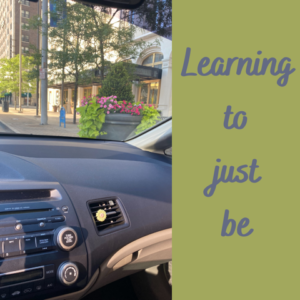

I Learned What Home Could Be: Writing, Faith, and the Meantime Life
“I learned—at least—what Home could be—
How ignorant I had been…”—Emily Dickinson
Finding Peace in the Meantime
Life for me and my family has, up until this point, consisted of checking in and out of hotels and riding in a car packed with dirty laundry—and, of course, my son’s little blue scooter. At least he made the most of our situation. Both my husband and I were unemployed, living off a credit card, and looking for work and housing, but my son had his scooter. He’d zoom through hotel lobbies and circle playgrounds while we unpacked fast-food dinners on a park bench.
This transient life made it hard for me to be creative. When I tried to journal, it was messy. My notebooks soon became a mix of practice responses for job interviews, math problems for budgeting, and scattered reflections.
I had to find a way to bring peace into my life. First thing, the kids were going to summer camp. Not that I didn’t enjoy being in one room with two toddlers and a teen, but they needed summer memories, friends, and crafts. It also meant they could spend hours being kids instead of overhearing arguments between my husband and me about money or where we’d go once our hotel stay ended.
I made an effort to add normalcy and routine—morning walks, reading books for myself and to the kids at bedtime. I started Bible plans as a way to focus my prayer life, especially when my mind was stressed with money and marriage worries. Looking back now, I’m reminded of a workbook I cherished in high school: In the Meantime by Iyanla Vanzant. It’s a 40-day workbook structured to mirror sacred time in Scripture—the 40 years of Israel, the 40 days of Jesus. Christian workbooks and Bible plans can steady our faith when life feels unsettled.
Key practices that brought peace:
- Summer camp for the kids
- Morning walks and bedtime reading routines
- Bible plans and focused prayer
- Christian workbooks for spiritual grounding
The Power of Conversation and Community
When writing was hard for me, conversation came naturally. It was instinct to call my family and friends for support. Back in college, I attended women’s circles. Although that season of my life was steeped in new age philosophies, those circles gave women of different ages and walks of life a space to share struggles and dreams, and to lift each other with encouraging words. As women, we often lose ourselves serving our families, isolating from community.
Now, as a Catholic, I see the deeper truth behind that longing to gather. Conversation and community are part of our faith. Jesus didn’t write books; He spoke to people, told parables, and offered encouragement. The early Church grew from circles of believers who prayed, listened, and shared stories. For writers, it’s a reminder that conversation is just as important as writing; I know I sometimes forget this myself.
What conversation and community offer:
- A space to share struggles and dreams
- Encouragement from people at different life stages
- Connection to our Faith tradition
- A reminder that writing and speaking both matter
What Home Really Is
I recently moved into a home, although it’s a short-term lease, on Dickens Ave. The name makes me think of Emily Dickinson, who wrote so much about home. Her poems remind us that home is not simply an apartment number, but a pattern of life: morning walks, dinners (even if it is a combo number), and bedtime stories. During my months in hotels, I realized the same truth. Wherever we stayed, I hung a cross on the wall. It was my way of reminding myself and my children that our true home is not found in an address but in Christ.
Home is not a place, but:
- A pattern of daily rhythms and routines
- A spiritual anchor in faith
- A reminder of what truly matters
Finding Your Way in the Meantime
So if you find yourself “in the meantime” of life, have faith that you can work with it and through it. The apostles wrote on the move; they didn’t have office space. They wrote from jail cells or while sitting on a rock. St. Paul didn’t have a content calendar, yet the Holy Spirit inspired him to write thoughtful letters and action plans for Christians. Don’t judge messy writing. Life doesn’t always fit neatly in the margins, and writing doesn’t have to either. Messy writing is authentic and raw. We don’t always see its value in the moment, but later it becomes a treasure, just like finding your middle school diary in your mom’s closet.
If you aren’t ready to write, create an action plan to stay grounded in prayer—adopt a Bible plan, pick up a Christian workbook. Or simply pick up the phone and talk to a good friend. The power of conversation is a tool for healing and evangelizing. Like the apostles, we are called to share the Gospel no matter what place in life we’re in. Like Dickinson, we search for what home could be. And like Christ, we discover that home is already within us.
If you’re in the meantime:
- Embrace messy, authentic work—it becomes a treasure later
- Consider a Bible plan or Christian workbook if writing feels impossible
- Call a friend; conversation is healing and evangelizing
- Remember: the Gospel spreads through your presence, wherever you are



 Let me begin, then, by saying that I never intended to become “the chicken lady” of my neighborhood. When my husband called from work one day, saying that a colleague had no further need of 4 unhatched baby chicks and did I think we could take them in for a while, I said “Sure” simply because I like animals and couldn’t stand the thought of those little chickies being – literally – thrown away. That was about the extent of my thinking.
 My little flock did not choose each other, but they’ve formed themselves into a community nevertheless. Although they are all different types of hens, they get along. Yes, there is certainly a pecking order (Sandy is at the top) but there is still room for everyone, despite their various temperaments. For example, Pebbles, our black Australorp, tends to get broody and take over the nesting box, while Pepper, a light Brahma and the smallest of the five chickens, likes to make up for her small size by being feisty and pecking everyone, including the dogs. Occasionally there are some ruffled feathers but most of the time there are contented, chatty clucks and check-ins, and at the end of the day they all go into the hen house and sleep peacefully together. If I’ve had a hard day with a difficult person, I really notice their ability to not hold a grudge and to let bygones be bygones. It reminds me that I might not always want to spend a lot of time around a certain person or persons, but I don’t have to take everything personally and I don’t have to carry resentment with me every day. (And I’m always somewhat flabbergasted that the hens consider our two pitties part of their community!)