
A Poem, an Ornament, and a Choice

A Poem, an Ornament, and a Choice

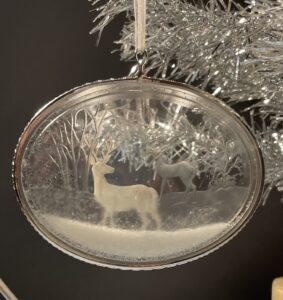
Even though it is now a few weeks since the official end of the Christmas season (with the exception of those who close out Christmas with the celebration of Candlemas), I still have one ornament up. This particular ornament, called “Snowy Woods,” is always the last one to be packed away, and every year it makes the short journey from the Christmas tree downstairs to the family prayer space, upstairs. It hangs in silence until the end of the month, inviting reflection, contemplation, and most importantly, it asks a single question as we begin the liturgical cycle again: Which path will we choose to follow this year?

The ornament is quite simple and is made of glass, surrounded by a metal frame. A snowy scene is etched on both sides of the glass; two deer walking apart yet aware of each other, in a wintery wood. Every time I look at it, Robert Frost’s poem “The Road Not Taken,” springs to mind.

The Road Not Taken by Robert Frost (1915)

(1) Two roads diverged in a yellow woods

And sorry I could not travel both

And be one traveler, long I stood

And looked down one as far as I could

(2) To where it bent in the undergrowth;

Then took the other, as just as fair

And having perhaps the better claim,

Because it was grassy and wanted wear;

Though as for that the passing there

Had worn them really about the same,

(3) And both that morning equally lay

In leaves no step had trodden black,

Oh, I kept the first for another day!

Yet knowing how way leads on to way,

I doubted if I should ever come back.

(4) I shall be telling this with a sigh

Somewhere ages and ages hence:

Two roads diverged in a wood, and I —

I took the one less traveled by,

And that has made all the difference.

This “Snowy Woods” ornament is a snapshot of the meaning the poem is getting at – how our choices affect our lives. In the ornament, the adult deer is looking back, pausing in mid-step. Has he heard a noise that caused fear? Or is he just taking a breather before continuing the way? Is the fawn following or leading? It all has to do with perspective.

 A snowy scene is etched on both sides of the glass; two deer walking apart yet aware of each other, in a wintery wood. 

When the ornament is held with the adult deer facing you, it seems as if the deer is looking back, over his shoulder. The shadowy fawn in the background appears to be watching and waiting for the adult deer to make a decision. But turn the ornament around and the positions are reversed. The adult is no longer looking over his shoulder but is gazing into the shadowy world at the small fawn. His steps and his gaze are very much focused on the small deer. The fawn, on the other hand, is looking out, away towards something outside of our vision. Both positions are telling. The fawn waits for the adult deer to make his decision, to take the path “less traveled by,” even though the path that the deer will take is set out by the fawn. The paradox of Christianity.

The adult deer is a perfect example of a Christian. He is solid. He is not shadowy or vague, but entirely painted in. His hooves are firmly rooted on the ground, even being entirely covered by the heavy snow. He is part of the physical, visible world we all live in. He is concerned with the daily struggles of life, poised to flee or fight, while wrestling with the heavy snowfall, the daily crosses of his world. While he is engaged, he is being watched by a small, shadowy figure, a guiding spirit who assists and guides his steps. This spirit might be an angel or even a figure of Jesus himself, always just out of sight, but somehow his presence is felt. The fawn, not the adult, knows the way through the snowy woods. It’s eyes are on something else, something higher and distant, away out of time and space. Unlike the solid white adult deer, the fawn is almost transparent, pointing to a spiritual, unseen aspect.

The two deer in this ornament are in a profound relationship, despite the fact that they are on two different levels. They remind us that no matter what path is chosen, the traveler will not remain in the crossroads. A choice, consciously or not, is always made. St. Catherine of Siena talks about this in her book Dialogue. She writes that “as long as you are pilgrims in this life you are capable of growing and should grow. Those who are not growing are by that very fact going backward.”

Each year, this simple little ornament strikes a chord with me. After all the decorations are done and we are looking forward, preparing to set out again, it beckons and asks, “What path will you follow this year? And will you walk it with Me?”

Photos courtesy of Sarah Pedrozo.

*This ornament was designed by Hallmark artist Robert Hurlburt and is part of the Elegant Ornaments Collection, a group of ornaments often based on archived Hallmark greeting cards.


Hearing God’s Voice in Unexpected Ways

Hearing God’s Voice in Unexpected Ways

I am savvy regarding computer programs, social media sites, and internet surfing. Recently, I found a new feature on my cell phone that allows me to create stickers from photographs. I found joy quickly when I made stickers of the dog and began to share them. I only recently realized this feature has been around for a long time. A little deflated that my discovery was old news, I didn’t let it steal my joy and continue to play with it today.

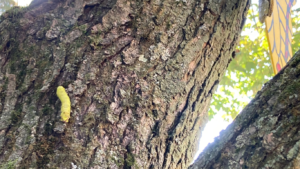
The other day, as I was digging through photographs for sticker making, I stumbled upon a short video I had captured a few days earlier. I had been sitting at my desk, and out the window, I saw one lonely leaf on the tree, literally wiggling side to side. As a butterfly lover, I thought it was a very large chrysalis. Jumping out of my chair, I reached for the binoculars, quickly discovering a rolled-up leaf had remained after the tree lost its leaves for fall.

I am obsessed with caterpillars and butterflies, so my perception is, in a sense, tainted. Anyone else looking at that tree would have seen a leaf blowing in the wind. I, however, had an inside scoop. Only a few months earlier, I had witnessed a considerable caterpillar making its way up the most extended branch. Still, it never dawned on me that it was winter and the butterflies had transformed many months ago. Since I am currently working on a project writing about bugs and caterpillars, I chalk up the vision I saw to divine inspiration! After all, my first book began with a caterpillar clutching a leaf as a storm erupted around it.

I should also note one other important aspect of my leaf video. In the moment I recorded, the sky was dark and gray. Yet, when I watched it back, a small area of light appeared, proof in my eyes this was a Holy Spirit-filled moment. Always in tune with how God communicates to me, I knew there was a reason I was so captivated by the leaf in the wind.

Because I am a woman of faith, open to the promptings of the Spirit, my perception is programmed to view the light in the video as God’s whisper. However, anyone else looking through the same lens and watching the same video could pick up the reflection of the ceiling light bouncing off the window.

Another example is how we perceive God’s fluffy clouds in the sky. There have been days when I’ve seen things like a bunny, a vintage feather pen, a replica of the Ark, etc. Someone else looking at those same puffy clouds probably wouldn’t see them as I do. That doesn’t mean my perception is wrong. It all depends on how God has conditioned my eyes to see what He has placed on my path.

The stirrings in my heart and the knowledge of God’s presence are all I needed to convince myself of an experience of a Spirit-filled moment. Circumstances have trained me to expect God to show up and do big and small things. The instance in the tree is one of those small things, but it may have a more significant impact someday.

Going to scripture, I reflect on Luke 24:13-15, when the disciples walked the road to Emmaus. Because they had witnessed the death of Jesus, they did not expect him to be on their path. God had closed their eyes at that moment, but their perception was also conditioned by what they had experienced earlier.

When we are consistently open to the promptings of the Spirit, God can and will do big things. He will set the scene right when He has something to show or share with you. How you perceive it all depends on your willingness to let God in. It might be something that only you can see or something others think is entirely absurd—these are the moments when you stop and pay attention. God is most likely speaking to you and only to you!


Copyright 2024 Kimberly Novak
Images: Canva

Finding Treasures in Pockets of Time


Finding Treasures in Pockets of Time

When I run into other moms at church, in the neighborhood, or at the grocery store, I find that I am having the same conversation over and over. I say, “Hi! How are you?” and she replies, “Busy!” and then delves into her litany of appointments and tasks that fill her schedule, and I reply in kind by agreeing and sharing my own over-scheduled obligations. We end our rushed conversation and run off to get something else done.

Sometimes there are things in our lives that we need to purge. It may not always be easy to remove it, but often, we are aware of the things that consume our time and give us nothing in return. I find, in my life, those things are typically self-centered, and when I choose to live the way Christ wants me to, I am given the strength to remove those things that take up too much of my life.

As mothers, though, so much of our life is spent in service to others. We are chefs, nurses, house cleaners, and chauffeurs, not to mention boo-boo kissers, story time tellers, snuggle buddies, and behavior correctors. Then our mother-in-law comes to visit, and we must be the perfect hostesses. The list goes on indefinitely, but the hours in the day do not.

How do we find time for Christ when we are pulled in so many different directions? It is especially difficult when these many different directions are for good things for our families. From time to time, I have found myself wishing for the seemingly simple life of a nun, especially when I am craving time and intimacy with our Lord but finding the demands of my vocation of motherhood to be standing in my way. But then I remember the beautiful gift of my calling, and I have worked to grow in my relationship with Christ within the demands of my schedule.

I rarely have large blocks of time, but I am regularly gifted with what I call “pockets of time” throughout the day. I have five minutes here or there, often while I am waiting for something, that I used to spend scrolling on my phone or otherwise distracting myself. Now, I try to be purposeful with these pockets of time and turn to God in prayer, even if I don’t have time to read the daily readings or journal in my Bible study workbook.

I used to get stuck in my growth toward Jesus because if I didn’t have 20–30 minutes to sit down, read, pray, and reflect, I wouldn’t do anything at all. Then, by the end of the day, I would feel like a failure because my spiritual time was just something else that I didn’t get done today (along with a shower or getting that laundry from a week ago folded). Somewhere along the way, I realized that God never gave me a set of expectations for how and when I have to pray. That came from my own unrealistic expectations, compounded by comparing myself to other women who seem to have it all together in their faith journeys.

Now, instead of dedicating 20–30 minutes to God in the morning, I turn to Him for a minute or two 20—30 times per day. Before I get out of bed in the morning, I say hello to the Lord, offer my day to Him, and ask Him to show me His will. When I begin a household chore, I offer it for someone in need. I pray for a moment before I start a workout, thanking God for the gift of my body, the temple which houses my soul and the Holy Spirit. I have learned that just a few moments is all it takes to recenter my day and draw closer to Christ.

The best part about approaching my prayer life in this way is how my spiritual life has deepened and grown. Previously, once I had completed my morning prayer time and reflection, I would check the “Time for God” box and then go on with my day. Now, by regularly recentering myself and refocusing on God many times throughout the day, I am able to let Him work in me and through me all day long. It is such a gift that God has helped transform my life so that my entire day has become a prayer.

© Maria Riley 2024

Magnificat of a Prodigal

Magnificat of a Prodigal

“I baptize you in the Name of the Father, and the Son, and the Holy Spirit,” the priest said, making the sign of the Cross on the baby, a newborn not expected to live, and marking her forever as Christ’s own.

My urgent baptism the day I was born was probably the greatest gift my parents ever gave me. It lit a flame within me that oftentimes seemed to flicker dimly yet refused to be extinguished. As I wandered aimlessly and recklessly through the next decades, the grace I received at my baptistm acted as a homing device to bring me back to the true home and true faith that stirred inside of me.

I am a prodigal daughter, one who strayed long and far. One who thought she could grab her inheritance early and do better with it out in the world than within her Father’s house. Like the older son of the parable, I ended up metaphorically broken, dirty, and perishing from hunger.

We were a family that was Catholic, but not a Catholic family; an obligation passed down through my mother’s side. We knew about Catholic things―prayers, holy days, the pope―but as a family, we did not practice the Catholic faith. Culturally, the 1970s was an age of rebellion―not obedience―to tradition, ritual, and authority. Catholicism was an easy scapegoat. I was drawn to the mysticism, the precision of the rituals, and the stories told in the stained glass, but I didn’t understand any of it. I was curious about the people honored with statues but didn’t know them either, save Jesus, Mary, and Joseph. The old churches with their intricate architecture beckoned and the modern ones reflected messages around me that this faith was nothing to love. So many seemed to hate it, and I followed along.

While still going through the required CCD and Sunday motions, I became ABC: Anything But Catholic. How about Hinduism, Buddhism, Judaism? Then other eastern philosophies and exploration into yoga. I read enough to pick and choose what worked for me. Occult, New Age, and pursuit of worldly goals led to darker passageways and heavier sins, but there was always some flash, some small ray kindling in me that kept me from journeying as deep into the darkness that had captured many of my friends.

He has come to the help of his servant … he has remembered his promise of mercy.


By my 30s, wrong paths and hard lessons had beaten me down. I had pushed God away, doubtful I had a way back, but I started attending an Episcopal church. It was Catholic enough to be familiar but without … well, whatever it was I claimed offended me in my youth. I pondered the creed in the Book of Common Prayer and tried to recall the Creed I had memorized as a child. Was it exactly the same? The Creed was something I always believed. I didn’t know why. I could say it without feeling like a hypocrite. I knew that if I were serious about reuniting with God, I had to go back to my beginning. With a “try me” attitude, I began listening to Catholic radio and watching Catholic television constantly. What I thought were tough questions about the faith were satisfied quickly and easily.

Tentatively, I considered going to Mass, but refused to set my alarm, daring God. If he wanted me back to the Catholic Church, he’d wake me up. He did. I played that game the next week. Once again, he won. This continued for weeks until I wanted to go to church, and just to make sure I wouldn’t miss Mass, I set my alarm.

He has lifted up the lowly … He has mercy on those who fear him …


At Mass, I felt like I had crashed a gala event. Still, each week I went. I sat in the back feeling invisible, until Communion when I felt conspicuous. Alone in the pew, I knew it was not my time. It took three years of going to Confession, remembering a lifetime of sins, and speaking them out loud before I felt like I could honestly receive the Eucharist.

He has scattered the proud in their conceit …


On Easter, the day we celebrate his Resurrection, came a resurrection for me. After many years, torturous examens, and woeful pleas for forgiveness, I stepped up to receive the Body of Christ. “Amen,” I whispered, closing my eyes to dam up the tears. Immediately, I was surrounded by a beautiful aroma that was like home-baked bread with an undefinable sweetness. Not sweet like candy, fruit, or flowers, just a sweetness all its own. The experience simulated walking into a cozy home on a windy, frigid day, with a fire in the fireplace, and a scrumptious dinner in the oven. It had the joy of being welcomed by happy dogs and held by arms that had been waiting just for me. It had the intimacy of snuggling under a blanket with the person you love the most, who knows you better than anyone, your faces millimeters apart, trading secrets and dreams, giggling over private jokes. This sensation would remain with me through the end of Mass, and it continued through the summer.

He has filled the hungry with good things …

More than a decade later, I might experience a brief wafting of this aroma when I receive the Eucharist. I miss the intensity of the first months, but I think he knows I’m convinced he is with me. He promised, “Behold, I make all things new.” He took me, a soul that didn’t expect to survive, and bore me anew.

My soul proclaims the greatness of the Lord.
My spirit rejoices in God my Savior.


Copyright 2024 Mary McWilliams
Cover photo: Canva
Image: Pixabay.com

God’s Christmas Wish

God’s Christmas Wish

Finding myself deep in the throes of holiday madness recently, a short phrase spoken by a house guest caused me to stop and think about where my focus is this Christmas Season.

“We want as much as we can get. All dogs want are the crumbs.”

Among the busyness that comes with the holidays are many suggestions for the gift-giving season. As a child, I recall giving my parents my gift wishes in not-so-subtle ways. I circled toys in catalogs and newspaper ads, as a blatant way of letting them know all I hoped for that Christmas. I have lovely memories of how my children voiced their wish lists, and I am enjoying how creativity is growing with each new generation.

Fixing our eyes on the birth of Christ becomes complicated when the commercialization of Christmas is all around us. Somewhere, at some point, there needs to be a balance. After all, God gave us the best Christmas gift ever, and doing the same for our families is good. Keeping our hearts aligned with God in the process is even better.

I never imagined such a profound statement coming from giving our dog apple pie crumbs. The truth in those words echoes in my heart days later. At this time of year especially, we do want as much as we can get, and if you think about it, the little dog considers the crumbs a full-course meal. I don’t think I will ever look at a piece of apple pie the same, and if my little dog plays her cards right, she may end up with a whole slice!

What would this look like if we flipped the circumstances just a little? Would crumbs be enough in everything we pray for or desire from God? If God’s will for our lives is not to receive the wish list in our minds but to receive only a portion, can we be as content as the dog receiving scraps? Taking it even one step further, let’s imagine that we are holding the meal, and God is patiently waiting for us to give Him a portion—how much are you willing to give God? Are you offering only crumbs or the entire piece?

A relationship with God requires opening your heart and giving God your time and energy. We put forth all of these things to the multitudes during the holidays. I never think twice about making time for shopping, baking cookies, and attending holiday gatherings. However, there are times when my prayer life suffers amidst the holiday madness. Christmas is a celebration of the birth of Christ, God’s one and only Son, given to us as a gift. It is a beautiful gift for you and me to offer our time, energy, and focus to the God who gave us life.

So how do we find that balance, the sweet spot where we can check off the holiday to-do list while staying true to our commitment to the intimacy of prayer? The obvious would be to put God first. This is easier said than done when our minds focus on everything else. Perhaps a written wish list between you and God might do the trick. Consider what God might wish for you, and then offer your requests prayerfully each day. Actions such as these will help to keep your heart and mind focused on involving God in the holiday preparations.

As you wrap presents and tie beautiful bows this holiday season, offer a prayer or two for God’s children who are happy and content with what little they have. Pray for the desire and grace to be satisfied with what God has given you, and perhaps drop a crumb or two to the little dog waiting at your side; God is right there with them.


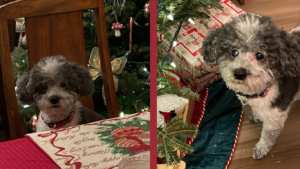
Copyright 2023 text and dog photo: Kimberly Novak
Other Images: Canva


Navigating through darkness to the Season of Light

Navigating through darkness to the Season of Light

My peace I leave with you, my peace I give to you. Not as the world gives do I give it to you. Do not let your hearts be troubled or afraid.
—John 14:27

The Lord spoke these words to disciples before the crucifixion. By the end of the discourse, it would be understandable that their anxiety was rising. He concluded: “I have told you this so that you might have peace in me. In the world you will have trouble, but take courage, I have conquered the world” (John 17:33). He knew what the earthly powers planned for them as his followers, and they needed to be reminded that no matter what the world dished out, his was not simply a better way, but the best way. He also sent this message before his birth. In reflecting upon the readings throughout Advent, we can quell the turbulent stirrings rousted during the holidays.

Living in the world is a hard contact sport, and only a fool would play a rough game without proper conditioning and back-up. Yet so many go through life without the support that faith gives. Our society has record numbers of people living with anxiety and depression, and plummeting numbers in church attendance and religious affiliation. The culture is identified by the disturbingly accepted phrase, “post-Christian society.”

Even believers can be shadowed by the unrest that balloons during the Advent and Christmas seasons. The constant pressure to spend, eat, socialize, and “be of good cheer” causes angst for many, even those who enjoy the hustle and bustle. The Devil, that slobbering, panting mongrel of darkness, dispatches four of his best henchmen to squeeze the vulnerable. These days, that applies to most of us. Anxiety, Panic, Fear, and Depression are among his supreme lieutenants because they are excellent collaborators of opportunism. He recruits limitless holiday help to brew botheration through the urgent and endless “best sale of the year” deals, the “get it or forget it” Christmas lists, and social engagements (or lack thereof).

For others, the season stirs up grief over deep loss. The reasons for the unease outnumber the people experiencing them. The pace of keeping up with the season triggers everything from dread to disappointment to despondency. It’s enough to make Santa’s elves want the holiday season to be done. How sad to want such a beloved and beautiful time—Advent and Christmas—to be over with a big sigh of relief. For the beast of the underworld, it’s pure delight, like fresh, bloody meat.

Scripture is always the balm for sufferings of the world, but the readings this Advent—including those from morning and evening prayer and daily Mass—penetrate the fog that can become ever so dense. We began Advent with the command to “watch.” Listen also to the messages of the season. Perhaps commit to memory a passage to push out the anxiety whenever it begins to bubble. “I will listen for what God, the Lord has to say; surely he will speak of peace to his people and the faithful” (Psalm 85:9).

During Advent, we encounter the faceless and the nameless that Jesus healed, proving that God sees us all—no matter how invisible we may feel—and wants to make us whole. “Great crowds came to him, having with them the lame, the blind, and many others. They placed them at his feet, and he cured them” (Matthew 15:30). Matthew recounts in 9:36: “At the sight of the crowds, his heart was moved with pity for them because they were troubled and abandoned, like sheep without a shepherd.” He even healed those not physically present as we hear the centurion’s pleas for his suffering, paralyzed servant (cf. Matthew 8:5-13).

We meet people this month who, with great trials, embraced the rays of the Son. December 13 is the feast of the fourth century martyr, St. Lucy, whose name means light. She chose a hideous torture that blinded her because she would not betray her Savior. Isaiah 40:29 fortifies us: “He gives power to the faint, abundant strength to the weak.” The following day, December 14, we remember St. John of the Cross who, more than five centuries later, continues to enlighten with his Dark Night of the Soul.

The Advent readings are a treasury of fortitude to battle distress: “… you shall no longer weep; He will be most gracious to you when you cry out; as soon as he hears, he will answer you” (Isaiah 30:19). And others: Psalm 121:5, 7-8; Isaiah 25:8; Wisdom 18:14-16; Song of Songs 2:10-11 to name a few. Throughout Advent, God sends us messages of hope and encouragement. We are assured in Philippians 4:6-7: “Have no anxiety at all, but in everything by prayer and petition, with thanksgiving, make your requests known to God. Then the peace of God that surpasses all understanding will guard your hearts and minds in Christ Jesus.”

Peace be with you.


Copyright 2023 Mary McWilliams

Feature Image by Rúben Gál from Pixabay
Image by Ri Butov from Pixabay

A Wonka Way of Life

A Wonka Way of Life

I love board games. I especially love them now that my kids have graduated from Candyland to (slightly) more advanced and strategic games. I find that playing board games with my kids is the easiest way for me to have them off screen time without them driving me insane or physically accosting each other. (Yes, my girls look adorable, but they’re feisty.)

Our current family favorite is Willy Wonka’s The Golden Ticket Game. Essentially, you play as one of the five children from the film, and collect Willy Wonka Bars through various actions. At the end of the game, when all the pretend candy bars have been collected, the players look inside their Wonka Bars to discover if they have won one of the coveted Golden Tickets. At least one player is left without a Golden Ticket, more if someone is lucky enough to have found more than one ticket in his or her own stock pile of candy bars.

Since they were itty bitty, I’ve never let my kids win at games. (Okay, maybe I skew the game a little bit, but I’ve never completely thrown one.) I believe that learning how to deal with losing is an absolutely fundamental skill that our kids need to learn as early as possible. We have a little song that the loser sings to the winner after a game, which goes, “You won, you won, but I had a lot of fun.” Then the winner has to clean up the game so there’s a tiny bit of retribution.

The original Willy Wonka and the Chocolate Factory movie from 1971 still gets regular viewing around our house too. (The anticipation is already growing for the Willy Wonka origins story releasing later this fall.) In the original film, we meet the eccentric Willy Wonka, who lives in a realm that seems contrary to the rest of the world. His jovial spirit and quirky mannerisms can seem enticing and confusing at the same time. He delivers countless iconic lines; my favorite one is when, after he says that they have so little to do with so much time, he exclaims, “Wait. Strike that. Reverse it.”

I feel like Jesus says that to me too in my call to Christianity. He says, “The world is doing X, but you need to strike that and reverse it.”

The American cancel-culture is infectious these days. When a person makes a single mistake, we are not only permitted but encouraged to cut them out of our lives permanently. This goes for celebrities and family members alike. If someone doesn’t agree with our religious or political views, we simply unfollow and block all communication. If someone hurts us, we self-medicate with booze instead of searching for true peace through forgiveness. We justify and excuse our actions because the rest of the world behaves that way too.

As Christians, we are called to live an upside-down, Willy-Wonka-type life. Where others refuse to forgive, we are called to love all the more deeply. Where others seek worldly recognition, we are called to work lovingly from the shadows. Where others seek riches, we are called to generously share all that we have been given. When the world says, “Do X,” we have to wait, strike that, and reverse it.

© Maria Riley 2023

Photo License: https://creativecommons.org/licenses/by-sa/2.0/deed.en

I Wasn’t Prepared

I Wasn’t Prepared

Image by lisa runnels from Pixabay

A few weeks ago in church, I listened to the sermon about the parable of the ten virgins, five of which were wise and the other five of which were foolish.  All went out carrying lamps to wait for and greet the coming Bridegroom. The five wise virgins brought oil with their lamps, whereas the five foolish ones did not. The five foolish ones took it upon themselves to wait until the Bridegroom came, at which point they would ask their wise counterparts for some of their oil. However, the wise ones told them that they could not share their oil with them, lest there would not be enough. The foolish virgins’ only other alternative was to go out and buy their own, but by the time they arrived at the scene of the Bridegroom’s arrival, they could not attend the wedding banquet with Him. The five wise virgins, on the other hand, were prepared, and hence, they were admitted.

My ears perked up when I heard this. When you think about it, it can be scary. It can feel pressurizing to be prepared for the coming of Jesus, lest we miss out on eternal bliss and peace. Nothing is worse than that, although when I heard this sermon, it reminded me of a similar experience of my own in which I was not prepared. No, I didn’t miss out on getting to heaven (at least not yet), but I missed out on something that could have been very good for me. It has been a hard lesson, and I’m still in the process of forgiving myself for this foolish mistake, which I will describe.

I was preparing to make a “leap of faith” and abandon my current temp job to start a freelance case study copywriting career. Saying goodbye to bosses, commutes, deadlines, pointless meetings, and office politics seemed almost within my grasp. I wanted to create a dream job scenario for myself which would allow me the flexibility to work from home doing something I loved, all while making my own hours, deciding what days I wanted to take off, being able to attend to my children’s upcoming issues at school or at home, et al. Being in job transition had allowed me that flexibility, and it had also allowed me to nurture my faith journey and my prayer life, and I got very attached to that routine.  The last thing I wanted was to stay in my current temp job or even to take on another job – temporary or permanent. 

The time had come for me, I had decided, to be in charge of myself, but when I received the phone call about a job interview in civil service, I should have been ecstatic. Here was a chance for me to work in an environment which is known for being accommodating to people who have children with special needs, for being generous with paid holidays, sick time, and time off in general, job security, solid benefits, and interesting work with good pay. My stupidity got in the way, and my emotions got the better of me because I thought that “my way” with the freelance copywriting career was the ticket to my financial success and my ability to be available for myself and my kids. As a result, I did not take preparing for the interview seriously. I went in with the attitude that I did not care whether I got the job, but that was before I got there and realized that this could be a great thing. 

As soon as I got to the office building in Ridgewood, Queens, I gaped. The surroundings were breathtaking. I looked around and realized that I could be happy making this trip into work every day. Then I went in for the interview. There was a panel of three people, all wonderful, warm, and friendly. They made me feel at home, and the questions they asked were pretty straightforward. Still, I did not feel as though I had done my job of preparing, and I’m almost sure that I blew it. I walked out of there wondering how I could have been so careless as to not prepare myself for this good thing. Had I taken it seriously, I could have gotten into the “banquet,” but I was like those five foolish virgins, and now for the rest of my life, I have to live with the consequences of my attitude. My only consolation in all of this is twofold – I learned a lesson, and I have not yet blown my chances of making it into the “banquet” of heaven.  At least with that, there’s still time to prepare.

© Copyright 2023 by Michael Vassallo

Featured image Image by Aksel Lian from Pixabay

Little Sundays

Little Sundays

Every Sunday is a Holy day of obligation, a day set aside to gather with community and worship Our Father in heaven. This day can also be observed by attending a Sunday Vigil celebrated on Saturday evening. Catholic teaching instructs us to refrain from engaging in work or activities that deter the worship owed to God. Recently I took a day away and referred to it as my “Sabbath,” and I pondered whether or not, in today’s society, these teachings are being honored.

I can admit that I have worked on Sundays in the past. Whether it be writing, cooking, or cleaning, these all take on the energy of work and direct my attention away from worshiping God. I could argue that my writing is spiritual and for the Glory of God, so perhaps that is allowed. I’ve yet to answer that thought. However, I know that engaging in writing on the Lord’s Day is different than attending church, coming home, and reflecting on the readings, sermon, and worship music.
It would be lovely to come home from Mass and simply enjoy celebrating God with my family and friends over a meal. My husband and I like to watch old black-and-white television programs, where families are often depicted attending church service on Sundays and then relax on their front porch, carelessly and effortlessly enjoying the day of rest. I guess observing the Lord’s Day in past generations proved a little easier to do. I wonder what it would feel like if, in today’s culture, we made a considerable effort to set this day aside for the one who created us.

“Work shall be done for six days, but the seventh is the Sabbath of rest, holy to the Lord.”
Exodus 31:15 NKJV

My sabbath day away showed me how much my heart and mind craved one-on-one attention with God. I promised myself more of these days away from my routine to enjoy a full day of prayer and spiritual activities. I’m a little nervous about the holidays approaching if I will be able to honor the time I have set aside. I am organized and a good planner, but we all know how life intervenes and takes us off course. Because of that, I began thinking about other ways to honor God ahead of Sundays and days of spiritual enlightenment. I hope that by creating Little Sunday moments, my heart will be ignited and thirsting for more of God. All the while effortlessly easing me into honoring the seventh day of rest.

I have a few ideas based on my individual preferences. However, you can all devise your own Little Sunday moments. Each day, our local Christian Radio station, 95.5 The Fish, invites listeners to pray The Lord’s Prayer. Engaging in those few minutes is enough to draw the Lord into my day and close to my heart. Another opportunity is praying the Divine Office or Liturgy of the Hours. Many Catholic prayer apps and online tools can help you get started.

If you want to keep your focus on Jesus, honor the day of rest, and grow closer to God, then consider praying about how God is calling you toward Him. From this, devise your plan for Little Sundays throughout your week. Engage in conversations with your family and friends, inviting them to participate. For the time being, when I feel called to write on the Lord’s Day, I will first engage in prayer and allow God to guide my thoughts. If they end up on the page, I know it was because God designed it for His Greater Glory. God calls us to be set apart or different from ordinary things and turn our focus toward Him. I pray that your Little Sundays become stepping stones toward your complete surrender to the Sabbath day of rest, holy to the Lord.


Copyright 2023 Kimberly Novak
Images: Canva

Everyday Holiness

Everyday Holiness

When I received the news that my first published short story had not only been accepted, but also chosen as the opening gambit for a travel writing anthology that included pieces by several well-known authors, my first thought was, “I have to call Mom and tell her I got the lead. She’ll be so excited.”  And then I remembered.

The woman who nurtured my first crayon scribbles, and typed my long-procrastinated school term papers on an old manual typewriter, had already been absent for fifteen years by then. Even now, thirty-four years after her death, I still get the same urge to call and tell her, whenever there’s happy family news.

Anyone who has ever lost a beloved family member, or cherished friend, understands.

This past week we’ve celebrated two special liturgies that traditionally open the month of November. They encourage us to honor all the saints in heaven, and to remember our beloved dead.

The Roman Catholic liturgical calendar gives a rhythm to our lives, alternating ordinary days with special feasts and dramatic seasons: Advent, Christmas, Lent, Easter and Pentecost.

But we don’t just remember our lost loved ones on the Solemnity of All Saints or at a Commemoration of all the Faithful Departed.

The simplest things can suddenly trigger a memory: the smell of a favorite family meal simmering in the kitchen; a glimpse of the lamp burning late into the night while a parent stays up late to pay bills; a toddler’s smile greeting us in the morning over a crib rail; the precious small gift from a thoughtful friend who somehow always knew just what we needed, and when.

Amidst many speeches that marked my oldest son’s baccalaureate ceremonies, the university dean who spoke at his academic awards assembly made a particular point for the new graduates. His words held a wisdom that has remained with me.

“It’s not this ceremony that’s important,” he said. “Or that splendid certificate that you’re about to receive. We’re celebrating all the mornings over the past four years that you got out of bed and went to class, all the nights you studied in the library instead of partying, all the papers you wrote with extra care, everything you did that led up to this day. Yes, today you’ll be ascending the stage, you’ll hear lots of applause, and your families are gathered here to celebrate with you. But it’s those ordinary days, the good choices you made one after another, the habits you established, that are your most important awards. They’re what you’ll take with you wherever you go for the rest of your lives.” (1)

In our Mass readings this weekend both liturgies contrast humility and charity with arrogance and entitlement.

Today’s Memorial of St. Charles Borromeo incorporates an Alleluia verse that is also used to celebrate the Solemnity of the Most Sacred Heart of Jesus:

“Take my yoke upon you and learn from me, For I am meek and humble of heart.” Matthew 11:29ab. (2)

In the Gospel reading, our Lord advises us “. . . do not recline at table in the place of honor . . . when you are invited, go and take the lowest place . . .” Luke 14:1, 7-11. (3)

Readings for the Thirty-first Sunday in Ordinary Time contrast a mother’s affectionate care and a child’s implicit trust, in the Responsorial Psalm 131: 1,2,3, with Our Lord’s condemnation of arrogant scribes and Pharisees, in the Gospel from Matthew 23: 1-12. (4)

St. Charles Cares for the Plague Victims of Milan by Jacob Jordaens (1593-1678), St. James Church, Antwerp, Belgium, public domain via Wikimedia Commons

St. Charles Borromeo was born in a castle on the shores of Lake Maggiore. His father was a Count of Lombardy whose aristocratic family’s shield bore the motto, “humilitas.”

His mother was Margherita de Medici, whose younger brother became Pope Pius IV. (5).

The paintings featured here commemorate St. Charles Borromeo’s assistance to the poor during a famine in Milan; and his refusal to leave the city after an outbreak of the plague. He remained behind in his own episcopal see while many other bishops and clergy fled. He stayed to pray for his people as their archbishop, and administered the sacraments to plague victims.

Even while he was serving as a papal representative to the Council of Trent, and performing as a leading figure in the Counter-Reformation, St. Charles Borromeo never forgot his family motto, humility; or the Jesus who washed his own apostles’ filthy feet.

Both of these paintings, and many more found in museums and churches across Europe (6), document St. Charles Borromeo’s devotion to the humble Virgin Mary. Her vivid presence in so many of his portraits reveals the close relationship they shared in his charitable work, in his intercession for the people of Milan, and in his dedication to the universal Church.

This November — while we’re preparing for Thanksgiving and the Solemnity of Jesus Christ, King of the Universe — may we, too, remember to practice the extraordinary virtues of ordinary everyday holiness.

©Copyright 2023 by Margaret King Zacharias

Feature Photo: Intercession of Charles Borromeo Supported by the Virgin Mary by Johann Michael Rottmayr (1656-1730) in the collection of Karlskirche, Vienna Austria, public domain, via Wikimedia Commons

Notes:

  1. Personal communication.
  2. (https://bible.usccb.org/bible/readings/110423.cfm).
  3. (https://bible.usccb.org/bible/readings/110423.cfm).
  4. (https://bible.usccb.org/bible/readings/110523.cfm).
  5. (https://www.newadvent.org/cathen/03619a.htm)
  6. (https://www.christianiconography.info/charlesBorromeo.html).


Stay in the Know

Join Our Newsletter

Members and supporters can get the latest on CWG news and events by signing up for our newsletter.

Please wait...

Thank you for signing up!

Catholic Writers Guild
P.O. Box 77
Eaton, IN 47338