
The Shepherd’s Pie: Grief and Conversion

The Shepherd’s Pie: Grief and Conversion

“A slice of hope to raise faithful kids.”

This uplifting, ecumenical show uses engaging conversations and fun entertainment reviews to offer positive insights and media resources for families and youth leaders. We discuss current issues that impact young people at home, in school, and in the world today.

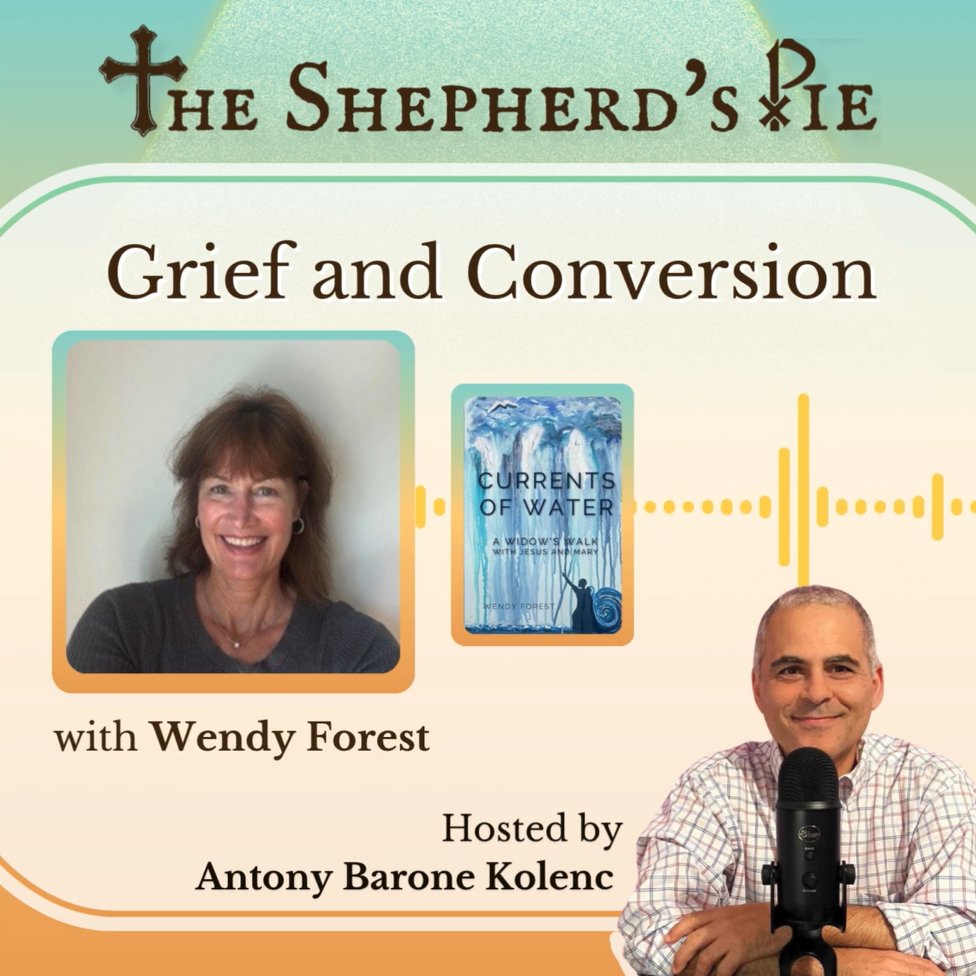
In this episode of The Shepherd’s Pie, I speak with Wendy Forest about her experience as a widow, and how grief led to her conversion to the faith, and we discuss her spiritual reflection, Currents of Water: A Widow’s Walk with Jesus and Mary.


Check out other episodes of The Shepherd’s Pie.


Copyright 2025 Antony Barone Kolenc

From Grief Through Mourning

Last year, I could not do it. This year I did.

In the Catholic Church, the month of November begins with two consecutive liturgies that honor our beloved dead, The Solemnity of All Saints and the Commemoration of All Souls.

We always hope that departed family members and friends might be celebrating the first feast with us, already among the saints in heaven. We trust that our prayers will help to console and sustain any loved ones who might, this year, still remain in purgatory.

It takes most people a long time to establish their ‘new normal’ after a family member’s or close friend’s death.

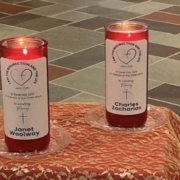
In my parish, one of these opportunities is a Mass of Remembrance offered each year on the Saturday morning before All Saints Day. A candle is provided for each family to place around the altar when their loved one’s name is proclaimed, and these candles are lit for each mass through the month of November

Last year, the 2024 Mass of Remembrance was scheduled just ten days after my husband’s funeral. With a sincere intention, I had placed his name on the list.

But when that Saturday morning arrived, I found myself still too exhausted from his sudden, unexpected death, the need to transport his remains from another state, and managing to stay functional — with help from close family and friends — for the funeral.

Last year, another dear friend stepped up to carry Charles’ Mass of Remembrance candle for me. This year I was able to carry it myself.

***

Beyond Catholic parishes’ roles in helping to organize funeral liturgies and hospitality, many also offer valuable longer-term support options, to help families survive devastating grief and manage the psychological challenges that always accompany any great loss.

We are all unique creations of God, and every person’s grief process is unique. So, I want to briefly share two more long-term support options offered by the grief ministry in my parish.

What has served me best might not be right for you. Likewise, parts of these programs that did not most resonate with me, might be just right for you.

I include them here because I believe they offer a range of valuable options to meet a variety of needs for different mourners.

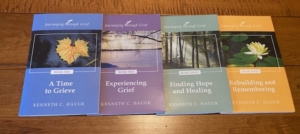
The first is a year-long series of booklets, +/- 40 pp. each, written by Kenneth C. Hauck and published by Stephen Ministries in 2004. Entitled  A Time to Grieve, Experiencing Grief, Finding Hope and Healing, and Rebuilding and Remembering. These were mailed to me quarterly after my late husband’s funeral, as gifts from my parish.

Because I am an introverted person who normally reads and writes alone, I appreciated the freedom to digest these words of wisdom privately, and on my own schedule. The quarterly mailing time frame felt just right, too.

For those who feel more enthusiastic than I do about watching videos and participating in weekly discussion groups, another excellent support option offered by my parish is titled Grieving with Great Hope.

Meditation Journal written by John O’Shaughnessy, Sandy O’Shaughnessy, and Fr. John Riccardo,
part of the Grieving with Great Hope parish program, published by Good Mourning Ministry, Inc.

This program includes a series of videos, and small discussion groups with fellow mourners from your own parish. Ordinarily, those who join this program are in closely similar time periods after a loss.

The program includes a journal published by John and Sandy O’Shaughnessy, with Contributing Writer Fr. John Riccardo, as part of Good Mourning Ministry, Inc.

Of the resources offered by this ministry, I’ve personally found silent meditation and private writing, with the suggested journal

reflections, to be the most helpful. But I have also witnessed the benefits gleaned by others, from watching the videos and participating in discussion groups.

***

At the Mass of Remembrance on October 25, 2025, my deceased husband’s date of passing was the longest elapsed. I had been prepared beforehand, by our deacon’s gentle and compassionate wife, to hear his name called first and to face the empty altar alone.

As I bowed before the altar I tried to discern, among all the candle holders so lovingly arranged, where might be Charles’ place. The Holy Spirit led me to a place on the side by my accustomed pew, when I sing with the funeral choir, near the altar and close under the crucifix.

While a total of almost forty names were called, I prayed for each soul, and watched each family approach the deacon to receive their candles.

Charles’ light had to hold his mountain alone, for a long time. I began to wonder, who will God send, to occupy that spot beside him?

About three-quarters of the way through the list, I heard the name of a dear friend, mentor, and fellow funeral choir member. She and her late husband had coordinated our county-wide nursing home citizen-visitor ministry throughout their long retirement years. I had been a part of that ministry.

I watched Janet’s four children — none of whom I had ever met — come up to receive their candle, and bow. I could feel them doing their own discernment.

When they came over, to place Janet’s candle next to Charles, I could almost hear her saying, “Don’t worry, Margaret. I’ll look after him myself.”

***

Wherever any of you may be in your own grief journeys, no matter who you might be mourning this November, please know that I am

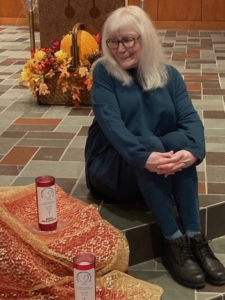
Author meditating on the candles, after Mass of Remembrance at St. Theresa of the Child Jesus Catholic Church, Des Moines, Iowa, October 25, 2025.

praying for you.

I ask your continuing prayers for me, too.

This will be my last CWG column for a while. I need a brief sabbatical; to continue dealing with the massive changes I’ve experienced

over the past fourteen months, and to discern where my own ‘new normal’ life will lead.

May the compassion of Our Lord’s most Sacred Heart, the love of Mary’s Immaculate Heart, and the wisdom of the Holy Spirit remain with you, as well.

Blessings, always,

Margaret


© Copyright 2025  by Margaret King Zacharias

All photos from author’s personal collection; used with permission by the author

Featured photo: Candles lit for Mass of Remembrance, St. Theresa of the Child Jesus Parish, Des Moines, Iowa, on
October 25, 2025. Author’s personal photo, published with permission.


Graveyard of the Atlantic: A Ghostly Encounter

Graveyard of the Atlantic: A Ghostly Encounter

Ghost stories tend to be relegated to October or similarly dark nights with a crisp edge to the air that makes you want to curl up safely in a blanket. But, just like ghosts remain transient, their stories don’t have to be fixed to a particular month. My family’s encounter with a spirit was on a warm June night off the coast of North Carolina, near the Graveyard of the Atlantic. I want to be careful and remain respectful as I tell you about my family’s recent encounter.
With any topic concerning what “lays beyond” I believe one should tread lightly. First, if whatever is haunting an area is truly a lost soul, they deserve certain considerations. The first step in any encounter is to pray for the happy repose of the soul who may not be able to be at rest until they receive intercessory prayer on their behalf. If, on the other hand, the haunting is of an evil origin, i.e. – a demonic spirit, the laity must use extreme caution as the demon’s only
desire would be the ultimate destruction of human souls. A priest of the Roman Catholic Church would provide the best guidance in those situations.

On a recent trip out to Hatteras Island in North Carolina, my family and I met up with dear friends at a beach house we had rented for a week. Hatteras Island is at North Carolina’s Outer Banks. Due to the thousands of shipwrecks and the unknown number of human lives lost in the area, the Outer Banks are referred to as The Graveyard of the Atlantic. The shallow sand banks along the coast are hard to see on a brilliant day. Add dark and formidable weather without high tech navigation systems and you have a recipe for disaster. Near our beach house, for
instance, lay the graves of a young couple. Captain Stephen Barnett and his wife Rebecca who, along with their baby boy, lost their lives when Captain Barnett’s schooner ran aground off of Ocracoke Island. It is a tragic story you can find here: https://www.ncgenweb.us/dare/cemeteries/index_barnettstephend.html

Several days into our trip, a squall hit the island as night closed in. The wind slammed against the outside walls and thunder boomed on both sides of the island. Being around 30 miles from the coast of North Carolina, storms feel ominous on an island. After talking late into the night with my friend, I finally headed to bed. Before settling in, I went down to the lowest level of the house to make sure the door was locked. As I turned from the door, I felt a presence very near to me. Deciding I was being silly and chalking up my prickling skin to the billowing storm
outside, I rushed up the couple flights of stairs to my bedroom.

Thunder continued to crash and the wind roared throughout the night.

The next morning dawned crystal clear. The island appeared freshly bathed and brighter after the torrential shower. Our family was the first awake. We headed to the topmost story of the house where the kitchen was located to make breakfast. My nine-year-old son greeted me with a hug and asked why I had been in his room the night before. The conversation went like this:

“Do you mean when I checked on you before I went to bed?”

“Never mind,” he responded, too sleepy to want to explain.

“No, I want to hear about it,” I encouraged. My skin was prickling again. “I gave you and your sisters a quick kiss and headed out of your room before going to my room. Is that what you mean?”

“You were standing by our door. Why were you standing there?”

My stomach felt suddenly heavy. I remembered the presence I had sensed in the downstairs entryway the night before and now my son had seen a form in his room. I kept my face blank and remained outwardly calm. I needed coffee before I could process what my son was asking me.

Mistaking my lack of response for disinterest, my son grew bored of the conversation. “Never mind,” he said, shaking his head and running off to play.

After we had eaten our breakfast and our friends were up and about, the two husbands took off with the children to explore the island’s shoals. My friend and I stayed at the house.

My friend asked, “Was anyone up last night during the storm?”

I froze. “What?”

“We saw someone at our door. I thought it was a child scared during the storm. When we called out, they didn’t come in. We got up to check but no one was there. Our kids said they stayed in bed.”

All I could do was stare. She had not heard my conversation with my son. Now two people had seen a presence. I told her I’d check with my children to see if they’d been up during the storm. When I asked my children later, none of them had left their beds.

Later, I approached my son again. “Can you tell me what the shadow looked like that you saw by your door last night?”

“Tall, short hair, very straight shoulders.”

His oldest sister chimed in, “That doesn’t sound like a description of Mommy. Why did you think it was Mommy?”

A thought struck me. Hesitantly, I asked, “Did the form look like what you’d expect a soldier or a sea captain to be like? The way it was standing so straight?”

“Yeah,” he nodded.

Looking nervous, my daughter broke in again, “Why, Mommy?”

I had one more question to ask my son, “Did you feel like the presence was nice and kind of watching over you during the storm or did you feel scared?”

“I wasn’t scared,” he responded with a shrug. “I think it was like someone was protecting me.”

When my husband and I discussed what my friend and our son had witnessed in the night, my husband reflected that there were gravestones speckled throughout the surrounding yards around the house. He wondered if the house had been built on a graveyard. A quick internet search showed us that, sure enough, the house may have been built on the site of the Zora Gaskins graveyard.

It seemed clear to me that whatever presence was seen during the storm could have been someone who died during a shipwreck, potentially during a storm, and meant no harm. As a Catholic, I believe that some souls are in need of intercessory prayer in order to be at rest. After explaining to our children what we might have experienced in the night and reminding them about the importance of praying for Holy Souls, we traveled to the local Catholic Church and obtained a bottle of holy water. Returning to the house, we offered prayers for the Holy Souls not only in the area but for all those who met their demise in the Graveyard of the Atlantic. We sprinkled holy water in each bedroom and at every threshold.

Even though we had a couple more stormy nights, we did not experience any more ghostly encounters. I pray our friendly ship captain is now at peace.

*One more note of caution: Do NOT seek encounters with spirits. Often, demons will pretend to be those that have gone beyond in order to trick us. The hatred demons have for humans is very real and they will do anything to lead souls astray. If you do experience an encounter, immediately pray something like the following and if the encounter does not cease, it’s time to call in a Catholic priest.

Eternal rest grant unto them, O Lord, and let perpetual light shine upon them. May their souls and the souls of all the faithful departed, through the mercy of God, rest in peace. Amen.

*Previously posted on my blog at www.eahensonbooks.com*

Copyright 2025 by Emily Henson

Edited by Maggie Rosario

The Meaning of Life: Part 1 of 3, An Introduction

“Live the present moment, filling it to the brim with love” (Cardinal Francis Xavier Nguyên Van Thuân, Five Loaves and Two Fish).

In the midst of ongoing world crises — wars in Ukraine and Gaza, economic uncertainty, and the loss of our Pope — there remains the desire to celebrate, to hope, to live, even as we mourn the Pope’s death.

As we Catholics ponder the future and await with joyful hope during this time of Sede Vacante, we celebrate the life of a good man who has gone home to the Lord, we have hope for the future, and we live each day awaiting news of our next shepherd.

Over the past three weeks, there has been a great outpouring of love for our Holy Father on Earth. He emulated our Lord as a man of mercy and compassion (“As he went ashore, he saw a great crowd; and he had compassion for them,” Mark 6:34). He understood Jesus’ call for mercy (“A bit of mercy makes the world less cold and more just,” March 17, 2013 First Angelus of Pope Francis). He was a man of great love for all people (“You shall love your neighbor as yourself,” Mark 12:31).

Pope Francis, a man who lived like Jesus lived, taught what Jesus taught, and loved like Jesus loved, was beloved and adored the world over because he knew the meaning of life. What did he know that we should know? How can we discover the meaning of life?


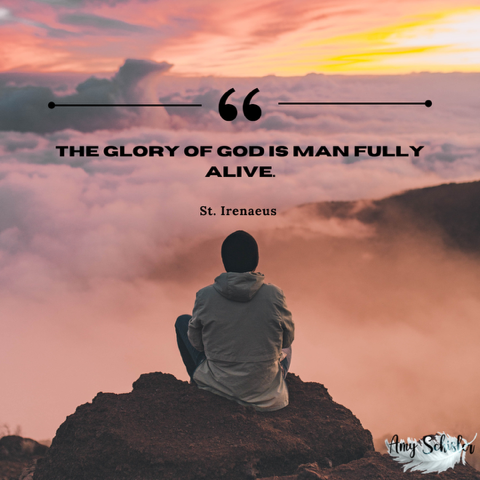
The glory of God is man fully alive

Fully Alive

Like Pope Francis, we are called to have mercy and compassion. We are called to love. We are called to be fully alive. This is the thing for which we are all searching — to be fully alive. And we can only get there through the acts of mercy, compassion, and love.

Our associate pastor, Father Michael Angeloni, recently gave a homily where he showed us the difference between mercy and compassion. He said that having compassion is feeling bad about someone’s circumstance or wishing better for someone; whereas showing mercy is taking action to help someone or make things better for them. Jesus had compassion, but he acted with mercy. Acting with mercy leads us to a deeper love of others.

People who understand this difference know the meaning of life. These people know that following Christ’s example and moving beyond trepidation and fear will lead us to living more fully. People like Pope Francis who said,

“Cast out the fears that paralyze you, so that you don’t become young mummies. Live! Give yourselves over to the best of life! Open the door of the cage, go out and fly!” (Pope Francis)

In his address “to young people and the entire people of God,” Pope Francis told us that Christ is alive; therefore, we should be alive!

In the First Century, St. Irenaeus said, “The glory of God is man fully alive.” We’ve been trying for thousands of years to find a way to be fully alive. I think that’s why so many seek out and follow those people who exemplify Christ but also those who exemplify society’s vision of happiness. Society would like us to believe that joy is what it is not. People who live fully know the difference between compassion and mercy as well as the difference between happiness and joy.

We are all seeking joy. It is the thing which man and woman most desire, whether they know it or not. But it’s not easily found. Often mistaken for other emotions, joy cannot be captured. It cannot be contained. It cannot be sustained in this life. We reach for it, long for it, pray for it because it is the thing which our souls most desire. St. Peter describes joy as “inexpressible and glorious…the result of your faith [felt by] the salvation of your souls” (1 Peter 1:8-9).

We are all searching for truth, meaning, fullness of life, and joy, but many of us are looking for the wrong things in the wrong places! 


Mercy always matters

Life in Abundance

Pope Francis said, “Jesus gives us life, life in abundance. If we are close to him we will have joy in our hearts and a smile on our face” (The Spirit of St Francis: Inspiring Words on Faith, Love and Creation, p. 84).

When we know the meaning of life — living life fully, and loving one another with compassion and mercy — we will know, understand, and spread joy!

The great writer and, dare I say, theologian, C.S. Lewis, wrote time and time again about joy. Even his memoir is titled, Surprised by Joy: The Shape of My Early Life. In it, he writes, “Joy must be sharply distinguished both from Happiness and Pleasure. Joy (in my sense) has indeed one characteristic, and one only, in common with them; the fact that anyone who has experienced it will want it again … I doubt whether anyone who has tasted it would ever, if both were in his power, exchange it for all the pleasures in the world. But then Joy is never in our power and Pleasure often is.”

Joy is never in our power. It is a gift from God. However, showing compassion, being merciful, and loving your neighbor will bring you joy. These things are the things that make us fully alive. Doing these things is our call. This is what will lead us to mission. We must embrace love, show compassion, and lead with mercy, and we will be people of joy. We—you and I—must live in the glory of God, fully alive, “for he came to give you life, ‘and life in abundance’” (Jn 10:10). (Pope Francis)

So how do we live life abundantly? We will explore that next time. Look for Part 2 on June 5, 2025.


Copyright 2025 Amy Schisler
Images copyright 2025 Amy Schisler, all rights reserved.

The Shepherd’s Pie: Poetry and the Stages of Grief

The Shepherd’s Pie: Poetry and the Stages of Grief


“A slice of hope to raise faithful kids.”

This uplifting, ecumenical show uses engaging conversations and fun entertainment reviews to offer positive insights and media resources for families and youth leaders. We discuss current issues that impact young people at home, in school, and in the world today.

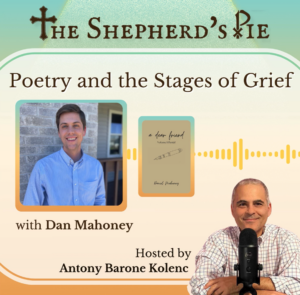
In this episode of The Shepherd’s Pie, Antony Barone Kolenc speaks with Dan Mahoney about how he was able to use poetry to help him cope with the death of his father as he worked through the five stages of grief, and we discuss his poetry book, “A Dear Friend.”


null


Check out other episodes of The Shepherd’s Pie.


Copyright 2025 Antony Barone Kolenc

Eternity of Spousal Love

Eternity of Spousal Love

After the death of my sweet father, my mother’s anguish was excruciating. The story of my father’s suffering and death was tragic. My mother’s grief was multifaceted. No longer having her best friend and beloved beside her in life was unbearable. Something else, however, crippled her even to consider: Would they, upon meeting in Heaven, recognize each other as husband and wife, or, as some posit, would they be so consumed in the beatific vision that their souls would never recognize a sense of past relationship? Would they be as strangers, or does Heaven allow for recognition of sacred, earthly bonds?

First, it is important to confirm the value that God has placed on marriage. In Genesis 2:18 God said, “It is not good for Man to be alone; I will make a helper fit for him.” The original Hebrew word, ezer, is commonly translated to ‘helper.’ However, in her book, Lost Women of the Bible, Carolyn Custis James points out that “the word ezer is used most often in the Old Testament to refer to God as Israel’s helper in times of trouble. … The ezer is a warrior.” (Custis, Lost Women of the Bible, 35-36) God’s design, therefore, is for a spouse to be a fierce protector, assisting their beloved on the path toward God. On our wedding day we likely had no inkling of the battles we would fight alongside our spouse – or on behalf of our spouse, for that matter. Yet it is the strength and fidelity with which we strive beside our spouse in the trenches of life that defines the kind of protector we are. For better or worse, in sickness and health – how have we fought for or protected our beloved?

In Jeremiah 1:5 God says, “Before I formed you in the womb, I knew you, before you were born, I set you apart.” It follows then that God knows our spouse long before we do. He knows our complimentary natures and interests will find fulfillment in each other. He knows the perfect ezer for us. Thus, the very foundation of our relationship with our future spouse is known by God Himself before we are even born. In the eternal eyes of God, does it follow that the love we will share with our spouse has no beginning? Perhaps this is what the Venerable Fulton J. Sheen refers to in his work The World’s First Love when he says, “Every person carries within his heart a blueprint of the one he loves. What seems to be “love at first sight” is the fulfillment of desire, the realization of a dream.” (Venerable Fulton J. Sheen, The World’s First Love, 2)

The more common question, however, is not whether each person has a potential soulmate or blueprint of the perfect spouse written on their heart. The question which weighs more on some hearts, especially those who have lost a spouse to death, is whether the relationship with our spouse ends when their soul leaves this world. If both spouses attain Heaven, will they recognize their past spouse as the person with whom they shared the sacrament of matrimony? Or, conversely, will every soul forget such earthly relationships? Naturally, when this question is posited, strong emotions can arise and theorization can cause significant debate. It is best, in these cases, to review Biblical passages and the writings of the Saints. It is prudent to remember that the reality will remain a mystery until we arrive in Heaven’s splendor.

If the connection to our spouse is simply that of a corporeal attachment or strictly a physical ‘oneness’, the argument that the spousal relationship ends upon the death of either spouse is very convincing. The body is dead, and so must be the bodily connection. The problem with this idea is that marriage is not simply corporal but spiritual. Marriage is not a contract – a legalistic agreement between two parties. Marriage is a covenant, a spiritual agreement or promise between God, man, and wife of a perpetual nature. The Venerable Fulton J. Sheen says:

This unity of two in one flesh is not just biological, as it is in animals. Rather, it has a spiritual and psychic quality understood by few. … This union of the object and the mind, or the thing known and the knower, is one of the closest unions possible in the natural order. … Sacred Scripture speaks of marriage as knowledge because it represents a union much more profound and lasting, much more bound up with our psychic structure, than the mere biological unity that comes from the mating of animals. Marriage involves a soul, a mind, a heart, and a will as much as it involves reproductive organs. … The union, therefore, may be described as psychosomatic, in the sense that it affects the whole person, body and soul, and not merely the lower part alone. (Venerable Fulton J. Sheen, Three to Get Married, 124-125)

How then can something that God joined together – body and soul – be ‘undone’ even by God Himself? Remember, in the gospel of Matthew, Jesus states:

Have you not read that He who made them from the beginning made them male and female, and said, “For this reason a man shall leave his father and mother and be joined to his wife, and the two shall become one’? So, they are no longer two but one. What therefore God has joined together, let no man put asunder.” (Matt 19:5-6)

In response to those who would posit, ‘God can do anything He wants’ (i.e. – separate what He had joined together), C.S. Lewis retorts, “His Omnipotence means power to do all that is intrinsically possible, not to do the intrinsically impossible. You may attribute miracles to Him, but not nonsense.” (C.S. Lewis, The Problem of Pain, 18) Would it be nonsense, then, for God to put asunder what He had joined? Or, would it make sense that a husband and wife who had made a covenant of marriage with God and lived their vows according to God’s law still share a special relationship or recognition in Heaven?

One might ask what this means for someone who has multiple spouses due to being widowed and then remarried. Are both individuals recognized as your spouse in Heaven? First, remember that relationships in Heaven remain a mystery to those of us on earth. If we consider, however, that the primary goal of marriage is to help your spouse get to Heaven, even if someone remarries, their new spouse takes up the proverbial baton. The new spouse is their ezer for the remainder of their life and they are their spouse’s. When both spouses greet that individual in Heaven, they both would certainly bear the honor of having helped that person get to Heaven. Neither marriage sacrament supersedes or negates the other. In Heaven, the construct of marriage would no longer be necessary but the sacramental remnant could very much remain, for any and all spouses. Now, in communion with all the saints, they enjoy the eternal bliss they helped one another attain.

Scholar and philosopher, Dietrich von Hildebrand says this of the abiding nature of sanctifying love:

Collaboration in the sanctification of the beloved becomes the focus of our love, raising it gloriously above the life of this world. It embraces the beloved not only within the limits of this life and for this life, but also for eternity. The eternal welfare of the beloved is the culminating point of all that love affirms. This lends to this love a touching selflessness which is not possessed even by the highest natural love. (Dietrich von Hildebrand, Marriage: The Mystery of Faithful Love, 46-47)

Even for the sake of proving an eternity of spousal love, one cannot ignore Matthew’s Gospel where Jesus did say, “For in the resurrection they shall neither marry nor be married; but shall be as the angels of God in heaven. (Matt 22:30) Certainly! Why would new marriages be made in Heaven when the initiation of that sacrament is primarily to help each other obtain Heaven? This does not, however, negate a preexisting, sacred bond between past spouses. Furthermore, God reserves special places in Heaven for those He holds most dear: His Son at His right hand with Mary, Queen of Heaven, at Jesus’s right hand (Psalm 45:9). This reveals that some earthly relationships are indeed lasting in Heaven – Jesus as Son, Mary as mother. Thus, it is probable that the spousal relationship will be as honored or remembered in Heaven as it was on earth.

Another argument for the eternal nature of the spousal relationship can be seen in the analogy of Christ’s relationship to His church.

Be subject to one another out of reverence for Christ. Wives, be subject to your husbands, as to the Lord. For the husband is the head of the wife as Christ is the head of the church, his body, and is himself its Savior. As the church is subject to Christ, so let wives also be subject in everything to their husbands. Husbands, love your wives, as Christ loved the church and gave himself up for her that he might sanctify her, having cleansed her by the washing of water with the word, that he might present the church to himself in splendor, without spot or wrinkle or any such thing that she might be holy and without blemish. Even so husbands should love their wives as their own bodies. He who loves his wife loves himself. For no man hates his own flesh, but nourishes and cherishes it, as Christ does the church, because we are members of his body. (Eph 5:21-20)

Christ is head of His church as husbands are head of their wives. Will Christ’s dominion over His Church end at the final resurrection when there is no longer an earthly church? Did He give Himself up in order to cleanse and sanctify her and present her spotless before Him only to become separate from her in Heaven? No! Christ’s Church is His care, His beloved for all eternity. Similarly, according to this analogy, so must the husband and wife, connected as the head is to its body, be in some sense connected even when the flesh has died.

Even our earthly bodies will be raised at the final resurrection according to St. Paul:

For the Lord Himself will descend from heaven with a shout, with the voice of the archangel, and with the trumpet of God; and the dead in Christ shall rise first. Then we who are alive and remain shall be caught up together with them in the clouds to meet the Lord in the air, and thus we shall always be with the Lord. (1 Thessalonians 4:16-17)

Thus, body and soul, we will be with Christ and He with His Church. It is fair to believe, then, that an acknowledgement between spouses of their body and soul connection will persist in eternity.

Ultimately, the spousal devotion is but a glimpse of the brilliant love awaiting us in the arms of Our Heavenly Father. Our tenderness for our spouse encourages us daily to assist them in obtaining Heavenly rest. Surely God, in His boundless benevolence, will allow us the joy of seeing our spouse, our ezer, in Heaven, whom we had fought tirelessly beside in the trenches of this life. C.S. Lewis captures this longing in an exchange between he and his wife near the end of her fatal illness:

[C.S. Lewis asked her] “If you can – if it is allowed – come to me when I too am on my death bed.” “Allowed!” she said. “Heaven would have a job to hold me; and as for Hell, I’d break it to bits.”… There was no myth and no joke about the will, deeper than any feeling, that flashed through her. (C.S. Lewis, A Grief Observed, 75)

There is significant proof in Biblical passages as well as in the writings of Saints and renown thinkers that the spousal love will endure in some way for eternity. When precisely the first conception or foundation of the spousal connection is created and whether it endures in Heaven is known only by God and those who have attained Heaven. Only those of us who have loved our spouses profoundly, body and soul, can know the depth with which we hope to know them as intimately in our next lives.

Elderly couple holding hands and sitting together on a bench.

… Love, which is a reflection of God’s unbodied essence, will remain their eternal ecstasy! There will be no faith in heaven, for we will already see; there will be no hope in heaven, for we will already possess; but there will always be love. God is Love! ~ Venerable Fulton J. Sheen, Three to Get Married, 216


Copyright 2025 by Emily Henson

Edited by Maggie Rosario

Memento Mori

Teach us to count our days aright,
that we may gain wisdom of heart.
(Psalm 90:12). (1)

Memento Mori

When I was growing up, “Remember your death” was an almost universal expression of Christian practice during Lent.

Parents taught their children that we are “ashes to ashes, dust to dust.” My own mother, and a variety of other mature women I knew then, quipped their excuses for not mopping under beds with the old joke, “My friends might be down there, visiting me today.”

It’s human nature to fantasize that we are the exceptions, that we will never wrinkle and decline, that we ourselves will never die. The elders then were offering us as children an essential grounding in reality.

Last September, I lost my beloved husband of almost 50 years

Although I recognized our advancing age, decreasing energy, and the burgeoning of necessary medical checkups, I shied away from his earnest attempts to provide me with important survival information.

My response was bright-eyed and cheery. “But we’re not going to die,” I kept telling him. “At least, not yet.”

I know he showed me where he was hiding the outdoor emergency house key … Five months later, the kids and I still haven’t been able to find it. Fortunately, we had other keys.

A massive heart attack, caused by blockage in the LAD, left artery descending, took Charles away from us far too soon. This silent and deadly killer is nicknamed “the widow maker” by medical professionals, for good reason.

I’m deeply thankful for the memory that last April, he raced me across the parking lot at St. Thomas the Apostle Church in Tucson, right after we had received Eucharist together on Easter Sunday. I’ll never forget his grin when he beat me to the car.

Despite my evasion, a spiritual call to prayer for the dying does run in my maternal family line. I experienced it even in my Methodist childhood, with elderly family members “checking in” as their time of passing neared.

Once I was confirmed in the Roman Catholic Church in 1989, insistent calls to pray for fellow parishioners, and even total strangers, drew me to the Adoration Chapel more and more often.

After a while, I began to notice that every time I felt a particular call to prayer, the same people were already there, or coming through the door right behind me; each of us always with a rosary in our hands.

At a Catholic Life in the Spirit conference held at Notre Dame University in 1998, I heard a speaker on the topic of charismatic gifts say, “Here’s a terrible one – knowing when people are going to die.”

I disagree. It’s a beautiful gift in the Body of Christ, a blessing that Our Lord pours through us, in the power of the Holy Spirit.

These calls to prayer mean that someone who loves us knows when we’re coming home; someone is lighting a candle in the window to guide us and welcome us; someone is calling companions together to support us. The transportation provided for that journey is prayer.

Every time any member of the Church prays a rosary, aren’t we asking the Blessed Mother for this very assistance at the time of our own deaths?

Catholics who respond to a felt call, to pray a rosary for others, are serving Mother Mary as her hands here on earth.

Has this understanding spared me any of the dreadful earthly experiences that follow the sudden death of a spouse — the incapacitating waves of grief, the hollow feeling of emptiness, the seemingly endless sleepless nights – the lawyers, bankers, and brokers, with their complicated rules and reams of paperwork – the daunting responsibilities to console grieving children and grandchildren, and to navigate the family through a disorienting new universe?

No. I have not been spared any of these.

But I’m grateful that, by mystical grace, I was granted the privilege to be with my husband, in prayer, at the time of his death; with God’s love swirling around us and through us both. That, for me, is everything.

T.S. Eliott wrote, in the concluding lines of his profoundly religious poem Ash Wednesday:

“When the voices shaken from the yew-tree drift away,
Let the other yew be shaken and reply.
… Teach us to sit still
Even among these rocks,
Our peace in His will
And even among these rocks
Sister, mother
… Spirit of the river, spirit of the sea,
Suffer me not to be separated
And let my cry come unto Thee.” (2)

Holy Mary, Mother of God, pray for us now, and at the hour of our death.

Amen.

Notes:
1. https://bible.usccb.org/bible/psalms/90
2. https://englishverse.com/poems/ash_wednesday © 2003-2025 English Verse

Copyright by Margaret King Zacharias, February 15, 2025.

Feature photo used by permission of the author.