God’s Got Our Back

God’s Got Our Back

I went to Confession hungry—hungry for something I couldn’t articulate at the time, but God knew and satisfied that unnamed gnawing through one of His kind priests.  Monsignor Ignacio gave me the penance of learning Psalm 139.  He told me how much God loved me and that, if I prayed this psalm, I would know absolutely just how deeply God knows, accepts, and loves me. I think I cried all the way home, realizing that, despite my faults, imperfections, and self-doubts, someone—God—could love me so completely.

I went on to memorize excerpts from that psalm and prayed it every morning for a while. I shared copies with friends and family.  I even wrote it down on scratch paper during a plane ride to visit my daughter and gave it to a misty-eyed young man sitting next to me. He cried.

Eventually, I stopped the daily morning recitation and drifted into a rhythm of aimless newly retired life. But I was hungry again. I was preparing to offer a workshop at our local Catholic Writers Guild meeting. “Writing with Intent” aimed at sharing tips and tools to kick-start or rejuvenate the writing life. At that time, chapter members ranged from new writers to seasoned authors. What could I possibly offer that would appeal to and encompass such a range of needs?  I began to worry and stress over the presentation.

That’s when Psalm 139 surfaced again. When we are hungry, God’s words speak to our hearts. Whether new to the pen and unsure of intent or seasoned with countless pages and seeking fresh perspectives, as Catholic writers, we need to know, without a doubt, that God loves us and has got our back. It is He Who guides our writing and satiates our hunger when we ask.

“Probe me, God, know my heart;

try me, know my concern.

See if my way is crooked,

then lead me in the ancient paths.”—Psalm 139: 23–24

The reading and meditation on excerpts from Psalm 139 set the introductory tone for the workshop, which was well received by all.  God was right there for me and them. Then and now.

Excerpts from Psalm 139


Lord, You have probed me, You know me:

You know when I sit and stand;

You understand my thoughts from afar.

My travels and my rest You mark;

with all my ways You are familiar.

Even before a word is on my tongue,

Lord, You know it all.

Behind and before, You encircle me

and rest Your hand upon me.

. . . 

If I fly with the wings of dawn

and alight beyond the sea,

even there Your hand will guide me,

Your right hand hold me fast.

. . .

You formed my inmost being;

You knit me in my mother’s womb.

I praise You, so wonderfully You made me;

wonderful are Your works!

. . .

How precious to me are Your designs, O God;

how vast the sum of them!

Were I to count, they would outnumber the sands;

to finish, I would need eternity.

. . .

Probe me, God, know my heart;

try me, know my concern.

See if my way is crooked,

then lead me in the ancient paths.


—Psalm 139: 1–5, 9–10, 13–14, 17–18, 23–24

St. Joseph Edition of The New American Bible


© Paula Veloso Babadi 2025

Edited by Gabriella Batel

When not playing pickleball or “Nana,” Paula Veloso Babadi cooks, gardens, and writes poetry and short personal essays. You can find her first book-length collection, Everywhere Hope, at amazon.com.

Two by Two

Jesus summoned the Twelve and began to send them out two by two. (Mark 6:7)


Two by two. Not alone. Not in a group. Jesus sent out the twelve two by two.

Jesus could have sent the disciples out on their own. After all, there would come a time when they would each go their own way — James to Spain, Thomas to present-day Iran, Andrew to Greece, John to Asia, Matthew to Africa, and so on. He could have told them that this first sending out was meant to prepare them for what was to come. He could have told them that there are times in life when they would feel and be alone, and they would have nobody to turn to or consult or just talk to.

Likewise, He could have sent them in two groups of six or three groups of four. There’s safety in numbers. Plus, groups of young men traveling around the globe attracting audiences have always been popular, right?


Two Are Better than One

Instead, Jesus sent them two by two. He knew that two is better than one, and often two work better than a group. In Ecclesiastes, we read,

Two are better than one … If the one falls, the other will help the fallen one. But woe to the solitary person! If that one should fall, there is no other to help. (Ecclesiastes 4:9-10)

C.S. Lewis takes it even farther. He tells us in the introduction to  Athanasius’ On The Incarnation, “Two heads are better than one, not because either is infallible, but because they are unlikely to go wrong in the same direction.” Two people are more accountable and hold each other accountable. They recognize when one is going off course and can steer each other to the right place, be it a safe harbor or a challenging cliff that can only be climbed together.


Finding A Second

For several years, I have thought about whether I need a spiritual advisor. Of course, being human and being the independent, forge ahead at all costs person I am, I’ve always laughed it off as something I don’t need and certainly don’t have time for! I never stopped to think that maybe I don’t have time for one because I’m not making the time or because I’m not where I’m meant to be and am too busy running around to see it.

More and more, this concept of having someone else in my spiritual corner — someone to help me when I’m falling, when I’m off course, when I need help — has been weighing more and more on my heart. I finally reached out to a friend who is a spiritual advisor and asked her opinion. As expected, she told me that “the Holy Spirit is a nudger worth listening to.”

In sending the Apostles out two by two, Jesus affirmed the view of two people working together to help each other out, to receive help when one falls, and direction when off-course, to further the Kingdom. If Jesus felt that this was the best way to go about our missions and bring His Word to the world, who am I to try to make the journey solo?


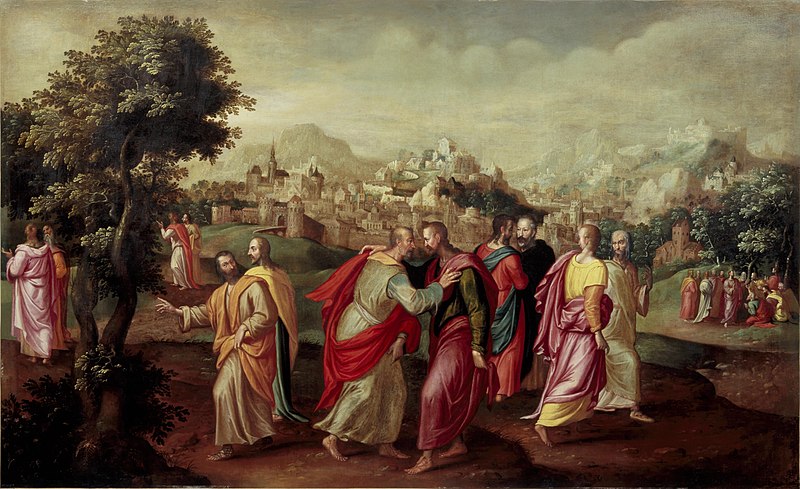
Christ Sends Apostles Out in Pairs Anonymous Dutch Painting, Public Domain

Christ Sends Apostles Out in Pairs Anonymous Dutch Painting, Public Domain


We Can’t Do It Alone

So they went off and preached repentance. The Twelve drove out many demons, and they anointed with oil many who were sick and cured them. (Mark 6:12-13)

As two together, the Apostles experienced the fruits of the Holy Spirit. They were successful, doing as Jesus told them, and healing may of their afflictions, both spiritual and physical. Perhaps they would not have been able to accomplish this on their own. Even after Jesus died, and they were to carry on the mission, they needed the Holy Spirit to descend upon them and grace them with confidence and ability. They couldn’t do it alone.

My brothers and sisters, if you are pondering where to turn for guidance and companionship on your spiritual journey, know that you are not alone and that you aren’t meant to be. If not a spiritual advisor, seek someone who will share the mission with you, be there when you fall, and steer you in the right direction. Two are better than one.

“For where two or three are gathered together in my name, there am I in the midst of them.” (Matthew 18:20)


Let us pray: Lord, I ask you to open my heart and my mind to the nudging of the Holy Spirit. I pray that you lead me to the person you have chosen as my spiritual partner. Help us to further Your Kingdom as we walk two by two. Amen.


Copyright 2025 Amy Schisler

Earthly Acts of Spiritual Love

Earthly Acts of Spiritual Love

‘Love bears all things,
believes all things,
hopes all things,
endures all things.’ (1 Cor. 13:7)

If everything we have known from personal experience and from knowledge of history tells us that all human lives are entwined with suffering, then why are we so surprised by the persistent presence of that pain, and why do we expect, even demand that it go away?

We have within our deepest hearts a hidden and vague knowledge that the way the world is now is not how it once was, nor how it ought to be. That secret knowledge stirs conflict within us.

As a psychotherapist working in medical settings, many of my clients experience suffering due to debilitating diseases, disabling conditions, chronic mental illnesses, substance use disorders, and, too often, the gradual erosion of close personal and family relationships. Psychotherapy can help foster fortitude and resilience in contending with all the things that can afflict a client. But the need for fortitude and resilience is not limited to persons in
psychotherapy. All persons experience loss, adversity, injustice, and painful events in life. How could it be anything else, considering we journey through a fallen world of sin, where sickness and death beset everyone?

Our modern inclination is to think of the presence of pain as a mistake, as something to blame someone else for, as something that can and should always be removed or remedied. Many of the difficulties of daily life can and ought to be corrected, and of course, we should strive to resolve our problems and give aid and comfort others who suffer. But the existence of pain represents more than simple error or misunderstanding. Some pain can be alleviated, and yet, sometimes pain must be borne – because it is an unavoidable element of life in a fallen world, not because we are morbid or weak or masochistic.

In the beginning, God and the human person walked together in harmony. Yet, since the cataclysmic events in Eden, we are heavily hampered by hardship. The entire story of the Bible is the tale of how God has responded to the consequences of what occurred in Eden. The Bible would not exist if Adam and Eve had not fallen. All of sacred Scripture relates the story of God’s actions to guide and rescue his children who are dwelling in darkness
and shadowed by death.

Jesus took upon himself the abominable scope of pain in this sin-filled world, to show us how to bear it, while still keeping faith beyond sight, while simultaneously bearing with every other person compassionately, because they, like ourselves, are caught in this web of painful sin-tainted darkness,
and we are each on the way in search of His kingdom. Some might say, “Why doesn’t God bring this messed up world to an end, and just sweep
away all the pain and bring lasting joy in its place? If He really was good, that’s what he would do now!”

But, when were you hoping for him to replace His plan with yours? His timing with yours? Sometime long ago, before you were born, perhaps? Or before your children, or grandchildren, or great, great grandchildren have had the chance to come into this world? Do you know what part the people yet to be born might play in His greater plan? Maybe we can shoulder the situation as it is and strive to do our part to bring goodness into the world.

God pointed out to St. Paul that humble and courageous acts of faith and love will light the path of our feet through the rubble and the trouble of life.
In his first letter to the Corinthians, St. Paul shines a light on deeper dimensions of love. He surprises his readers with the suggestion that it is love that bears, believes, hopes, and endures all of the challenging things of life on earth. Quite often, love is considered to be movements of emotions, yet St. Paul shows how love engages the activities of will. Through all the hard and the cold and the unfair and unknown things of this life, it is these willful acts
of love that will guide our way.

Bearing, believing, hoping, and enduring are not simply aspects of love. They are the key actions of love. Yet these particular acts of love are limited to our time on earth and are not elements of how love will be known in heaven. One will no longer need to bear or to endure pain, anguish, or injustice in heaven, because those things don’t exist there. One will not need to believe in what is invisible, or to hope for what is beyond the known, because all the things hoped for and believed in will be fully known and revealed in heaven.

But here, now, while we still live in a body and are under the sway of concupiscence, we have available to us the essential tools of spiritual love: bearing, believing, hoping, and enduring. Jesus, and our blessed Mother, and the saints, have shown us by their example how to practice earthly acts of love.

copyright 2025 Tom Medlar

What are you looking for?

“The two disciples heard what he said and followed Jesus. Jesus turned and saw them following him and said to them, ‘What are you looking for?’” John 1:38


My favorite hymn when I was a child was, Here I Am, Lord. I loved the rhythm and the simple prose, and I thought the sentiment behind the words was lovely even if I didn’t quite understand their importance. As an adult, the song continues to be my favorite hymn, and it brings tears to my eyes every single time I hear it. Though I still love the music and the words, it’s the deeper meaning that gets to me now. Jesus asks us to serve, and we need to respond like Samuel and the Apostles, ready to answer and do His will.

Awaiting God’s Call

This month, we celebrate the feast day of St. Elizabeth Ann Seton, our first American-born saint. Two of my three daughters graduated from Mount St. Mary’s in Emmitsburg, Maryland. Emmitsburg was the home and final resting place of Mother Seton. Mother Seton to Emmitsburg moved in 1809, where she founded the Sisters of Charity of St. Joseph’s, the first community for religious women established in the United States. It was in Emmitsburg where she also began St. Joseph’s Academy and Free School, the beginning of Catholic education in the United States. 

Before becoming a nun, Elizabeth was a wife and mother. She was not Catholic but was very religious. While nursing her sick husband in Italy, she learned about Catholicism from friends who lived there and was intrigued by the Church and its sacred traditions. The more she learned and attended Mass, the more she felt called to become Catholic.

Hearing God’s Call

Years, later, she heard the call to become a nun, and later, she heard the call to found the order and the school in Emmitsburg. 

Mother Seton wrote, “We know certainly that our God calls us to a holy life. We know that he gives us every grace, every abundant grace; and though we are so weak of ourselves, this grace is able to carry us through every obstacle and difficulty.”

Many generations before Mother Seton, Jesus asked Andrew and John, “What are you looking for?” (John 1:38) They immediately followed Him, asking where He was staying. Then they sought others and encouraged them to join as well (Andrew’s brother, Simon, John’s brother, James, and Andrew’s friend, Phillip). Without hesitating, they answered Jesus’ question with their actions. 

Jesus still asks this question, but so many fail to hear it or understand from whom it comes. So many of us spend our lives searching for meaning, for happiness, for belonging when Jesus openly and willingly offers us all that and more. When faced with Jesus’ question, we look for the answer in other people, in media and entertainment, or in addictions, and often overlook the most basic, most obvious places—Holy Scripture, the Mass, the Church. It was in the Church, at Mass, and through the sacraments that Mother Seton heard the call to convert, to become a nun, to serve, and to teach.

Answering God’s Call

We, too, are being called. We can hear God’s voice each time we attend Mass, go to Confession, or seek the Lord in Adoration. He is calling out to us to help Him build His Kingdom, to serve, to teach, and to bring others to Him.

Listen for the voice of Jesus in your daily life. Shut out the noise and the distractions. Be alert and awake. He is asking, “What are you looking for?” All you need to do is answer in the same way Mother Seton did, “Here am I, Lord; I come to do your will,” (1 Samuel 3:8, Psalm 40:9). “Speak, for your servant is listening” (1 Samuel 3:10).

Let us pray, “Oh my God, forgive what I have been, correct what I am, and direct what I shall be” (St. Elizabeth Seton). Amen.


copyright 2025 Amy Schisler

Edited by Heather Gaffney

Ut in Deo Sit

Ut in Deo Sit

If one of the key elements of loving another person is to will that person’s good, what exactly does that mean? Well, of course, willing their good can include willing that they be happy; that they be healthy and well; that good things will happen to them; that good things will come their way; etc. But the deepest love you can have for someone is to will their ultimate good. And what is their ultimate good? What is every single human being’s ultimate good? Ut in Deo sit: that they may be in God. To will someone’s ultimate good is to will that they might reach their intended destiny, the destiny for which they were made: to be in God, to share forever in the eternal circulation of love that is the divine life. Thus, to will someone’s ultimate good is to will that they might choose Love. To will someone’s ultimate good is to will that they might say Yes to their God-given mission of love and fulfill that mission in their lives. To will someone’s ultimate good is to will that they might excel in the school of love, continuing to grow in their ability to love selflessly as their life progresses. To will someone’s ultimate good is to will that they might grow into God’s “bright image” of them.

Keeping the beloved’s ultimate good in mind and heart will guide you as you strive to will the good for them at specific times and in specific circumstances of their lives. To will their good at any point in time is to will whatever will help them learn to love God and neighbor more deeply. To will their good is to will whatever will help them to say Yes to their mission of love. To will their good is to will whatever will help them fulfill that mission. To will their good is to will whatever will help them to excel in the school of love, to will whatever will help them to grow in their ability to selflessly give and receive the gift of self in love. To will their good is to will whatever will help them take another step toward becoming the loving person God created them to be. To will their good is to will whatever will help them be in God.

In a happy coincidence (actually, it’s not a coincidence at all), to will all of that for the beloved is simultaneously to will their ultimate happiness, and to will that they find a profound sense of meaning and purpose in life, and to will that they be free, and to will that they be at peace. For the fulfillment of all of those deepest desires of their heart is ultimately to be found in Love.

* This article is based on an excerpt from Rick’s latest book, The Book of Love: Brief Meditations. Photo by Marcos Paulo Prado on Unsplash

Copyright 2024 Rick Clements


Accepting God’s Will in Our Lives

Accepting God’s Will in Our Lives

Are you thinking about simplifying your life? Do you have a lot of items in your house that you are not using? Perhaps it is time for you to give some of these things away.

Maybe you feel that God wants you to imitate some of the saints who lived simply so that you can spend some extra time in prayer. If God is calling you to this, think about some of the things preventing you from continuing on with this call.

Maybe it is your career, the internet, etc. Perhaps you are spending too much time on the computer, and you need to cut back on your computer use. Even though Lent is over, we can always still practice doing acts of penance.

Sometimes God allows hard things in our lives to wake us up. Perhaps Your Amazon account was all of the sudden suspended, and you can’t upload your new manuscript on Amazon’s platform. Maybe your website is down, and you can’t log into your website account. Anything can happen.

No matter what happens, God is in control. He is going to take care of you. We should put all of our hope and trust in Him. We can always try to undo our mistakes, but sometimes God uses these mistakes as a lesson. So that we can learn from our mistakes. Sometimes God uses other people to help us make wise decisions.

If you feel called to a life of simplicity, find a quiet place in your house that is not distracting. Pick a time of the day that works best for you. Put some books and the Rosary nearby. Ask God to help you as you draw closer to Him.

It will not be easy, at first, for you to take breaks from the rest of the world. But if you want to practice the contemplative lifestyle, then it is also a very good idea for you to be cracking down on some of the things in your house that are keeping you spiritually from the Lord.

God will give you the strength you need to continue on this path. In the meantime, don’t give up on this idea! Work towards your goal! Do you have some plans that can help you with your call? Write them down on a piece of paper! Keep them nearby so that you can remember them.

Copyright 2024 Angela Lano

The Mystery of Being in Time

Cath-Lit Live: Places of Grace

Cath-Lit Live: Places of Grace

“Cath-Lit Live!” features brief interviews with Catholic authors who are releasing new books. Hosted by Catholic author and speaker Amy J. Cattapan, “Cath-Lit Live!” gives viewers a glimpse into the latest Catholic books while getting to know a bit about the author as well.


Places of Grace: My Visits to Shrines, Chapels, Graves, and Monasteries and the Graces I Received by Fr. Edward Looney

Places of Grace is a travel memoir recounting how God has worked in the life of Fr. Edward Looney through his visits to shrines, chapels, monasteries, and graves in the US and throughout the world. In Places of Grace, Fr. Looney recounts his experiences at shrines, chapels, monasteries, and graves, naming a grace he received from the Lord at each site. That grace will be different for each person. In his typical style, Fr. Looney weaves together personal anecdotes and experiences to arrive at a greater spiritual point, helping the reader and future pilgrim to better appreciate the holy sites they will visit during their earthly pilgrimage to Heaven. This book does not present the historical facts or architecture of holy sites, but the spiritual experience of a Catholic priest who hopes you will discover God’s grace at a shrine or holy site.


null


About the author:

Fr. Edward Looney was ordained a priest in 2015 for the Diocese of Green Bay. In addition to a Bachelor of Philosophy, a Baccalaureate in Sacred Theology (S.T.B.), and a Master of Divinity, he holds a Licentiate in Sacred Theology (S.T.L.) from the University of St. Mary of the Lake-Mundelein Seminary. Fr. Looney specializes in Marian theology, having authored numerous works on Mary, including A Lenten Journey with Mother Mary and How They Love Mary: 28 Life-Changing Stories of Devotion to Our Lady available from Sophia Institute Press. He is a past president of the Mariological Society of America and continues to research, reflect, and write about Mary. Fr. Looney is a popular media personality, podcast host, and contributor to online publications and print publications like Living Faith. His interests include the Blessed Virgin, sainthood causes, shrines, and film/television.

You can catch “Cath-Lit Live” live on A.J. Cattapan’s author Facebook page. Recorded versions of the show will also be available to watch later on her YouTube channel and Instagram.


null


Copyright 2024 Amy J. Cattapan
Banner image via Pexels

The Creative Power of Love

The Creative Power of Love

Love is creative. Love is transformative. Love can create something good that was not there before. Love can take what is there and transform it into something better.

The Christian faith teaches that God created the universe ex nihilo: out of nothing. Not out of some pre-existing primordial matter, but out of nothing. The entire cosmos, everything that exists in the universe, all created out of nothingness. How could that be? How could God possibly have created everything that exists, including ourselves, out of nothingness? By the creative power of love. That is why the Christian faith also teaches that God created the universe ex amore: out of love. Love can make be. Love can bring something into existence that did not exist before. Finding and approving of the good in other people (and ourselves) is actually a form of participation in creation, in God’s creative power, because it is a participation in God’s creative love.

Purely human love can be transformative (as exemplified, at a simple level, by what has been referred to as the “Pygmalion effect”), but just think of what love can do when it is the divine love flowing through us, the divine love that created everything that exists and sustains everything in being from moment to moment! If we take the time and effort to look carefully, we can see goodness in other people that we may never have noticed before. In fact, we can sometimes see goodness in them that they have never noticed before! We may even be able to see goodness in them that is not actually there yet! When we look at another person with an open mind and an open heart, we can see into the possible future. We can catch a glimpse of God’s bright image of that person. We can catch sight of the God-given potential for goodness in that person, a vision of who and what God created that person to be. We can see that person, at least partially, through God’s eyes. And when we communicate that goodness to the person in whom we see it, when we convey our approval of the goodness we see in that person, that approval can transform them. That approval, that encouragement of the good and the potential for good in the other person, can cause them to blossom and thrive like never before. Some parents know this. Some teachers know this. Some coaches know this. They have seen it happen firsthand. In fact, one of the most rewarding experiences one can ever have as a parent, as a teacher, or as a coach, is to watch something good and beautiful appear in your child, in your student, in your athlete, that was not there before, or that was at best partial and undeveloped, in response to your approval and your encouragement of that person.

God has given each of us the incredible privilege, and the serious responsibility, of participating in the creative, transformative power of love. Take the time today to stop and notice the goodness in at least one person, and to praise them for that goodness. You just might transform someone’s life.


* This article is based on an excerpt from Rick’s latest book, The Book of Love: Brief Meditations. Photo by Greg Rakozy on Unsplash

Copyright 2024 Rick Clements


Sanctifying Habits: What is God Asking of Me Today?

Sanctifying Habits: What is God Asking of Me Today?

Habits and routines are such strange things. When I’m establishing them, it feels like dragging a screaming toddler uphill in the snow, and then breaking them is as easy as that same toddler falling asleep in her car seat the minute she’s strapped in. Seriously. I can work for months and months and solidify a productive routine, and the moment that something throws me off, it’s like I’m starting from scratch again.

The crazy thing is that this is true even if I plan and take time for a valid reason. I allow myself a break from writing when I have family vacations or I recognize my need for rest. I am a wife and mom before I’m a writer, and when my family needs me, I let my writing habits fall away.

When I allowed myself some honest silence with Jesus about this, I realized I’m struggling with feelings of inadequacy. I see what other people are doing. I hear about their book launches and new contracts. I watch their reels on social media and see their following count. I read the lives of the saints, and their virtue seems unattainable. I can’t possibly be as amazing as Joan or Faustina or Thérèse. When I see what everyone else is accomplishing, I feel like I’m falling short.

In His mercy, God spoke to me in the silence. He told me that He doesn’t want me to be like Joan or Faustina or Thérèse—because I’m not them. I’m Maria. And He has a special, completely unique mission for me. I can’t possibly be like any of the great saints, but it doesn’t mean I can’t be a great saint in my very own way.

Theodore Roosevelt wisely said, “Comparison is the thief of joy.” I can’t count the number of times I’ve shared a version of this quote with my kids. It comes out of my mouth in ways like, “Be grateful for what you have”; “If all you think about is what you’re missing out on, you’ll be miserable”; or “Look at what you do have! Focus on that!” Not surprisingly, I don’t have the eloquence of Theodore Roosevelt, but the sentiment is the same.

If only I had the ability to take my own good advice. I can be astonishingly wise when it comes to parenting and remain quite dense when it comes to myself.

Learning about the great saints of our Faith is a joy. Having powerful intercessors in Heaven whom I can call on during my difficult times is an unmatched blessing. Feeling inspired by their willingness to give everything to Christ is, well, inspiring.

Thinking I’m failing in my vocation because my life doesn’t look like theirs? Now that is worthless. A complete waste of time and energy. I heard a priceless gem while listening to The Endow Podcast this week:

God doesn’t recycle.

God is constantly creating anew. Every single snowflake is unique. No two flowers are identical. And no one else in the entire history (or future) of the world had or will have the same soul, experiences, thoughts, ideas, disappointments, relationships, situations, creativity, frustrations, or wonder as me. I’m the one and only me.

God loves me so much He not only created me, but He then continues to give me encounters for my own sanctification. God deeply desires for me to become a great saint, and He knows exactly who I am, what I’m capable of, and what my circumstances are. He calls me today from right where I am.

So today I am composing an imperfect blog post and getting myself back on track. What is God asking of you today?

© Maria Riley 2024