
Karina Teaches – Lesson 4

Over this year, Karina is going to share some of her writing seminars on the blog, with the lessons and references for further study. We’ll be posting these once a month. There’s no assigned homework, but if you have questions, please ask them in the comments. Her first workshop is worldbuilding. This is Lesson 4. Here are the links to Lesson 1, Lesson 2, and Lesson 3.

Worldbuilding 101, Lesson 4: Your People

On the last day, God created Man (male and female), but we’re going to do it on Lesson 4.

For some of you, this won’t be too hard–you’ll have basic humanoids with some special quirk that makes them unique.

As you’ve already heard me say–and everybody join in this time–you need to think about the impact of the differences you make on the rest of your world. For example, for my novel Discovery, my husband Rob and I have postulated a race of creatures that are more patterned after starfish–radial symmetry rather than the vertical symmetry of humans. This introduced a whole slew of interesting questions:

–Do they have a sense of right/left/forward/back?

–Are certain digits devoted to walking and some to handling tools? Or are they ambidextrous?

–Where are their eyes? How do they see?

–How do they eat, sleep, procreate?

–What would their homes, vehicles, and equipment look like?

Fortunately for Rob and me, we will be dealing with humans exploring a long-dead spaceship, possibly abandoned, so we have some wiggle room for unanswered questions. We could concentrate just on the things that directly apply to the space ship, its design and especially its life craft. If we take our humans to this planet in another book, we’ll need more answers!

Even if you’re doing fantasy and are going to use some of the time-honored “aliens” like vampires, werewolves, etc., you still need to decide their biology, needs and how they are different. Is vampirism a disease, a genetic defect or a choice? Why can’t they come out into the sun? How does it really affect them–sunburn, allergic reaction or the good ol’ burst into flames? Do werewolves have to change in a full moon, or can they only change in the full moon? What happens to their clothes?

I’ve had a lot of fun playing with the usual clichés of fairy creatures in my Dragon Eye, PI universe. (www.dragoneyepi.net). For example, my elves are very long-lived. Well, when you live to be 500-600, your biology should slow down a bit, and so does your sense of time. Thus, while elves are able to interact with humans, they are also infuriatingly slow. Their language, for example, is full of prerequisites–to apologize for bumping into someone requires you recognize their social status and that of their family and tribe as compared to yours, the nature of the offense, the impact of that offense on the relationship and the relationship of their people… As my dragon detective Vern likes to complain, “It can take them half an hour to ask where the bathroom is.” (And, thanks to their changed biology, they do have half an hour before the need is urgent.)

Keep in mind, too, that the more that quirk is part of their nature, the more effect it will have on their civilization–but that’s lesson 5.

For more reading:

https://www.amazon.com/Essential-Guide-Alien-Species-Star/dp/0345442202/ref=sr_1_1/104-5069618-1512745?ie=UTF8&s=books&qid=1189371773&sr=1-1 The Essential Guide to Aliens (Star Wars) by Ann Lewis and RK Post. It’s amazing what people have come up with for creatures. Contains their history, biology and sociology. Great for ideas.

Dragon Magazine: Although out of print, each issue had a bestiary with incredible detail about certain kinds of creatures.

Dungeons and Dragons Players Handbooks or Monster Manuals: Pick a fantasy creature and these writers have thought of everything from how they react in an adventure to what they wear as pajamas. Forget the dice and the stats and just play with the ideas.

Real life creatures: Google a species that may have traits you want – like starfish or manta rays or birds. Even if you aren’t looking for a full creature, you might learn something. For example, if your alien has wings and can fly, you will want to study what else is involved – do they have feathers or skin like a bat? Do they fly or just soar like a flying squirrel? How does their anatomy support the wing structure?

 

Confirmation: Are We Doing it All Wrong?

One of my favorite blogs is written by our own, Jennifer Fitz. She writes for Patheos and her blog is called “Sticking the Corners“. I began to read her April 19th post which was titled, “What’s Wrong with Age-Bracketed Sacramental Prep?” As I read, (get this) I gave her a “fist pump” and said, “You go girl.” That was because she quickly nailed it about her topic and also opened up my eyes to a fact I have thought about but never really paid any attention to. Her column made me pay attention. (Thanks, Jen.)

The subject discussed the practice of giving the Sacraments of First Reconciliation and First Holy Communion to children who are usually around seven to eight years old. Then, for some reason, we give the Sacrament of Confirmation to these same kids at unspecified times in their lives, like at twelve, fourteen, maybe seventeen. Sometimes they just stop coming back. That all started my wheels spinning and my mind meandered back in time to when I was in third grade and my classmates and I received our Confirmation. Why third grade back then and teenagers and older now? (The RCIA “candidates” and Easter Vigil is another topic for another time.)

Back to our newly-confirmed teenagers. We all know that these young folks do not turn into Apostles with tongues of fire dancing over their newly baptized heads. They are not dashing out into the streets converting Muslims and Hebrews and Presbyterians and Scientolgists and atheists. Why? Because they are not ready. (In fact, I stink as an evangelizer and I received my Confirmation long, long ago.) To the point: maybe the Sacrament of Confirmation should NOT come later. Maybe it should come before, like in second or third grade like it was for me and my peers of the 1950s and into the 60s. We became Soldiers of Christ in 3rd Grade and what did we know? The answer is nothing, absolutely nothing.

Then why receive Confirmation so young? Jennifer’s blog made me realize that what they were doing back then was the right way. We needed a shield of armor and a shroud of protection as we began our journey toward fourth grade and being ten years old. The Sacrament of Confirmation is our spiritual armor against the evil that surrounds us. It is to protect us as we move on and grow. By the time a kid is seventeen his/her faith formation has been set in place. Isn’t receiving Confirmation after the fact somewhat like putting on the body armor after the explosion?

Would it not be better to have the Holy Spirit and His gifts given to a child so they might have that protection available to them as they grow and confront the world and its temptations? Would not the graces that flow from the Sacrament be available to them as the world they are growing into invades their lives? It makes sense to me.

Many of these kids do not receive religious education at home. Oftentimes they are sent off to CCD or Faith Formation by their parent(s) who think that is all they have to do to instill the faith in their kids. The problem is, the secular world has gobbled up so much of our lives that it takes a lot more than an hour or so a week to instill anything in anyone. It has to be an ongoing process with a base of operations. That base is home base and without the fortress of a spiritually guided home front, the struggle for these young people will be ongoing, frustrating, and long term.

From the President’s Desk – Mediocrity

Copyright Ellen Gable Hrkach

Copyright Ellen Gable Hrkach

“Do not be satisfied with mediocrity.” St. John Paul II

Any person who settles for mediocrity in terms of his or her spiritual life is setting himself up for failure.  Reaching high for the virtues and striving for perfection isn’t always easy, but it’s always worthwhile.  None of us will ever be perfect, but we must try.  Most of us will fall short frequently, but as Catholics, we’re blessed to have the Sacrament of Reconciliation to give us the grace to be better people.

Authors who settle for mediocrity with regard to their writing are also setting themselves up for failure.  Articles and books that have not been professionally edited will frustrate readers. These authors can become known for their mediocre writing, and readers may not return for more.  If you’re posting to a blog, ask a writer friend to be your second pair of eyes. If you’re traditionally publishing a book, your assigned editor will help make your book as professional as possible. If you are self-publishing, please hire experienced and professional editors to edit your book. Most importantly, humbly consider any and all suggestions from your editor.

Don’t settle for mediocrity in either your spiritual life or your writing life. Strive to be the best you can be!

Special thanks to CWG member Allison Gingras for featuring my third novel, Stealing Jenny, during her radio show, A Seeking Heart, this week!  Check out a few of the shows here:
https://www.realliferadio.com/a-seeking-heart-with-allison-gingras.html

And, today, I’ll be live on A Seeking Heart from 10:00 until 10:45.  Listen live here at this link: https://www.realliferadio.com/a-seeking-heart-with-allison-gingras.html

If you’d like to call while we’re on the air, here’s the number: Call 1-855-949-1380

CWG News:
We  have an upcoming live conference in July in Somerset, NJ (July 22-24) and registration is now open.

The Catholic Writers Retreat is taking place in late October.  Your Word is my Delight takes place October 25-29, 2015 at the St. Francis Retreat Center, 703 E. Main Street, DeWitt, Michigan 48820. Register on line at here at this link, Click on Other Offerings, or call 866-669-8321. $490 for five days.

As always, if you have any questions, comments or concerns, please do not hesitate to email me: president (at) catholicwritersguild (dot) (com)

In Jesus and Mary,

Ellen Gable Hrkach

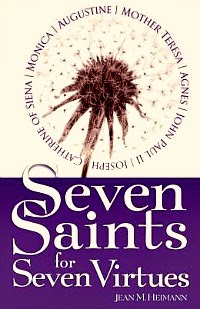
Jean Heimann and Seven Saints – CWG April Book Blast

This month, the Catholic Writers’ Guild is touring Guildie Jean M. Heimann’s book, Seven Saints for Seven Virtues. It’s been awarded the CWG Seal of Approval. Check out this collection of seven stellar saints who model heavenly virtues that inspire us to lead holy lives.

Seven Saints for Seven Virtues

Jean M. Heimann

Summary: To live a virtuous life might seem like a daunting task, but we are fortunate to have examples to follow—the saints who have faced sin through the embodiment and exemplification of virtue. In this book, the reader will meet seven saints who lived seven virtues, and will discover concrete ways that they can live those virtues in their own lives. Each chapter will include:

  • A quote from the saint
  • A personal reflection on each saint
  • A brief biography
  • A discussion on the spirituality of each saint, and concrete examples how to emulate this saint and grow in the virtue that saint models
  • A prayer to conclude each chapter, asking for the intercession of that saint

Seven Saints for Seven Virtues covers a wide range of spirituality and life circumstances, demonstrating that everyone, in every role of life, has the opportunity to live a virtuous life.

Find it Amazon — https://www.amazon.com/Seven-Saints-Virtues-Jean-Heimann/dp/1616368454

Or Servant Books — https://catalog.franciscanmedia.org/Product.aspx?ProductCode=T36845

Check out Jean’s blog, Catholic Fire: https://catholicfire.blogspot.com/, to learn more about the saints.

Karina Teaches – Lesson 3

Over this year, Karina is going to share some of her writing seminars on the blog, with the lessons and references for further study. We’ll be posting these once a month. There’s no assigned homework, but if you have questions, please ask them in the comments. Her first workshop is worldbuilding. This is Lesson 3. Find Lesson 1 here and Lesson 2 here.


Lesson 3: Life!

 It’s life, Jim, but not as we know it.

–Star Trek


If you’ve followed the last two lessons, you should know a little more about your world–or at least you have some questions to look into. Now it’s time to think about the wondrous creatures that inhabit it.


Just like with all aspects of your world, your creatures can be as strange or as ordinary as you wish–and how much you think about them depends on how much you need them in the story. If you have a jungle setting, think about the bugs; if you have an inner city, there must be some scavengers to pick at the trash. If the entire story takes place in the immaculate office of the Supreme Coordinator, or in the pristine tower of the Mage of D’loriab, animals may not be a big concern.


If you do need an environment, take a little time to think about it. What are the predators? What are the prey? Why do they look and act the way they do? Are they good eating? What kind of abilities do they have and how does it help them survive? What roles do they serve in the ecosystem?


If you make up an unusual animal, make sure it makes sense. What use is it to have a horse with five legs, for instance? Also be sure it fits in your world–a heavy gravity world will probably not have a lot of tiny flying insects, for example. What will take their place for spreading pollen–or annoying your adventurer as he makes his way through the bogs of New Juno?


For More Reading:


https://sciencefictionbiology.blogspot.com/2007/05/would-extraterrestrial-life-use-dna.html


The Science of Aliens by Clifford Pickover: https://www.amazon.com/Science-Aliens-Clifford-Pickover/dp/0465073158/ref=pd_bbs_sr_1?ie=UTF8&s=books&qid=1205018387&sr=8-1: Excellent Book! He looks at the incredible, unbelievable weirdness of earth life and extrapolates to what we could find beyond. With examples for SF tossed in, it’s a fun must-read.


Time to “Slap Back” at the Self-Serving Intolerance of the Anti-Catholic/Christian

Sorry–it is Good Friday and I do not feel too “bubbly” right now. When I began to contemplate the Cross today and Who was nailed to it I found myself disgusted. I am disgusted and fed up with the approximately 2% of the population who are gay and are screaming at the “intolerance” of the Catholic/Christian community which comprises 80% of the American population. I am tired of us being called “intolerant” and “homophobic” and “racist” etc., simply because they do not get their way in every little thing they demand. Have they ever once considered what that Cross we revere stands for? The fact is, they have hijacked the Cross and insist it represents them and their self-indulgent ideology. We Christians are the “bad people.” This perverse nonsense has to stop.

I am also tired of the mainstream media and the Hollywood elite denigrating and mocking Christianity and all who belong to it as “fools.” Aren’t you tired of being trashed by the anti-God people? Why can’t they seem to understand one bit of the the kindness and goodness that has been extended to ALL people by Catholic/Christians, you know, people like all of us. Bill Maher says that people who believe in God, “are idiots and they are stupid.” Has he or any of his fellow God-haters ever taken one damn moment and looked at that Cross and reflected about the sweet mercy, flowing grace and abundant love that smeared blood red all over the wood? I think not.

The United States State Department says that in at least 60 countries, Christians face persecution simply because they are Christian. Imagine, being hated for loving. How twisted is that? Seventy-five percent of the world’s population lives in areas with severe religious persecution. Yes, yes, I know, we are supposed to “turn the other cheek.” Well, this Catholic man says I’ll turn it but if you keep slapping my face every time I do, sooner or later I am going to slap you back. My brothers and sisters, I think it is time to start slapping back. Not with fists and pipes and lies and rants but with the written word defending our Faith against all attacks, even if it is a Tweet on Twitter or a blurb on Facebook.

I also want our bishops to get up there and start defending Christ and His people. And I want them to tell their priests to defend it also. (When was the last time you heard a priest in your parish defend the faith against the evil run amok all over the world including the USA?) I want them to say “We don’t need your your damn tax exemption 501c3. We must defend our faith no matter what.”

That’s right, forget this “PC” (politically correct) nonsense. We, as Catholics, do not put pen to paper and lie, slander or foment falsehoods about people. We write about Jesus Christ and the beautiful Faith He has given to us. That is not evil or intolerant. That is what we are about. We are about loving our neighbor and, for the most part, we do.

Last June ISIS overran the city of Mosul in Iraq. They killed countless numbers of our brother and sister Chaldean Catholics. The Church in Erbil has set up camps and is helping more than 130,000 refugees settle in temporarily until they might once again go back home to Mosul. Pope Francis has set an example for us all, including our hierarchy. He has sent Cardinal Fernando Filoni, the Prefect for the Congregation for the Evangelization of Peoples, to these displaced Catholics. The Holy Father has initiated a program to give out cakes to each of the families in the camps. A total of more than 20,000 cakes will be distributed as the Holy Father shows them they all have his support and he is standing up to the maniacal, Satan driven savages of ISIS. He has taken the lead.

All I am asking for is more defense of the faith via the spoken and written word and some leadership from our safely placed American hierarchy in mounting a campaign to do so. Jesus never said it would be easy following Him. Seeing what happens to Him on Good Friday proves it. War is being waged against us, not only over there but right here in our own country. Time to “slap back.”

Connie Rossini and St. Therese – CWG March Book Blast

This month, the Catholic Writers’ Guild is touring Guildie Connie Rossini’s book, Trusting God with St. Therese. It’s an SOA winner as well as an award-winning novel, and an inspiration to anyone needing find inspiration in the face of difficult situations.


Summary: Are your fears, weaknesses, doubts, and anger keeping you from intimacy with Christ? Do you struggle with despair? Let St. Therese teach you perfect trust.  Learn how Therese of Lisieux trusted God through tragedy, scruples, spiritual darkness, and physical suffering. Connie Rossini pairs episodic stories from the saint’s life with memories of her own quest to trust. With Sacred Scripture, the Catechism of the Catholic Church, and insights from psychology, Rossini leads readers to surrender their lives completely to Jesus. Practical and accessible, Trusting God with St. Therese includes questions for reflection that make it perfect for book clubs and faith-sharing groups.

Buy it on Amazon: https://www.amazon.com/dp/B00LTATI6C

Excerpt

St. Therese’s trust in God is almost legendary—so much so that we might consider such trust beyond our reach. In her family and later in the Carmelite cloister, she was bathed in a culture focused on Christ. When she struggled at school, she came home to learn among those who understood her. When she wanted to give herself fully to God, she became a nun. When she began to speak about her little way of spiritual childhood, others encouraged her. We daily encounter challenges to trust that she never faced. The world around us—sometimes even including our dearest family members—meets our desire for God with indifference or hostility. In the Church, others think us presumptuous for even striving to follow God more faithfully. And an insistent voice inside us urges us at every step to abandon our course. “Why focus on trust?” we ask ourselves. There are so many pressing problems for Catholics in today’s world: battling the Culture of Death, bringing strays back to the faith, revamping catechesis, caring for the poor. Why not focus instead on one of these? When we ponder this question more deeply, the mistaken notion behind it reveals itself. We do not practice one virtue or join an apostolate in isolation from the rest of our Christian life. Focusing on trust does not take us away from these other important things. It helps us advance in them. Fighting the Culture of Death, for example, can be discouraging, heartbreaking, and personally risky. Trust gives us the strength to persevere. Likewise, we must trust God with the hearts of the lost, for ultimately only he can convert them. We must trust him to work through his Church, even when the humans who make up that Church fall short. And unless we can accept God’s providence, the trials of the poor will crush our spirits. Why should we focus on trust?

In a letter to Sr. Marie of the Sacred Heart, Therese put it concisely: “It is trust, and nothing but trust that must bring us to Love” (PST, 61). “Love,” of course, is God himself. In other words, we cannot grow close to him until we trust him.


Karina Teaches – Lesson 2


Over this year, Karina is going to share some of her writing seminars on the blog, with the lessons and references for further study. We’ll be posting these once a month. There’s no assigned homework, but if you have questions, please ask them in the comments. Her first workshop is worldbuilding. This is Lesson 2. Find Lesson 1 here.


Lesson 2: Physics, Geology and Geography

HEY! Don’t open that! It’s an alien planet! Is there air? You don’t know!

–Guy Fleegman, Galaxy Quest

The more we know about the universe and what it takes to create Life, the more we realize just how amazing it is that any life–let alone sentient life–could have developed even once. The world must have a sun that is the right age, be in orbit at the right distance with an atmosphere to block out dangerous radiation and provide something to breathe. There must be carbon or some other basic building block that can combine with other elements to produce complex molecules that will work together. And of course, there must be water or a logical water-substitute. There must be time for those to evolve, societies to develop, etc…

Now, you may not have to start with quite these basics, but you should know to some degree (as determined by the need of the story) how what you’re doing will alter that delicate balance. Alter the mineral content of the world, and you might change its gravity. Change the gravity too much and you lose atmosphere. Introduce two moons and you mess with the tides. Even removing the tilt of your world (the earth sits at about a 23.5 degree tilt to the sun) and you mess with the seasons and the warming of the planet. Not that you can’t do these things, but you need to be aware of them and how they affect your world–and (if they are important to your story) what you’ll do for a work-around.

Second point for today is that planets are not homogeneous. Mars, for example, has a rep for being rather plain and desert-like, but it has fantastic topography, from huge mountains to incredible canyons, long stretches of deserts and rocky flatlands. There are polar ice caps (albeit made of carbon dioxide). Even the gas giants have regions of different climates and “topography,” or else they would not have storms. So the idea of a completely “Springlike” planet or an entirely harsh, rocky world isn’t especially believable.

Of course, there are exceptions. Arrakis (Dune) was desert from pole to pole, but Frank Herbert made it successful for several reasons: it was critical to the story, believable in its presentation, grounded in reason (the scarcity of water and the actions of the sandworms, who walled off water and kept it from rising to the surface), and he acknowledged (through the characters) its uniqueness in the galaxy, thus making it a mystery to draw you into the book rather than a distraction to pull you out.

The point, of course, is to know WHY your world is the way it is, and to make sure that its unique characteristics carry their own unique consequences. Fantasy artists can toss in another moon because it’s cool; writers have to deal with how that second moon affects the werewolves every month–or how it affects the counting of the months, for that matter.

Unless you are an astrophysicist, astrobiologist and geologist, you probably can’t readily say what will happen when you start tweaking your world. Fortunately, others have done that thinking for us. Find books, seek out professors at your local university–or call around and find an expert. And of course, remember that how deep you get into worldbuilding depends on how vital your world is to your plot–if you’re writing a fantasy tale that takes place inland, you don’t need to know how your second moon affects your tides so much as how it affects your werewolves. If you’re doing a “pirates on Xenologia” adventure, you’d better know how the oceans react to your second moon.

But my story takes place on Earth! You may not have to worry about the physics (unless you are introducing some paranormal element, in which case you might consider the “physics” of that), but your area still has geology and geography. Consider the differences between San Francisco, Chicago and Phoenix, for example. One is hilly and foggy; the other has multiple rivers; the third is flat and dry. Each has its own geography, and keep in mind that for the sake of your story “geography” includes man-made elements. Part of the geography of Los Angeles includes Chinatown, Little Tokyo, Hollywood, Beverly Hills… When I think about the geography of my hometown, Pueblo, Colorado, I think of the winding highway, I-25, with the mall at the north end, just before the big stucco welcome signs, and the rusting steel mill on the south end, where the city sort of peters out to an empty lot of the old drive-in and the greyhound race track.


For More Reading:

https://en.wikipedia.org/wiki/Extraterrestrial_life

https://www.humantruth.info/aliens.html A fair summary of different life possibilities–from organic to robotic

https://www.amazon.co.uk/exec/obidos/ASIN/0091886163/vexencrabtree “What does a Martian Look Like? The Science of Extraterrestrial Life” by Jack Cohen


Reconnecting with an Old Family Friend: St. Therese

I have a small bedroom I converted into an office. Against the wall next to the closet is a narrow bookcase. It is about seven feet tall and one foot wide and has seven shelves. It is a great dust collector. Anyway, I had this sudden urge to “straighten up” the mess of papers and supplies I had so “neatly” placed on those shelves over the past few years. So I reached for the stack of old Writer’s Digest and Writer magazines on the third shelf. I placed one hand on top and tried to get my other underneath the stack. As if working together in synchronized dance, they all slid out and landed in a pile on the floor. I shook my head and chuckled. “Typical you,” I mumbled to no one.

Included in my extended Catholic family (besides you and all Catholics) are the saints. Regarding the saints, there are many of these family members I have never even heard of. But, I do know that if I ever hear about one of them and seek them out, they somehow heed my call. For example, recently I “met” St. John of God for the first time and I had never heard of him. After reading about him, suffice it to say that this saint is no longer extended family for me. No sirree, he is now close family. I give him a ‘shout-out’ every day. (You can Google his name and a wealth of info comes up).

But what about an old family member who you were very close to and then, for some inexplicable reason, you more or less ignored them for many years? How do you finally get back together with them? I’ll tell you one way it can happen. They might hit you upside your head with a clear and unmistakable message. Guess who my message sender was? It was St. Therese, the “Little Flower.” Many of you know what I am talking about. There is no subtlety when she is communicating with you. You can do like me though. You might begin to take her for granted and then begin to ignore her. SIGH–I did that, I admit it. Not anymore.

I should explain that my family and I have had some profound experiences courtesy of this great saint. In fact, I could write an entire short story right now about each of several miraculous things that have happened in our lives courtesy of St. Therese’s intercession. (I actually started to do that so I just deleted more than 400 words of “stuff” that was turning this into a novella.) “C’mon Larry, get to the point.” (That’s me talking to me.)

I bend down to begin picking up the magazines which are spread evenly across the floor. The mastheads are all showing as if they were put on display. In the middle of the pile I see a thin box. It does not belong. It is an interloper. I pick it up and see it is an old Xerox box, 8.5 X 11 by about one half-inch thick that held something called transparency paper. I did not even know what that was and then the end of this box popped open and a bunch of photos slid out. Guess whose 8 X 10 photo is on top looking right at me with this satisfied smile that made my knees get weak? Yup–you got it, St. Therese.

Two hours later that photo of my sweet, little friend (and your friend too), was in a very nice 12 X 15 bordered frame hanging on the wall a few feet away. Now I get to see her every day and she still is smiling gently. Since we have reconnected I have seen more ROSES than I can count. I found the booklet, “Mary Day by Day” in the garage (don’t ask me how it got there) which was Blessed Mother Teresa’s favorite book. I received an e-mail from someone named Therese Martin (St. Therese’s real name) and, thanks to the encouragement of Elizabeth Schmeidler, my book is coming out in print in a few weeks. I also am reading Connie Rossini’s book, “Trusting God with St. Therese.” How timely is that? I might add that our stillborn daughter’s name is Theresa Mary and my granddaughter’s name is Theresa Marie.

I shall end this now by simply asking St. Therese to please pray for all of us and by promising her that she can stay smiling at me from up on that wall for the rest of my life.

Margaret Rose Realy and Lent – CWG February Book Blast

Cultivating Gods Garden - Feb 2015

This month’s CWG Book Blast is to get you ready for Lent. We’re a little behind, but that doesn’t make Margaret Rose Realy’s book any less applicable. It’s a perfect springtime meditation as well. It has the CWG Seal of Approval and is published by Patheos Press.

Cultivating God’s Garden through Lent

Margaret Rose Realy, Obl. OSB

These daily reflections for Lent offer tranquility and simplicity by finding God through nature. Readers who love gardens and woods and find solace in experiencing the Creator through these environments will enjoy these prayerful reflections.

Excerpt:

Thursday after Ash Wednesday

 Fast from bitterness; turn to forgiveness

Fast from hatred; return good for evil

It was a relatively small patch that I had dug at the back end of the yard to the rental house where I planned a vegetable garden. As an undergraduate at MSU, and a decade older than my classmates, I knew that growing my own food was a necessity; I did not have parents supporting my education.

I dug a portion of the sod and broke up clumps, picked stones and broken glass from the soil, raked it smooth, and mounded the edges to help direct water. Purchasing seeds, I then planted the early season crops of peas, radishes, kales, and a few herbs. A few weeks later I would purchase starter plants for vegetables that took longer to mature such as eggplants, tomatoes, and peppers.

I returned home rather late after classes one day about a week later and again headed to the back of the yard to water the seedlings before sunset. A few feet away I stopped dead in my tracks, saddened by the state of my garden patch. The mounded edges had been kicked into the lawn. Two-thirds of the patch had been covered over with pieces of hand-dug sod, while the remaining third was trampled. Apparently I had unknowingly encroached into the neighbor’s property.

Disheartened, I cleaned up what remained but knew I did not have enough time in my schedule to expand the now even smaller patch.

Soon afterwards, as weather permitted, I planted starters of tomatoes and eggplants in the remaining section of garden. In another garden area bordering the house I tucked in some bush zucchini seeds.

Throughout the summer when I was studying in my room, I would often hear the neighbor mowing his yard and anxiously hoped my plants were safe. They were often coated with grass clippings but never really damaged.

It wasn’t long until the fruits of my labor ripened and canning and freezing commenced. There is something about tomato and zucchini plants in that I always underestimate their production. Even with the smaller plot I had an overabundance.

While washing the vegetables I looked out the window over the kitchen sink. Sitting in the shade of a large sycamore tree was the woman who lived with the man who mowed the lawn that covered my plants with debris. What I saw was just another woman on a hot August day trying to find a cool place to sit. I had lived next to her for almost a year and never knew her name. After all, I was just another student in the rental house next door.

I carefully laid newspapers in the bottom and up the sides of a small cardboard box. I placed a few small zucchini to one side and then piled several large tomatoes on the other. I took a deep breath and headed out the screened side door.

As I approached the woman I introduced myself and held out the box of vegetables. I could tell by the look on her face she was surprised to see me. I think she realized for the first time that I, the student next door, was close to her own age and not a teenager.

As she accepted my gift she seemed dumbfounded by my presence. She never rose from the lawn chair or told me her name. Avoiding eye contact, she spoke a barely audible “Thanks.”

Feeling rejected, but without bitterness, I turned away and went back to my kitchen to continue putting food by. Looking again through the window I noticed that my neighbor had left her shady area and taken with her my gift.

That September I found a room in a house closer to campus. Before I moved away I kicked the mounded edges of dirt into the little patch that had been my garden, smoothed it over, and dusted it with seeds for new lawn. I patted down my pant legs and “shook the dust from my sandals,” knowing I had already moved on.

____________________________

Heavenly Father,

Guide me to always reflect you to those around me. Spare me the shame of reciprocal behaviors rooted in personal pride and let me not limit your love to human love. Grant me to be charitable and forgiving in the face of apathy or anger, so that those whom I meet will know it is you that I serve.

Amen.

Available online at:

Amazon, https://bit.ly/1Ms4EPF

Patheos Press, https://bit.ly/1iBPxTm

Barnes & Noble, https://bit.ly/17J9Fn2

Website: https://www.patheos.com/blogs/prayergardens

Author Central: https://amzn.to/1AKPvUS

Still not sure? Check out this review:

Cultivating God’s Garden through Lent offers daily reflections for each of the days of Lent. These reflections come from the writer’s experience bringing order to gardens both real and spiritual. At every turn of the trowel, every sprinkle of seed, every tug of a weed, Margaret points out to us the rich, loamy meaning that God has for us, just waiting there quietly, if only we will make ourselves still and small enough to see. Margaret does this, shares the fruits of her contemplation with us, and in doing so, invites us to examine our own gardens, wild and weed-ridden they may be. If we stop and look with her, we will see the kind of quiet, luscious adventure that only a gardener can find. This is the first book to ever make me wish Lent could be longer than it already is. The meditations in Cultivating are just the right length to slow you down without dragging it out, and the messages are presented so clearly… I cannot wait to see what sorts of seeds come forth from the read during that time of cold, silent, invisible growth [of Lent]. ~ Mrs. Erin McCole Cupp, OP

Stay in the Know

Join Our Newsletter

Members and supporters can get the latest on CWG news and events by signing up for our newsletter.

Please wait...

Thank you for signing up!

Catholic Writers Guild
P.O. Box 77
Eaton, IN 47338