
When I Behold Your Heavens: Hope

“ For I know the plans I have for you…”—Jeremiah 29:11

My writing life might have continued like a lost balloon soaring aimlessly into the evening sky, but the 2019 Florida Eucharistic Congress in Jacksonville changed its course. Thanks are long overdue to the Most Reverend Felipe J. Estevez, S.T.D., retired Bishop of St. Augustine. Back then, during his busy tenure, he took the time to read my newly published book, Everywhere Hope, and penned a treasured letter about it shortly after the Congress, of which the theme was “Hope.” 

Bishop Estevez’s warm encouragement spurred me to continue writing, but with a clearer purpose.  I went on to define my author mission—“to be God’s instrument in building up the Body of Christ”—and was content to define my audience as primarily Catholic. My desire changed from pursuing publication to simply encouraging the faithful, even if only one person benefited from my words.  

In an excerpt from his letter, Bishop Estevez wrote, “The last chapter on Language was deeply Catholic in a profound acceptance of cultures as John Paul II envisioned it—diversity enriching unity… [W]hat a contrast to the threats of nativism and White Supremacy movements affecting us these days… Paula, your book is so rich for it integrates poetry and spirituality, lived experience and wisdom, deep Catholic practice and real human experience, a genius of feminine perception… .”  

I can’t express enough how grateful I am to have been in a diocese under the shepherding of Felipe J. Estevez, S.T.D.  He truly imitated Jesus and always showed reverence, love, devotion, and kindness to his flock.  My deepest personal thanks for his unexpected letter in response to the book I gifted him on behalf of our local Catholic Writers Guild years ago is not enough to thank this holy and humble man of God. 

“O Lord, our Lord, how glorious is your name over all the earth! …When I behold your heavens, the work of your fingers, the moon and the stars which you set in place—what is man that you should be mindful of him, or the son of man that you should care for him?”—Psalm 8: 1,3–4

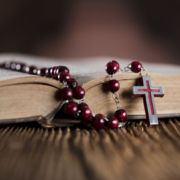
Bishop Estevez especially liked the photo above and the poem “Sweet Light” (about marriage) that accompanied the picture.  Here is the poem:


Sweet Light

by Paula Veloso Babadi


No shadows here when light is

L’Heure Bleue” to artist eyes

Or “sweet” to camera canvas.


One side of Earth

Basks in your sunlight

While I rest shadowed

On the other side.


You are brilliant day—

Burning, tumultuous, blinding, busy, wide awake.

I am subdued night—

Serene, quiescent, muted, dreaming, slumbering.


You own most phases of the Earth’s turning as

Your searing light often blinds onlookers

To the pale beauty behind your blaze.

My light reflects gently on the quieter side where,

When you’re gone, the stars become visible.


Our co-existence is casually questionable,

And yet, for all our differences,

We twice share Twilight

When Earth succumbs to neither night nor day.

In the blue hour of this sweet light, we are one.

It is enough for me.


Copyright 2025 Paula Veloso Babadi

Photo license purchased from Shutterstock

Edited by Gabriella Batel

Sacred Mysteries of the Rosary

Sacred Mysteries of the Rosary


The Joyful Mysteries

Not a man, this messenger announcing.

Not by man, but by God’s will, this opening.

You have been favored to be God’s mother.

So it will be, as I serve the Other.


Beautiful the feet, her journey complete.

God’s family with man; grains of new wheat.

Convey the Divine, bring forth His spirit.

Magnify and rejoice as you hear it.


Singular birth, most humble beginning.

A King in a manger, nothing stranger.

From above, afar, the fields, are coming;

Famished seekers, relieved of their hunger.


This truth can’t be known; it must be revealed;

Adored or rejected; thoughts unconcealed.

God, as a baby, our arms can enfold.

Piercing projected; such sorrow foretold.


“The son must obey the father,” He said.

Joyful reunion, such sorrowful dread;

“You see, I was at home. I was not lost.”

She ponders, says “Yes,” whatever the cost.


The Luminous Mysteries

Bathed in our sins and so bearing our cost.

Fulfilling by willing, saving the lost.

Present in sacrament, baptism first.

Trinity rising from water’s rebirth.


Now, Mother? Yes, time to let joy overflow.

Wedding and feasting, delights that will show.

You’ve come to bring joy, reveal His design.

Presence brings comfort, so share such as thine.


His Kingdom nears; the King appears.

Return from exile, cast off your stale fears.

Sown in seedlings, true harvest will ripen.

Remorse meets mercy, stony hearts open.


Please stop, I’m sorry to see this vision.

I don’t understand this fearful mission.

Fear not, I’m with you; I know what you need.

With time, you will see the new life I breed.


This bread is my body, for you given.

Forgive them again, seven times seven.

The cup is a promise, never broken.

Do as I do, you’ll not be forsaken.


The Sorrowful Mysteries

The consoling angel daubs beads of blood

As tears and sweat form into pools of mud.

Above their anguished groaning can be heard,

‘Be done to me according to your word.’


Beads and hooks arrayed along leather strips

Like birds of prey strike the flesh they assail.

How can it be that those wielding the whips

Are healed by this very one that they flail.


My pride and arrogance a mockery

Of you wearing that wicked crown for me.

Imitating your naked humbleness

Merits the cloak in which I hope to dress.


Too heavy, too great, too fearful for me.

Yet fear is tempered by pity for thee.

Who carries my guilt, pays my penalty

Through death on a cross to eternity.


Transfixed is my gaze, my hopes pinned on thee,

Hanging suspended on Calvary’s tree.

“I thirst,” you say, as you pour out your heart.

“Finished,” you say, creating a new start.


The Glorious Mysteries

Do dim tombs typically bloom with light?

Who once entombed wakes to a morning bright?

Do burial clothes often display their wearer?

Who bears wounds in a body now fairer?


Beyond sight to wider light, He rises.

Here now ever present, He surprises.

Beyond time to forever, He returns.

The path beyond history, He confirms.


Heavenly intruder in fire descends.

I am love; you shall love; love never ends.

God present for all, Church for a body.

Go tell it, go share it; for all, it’s free.


Bodies only went the way of all flesh,

From ashes to ashes until that day.

Lifted high for her maker to cherish.

She first, before all others, gone this way.


A Queen is in Heaven, mother love reigns.

Mercy, she offers, and prayer she explains.

Guide us through exile, in tears do we plead.

Return home, take shelter; hope will succeed.


copyright 2025 Tom Medlar

Making Peace with the Sea Oats

Making Peace with the Sea Oats

by Paula Veloso Babadi

“Peace I leave with you; my peace I give to you. I do not give to you as the world gives. Do not let your hearts be troubled, and do not let them be afraid.”—John 14:27

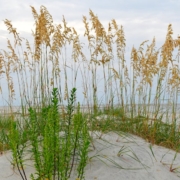
Letting go isn’t always easy. I know because I’ve been holding on to a dilapidated container housing sea oats that are at least sixty years removed from the Pensacola dunes where our family picked them. Every time I look at them, I am reminded of a happy childhood, where every Sunday after Mass, my parents, sisters, and I would trek to paradise in our yellow station wagon, packed with a picnic, beach gear, and lots of laughter and singing.

Two years ago, I wrote a poem about those sea oats after realizing that every time I passed by them in my office/library a few more oats would fall to the ground. I questioned why I couldn’t just throw them out. They weren’t just sea oats to me—they were the sun and smile of my parents, the kindness of my sisters who spent their allowances to buy the wicker urn. They were the warmth of our home, the memory of gatherings in the family room (where they sat for years), a lovely complement to the wavy blue colors of the carpet. I knew they were a daily reminder of my wonderful parents and sisters, and I wasn’t ready to let go.

When I complained about the mess the sea oats were making, my sister, Virginia, recommended a couple of years ago that I should take a picture and then dispose of them in a dignified manner. I never did. But after talking with Virginia today, I told her I was ready to let them go and would bury them in my garden in a nice spot where they will enrich the earth. I’ll hold on to my memories, and I am at peace with that gift.


Sea Oats

by Paula Veloso Babadi


More than half a century ago,

they stood tall in a white wicker urn,

salty grain dipping towards the ocean

of my parents’ multi-blue Sears and Roebuck carpet.


Before storms Camille, Opal, and Ivan,

before the erosion of sugar-fine dunes,

before laws forbidding their plucking,

we watched our treasures sway in the air-conditioned breeze

and smiled with memories of their harvest,

on lazy Gulf days by surf, sun, and sea life.


Today, my parents are gone.

The sea oats are withered and sparse

drooping over now-grayed wicker walls,

resting against my crisp white library shelves.

Any breeze might rob them of the last browned seeds,

But parting is not yet an option.


Copyright 2025 Paula Veloso Babadi

Edited by Gabriella Batel

Photo Credit Pexels

Broken Shells

Broken Shells

by Paula Veloso Babadi

“The Lord is near to the brokenhearted and saves the crushed in spirit.”—Psalm 34:18

I recently spent a day with some family on the beach at Daytona. Although it’s the “dog days” of summer, we were blessed with a light breeze, refreshing salty air, and cold waves. We enjoyed a terrific time together.  

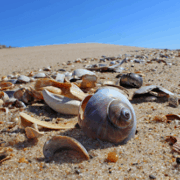
I believe sand and sea are God’s healing gifts, and I am reminded of a December day over 30 years ago.  My husband and two young sons enjoyed lunch with a family friend at his home on the shores of Ponte Vedra Beach. As my sons ran off looking for sharks’ teeth and my husband chatted with his friend, I ventured beyond the graceful French doors that opened onto the ocean. Amid inhaling the crisp salt air and reveling in the cool breeze, I felt a twinge of sadness as I eyed the broad expanse of broken shells before me. How much we humans are like these shells—huddled together, separate, yet one on the canvas of creation.

Today, along miles of shoreline, there still are jewels, brushed and polished by the repeated breaking of waves and warmed to a glow by sunshine on clear (and even cloudy) days. Even though life is good, that day, I felt broken inside, just like the shells. But as the sun warmed my arms, I knelt to take a closer look. Our wise Creator gifted me with the hope of repurpose and repair, and the vision of being whole in Him. Whether crushed or damaged, we are part of His perfect painting: His polished masterpiece.  That vision gave me hope, then and now, and inspired the poem I wrote below.


Broken Shells

by Paula Veloso Babadi


Broken shells upon the shore

washed in by gentle waves once more,

paint the sand with shattered dreams—

their beauty lost in fragments.


One masterpiece in the array,

amidst the broken pieces lay

too well concealed for me to see

its beauty on the canvas.


Though I am broken-pieced this day,

God’s healing sun and ocean spray

brush me into a form anew

whole again amidst the broken shells.


Copyright Paula Veloso Babadi 2025

Edited by Gabriella Batel

“Mary, Mother of Poets”

Mary, Mother of Poets


The poet is a cultural crime fighter,

A merchant of the timeless,

A calligrapher of gravestone inscriptions.


The poet wanders wasted lands, and

Ponders books of ancient lore.


The poet tosses runes skyward, and

Traces the descent of inscrutable phrases.


The poet leans into the cave of echoes,

Listening for words spoken before speech began.


Ancient poets are being found in melting glaciers,

Their names, long etched in ice,

Now melt into a crevasse of collective forgetfulness.


Yet, lo, the boldest poet is a banal figure, deaf and dumb,

Next to the singular lady who conversed with glorious Gabriel.

The chosen woman who bears

The body of God,

The scar of the sword,

And the mission of forgiving the crowd calling for the death of her son.


Her ever-silent, inwardly-listening husband heard

The dream-speech of divine messengers,

And used the sign language of lowered eyes, bent knees, and folded hands

To tell what he’d heard.


Happy the mother who magnifies the Lord,

Who rejoices in God the savior.


Happy are we to have a mother who hears the whispered dying wishes

Of the lowest and the highest.


Happy to have a blessed mother who shares

Her gravitational hearing,

Her galactic awareness,

Her celestial serenity and

The super nova intensity of her love.


Queen mother of Being,

Holy fountain of mercy.

Listening silently to each soul.

Every person’s prayer pondered in her eternal perspective.


© copyright 2025 Tom Medlar

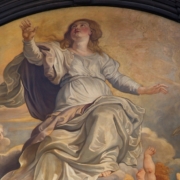
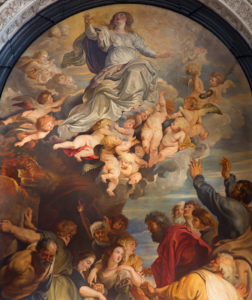
Antwerp – The Assumption of the Blessed Virgin Mary, a copy after Peter Paul Rubens (1613) in Lady Chapel in st. Charles Borromeo church on September 5, 2013 in Antwerp, Belgium

“Woman at the Well”

Woman at the Well

All that I thirst for,
Being known and not condemned.
Eternal relief.

I came to see you.
I have never not loved you.
Do you see me now?

You came first to me?
You wanted water from me?
They all left me dry.


copyright 2025 Tom Medlar

Two Poems: “Sewing Light” and “A Habit of Prayer”

Sewing Light

Evening gasps,

Grasping closer his dusky cloak

Till he’s a shadow in the corner.

Loitering longer near this luminous lady sewing in light.


Time glides beside Evening,

Stilled to see His winged spirit is her guest.


Your presence, Lord, is felt

By the powers of nature.

Your silence speaks to the cycles of movement,

To our longings for the everness of you.


Abide always, meekest one.

Fill my breath with the motions

Of your arriving and going,

She prays.

© Copyright 2025 Tom Medlar


“St. Elizabeth of Hungary Working for the Poor” by Marianne Stokes (public domain)


A Habit of Prayer

A wedding dress, made for me.

For we, I wield the thread.


A habit of prayer I sew.

I sow the seeds of silence.


Along the aisle of silence, on the Father’s arm,

The Father escorts me, the alpine path to the altar.


Thou takes me to holy wed.

Monastic cell, the marriage bed.

© Copyright 2025 Tom Medlar

The Shepherd’s Pie: Poetry and the Stages of Grief

The Shepherd’s Pie: Poetry and the Stages of Grief


“A slice of hope to raise faithful kids.”

This uplifting, ecumenical show uses engaging conversations and fun entertainment reviews to offer positive insights and media resources for families and youth leaders. We discuss current issues that impact young people at home, in school, and in the world today.

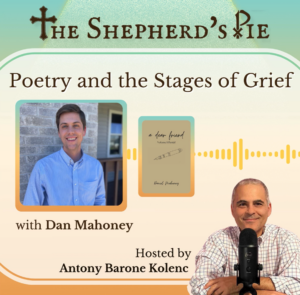
In this episode of The Shepherd’s Pie, Antony Barone Kolenc speaks with Dan Mahoney about how he was able to use poetry to help him cope with the death of his father as he worked through the five stages of grief, and we discuss his poetry book, “A Dear Friend.”


null


Check out other episodes of The Shepherd’s Pie.


Copyright 2025 Antony Barone Kolenc

My Proposal

My Proposal


Always one with the Divine dispatch
Never a thought for himself

Always a swift and selfless messenger
Never a pause to ponder his view

Now God asking to become a person
Never had this happened before

Great Gabriel approaching
This person
This question
This transition

God asking if this Mary might become His mother

Always he’d flown on the wings of the Lord
Never had he felt like a human, hesitant to be seen

Do not be afraid, Gabriel, for you have been chosen for this role

This is my proposal to her

Announce what I say to you

Gabriel turned and looked longer at Mary
He saw all that was pending
All heaven held its breath

I love God who wisely arranges all things
I love this Mary, so different from all other persons
I love Him who wants to be her son

Gabriel brightly and silently came before Mary.


copyright 2025 Tom Medlar

Balancing in Thin Air

Balancing in Thin Air

If you’ve never experienced vertigo, be thankful. It is unpleasant to say the least. Over the last few years, I’ve been grappling with recurring bouts of vestibular neuritis, a fancy word for damage to the inner ear system, causing severe spinning, dizziness, nausea, motion sensitivity, and loss of balance. New life phase, new challenge.

Before vertigo, I floundered to manage work and family responsibilities; before that, it was life as a newlywed, life in college, and high school days. Well, you get the picture. When my resources were spread thin and it seemed there was no air to breathe, finding spiritual equilibrium became even more critical than regaining physical balance.

Two lessons from my father gave me a better perspective during times of imbalance.

One prayer I learned from him—Lord, let me never stray far from You, but if I start to wander, pull me back—helped me visualize a lifesaving rope tied around my waist. I felt safe knowing that as long as I didn’t cut the rope, God was at the other end and would not let go of me. I didn’t need to walk a tightrope alone. Secondly, one of Daddy’s favorite scriptures helped me imagine that I was one of the birds Matthew spoke of and that God would always take care of me:

“Look at the birds of the air: they neither sow nor reap nor gather into barns, and yet your heavenly Father feeds them. Are you not of more value than they?”—Matthew 6:26

I’ve shared this verse many times and eventually wrote the poem below as I considered what it means to be the bird.

Life will always present situations that upset my current balance and sometimes whoosh the air from my lungs. When I remember these simple lessons from my father, attend Mass, and receive the sacraments, I find that I’m not suffocating anymore. I stand steady and straight. I can breathe again.


Become the Bird

by Paula Veloso Babadi

“Look at the birds of the air: they neither sow nor reap nor gather into barns, and yet your heavenly Father feeds them. . . ”—Matthew 6:26


When air is thin

breathe out

breathe in.


Breathe in

beauty

and truth.

Breathe out

despair

and fear.


Into thin air

disperse

your sighs,

and

out of thin air

become the bird.


Copyright 2025 Paula Veloso Babadi

Edited by Gabriella Batel