Maybe I’m Amazed

By Janice Lane Palko

Do you collect anything? Aside from the occasional Christmas ornament I pick up whenever I travel to a new destination, I don’t collect anything material. However, I do have a collection of intangible treasures that I regard as priceless.

One gem is the first time I saw a shooting star. I was probably eleven years old, and we were at a picnic playing hide and seek. As the call of “Olly olly oxen free” went up, I emerged from my hiding place to run across a dark field to home base, when on the horizon before me, a shooting star streaked across the sky. I was so amazed by the sight that I stopped short and stood in the black field with my mouth gaping in awe.

Another gem I collected twelve years ago while on a cruise in the Caribbean with my family. It was that magical time of day when it’s still light but the sun is sinking and everything drips with melting gold. There were several other ships in port in St. Maarten with us, and as evening drew near, one-by-one the ships left for the open sea. The water was flat and the wind was nil. As my dad and I stood at the rail on the upper deck, we watched as each ship sailed into the setting sun. But what I will never forget is how each of their wakes left a golden filigree on the placid surface of the sea for miles.

I picked up another treasure several years ago while on another cruise–this time near Mexico. After spending the afternoon in port, we came back to our room to recuperate before getting ready for dinner. While my husband and son lounged in our cabin, I went out onto the small veranda off our room, sat in the lounge chair, and closed my eyes to relax. As I was dozing, I was awakened by the sound of several shipmates on the decks above and below me shouting, “Whale!” I glanced to my right, and there beside the ship was this enormous whale leaping out of the ocean. I couldn’t get to my feet fast enough to open the cabin door and yell, “Come quick. There’s a whale!” As my family watched this sleek whale put on a show, I looked above and below us. Hundreds of passengers had gathered on the verandas of the various decks. There were so many people lining the rails on this side of the ship, it was a wonder we didn’t tip.

Just last month, I added a new treasure to my collection. We had tickets to see U2 at Pittsburgh’s Heinz Field. It was rather chilly for June. And cloudy, but that is not unusual for Pittsburgh. We had cheap seats, high in the upper deck, but as they gave a glorious view of Pittsburgh’s skyline, I didn’t mind sitting up that high. But what really impressed me was something that happened moments before U2 took the stage. Although it was not raining anywhere in sight, a red rainbow formed over the field and terminated above where the group would soon appear. Now, I’ve seen many rainbows, but this was unusual because there was no precipitation and because you could not see any other colors of the spectrum but red against the leaden sky.

Red Rainbow

It seemed that everyone saw the phenomenon at once as a gasp arose from the crowd and thousands of cell phones were held aloft to capture the beautiful sight. The red rainbow stayed for several minutes, and then before it faded, it cast its light on the surrounding clouds turning them a rosy pink. Sure, U2 was good, but I’ll never forget that red rainbow.

I can’t remember where I read this, but someone once observed that humans are continuously fascinated by God’s handiwork but easily become bored with things made by human hands. Case in point. If you grew up during the 1960s and 70s, you may remember the nation’s fascination with the space program. People clustered around their televisions to watch Neil Armstrong walk on the moon, but with each successive trip into space, less and less people paid attention. Yet, people never get bored with watching something as simple as a sunset.

Why does that happen? Clearly, there is something embedded in the human soul that longs for the Divine. The summer provides us with more opportunities to be out in nature and to observe God at work in His creation. Keep your eyes open. It may be something as simple as a hummingbird buzzing your garden or as spectacular as bioluminescent ocean waves pounding a beach or the flash of the Northern Lights that give you a glimpse of His glory. You never know what treasure He may cast before you that will spark your sense of amazement and that will become a cherished addition to your treasure chest.

“Little Nellie of Holy God”–The Toddler Who Inspired a Pope*

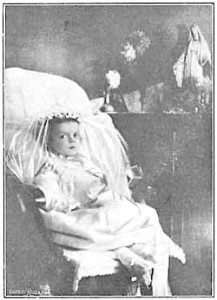
Ellen Organ was born on August 24, 1903 in what was known as the “married quarters” of the Royal Infantry Barracks in Waterford, Ireland. Her dad, William, was a soldier in the British army. Shortly after Ellen’s birth she was baptized into the faith at the Church of the Trinity. No one knows why, but from that point on Ellen Organ was called “Nellie.”

By William Organ - Own work, CC BY-SA 3.0, Link

By William OrganOwn work, CC BY-SA 3.0, Link

By the age of two, Nellie displayed a pronounced spirituality rarely seen in a child, especially one so young. While walking to Mass holding her dad’s hand she would constantly talk about seeing “Holy God.” This was something she began saying without having heard such an expression. Even her dad admitted years later he had no idea why his daughter began saying “Holy God.” Nellie’s parents were both devout Catholics and her mom, Mary, had an especially deep devotion to the Blessed Mother. She would take walks with Nellie, always talking about Jesus and Mary. She and her husband also made it a family custom to pray the family Rosary every day. Nellie, doing as her mom showed her,  always kissed the Crucifix and the large beads between decades. The first words she learned were “Jesus” and “Mary.”

Nellie’s life and the lives of her brothers, Thomas, David and their sister, Mary, were about to change dramatically. Their mom became very ill with tuberculosis. Nellie, the youngest of her siblings, was by her side constantly and was actually hugging her mom when she died in January of 1907. Nellie was three years old.

The children’s dad could not provide proper care for them. Consequently, he turned to his parish priest for help. Thomas, who was the oldest at age nine,  was sent to the Christian Brothers and David to the Sisters of Mercy. Mary and Nellie were taken in by the Good Shepherd Sisters in Cork City. They arrived there on May 11, 1907. The sisters treated them kindly and were very good to the girls. Nellie was happy to call all of the sisters, “Mothers.”

Nellie was three years and nine months old when she arrived at the Good Shepherd Sisters home. A young girl named Mary Long slept next to Nellie. Nellie never complained but Mary heard her crying and coughing during he night. She told the sisters and Nellie was moved to the school infirmary.

Upon examination it was discovered that Nellie had a crooked spine (the result of a serious fall) that required special care.  Sitting up was very painful for the child and sitting still for any length of time caused her great pain. Her hip and her back were out of joint. She was only three and she tried to hide her pain. But she could not “fake” feeling well. All the sisters could do was make the child as comfortable as possible.

Nellie astonished the nuns with her insight and knowledge of the Catholic faith. The sisters and others that cared for Nellie Organ believed without reservation that the child was spiritually gifted. Nellie loved to visit the chapel which she called “the House of Holy God.” She referred to the tabernacle as “Holy God’s lockdown.”  And she embraced the Stations of the Cross. Upon being carried to each station she would burst into tears seeing how Holy God suffered for us. She also developed an acute perception of the Blessed Sacrament.

One day Nellie was given a box of beads and some string. Being a three-year-old she put some in her mouth and inadvertently swallowed them. People saw her gagging and choking and rushed her into the infirmary. The doctor present was able to remove the beads from Nellie’s throat.

They were all amazed how brave the little girl remained as the doctor probed  into her throat, removing the objects. She never made a sound. At this time it was discovered that, just like her mom,  she had advanced tuberculosis. The doctor told the sisters there was no hope for recovery and gave Nellie only a few months to live.

Nellie loved the Holy Eucharist deeply. She would ask the sisters to kiss her when they were coming back from Communion so she could share their Holy Communion. She desperately wanted to receive her First Communion. But the rule of the Church was a minimum age of 12. Nellie was only three.

Nellie told of visions she was having of “Holy God” as a child and the Blessed Mother standing nearby. Her faith was so pronounced that the Bishop agreed (since she was close to death) to confirm her. She received her Confirmation on October 8, 1907. Then, on December 6, 1907, after considering all the facts, the local bishop, in consult with the priests, allowed Nellie Organ to receive her First Holy Communion. Nellie Organ died on February 2, 1908.

Nellie Organ’s story spread throughout Europe and reached the Vatican. It was presented to Pope Pius X by his Secretary of State, Cardinal Merry del Val. It was providential because the Holy Father had been looking for a reason to lower the age of receiving First Communion to the age of seven but was not sure about doing it.

When Pius X read the documents about “Little Nellie of Holy God,” he immediately took this as a sign to lower the age. The Pope immediately issued a Papal Decree called Quam Singulari, changing the age of receiving First Holy Communion from 12 years old to age seven.

Pope Pius X, who would become St. Pius X, after issuing Quam Singulari, took up his pen and wrote, “May God enrich with every blessing — all those who recommend frequent Communion to little boys and girls, proposing Nellie as their model. –Pope Pius X. June 4th, 1912.”

*edited version published in Aleteia on March 3, 2017

©Copyright Larry Peterson 2017 All Right Reserved

It’s Perfect – Not!

By Janice Lane Palko

It was Father’s Day weekend thirty-one years ago. Married only a couple of years, my husband and I had moved into our first house that previous January. We’d spent that spring painting, wallpapering—the things you do to get a home into shape. On Saturday of that weekend, I’d cleaned the whole house while my husband had spent the day outside trimming hedges, weeding, and cutting grass in anticipation of a Father’s Day picnic for both sides of our family—the first event in our first home.

As we called it a day, I remember looking at our neatly manicured lawn and gleaming house and thinking, “Everything is perfect.”

Then the phone rang at 7:04 a.m. Who calls that early on a Sunday morning? I thought as my husband rolled over and answered it. When I saw the color drain from his face, I knew something was terribly wrong. He hung up and stared blankly at me, too stunned to show any emotion. “That was my mom. Tommy’s been killed in a motorcycle accident.” Tommy was his twenty-three-year-old little brother.

We’d anticipated a Father’s Day picnic filled with fun and laughter. Instead, we were now faced with death, identifying a body at the morgue, and making funeral arrangements.

So much for perfection.

Flash forward to June seven years later. I’m sitting in a counselor’s office after suffering for months with panic attacks. “From what I’ve observed,” the kind therapist said, “You are very hard on yourself. You need to allow yourself to be human. You think you have to be perfect.”

As you can see, my dance with perfection has been filled with missteps. From Tommy’s death, I learned that life is not perfect and never will be, and through my joust with anxiety, I learned that I am not perfect and never will be.

So, how does someone who’s had these types of reality checks with perfection square them with Jesus’s words in Matthew’s Gospel where He instructs us to “Be perfect just as your heavenly Father is perfect.”

To a perfectionist, His words area a recipe for disaster. You may have heard the adage “Perfection is the enemy of the good.” Well, when we perfectionists get rolling, we tend to discount anything, however good, that does not meet our level of perfection. We get tangled up in being immaculate. I’ve worked hard not to be a perfectionist, so when I came across that bit of scripture again recently, I, once again, reacted to it with disregard and confusion—not a good way to react to scripture.

I know perfection is impossible and shouldn’t even be pursued lest I become paralyzed in my quest to be flawless. There is no perfection on this side of eternity. I know I cannot be perfect, I made myself sick trying. Why would Jesus impose such an impossible directive on those He loves?

Ah, but I’ve also come to learn that when Jesus commands us to do something, He always promises to provide us with the grace to achieve it. His words in John’s Gospel provide the key. “Apart from me you can do nothing.” Apart from Him, I cannot reach perfection. Apart from Him, the world wallows in sin and destruction. Perfection in the way Jesus means is a work of transformation and something for me not to achieve but to surrender to. Through Jesus and His act of redemption, we reach perfection. Paul in his letter to Philippians gives us this assurance: “I am confident of this, that the one who began a good work in you will continue to complete it until the day of Christ Jesus.”

I’ve learned that Jesus is working on me, and that sounds absolutely perfect to me.

When Picking up Your Pen Is Picking up Your Cross

By Janice Lane Palko

How do you regard your writing career? Perhaps you’re like me. I’ve been putting words on paper for more than 20 years, and I’ve always regarded my propensity to write as a being a blessing and as a calling of sorts. I wrote last month how God and, to a lesser extent, we humans can take something meant for harm and turn it into good. My writing has been a blessing wrought from misery.

I’m a natural-born worrier. Some families seem to pass on the proclivity to become addicted to alcohol, drugs, or gambling while others seem to be prone to divorce or commit suicide, but my family’s fatal foible is to fret. We are world-class worriers. After my third and last child was born, now nearly 25 years ago, I began to experience panic attacks. At first, I didn’t know what was happening to me, but as a worrier, I, of course, assumed it had to be something catastrophic like a brain tumor. After consulting my family doctor and a visit to a therapist, it became apparent that I was under too much stress—a lot of which I was putting upon myself. In addition to having three small children at the time and getting no sleep and experiencing several family health crises, I have a vivid imagination. As such, I realized through some introspection and prayer, that I was using my God-given imagination to terrorize myself. For instance, if I saw a carjacking on the news, I would cast myself as a victim and play out the scenario in detail in my mind of what it would be like to be taken captive and held by brutal criminals.

Through prayer, reprioritizing my things in my life, and discovering that I could terrorize people on the page through writing instead of myself, I found a happier, more peaceful, and more productive life. That’s why I’ve always viewed my writing career as a blessing in my life. It refocused my mind on more productive things.

During this Lent, however, I’ve come to another perspective–one that seems contradictory since I love writing so much. I’ve become aware that writing may also be my cross. Not to trivialize Jesus’s passion and death by comparing it to the life of a writer, but when you are a writer, life is not all sunshine and roses. There is suffering. How many of us could paper the walls with rejection slips? How many of us have had a piece you’ve sweated over fall flat? How many of us have looked at a paltry royalty check and wondered if it’s all worth it? How many of us have watched as books like Fifty Shades of Grey soar to the top of the bestseller’s list while our writing attempts to edify and inspire bump along the bottom of the Amazon charts? How many of us have put in a full day’s work or spent all day taking care of a home and children only to use what little “me time” there is to eke out some writing?

In writing this piece, I did some research on what it means for Catholics to “take up their cross.” It seems that passage of scripture is often difficult to define, but I like this thought on it that Saint Pope John Paul II gave during World Youth Day in 2001.

“As the cross can be reduced to being an ornament, ‘to carry the cross’ can become just a manner of speaking. In the teaching of Jesus, however, it does not imply the pre-eminence of mortification and denial. It does not refer primarily to the need to endure patiently the great and small tribulations of life, or, even less, to the exaltation of pain as a means of pleasing God. It is not suffering for its own sake that a Christian seeks, but love. When the cross is embraced, it becomes a sign of love and of total self-giving. To carry it behind Christ means to be united with him in offering the greatest proof of love.”

Like the proverbial double-edge sword, I’ve come to see my writing as both a blessing and a cross much as Jesus’s cross is both a curse as it spelled suffering and death and yet, at the same time, was the greatest sign of His love for us. Suffering and love are always intertwined.

Therefore, as we come to another Easter, I’m going to dwell less on the suffering endured as a writer and strive to be more like Jesus and take up my cross and offer everything I put on the page as a great proof of love.

Who Do You Say That I Am?

By Janice Lane Palko

You’ve seen those Ancestry commercials about people who believe they are one race or nationality and then take a DNA test and find out they are not who they thought they were. My husband could be featured in one of those commercials.

This past Christmas, I bought him a DNA test because my parents had had their DNA tested as a gift for me and my siblings. Hence, I thought testing my husband would give our children a clearer picture of their genetic heritage.

My parents’ tests confirmed what my great-grandparents and grandparents had always told me—that I was predominantly Irish, with a splash of English, Welsh, and German. My hubby has always believed that he is half Italian and half Slovak. Imagine our surprise then when I opened the Ancestry email two days after Christmas and learned that he was 29 percent Italian, 25 percent Slovak, and, faith and begorrah, 19 percent Irish! Where did his green roots come from? We still have no idea.

My mother, whose maiden name is Hughes, registered 11 percent Irish and 50 percent Great Britain. Technically, my husband was more Irish than my Irish mother. The target of good-natured jokes from my family over the decades for not being Irish, my hubby now is one of the clan. He has taken great delight in his newly found heritage, lording it over my family, prompting him to don his “Who’s Your Paddy?” T-shirt reserved only for St. Patrick’s Day wear. The axis of our world has shifted a bit, and now I will have to throw away the “Honorary Irishman” button I gave him 36 years ago when we were first dating.

Accompanying the DNA test came a free month’s subscription to the Ancestry website, and I took full advantage of it. I discovered some things along the way. I learned that one paternal great-grandfather, James Lane, had a mother named Mary, a sister named Mary, two wives named Mary as well as a daughter named Mary, which made keeping all the Marys straight very difficult. I learned that a maternal great-great grandfather, who the family had been told had died when my great-grandmother was very young, most likely skipped town to take up with another woman in Colorado. I also learned that my English great-great grandmother who owned a bar, smoked a pipe, had a tattoo, and a pet parrot (I must have descended from sea captains.) and had 13 children was not widowed as had been reported by my late grandfather. She had divorced her husband as her marriage license to her second husband, my great-great-grandfather, stated because of “cruelty and barbaric abuse.” She went on to have a set of twins, one of whom was my great-grandmother. While Catholics dominated my heritage (hence the myriad Marys), I did find some Welsh Baptists and Cornish Methodists among the lot.

However, the most stunning discovery was that I had a fifth great-grandfather, Martin Short, (not to be confused with the comedian and actor), who came from Dublin in 1750 to the U.S. and fought at the battles of Bunker Hill and Yorktown and crossed the Delaware with General George Washington.

In addition, I learned some other, more important things. First, life matters. Although in this day and age, we treat it rather cavalierly, why, if life were not so important, would our ancestors have taken such pains to record births and deaths and chronicle who we have descended from?

Second, as writers, we provide a link to the past. I taught memoir writing for a number of years, and I always urge everyone to write their life story. What we put on paper today may one day offer clues, insights, or inspiration to someone yet to be born.

Third, you are dead for a very long time. My searches revealed a few relatives who died days after birth or as young children and one centenarian. However, no matter how long any of them lived, most have now been dead longer than they were alive, and with each passing day, they are even “deader.”

We will all eventually be dead longer than we have been alive. Therefore, plan accordingly. Make the most of your time on stage. Dream big, write beautifully, love with passion, leave a legacy. And all the while, prepare for your eternity. What you do now will determine where you will be later.

Finally, whether you think you are one nationality or ethnicity and you find out that you are not, or whether you find heroes or scoundrels or just common housekeepers, coal miners, railroad laborers, or shopkeepers in your background or not, it really doesn’t matter. Jesus posed this question of his disciples: Who do you say that I am? We should also ponder the converse. Who does He say that we are? What is our real identity? What He tells us is that we are His fallen creation, who He reclaimed for Himself on the cross so that we could become His beloved children and live with Him in eternity.

While it is interesting to know where you’ve come from, it’s more important to know where you’re going. That supersedes any knowledge of our earthly identity. Cling to your heavenly heritage because it’s the only one that truly lasts.

Christmas is a Time for Miracles: Our Family Experienced One

Christmas Season is still with us, so I thought I would share this true story about a Christmas miracle.

During the Christmas season I believe God’s loving hand sweeps down and touches many of us with a little extra something when we might need it most. Haven’t you ever, after having something unexpected and wonderful happen, blurted out, “I can’t believe it; it’s a miracle!”

Sometimes what happens to you or someone close to you is inexplicable, mystifying and mysterious and you just know in your heart that God had His hand in the mix. The following is true and it happened to my family during the Christmas season of 1960. I can remember it as if it happened today. There is no logical explanation, save God intervened and gave us an unexpected Christmas gift.

Our Mom had just turned forty and suddenly was going back and forth to the hospital for two or three days at a time. I had just turned 16 and was more or less oblivious to most everything except Barbara McMahon, who lived around the corner. Every time Mom came home she looked worse. My sister, Carolyn, 13, told me the black and blue marks on Mom’s arms were from IV needles. I figured she knew what was up, especially since she wanted to be a nurse.

Dad just kept telling us it was the “grippe” (today we call it the flu). “Don’t worry,” he’d say, “It’s just a real bad grippe.” Grandma, who lived with us, embraced that concept without question. Today, the psychology experts call that Denial. Grandma proved to be really good at it.

Mom was home for Thanksgiving but Grandma was doing most of the work, using my poor sister as her trainee. I know that it was sometime after Thanksgiving that Mom went back into the hospital. Then came December 18. That was the day Dad, Grandma, Carolyn and myself, took the subway down to Lenox Hill Hospital in Manhattan for a simple Sunday visit with the woman who was the wife, mother and daughter in our lives. Christmas was one week away, and that visit turned out to be anything but simple.

Mom was on the third floor and when we got to her room a several doctors and nurses were standing around her bed. Mom was on the bed, her head on the pillow and turned to one side. Her eyes were closed. I remember how still she was. I was instantly frightened. Carolyn and I looked at each other, and she too was filled with fear. It is amazing how fast fear can embrace you.

Grandma placed her hand over her mouth and started to cry. One of the doctors pulled our dad to the side and quietly talked to him. I watched him shake his head ever so slightly. Then he came over to me and (this is a direct quote from him on that day), “Please take your sister and Grandma to the chapel and say a rosary together. Your Mom needs all the prayers she can get right now.”

Trying to grow into a man in a matter of seconds, I put my arm around Grandma’s shoulder and said, “C’mon Grandma, let’s do what Dad asked.” She was so distraught she simply complied and followed my lead. As we headed to the inter-denominational chapel a priest hurried towards Mom’s room.

I have no idea how long we were in that little chapel but I do know we had prayed two rosaries when a nurse came in and asked us to come back to the room. We were a bit shocked because the nurse was smiling. Grandma, with her worn out arthritic knees, jumped up and broke into the funkiest sprint I have ever seen. She had erased thirty years just like that.

When we walked into that room we were confronted with a sight to behold. Mom was sitting up in bed, smiling. Dad was next to her with his arm around her shoulder. He was sporting a grin that spread across his entire face and tears were streaming down his cheeks. Standing on the other side of the bed was the priest we had seen in the hallway. He was standing there with his hands clasped together with a look on his face I cannot describe. For me, it was a moment etched indelibly in my mind and I can see it as clearly as I did back then.

Our Mom, who we thought was dead, extended her arms and said, “Well, don’t I get a hug from you two? C’mon, get over here.”

Mom was not only better, she was ALL better. Her arms were clear, her face had color and her eyes were bright and cheerful. Several doctors were outside huddled together in disbelief. They had no explanation for her sudden recovery. We finally learned that Mom had leukemia, and in 1960, your chances with that disease were virtually non-existent. We also learned that Dad had asked us to go to the chapel because the doctor had told him she only had moments left. He did not want us to see her pass on.

My father and the priest believed they had witnessed a miracle. Grandma, Carolyn and I witnessed the results of that miracle. Mom came home the next afternoon.

Christmas of 1960 was spiritual and fabulous. What had happened filled us all with an awe-inspired sense of what Christmas means….New Life. As for Mom, she was fine until the end of January. She enjoyed Johnny’s second birthday and Danny’s eleventh birthday. In early February she was back in the hospital. She died on February 18, 1961. God gave her back to us for one last Christmas, and it was the best Christmas ever.

So please, trust me when I tell you: Christmas is really a time for miracles.

©Copyright Larry Peterson 2016
(An edited version of this ran in Aleteia on December 23)

Visiting Homebound Elder-Catholics—A Privilege and Sometimes, an Unexpected Challenge

I have been an EMHC (Extraordinary Minister of Holy Communion) for over twenty years. I have had the honor and privilege of bringing Holy Communion to many people in many places: hospitals, nursing homes, hospice centers, assisted living facilities,and, of course, to the homebound. I love being part of this ministry and it has brought me in touch with some amazing people who have lived their Catholic lives quietly, faithfully and without fanfare or notoriety.

Most of those I visit are Elder-Catholics.These are the Catholic faithful who have, throughout their lives, supported their church, been active in various ministries and carried on the faith that was and still is, part of their very being. Some were born into the Faith and it was nurtured in them by their parents and oftentimes by nuns, brothers, priests and Catholic laypersons.  They in turn have passed it on to their own children. Some found the faith as adults and converted. (I so admire those people.) And so, as is the way of things, the Church continues.

I would like to share a story about one of these people. His name is John. I have been bringing  Holy Communion to John every Sunday for a little more than a year. He is ninety years old, an Army veteran who spent almost thirty years in the Far East and was married for sixty years. His wife, Mary, passed away several years ago. He loved her dearly and misses her greatly. John is not delusional, or suffering from dementia or anything like that. His mind is sharp and clear. Physically, John is  deaf (hearing aids help a tiny bit) and wheelchair bound.

When I arrive at his front door, I push the doorbell. I hear a chime; he does not. Inside, several strobe lights begin to flash, notifying him someone is at the door. He is expecting me and the front door is unlocked. I walk in and he gives out a big, “Hey, hey, good morning.”

I more or less holler back, “Hey John, how you doing today?”

He is always wearing  a smile. He says, “Well, I’m still here.” We both laugh.

John is facing a dilemma. He picks up the newspaper from a few days before and points to a story. “Have you gotten any feedback on this?” I look at the paper he has opened to an article dealing with the church’s newly revised guidelines on cremation. I shrug and tell him I have not. He says, “I have a problem and maybe you can help me out. I need some guidance.”

I am not “Father Larry” or “Deacon Larry”…I’m just Larry. I immediately feel a bit insecure because I do not like telling folks what they should or should not do when it comes to their personal faith issues. I quietly ask the Holy Spirit to quickly help me out. Then I say, “I’ll try, John. But I may not be able to. I will go to Father Anthony and ask him if necessary.”

Being part of this ministry can have unexpected rewards. God was about to bless me with a glimpse into the hearts of two Catholics, a man and a woman, people of faith who married in the faith and lived it and who shared a love that did not die upon the death of one–rather, it simply continued and still existed. John says to me, “You know, I am upset about this article. It says we Catholics must bury the ashes of loved ones in sacred ground.”

I said, “That isn’t anything new. Some folks are scattering ashes over the Gulf of Mexico or off mountaintops or sharing them among family members. Those kinds of things are not approved of.”

“Look”, he says. “I have Mary’s ashes here with me. I talk to her every day. I’m all alone and I feel she never really left and I get such comfort from that. Do I have to get her over to the cemetery?”

I’m looking at him and tears are filling his eyes. He wants to be a GOOD Catholic man and he loves his wife and wants to be loyal to her. He will give her up if the Church requires it even though the pain he will feel is unimaginable. It did not matter. He would be true to his faith no matter what. I was looking at a man who would have gladly embraced a martyr’s crown if he had been called upon to do so.

I knew that cremated remains are supposed to be kept intact and placed in a proper vessel. Nervously I began to answer but he continued. “I have a spot down at the VA for both of us. I made arrangements with the funeral home and when I pass they are going to take us together down to the VA and bury us next to each other.”

I breathed a sigh of great relief. Casting doubt to the wind, I told him, “John, that is great. She can stay here with you. She is encased in a vessel and is scheduled for burial. You will make the trip to the VA together. Don’t worry about a thing.”

I will never forget the smile that broke out across his face. I’m not sure if I gave him  proper “guidance.” No matter; in this case I am sure the Holy Spirit helped me out. I will check with the priest when I see him.

©Copyright Larry Peterson 2016. All Rights Reserved

Alzheimer’s Disease Has Turned Me into a “Guilt-Free Liar”

By Larry Peterson

My wife, Marty, has Alzheimer’s Disease, which can lead to the unexpected, like this essay. I did not plan on writing what follows but certain things, silly things, happened last night that I found myself still thinking about this morning. I thought this might provide some insight into the daily world of Alzheimer’s patients and their primary caregivers.

After dinner (by the way, I am turning into a pretty good cook) Marty asked me, “What time is my show on?”

Reflexively I asked her, “What show?” (I know she has no favorite show. I also know she has stepped into what I call ‘Uh-oh time.’ I call it this because these are the moments that can lead her to become quickly frustrated and agitated).

She looked at me and I could see her tensing up. Raising her voice a decibel or two, she said, “You know what show. Just tell me what time it comes on.”

Quickly I became a liar. I have become a guilt-free, therapeutic liar because, in my world, I have to survive. My realization is that without me she is alone and she can no longer survive on her own. “Sorry, sweetie, your show is not on tonight. There is a special about sharks, and you don’t care about sharks, do you?”

“You know I don’t like sharks. But that’s okay. I can watch the news, right?”

“Absolutely.”

She headed to the sofa, sat down and picks up her puzzle book. She always was good at doing the anacrostics (I find them incredibly difficult) but now she more or less looks at the page, holding the pencil on it. The pencil never moves. Then she said, “Do I have to go to work tomorrow? I’m so tired. I really could use a day off.”

Two years ago I might have tried to explain to her that she does not have a job and has not worked in seven or eight years. However, with my Liar’s Hat still in place I answered, “You’re right. You do look tired. I think you need a day off too. Don’t worry, I’ll call in for you and tell them you’re sick.”

“You would do that for me? That’s’ so nice. I’m so glad I don’t have to get up and go in. Is today Sunday?”

Whew, a relief question. I could tell the truth. “No, it’s Wednesday.”

“Wednesday, are you sure?”

“Yes, it’s Wednesday.”

Things were quiet for a while. It was about 9 p.m. when I walked back to the bathroom. Suddenly I heard smashing and banging coming from the utility room off the kitchen. I headed in there and Marty had, in a matter of minutes, emptied the wall cabinet of all the plastic containers, glasses and cups and other things that were inside and stacked them all on the washer and dryer below. “Hey, hon, what are you doing?”

She looked at me and I could see she was agitated. “We have all this junk. We have to get rid of it. Why do we have all this junk? We have to throw it out.”

Immediately, I switched back to my Liar’s Hat. “Okay, when should we throw it all out?”

“I don’t know; maybe right now?”

“Well, it is kind of late. Maybe we can do it in the morning.”

“I don’t feel like putting it all back tonight.”

“Don’t worry about it. I’ll do it.”

“Oh, thanks. I’m too tired.”

There was one final question. She looked at me and asked, “We’re married, right?”

“Yes Marty, we are married.”

She got into bed about 9:30 and was asleep in about two minutes. I was mentally worn out but I looked at her and realized that the innocence of childhood has come back from an unknown place and once again embraced her. I also knew that when she awakes in the morning she will not remember anything of what has happened.

Since I do not “punch a clock” I have the joy of being able to attend daily Mass at 8 AM. Marty will wake up at about 7 AM, and she always asks me, “Are you going to church?”

I answer, “Yup.”

She will ask, “Will you take me with you?”

“Of course.”

From 1 Corinthians 13:4-5

Love is patient, love is kind. It does not envy, it does not boast, it is not proud. It does not dishonor others, it is not self-seeking, it is not easily angered, it keeps no record of wrongs.

As a caregiver to a child of God, I have been blessed.

Being a caregiver for his wife with Alzheimer's Disease has turned Larry Peterson into a guilt-free liar.

By GelonidaOwn work, CC BY 3.0, https://commons.wikimedia.org/w/index.php?curid=29513537

©Larry Peterson 2016 All Rights Reserved

Lent: Highlighting Forgiveness & Redemption for All; Even “Dutch” Schultz

We are now into the third week of Lent and the road to redemption has been halfway traveled. Throughout the world Catechumens have almost reached their goal of full inclusion into the Catholic Church, which takes place during the Easter Vigil. It is a beautiful thing. In addition, this past December 8, Pope Francis started us on our journey into the Holy Year of Mercy.  The slogan for The Holy Year of Mercy is, “A Time to Heal, to Help, to Forgive.”  Yes, forgiveness is everywhere.

To give an example of how God’s mercy is ALWAYS available to those who seek it I would like to briefly mention a man by the name of Arthur Flegenheimer. Arthur was born in New York City in 1901, of German-Jewish ancestry. By the time he was 27 he was known as Dutch Schultz and was quickly becoming one of the most feared mob bosses in New York. The “Dutchman” was a bootlegger (running illegal whiskey), a numbers boss operating in Harlem and a “shakedown artist” within the NYC restaurant industry, offering protection while using the restaurant unions as cover.

His main enforcer was the infamous, Vincent “Mad Dog” Coll, a brutal killer who did Schultz’s bidding without hesitation. Eventually the “Dutchman” got tired of Coll’s wanting more money. As “Mad Dog” sat in a telephone booth talking on the phone he was machine-gunned to death by Schultz’s henchmen. Dutch actually proved to be a more brutal killer than “Mad Dog” Coll. So how does my brain tie together Dutch Schultz and the Holy Year of Mercy combined with Forgiveness? Actually, it is not that hard to do. This is the phenomenal redemption available to all through the Church and her Sacraments.

Dutch Schultz wanted to kill U. S. Attorney Thomas E. Dewey (later to be Governor of NY and the presidential candidate losing to Harry Truman in the 1948 election). The Mafia Commission told Schultz,  “NO, it would cause us too much trouble.” Schultz refused to listen and decided to  kill Dewey anyway. The mob, under Lucky Luciano, sent “Murder Inc.” after Schultz. On October 23, 1935, they gunned him down in a restaurant in Newark, N.J. Enter the sacrament of Penance and Forgiveness. Enter Mercy.

Earlier, Dutch Schultz had been acquitted on tax evasion charges, and at that time he converted to Catholicism. He believed that Jesus had saved him. When he was shot he did not die right away. He was taken to the hospital for surgery and he immediately asked for a priest. He was 34 years  old and his last thought while he was dying was to  ask Jesus for forgiveness and mercy. The “Dutchman” went to confession, received absolution and was administered the Last Rites of the Church by a priest. Then he died. Did Dutch Schultz go right to heaven? Did he get to the “pearly gates” and have St. Peter say, “Sorry, Dutch, that priest made a mistake. What you did was uunforgivable. You are not welcome here.” I think not.

In a few weeks it will be Good Friday. Catholic/Christian people all over the world will mourn and honor the bloodied, tortured and crucified Son of God, Jesus Christ: Jesus, the God-man who embraced forgiveness for all people and extended love to everyone. This is also what He wanted us to do. This is why he suffered and died for us. He offered Himself to His Father for us. Then we celebrate His Father’s gift back to us, the Risen Christ. We all have been saved and we all  have the choice of whether or not we want to share eternal life with the Blessed Trinity. All we need to do is seek forgiveness. Because of God’s Mercy, even a Dutch Schultz can join in the Redemption Celebration. It is a beauty beyond description.

©Larry Peterson 2016.  All Rights Reserved

Humility and Pope Francis

Image source: Cassie Pease Designs..

This is from the Gospel of Luke; Chapter 9: vs 46-50

An argument arose among the disciples about which of them was the greatest.

Jesus realized the intention of their hearts and took a child and placed it by his side and said to them, “Whoever receives this child in my name receives me, and whoever receives me receives the one who sent me. 

For the one who who is least among all of you is the one who is greatest.”

This gospel reading is all about the greatest of all the ‘deadly’ sins, Pride. It is also about the greatest of all ‘heavenly’ virtues, Humility. This is a “clash of the titans” of evil vs Good. And Pope Francis, without trying and by just being who God made him to be, wears the mantle of humility without fanfare, showmanship, pretentiousness or anything that might be self-serving in any manner. Yes, he wears that mantle and it is fastened to his shoulders with the clasp of Love. In so doing he continually  shows  the whole world what it means to think of yourself the least among all others.  (Was that a Fiat Hatchback or a Ford Taurus?)

Jorge Mario Bergoglio never asked to be a bishop or a cardinal. He never “lobbied” for these positions or  sought them out in any way. He did not have “super-PACs” at his beck and call when the vacancy for Pope opened. He simply loved being a priest, working with the poor and homeless, and doing his best to follow God’s call so he would make his life pleasing to Him. Make no mistake, God called him to the papacy. The secular world may mock that concept, but that is why they do not understand. That is why they cannot experience the joy so many millions of faithful are experiencing with his papacy. If they could only swallow their damn pride a bit and open their hearts to some  humility, they may find the elusive peace that evades them.

Pope Francis is filled with the Holy Spirit. That Spirit leads him to stop his motorcade and wade into a crowd of children and hug them and kiss their foreheads. It compels him to embrace the crippled, the disfigured, the mentally challenged, the homeless as well as the “uppity-ups.” He has no qualms about walking into a prison and embracing hard-core murderers, rapists, thieves, and drug dealers. Pope Francis sees the Face of Christ in EVERYONE.

Last September, during his stop in Washington, D.C.,  he visited with President Obama and then offered Mass in the National Cathedral of the Immaculate Conception. When he finished he made a point of going to the offices of the Little Sisters of the Poor. He had to send a message to the entire world about the solidarity that exists within the Church when it comes to respect for life, ALL life. That message required no words—just action. The Pope gave that message by meeting with the Sisters who take care of the elderly poor free of charge, and have been doing so since St. Jeanne Jugan founded the order back in 1841.

Pope Francis left our country a more contented and inspired nation. He reached out to everyone and many  responded. He represents the Goodness and Love that Jesus Christ brought to us and, despite the horrors of jihad and the emptiness of secularism pervading our lives, his presence and example make our world a better place. He is HIS ambassador on earth and  he represents HIM well. We have all been blessed.

©Larry Peterson 2016

Stay in the Know

Join Our Newsletter

Members and supporters can get the latest on CWG news and events by signing up for our newsletter.

Please wait...

Thank you for signing up!

Catholic Writers Guild
P.O. Box 77
Eaton, IN 47338