Tennessee’s Filipino-American community revives homemade Thanksgiving lunch for the hungry

“Rather, when you hold a banquet, invite the poor, the crippled, the lame, the blind;
blessed indeed will you be because of their inability to repay you. For you will be repaid at the resurrection of the righteous.” — Luke 14:13-14 (1)


Throughout November in the United States, the corporal work of mercy of feeding the hungry is performed in abundance. Countless people shop prescribed lists of cranberries, pumpkin, potatoes, gravy, stuffing and turkey so food pantries and churches can hand out bags and boxes brimming with enough food for economically strapped families in their community to have a traditional Thanksgiving dinner that they could not afford. But in the “Walking Horse Capital of the World,” Shelbyville, TN, less than two hours south of downtown Nashville and 90 minutes from the Alabama border, scores of people were treated to a special kind of Thanksgiving lunch lovingly prepared and joyfully served on a relatively clear and warm day Nov. 15.

As part of Project Give Back to God, Dr. Alex and Mrs. Merchie Fider, in a joint effort with the Filipino-American Association of Tennessee, Inc. (Fil-Am), serve “… the indigent Filipinos and Americans in dire need.” With an assist by officers and members of the Bedford County Sheriff’s Department, they geared up to serve at least 200 people — most of whom are patients and their families of the Fider’s clinic– their twist on a Thanksgiving meal.

All hand-prepared by Mrs. Fider, the spread of Filipino fare included egg rolls, wings, ribs, rice, noodles, soup, and much more to fill the belly and feel the love. In addition to the patients, the invitation went out by flyer and word of mouth to “VIPS such as poor patients, physically disabled, mentally challenged patients, homeless people, including their children, and most of all, people in dire need.” Held outside in back of the Fider’s clinic, cooperative weather was a must.

“For the past weeks, cold spell brought with wind chill came to TN while snow in the East Coast,” Dr. Fider reported to his Facebook friends. “Merchie and I prayed the Rosary at St. Rose of Lima Church, Murfreesboro, and St. Williams Church, Shelbyville, last week to beg Our Lady of Fatima to grant us the Miracle of the Sun that happened on 1917 in Fatima, Portugal.” Even though the weather turned balmy, they were prepared regardless. In preparation that, to passersby, probably looked like a set-up for a wedding banquet, rented tents and tables were brought in, in addition to portable toilets so diners had facilities to wash before and after eating.

For the Fiders, who immigrated to this country from the Philippines in the early 1980s, it’s not only an opportunity to commemorate the first Thanksgiving in the land, but also an expression to give glory and thanks to God for many blessings and share their native culture with their adopted homeland.

The Thanksgiving lunch began in 2015, but when Covid hit, it stopped. Thanksgiving 2025 marks not only the tenth anniversary of the first lunch, but also its revival since Covid. This lunch was the first one outdoors, and the Fiders were grateful for the favorable weather. “Merchie and I thanked Our Lady of Fatima for the miracle of the Sun and for giving joy to all of them,” Dr. Fider said.
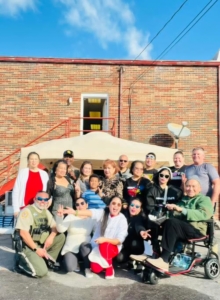
A group of volunteers gather in front of a tent for a group picture.

Volunteers of the Thanksgiving lunch enjoy the day.

For people charged with preparing Thanksgiving dinner for their families and who find it exhausting and stressful, can you imagine making more than 200 eggrolls? Mrs. Fider begins some of the dishes early, such as the eggrolls because they are hand-rolled. “The cutting is difficult because you have to cut it very fine to roll it,” she said. She wouldn’t consider eliminating the eggrolls, either. They are a favorite of their diners who anticipate having them. Some of the foods, such as rice, can only be made the day of the feast. She shops the ingredients when she can, normally after a long day of running the clinic.

In the end, about 150 people came. Diners included children, wheelchair-bound patients, and folks with canes and walkers. “I also invited homeless people that we met on the streets and hanging out in gas stations,” Dr. Fider said. Any leftover food was packed up for to-go orders. Nothing was wasted and everything was enjoyed – despite the intensive work.

“We can’t ask a caterer to do it … it’s different,” Mrs. Fider said.

No skimping, no compromising. The volunteers treat folks like family, or rather, Very
Important People.

“The VIP guests may be angels in disguise,” Dr. Fider posted. “Amen.”


AI Feature photo of Filipino banquet created in Adobe Firefly by Mary McWilliams
Inset photo contributed by Alex Fider and used with permission.
Scripture texts in this work are taken from the New American Bible, revised edition ©
2010, 1991, 1986, 1970 Confraternity of Christian Doctrine, Washington, D.C. and are
used by permission of the copyright owner. All Rights Reserved.

© Copyright 2025 by Mary McWilliams

Edited by Rietta Parker
She is not in Scripture, but St. Veronica Captures the ‘True Image’ of Christ’s Teachings

She is not in Scripture, but St. Veronica Captures the ‘True Image’ of Christ’s Teachings

July 2025 revealed significant information about family caregivers that applies to millions of people. The data has gone largely unnoticed in favor of more scintillating political headlines of the summer. AARP and the National Alliance for Caregiving released the 140-page,Caregiving in the US, a report which discloses the startling revelation that nearly 25 percent of Americans are long-term caregivers of a family member. That percentage translates to 63 million caregivers, an increase of 45 percent in only 10 years.¹

The non-quantifiers: loneliness, isolation, and lack of training haven’t changed in the last decade. The struggle to continue working for financial stability versus giving the appropriate care the loved one needs remains an issue, although government programs have been enacted this year to pay some caregivers. The majority of family caregivers are women, who are among the 59 million providing for patients that the report refers to as having a “complex medical condition or disability.” ¹

The role of faith and prayer are absent from the report and, if it were included, might provide a bright spot in an otherwise bleak portrait. The Catholic Church’s contributions to hospitals and hospice have been documented over the generations, but strangely, there is no patron saint for this kind of family caregiving. St. John typically pops up first in a search for bringing the Blessed Mother into his home following the Crucifixion. St. Vincent DePaul for his nurturing sometimes is mentioned. St. Elizabeth of Hungary who fed the poor is an option for people looking for a woman caregiver. There are others too, all of whom provided mighty works of corporal mercy, but don’t quite reflect the model of family caregivers that could provide the quiet, strong support the faithful seek.


Here is one to consider: St. Veronica. 

What did Veronica do?

Veronica is known for handing a cloth to Jesus Christ on the Via Dolorosa to wipe his face. He imprinted his face, and this cloth that is still believed to exist is stored in Rome at the Vatican. That is Veronica’s action at the most basic level.

But what exactly did she do and what does it have to do with modern-day family caregivers?

Veronica was available in the moment when Jesus would pass by, willing to change her whole life. She had paid attention to the events leading up to Jesus’s way to the cross and anticipated, regardless of the difficulties it would bring to her personally, the moment when she would be needed. She broke through the Centurion guards to reach Jesus. Consider that risk. Without looking and with just an elbow, one of the guards could have knocked her to the ground, rendering her unconscious. Any one of them could have applied more force, just for the fun of it. We know, based on what they did to Jesus, that inflicting pain was sport to them. In any way, they could have prevented her from reaching Him. Her focus, faith, and compassion, just to offer a moment of comfort and care to a man who was on his way to death, were stronger than a Centurion guard. It seems like so much to do for something so little, and in the end, wouldn’t change the outcome.

Family caregivers exhibit these characteristics.

True, in 2025 the landscape is much different, but caregivers still have their own kind of Centurion guards. Anyone dealing with insurance companies, medical establishment, or critical and absent family members faces their own Centurion guards. There is also the inner Centurion guard to confront. Uprooting your life to take care of someone isn’t easy to do, even knowing it’s the right thing and you’ll end up doing it. These foes want to tear the caregiver down, but faith, focus, and compassion prove stronger. Caregiving can last for weeks, months, or years. Some days can feel like years, but in many cases the whole period turns out to be little more than a blink compared with two people’s lifetimes. It’s a big job too, but it’s those ordinary happenings — sharing a memory while buttoning a pajama top or finding a silly moment during a bath— that prove to have the same impact as offering and receiving a face cloth. 

Who was Veronica?

Maybe the most surprising facet of the Veronica story is that, unlike Simon of Cyrene and the weeping women, Veronica is not mentioned in the Bible. She is a part of Catholic tradition. We know her from the sixth of the 14 traditional Stations of the Cross, a Catholic devotion that has been in existence for centuries. Some traditions claim her as the unnamed woman who hemorrhaged for 12 years (Matthew 9:20-22; Mark 5:25-34; Luke 8:43-48). We also know her through Catholic mystics. The 14th Century reclusive English nun, Julian of Norwich, refers to her by name in the second and eighth visions in The Revelation of Divine Love in Sixteen Showings but does not speak specifically about her.

No one, however, offers a caregiver profile of Veronica better than Bl. Anne Catherine Emmerich, beatified by Pope St. John Paul II in 2004. She describes Veronica in enthralling detail in the visions recounted in The Complete Vision of Anne Catherine Emmerich.² In his podcast, The Life of Jesus Christ in a Year, taken from the four-volume set of the same title, Fr. Edward Looney reads from the book and offers his insights that mirror the same captivating minutiae. ³ In Complete Visions, she sets the scene in a tense and crowded Jerusalem streetscape when, emerging from a flight of steps, a “tall elegant woman holding a little girl by the hand” hurries toward the procession. ² Her name is Seraphia, and she is the wife of a Temple council member named Sirach. The girl, about nine or ten, is her adopted daughter, and she is hiding a mug of spiced wine under her cloak to offer to the Lord. The two encountered resistance when trying to break through frontline guards.

“Transported with love and compassion, with the child holding fast to her dress, she pressed through the mob running at the side of the procession, in through the soldiers and executioners, stepped before Jesus, fell on her knees, and held up to Him the outspread end of the linen kerchief …” ²

The kerchief, sometimes called a cloth, sometimes the veil of Veronica, is described as “… a strip of fine wool about three times as long as wide. It was usually worn around the neck, and sometimes a second was thrown over the shoulder. It was customary upon meeting one in sorrow, in tears, in misery, in sickness, or in fatigue, to present it to wipe the face. It was a sign of mourning and sympathy.” ²

If that is not a sign of a caregiver, then what is?

Additionally, Bl. Anne Catherine goes on to say that Seraphia, who was older than the Blessed Mother, is a relative of Jesus through John the Baptist’s father, and that she knew Mary since the Queen of Heaven had been a little girl. Seraphia knew Jesus was the Messiah, having also been related to Simeon who helped to raise her, and that she made sure Jesus, as a 12-year old, was fed during the harried time Mary and Joseph were searching for Him only to find the boy preaching in His Father’s house. She literally was a family caregiver of various methods over the lifetime of Jesus Christ.

Our Lord’s sense of irony won’t be lost on many caregivers who feel unseen and unheard: the individual who cares for Him and preserves His image is absent in Scripture. 

Bl. Anne Catherine says so much about this courageous woman in only two pages of Complete Visions and also in The Life of Christ, including how she came to be known as “Veronica.” It means “true image.”² The cloth that the Vatican protects is often referred to as “The Veronica.” Like many who loved the Lord, she was later persecuted, arrested, and died a martyr from starvation. Her feast day is in July (12th), the same month this latest report on caregivers was released. She is heralded rightly as the patron saint of photographers and of laundresses. If we are to believe Bl. Anne Catherine Emmerich, however, she deserves as well to be regarded as patron of one of the most precious roles in modern society: the family caregiver.

Saint Veronica, pray for all caregivers!


1. AARP and the National Alliance for Caregiving, Caregiving in the US Research Report (Location unlisted July 2025), 7.

2. Emmerich, Anne Catherine and Catholic Book Club Editors, The Complete Visions of Anne Catherine Emmerich, Catholic Book Club. (Location unlisted 2014), 676.

3.  Looney, Edward. “Day 274: Veronica Wipes the Face of Jesus. The Mystical City of God in a Year.” April 11, 2022. Audio Podcast, 35 min. 5 sec. https://open.spotify.com/episode/4JYwyULbJvqYggsXB3A0nU?si=Dm0ED69mSTS7jJJ6NuSnBQ

Featured Image by 🆓 Use at your Ease 👌🏼 from Pixabay

Copyright 2025 by Mary McWilliams

Edited by Rietta Parker

 

The Shepherd’s Pie: Christian-Jewish Relations

The Shepherd’s Pie: Christian-Jewish Relations


“A slice of hope to raise faithful kids.”

This uplifting, ecumenical show uses engaging conversations and fun entertainment reviews to offer positive insights and media resources for families and youth leaders. We discuss current issues that impact young people at home, in school, and in the world today.

In this episode of The Shepherd’s Pie, Antony Barone Kolenc speaks with Jonathan Feldstein about building bridges between Christians and Jews,
discussing his organization, the Genesis 123 Foundation.


Check out other episodes of The Shepherd’s Pie.


Copyright 2025 Antony Barone Kolenc

God’s Prime Minister

God’s Prime Minister

“And I tell you, you are Peter, and on this rock I will build My church, and the gates of Hell shall not prevail against it. I will give you the keys of the Kingdom of Heaven, and whatever you bind on Earth shall be bound in Heaven, and whatever you loose on Earth shall be loosed in Heaven.” —Matthew 16:18–19 (ESV)

Most of us Catholics know that when Jesus handed Peter the keys to the Kingdom of Heaven, He was establishing Peter as the first pope. And as we read Acts during the Easter season, it’s a great time to see how Peter boldly and faithfully achieved this role.

However, what fewer people know is that Jesus wasn’t doing something new. He was fulfilling the practice of the Old Testament kings by establishing a prime minister: a man who managed the king’s affairs and had charge of the palace… and, therefore, its keys (Isaiah 22:15–25). This is exactly what Jesus was giving Peter—and all subsequent popes—the power and the charge to do.

So, let’s remember that the pope is God’s righthand man on Earth and has charge of the keys of the kingdom and deserves our allegiance while we await the return of the King.

© Isabelle Wood 2025

Edited by Gabriella Batel

Who Do You Say That I Am?

I felt it rising in successive waves, even before the crowd leapt to its feet and the cries of “Il Papa!” began. Love. I had sensed it before, of course, with family, during Mass, in Adoration. But it had never washed through me carrying such purity, such humility, such simple joy.

The passenger, in a white automobile that weaved its way through St. Peter’s Plaza on that cold but clear late-April day in 2005, beamed his smile and waved like a provincial child enjoying his first ride at an amusement park he never expected to visit.

Those of us in attendance rode his surges of love like experienced surfers. But I asked myself, “Who is this man?” He presented quite a contrast to the impression I had gleaned from some of the Benedictine monks at the Iowa basilica where I served as an informal oblate.

I had heard about a stern taskmaster, a strict enforcer of magisterial teaching, an incisive theologian, a very different portrait from the palpable sweetness I felt emanating from the person who descended from his car and ascended to the dais.

In recent weeks, my son had described him as “a good choice to bat cleanup for the pope whose act no one wants to follow.”

We were there that day solely by the workings of Divine Providence. Our travel plans had solidified almost two years before, when my son and his fiancée expressed a desire to see Europe, once he passed Part I of his medical-school boards. When I offered to take them if they would make it a pilgrimage, my husband decided to come along. None of us knew then that our beloved, majestic world missionary pope, now Saint John Paul II, would return to his heavenly home before we undertook our journey.

As we packed our bags for the trip, we had been following daily proceedings in the Sistine Chapel for more than two weeks, and were still uncertain whether there would be a new pope in the Chair of Saint Peter when we reached Rome.

Only the day before this audience, when we arrived at Da Vinci airport, we had learned from our Roman guide that her brother who worked at the Vatican would be able to get us tickets for Pope Benedict XVI’s first outdoor public audience in Saint Peter’s Square.

I have a vivid recollection of every word that Pope John Paul II spoke at my first papal audience in 1995. He was dynamic then, in full vigor. He stood at the microphone for hours. He presented his homily himself, four times, speaking fluently in four different languages.

I recall not a word of the brilliant theologian Pope Benedict XVI’s first papal address to a crowd of pilgrims in St. Peter’s Square in 2005. I just remember the overwhelming force of his love.

In September 2022, I had the opportunity to develop a few more insights about who Pope Benedict XVI—a reticent man, a highly influential intellectual, the humble confidant of his charismatic predecessor—really was.


null

Birthplace of Joseph Ratzinger, Pope Benedict XVI, in Marktl am Inn, Germany


Just after dawn on a frigid German morning with a blustery wind, my group of Oberammergau pilgrims walked through the few narrow streets of Marktl am Inn into its central platz, to view Joseph Ratzinger’s birthplace. We toured the small, charming Saint Oswald’s church where he was baptized on the same day he was born: Holy Saturday, April 16, 1927.


null

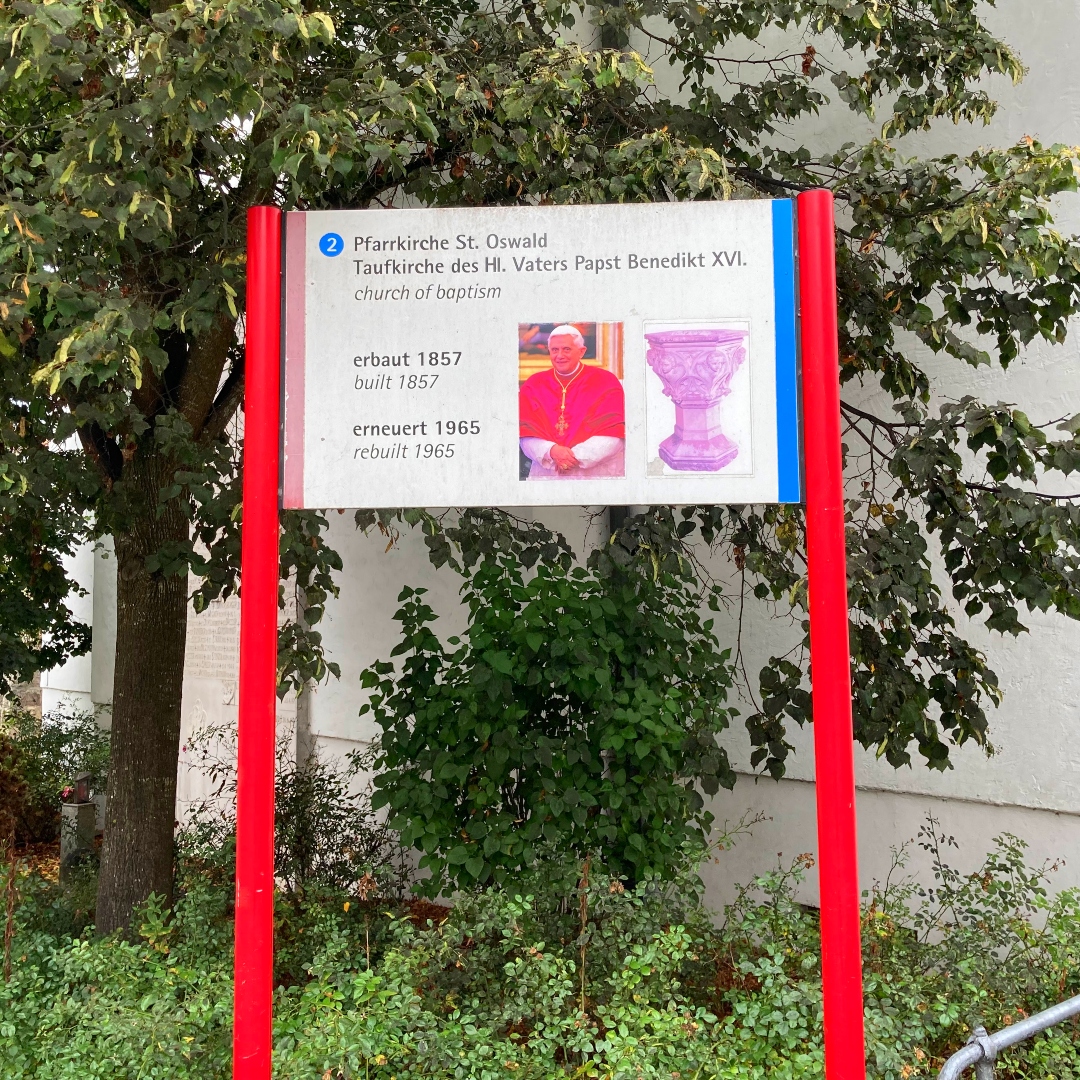
Sign outside St. Oswald Church, Marktl am Inn, Germany: Baptismal Church of Pope Benedict XVI


This is where it all began, the overflowing well, the place where his cup of love was first filled.

I hoped I might find some answers to how a sensitive child and brilliant adult lived through so many decades of ministering to the same human frailties; and through so much social change. How did he preserve his deep faith in God’s love, and his radiant transmission of that love, throughout his entire lifetime?

How did he accept the murder of his cousin with Down’s syndrome, by the Third Reich? How did a sensitive teenager who was already deeply aware of his vocation live through repeated encounters with Nazi evil—beginning with his first, but not last, conscription into their military forces at the tender age of 14?

On the left wall of Saint Oswald’s church, as one enters the tiny entryway, is hung a glass case clad in steel. It displays new parish “arrivals” for the current month, baby pictures of the infants most recently baptized into the parish. On the right wall hangs a sturdy matching case that features funeral program photos of recent “departures.”

Joseph Ratzinger’s own last words complete the circle: “Jesus, I love you.”

May perpetual light shine upon His Holiness Pope Benedict XVI, and may his lifelong lessons about the healing power of love continue to enlighten our troubled world.


null

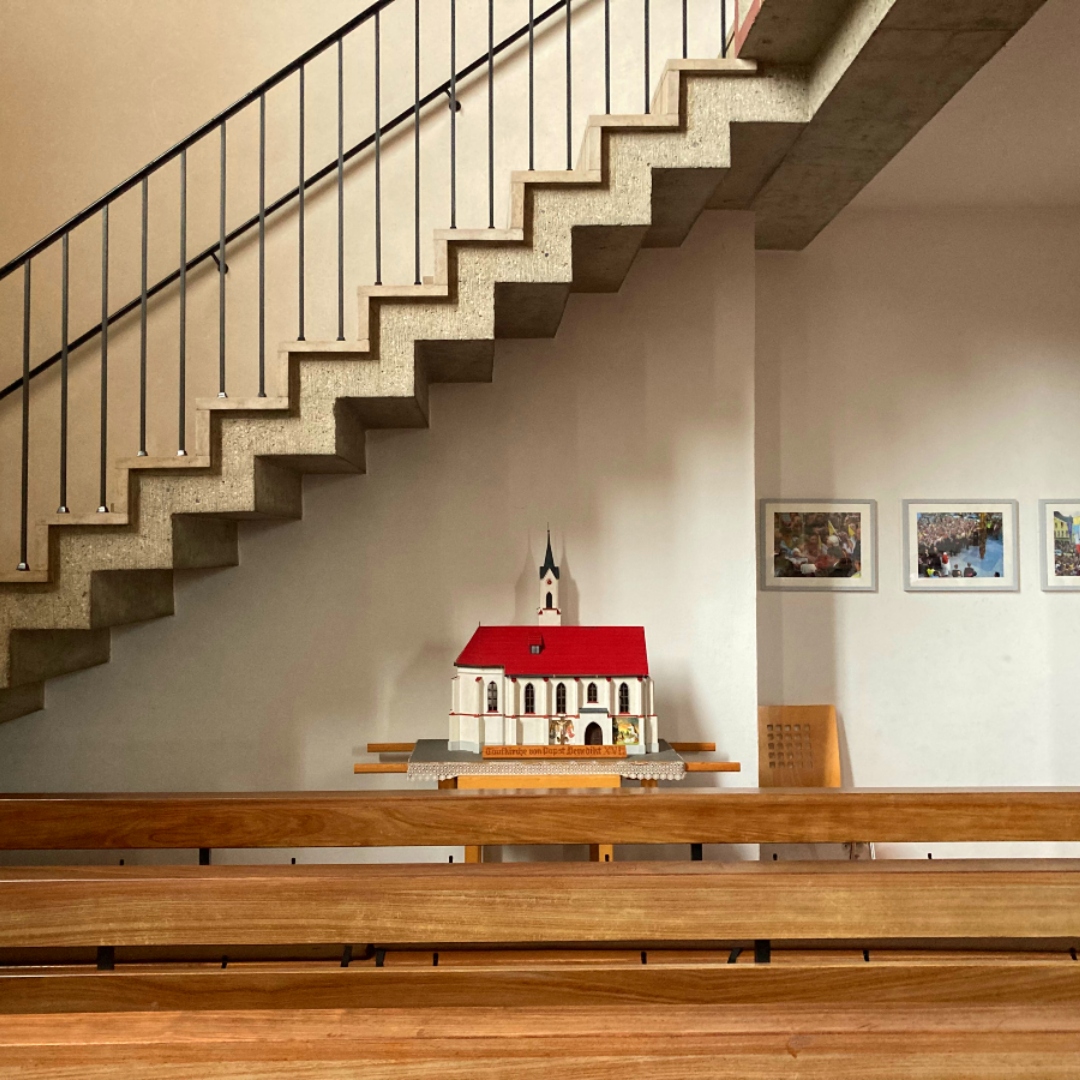
Scale model of St. Oswald Church, inside the church, Marktl am Inn, Germany: Baptismal Church of Pope Benedict XVI


Copyright 2023 Margaret Zacharias
Photos copyright 2022 Margaret Zacharias, all rights reserved.

Who Are the “Scribes and Pharisees?”

Who Are the “Scribes and Pharisees?”

By the grace of God, I was able to travel to Germany and attend the 2022 Oberammergau Passion Play. I learned why most people blessed with this opportunity can afterwards only murmur, “It was a privilege.”

The experience was truly beyond words. Try, for example, to describe what you feel at the moment of Eucharistic consecration?

But there are a few insights that I think I can articulate. I’ll pass over the incredible chill of an outdoor theater high in the Alps. I won’t waste words to confirm that every villager in Oberammergau, from babes in arms to tottering elders, has indeed been focused on this reenactment of the Passion of Christ, as their personal act of worship, for the past 388 years.

It was like stepping into a time travel machine. In the audience, we felt almost a part of the action, 2,000 years ago on the surging streets of Jerusalem.

But who were “the scribes and the pharisees?”

When we hear this phrase read from scripture at mass, it’s all too easy to think, “Jesus, good. Scribes and pharisees, bad.”

At the 2022 performance, these gentlemen were portrayed as dignified representatives of an ancient religious tradition, caught in an impossible trap by politics of the Roman Empire.

Yes, a few simply dismissed Jesus’ words. But many tried to listen and understand. They stood in groups gathered all across the stage, discussing the new ideas with one another, getting angry, shrugging, stomping away, and returning to debate some more. I couldn’t help but feel that’s really the way it must have been.

Jesus was a 33-year-old man, trying to articulate a new revelation in human language. The scribes and pharisees, who were attempting to take it in, did not share one understanding, nor were they of one mind about what they should do.

The brilliant actor who portrayed Jesus also found the fine edge. I was fully aware of him as our Divine Savior, and that he knew exactly what the consequences of his words and actions would be. But he was also a young man debating theology with his elders in exactly the tempestuous manner that impassioned young human adults tend to use. As our faith teaches us, he was God and human, at the same time in one person.

We live in an era when we are called to raise our consciousness about the different ways we assign people into categories, and then speak as though a category label describes every individual.

This was my third trip to the country of Germany. I’ve admired their religious monuments in cities, villages, and fields; prayed with the people at mass; felt awe and wonder at their abiding faith. That faith has sustained generation after generation of German Catholics through all that they have endured.

We speak too easily in North America about “Germans” as synonymous with “Nazis.”

What if fate had placed you in 20th century Germany, to live the most important stages of your life through two world wars, and under the sway of the Third Reich? How would you have faced the moral challenges? What destiny would you have chosen within a fate you could not escape?

We’ve forgotten that Adolph Hitler hated Catholics as much as he hated the Jewish people; forgotten the martyrs who died terrible deaths to defend their vision of Germany.

Contemporary literary fiction is replete with tales of Nazi-resistance movements in France, England, Denmark, Italy, and Holland.

But the full depth and breadth of Nazi-resistance movements within Germany itself – encompassing laborers, mothers, altar boys, laundresses, aristocrats, Protestant clergy, Catholic priests, members of religious orders, and even rebel German Air Force officers — have been brought forward only in the 21st century.

On this first Saturday of November, I offer a short list of good books about the German resistance to the Third Reich.

  • Von Moltke, Helmuth and Freya, translated by Shelley Frisch, Last Letters: The Prison Correspondence, September 1944-January 1945, New York: New York Review of Books, 2019; Editors’ Introduction copyright 2019 by Helmuth Caspar von Moltke, Dorothea von Moltke, and Johannes von Moltke.
  • Utrecht, Daniel of the Oratory, The Lion of Munster: The Bishop Who Roared Against Hitler, Charlotte, N.C.: Tan Books, 2016.
  • Riebling, Mark, Church of Spies: The Pope’s Secret War Against Hitler, New York: Basic Books, 2015.
  • Zeller, Guillaume, translated by Michael J. Miller, The Priest Barracks: Dachau, 1938-1945,San Francisco: Ignatius Press, 2015
  • Rychlak, Ronald J., Hitler, the War, and the Pope, Huntington, IN: Our Sunday Visitor Publishing Division, 2010.
  • Rabbi David G. Dalin, The Myth of Hitler’s Pope: How Pope Pius XII Rescued Jews from the Nazis, Washington, D.C.: Regnery Press, 2005.
  • Lapomarda, Vincent A., The Jesuits and the Third Reich, Second Edition, Lampeter, Ceredigion, Wales, United Kingdom: The Edwin Mellen Press, Ltd, 2005.
  • Anonymous, The Persecution of the Catholic Church in the Third Reich: Facts and Documents, Gretna, LA: Pelican Publishing Company, 2003.
  • Coady, Mary Frances, With Bound Hands, A Jesuit in Nazi Germany: The Life and Prison Letters of Alfred Delp, Chicago: Loyola Press, 2003.
  • Goldmann, O.F.M., Gereon Karl, The Shadow of His Wings, translated by Benedict Leutenegger, San Francisco: Ignatius Press, 2000.
  • Koerbling, Anton, Father Rupert Mayer: Modern Priest and Witness for Christ, Munich, Germany: Schnell & Steiner, 1950.

Copyright 2022 by Margaret Zacharias

The Passion of Christ

The Passion of Christ

These days the media seems to besiege us with headlines about the next terrible plague. Whether it’s the latest Covid variant or a new, horrible pox, it’s challenging not to become anxious. We shudder, and continue to pray that we and our families will be spared.

Imagine living in the seventeenth century Alps. Already ravaged by the Thirty Years’ War, Bavarian villagers learn that the Black Plague has come to town, in the person of a foreign peddler. They know that this frightening new disease has killed entire populations throughout the region. What will they do?

In 1633, the citizens of the Catholic village of Oberammergau, Germany, made a communal promise to God. If he saw fit to spare their town, if no one in the village died of the plague over the next twelve months, they would perform a play about the passion of Christ every tenth year, in perpetuity.

The first Oberammergau Passion Play to fulfill that offering was staged in 1634. Their promise has been faithfully kept for almost 400 years. (For more information, visit www.passionsspiele-oberammergau.de/en/home.)

Both the script and the methods of performance have evolved over the centuries. But even today, the play is still performed in its historical style of tableau. It is presented in two parts, each two-and-a-half hours long, with a break for dinner in between.

Every actor must have been born in the village, and nearly every native citizen is included somewhere in the ensemble of players.

In 2019, I watched a video of the casting ceremony for the 2020, now 2022, performances.

With an altar server carrying the crucifix before him, the parish pastor processed out of his church into the village square. The entire platz was filled with townspeople. Gathered to hear him announce the names of the persons chosen to portray the most illustrious characters, they maintained absolute silence.

The priest stopped next to the village school teacher; a young woman attired in an impeccably-pressed shirtwaist dress.  She was poised at a large blackboard, already prepared with the names of the major characters, to write the names. An alternate was also chosen for each role, in order to sustain the lengthy performance season, five days a week from May to October.

As the teacher carefully inscribed each name in exquisite handwriting, no cheers or congratulations marred the solemnity of the occasion. Only a few murmurs of satisfaction, or mild disappointment, could be heard on the film.

I’m still hoping and praying to attend the 2022 Passion Play this September.

In 2018, when my travel companion and I first began to consider our mutual bucket list trip, we were both in perfect health. Then the originally scheduled 2020 event was postponed to 2022 because of the world-wide Covid-19 pandemic.

Recently, just as our long-awaited dreams seemed about to become reality, my travel companion sustained injuries in a bicycle accident. The same week in July, I sprained an ankle.

As I walked down the hall of my apartment building a couple of nights ago, I ran into a friend who is over ninety years old. She was working out a pain in her hip at the same time I was exercising my sprained ankle.

She said, “I’ll give you my Oberammergau jacket.”

I looked at her tiny frame, then at my own considerably more substantial one, and said, “Thank you so much. But I don’t think it will fit me.”

She told me that she had attended the Oberammergau Passion Play in her younger years. After we conversed with awe about the endurance of this Bavarian tradition, she shared a parting thought about her own pilgrimage.

“I always think of that time as a special privilege.”

Both of my friends regularly take advantage of the opportunities offered to us all as Catholics, to attend mass and to be active serving neighbors in urban villages that can operate like small towns.

As I reflected on her words, I heard a message from the Holy Spirit.

At every mass, in every liturgical season, we have motivation to gather as a living community, just as the townspeople do in alpine villages like Oberammergau. We have daily chances to meditate on the passion of Christ at every mass.

It’s because the people of Oberammergau do these things that they have been able to keep a four-century-old promise, generation after generation.

It really doesn’t matter if health challenges, personal finances, family responsibilities, or the world situation allow us to travel to Jerusalem or Oberammergau – or not.

Christ’s loving offering of his passion for our salvation is eternal.

He comes to us every day, on every altar, wherever and whenever the eucharist is celebrated.

How blessed we are, indeed, by that special privilege.


Copyright 2022 by Margaret Zacharias 

The Strange Paradox of COVID-19: Saving the lonely by making them lonelier

I have learned that loneliness has no boundaries. It reaches out for everyone and captures many of the unsuspecting, including the seemingly happy, satisfied, and successful. Yes, loneliness is capable of dragging the lonely into a world of hidden misery and often depression. It can attack anyone at any time, and it has become a social condition of almost epidemic proportions.

I have been widowed twice and know full well how loneliness can occupy a unique place in the widowed equation. Loneliness also reaches out and captures those who may have lost a child, a parent, a sibling, or even a dear friend. I carry the loneliness package from all of those.

Suddenly, loneliness has been gifted with a new victim to feast on: It can now extend its ravenous appetite into the pandemic known as COVID-19, AKA the coronavirus.  Loneliness is about to ravage the senior citizen in ways never imagined. One way will be to take away their chairs and sofas.

I have been bringing Holy Communion to the homebound on Sundays for over twenty years. It may be the most uplifting thing I do, and I know I have been spiritually rewarded many times over. One Sunday in early March, I confronted a new wrinkle in my visits. Virginia (age 98) resides in an independent living apartment. It is a reasonably long walk from the parking lot to the building entrance. Once there, you use a keypad to gain access. I scroll to Virginia’s name and get her on the speaker. She buzzes me in.

As the sliding doors open, I stop short. No one is there. Every Sunday, there are four or five, maybe six, people in the lobby sitting around chatting and just visiting with each other. They know my name, and I always get a friendly welcome from them. We exchange a few pleasantries (I usually joke about something), and then I go on my way.

But this Sunday no one is there. I just stood there because it took me a few seconds to realize that no one was there because the furniture was gone. The lobby was empty. There was no sofa, or chairs, or coffee table. They had been removed, and there was no place to sit and talk. This was done courtesy of the management “protecting” the residents against COVID-19 or coronavirus. We must keep the elderly SAFE. No problem; just keep them in their rooms — ALONE.

The situation impacted me deeply. I have been visiting the sick and homebound for a long time, and they do not ask for much. However, in their low-profile, quiet world, they look forward to sitting together (if possible) and just talking about whatever it is they talk about. My visit is a big deal for them. I see each of my folks for about ten minutes each, sometimes a bit longer.

I may be the only visitor they see all week. Yet my visit buoys them up for my next visit which is a week away. The folks who gather in the lobby every week are non-Catholic and do not receive. But I do get to say a short prayer with them, and they like my doing it. So do I.

But now, on that Sunday morning in March of the year 2020, it seems things had changed in a way no one could have ever imagined. The powers that be want us to be alone. They want us to avoid each other, not touch each other, and become individual entities. But we are social beings, and like it or not, we need each other. We need to touch and hold and shake hands and hug, especially among family and friends.

Nursing homes all over the country have been placed on “lockdown.” Patients in these places will be relegated to their beds. Family and friends will not be allowed to visit them. Independent living apartments will have empty lobbies and courtyards. There will be no place for the tenants to sit and congregate.

Will our country and maybe the world soon have billions of separate individuals with no one to talk to or visit with? It is such a strange paradox: saving the lonely by making them lonelier than they already are.

We had all better pray like we never prayed before that this coronavirus is vanquished quickly. We cannot live this way for very long.

Copyright©Larry Peterson 2020

Roe v Wade: 46 years later, hurting baby turtles is illegal but, in America, killing baby people is a “guaranteed right”

Sea turtles are protected by Florida’s Endangered and Threatened Species Act of 1977. They are also protected by federal law which prohibits disturbing sea turtles while they are “nesting” (AKA: unborn). The Marine Turtle Protection Act states that “no person may take, possess, disturb, mutilate, destroy, cause to be destroyed, sell, offer for sale, transfer, molest or harass any marine sea turtle or its nests or eggs at any times.”

Yes, we sure love our turtles, especially here in Florida where they nest around the entire peninsula. In fact, we love them so much we have penalties for “disturbing” them. A first offense could cost a person up to 60 days in jail and a $100-$500 fine. A second charge could put you in the slammer for six months with a punishment of $1000. After that, the penalties continue to increase with each additional offense. Federal penalties include jail time and fines up to $15,000 for each offense.

Naturally, we do need laws to protect our wildlife and our environment. But what about “Baby People?” Don’t they count? Why is it perfectly “legal” to kill Baby People who have not been born and you can go to jail for harming or disturbing a baby turtle that has not been born? Does that make sense?

The Loggerhead Sea Turtle is one of these protected turtles. Like Baby People, it can be found all over the world. However, its primary habitat is the Florida coast and the coastline as far north as Virginia. It is estimated that these turtles build 67,000 nests a year along the beaches. The female lays her eggs in the sand and buries them. After two months they hatch, crawl to the sea and begin their lives. Those that survive will live close to 60 years.

It is illegal to harm, harass, or kill any sea turtles, their eggs, or hatchlings. It is also illegal to import, sell, or transport turtles or their products. It is perfectly legal to kill Baby People who have not been born. Since Roe v. Wade was passed in 1973, over 61,000,000 abortions have been performed in the United States. Sixty-one million baby people have been vanquished from existence, many of them burned alive via the saline abortion method. That extrapolates out to, on average since 1973, 1,326,086 Baby People a year killed in America.

In 2017 there were 3.86 million births in the United States. That means that approximately one out of every four pregnancies in our country results in a life extinguished. Sea turtles are given every chance to survive, with the government going so far as to put people in prison who might interfere with their survival. On the other hand, Baby People are welcomed into legalized and sweetly painted extermination camps and, unmercifully and without fanfare or emotion, eradicated.

Whatever are we doing? We civilized people have allowed a portion of our past to be destroyed. We are allowing our present to be vilified by what can only be called a great lie fabricated as the virtue of “helping” women. We have short-circuited the future of our children and grandchildren. We have taken away from them the possibility of another Rembrandt, another Mozart, another Jonas Salk, another Martin Luther King Jr. or even another Abraham Lincoln living among them.

Most of all, we have taken away the meaning of the beauty and wonder of human life. We have changed it from a wondrous mystery, given to us by God our Creator. Instead, we have turned it into a disposable commodity that can be discarded at will under the guise of “reproductive rights.” Does not “reproductive rights” mean having the freedom to reproduce — not to destroy? Un-reproducing leaves only one result; that result is death.

There is a world-wide abortion counter that ticks off the abortions around the world as they happen. Look for yourself. More than one life a second is being aborted. Genocide of the innocent, living in and out of the womb, is rampant on planet Earth. Whatever have we wrought?

As the great St. John Paul II said, “A nation that kills its own children is a nation without hope.”

©Larry Peterson 2019

The Betrothal of the Blessed Virgin Mary to St. Joseph is tied to the Protection of the Unborn Children, Marriage and Family

January 22 is the day the Catholic Church in America sets aside all else and joins in prayer for the Legal Protection of Unborn Children. Traditionally, in the pre-1955 Church calendar, this day was set aside to honor the Betrothal of the Blessed Virgin Mary to St. Joseph. Today, the Mass for this feast is still celebrated by some religious orders using the Latin rite.

This is such a beautiful thing for the Church to do. By simultaneously joining together the Day of Prayer for the Unborn with Roe v. Wade and the Betrothal of Our Lady, it heralds the beauty of motherhood, and it trumpets the profound, spiritual importance of marriage and family.

When Mary was engaged to Joseph, before their marriage, she was discovered to be pregnant—by the Holy Spirit. Joseph, her husband, since he was a righteous man, yet unwilling to expose her to shame, decided to divorce her quietly.” (Matthew 1:18)

“Behold, the virgin shall be with child and bear a son, and they shall name Him Emmanuel.” (Matthew 1:23)

In the Old Testament days, Jewish marriages happened in stages. First came the betrothal. At this ceremony, the couple gave their consent. They were now considered truly married. However, before they would actually move in together as a husband and wife, there was a period of time where they spent time away from each other. This could be up to a year, and it was during this separation that the “newlyweds” were to learn from older married couples how to be good Jewish spouses.

In his 1989 Apostolic Exhortation, Redemptoris Custos, Pope John Paul II used the following words to describe the marriage ceremony of the Virgin Mary and St. Joseph: According to Jewish custom, marriage took place in two stages: first, the legal, or true marriage was celebrated, and then, only after a certain period of time, the husband brought the wife into his house. Thus, before he lived with Mary, Joseph was already her husband.”

When God does things, He sure is meticulous. Mary and Joseph were, according to the law, married. There are those who say that Jesus was born out of wedlock. If the betrothal had not taken place, that might be accurate. But under the law, they were married. There are some would have you believe that Mary was no different than an unwed mother. This is false. The Blessed Mother was a married woman at the time of the Annunciation. She even asked the Angel Gabriel, “How can this be since I know not man?” She is told it will be by the Holy Spirit. The Angel also informs Joseph. Therefore, within the Holy Family, the sanctity of marriage and family is fully protected.

Since the Roe v. Wade and Doe v.Bolton decisions on January 22, 1973, more than 60,000,000 lives have been eradicated. The number is incomprehensible. Yet there are so many who justify this by using the rare examples of teenage rape or incest, Down Syndrome, deformities, lack of finances, and so on. We could also say the Blessed Virgin Mary’s pregnancy was abnormal or irregular. After all, Jesus was conceived by the Holy Spirit. Jesus’ total DNA comes from a woman. Biologically, Jesus is not the son of Joseph, the Nazarene carpenter. But this man define’s fatherhood, and his example screams out to all men: Love and protect the child and his/her mom, no matter what. Be loyal and true. Give them your name if you must.

Fittingly, on the 45th anniversary of the two most ignominious Supreme Court decisions ever handed down, as we pray for the protection of the unborn, we can look to the marriage of Joseph and Mary, a marriage established by God and made perfect by His Son.

It is hard to even imagine a better husband or father than a simple carpenter named Joseph. He is an example for all mankind.

We ask the Most Holy Family to pray for all the unborn and children everywhere.

Copyright 2018 Larry Peterson