Giving Back to the Giver

Giving Back to the Giver

We tend to think of our lives as entirely our own, to do with completely as we please, but they’re not. Our lives are a total gift from God, given to us out of God’s love for us, out of God’s desire to share his life with us. “Already to exist is a work of love!”[1] The fact that you’re here, that you’re alive, is, in itself, a sign of God’s love for you. You didn’t have to exist; innumerable others could have existed in your place. But God chose you. God chose to give you the gift of life, to offer you a share in the divine life. God chose you for a unique place within the Body of Christ. God chose you for a unique mission of love within the Body of Christ, a mission that no one else can fulfill.

Surrendering your life to God is then, in reality, merely offering back to God, in gratitude, the gift that you have already been given. Surrendering your life to God is an acknowledgment of that gift, and an offer to allow God to use your life in whatever way God wills for the good of the rest of the Body of Christ. To surrender your life to God is to offer yourself as a channel, a conduit, for the divine love.

Surrendering your life and your heart to God can begin right now, today, with a simple prayer. Maybe something like the following, or something similar, expressed in your own words:

Thank you, Lord, for the gift of my life. I give my life back to you in love and gratitude for that gift. Do with my life as you will. Use me as your instrument in the world. Help me to see and fulfill the mission of love you have planned for me.

Learning to completely surrender our lives and our hearts to God is actually a lifelong process. We may sometimes feel the gravitational pull of our egos, seeking to draw us back into our old self-centered ways, away from God and our mission of love. That’s why it’s good to pray some version of this prayer of surrender on a regular basis: as a repeated expression of our love for God, as an ongoing request for God’s guidance and grace, and as a reminder to ourselves of the commitment that we have made to God and to our God-given mission.

[1] Hans Urs von Balthasar, Heart of the World. Translated by Erasmo S. Leiva. San Francisco: Ignatius, 1979, 26-27.

* This article is an excerpt from Rick’s latest book, The Book of Love: Brief Meditations (https://www.amazon.com/dp/B0BVSXX6P9/)

Photo by Priscilla Du Preez on Unsplash

Copyright 2023 Rick Clements

Cath-Lit Live: Single Truth by Annie Harton

Cath-Lit Live: Single Truth by Annie Harton


“Cath-Lit Live!” features brief interviews with Catholic authors who are releasing new books. Hosted by Catholic author and speaker Amy J. Cattapan, “Cath-Lit Live!” gives viewers a glimpse into the latest Catholic books while getting to know a bit about the author as well.

null


Single Truth: You Are More Than Your Relationship Status by Annie Harton

Single Truth is written from the heart of a marriage counselor who shares her story of longing, heartache, and adventure as a single woman in her 30’s. Two years following an excruciating breakup with her first love, she committed to a year-long dating fast to dive deeper into her personal relationship with God, confront her deepest fears, and learn to embrace her season of singleness.

This book will help you to:

  • Experience a love that is free, faithful, and fruitful
  • Discover your true identity in Christ
  • Accept the gift of the present moment

Annie Harton provides a refreshing perspective on singleness as she integrates her personal experience with her background in theology and psychology. She learned the hard way to not let her relationship status define her. Join her on a journey of getting unstuck and thriving in the tension of “ready—but not yet.”


null

About the author:

Annie Harton is a proud alumna of Saint Mary’s College and the University of Notre Dame. She is a licensed marriage and family therapist, author, and speaker. Her book Single Truth inspired her to start a business called You Are More. She specializes in helping singles and couples explore how they’re more than their diagnoses, their pasts, their jobs, and their relationship statuses; while also reminding them that God is more than any problem they bring Him.


You can catch “Cath-Lit Live” live on A.J. Cattapan’s author Facebook page. Recorded versions of the show will also be available to watch later on her YouTube channel and Instagram.


null


Copyright 2023 Amy J. Cattapan
Banner image via Pexels

Should I Continue On as A Writer?

 Should I Continue On as A Writer?

It’s very tempting to quit the writing business. If some of your books are not selling very well, whether they are traditionally published or self-published, it could affect your attitude. I saw an episode a couple of nights ago of the well-known television series The Waltons that focused on this topic.

John Boy (the main character) was a writer. He wrote a novel about World War 2. He mailed his manuscript to his editor, who lived in New York. A few weeks later, John Boy traveled to New York. He discovered his novel had been rejected because it was very similar to the other books selling on the market.

The editor advised John Boy to write something new. John Boy got really

upset about the rejection. He had hoped his book would be accepted because he needed money to support himself. His attitude affected not only himself but his work, family, and friends. He admitted to his editor that he wanted to quit the writing business.

Did he quit? Well, you will have to watch the episode and find out! My point is that it’s normal for any writer to have writer’s block or to feel down about their work. Even the most experienced writer will have moments when their story is not going very well or it is not getting the approval from readers that they were hoping for.

One writer said on his website that he reads not just the positive reviews of his work but also the negative reviews. Why is he doing this? He wants to learn from his mistakes and make the next book better.

Writing is not an easy career. Most new writers assume that they will become famous overnight. Wrong! One thing that bothers me is that some movies and television shows often show new writers as instant successes.

They make the audience believe that editors always accept new writers on the spot. It’s true that they do sometimes accept new writers, especially if a new story fits their guidelines and message that they want to pass down to future readers.

So don’t be discouraged if your book is not selling well. And most important of all, don’t compare yourself to other writers! Each writer has his or her own unique gifts and qualities.

Keep on writing! Don’t let your book get you down! Put your trust in the Lord; he will take care of you.

Copyright 2023 Angela Lano

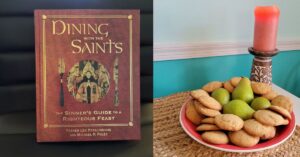
Book Review: Dining with the Saints: The Sinner’s Guide to a Righteous Feast

Review: Dining with the Saints:

The Sinner’s Guide to a Righteous Feast

Viewers of the long-running tv drama, Blue Bloods, have created a popular culture undercurrent of anticipation for the program’s Sunday supper scenes. In it, four generations of Reagans, New York-based Irish American Catholics dedicated to law and service, gather to pray, argue, commiserate, laugh, and reminisce over a family-prepared meal. There, they remind one another from whence and whom they came and where they are going. The elders, Gramps and Dad, preside from each end of the dining table like two Solomons, maintaining order and reason. Regardless of the strife and animosity that may have come between siblings or parent and child during the week, they now sit for a meal among kin. All ages participate in an unspoken understanding that the place is sacred and together they join in a reverent act.

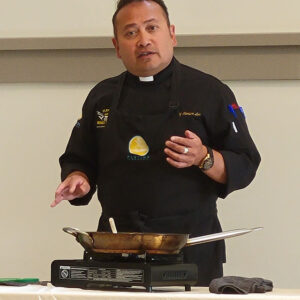
What the fictional Reagans play out exemplifies “theology of food,” the concept behind Fr. Leo Patalinghug’s ministry, Plating Grace. In Dining with the Saints: The Sinner’s Guide to a Righteous Feast, he and co-author, Michael P. Foley, help diners create their own family altar and a feast for the body, mind, and spirit that recalls Psalm 34:8: “O taste and see that the Lord is good.” Countless studies have documented increased depression, loneliness, and poor health habits in this country. We are paying for the lack of tradition, family, and faith. Twenty-first century Americans starve not only for nutritious meals but an “encounter experience” with one another. The authors are keenly aware that the canceling of thanking God for His gifts and sacrifices, for which we hunger, and asking Him to bless our meals before digging in leaves a void within. “We fear that the loss of the family dinner will also have a bad effect on the very source and summit of our worship (page x).”

More than a cookbook, Dining with the Saints provides a framework upon which folks may fortify their bodies, relationships with one another, and with God. The volume packs ideas for meals, conversation, and prayer in its 353 pages. Most of the 140 recipes, designed by Fr. Leo to be tasty, convenient, and nutritious, require few ingredients and little prep and cook time to afford a nourishing homemade repast.

Father Leo is known for his affability and humor. His experiences include penning the book Saving the Family and Spicing Up Married Life, an EWTN cooking show, and a memorable “beat down” of Bobby Flay on the Food Network, all of which showcase the means and methods by which he evangelizes. His fans will want this latest. This work, however, is just as much Mr. Foley’s. The hardcover’s title, clever cover design, and organization all parallel his other books, Drinking with the Saints: The Sinner’s Guide to a Holy Happy Hour and the smaller Drinking with your Patron Saints: The Sinner’s Guide to Honoring Namesakes and Protectors. The Baylor University professor with expertise in the early church, charmingly and theologically contributes Food for Thought portions and saints and seasons and with the recipes. “Whenever possible, Dining with the Saints presents what a saint actually ate or a piece of advice he or she gave about eating and drinking.” (page x). Mr. Foley’s knowledge of hagiography (the lives of the saints) presents some twists and turns, even for saint devotees.

It’s well known that St. Padre Pio bore the stigmata, but how many could correctly name his favorite vegetable or how it reflects of his personality? Another curiosity is the Chicken Tikka Masala (April 21) that many would assume would be attributed St. Thomas who was “hailed as the apostle of India,” but not so. That honor goes to Italian-born St. Anselm. For our Doubting Thomas, the authors chose a German sweet bread, Saint Thomas’s Kletzenbrot (Dec. 21). Some dishes have rather straightforward names such as Angel Food Cupcakes (Oct. 2, Feast of Guardian Angels), but the intriguing gelatin mold made with fresh raspberries may be lost for the evening’s dessert because it’s called Blancmange (December 29, Feast of the Holy Innocents). Candlemas, also known as the Presentation of Jesus Christ (Feb. 2), offers the ever-delectable Lemon Meringue Pie.

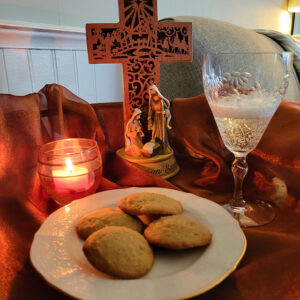
The authors deliver a delightful glimpse into Catholic church past using the 1962 Roman calendar which has more feast days, many unknown to post-Vatican II generations. Even the most catechized Catholic will appreciate discovering some long-forgotten days, such as Drunkard’s Thursday and Quinquagesima Sunday. Part One of the book ties recipe selections with the Feasts of Saints calendar. Part Two addresses the Liturgical Seasons. A five-page reference shows a side-by-side comparison of the “new” date with the traditional. A practical index based on course or main ingredient helps the culinarian find a recipe more quickly. The authors, however, encourage preparing the dishes any time. Enjoy the savory Sausage with Onion Gravy dedicated to Gregory the Great on the “old” date of March 12, the “new” date of September 3, or whenever the occasion fits. St. Gregory’s Food for Thought reminds that “evangelizing requires fellowship with people . . .becoming a part of other people’s lives. . . . Breaking bread together creates a sense of communion . . .” (page 40).  Share it with those close to you and those you want to know. Download some Gregorian chants and enjoy food, fellowship, and God’s blessings upon you.


Copyright 2023 Mary McWilliams
Images and quotes used with permission, copyright 2023, Regency House

ANGELS AND DOWNTURNS

ANGELS AND DOWNTURNS

The sound of anxious footsteps made me jolt awake.  My wife whizzed past the living room couch I had been sleeping on ever since that horrible night, heading into the kitchen. The morning sun peered in through our windows. The sound of coffee pouring into my wife’s mug from the kitchen Keurig machine filled the air, and she appeared back in the living room.

“Since you’re gonna be home today, you’ll have to drop AJ’s medication off at his school,” she whispered curtly.

“Fine,” I muttered.

“Have a good day.”  With that, she blew me a half-hearted kiss and walked out to her car.

I shook my head.  Gosh, is she ever gonna forgive me for losing my job?

After I dropped my son’s medication off with the school nurse, I walked back to my car, and an idea dawned on me. St. Frances de Chantal Roman Catholic Church was nearby.  I hadn’t been to that particular church in a while and wanted to stop in.

It was Lent.  A crown of thorns rested on a table in front of me.  Off to the side, a man was praying the Stations of the Cross. I surveyed the crown of thorns, negative thoughts filling my head. How could I let this happen? Boy, I felt like a failure. How long before I would find another job? As anger swelled within me, I picked up the crown of thorns. Studying it briefly in my hands, I wanted to put it on my head and hurt myself.

“Hey!” the man praying the Stations of the Cross whispered angrily.

I turned to him, and he was now glaring at me.

“Put that crown of thorns down!”

I defensively held my hands up and said, “I’m sorry.  Here.” I replaced the crown of thorns on the table.

The man charged toward me. He was built like a football player. Tattoos covered his meaty arms. “Don’t disrespect my Lord!”

My body trembled. “I wasn’t trying to,” I said, my voice cracking. “Honestly. Please, don’t get crazy.”

“I’m not crazy!” he argued.

“Okay,” I said, pivoting on my heel, “I’ll leave now.”

I started toward the exit. So much for quiet reflection in a different church.

“Wait!”

I paused and turned toward the man.

“I’m sorry,” he pleaded, his face now displaying a contrite smile.  “I didn’t mean to get like that. I have an aggressive personality sometimes. I’m just very protective when it comes to God. Can you forgive me?”

 “Of course,” I said, my awkwardness melting away. “And I wasn’t gonna walk out with that crown of thorns. Honestly. Can you forgive me?

The man chuckled.  “I just did.  Can I just ask what you were doing, though?”

I mentioned my job loss, the anger I felt toward myself, the impulse to inflict bodily harm on myself.

“Do you wanna talk?” he asked, compassion in his eyes.

“Sure.  I’m Jeff, by the way.”

“I’m Justin.”

We shook hands and sat in one of the pews.

At first, we engaged in small talk. About my former career in the financial industry. About his twenty years with the New York City Fire Department. About my children’s autism. About his grown daughters and toddler grandsons. Then Justin revealed that he was a full-time demonologist. It was ironic how he had made a living putting out physical fires. Now he was putting out spiritual ones!

Our conversation progressed to a deeper level.  For the next ninety minutes, Justin shared details with me about God. About Jesus. About the Blessed Mother. Even about angels. And the devil. In fact, one of his tattoos was of Our Lady of Fatima. It was a wonder how such a macho man could have such a soft spot for the Virgin Mary. That intrigued me, but I was more impressed with the knowledge he bestowed on me. He revealed that when Peter denied Jesus three times, he was denying each of the Three Persons in the One God. He mentioned that when we die, Jesus will judge us from the Cross. He discussed the differences between Novus Ordo and the pre-Vatican II Latin Mass. And several other things, too.

As Justin talked, I appreciated that he forgave me enough to want to give me all this knowledge about our faith. He even encouraged me to consider my job loss a cross to carry during this Lenten season.

After our conversation, Justin walked me out, a bigger smile on his face this time. He grabbed me in a bear hug, and we went our separate ways.

For months after that chance encounter, I considered myself lucky. Had I still been at that miserable job getting screamed at by that tyrannical lady, I would not have dropped my son’s medication off and then stopped into that church. That conversation with Justin would never have taken place, and I would not have made a new friend.

Justin had been my angel that day, and in addition to everything that I learned from him, I realized that I needed to ignore the misconception that all angels are feminine and gentle. I learned that they can also be rough around the edges at times. But whether they are soft and delicate or rough and challenging, all angels serve the same purpose – to bring us closer to God.


©Copyright by Michael C. Vassallo

Image by lbrownstone from Pixabay

Hand It Over

Hand It Over

To give the gift of self to God in love is to entrust our lives to God, to hand our lives completely over to God. Unfortunately, many of us find this to be rather difficult to do. If God has given us the gift of himself, the gift of his heart, in Jesus Christ, why are we so reluctant to respond with our own gift of self in return? There can, of course, be many reasons, but one of the main reasons is control. We want to be in control of our lives. But to give the gift of self in love requires that we give up some of that control. In fact, we have to be willing to surrender ourselves to the beloved.

Admittedly, the concept of “surrender” often carries with it some negative connotations—connotations like defeat, failure, weakness, etc. But nothing could be further from the truth when it comes to “surrender” in the context of love. Loving self-surrender is a sign of strength, not weakness. Loving self-surrender is actually the ultimate exercise of one’s power over one’s own life. Which requires more strength: to cling to one’s ego throughout a life lived in the self-centered pursuit of pleasure, power, status, etc., or to give one’s self away in love? As André Gide once observed, “Complete possession is proved only by giving. All you are unable to give possesses you.” To cling to one’s self is to be enslaved to the self, to be at the mercy of the self’s whims and desires, to be imprisoned within the walls of one’s ego. In contrast, to give one’s self away in love is, paradoxically, to be in full possession of one’s self, breaking out of the dungeon of the ego and into the infinite spaces of the divine love.

Still, the prospect of giving oneself away in love to another, even to God (and for some of us, especially to God), can be frightening for many of us. What would God do with my heart? What would God demand of me? What would my life be like if I handed myself over to God?

Well, in a word…better. Surrendering your heart to God makes your life better because surrendering your heart to God aligns you with the purpose for which you were made. You were made for union with God and your fellow human beings. You were made to share in the divine life of love forever. But to be able to flow within the Body of Christ, you have to be willing to let go of some control over your life. You have to be willing to let go and love. You have to be willing to hand your life over to God.

Copyright 2023 Rick Clements

* This article is an excerpt from Rick’s latest book, The Book of Love: Brief Meditations

Photo by Jon Tyson on Unsplash

Cath-Lit Live: Becoming Wife by Rachel Bulman

Cath-Lit Live: Becoming Wife by Rachel Bulman

“Cath-Lit Live!” features brief interviews with Catholic authors who are releasing new books. Hosted by Catholic author and speaker Amy J. Cattapan, “Cath-Lit Live!” gives viewers a glimpse into the latest Catholic books while getting to know a bit about the author as well.


Becoming Wife: Saying Yes to More Than the Dress by Rachel Bulman

Whether you are preparing to be or are already a wife, you likely are immersed in the external reality of marriage. But being wife is so much more: It’s a call to holiness and a vocation of incredible significance. Becoming Wife explores what it means for a woman to fulfill this vocation. Catholic wife, mother, speaker, and author Rachel Bulman shares – like a friend over a cup of coffee – how being a wife is at once a calling and a purpose. The more a wife makes herself a gift to her husband, to her children, and to the world, the more she inevitably becomes the person God created her to be. She becomes more wife, more woman, more Christian. Thus, she fulfills her identity as a daughter of God and cultivates the soil from which her motherhood comes to fruition. By exploring the life of the Blessed Mother and the guidance of great minds in the Church, like Saint John Paul II and Saint Teresa Benedicta of the Cross, this book unwraps the gift of becoming a wife and what it means to make a “total gift” of oneself through matrimony. 


null


About the author: Rachel Bulman is a lover of humanity, especially her husband and six children. A national speaker and author, she also appears with her family in the show Meet the Bulmans, currently airing on the Word on Fire Institute’s YouTube channel. She serves on the advisory board of The GIVEN Institute and frequently gives talks at retreats, conferences, and other gatherings. In her spare time, she enjoys reading a good book, lifting weights, and perfecting her Old Fashioned cocktail recipe. 


You can catch “Cath-Lit Live” live on A.J. Cattapan’s author Facebook page. Recorded versions of the show will also be available to watch later on her YouTube channel and Instagram.


null


Copyright 2023 Amy J. Cattapan
Banner image via Pexels

Learning a New Language

Learning a New Language

Do you want to learn a new language?

Learning a new language can be a lot of fun. You can learn new words, phrases, and sentences. You can challenge yourself each day by setting up little routines in your daily schedule to help you in your language learning process.

Use flashcards

Flashcards can be a way for someone to learn a new language. Writing down a word or a sentence on a blank sheet of paper reinforces the pronunciation to come alive in your mind. If you mess up one time on the flashcard, don’t worry. Rewrite the word over again on another small piece of paper.

Say the word out loud

Saying the word out loud also helps your brain to think more about pronunciation. If a word or sentence seems difficult to you at the time, put it away in a separate pile for a while. Come back to it later when you want to try again.

Find a website

There are many language learning websites out there. Some of them have really good monthly prices. Pick a website that is within your budget.

Don’t overwhelm yourself

It’s tempting for people to go back and forth between two or three languages at once. Don’t do this! I made this mistake when I was getting started with learning a new language.

Pick a language that you really want to learn. Don’t pick one just because a friend or a family member suggested it.

If you are still having trouble deciding what language to learn, pray about it: ask God to give you wisdom about which one interests you the most. If, for some reason, a particular language keeps on coming back to you, like sign language, for example, that could be a sign, you should stick with that language.

Practice makes perfect

Just like we are more likely to stick with a prayer routine if we are consistent with it, the same is true for language learning. Pick a certain time during the day to work on your language skills. For some people, the morning will be best; for others, it might be the evening. Go to another part of the house so that you aren’t disturbing friends or family members.

If you are traveling, try sticking with your little routine. You can say what you know out loud in the car while your spouse or another family member is driving. If you skip a couple of days or a week during your vacation, don’t worry. You can come back to it again after you are done with your trip.

Copyright 2023 Angela Lano

When in Doubt, Keep Leaning Toward God

When in Doubt, Keep Leaning Toward God

A doubting priest is an unlikely envoy of faith.

To show what He can do with faith the size of a mustard seed, God–not karma, nor fate, nor kismet, nor coincidences, nor the cosmos, nor the stars–permitted a series of experiences and events to converge on a late summer day 760 years ago.

A priest, known simply as Peter of Prague, doubted the Real Presence of the Lord in the Holy Eucharist. Aware that his soul was in jeopardy, he sought spiritual counseling and was advised to go on pilgrimage. Venturing from his native Bohemia, his sojourn ended and his encounter began in the breathtaking Tuscan valley town of Bolsena, Italy in St. Christina Chapel. When Fr. Peter uttered the words of Consecration, the host began exuding blood onto his hands. Upset and confused, he had the presence of mind to run to nearby Orvieto where Pope Urban IV lived most of the time.

An unlikely pope, Fr. Jacques Pantaleon was a priest and canon lawyer, who, after three months of contentious voting involving some jealous cardinals, was finally determined to be the successor of Peter as Pope Urban IV (Webster). Before that, he had been dispatched to address both ecclesial and political conflicts and recognized the seriousness of Fr. Peter who rushed to him in distress.

Orvietto Duomo

Whether He chooses a faltering priest from Prague, a young girl from Nazareth, an impulsive fisherman from Galilee, or a weary father from Cyrene, the Lord uses the most unlikely to help us see his most miraculous presence. How unlikely are you?

For Catholics, the Eucharistic miracle happens at each Mass. But some Catholics, for whatever reason, have a difficult time believing, and that is a problem. American Catholics are in the midst of a three-year Eucharistic Revival, planned by the US bishops, which will culminate next year. As a Christ-centered community, we need to uplift our brothers and sisters along this journey to belief.

We all are on a lifelong pilgrimage to the Source and Summit, and we’re all in different places along that road. When we come upon someone thirsting, we are called to be refreshment. I imagine that typically those words of incredulity are uttered not to spiritual directors, priests, or the pope, but more often during conversations in church kitchens as volunteers prepare a parish dinner, in small prayer groups, or over pizza on movie night. You may hear a Catholic say of the Real Presence, “Isn’t it just a symbol?” or “We’re not really expected to believe that!”

How are we to respond? Certainly not with a gasp, condescending disbelief, or placation. Nor should we dismiss it any more than we would shoo away a hungry child for someone else to feed. Rather, we meet the disbelief with understanding and acknowledgment of the problem. Gentle inquiry and an urging to speak of the misgiving in the privacy of the Confessional. Above all, in reassurance and fellowship that Jesus has and still calls the doubtful.

“Come and see,” Philip said to Nathaniel who challenged if anything good could come from Nazareth (cf. John 1:46). A believing disciple enlightened a cynic who came to know and love the Truth.

Our all-knowing, sweet Jesus also chose Thomas the Apostle. Even in his skepticism, Thomas wanted to pull Jesus to him when he demanded to put his finger in the wounds (cf. John 20:24-28). Jesus did not refuse him. He met him in his dubiety.

We know that in his questioning, Peter of Prague didn’t turn away from God in shame. Rather, he moved closer to Him in humility: “I believe; help my unbelief,” cried the father, begging Jesus for deeper devotion so his son could be made clean (cf. Mark 9:24). Fr. Peter wanted to be made clean too, first starting with awareness of his sin. Then he sought help from his spiritual director and took his advice for spiritual examination. When the Blood of Christ dripped from the host onto his hands, Peter ran to his pope. The accounts say that that Pope Urban IV absolved him, so we know he confessed to Jesus, in persona Christi through Pope Urban IV, and repented for his weak faith. Most likely, he prayed without ceasing and kept reaching for Christ.

Jesus said to the naysayers, “Those who eat my flesh and drink my blood have eternal life, and I will raise them up on the last day; for my flesh is true food and my blood is true drink.” (John 6:54-55). With those words, many left Him (cf. John 6:66).

Peter of Prague was different. So was Nathaniel. And Thomas. They voiced their apprehension but continued to advance toward the Light.

He wants us all. Allow him to find you. Let’s help our searching brothers and sisters allow him to find them too.


Copyright 2023 Mary McWilliams

Sources:

Webster, Douglas Raymund. “Pope Urban IV.” The Catholic Encyclopedia. Vol. 15. New York: Robert Appleton Company, 1912. 26 Jul. 2023 <https://www.newadvent.org/cathen/15212a.htm>.

Vogt, Brandon, editor. Word on Fire Bible: The Gospels. Park Riege, IL: Word on Fire Catholic Ministries, 2020.

Orvieto Duomo Image by Avantino Pergetti from Pixabay https://pixabay.com/photos/duomo-orvieto-church-gothic-italy-1368754/

Tuscan Valley Image by Sabine from Pixabay https://pixabay.com/photos/tuscany-city-architecture-travel-3356748/

Retreat and Discernment

Retreat and Discernment

Our gospel reading this weekend reports that “Jesus took Peter, James, and his brother, John, and led them up a high mountain by themselves.” (Matthew 17:1) (1)

Other passages in scripture also demonstrate how our Lord retired into the wilderness, alone or with spiritual companions, as an integral part of his spiritual rhythm. He used these respites to focus on prayer, and to replenish his energies during a demanding physical ministry of teaching, preaching, and healing.

Retreats and spiritual direction offer refreshment for our own lives as Catholics, too. Recently, I participated in a first formal one-day orientation to the teachings of St. Ignatius.

For many years, my primary resource for discernment has been Authenticity: A Biblical Theology of Discernment, written by Thomas Dubay, S.M. (2)

That reading provided a welcome foundation for what I experienced at “Image & Imagination in Prayer,” an Ignatian retreat sponsored by Emmaus House in Urbandale, Iowa on July 22.

Emmaus House was founded in the Diocese of Des Moines by Jesuit priests in 1973, at the invitation of then-Bishop Maurice Dingman. At first, Emmaus House served the diocese by providing spiritual direction and retreats exclusively for Catholic clergy. But it quickly expanded to offer these resources for members of the Catholic lay community as well as some Protestant clergy. (3)

I was intrigued by how original spiritual methods developed by St. Ignatius of Loyola in the 16th century anticipated several techniques employed by archetypal psychologists today.

Swiss physician C. G. Jung, the founder of archetypal psychology, studied Ignatius’ teachings in the early 20th century, and gave a series of lectures about their value in Zurich between 1933 and 1941. English translations of these lectures have been published only recently, in January of 2023.

Both approaches focus on events in ordinary daily life. Both are designed to bring forth the full flowering of human individuality. Both honor the integrity of images and feelings as they emerge from a person’s inner being, and use “active imagination” to help deepen relationship with the unique divine spark alive in each of us.

What Dubay calls outer verifications occurred throughout my one-day introduction to Ignatian method. I crossed paths with dear friends from different parts of the diocese as well as from different eras in my life; and encountered new acquaintances who wandered in my direction for a purpose we discovered together only as we met.

Under leadership of spiritual director Amy Hoover (4), we contemplated a series of readings and questions offered for private prayer and reflection. Then time was provided for optional sharing with individual retreat partners at our tables.

Reported movements of the Holy Spirit permeated the retreat throughout the day. These repeated, meaningful ‘coincidences’ — simultaneous events without any causal relationship — are what Jung called “synchronicities.”

In one humorous example, intending to excuse myself for a trip to the coffee table during a break, I commented to my companion, “I think I need some sugar.”

Snickers bars immediately dropped down from above our heads, right in front of our faces, like manna from heaven.

We both looked up to see the refreshment hostess making rounds with a bag of candy. But how did she manage to arrive at our table — one of more than twenty in a large parish hall — to be there at the exact moment I spoke?

Later, we were asked to write what we noticed about a picture postcard. While I had written about the display of creation — seasonal weather, contrasts in foliage, moss growing on ancient stones — one of my table mates had first noticed that “there’s no human being here.” She had placed herself and her husband taking a walk, right into the picture, as her focus for the scene.

Another companion among us had been seized first by curiosity about the path’s curve into a distance that lay behind bushes and trees. He had written with poetic insight about what might lie unseen around the bend.

Most dioceses in the United States publish a list of trained spiritual directors and local retreat opportunities, often right on their websites. If you haven’t yet experienced these gifts of our faith, it might be worth exploring what resources are available near you.

Scriptural readings for the Memorial of St. Ignatius of Loyola on July 31, and for the Feast of Transfiguration of the Lord on August 6, are rich with vivid images for further contemplation on your own, too.

I pray that each of us can experience a personal transfiguration this August. May we feel the awe and wonder that enlightened Peter, James, and John two thousand years ago, when they witnessed our Lord in earnest conversation with Moses and Elijah on Mount Tabor.

©Copyright 2023 by Margaret King Zacharias

Featured Photo: View frim summit of Mount Tabor ©Copyright 2023 by Margaret King Zacharias 

NOTES:

  1. https://bible.usccb.org/bible/readings/080623.cfm.
  2. San Francisco: Ignatius Press, 1977, originally published by Dimension Books.
  3. https://www.theemmaushouse.org/history.
  4. https://www.theemmaushouse.org/eighth-annual-ignatian-retreat

Stay in the Know

Join Our Newsletter

Members and supporters can get the latest on CWG news and events by signing up for our newsletter.

Please wait...

Thank you for signing up!

Catholic Writers Guild
P.O. Box 77
Eaton, IN 47338