Pilgrim Tales: God of the Unexpected: A Pilgrim’s Romance

There was only one person who could motivate me to do something so ridiculous as to set off for a hike through the mountains before dawn: Jeremy. -“Pilgrim’s Romance”

I fell in love with Bernadette’s story the moment it popped into my head. At 9:00AM. On the morning of the anthology submissions deadline. Yikes!

I’d always been one to do things last-minute, but that was cutting it close, even for me. Truth be told, I’d written off participating in the anthology, because it was for short stories. Until that day, I’d never written a short story that hadn’t ballooned into a full-fledged novel—or a multi-book series. Brevity has never been one of my gifts. So write a short story? Me? That was a funny joke.

But God has a sense of humor.

See, over the years I’ve noticed this pattern… Maybe you’ve experienced it too? How God likes to look at our lists of “Things I Will Never Do Because (fill in the blank with our insecurities),” and then proceed to ask us to do them. It seems He takes great delight in calling us to things that we are only capable of accomplishing with His help. When we write ourselves off, He holds out His hand, smiles a somewhat mischievous smile, and says, “Trust Me.”

Translation: Watch this.

When Pope John Paul II said that “Life with Christ is a wonderful adventure,” he wasn’t kidding! Some of the best—and hardest—things God has ever called me to have been things that I would never have been capable of doing without His constant provision. It’s an exciting way to live, though honestly, it isn’t easy. Still, it has always been worth it.

Bernadette has a chance to step forward into her own adventure in “A Pilgrim’s Romance,” trusting God in unexpected ways. No surprise, JPII has his own little part to play in her story as well. The hiking pilgrimage she and Jeremy take is named after the beloved saint, who himself often took young people on hikes up into the mountains while he was still a parish priest in Poland during the Communist regime. Then Fr. Karol Wojtyla had a deep love for youth, and a passion for calling them to greatness—something he never lost when he became Pope John Paul
II.

I was deeply inspired by him when I was a teenager and young adult, and felt that call to greatness through his words and example. I firmly believe he has been praying for me for the past twenty years, and it is no accident that my first—somewhat miraculous—short story includes a group of young people hiking with their pastor. I didn’t plan it that way, but I surrendered my “I can’ts,” and it turned out far better than I ever expected.

Isn’t that just how God works?

Read “A Pilgrim’s Romance,” and other short stories by the Catholic Writers Guild in Pilgrim Tales: a Catholic Writers Guild Short Story Anthology available now on Amazon in print and e-book.

Feature Photo by Nancy Bechel
© Copyright 2025 by Nancy Bechel

Edited by Rietta Parker

Pilgrim Tales: Pilgrimage to L5

… Lucy and her mother aren’t just Catholic tourists. They’re seeking a new life after the death of Lucy’s father, and Lucy’s mom took them on this pilgrimage for help finding her new way forward. — “Pilgrimage to L5”


Churches were boring. And sad.

I’m tired of being bored and sad, she thought, casting her eyes upward. God, couldn’t something exciting happen?

Not everybody thinks pilgrimages are exciting. Eight-year-old Lucy Granger sure didn’t. In Pilgrimage to the L5 Space Station, she gets the chance to go to the home of the founder of the famous Rescue Sisters—St. Gillian of L5—on the anniversary of her sainthood, even. But it’s a lot of listening, looking, and praying, and she’d rather be doing something more exciting.

When the station’s cat leads her to the escape pod, she’s in for more excitement than she expects!

When CWG decided to make an anthology based on pilgrimages, I admit I was a little stumped at first. I’ve been on a couple of pilgrimages myself, but I’m a sci-fi writer. How could I make a pilgrimage in space—and even more, make it exciting in the way people expect sci-fi to be exciting?

I have a standard Catholic SF universe I write in: The Rescue Sisters (https://www.amazon.com/dp/B09L59B69G). This is a group of intrepid women religious who do search and rescue operations, run orphanages and hospitals, and work in safety capacities—all in outer space. My husband and I came up with the idea and we have six short stories and two books in the series so far, three of which are for children.

So I wanted to do another Rescue Sisters story for the anthology. The pilgrimage part wasn’t too hard. I had my own built-in-saint, St. Gillian of L5, founder of Our Order of the Rescue (a.k.a. the Rescue Sisters). It would be fun to return to her old stomping grounds. I’d already done an L5 story, “These Three,” so it let me bring some favorite characters back.

Next, I had to set up the rescue. What could be more natural than a bored child wandering off and getting into trouble? Toss in a cat who’s only too glad to help, and some fun complications, and that part was taken care of.

But what makes a Rescue Sisters story really good is the secondary plot—something tying into their identity not just as rescuers but as Catholics. That’s when I came up with the idea that Lucy and her mother aren’t just Catholic tourists. They’re seeking a new life after the death of Lucy’s father, and Lucy’s mom took them on this pilgrimage for help finding her new way forward.

I think the most life-changing pilgrimages happen when someone comes seeking a new way — a new way to live, a new way to love, a new way to heal.

Jesus said, “I am the Way,” yet how he leads us can be very different. Lucy’s mom finds her way—but in the course of her adventure, so does Lucy—and discovers church isn’t so boring after all.

Read “Pilgrimage to L5” in Pilgrim Tales: a Catholic Writers Guild Short Story Anthology starting this December on Amazon.

© Copyright 2025 by Karina Fabian


Edited by Mary McWilliams

Questions about the Catholic Writers Conference Online? We have answers!

The Catholic Writers Conference Online is happening Jan 30-Feb 1, with pitch practice Feb 2-3 and pitch sessions Feb 9-12. It’s $65 for non-members, $45 for members. Register at https://www.bigmarker.com/series/2026-catholic-writers-confer/series_summit.

Here are some of the common questions we get.

  1. I can’t make every session. Will there be recordings? We always record unless the presenter asks us not to. We try to publish as quickly after a session as possible, but all will be available after the conference. You’ll use the link that got you into the session, so don’t delete those emails!
  • Recordings should be available for several months, and you can see them more than once. However, they are only for conference attendees, so you cannot share or copy them.
  1. Will there be handouts or lecture notes? Some presenters will offer handouts. Please keep in mind that, like the recordings, these cannot be reproduced without permission, but they are available for your use. We’ll make those available with the recordings.
  2. How do I learn about pitch sessions? Please go to https://www.catholicwritersguild.org/cwco-pitch-sessions. All the details, from publishers and guidelines links to the schedule and signup form, are on that page. Please research the publishers and pick the best fit. We charge for people changing their minds after registering. (It is extra work and often means someone was denied a spot.)
  3. I can’t make the conference, but I want to pitch. How can I do that? Please email [email protected], and we’ll send details. We are letting CWG members pitch for $5 and non-members for $10.
  4. I’m not sure the online conference is worth it. Where can I learn more about the presentations? Go to https://www.catholicwritersguild.org/online-conference/. We have the schedule, presenter bios, and pitch session information.
  5. Do I need to download an app? No. Our BigMarker webinar software does not require you to download anything. That said, it’s a bandwidth hog. It works better with strong internet connections—and you might want to get those in your family to lay off the MMORPGs for the weekend.
  6. Where’s the coupon code for members? Dues-paying CWG members get a $20 discount. (That’s half your annual dues back right there!). Go to Heartbeat and look under Members, either in Member-bennies or Online-conference. Clergy and religious sisters and brothers are free. Contact [email protected] for the code.

The Shepherd’s Pie: Human Trafficking & Faith

The Shepherd’s Pie: Human Trafficking & Faith

“A slice of hope to raise faithful kids.”

This uplifting, ecumenical show uses engaging conversations and fun entertainment reviews to offer positive insights and media resources for families and youth leaders. We discuss current issues that impact young people at home, in school, and in the world today.

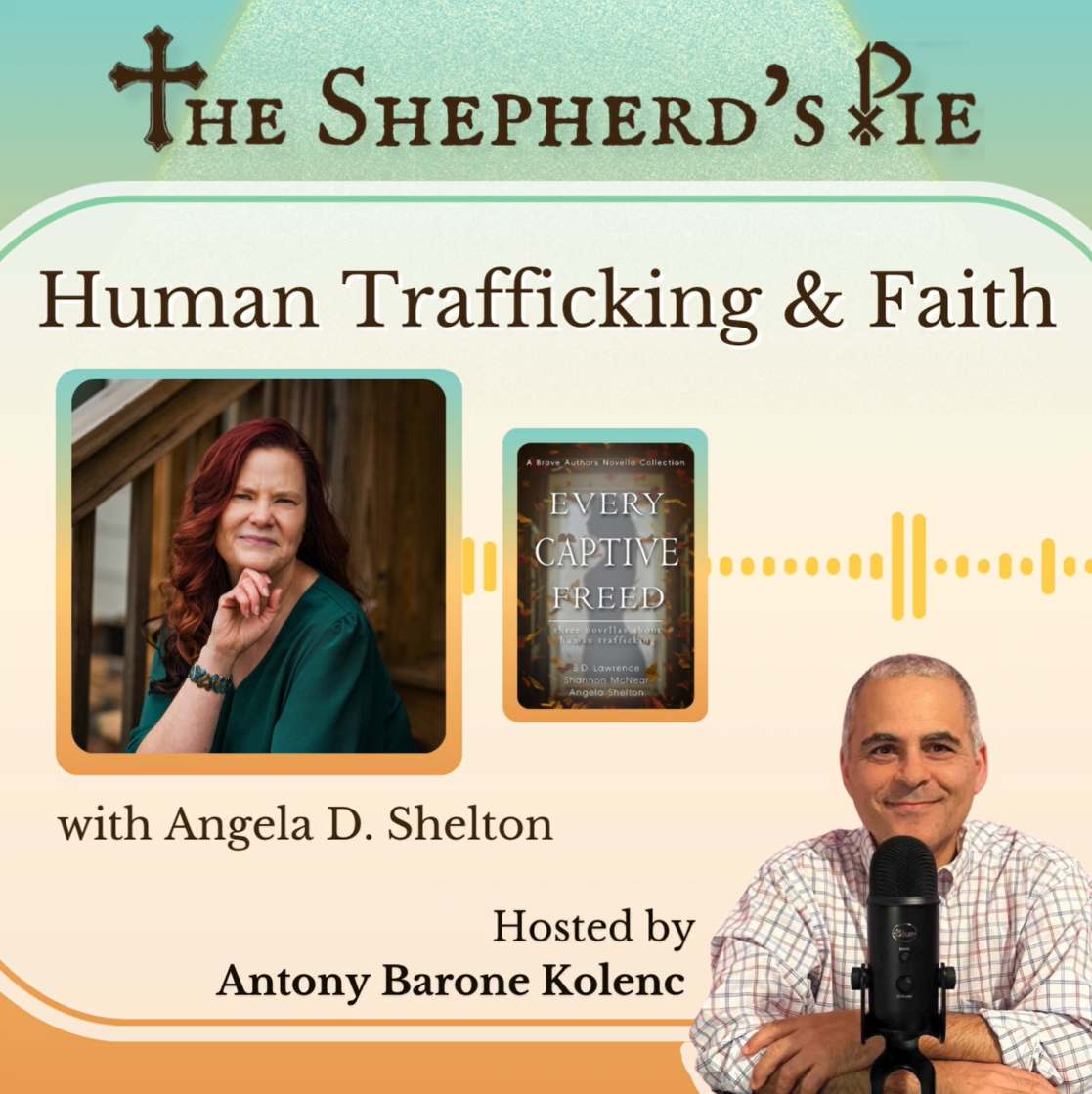
In this episode of The Shepherd’s Pie, Antony Barone Kolenc speaks with Angela D. Shelton about how to protect our families from the dangers of human trafficking, and we discuss her anthology, Every Captive Freed.


Check out other episodes of The Shepherd’s Pie.


Copyright 2025 Antony Barone Kolenc

Back-to-School Isn’t Just for Kids: Why Student Memberships Matter for Aspiring Publishing Professionals

Back-to-School Isn’t Just for Kids: Why Student Memberships Matter for Aspiring Publishing Professionals

A week ago, I dropped off my daughter at her first day of high school. She was nervous about the new environment and stepping onto the campus with no friends. 

Stepping into the workforce can feel the same way, too. 

I recently graduated with a master’s in publishing from Pace University and am transitioning in my 40s from English teacher to publishing professional. As I prepared to graduate this past May, I asked myself, What now? I would be stepping into the real world of publishing, navigating a job search with no friends or connections in publishing.

That transition taught me about the value of student memberships in professional organizations. Just like a high schooler joining after-school clubs, joining professional organizations is a great way to make friends with people who share your passion, and grow in your trade. Plus, student memberships offer an alternative to internships, which often aren’t an option for adults with families and full-time jobs.

How Student Memberships Open Doors

When I was preparing to graduate last May, I was afraid that I would lose the only connection with the publishing world that I had. I remember mentioning this to my professor during one of our last online classes. She recommended that I ask the university to keep me on the mailing list so I could continue receiving their job postings, and assured us that we could still reach out to her after we graduated. Classmates made it a point to connect on LinkedIn by sharing their profiles at the end of our last presentation. 

All of this was helpful, but I knew I needed more. 

Internships weren’t an option for me; I was an online student working as a full-time teacher far from the New York City campus where most opportunities existed. That’s when I started to look into mentorship programs and professional publishing organizations. Luckily, Pace offered a mentorship program that was ideal for online students like myself. Pace paired me with an industry mentor, and later, Johanna Vondeling from Bay Area Women in Publishing generously offered to mentor students after speaking in one of my classes. Both mentorships helped me grow and introduced me to wonderful people in the field.

But soon the mentorships were over, too, and I was left with uncertainty. I found myself looking for the next step. That’s when I began exploring professional publishing organizations.

From Writing Groups to Publishing Organizations

I had already been part of writing communities like the Catholic Writers Guild —which, by the way, also offers a student member rate (I’ll share the discount code at the end)—as well as Romance Writers of America, and First Coast Romance Writers. However, I didn’t fully understand the distinction between writer organizations and publisher organizations until I conducted my thesis research on diversity challenges in Catholic and Christian publishing.

I interviewed leaders at the Association of Catholic Publishers (ACP) and the Protestant Church-Owned Publishers Association (PCPA). I was inspired by their vision for inclusive publishing, and both offered affordable student memberships that I joined.

I then began to Google other publishing organizations with student membership rates. One thing that I want to share is that if you find an organization and don’t see a student membership advertised, don’t hesitate to reach out. I reached out to the Independent Book Publishers Association (IBPA) and asked about a student rate, only to learn that they had just launched the program and hadn’t advertised it yet, and the CEO emailed me directly and was kind enough to give me an early-bird student code! 

Winning the FAPA Scholarship

And then I found FAPA. The Florida Authors and Publishers Association (FAPA) offers a generous student scholarship that I’ve yet to see matched. Winners receive a one-year student membership, a $500 award, and a complementary ticket to their annual FAPACon. 

I applied and won.

Attending FAPACon this summer was eye opening. I was impressed by how they fund their scholarship program: from proceeds raised by raffle baskets. They also had a unique “Speed Dating with the Pros” event where small groups rotated among tables to meet industry experts for an intimate Q&A. 

I also met many Christian authors and publishers there. As a Catholic writer, I had assumed I’d only meet Faith-based peers at explicitly Christian events, so I was pleasantly surprised to discover Christian publishers at FAPA. This experience reminded me that publishing communities are more diverse than we expect, and there’s growth in stepping outside our usual circles.

Publishing Organizations with Student Benefits

Although I’m new to many of these organizations and learning about all the benefits they offer, here is a snapshot of the perks I found useful:

  • Association of Catholic Publishers (ACP)
    • Only $10 for students
    • Online member platform for communication
    • Catholic Reads book club.
    • Access to webinars
  • Independent Book Publishers Association (IBPA)
    • $85 student rate
    • Discounted registration for Pub University (their annual educational conference)
    • Member networking through Slack
    • Webinars and roundtables
  • Protestant Church-Owned Publishers Association (PCPA)
    • $25 student membership
    • Annual conference
    • Free weekly webinar
    • Active job board

3 Ways to Make the Most of Student Memberships

  1. Introduce Yourself and Connect
    Every group has a platform—Slack, an app, or a forum. Don’t just sign up; post an introduction and start meeting people.
  2. Show Up for Events
    Conferences, webinars, and roundtables are where real connections happen. Even one good conversation can make a difference.
  3. Use the Perks
    Take advantage of discounts, free subscriptions, and services. These benefits save money and keep you plugged into the industry.

Final Thoughts

So as this school year begins, I encourage every college or graduate student—especially those exploring publishing—to look into student memberships. I only learned about them in my last year of grad school, and I wish I had taken advantage of them sooner.

Starting a new career can feel a lot like being an awkward freshman—you’re unsure where to sit, whom to talk to, or how to find your place. Professional organizations are like those after-school clubs that give students a sense of belonging. They provide community, guidance, and opportunities that make the transition less intimidating and much more rewarding.

If you’re stepping into publishing, don’t do it alone. Find your “club,” introduce yourself, and start making connections. Before long, you’ll realize you’re not the new kid anymore—you’re part of the community.

P.S. If you’re a student writer looking for your first “club,” the Catholic Writers Guild is a great place to start. CWG offers a special student membership code for 50% off the regular price. Use code: STUDENTGUILDIE when registering to claim your discount and start connecting with fellow Catholic writers.

Copyright 2025 Janet Tamez

Edited by Gabriella Batel

The Shepherd’s Pie: Faith and Remembrance

The Shepherd’s Pie: Faith and Remembrance

“A slice of hope to raise faithful kids.”

This uplifting, ecumenical show uses engaging conversations and fun entertainment reviews to offer positive insights and media resources for families and youth leaders. We discuss current issues that impact young people at home, in school, and in the world today.

In this episode of The Shepherd’s Pie, Antony Barone Kolenc speaks with Father Jonathan Torres about his journey as a priest-author, and how the theme of remembrance is central to the Christian faith, and we discuss his fantasy novel, Blinding Dawn.


(info about this episode, get that here: https://anchor.fm/the-shepherds-pie )

Check out other episodes of The Shepherd’s Pie.

"The Shepherd's Pie: Faith and Remembrance" by Antony Barone Kolenc (Catholic Writers Guild blog)


Copyright 2025 Antony Barone Kolenc

The Shepherd’s Pie: History and Christ’s Life

The Shepherd’s Pie: History and Christ’s Life

“A slice of hope to raise faithful kids.”

This uplifting, ecumenical show uses engaging conversations and fun entertainment reviews to offer positive insights and media resources for families and youth leaders. We discuss current issues that impact young people at home, in school, and in the world today.

In this episode of The Shepherd’s Pie, Antony Barone Kolenc speaks with Bill Kassel about the life of Christ as seen through the eyes of his family, and we discuss his historical fiction novel, My Brother’s Keeper.


Check out other episodes of The Shepherd’s Pie.


Copyright 2025 Antony Barone Kolenc

Mystical Writings: Ignite your Summer Reading with In-a-Year Podcasts on the Writings of Mystical Visionaries

Nothing takes the place of reading. Nothing takes the place of listening. Rather, when the written word and spoken word team up, they form an ideal partnership for greater enjoyment and understanding.

When Fr. Mike Schmitz launched his Bible in a Year podcast in 2021, he started a quiet movement that opened opportunities for people, both familiar and unfamiliar with Sacred Scripture, to dive more deeply into God’s Word. The popularity of Fr. Schmitz’s podcast proved the success of how reading and listening work together. He followed up two years ago with readings and insights on the Catechism of the Catholic Church in a Year, a work that even many Catholics don’t realize is a beautifully composed pastoral document.

The Catholic Church permits other documents for public consumption, including some mystical writings of saints and others on their way to sainthood. Unlike the Bible and CCC, we are not required to believe in private revelations, and these writings are not regarded as truths, but no one can deny the hearty fascination the faithful have for these revelations, particularly those communicated from Jesus and the Blessed Mother.

The problem is these writings are rarely easy to digest alone.

Some are hundreds of years old, often containing obscure language we are unfamiliar with today. They are “mystical,” a quality that brings with it an air of perplexity. Hearing the words helps. Having a guide summarize and offer insights invites clarity which is why these “in-a-year” podcasts, along with the books, is the ideal combination. People who would never pick up these books to read might listen, and when they hear something that piques their curiosity, go to the book to examine it further. Others want the books with them to read along, review later, and meditate on the message.

Some publishers are seizing the opportunity, offering asynchronous reading-a-day podcasts on some rather substantial writings by prolific visionaries. Read by priests, they follow a format of a few paragraphs each day, with brief commentary and observations, not longer, usually, than about 20 minutes and are available for free on the unusual platforms, such as Spotify and Apple iTunes. The podcasts run transcripts, but they are AI generated and many of the words and names are wrong.

The benefit of having the books to refer to is the availability to spend time with revelatory or descriptive excerpts, compare them with other writings, and use them to reflect on related Bible passages.
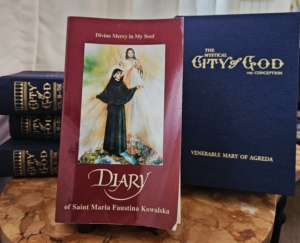
A picture of the Diary of Saint Faustina and The Mystical City of God: the Conception by Venerable Mary of Agreda.

Probably the most well-known of the three mentioned here is the Diary of St. Faustina. This in-a-year podcast presented by Most Rev. Joe Roesch, MIC, the Superior General of the Marian Fathers of the Immaculate Conception, along with the diary’s publisher, Marian Press, breaks down the messages our Lord dictated to his “Secretary of Divine Mercy.” Most Catholics are familiar with the message of the Lord’s Divine Mercy since it is celebrated the Sunday after Easter. St. Faustina’s diary offers a great deal more of Jesus’s message of mercy to those who know and love Him. Listeners who have not read the diary will be struck by Faustina’s desire to convert souls, the distress the unconverted cause her and the intimacy she and Jesus share. In entry 928, she describes how bereft she is at this, and Jesus begs her to stop crying. (Faustina 2014, 359)

Fr. Roesch also voices the Imitation of Christ by Thomas a Kempis, a Catholic classic from the 1400s, is considered a “must-read” by those who want to take up their cross and follow Him.

Fr. Edward Looney, author of nearly a dozen books, many of which are reflections and meditations on the Blessed Mother, began a partnership with Tan Books back in 2022 to produce the podcast, The Mystical City of God: The Divine History and Life of the Virgin Mother of God based on the four-volume set of messages manifested to Maria of Agreda in the 1700s by the Blessed Mother. Fr. Looney’s guidance through the readings, especially in the beginning, is indispensable and reassuring. He admits that the readings are rather difficult, or “dense,” as he describes it, with archaic language and meandering backstory, and his encouragement provides the added push in Book One to give the listener time to become enthralled, which he or she will.

Her writings are filled with details, big and small, of the Blessed Mother’s life, from an explanation of Jesus’ mysterious seamless tunic (2) to Mary’s conversations and relationship with God through a nine-day experience of her own mystical vision of Heaven before the Incarnation (3). 

Last year, they released The Life of Jesus Christ in a Year: from the Vision of Anne Catherine Emmerich, which might be more widely known. This two-volume set is separate from the Emmerich books, Life of the Blessed Virgin Mary and The COMPLETE Visions of Anne Catherine Emmerich. Her writings were reportedly an inspiration for Mel Gibson’s The Passion of the Christ. She unveils many revelations, including those about the Woman at the Well. The two days Fr. Loney spends on Jesus and the Woman reveal jaw dropping details of their conversation, her dress, demeanor, personality and names. Yes, she claims the unnamed woman in the Gospel of John has three (Looney 2024).

Choose your favorite or suggest another. Happy reading and listening!


Feature Photo by Johannes Plenio: https://www.pexels.com/photo/landscape-photography-of-forest-1103971/

Inset photo by Mary McWilliams

Kowalska, Saint Maria Faustina. Divine Mercy in My Soul.  Marian Press, 2014. 

Roesch, Joe. 2024. “Day 184: Diary Entries 927-932”. Podcast audio. Saint Faustina’s Diary in a Year. September 21, 2024. https://open.spotify.com/episode/08dEyAJAWXRMbkjcsfSBPy?si=I2iRFlWaRDG3BqVbMMOJKw

Looney, Edward. 2022. “Day 179, Volume 2, Book 4, Chapter 29, Paragraphs 691-695”. The Mystical City of God in a Year. June 22, 2022.

Looney, Edward. 2022. “Day 101: Volume 2, Book 3, Chapter 7, Paragraphs70-86”. The Mystical City of God in a Year. April 11, 2022. https://open.spotify.com/episode/48B37MR3IZ3K1Q39WhO6AA?si=aiqLUECaQCqNDtuxvAsd2Qhttps://open.spotify.com/episode/5Y66gdUgcu0lt4mMIHmFHP?si=f7k1zsakQ-GcMY5Jt6rOug

Looney, Edward. 2024. “Day 103: The Woman at the Well Part 1”. The Life of Jesus Christ in a year: From the Visions of Anne Catherine Emmerich. September 19, 2024. https://open.spotify.com/episode/2J9eoeIQbuIYqa4dSXyFmx?si=xF6JwNxgS_ykOTzqDQS0nw


Copyright 2025 by Mary McWilliams

Edited by Rietta Parker

The Meaning of Life – Part 3 of 3, Being Fully Alive, Happily Ever After

 I will seize the occasions that present themselves every day; I will accomplish ordinary actions in an extraordinary way. (Cardinal Francis Xavier Nguyên Van Thuân, Five Loaves and Two Fish)

Life is a journey on which we grow, learn, discover, and become. We begin that journey with many questions. Who am I? What is my purpose? What should I do? Where should I go? Where will I end up? The questions are large, small, simple, and complex; and often, the answers we discover lead to more questions. We long for answers with tidy endings, but life is not a book with a happily ever after!

Or is it?

Discovering the Meaning of Life

Think about how many self-help books there are out there. How many articles and podcasts and Ted Talks are there about finding yourself, knowing your purpose, or discovering the meaning of life? We are surrounded by authors, psychologists, doctors, talk show hosts, podcasters, TikTokers, journalists, and more who purport to know what we’re seeking and where we can find it. They all claim to have the answers!

I’d like to propose that many of those books should be tossed out, articles ripped from the seams of the magazines, and recordings silenced! We all have inside of us what we need to discover the meanings of our lives and the directions in which we should be heading. All we need is to have faith, lead with mercy and compassion, and love one another. Through faith and prayer, we can discover how to follow our paths and live life abundantly, the way God intended us to.

We need to open our eyes to the gifts and talents God has given us and learn to use them, and use them well. We need to look deep inside ourselves and find what we are good at, what we are passionate about, and pray about what we are to do with that knowledge, those skills. We need to keep asking questions and keep looking for God to answer them.

We must seize upon the words of Cardinal Francis Xavier Nguyên Van Thuân: “I will seize the occasions that present themselves every day; I will accomplish ordinary actions in an extraordinary way.”

I will admit, this isn’t easy. It’s taken all my life—over fifty years—to find my path and discover answers to my questions. And I’m not alone. We live in a world in which we are surrounded by so much noise, we can’t hear God calling our names and don’t know which way to turn to find the right answers and the right path.

Finding Our Calling

The truth is, we can’t live our lives abundantly until we discover our callings, and we all have a calling. We all have a path that has been laid out for us. It has always been there, waiting for us to find it, to ask the right questions. It’s up to us to discover the path and up to us to choose to follow it. God will not force us to do anything we don’t want to, but He will lay the path and give us clue after clue, prompting upon prompting, and sign after sign. We can look for and acknowledge them, or pretend they don’t exist. There is always an answer to our question. We may not like the answer, or we may not be prepared to accept it, but it’s always there. Psalm 16 tells us, “You make known to me the path of life; you will fill me with joy in your presence, with eternal pleasures at your right hand” (Psalm 16:11).

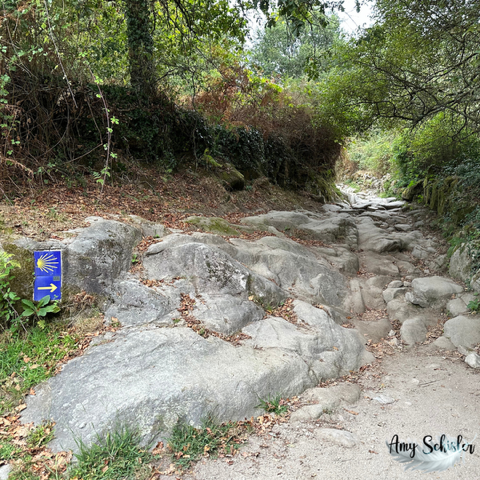
Don’t get me wrong. Even when you find the path, you will still have questions and will continue to search for meaning. However, the longer you follow your path, the more answers you will receive. It won’t always be easy. Sometimes the path will be clear and obvious, paved and lighted. Other times, the path will disappear around a bend into the darkness, and we must find our way to the light. Those are the times the answers aren’t readily apparent. Those are also the times when staying on the path is the most rewarding. Those are the aha moments we have when we look back and see the answers so clearly, we can’t figure out how we missed them along the way. Pope Francis said, “If we wish to follow Christ closely, we cannot choose an easy, quiet life. It will be a demanding life, but full of joy” (The Spirit of St. Francis: Inspiring Words from Pope Francis, p.87).

Called by Name

So many throughout the Bible were called, some by name. God called out to Abraham, Jacob, and Moses, using their names twice to get their attention (Genesis 22:11-13; 46;1-4; Exodus 3:1-10), and I wonder how many times He has to call my name because I’m too busy to pay attention. I think of Samuel in 1 Samuel 3:4 who was called by God but didn’t recognize that it was the Lord calling him.

How often do we hear the call but don’t realize it’s the voice of God?

I lovingly recall Mary Magdalene weeping at the tomb, asking the “gardener” where Jesus’s body was. It was only when the man addressed her by name that she recognized it was the Lord (John 20:11-16). How often have I stood and looked at something without understanding that it was God trying to get me to see Him?

At some point, each of us is called by name, and at that point, we will know that we are fully alive, ready to answer God’s call. If we listen and turn toward the voice with an openness and readiness, we will see our paths illuminated before us, littered with the answers to our questions. Yes, there will be twists and turns and many crossroads as we continue to question the way, but the path is there, and so are the answers. All we need to do is be willing to follow the path wherever it leads us, and open ourselves up to living life in abundance. And that is how we will find our happily ever after.

To wrap up this series, let us reflect on these words of St. John of God:

If we look forward to receiving God’s mercy, we can never fail to do good so long as we have the strength. For if we share with the poor, out of love for God, whatever he has given to us, we shall receive according to his promise a hundredfold in eternal happiness. What a fine profit, what a blessed reward! With outstretched arms he begs us to turn toward him, to weep for our sins, and to become the servants of love, first for ourselves, then for our neighbors. Just as water extinguishes a fire, so love wipes away sin. (Cartas y Escritos 18)


Copyright 2025 Amy Schisler

Images copyright 2025 Amy Schisler, all rights reserved.

The Shepherd’s Pie: Christian-Jewish Relations

The Shepherd’s Pie: Christian-Jewish Relations


“A slice of hope to raise faithful kids.”

This uplifting, ecumenical show uses engaging conversations and fun entertainment reviews to offer positive insights and media resources for families and youth leaders. We discuss current issues that impact young people at home, in school, and in the world today.

In this episode of The Shepherd’s Pie, Antony Barone Kolenc speaks with Jonathan Feldstein about building bridges between Christians and Jews,
discussing his organization, the Genesis 123 Foundation.


Check out other episodes of The Shepherd’s Pie.


Copyright 2025 Antony Barone Kolenc