Just A Little Bit

Just A Little Bit

My default mode is all-or-nothing. Do I want to volunteer at church? I’m gonna sign up for everything and do it all. Do I feel overwhelmed about keeping memories for the kids? No one gets a baby book at all. Do I want to lose weight? I track every single calorie and work out for two hours, five days a week. Am I struggling to find time to write while the kids are home for the summer? I should just quit writing altogether.

What I love about the all-or-nothing mentality is that when I put it in writing like this, I can clearly see the absurdity of my logic. Yet, when I’m in my moments of being overwhelmed, quitting completely feels like not only a rational option, but the only viable one.

I’ve developed many different strategies for combating this all-or-nothing mentality, including prayer, taking deliberate personal time, and talking to a friend who is currently more rational than I am. But sometimes the best defense is a good offense, and I’ve been working on reminding myself that even if I can only accomplish a little bit, that still has value.

The reality for me is that during the summer, when my four daughters are home all day, I won’t be gifted with large blocks of time for writing. Thirty minutes, first thing in the morning may be all I get one day, and that is still better than not writing at all. I don’t have the luxury (nor endurance) for two-hour workouts anymore, yet twenty minutes on the elliptical still beats sitting on the couch all day.

Ever since I made a pilgrimage to Fatima in November of 2022, my heart has longed to move to Portugal. I’m telling y’all—all-or-nothing. I felt so much peace and so close to God while I was there that I want to uproot the whole family and move to a country where we don’t speak a single word of the native language.

One of my favorite heavenly friends, Saint Thérèse of Lisieux reminds me every day (through my garden flag) to bloom where I’m planted. It’s possible God wants me in Fatima one day, but I know that today is not that day. My kids are struggling enough with a move within the continental U.S., and I can’t imagine if we took them to a whole new country without explicit direction from God.

Yet my heart longs for that pilgrimage feeling, so in my growing attempt to do just a little bit, I planned something slightly smaller than a move to Portugal. This past weekend, my family went on our first ever mini-pilgrimage. We have visited churches while traveling before, but we’ve never set out with the sole purpose of growing closer to Christ through experiencing a holy site right here, close(ish) to home.

Now that we live in Kansas, we are only about two hours away from Gower, MO, the home of the Benedictines of Mary, Queen of the Apostles. This may sound familiar, as this is the place where the body of their foundress, Sister Wilhilmena Lancaster, has been discovered as “incorrupt.”

Her body was not embalmed, and she was laid in only a simple, wooden coffin. Yet after four years in the ground, her body and habit remain intact. A case for sainthood has not even been opened yet, since it hasn’t been five years since her death.  The nuns of the abbey excavated her remains to move her to the newly completed St. Joseph’s Shrine, fully expecting to find only bones to inter. I can only imagine the reactions of her fellow sisters when they made that discovery!

Since we were going to be in Missouri, we decided to also stop by the nearby town of Conception, which is the home of an abbey of Benedictine monks, a seminary, and the Basilica of the Immaculate Conception. We left home on Sunday afternoon after Mass with our regular parish and visited the stunning basilica (including cookies baked by monks!) before getting to the hotel. Then on Monday we went to the other abbey and celebrated the traditional Latin Mass with the Benedictines of Mary, Queen of the Apostles and saw the body of Sr. Wilhelmina.

And that was it (ok, then we stopped at Sam’s Club on the way home because, you know, real life). We were out of our house for barely more than 24 hours, and it was one of the best family trips we’ve ever taken. The mini-pilgrimage was long enough to feel spiritual and fulfilling, and gratifying that I’m doing right by these kids that God has entrusted to my care. The mini-pilgrimage was short enough that my kids weren’t biting each others’ heads off and completely sucking my joy dry.

A little bit was enough. A little bit was beautiful and rewarding. I’m gonna keep trying to do just a little bit each day.


Maria Riley 2023

Cath-Lit Live: The Chalice Series by Erin Lewis

Cath-Lit Live: The Chalice Series by Erin Lewis

“Cath-Lit Live!” features brief interviews with Catholic authors who are releasing new books. Hosted by Catholic author and speaker Amy J. Cattapan, “Cath-Lit Live!” gives viewers a glimpse into the latest Catholic books while getting to know a bit about the author as well.


null


Firetender (Book One)

Sometimes true strength only comes with surrender. Hot-headed Dallas Malone has spent most of his life putting up emotional walls around himself, softened only by his best friend Channing, who he protects with the fierceness of a big brother. When the two are faced with sudden homelessness, Dallas’s impulsive decisions leave them fleeing from law enforcement and land him in prison. While struggling for mere survival in an abusive environment, his mistakes threaten to ravish Dallas like a wildfire, unless he can learn to allow something more powerful than himself into his life.


null


Enkindle in Me (Book Two)

Dropped back into the real world with a newfound faith following a lengthy prison sentence, 23-year-old Dallas Malone is bombarded by the tantalizations of secular society and all the changes that seem to have occurred overnight. His Catholic faith burns deep inside him, but now he must live it out amidst morally bankrupt co-workers and without the support of his best friend. Struggling to get back on his feet and prove himself, Dallas’s wounds are becoming scars, and he knows he’s not that same person he used to be. When he meets Samantha, enchanting and headed for trouble, his natural protective instinct is inflamed while past demons of failure chip away at what he thought he knew was a true calling from God enkindled in his heart. Can Dallas forgive himself and heal from his past mistakes to discern the life path God has laid out for him as a man?


null


About the author:

Erin Lewis is a first-time author who has combined her interest in writing fiction with her love of her Catholic faith and her desire to support religious vocations. Her inspiration for writing the Chalice series came three years ago when she completed a story based on characters she had originally created over twenty years earlier. She lives with her husband and four children in Georgia.


You can catch “Cath-Lit Live” live on A.J. Cattapan’s author Facebook page. Recorded versions of the show will also be available to watch later on her YouTube channel and Instagram.


null


Copyright 2023 Amy J. Cattapan
Banner image via Pexels

Not to Worry—If Another Pandemic Strikes, Catholic Saints are Ready to Protect Us

Not to Worry—If Another Pandemic Strikes, Catholic Saints are Ready to Protect Us


The Catholic Church has patron saints for many causes. There are so many, they even had to be alphabetized. Under the letter A, there are 23 named saints, such as Saint Agatha, the patroness of bakers and nurses, and the great Saint Augustine of Hippo, the patron saint of printers and brewmasters. Under G, there is Saint George, responsible for fifteen patronages, including butchers, shepherds, and Boy Scouts.

We Catholics have protectors against pandemics

You get the idea; we Catholics have a lot of patron saints, and almost every facet of life experience seems to be covered. We can always turn to Saint Jude, the patron of impossible causes, if it looks impossible.

Since the coronavirus pandemic has passed, we might sleep better at night knowing there are saints in the queue, ready to go to war against any and all attacks by invisible microbes and virulent demons looking to bring us down. Here are a few examples:


  • Saint Quirinus of Neuss: patron saint against bubonic plague and smallpox

Quirinus was born in the first century and died in the year 116 A.D. Legend has it that he was a Roman tribune and was ordered to execute Alexander, Eventius, and Theodolus. These men had been arrested on orders of the emperor. Their crime: being Christian. But Quirinus witnessed miracles performed by the three men. Instead of executing them, he embraced the faith and was baptized into the faith along with his daughter, Balbina. He and Balbina were decapitated for being Christian and buried in the catacomb on the Via Appia.

We move ahead 1300 years. Documents from Cologne, dated 1485, say Quirinus’s body was donated in 1050 by Pope Leo IX to his sister, the abbess of Neuss. Soon after, Charles the Bold of Burgundy laid siege to Neuss with his army spreading from western Germany, the Netherlands, and as far south as Italy. The citizens of Neuss invoked Quirinus for help, and the siege ended. Wellsprings popped up and were dedicated to him. He was then called on to fight against bubonic plague and smallpox.

There is a saying by farmers associated with Quirinus’s feast day, March 30: “As St. Quirinus Day goes, so will the summer.” 


  • Saint Anthony the Great: patron saint against infectious diseases

Saint Anthony the Great was one of the greatest saints of the early Church. Anthony was one of the first monks and is considered the founder and father of organized Christian Monasticism. He organized disciples into a community and these communities eventually spread throughout Egypt. Anthony is known as Anthony the Great, Anthony of Egypt, Anthony of the Desert, and Anthony of Thebes. He is also known as the Father of All Monks. His feast day is celebrated on January 17.

Saint Anthony the Great is also the patron saint for those fighting infectious diseases. We might all call on him now, since infectious diseases will always be attacking us.


  • Saint Edmund the Martyr: patron against pandemics

Saint Edmund is the acknowledged patron saint against pandemics. He died in 869, and hardly anything is known about him. Yet there are churches all over England dedicated to him. Saint Edmund cannot be placed within any ruling dynasty, yet the Danes murdered him in 869 when they conquered his army. In addition to being the patron saint against pandemics, Saint Edmund the Martyr is also the patron of torture victims and protection from the plague.


We might mention a few more saints who are patrons of those suffering from familiar illnesses and afflictions:

  • Saint Damien of Molokai: patron saint of those with leprosy (Hansen’s Disease)
  • Saint Dymphna: the 15-year-old Irish girl who is the patroness of those suffering from emotional disorders.
  • The Fourteen Holy Helpers: patron saints against epidemics, bubonic plague, aka the Black Death
  • Saint Matthias: patron saint of alcoholics and those with smallpox
  • Saint Tryphon: patron of those fighting off bed bugs, rodents, and locusts.


The list seems endless, so if you ever need a patron saint for anything, check this list of patron saints by occupation and activity. 

Most likely there is a saint just waiting for your call.


null


Copyright ©Larry Peterson 2023
Images: Pexels

Corpus Christi: We Are the Body of Christ, and You Are What You Eat

Corpus Christi: We Are the Body of Christ, and You Are What You Eat


We have all heard the saying, “You are what you eat.” If that’s true, I am parts pizza, BBQ, peanut butter, and have coffee with a side of wine for blood!

So, IF we, Catholics, parishioners, Christians … are the “Body of Christ,” what are we made of—and most importantly, why does it matter?

First, let’s change the word “eat” to “consume.” We are formed by more than just what we eat. Everything we read, watch, listen to, and surround ourselves with has a bearing on who and what we are. If I eat a lot of greasy food, play a lot of high-intensity adrenaline-filled video games by myself, never get up from the couch or walk more than 100 feet a day, and smoke cartons of cigarettes while drinking nothing but energy drinks, my life expectancy goes from 82 years to 56.

But if I eat balanced meals, take time to shut down and refresh, get moderate exercise, and have a community of friends—neighbors, church family, clubs, and so on—suddenly I will be living a longer, and most importantly, happier life.

Now, that’s the outside life. Let’s talk about the inside life—the soul life. When we receive the Eucharist, we do not consume just a piece of bread or a sip of wine. No. We are receiving Jesus himself, in all his divine glory, sort of like a spiritual superpower; let’s call it “Jesus Juicing.” We begin to transform from the inside—out and become more like Him; better able to love and serve others. When our inside, our soul, begins to strengthen from “Jesus Juicing,” we find we have more peace, more wisdom, more self-control. But it not only benefits us, but the larger Corpus Christi, or Body of Christ, the Church! Remember, WE are the Body of Christ, the Corpus Christi. WE are the Church.


null


Being in a community isn’t a solo event. We are being nourished so we can help others. A great example is a group called New Roots for Refugees, run through Catholic Charities. My wife and I are avid gardeners. Last weekend we went to the New Roots for Refugees plant sale. Refugees from many different countries work together, growing vegetables and flowers that are then sold to gardeners—or after maturing—the fruits and vegetables are sold to eat. Interacting with these beautiful souls, we the Corpus Christi are being nourished by not just by the plants, but by “Jesus Juicing!” We’re strengthening our ties with people in need in the Body of Christ, and doing what we are all called to do—loving and serving each other.

So, there are 3 important things to remember on the feast of Corpus Christi:

  • We don’t need to just strengthen our outside-selves, but also our inside-selves with “Jesus Juicing.”
  • When we take care of the inside-selves, it will change the outside-selves.
  • We are not built to be a solo act. We are strengthening through “Jesus Juicing” to be of service to others.

Questions:

  • Are you allowing yourself to be changed?
  • How will you be of service to our Corpus Christi?

null


Copyright 2023 Ben Bongers

Photos copyright 2023 Ben Bongers, all rights reserved.

All Aboard The Surrender Express!

All Aboard The Surrender Express!


I am a huge fan of nostalgia, ranging from black-and-white television shows to antique furniture and sentimental trinkets. Simple times, unique vehicles, and outdated fashions appeal to a special part of me. One, in particular, stands out among the rest, and that is the old-fashioned train.

A few years ago while planning a vacation, I found a vintage train car converted into a hotel room. To my surprise, there are several of these throughout the country! I found a couple within driving distance, bringing my mission to fulfillment. My favorite was the Chattanooga Choo-Choo, which sits on the actual train track, and the ticket station is now the hotel lobby. 

The exterior of the passenger car was untouched other than fresh paint, and much of the inside retained the feel of that era, aside from having a bed and modern-day necessities. Oh, how I longed to go back in time, dressed with the white gloves and pretty hat.  Little did I know that dream would also one day be a reality.  A year or so later, I boarded a 1940s-themed dinner train, dressed as if I had stepped out of 1941.

The lure of the train was whimsical, and the sounds of the engine chugging before picking up speed drew me into a place of wonder and relaxation. As a child, I could hear a train whistle in the distance from my grandmother’s house and often thought about who might be on it and where it was going. 

More recently while chatting with a friend, a nonchalant answer got me thinking. When asked how things were going, my friend responded, “The train has left the station.” To which I asked, “Are you on it?”

I’ve been reflecting on that lighthearted exchange and the image of running to catch a train as it’s leaving the station, and I considered how it relates to my faith and God’s plan. Begging the ultimate question, am I living each day on my itinerary or God’s? I don’t even want to count how often I was so focused on my plans that I was blind to how God was trying to direct my steps. I’m not one to dwell on the past. However, I am always eager to learn from my mistakes.

For train travel, there is no room for adjustments once a trip is planned and advertised. Regardless of who is and isn’t on the train, it will leave the station on time. I like to live my life in this way—trusting the schedule that God has set for me. However, sometimes I want to sneak in a secondary scheme or backup plan. When I do this, there is the possibility that my plan B is wavering from God’s ultimate plan. The fruit is in the process of discerning whether or not to travel my way or surrender to God’s will.

Surrendering to the will of God involves prayerful communication, trust, faith, and a willingness to let go. The image of someone running after a train looks great in the movies, but in real-life instances, I don’t want to have to run after something God had right in front of me. I prefer to be on board, seated comfortably and have it fall right into my lap.

Another recent conversation regarding God’s will focused on whether or not to take action in creating a plan B for a particular situation. When it was all said and done, the family decided to take the need directly to God through prayer, leaving the outcome in His hands. A measurable amount of faith and trust in God were the key components to this family surrendering the need and the result to our Lord.

Complete acts of surrender are to be celebrated, regardless of the conclusion. As a highly organized person, it makes total sense to have a safety net; in some cases, it is a strategic move. Then again, factoring in my faith and relationship with Jesus reminds me that God is in control. It would be easy for me to go about my life as I think it should go, whereas it will be fulfilling and beautiful when God lines it all up for me. 


Maria Riley shares tips for combating writer’s block.

As a Catholic writer, I am blessed and challenged by the knowledge that what I am writing is not really my own words. My goal every time I sit down at the keyboard is to write the words God wants from me. For this reason, I have learned that I don’t suffer from a traditional writer’s block, but rather a spiritual block when the words don’t come.

I’ve often joked that I wish God would send me an email outlining exactly what he wants me to do. I am not known for my patience. When I feel lost without inspiration, I want a quick fix and immediate answer to what I should be writing that day. The reality is that God doesn’t work on our timeline. His inspiration isn’t a tap we can turn on and off when we are ready for it.

The tricks for overcoming a spiritual block are simple in theory, but the practice can be challenging. The more we talk to God through reading scripture, spending quiet time in prayer, and pursuing faith-based activities and friendships, the more we will hear God communicating with us throughout the day. The more we hear directly from God, the easier it is to sit and write with confidence and ease.

Unfortunately, our daily lives are inundated with noise and distractions that prevent us from hearing the quiet words God is trying to speak into our hearts. It has been my experience that God rarely yells. He is always reaching out and seeking us, yet he waits patiently for us to respond to him.

Finding time to sit quietly seems counterintuitive when a deadline is looming, yet it may be the only way to fully open the channel to God. Nathaniel Hawthorn penned one of my favorite quotes: “Happiness is like a butterfly, which when pursued, is always just beyond your grasp, but which, if you will sit down quietly, may alight upon you.”

I have found this to be true for writing inspiration. So long as I am using my own strength and resources to actively pursue the right subject matter, I will always fail. If I can force myself to sit down, be still, and listen, that is when the creative juices flow freely.

Another method for combatting Catholic writer’s block is to not wait until you are at the computer to gather your inspiration. I keep a running note on my phone in which I can jot notes whenever I feel divine inspiration. I frequently get ideas while listening to a sermon, chatting in a conversation, or while hearing God’s word on a podcast. Since I practically always have my phone with me, the notes app is a perfect go-to place to gather these ideas.

By prioritizing quiet, contemplative prayer time, I feel close to God, even though I don’t always pray with the consistency that I’d like. Like everyone, my hectic schedule and constant disruptions get the best of me. Throughout my day I try to offer up my work and sufferings as prayer, and I pray for others when they pop into my mind. I struggle, though, to find significant blocks of time to sit silently and listen to God.

Every night before I fall asleep, I speak to God. I discovered that consistently I felt inspired and motivated each night. I realized that this was my contemplative prayer time. The house is quiet, everyone else is asleep, and I turn my thoughts to God. I first give thanks for my blessings, then ask for forgiveness for my shortcomings, and then I let my mind wander with the help of the Holy Spirit. Now I recognize that some of my best ideas are developed in those quiet moments.

When all else fails to combat your writer’s block, I recommend writing what you know. For me, I know writer’s block today. As I write, I pray that I can inspire another writer to continue on a mission from God to share his word with the world in that writer’s own unique way.

Maria Riley 2023

Cath-Lit Live: Ashes, Visible and Invisible

Cath-Lit Live: Ashes, Visible and Invisible

“Cath-Lit Live!” features brief interviews with Catholic authors who are releasing new books. Hosted by Catholic author and speaker Amy J. Cattapan, “Cath-Lit Live!” gives viewers a glimpse into the latest Catholic books while getting to know a bit about the author as well.


null


Ashes: Visible and Invisible by Catholic Teen Books

A boy in ancient Israel, a girl in modern-day America, a young man in the far future; a dozen teenagers in different settings. What do they all have in common? Each of these otherwise unrelated young people is presented with a choice, the same choice that every teen must make at some point in their lives: God or self. Sacrifice or selfishness.

The stakes vary. Some characters in this anthology risk being eaten by dinosaurs while others must simply rise to a new level of maturity in their everyday life, or choose a higher level of generosity.

Ashes: Visible and Invisible is a collection of stories that will both entertain young readers and invite them into a deeper understanding of Lent and their faith.


null


About the author:

An avid reader since childhood, award-winning author and journalist Amanda Lauer is the creator of the Heaven Intended Civil War series. A World Such as Heaven Intended won the 2016 CALA Award and A Freedom Such as Heaven Intended earned the 2022 Catholic Media Book Awards: First Place Catholic Novels: Inspirational. In addition, Lauer has written two time-travel novels Anything But Groovy and Royal & Ancient. Ashes: Visible & Invisible, a follow-up to Treasures: Visible & Invisible, is her second anthology written will fellow Catholic Teen Book authors.


You can catch “Cath-Lit Live” live on A.J. Cattapan’s author Facebook page. Recorded versions of the show will also be available to watch later on her YouTube channel and Instagram.


null


Copyright 2023 Amy J. Cattapan
Banner image via Pexels

A Catholic Man Considers Grief and Bereavement

A Catholic Man Considers Grief and Bereavement


“Blessed are those who mourn, for they shall be comforted.” (Matthew 5:4)


We say many “comforting” things to people in mourning. Still, I have discovered that for those who are in a mournful state, comforting them sometimes is not possible. Many have what is akin to a deep, open wound that is extremely painful. For many, the healing and scarring process takes a long time. The scar formed is always there to remind us of what was.

We firmly believe, and hence we hope that, just as Christ is truly risen from the dead and lives forever, so after death the righteous will live forever with the risen Christ and he will raise them up on the last day. Our resurrection, like his own, will be the work of the Most Holy Trinity. (Catechism of the Catholic Church 989)


Oh yes, we know all these things. We indeed say that we believe these things. Every Sunday, we profess our faith out loud and in public, saying, “and [He] rose again on the third day.”

As Catholic Christians, we have been comforted by our faith during our lives. The belief that death is only a transition to a world filled with perfect happiness is instilled in us. We shall be sharing our heavenly world with Jesus, the Blessed Mother, angels, saints, and loved ones gone before us. There will be no more pain and suffering, no illness, and nothing negative. Shouldn’t we be jumping up and down with joy? Unfortunately, “tomorrow” now has a permanent hole in it, and we have no idea how to fill it.


Victims of Adam and Eve’s original sin

We are human beings after all. We are also victims of Adam and Eve’s original sin. This is the sin that brought us illness and death. This is the reason for our grief. This is the reason for our pain and suffering. This is the reason for bereavement, which means “deprivation” or to have “suffered a loss.”


“Big Boys don’t cry”

Having these feelings is normal. As a man, I have tried to stifle any outward display of emotion in public. (That is how we were raised—”big boys don’t cry.” Well, real men do.) At home, who cares? No one is there to see my crumblings. After my wife’s funeral a few years ago, I did fail miserably at Walmart. Several  days after her funeral,  I had gone there to get a few things. I noticed that there were no customers in the  cell-phone section  I needed a memory chip for my phone so I asked the clerk where they were. He pointed them out and I grabbed a new chip and handed it to him.

He offered to put it in the phone and transfer my photos into it. He opened the picture file and there is my wife smiling at me. I lost it and morphed into a babbling spectacle at, of all places,  Walmart. A nice little crowd gathered for my impromptu performance but kept their distance. Hey, I might have been a lunatic or an old terrorist … whatever. You get the picture (pun intended). I was told by the facilitator of a bereavement group that my reaction was perfectly normal. Maybe it was, but I sure was embarrassed.


null


We come face to face with a journey we all must take

The point is, as Catholic Christians, we all witness death during our lives. And we should remember that seeing death brings us face to face with a journey we all must make. Grief is an internal process, and everyone experiences it in their own unique way. We all know of the Resurrection and the reward of eternal life. However, it can be tough to deal with when you get hit with the personal impact of a loved one’s death and the grief that instantly explodes inside you.


What she did for all of us is indescribable

Time and prayer help heal those deep wounds. But days come and go and it does happen. We are mortal humans. We must feel the pain. Imagine how our Blessed Mother felt watching them torture and kill her Son. What she did for all of us is indescribable.

Belief in the resurrection of the dead has been an essential element of the Christian faith from its beginnings. “The confidence of Christians is the resurrection of the dead; believing this we live.” (CCC 991)


We should never forget this. Do not be afraid—the Eternal Now awaits us all. It will be a wondrous place indeed.


Copyright©Larry Peterson 2023
Images: Pexels

Do Whatever He Tells You by Maria Riley

I love meditating on the Wedding at Cana. Attending a wedding seems like such an ordinary event for Jesus and his friends to attend. I imagine them laughing and enjoying themselves, much the way I do when I attend weddings, which helps me remember that Jesus was fully human too.

Another reason that I love the Wedding at Cana is that Jesus, as an adult, remained obedient to His mother. As a mom myself, I love this. His obedience also is a significant part of our understanding of Mary as the great mediator. She brings each of us closer to Christ by bridging the gap between us and Him. She tells Jesus that the wine has run out, and despite Him telling her it’s not yet His hour, Jesus obeys His mother (cf. John 2:3-4). Jesus’s first public miracle happened through the intercession of Mary.

Recently, while I meditated on this mystery, my mind didn’t focus on Jesus, His friends, nor His mother. Instead, my thoughts lingered on the servants, those who assisted Jesus in His first miracle. These servants aren’t even named in the scripture, yet by following the advice of Mary and obeying Jesus’s command, they partook in a beautiful miracle that all Christians know about.

They did whatever He told them (cf. John 2:5). And here’s the amazing thing—all He asked them to do was fill some pitchers with water. That was it! Jesus basically said, “Just go grab some water, and then leave the rest to me.” Because of the servants’ obedience, a miracle ensued.

Sometimes I think I’m not doing enough to live out my faith. I think I need to live in more drastic poverty or pray for hours every day. But maybe, just like the servants, Jesus is actually asking me to do something simple and well within my abilities, training, and current life situation.

When I stop to listen, this is what I hear Jesus say to me: “Fill this cup of milk, then graciously clean the spilled milk for the eighth time today. Write this story. Feed this family I have given you. Read aloud with this child.”

These commands, doing whatever He tells me, may not be as complicated as I think. Easy? Not always. Almost every day He reminds me, “Love your husband, and forgive him for not being perfect. In all things, selflessly love the way that I love you.”

If I humble myself and accept these charges from Him, then I open the door for the miracle to happen. If I do my small part, no matter how insignificant it may seem, I am honoring the will of God.

I’m not in the business of turning water into wine. But filling pitchers with water? I can do that.

A Mirror of Christmas: the Happily Married Couple

A Mirror of Christmas: the Happily Married Couple


Honoring Traditional Marriage during the Christmas Season

Joseph and Mary set the standard for married couples. This is about a couple who did their best to meet that standard. There are many more like them. No couple can compare to Joseph and Mary, but many do try to follow their example. This couple did for 68 years.

St. John Paul II said, “Marriage is an act of will that signifies and involves a mutual gift, which unites the spouses and binds them to their eternal souls, with whom they make up a sole family, a domestic church.”

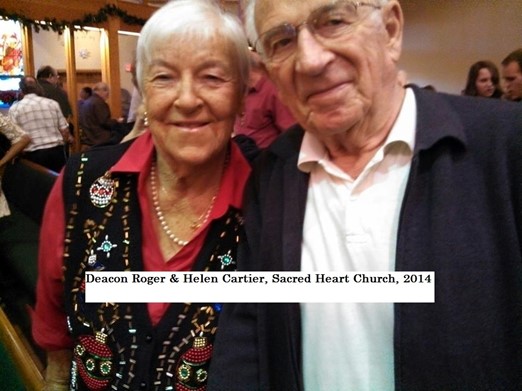
The sainted Holy Father was referring to people like Roger and Helena when he made that statement. That is because this couple did, in fact, create a domestic church when they took their marriage vows so long ago. These two people, this man, and woman are a Catholic love story not only for today but for all time. They made the ultimate commitment to each other, emptied themselves for each other, and never looked back.

I am using them as examples of the countless couples like them, past and present, who have also joined together to create “domestic churches.” These domestic churches that supported their love were built on the cornerstone we know as faith; faith in Jesus Christ. And it was Jesus who was the cornerstone of the first domestic church, which included Mary and Joseph.

Spread across the landscape of our society are many well-springs of marriage and family. These homes have one predominant thing in common. God is the essence and focal point of their lives. Roger and Helena were the patriarch and matriarch of one of those families.


null


The family is the nucleus of any society

Of course, we all know that many marriages have not worked out. But this essay is not about failed marriages. This is about the millions of marriages that have stood the test of time and became domestic churches. Sadly, secularism has convinced many the world over that marriage is what “you” want it to be, with whomever you want to be. It also proclaims that those of the Judeo-Christian faith are intolerant and have NO love in their cold hardened hearts for diversity. This secularistic atmosphere has cut deeply into the very fabric of our society and wounded it severely. That fabric is the family. And the family is the nucleus of any society.

Roger passed away in 2017. He was 91. Helena passed in in 2019 at the age of 90. Roger was a retired letter carrier. He was also an ordained deacon in the Catholic Church. When Roger passed on to his eternal reward, he and Helena had just celebrated their 68th wedding anniversary.


The thought of applying to the permanent diaconate horrified him

The Deacon was a World War II veteran. He was hired by the post office after he and Helena were married. A few years after that, he became quite active in the Knights of Columbus. He rose to the District Deputy’s position giving him oversight of many K of C councils in the Connecticut area. Then his good friend, Father Kuzdal, suggested to Roger that he should apply to the permanent diaconate. Roger was horrified. He believed he was highly unqualified to do this.

What Roger and Helena did not realize at the time was that God had chosen both of them. Just as Mary Magdalene was there to help the apostles, Helena would help her husband in a ministry that required ordination into the Sacrament of Holy Orders. They had embraced themselves with each other’s love and wrapped their Catholicity around it. The “domestic church” they created was what St. John Paul II spoke of.

Deacon Roger told me how close he was to leaving the diaconate program. All the other candidates were college graduates, seemingly well versed in Scripture, and well-spoken. He was sure he had no business being in such lofty company. He went to Father Kuzdal and voiced his concerns. Father looked at him and said, “Roger, you have a quality these other fellas do not have. You are a natural listener. You have a gift. You do belong here.”

The final confirmation came from his partner in love and life, Helena. She agreed with Father Kuzdal, and in 1986, L. Roger Cartier became Deacon L. Roger Cartier. He was ordained in the Diocese of Norwich, CT, and remained there for a year. Then it was on to Pinellas County, Fl, where he served until his retirement from ministry.

Deacon Roger assisted quietly and efficiently over the years, always being there when needed. He was the spiritual director of both The Legion of Mary and the St. Vincent de Paul Society. Roger always donned his Santa outfit for the Christmas parties delighting countless children, and he visited the school frequently, talking to the kids about being Catholic.

He was always available for Stations of the Cross, or Benediction and novenas. Roger visited the funeral homes when folks passed, did internments at the cemetery, and still spent time with the families. He was a constant fixture at the local hospital and nursing homes. He also presided over weddings and performed Baptisms.


The man was a listener. People sought him out specifically for that reason.

The one thing that was most noticeable (at least to me) was the one on one conversations he always seemed to be having with someone. This is where Father Kuzdal, so many years earlier, had profiled Roger Cartier correctly. The man was a listener. People sought him out specifically for that reason. He would look them in their eye and listen.and he would remember to ask them the next time he saw them how things were going with “such and such”: lousy back, a surgery, kids, financial worries, family problems, or whatever it might be. People loved him because they knew he cared about them. He was REAL.


null


Deacon Roger and his Helena left behind three daughters, nine grandchildren, and 14 great-grandchildren. They had formed a domestic church within our midst, and today it has expanded to over a dozen more domestic churches. It was my honor and privilege to know them. For all those who did not, comfort in the fact that people like Roger and Helena are always among us. Goodness exists and is often part of a domestic church that extends its loving arms to all that may cross its path.

Christmas is about love and giving. A young, happy couple celebrated the first Christmas by greeting their newborn Son. The Cartiers, and those like them, are the reflection of that very first Christmas.

Man and woman are created in God’s image and likeness; and for this reason, marriage likewise becomes an image of God. (Pope Francis: Rome, Italy, May 25, 2018)


Copyright© Larry Peterson 2017, 2022
Image: Pexels