Who Are the “Scribes and Pharisees?”

Who Are the “Scribes and Pharisees?”

By the grace of God, I was able to travel to Germany and attend the 2022 Oberammergau Passion Play. I learned why most people blessed with this opportunity can afterwards only murmur, “It was a privilege.”

The experience was truly beyond words. Try, for example, to describe what you feel at the moment of Eucharistic consecration?

But there are a few insights that I think I can articulate. I’ll pass over the incredible chill of an outdoor theater high in the Alps. I won’t waste words to confirm that every villager in Oberammergau, from babes in arms to tottering elders, has indeed been focused on this reenactment of the Passion of Christ, as their personal act of worship, for the past 388 years.

It was like stepping into a time travel machine. In the audience, we felt almost a part of the action, 2,000 years ago on the surging streets of Jerusalem.

But who were “the scribes and the pharisees?”

When we hear this phrase read from scripture at mass, it’s all too easy to think, “Jesus, good. Scribes and pharisees, bad.”

At the 2022 performance, these gentlemen were portrayed as dignified representatives of an ancient religious tradition, caught in an impossible trap by politics of the Roman Empire.

Yes, a few simply dismissed Jesus’ words. But many tried to listen and understand. They stood in groups gathered all across the stage, discussing the new ideas with one another, getting angry, shrugging, stomping away, and returning to debate some more. I couldn’t help but feel that’s really the way it must have been.

Jesus was a 33-year-old man, trying to articulate a new revelation in human language. The scribes and pharisees, who were attempting to take it in, did not share one understanding, nor were they of one mind about what they should do.

The brilliant actor who portrayed Jesus also found the fine edge. I was fully aware of him as our Divine Savior, and that he knew exactly what the consequences of his words and actions would be. But he was also a young man debating theology with his elders in exactly the tempestuous manner that impassioned young human adults tend to use. As our faith teaches us, he was God and human, at the same time in one person.

We live in an era when we are called to raise our consciousness about the different ways we assign people into categories, and then speak as though a category label describes every individual.

This was my third trip to the country of Germany. I’ve admired their religious monuments in cities, villages, and fields; prayed with the people at mass; felt awe and wonder at their abiding faith. That faith has sustained generation after generation of German Catholics through all that they have endured.

We speak too easily in North America about “Germans” as synonymous with “Nazis.”

What if fate had placed you in 20th century Germany, to live the most important stages of your life through two world wars, and under the sway of the Third Reich? How would you have faced the moral challenges? What destiny would you have chosen within a fate you could not escape?

We’ve forgotten that Adolph Hitler hated Catholics as much as he hated the Jewish people; forgotten the martyrs who died terrible deaths to defend their vision of Germany.

Contemporary literary fiction is replete with tales of Nazi-resistance movements in France, England, Denmark, Italy, and Holland.

But the full depth and breadth of Nazi-resistance movements within Germany itself – encompassing laborers, mothers, altar boys, laundresses, aristocrats, Protestant clergy, Catholic priests, members of religious orders, and even rebel German Air Force officers — have been brought forward only in the 21st century.

On this first Saturday of November, I offer a short list of good books about the German resistance to the Third Reich.

  • Von Moltke, Helmuth and Freya, translated by Shelley Frisch, Last Letters: The Prison Correspondence, September 1944-January 1945, New York: New York Review of Books, 2019; Editors’ Introduction copyright 2019 by Helmuth Caspar von Moltke, Dorothea von Moltke, and Johannes von Moltke.
  • Utrecht, Daniel of the Oratory, The Lion of Munster: The Bishop Who Roared Against Hitler, Charlotte, N.C.: Tan Books, 2016.
  • Riebling, Mark, Church of Spies: The Pope’s Secret War Against Hitler, New York: Basic Books, 2015.
  • Zeller, Guillaume, translated by Michael J. Miller, The Priest Barracks: Dachau, 1938-1945,San Francisco: Ignatius Press, 2015
  • Rychlak, Ronald J., Hitler, the War, and the Pope, Huntington, IN: Our Sunday Visitor Publishing Division, 2010.
  • Rabbi David G. Dalin, The Myth of Hitler’s Pope: How Pope Pius XII Rescued Jews from the Nazis, Washington, D.C.: Regnery Press, 2005.
  • Lapomarda, Vincent A., The Jesuits and the Third Reich, Second Edition, Lampeter, Ceredigion, Wales, United Kingdom: The Edwin Mellen Press, Ltd, 2005.
  • Anonymous, The Persecution of the Catholic Church in the Third Reich: Facts and Documents, Gretna, LA: Pelican Publishing Company, 2003.
  • Coady, Mary Frances, With Bound Hands, A Jesuit in Nazi Germany: The Life and Prison Letters of Alfred Delp, Chicago: Loyola Press, 2003.
  • Goldmann, O.F.M., Gereon Karl, The Shadow of His Wings, translated by Benedict Leutenegger, San Francisco: Ignatius Press, 2000.
  • Koerbling, Anton, Father Rupert Mayer: Modern Priest and Witness for Christ, Munich, Germany: Schnell & Steiner, 1950.

Copyright 2022 by Margaret Zacharias

The Passion of Christ

The Passion of Christ

These days the media seems to besiege us with headlines about the next terrible plague. Whether it’s the latest Covid variant or a new, horrible pox, it’s challenging not to become anxious. We shudder, and continue to pray that we and our families will be spared.

Imagine living in the seventeenth century Alps. Already ravaged by the Thirty Years’ War, Bavarian villagers learn that the Black Plague has come to town, in the person of a foreign peddler. They know that this frightening new disease has killed entire populations throughout the region. What will they do?

In 1633, the citizens of the Catholic village of Oberammergau, Germany, made a communal promise to God. If he saw fit to spare their town, if no one in the village died of the plague over the next twelve months, they would perform a play about the passion of Christ every tenth year, in perpetuity.

The first Oberammergau Passion Play to fulfill that offering was staged in 1634. Their promise has been faithfully kept for almost 400 years. (For more information, visit www.passionsspiele-oberammergau.de/en/home.)

Both the script and the methods of performance have evolved over the centuries. But even today, the play is still performed in its historical style of tableau. It is presented in two parts, each two-and-a-half hours long, with a break for dinner in between.

Every actor must have been born in the village, and nearly every native citizen is included somewhere in the ensemble of players.

In 2019, I watched a video of the casting ceremony for the 2020, now 2022, performances.

With an altar server carrying the crucifix before him, the parish pastor processed out of his church into the village square. The entire platz was filled with townspeople. Gathered to hear him announce the names of the persons chosen to portray the most illustrious characters, they maintained absolute silence.

The priest stopped next to the village school teacher; a young woman attired in an impeccably-pressed shirtwaist dress.  She was poised at a large blackboard, already prepared with the names of the major characters, to write the names. An alternate was also chosen for each role, in order to sustain the lengthy performance season, five days a week from May to October.

As the teacher carefully inscribed each name in exquisite handwriting, no cheers or congratulations marred the solemnity of the occasion. Only a few murmurs of satisfaction, or mild disappointment, could be heard on the film.

I’m still hoping and praying to attend the 2022 Passion Play this September.

In 2018, when my travel companion and I first began to consider our mutual bucket list trip, we were both in perfect health. Then the originally scheduled 2020 event was postponed to 2022 because of the world-wide Covid-19 pandemic.

Recently, just as our long-awaited dreams seemed about to become reality, my travel companion sustained injuries in a bicycle accident. The same week in July, I sprained an ankle.

As I walked down the hall of my apartment building a couple of nights ago, I ran into a friend who is over ninety years old. She was working out a pain in her hip at the same time I was exercising my sprained ankle.

She said, “I’ll give you my Oberammergau jacket.”

I looked at her tiny frame, then at my own considerably more substantial one, and said, “Thank you so much. But I don’t think it will fit me.”

She told me that she had attended the Oberammergau Passion Play in her younger years. After we conversed with awe about the endurance of this Bavarian tradition, she shared a parting thought about her own pilgrimage.

“I always think of that time as a special privilege.”

Both of my friends regularly take advantage of the opportunities offered to us all as Catholics, to attend mass and to be active serving neighbors in urban villages that can operate like small towns.

As I reflected on her words, I heard a message from the Holy Spirit.

At every mass, in every liturgical season, we have motivation to gather as a living community, just as the townspeople do in alpine villages like Oberammergau. We have daily chances to meditate on the passion of Christ at every mass.

It’s because the people of Oberammergau do these things that they have been able to keep a four-century-old promise, generation after generation.

It really doesn’t matter if health challenges, personal finances, family responsibilities, or the world situation allow us to travel to Jerusalem or Oberammergau – or not.

Christ’s loving offering of his passion for our salvation is eternal.

He comes to us every day, on every altar, wherever and whenever the eucharist is celebrated.

How blessed we are, indeed, by that special privilege.


Copyright 2022 by Margaret Zacharias 

Puerto Rico’s ‘Father of Public Education’ Never Went to School

Rafael Cordero y Molina came into this world on October 24, 1790, in San Juan, Puerto Rico. He was born into a low-income family and had two older sisters. His dad, Lucas Cordero, worked on a tobacco farm and his mom, Rita Molina, took care of the children and the home. Although considered “free,” they were also Black, and because of that, their children were not allowed to attend school.

Dedication and determination led him forward

Rafael’s parents had a small amount of education and imparted what they could to their children. Rafael showed an instant love of reading and began to read as much as possible. He developed a passion for literature. That dedication, coupled with his determination to become a teacher, led him on his arduous journey to achieve his goal.

Rafael’s mom and dad did their best to instill the faith into their children. Instruction in the faith by the local priest was open to all. At the age of 14, he received the Sacrament of Confirmation. From that point forward, he would continue to grow in faith and remain a devout Catholic his entire life.

He always refused money for teaching

Rafael began working in the tobacco fields at a young age. When he was twenty years of age, he managed to open a school in the town of  San Germán. From the very beginning of his career as a teacher, the young man would never accept any money or gifts for his teaching. His earnings as a tobacco farmer and maker of tobacco products were the only monies he would ever consider using.

Rafael’s school in San Germán was on the street known as Moon of San Juan. In the beginning, it was just Black and biracial children attending his school. As time went by, underprivileged white children also began attending. When racial segregation was a dominant factor in many places around the world, Rafael treated all people the same and never discriminated against anyone.

He would be at this school for the next 58 years. He taught children not only how to read and write, but also arithmetic, history, Catholic doctrine, and even calligraphy. The place was not only a school; it was also his home and a tobacco shop. He would instruct the children, and while they studied, he would roll cigars to sell. On the walls, he had images of Our Lady of Mount Carmel and his patron, St. Anthony of Padua. There also was a large crucifix hanging for all to see.

In 1847 Juan Prim y Prats became the governor. He hated all non-whites and immediately set out to subjugate them. Governor Prim instituted direct repression of Blacks on the island. He decreed the “Bando Negro” law which justified any aggression against Blacks, be they free or slaves. Writings show that Prim visited Rafael’s school several times and, unexpectedly, always approved of its operation. Rafael attributed that to prayer and protection from Our Lady. Prim lasted in power only a year, and all Blacks and people of mixed race on the island breathed a deep sigh of relief.

His reputation as a saintly teacher grew

Rafael Cordero’s reputation as a saintly teacher grew, and more people wanted to send their children to him, including the rich. People began calling him the “Maestro.” Some of those who studied under him included Alejandro Tapia y Rivera, a famous poet, and playwright; Román Baldorioty de Castro, a professor and politician; and José Julián Acosta, the journalist.

“Maestro” Rafael Cordero devoted his entire life to the free education of children and young people. In 1868, sensing the end of his life was near, he called his students together and prayed with them. He gave them his blessing, saying, “My children, pray for this poor old man who has taught you how much he knew. He has nothing left but a breath of life.”

He became known as the father of Public Education in Puerto Rico

A few minutes later, at 5 p.m. on July 5, 1868, he died. Next to him were a burning candle and scapulars sent to his bedside by the Carmelites. More than 2000 people attended his funeral, and he became known as the Father of Public Education in Puerto Rico.

Each year in Puerto Rico, the Rafael Cordero National Medal is given to the annual Teacher of the Year. Schools are named after him in Puerto Rico, Jersey City, N.J., and Brooklyn, N.Y. Finally, the schoolhouse where he taught is registered as a historical site in the National registry of Historical Places of the United States.

A man of heroic virtue

In 2004 the process of Rafael Cordero’s canonization was begun. On December 9, 2013, Pope Francis declared that Cordero had lived a life of heroic virtue and was worthy of the title Venerable.

Venerable Rafael Cordero y Molina, please pray for us.


Copyright©Larry Peterson 2022

Pope St. Stephen I—He defined the Sacrament of Baptism and it Stands to this Day

If we could travel back in time to the middle of the third century we would quickly discover the Catholic Church, although quite different from today, had many similarities to our modern-day Church. There was plenty of hierarchical infighting going on and the politics of leading the Church was in flux.

In 250 AD, the Roman emperor Decius, unhappy as to how Christianity was spreading, embarked on a persecution of the Christians that, until that time, was the most brutal they had ever faced. Among the first to die was Pope Fabian, the sixteenth pope, who had held the papacy for fourteen years.

When Fabian died, he was followed by Pope Cornelius, who died within a year. He was followed by Pope Lucius I, who also died within a year. Both of these men died of natural causes. The Church was then without a pope and was run by a collective, under the direction of a priest named Novatian.

Emperor Decius demanded that all Christians offer sacrifice to the Roman gods to show their loyalty to Rome. Any who refused were executed. Others fled into the countryside or tried to bribe officials. The last recourse was to reject the Faith. Many took this route. It was an easier path than giving up one’s life.

After Fabian’s murder, a huge pastoral problem arose. Emperor Decius’ persecution had seen many Christians purchase certificates attesting to the fact that they had made the required sacrifices to the Roman Gods. Other had denied that they were Christians, while still others took part in pagan sacrifices.

These people were called “lapsi.” The question within the still-fledgling Church was whether, if they repented for their sins, they could be readmitted to full communion with the Church. If they could, what would be the conditions? Novatian was preaching the false doctrine that those people who were “lapsi” could not be forgiven while the Catholic position was to grant full communion to those who fully repented.

Novatian and his followers would only grant fellowship to the sinners, not full communion. Novatian went even further and said that those who had denied the Faith and worshipped idols could not be forgiven, as the Church did not have the power to do so. He said that being baptized does not administer forgiveness for certain heinous sins.

Pope Lucius had appointed his archdeacon, Stephen, as his successor (this was way before the College of Cardinals) and Pope Stephen I was faced with the task of reuniting the Church from the schism started by Novatian. He began his papacy in the year 254.

Stephen’s most important battle was his defense of the Sacrament of Baptism. The Novatianist priests were re-baptizing those who sought forgiveness. Stephen insisted that re-baptizing a previously baptized person was unnecessary. He argued that only absolution was required to regain full communion with the church. Cyprian of Carthage and other African and Asian bishops called what the Novationists were doing as heretical.

Stephen, who had the support of Cyprian and other bishops, was pressured from others within the Church to be flexible and allow re-baptism for the Novatianist priests. Stephen would not waver and stayed true to his conviction. Even Cyprian changed his mind and disagreed loudly, claiming that baptism administered by heretics was invalid. All those people who had received this sacrament would need to be re-baptized.

But Stephen was the Bishop of Rome. The unwavering defense of his position on Baptism more than likely established Rome as the seat of the Church. He claimed that he was occupying the seat of Peter as handed down by Christ. Stephen is recognized as the first pope to formally announce the primacy of Rome. He also decreed that baptism, if administered by anyone with the right intent, is valid. That practice stands today, 1800 years later.

Stephen died in 257 and his Feast Day is August 2. He is honored as a saint in both the Catholic Church and the Eastern Orthodox Church.

St. Stephen I, pray for us.

Copyright 2018 Larry Peterson

The Nativity of Our Lord

NativityLuke 2: 1-20 The Infancy Narrative

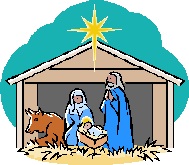
In those days a decree went out from Caesar Augustus that the whole world should be enrolled. This was the first enrollment, when Quirinius was governor of Syria. So all went to be enrolled, each to his own town. And Joseph too went up from Galilee from the town of Nazareth to Judea, to the city of David that is called Bethlehem , because he was of the house and family of David, to be enrolled with Mary, his betrothed, who was with child. While they were there, the time came for her to have her child, and she gave birth to her firstborn son. She wrapped him in swaddling clothes and laid him in a manger, because there was no room for them in the inn.

Now there were shepherds in that region living in the fields and keeping the night watch over their flock. The angel of the Lord appeared to them and the glory of the Lord shone around them, and they were struck with great fear. The angel said to them, “Do not be afraid, for behold, I proclaim to you good news of great joy that will be for all the people. For today in the city of David a savior has been born for you who is Messiah and Lord. And this will be a sign for you: you will find an infant wrapped in swaddling clothes and lying in a manger.” And suddenly there was a multitude of the heavenly host with the angel, praising God and saying:

“Glory to God in the highest and on earth peace to those on whom his favor rests.”

When the angels went away from them to heaven, the shepherds said to one another, “Let us go, then, to Bethlehem to see this thing that has taken place, which the Lord has made known to us.” So they went in haste and found Mary and Joseph, and the infant lying in the manger. When they saw this, they made known the message that had been told them about this child. All who heard it were amazed by what had been told them by the shepherds. And Mary kept all these things, reflecting on them in her heart. Then the shepherds returned, glorifying and praising God for all they had heard and seen, just as it had been told to them.

We, too, keep all these things, reflecting on them in our hearts, and give glory and praise to God for all we have seen and heard, just as it has been told to us.

Merry Christmas

A blessed Christmas Eve to all

Luke 2: 1-20 The Infancy Narrative

NativityIn those days a decree went out from Caesar Augustus that the whole world should be enrolled. This was the first enrollment, when Quirinius was governor of Syria. So all went to be enrolled, each to his own town. And Joseph too went up from Galilee from the town of Nazareth to Judea, to the city of David that is called Bethlehem , because he was of the house and family of David, to be enrolled with Mary, his betrothed, who was with child. While they were there, the time came for her to have her child, and she gave birth to her firstborn son. She wrapped him in swaddling clothes and laid him in a manger, because there was no room for them in the inn.

Now there were shepherds in that region living in the fields and keeping the night watch over their flock. The angel of the Lord appeared to them and the glory of the Lord shone around them, and they were struck with great fear. The angel said to them, “Do not be afraid, for behold, I proclaim to you good news of great joy that will be for all the people. For today in the city of David a savior has been born for you who is Messiah and Lord. And this will be a sign for you: you will find an infant wrapped in swaddling clothes and lying in a manger.” And suddenly there was a multitude of the heavenly host with the angel, praising God and saying:

“Glory to God in the highest and on earth peace to those on whom his favor rests.”

When the angels went away from them to heaven, the shepherds said to one another, “Let us go, then, to Bethlehem to see this thing that has taken place, which the Lord has made known to us.” So they went in haste and found Mary and Joseph, and the infant lying in the manger. When they saw this, they made known the message that had been told them about this child. All who heard it were amazed by what had been told them by the shepherds. And Mary kept all these things, reflecting on them in her heart. Then the shepherds returned, glorifying and praising God for all they had heard and seen, just as it had been told to them.

We, too, keep all these things, reflecting on them in our hearts, and give glory and praise to God for all we have seen and heard, just as it has been told to us.

Merry Christmas