Buried Treasure

Buried Treasure


When I enter my house, I shall find rest with her, for companionship with her has no bitterness, and life with her has no pain. – Wisdom 8:16


As Mom’s life was fading, we kept vigil by her bedside. Adjacent to Mom’s hospital bed sat the king-sized bed, which allowed me to rest comfortably overnight.

During the day, Mom’s faithful aide was present and hospice staff sifted in and out – the nurse, social worker, hospice aide, chaplain. There was a grief counselor on call, who promised availability for an entire year after Mom died.

With a tiny syringe, we administered medication and water, squeezing them into the corner of Mom’s mouth. I could hear her swallow the liquid. Also given were strong painkillers to ease her moments of agitation and restlessness.

In the afternoon came a lull as Mom slept. Feeling weary, I stretched out beneath the bedspread of the king-sized bed and closed my eyes.

My daughter entered the room and sat quietly at the bedside of her beloved “Gigi.” After a time, she approached the king-sized bed and lifted the bedspread. Then, my daughter climbed in beside me. We spoke not, but just lay beneath the cover, our mutual grief providing a blanket of comfort and support. She remained there with me for an hour or more as I recalled times she’d spent as a child with Gigi – playing, painting, eating popcorn, and for six months as a teenager, living in one of the bedrooms here. Deep within all of us, gentle transitions were taking place.

Thank you, Lord, that amidst the loss of a loved one there can be relational gain.

Reflect: Think of your loved one’s family members, whether they live near or far. If there is any discord, pray for healing.


The above selection is Entry #51 in Part V: The Final Season of Minding Mom: A Caregiver’s Devotional Story by Lisa Livezey (© 2024, En Route Books and Media)

Minding Mom: A Caregiver’s Devotional Story by Lisa Livezey | En Route Books and Media

Featured Image: (photo courtesy of Bronwyn Livezey)

Bed Climb

Bed Climb

He lay down to sleep, resting his head on a stone.  – Genesis 28:11 (GNT)


When Mom and Dad became empty-nesters, they hired a contractor to renovate the spacious attic area of their home, raising the roof and adding large windows, closets, and a small bathroom.  The result was a master bedroom that felt like sleeping in a treehouse.

After Dad’s death, Mom continued climbing the six steps to this attic-level bedroom for both her afternoon naps and overnight sleep. I found it a pleasant place to help Mom each morning. After her shower, I would place a chair by the window and blow dry Mom’s hair using a round brush.  She had naturally wavy and full hair, so my styling efforts yielded nice results.

With Mom’s needs increasing, I struggled to attend to her in the small bathroom. A bigger bathroom, located on the middle level, connected to a large blue bedroom. I started directing Mom to that bedroom for afternoon naps and she obediently complied, but at night insisted on the attic bedroom.

Rather than fight, I placed the two massive wooden dining room table inserts atop the bed in the attic room thinking this would deter Mom. You can imagine my surprise the next evening when, after tidying up the kitchen, I headed upstairs to find Mom lying atop the table inserts!

The next day, my husband replaced the attic bedroom doorknob with a lockable knob.  When Mom tried the door and found it locked, she compliantly turned and went into the blue bedroom.

Help us and our loved ones to adjust, Lord, as we adapt to their changing needs.

Reflect: What changes have you made recently to accommodate your loved one?  Ask the Lord for extra grace amidst the changes.


The above selection is Entry #46 in Part V: The Final Season of Minding Mom: A Caregiver’s Devotional Story by Lisa Livezey (© 2024, En Route Books and Media)

Minding Mom: A Caregiver’s Devotional Story by Lisa Livezey | En Route Books and Media

Featured Image: (www.freepik.com)


From Grief Through Mourning

Last year, I could not do it. This year I did.

In the Catholic Church, the month of November begins with two consecutive liturgies that honor our beloved dead, The Solemnity of All Saints and the Commemoration of All Souls.

We always hope that departed family members and friends might be celebrating the first feast with us, already among the saints in heaven. We trust that our prayers will help to console and sustain any loved ones who might, this year, still remain in purgatory.

It takes most people a long time to establish their ‘new normal’ after a family member’s or close friend’s death.

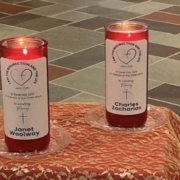
In my parish, one of these opportunities is a Mass of Remembrance offered each year on the Saturday morning before All Saints Day. A candle is provided for each family to place around the altar when their loved one’s name is proclaimed, and these candles are lit for each mass through the month of November

Last year, the 2024 Mass of Remembrance was scheduled just ten days after my husband’s funeral. With a sincere intention, I had placed his name on the list.

But when that Saturday morning arrived, I found myself still too exhausted from his sudden, unexpected death, the need to transport his remains from another state, and managing to stay functional — with help from close family and friends — for the funeral.

Last year, another dear friend stepped up to carry Charles’ Mass of Remembrance candle for me. This year I was able to carry it myself.

***

Beyond Catholic parishes’ roles in helping to organize funeral liturgies and hospitality, many also offer valuable longer-term support options, to help families survive devastating grief and manage the psychological challenges that always accompany any great loss.

We are all unique creations of God, and every person’s grief process is unique. So, I want to briefly share two more long-term support options offered by the grief ministry in my parish.

What has served me best might not be right for you. Likewise, parts of these programs that did not most resonate with me, might be just right for you.

I include them here because I believe they offer a range of valuable options to meet a variety of needs for different mourners.

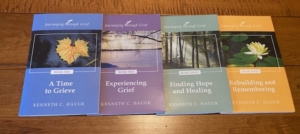
The first is a year-long series of booklets, +/- 40 pp. each, written by Kenneth C. Hauck and published by Stephen Ministries in 2004. Entitled  A Time to Grieve, Experiencing Grief, Finding Hope and Healing, and Rebuilding and Remembering. These were mailed to me quarterly after my late husband’s funeral, as gifts from my parish.

Because I am an introverted person who normally reads and writes alone, I appreciated the freedom to digest these words of wisdom privately, and on my own schedule. The quarterly mailing time frame felt just right, too.

For those who feel more enthusiastic than I do about watching videos and participating in weekly discussion groups, another excellent support option offered by my parish is titled Grieving with Great Hope.

Meditation Journal written by John O’Shaughnessy, Sandy O’Shaughnessy, and Fr. John Riccardo,
part of the Grieving with Great Hope parish program, published by Good Mourning Ministry, Inc.

This program includes a series of videos, and small discussion groups with fellow mourners from your own parish. Ordinarily, those who join this program are in closely similar time periods after a loss.

The program includes a journal published by John and Sandy O’Shaughnessy, with Contributing Writer Fr. John Riccardo, as part of Good Mourning Ministry, Inc.

Of the resources offered by this ministry, I’ve personally found silent meditation and private writing, with the suggested journal

reflections, to be the most helpful. But I have also witnessed the benefits gleaned by others, from watching the videos and participating in discussion groups.

***

At the Mass of Remembrance on October 25, 2025, my deceased husband’s date of passing was the longest elapsed. I had been prepared beforehand, by our deacon’s gentle and compassionate wife, to hear his name called first and to face the empty altar alone.

As I bowed before the altar I tried to discern, among all the candle holders so lovingly arranged, where might be Charles’ place. The Holy Spirit led me to a place on the side by my accustomed pew, when I sing with the funeral choir, near the altar and close under the crucifix.

While a total of almost forty names were called, I prayed for each soul, and watched each family approach the deacon to receive their candles.

Charles’ light had to hold his mountain alone, for a long time. I began to wonder, who will God send, to occupy that spot beside him?

About three-quarters of the way through the list, I heard the name of a dear friend, mentor, and fellow funeral choir member. She and her late husband had coordinated our county-wide nursing home citizen-visitor ministry throughout their long retirement years. I had been a part of that ministry.

I watched Janet’s four children — none of whom I had ever met — come up to receive their candle, and bow. I could feel them doing their own discernment.

When they came over, to place Janet’s candle next to Charles, I could almost hear her saying, “Don’t worry, Margaret. I’ll look after him myself.”

***

Wherever any of you may be in your own grief journeys, no matter who you might be mourning this November, please know that I am

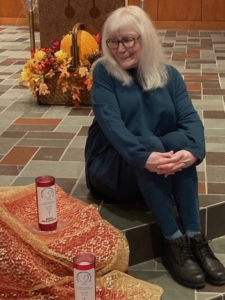
Author meditating on the candles, after Mass of Remembrance at St. Theresa of the Child Jesus Catholic Church, Des Moines, Iowa, October 25, 2025.

praying for you.

I ask your continuing prayers for me, too.

This will be my last CWG column for a while. I need a brief sabbatical; to continue dealing with the massive changes I’ve experienced

over the past fourteen months, and to discern where my own ‘new normal’ life will lead.

May the compassion of Our Lord’s most Sacred Heart, the love of Mary’s Immaculate Heart, and the wisdom of the Holy Spirit remain with you, as well.

Blessings, always,

Margaret


© Copyright 2025  by Margaret King Zacharias

All photos from author’s personal collection; used with permission by the author

Featured photo: Candles lit for Mass of Remembrance, St. Theresa of the Child Jesus Parish, Des Moines, Iowa, on
October 25, 2025. Author’s personal photo, published with permission.


This Magic Moment

This Magic Moment


And he vanished from their sight.  – Luke 24:31(NRSVCE)


Our youngest son, Trevor, entered the world when I was forty-three. Creative, talkative, and strong-willed, he brought much delight to my parents in their later years. When Trevor was three, Mom nicknamed him “The White Tornado” from the way his platinum-blonde, bowl haircut whirled about as he raced through their house.

Trevor was age eight when Dad died, and the grief he suffered at the loss of his beloved grandfather continues to this day. The year prior, Trevor had started teaching himself card tricks, eventually advancing to simple illusion-type magic tricks.

Always eager for a new audience, Trevor practiced his magic acts on Mom in her last days and on the hospice staff that came to the house. The nurse manager especially enjoyed his antics, and she dubbed him “The Great Trevini.”

After every trick, Trevor would ask, “Do you know how I did it?” Despite his delight at presenting magic, he also enjoyed divulging the method behind the trick. What’s harder to explain in words is the magical effect that his moments of fun brought to a home where Alzheimer’s was ravaging a loved one’s body and brain.

Dear Lord, thank you for Your mysterious ways, such as how you returned to heaven through the clouds. Thank you, also, for the mystery of the way child’s play can bring comfort to those around him.  

Reflect: Is there a child you know whose young spirit can bring a fresh moment to you and your loved one? Pray about having that young person stop by to visit.


The above selection is Entry #42 in Part IV: Summer Daze of Minding Mom: A Caregiver’s Devotional Story by Lisa Livezey (© 2024, En Route Books and Media)

Minding Mom: A Caregiver’s Devotional Story by Lisa Livezey | En Route Books and Media

Featured Image: The Great Trevini (photo:Lisa Livezey)

Making Peace with the Sea Oats

Making Peace with the Sea Oats

by Paula Veloso Babadi

“Peace I leave with you; my peace I give to you. I do not give to you as the world gives. Do not let your hearts be troubled, and do not let them be afraid.”—John 14:27

Letting go isn’t always easy. I know because I’ve been holding on to a dilapidated container housing sea oats that are at least sixty years removed from the Pensacola dunes where our family picked them. Every time I look at them, I am reminded of a happy childhood, where every Sunday after Mass, my parents, sisters, and I would trek to paradise in our yellow station wagon, packed with a picnic, beach gear, and lots of laughter and singing.

Two years ago, I wrote a poem about those sea oats after realizing that every time I passed by them in my office/library a few more oats would fall to the ground. I questioned why I couldn’t just throw them out. They weren’t just sea oats to me—they were the sun and smile of my parents, the kindness of my sisters who spent their allowances to buy the wicker urn. They were the warmth of our home, the memory of gatherings in the family room (where they sat for years), a lovely complement to the wavy blue colors of the carpet. I knew they were a daily reminder of my wonderful parents and sisters, and I wasn’t ready to let go.

When I complained about the mess the sea oats were making, my sister, Virginia, recommended a couple of years ago that I should take a picture and then dispose of them in a dignified manner. I never did. But after talking with Virginia today, I told her I was ready to let them go and would bury them in my garden in a nice spot where they will enrich the earth. I’ll hold on to my memories, and I am at peace with that gift.


Sea Oats

by Paula Veloso Babadi


More than half a century ago,

they stood tall in a white wicker urn,

salty grain dipping towards the ocean

of my parents’ multi-blue Sears and Roebuck carpet.


Before storms Camille, Opal, and Ivan,

before the erosion of sugar-fine dunes,

before laws forbidding their plucking,

we watched our treasures sway in the air-conditioned breeze

and smiled with memories of their harvest,

on lazy Gulf days by surf, sun, and sea life.


Today, my parents are gone.

The sea oats are withered and sparse

drooping over now-grayed wicker walls,

resting against my crisp white library shelves.

Any breeze might rob them of the last browned seeds,

But parting is not yet an option.


Copyright 2025 Paula Veloso Babadi

Edited by Gabriella Batel

Photo Credit Pexels

Dramatic Dahlia

Dramatic Dahlia


And from His fulness we have all received, grace upon grace. – John 1:16


I noticed it in the neighbor’s yard near Mom’s house – a giant flower blooming upon a single tall stem. It was unlike any cultivated flower I’d ever seen.  Peach in color, it had straight, pointed dense petals that radiated up and out to result in a huge blossom the size of a dinner plate.

Although this immense bloom stood near other flowering shrubs, its dramatic size captured the onlooker’s gaze. I’d never seen anyone working in the yard but was tempted to knock upon the door just to find out the variety of this stunning stroke of nature.

You can imagine my surprise the next afternoon, after walking through Mom’s rec room and climbing the six steps to the kitchen to find that very same flower standing in a vase on the kitchen table. The aide stood at the counter preparing an afternoon snack for Mom, and she filled me in.

On their daily walk, Mom and her aide had shared friendly conversation several times with the neighbor in whose yard the flower grew. It was he who had picked this masterpiece and chosen to bestow it upon my sweet, Alzheimer’s-stricken mother. The gardener gave the best flower of all to Mom.

Lord, thank you for choosing the most fragile among us to receive the greatest graces.

Reflect: Can you think of a time when someone brought you flowers or fresh garden produce?  Think about the fragrance or the taste, appreciating God’s goodness in those moments


The above selection is Entry #37 in Part IV: Summer Daze of Minding Mom: A Caregiver’s Devotional Story by Lisa Livezey (© 2024, En Route Books and Media)

Minding Mom: A Caregiver’s Devotional Story by Lisa Livezey | En Route Books and Media

She is not in Scripture, but St. Veronica Captures the ‘True Image’ of Christ’s Teachings

She is not in Scripture, but St. Veronica Captures the ‘True Image’ of Christ’s Teachings

July 2025 revealed significant information about family caregivers that applies to millions of people. The data has gone largely unnoticed in favor of more scintillating political headlines of the summer. AARP and the National Alliance for Caregiving released the 140-page,Caregiving in the US, a report which discloses the startling revelation that nearly 25 percent of Americans are long-term caregivers of a family member. That percentage translates to 63 million caregivers, an increase of 45 percent in only 10 years.¹

The non-quantifiers: loneliness, isolation, and lack of training haven’t changed in the last decade. The struggle to continue working for financial stability versus giving the appropriate care the loved one needs remains an issue, although government programs have been enacted this year to pay some caregivers. The majority of family caregivers are women, who are among the 59 million providing for patients that the report refers to as having a “complex medical condition or disability.” ¹

The role of faith and prayer are absent from the report and, if it were included, might provide a bright spot in an otherwise bleak portrait. The Catholic Church’s contributions to hospitals and hospice have been documented over the generations, but strangely, there is no patron saint for this kind of family caregiving. St. John typically pops up first in a search for bringing the Blessed Mother into his home following the Crucifixion. St. Vincent DePaul for his nurturing sometimes is mentioned. St. Elizabeth of Hungary who fed the poor is an option for people looking for a woman caregiver. There are others too, all of whom provided mighty works of corporal mercy, but don’t quite reflect the model of family caregivers that could provide the quiet, strong support the faithful seek.


Here is one to consider: St. Veronica. 

What did Veronica do?

Veronica is known for handing a cloth to Jesus Christ on the Via Dolorosa to wipe his face. He imprinted his face, and this cloth that is still believed to exist is stored in Rome at the Vatican. That is Veronica’s action at the most basic level.

But what exactly did she do and what does it have to do with modern-day family caregivers?

Veronica was available in the moment when Jesus would pass by, willing to change her whole life. She had paid attention to the events leading up to Jesus’s way to the cross and anticipated, regardless of the difficulties it would bring to her personally, the moment when she would be needed. She broke through the Centurion guards to reach Jesus. Consider that risk. Without looking and with just an elbow, one of the guards could have knocked her to the ground, rendering her unconscious. Any one of them could have applied more force, just for the fun of it. We know, based on what they did to Jesus, that inflicting pain was sport to them. In any way, they could have prevented her from reaching Him. Her focus, faith, and compassion, just to offer a moment of comfort and care to a man who was on his way to death, were stronger than a Centurion guard. It seems like so much to do for something so little, and in the end, wouldn’t change the outcome.

Family caregivers exhibit these characteristics.

True, in 2025 the landscape is much different, but caregivers still have their own kind of Centurion guards. Anyone dealing with insurance companies, medical establishment, or critical and absent family members faces their own Centurion guards. There is also the inner Centurion guard to confront. Uprooting your life to take care of someone isn’t easy to do, even knowing it’s the right thing and you’ll end up doing it. These foes want to tear the caregiver down, but faith, focus, and compassion prove stronger. Caregiving can last for weeks, months, or years. Some days can feel like years, but in many cases the whole period turns out to be little more than a blink compared with two people’s lifetimes. It’s a big job too, but it’s those ordinary happenings — sharing a memory while buttoning a pajama top or finding a silly moment during a bath— that prove to have the same impact as offering and receiving a face cloth. 

Who was Veronica?

Maybe the most surprising facet of the Veronica story is that, unlike Simon of Cyrene and the weeping women, Veronica is not mentioned in the Bible. She is a part of Catholic tradition. We know her from the sixth of the 14 traditional Stations of the Cross, a Catholic devotion that has been in existence for centuries. Some traditions claim her as the unnamed woman who hemorrhaged for 12 years (Matthew 9:20-22; Mark 5:25-34; Luke 8:43-48). We also know her through Catholic mystics. The 14th Century reclusive English nun, Julian of Norwich, refers to her by name in the second and eighth visions in The Revelation of Divine Love in Sixteen Showings but does not speak specifically about her.

No one, however, offers a caregiver profile of Veronica better than Bl. Anne Catherine Emmerich, beatified by Pope St. John Paul II in 2004. She describes Veronica in enthralling detail in the visions recounted in The Complete Vision of Anne Catherine Emmerich.² In his podcast, The Life of Jesus Christ in a Year, taken from the four-volume set of the same title, Fr. Edward Looney reads from the book and offers his insights that mirror the same captivating minutiae. ³ In Complete Visions, she sets the scene in a tense and crowded Jerusalem streetscape when, emerging from a flight of steps, a “tall elegant woman holding a little girl by the hand” hurries toward the procession. ² Her name is Seraphia, and she is the wife of a Temple council member named Sirach. The girl, about nine or ten, is her adopted daughter, and she is hiding a mug of spiced wine under her cloak to offer to the Lord. The two encountered resistance when trying to break through frontline guards.

“Transported with love and compassion, with the child holding fast to her dress, she pressed through the mob running at the side of the procession, in through the soldiers and executioners, stepped before Jesus, fell on her knees, and held up to Him the outspread end of the linen kerchief …” ²

The kerchief, sometimes called a cloth, sometimes the veil of Veronica, is described as “… a strip of fine wool about three times as long as wide. It was usually worn around the neck, and sometimes a second was thrown over the shoulder. It was customary upon meeting one in sorrow, in tears, in misery, in sickness, or in fatigue, to present it to wipe the face. It was a sign of mourning and sympathy.” ²

If that is not a sign of a caregiver, then what is?

Additionally, Bl. Anne Catherine goes on to say that Seraphia, who was older than the Blessed Mother, is a relative of Jesus through John the Baptist’s father, and that she knew Mary since the Queen of Heaven had been a little girl. Seraphia knew Jesus was the Messiah, having also been related to Simeon who helped to raise her, and that she made sure Jesus, as a 12-year old, was fed during the harried time Mary and Joseph were searching for Him only to find the boy preaching in His Father’s house. She literally was a family caregiver of various methods over the lifetime of Jesus Christ.

Our Lord’s sense of irony won’t be lost on many caregivers who feel unseen and unheard: the individual who cares for Him and preserves His image is absent in Scripture. 

Bl. Anne Catherine says so much about this courageous woman in only two pages of Complete Visions and also in The Life of Christ, including how she came to be known as “Veronica.” It means “true image.”² The cloth that the Vatican protects is often referred to as “The Veronica.” Like many who loved the Lord, she was later persecuted, arrested, and died a martyr from starvation. Her feast day is in July (12th), the same month this latest report on caregivers was released. She is heralded rightly as the patron saint of photographers and of laundresses. If we are to believe Bl. Anne Catherine Emmerich, however, she deserves as well to be regarded as patron of one of the most precious roles in modern society: the family caregiver.

Saint Veronica, pray for all caregivers!


1. AARP and the National Alliance for Caregiving, Caregiving in the US Research Report (Location unlisted July 2025), 7.

2. Emmerich, Anne Catherine and Catholic Book Club Editors, The Complete Visions of Anne Catherine Emmerich, Catholic Book Club. (Location unlisted 2014), 676.

3.  Looney, Edward. “Day 274: Veronica Wipes the Face of Jesus. The Mystical City of God in a Year.” April 11, 2022. Audio Podcast, 35 min. 5 sec. https://open.spotify.com/episode/4JYwyULbJvqYggsXB3A0nU?si=Dm0ED69mSTS7jJJ6NuSnBQ

Featured Image by 🆓 Use at your Ease 👌🏼 from Pixabay

Copyright 2025 by Mary McWilliams

Edited by Rietta Parker


A Pal’s Eval

A Pal’s Eval


“What you are doing is not good. You and the people with you will wear yourselves out, for the  thing is too heavy for you.”  –  Exodus 18:17,18


I contacted my church friend, Steve, who worked for a company that offered on-site consultations to those caring for an aging loved one at home.

Steve arrived on a Sunday afternoon – Mom and I met him at the door. Although Mom didn’t know why he was there, her antennae were up. Saying she didn’t want to intrude, Mom descended the six steps to the rec room as Steve and I sat at the kitchen table.

Eventually I checked on Mom and found her trying to listen in while simultaneously “organizing” the room. Books and videos were strewn everywhere. “Mom, would you like to join us?” I asked.

“I want to give you privacy,” she answered. I welcomed her up to the kitchen.

Mom sat at the table, eagerly listening as Steve discussed assisted living options. Suddenly she reached across the table to me, “We can do this, Sis!” she said eagerly.  Hmmm, I thought. Does she think we are siblings discussing options for a parent or is she trying to tell me something?

Steve and I finished and stood up as he gathered his papers. As we walked towards the door, Steve lowered his voice and offered his initial take on things.

“Your Mom is doing well,” he said, “But it’s full-time work for you amidst your own full-time life and family.” He promised a follow-up email containing a summary and recommendations.

Thank you, Lord, for kind friends who provide knowledgeable, unbiased advice.

Reflect: Are you weary from your full-time caregiving work on top of your own full-time life?  Know that God sees you laboring in the trenches and pray for wisdom.


The above selection is Entry #33 in Part IV: Summer Daze of Minding Mom: A Caregiver’s Devotional Story by Lisa Livezey (© 2024, En Route Books and Media)

Minding Mom: A Caregiver’s Devotional Story by Lisa Livezey | En Route Books and Media

Meeting Bruder Klaus

Meeting Bruder Klaus

Part II

Niklaus von Flüe was born to a successful and well-respected Swiss farming family in the Flüeli-Ranft region near Sachseln, Canton Obwalden, Switzerland, in 1417. At the age of 30, he married a local teenager named Dorothy, and together they brought forth ten children, while Klaus maintained and extended his family’s position in his community. He served his community as a soldier, councilor, and judge. He was known for his strong moral conscience, practical prudence, and thoughtful wisdom. Then he received a call from God that changed everything.

Biographers, theologians and, most recently, psychologists have translated and interpreted in different ways the historical resources about mystical visions Bruder Klaus experienced throughout his life. These visions began while he was still in the womb. But all commentators have come away with deep respect for his genuine holiness.



The first biography was written by the Abbot of Einsiedeln Abbey while Niklaus was still alive (1). Bruder Klaus recognized both the places and people at his infant baptism, because he had seen them before he was born, and his adult spiritual director, Heiny am Grund of Lucerne, authenticated these recollections (2).

Bruder Klaus gave wise counsel that prevented a civil war from arising in a conflict between urban and rural cantons, at the Tagsatzung of Stans in 1481.

His direct and powerful experiences of God eventually led him to become a hermit in the Ranft, with his wife Dorothy’s full support. She continued to raise their family in their original family home, while his older sons worked the farm.

Bruder Klaus himself was illiterate. He drew maps of his encounters with a living God, and shared his drawings with trusted priests and monks as well as his loyal wife and children. As a man of the people and a man of his time, Bruder Klaus lived by the sacraments and prayer. He used images to communicate the ineffable.

His invincible moral character has continued to inspire pilgrimages to his simple home, and awe for his holiness, for more than six hundred years. He lived in a time of polarization, greed, and the violence of war – a time not unlike our own — through a century when even the Church was electing three conflicting popes.

And his legacy of faith has endured. He was beatified in 1669, and canonized in 1947 by Pope Pius XII.

I could go on and on myself, trying to tell you about Bruder Klaus.

What I really want to do today is to show you. Here’s an opportunity for a virtual pilgrimage of your own. I think you’ll find the film and images that follow worthy of meditation, should you feel inclined to experience the spirit of St. Niklaus, and his lasting impact, through traditional sounds and scenery of Switzerland that still resonate today. Film: https://www.youtube.com/watch?app=desktop&v=sm2Wjjs3-f0

Peace be with you.

Bruder Klaus Prayer

“My Lord and my God, take from me everything that distances me from you.
My Lord and my God, give me everything that brings me closer to you.
My Lord and my God, detach me from myself to give my all to you.”

Source, with attribution to the Catechism of the Catholic Church,

https://en.wikipedia.org/wiki/Nicholas_of_Flüe


© Copyright 2025 by Margaret King Zacharias

Sources

  1. https://en.wikipedia.org/wiki/Nicholas_of_Flüe
  2. Von Franz, Marie-Louise, Niklaus von Flüe and Saint Perpetua: A Psychological Interpretation of Their Visions, Asheville, N.C., 2022, pp. 10-11, IP 15, fn. 13-24. This work is cited here for scholarly translation of original German biographical sources and summary of historical facts about Bruder Klaus, originally written in German and only recently translated; without endorsing all interpretations made in this volume, per the caveat offered in the book below.
  3. Ulanov, Anne Belford, and Dueck, Alvin, The Living God and Our Living Psyche: What Christians Can Learn from Carl Jung, B. Eerdmans Publishing Co., 2008. The authors warn that, although theology and psychology can each offer valuable insights to the other, they are not the same, and not all of their different perspectives always overlap or agree.

Images:

Featured Image: Main room of the home where St. Niklaus von Flüe lived with his wife Dorothy and ten children during the first half of his life. Attribution: A Pakeha, CC BY-SA 4.0 <https://creativecommons.org/licenses/by-sa/4.0>, via Wikimedia Commons. File URL

Painting after the prayer wheel visions hand-drawn by St. Nicholas of Flüe. Attribution: Public domain, via Wikimedia Commons.

Woodcut after the map of his visions, hand-drawn by St. Niklaus von Flüe. He called the original scrap he used for prayer in the humble Ranft hermitage, his “book.” Attribution: Public domain, via Wikimedia Commons.


Have You Doodled Today?

Have You Doodled Today?

Why Doodling, Graphic Novels, and Bible Journaling Belong in Every Catholic Writer’s Creative Life

I remember how I made my first friend in high school. On the school bus, I sat next to a blond-haired girl with wispy bangs and bright blue eyes. With her notebook on her lap, she taught me how to doodle an elephant. This was Josie’s signature doodle. She doodled that elephant all the time—even getting in trouble for it during class. Especially in Mr. Noble’s English class. He’d call on her for an answer and embarrass her for escaping once again into her elephant world of squiggly ears and squiggly trunks.

Because of this, I was too afraid to doodle in class until college. College was finally a space where students were treated as adults and given the freedom to learn in their own way. As I listened to lectures, fluttering butterflies and leafy vines climbed their way up and around the margins of my notebook. For me, doodling was a way to relax and allow the information to sink in.

Doodling as Creative Storytelling

When I had a baby during the COVID-19 lockdown, doodling became a way for me to linger on the page a little longer. After journaling about my day, I’d sketch a small scene alongside my entry. The drawings weren’t “good,” but they felt good.

Then I discovered One of Those Days, a funny comic series about first-time parenting. I immediately connected with the vivid scenes of real parenting moments. It opened my eyes to how graphic art can deeply resonate with readers—and to a new way of storytelling: memoir comics.

A Non-Artist’s Introduction to Comics: The Joy of SAW

Recently, I found the Sequential Artists Workshop (SAW), a nonprofit that offers comics courses and free Friday-night Zoom workshops. These weekly sessions draw people from all over the world. You don’t have to be an artist to join. I certainly don’t consider myself one—just a lifelong doodler.

People of all ages attend and make it their own. Some treat it as self-care time. Others show up with friends for a “creative happy hour.” And for me, it’s become a way to bond with my daughter, who’s a talented artist and graphic novel fan.

How Graphic Novels Helped My Daughter Fall in Love with Reading

I credit graphic novels with helping my daughter fall in love with reading and discover her artistic style. As a mom, I turned to graphic novels once I realized that my daughter wasn’t into traditional chapter books. Once I discovered her niche, I went all in. I’d buy her Archie comics in line at the grocery store and check out every graphic novel series I could find at our local library.

Why Catholic Writers Should Embrace Graphic Art

As Catholic writers, we often focus on words—Bible verses, Scripture reflections, essays. But art is also a powerful way to reflect, to pray, and to connect with others. In recent years, there’s been a rise in Bible journaling, doodling in the margins of Scripture, and Christian adult coloring books as tools for stress relief and meditation.

Catholic publishers are taking note, too. Graphic novels like The Saint Chronicles by Sophia Institute Press and The Action Bible by David C. Cook bring saints and sacred stories to life through stunning visual storytelling. These Christian comics are a wonderful way to reach young readers—especially those, like my daughter, who prefer illustrated formats.

Explore Other Creative Communities

If you’re looking for new ways to be creative and feel inspired, I encourage you to check out SAW’s Friday Night Workshops. I promise you won’t get in trouble for doodling. And who knows? You might even make a new friend or discover a whole new way to tell your story.


Copyright 2025 Janet Tamez

Edited by Gabriella Batel