Everyday Holiness

Everyday Holiness

When I received the news that my first published short story had not only been accepted, but also chosen as the opening gambit for a travel writing anthology that included pieces by several well-known authors, my first thought was, “I have to call Mom and tell her I got the lead. She’ll be so excited.”  And then I remembered.

The woman who nurtured my first crayon scribbles, and typed my long-procrastinated school term papers on an old manual typewriter, had already been absent for fifteen years by then. Even now, thirty-four years after her death, I still get the same urge to call and tell her, whenever there’s happy family news.

Anyone who has ever lost a beloved family member, or cherished friend, understands.

This past week we’ve celebrated two special liturgies that traditionally open the month of November. They encourage us to honor all the saints in heaven, and to remember our beloved dead.

The Roman Catholic liturgical calendar gives a rhythm to our lives, alternating ordinary days with special feasts and dramatic seasons: Advent, Christmas, Lent, Easter and Pentecost.

But we don’t just remember our lost loved ones on the Solemnity of All Saints or at a Commemoration of all the Faithful Departed.

The simplest things can suddenly trigger a memory: the smell of a favorite family meal simmering in the kitchen; a glimpse of the lamp burning late into the night while a parent stays up late to pay bills; a toddler’s smile greeting us in the morning over a crib rail; the precious small gift from a thoughtful friend who somehow always knew just what we needed, and when.

Amidst many speeches that marked my oldest son’s baccalaureate ceremonies, the university dean who spoke at his academic awards assembly made a particular point for the new graduates. His words held a wisdom that has remained with me.

“It’s not this ceremony that’s important,” he said. “Or that splendid certificate that you’re about to receive. We’re celebrating all the mornings over the past four years that you got out of bed and went to class, all the nights you studied in the library instead of partying, all the papers you wrote with extra care, everything you did that led up to this day. Yes, today you’ll be ascending the stage, you’ll hear lots of applause, and your families are gathered here to celebrate with you. But it’s those ordinary days, the good choices you made one after another, the habits you established, that are your most important awards. They’re what you’ll take with you wherever you go for the rest of your lives.” (1)

In our Mass readings this weekend both liturgies contrast humility and charity with arrogance and entitlement.

Today’s Memorial of St. Charles Borromeo incorporates an Alleluia verse that is also used to celebrate the Solemnity of the Most Sacred Heart of Jesus:

“Take my yoke upon you and learn from me, For I am meek and humble of heart.” Matthew 11:29ab. (2)

In the Gospel reading, our Lord advises us “. . . do not recline at table in the place of honor . . . when you are invited, go and take the lowest place . . .” Luke 14:1, 7-11. (3)

Readings for the Thirty-first Sunday in Ordinary Time contrast a mother’s affectionate care and a child’s implicit trust, in the Responsorial Psalm 131: 1,2,3, with Our Lord’s condemnation of arrogant scribes and Pharisees, in the Gospel from Matthew 23: 1-12. (4)
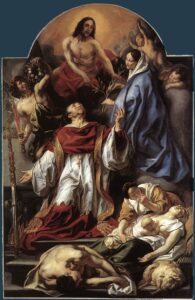
St. Charles Cares for the Plague Victims of Milan by Jacob Jordaens (1593-1678), St. James Church, Antwerp, Belgium, public domain via Wikimedia Commons

St. Charles Borromeo was born in a castle on the shores of Lake Maggiore. His father was a Count of Lombardy whose aristocratic family’s shield bore the motto, “humilitas.”

His mother was Margherita de Medici, whose younger brother became Pope Pius IV. (5).

The paintings featured here commemorate St. Charles Borromeo’s assistance to the poor during a famine in Milan; and his refusal to leave the city after an outbreak of the plague. He remained behind in his own episcopal see while many other bishops and clergy fled. He stayed to pray for his people as their archbishop, and administered the sacraments to plague victims.

Even while he was serving as a papal representative to the Council of Trent, and performing as a leading figure in the Counter-Reformation, St. Charles Borromeo never forgot his family motto, humility; or the Jesus who washed his own apostles’ filthy feet.

Both of these paintings, and many more found in museums and churches across Europe (6), document St. Charles Borromeo’s devotion to the humble Virgin Mary. Her vivid presence in so many of his portraits reveals the close relationship they shared in his charitable work, in his intercession for the people of Milan, and in his dedication to the universal Church.

This November — while we’re preparing for Thanksgiving and the Solemnity of Jesus Christ, King of the Universe — may we, too, remember to practice the extraordinary virtues of ordinary everyday holiness.

©Copyright 2023 by Margaret King Zacharias

Feature Photo: Intercession of Charles Borromeo Supported by the Virgin Mary by Johann Michael Rottmayr (1656-1730) in the collection of Karlskirche, Vienna Austria, public domain, via Wikimedia Commons

Notes:

  1. Personal communication.
  2. (https://bible.usccb.org/bible/readings/110423.cfm).
  3. (https://bible.usccb.org/bible/readings/110423.cfm).
  4. (https://bible.usccb.org/bible/readings/110523.cfm).
  5. (https://www.newadvent.org/cathen/03619a.htm)
  6. (https://www.christianiconography.info/charlesBorromeo.html).
 

What is the Rosary?

What is the Rosary?

October is the Month of the Rosary, and many authors have already written insightful and inspiring articles explaining and promoting it. We know the rosary is a tremendous tool, and that it also has many positive physiological benefits besides the more obvious spiritual ones.

But this October, I thought I’d try my hand at something a little different, namely a poem about the rosary.  Here it is, in three short verses.


What is the Rosary?

A rosary’s a ladder;

It goes up and down.

Connects us to Heaven,


Through Mary, on the ground.

Through the life of our Lord,

We travel anew.

By His death, we’re forgiven;

The covenant renewed.


By the work of the Church,

We two are made one.

Now our prayers are hers,

‘till God’s kingdom comes.


© Copyright 2023 by Sarah Pedrozo

Featured Image: iStock-Mary-statue-in-blue-with-rosary-formatted.jpg

A Beacon of Hope

A Beacon of Hope


And I say to thee: That thou art Peter; and upon this rock I will build my church, and the gates of hell shall not prevail against it.”

Matthew 16:18 (Douay-Rheims 1899 American Edition Imprimatur)

The idyllic seaside town of Lahaina on the island of Maui disappeared on August 8, 2023. 

An early morning brush fire, believed extinguished, suddenly erupted into a towering inferno that evening.

Fueled by hurricane winds, the wildfire roared down tinderbox slopes of the West Maui Mountains at more than a mile a minute (1), consuming eons of human history, dislocating thousands of people, and incinerating hundreds of human lives.

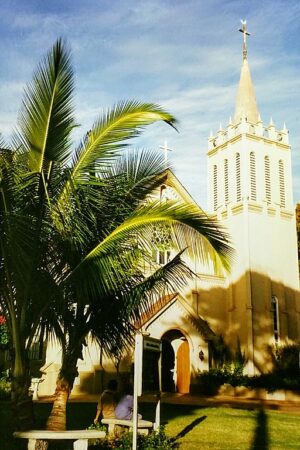
When the smoke cleared and helicopters were able to fly over the devastated site where Lahaina once stood, a lone white church spire still rose above the blackened rubble. Maria Lanakila Catholic Church stood alone, the only surviving structure for many blocks, and appeared undamaged.

Maria Lanakila means Our Lady of Victory in the Hawaiian language. It’s one of Most Reverend Larry Silva’s “cathedral churches” in the Diocese of Honolulu, which encompasses all of the islands of Hawaii (2).

Late in the evening on August 12, Bishop Silva flew to Maui. He toured the ruins on August 13, and celebrated a mass for the victims at Sacred Heart Chapel in Kapalua, about nine miles north of Lahaina (3).

“[Bishop Silva] …reported that the pastor, Father Kuriakose Nadooparambil, a priest of the Missionaries of Faith congregation, ‘was allowed to go in (to the church) with a police escort, and he reported that not even the flowers in the church were wilted or singed. There was only a covering of ash on the pews.'” (4)

Church officials acknowledge that there may be hidden structural damage that remains unknown until a full engineering inspection can take place. (5)

Bishop Silva also told Hawaii Catholic Herald that‘One of my friends, who often serves as my liturgical master of ceremonies when I am on Maui, told me that his uncle, uncle’s wife, their daughter and their grandson all were burned to death in their car, while they were trying to escape. My friend and his wife opened their home to other relatives who lost their home and suspects they will be living there for a couple of years.'”(6).

I also have close friendships in West Maui, nurtured through almost ten years of participation in the Maui Writers Foundation, and many family time-share vacations less than four miles from Lahaina.

I spent the first forty-eight hours frantically trying to reach my granddaughter’s hula teacher. She was dancing a starring role at Old Lahaina Luau late into the night, when we saw her last a few months ago. She got up early each morning to gather plumeria blossoms, and patiently teach a five-year-old girl authentic Hawaiian culture.

I finally received a text that with a new infant growing in her womb, she had managed to escape with her parents, her husband and her adolescent daughter. “It just happened so fast,” she said. They had traveled back roads to reach refuge with cousins on the south side of the island. They had lost everything they owned.

My husband and I worried for weeks about a couple who are also long-time friends. Their names kept appearing on ever-shorter lists of those “unaccounted for.” Their names were still there just two days ago and I was losing hope, when I received an email from them recounting how they had lost their business and had learned that their insurance will not cover any of their damages. But at least they’re still alive.

This morning, as I began to write this post, I received news that my treasured concierge, who had connected me with so many wonderful Lahaina people for almost 20 years, had been found by her brother, deceased in their Lahaina childhood home.

Their cousins, who also survived, had stopped by in the midst of the fire to hurry her along. She just wanted to run back into the house one more time, and said she’d be right behind them (7).

Where is Maria Lanakila in all of this? Who is Our Lady of Victory?

This was the sixteenth honorary title bestowed on Mary by a supreme pontiff or an ecumenical council. Declared by Pope Saint Pius V to commemorate the allied Christian victory over Ottoman Turks at Lepanto on October 7, 1571, the title reflects the success of a massive rosary prayer campaign (8).

Pope Gregory XIII changed the name of the October 7 liturgical celebration to Feast of the Holy Rosary in 1573 (9). That is the Marian mass we continue to celebrate, four-hundred-and-fifty years later.

We can offer our rosaries in days ahead to help the people of Lahaina.

Maria Lanakila, Our Lady of Victory, pray for us. Please succor the suffering souls of the victims, and comfort the sorrowful survivors of the Lahaina fires. May they all find hope, and strength for the future, through your motherly care.

Amen.


©Copyright 2023 by Margaret King Zacharias

Featured Image: Joel Bradshaw, Public domain, via Wikimedia Commons
Inset image: Howcheng, CC BY-SA 3.0 <https://creativecommons.org/licenses/by-sa/3.0>, via Wikimedia Commons
Notes:
  1. Official “gale force” windspeed of 67 mph at the time of Lahaina fire is documented here: https://www.nbcnews.com/science/science-news/drought-wind-mauis-wildfires-turned-historic-tragedy-rcna99196# and here: https://www.reuters.com/graphics/HAWAII-WILDFIRES/DRIVERS/gdvzwwgwrpw/
  2. https://en.wikipedia.org/wiki/List_of_parishes_of_the_Roman_Catholic_Diocese_of_Honolulu
  3. https://thedialog.org/national-news/maria-lanakila-catholic-church-survives-maui-wildfire-not-even-the-flowers-in-the-church-were-wilted-or-singed/ quoting Hawaii Catholic Herald
  4. https://www.thebostonpilot.com/article.php?ID=195341 and https://thedialog.org/national-news/maria-lanakila-catholic-church-survives-maui-wildfire-not-even-the-flowers-in-the-church-were-wilted-or-singed/ quoting Hawaii Catholic Herald
  5. https://www.staradvertiser.com/2023/08/11/hawaii-news/maria-lanakila-still-stands-but-waiola-church-is-gone/
  6. https://thedialog.org/national-news/maria-lanakila-catholic-church-survives-maui-wildfire-not-even-the-flowers-in-the-church-were-wilted-or-singed/ quoting Hawaii Catholic Herald
  7. https://www.staradvertiser.com/2023/08/25/hawaii-news/latest-lahaina-fire-victims-on-official-list-include-boy-7/am
  8. https://www.canticanova.com/articles/ot/artba1.htm
  9. https://en.wikipedia.org/wiki/Our_Lady_of_the_Rosary

Mount Carmel

Mount Carmel

By this Chronos time of our renewed baptism in the Holy Spirit at Pentecost, pleasant weather has finally arrived in most parts of the United States. Many of us as Catholics can look forward to outdoor liturgical celebrations with the beauty of nature surrounding us in this season.

The public witness of Corpus Christi processions; devotions to the Sacred Heart of Jesus and the Immaculate Heart of Mary; as well as the glory of sacramental ordination for well-formed young men to the sacred priesthood; all are spiritual highlights that await us in June.

Mount Carmel commonly refers to the promontory of a mountain range with the same name, located about thirty miles west of the Sea of Galilee, on a peninsula that penetrates into the Mediterranean Sea. Today it stands at the edge of a modern city, Haifa, Israel, near the ancient Crusader city of Acre.

Dedicated to the Blessed Virgin Mary as Our Lady of Mount Carmel, and stewarded by the Carmelite orders since the thirteenth century, this popular pilgrimage site is also called Stella Maris, Star of the Sea. This may be in part because the entire peninsula is surrounded by water, but the roots of the alternate title go back much further into history.

Scholars believe that the usage ‘Star of the Sea,’ as both a place name and as a title for Mary, began with St. Jerome. He translated Mary’s Hebrew name, according to its meaning in the annals of the Exodus from Egypt — Miriam, the sister of Moses and Aaron, bore the same name with the same spelling as Mary, the mother of Jesus.

The site on which the Mount Carmel monastery stands today has additional roots that go deep into the Old Testament.

Sign at the base of the statue of Elijah calling down fire from heaven to defeat the prophets of Baal, in the monastery gardens, Mount Carmel. Author’s personal photo, used with permission.

A sign engraved in Latin, Hebrew, and Arabic at the base of a statue of the prophet Elijah in the monastery gardens declares the understory grotto at Mount Carmel to be Elijah’s cave, and this mountain the site at which he defeated the prophets of Baal (I Kings, Chapter 18):

(17) When Ahab saw Elijah, he said to him, “Is it you, you disturber of Israel?”

(18) He answered, “It is not I who disturb Israel, but you and your father’s house, by forsaking the commands of the LORD and you by following the Baals.

(19) Now summon all Israel to me on Mount Carmel, as well as the four hundred and fifty prophets of Baal and the four hundred prophets of Asherah who eat at Jezebel’s table.”

(20) So Ahab summoned all the Israelites and had the prophets gather on Mount Carmel (I Kings, 18:17-20.). (https://bible.usccb.org/bible/1kings/18).

 Elijah’s activity on Mount Carmel did not stop there, either. In II Kings, Chapter 1, we read that:

(3) …the LORD said to Elijah the Tishbite: Go and meet the messengers of Samaria’s king, and tell them: “Is it because there is no God in Israel that you are going to inquire of Baalzebub, the god of Ekron?”

(4) For this, the LORD says: You shall not leave the bed upon which you lie; instead, you shall die … (II Kings, 1:3-4) (https://bible.usccb.org/bible/2kings/1)

 Elijah delivered the message as God had commanded. Then he raced with haste up to the top of Mount Carmel, so he could watch over the Jezreel Valley for this new king’s angry men, who had been sent to kill him.

Twice again Elijah was forced to call down fire that destroyed two commanders and two battalions of fifty men, before a third commander who had been sent with more men to capture him pleaded for mercy, and received it. (II Kings 1:1-18). (https://bible.usccb.org/bible/2kings/1)

Fr. Lawrence Hoffmann celebrates mass in the garden at Mount Carmel monastery, Haifa, Israel. Author’s personal photo, used with permission.

The holy mass that my pilgrimage group was privileged to experience in the garden at Mount Carmel was a peaceful and anointed celebration.

At the end of our liturgy, as the priest pronounced the final blessings, into the silence after each human response came a single gentle “caw,” in chorus from the birds in the trees.

Despite the many problems our human lives face today, and the impotent ‘baals’ that the misguided seek for answers, there is still ‘a God in Israel’ – as there always has been, and always will be.

Let’s live in Kairos time this June.

May you feel ‘amens’ resounding from God’s creation, and continue to bring your own witness into the world.

May you remember that Our beloved Lady, Star of the Sea, stands guard at Mount Carmel, where Elijah the Tishbite worked his miracles. They continue together, to watch over us all.

©Copyright 2023 by Margaret King Zacharias

Featured Photo: Welcome sign at Mt. Carmel. Author’s personal photo, used with permission.


Our Lady of a Thousand Names

Our Lady of a Thousand Names

Mary is our mother, and May is her special month. But who is Mary, really?

Mary of Nazareth was officially declared “Theotokos,” mother of God, at the Council of Ephesus in 431 A.D. This Greek-language title is still used in the Eastern Orthodox churches today. (1)

By the sixteenth century, popular devotion to the mother of Jesus in the Western church had multiplied into many titles. The traditional Litany of Loreto, approved by Pope Sixtus V in 1587, calls her mother, virgin, mirror, vessel, rose, tower, ark, house, gate, star, and queen. These vivid images are repeated, as diverse domains are placed into her care through one of only six litanies formally approved by the magisterium for public recitation. (2)

Those many queenships do not even to begin to exhaust her multitude of names.

All around the planet, there are shrines dedicated to Mary, often titled “Our Lady of …” with place names that have experienced church-approved apparitions and miracles, or with spiritual qualities like “peace, mercy, good hope.”

In their book, Marian Shrines of the United States: A Pilgrim’s Travel Guide, Theresa Santa Czarnopys and Thomas M. Santa, C.Ss.R. highlight more than fifty shrines dedicated to the Blessed Mother in the United States alone. (3)

With her parents, uncle, aunt, and husband Joseph, Mary was a historical human person. She is still remembered in Nazareth by contemporary villagers, whose ancestors have lived there continuously for thousands of years.

I heard one person say, sharing stories passed down in his family for generations, “We’re not sure it’s Joseph’s workshop, exactly. But all the carpenters worked right in this area, they always have, and so it probably looked a lot like this one.”

Those words were offered as a personal testimony when my group of pilgrims viewed an ancient builder’s studio in Nazareth that Israeli archeologists have managed to excavate with painstaking care. A similar tale was told about the ancient well where young Mary went to draw water.

Our faith considers the rosary a worthy meditation on the mysteries of Jesus’ human life; and also, about Mary’s life as his mother. Writings by a plethora of Saints who are formally recognized by the Roman Catholic Church often name the mother of Jesus as their guardian, guide, and friend.

At Our Lady of Lourdes, I was able to view a sign with Mary’s original words when she identified herself to St. Bernadette. By the letters engraved on that bronze plaque, she spoke in the local Pyrenees Mountain dialect, a combination of Spanish and French, probably the only language that Bernadette would have known. In 1858, when asked for her name, Mary said, “Yo soy Immaculata Conception.” “I am the Immaculate Conception.”

I was told, by an official guide there, that the poor young girl had no idea what those fancy words meant. But she memorized them. Only her parish priest, who had recently received the provincial distribution of papal bull Ineffabilis Deus from Pope Pius IX in Rome (4), was able to recognize the meaning of that particular message from Mary.

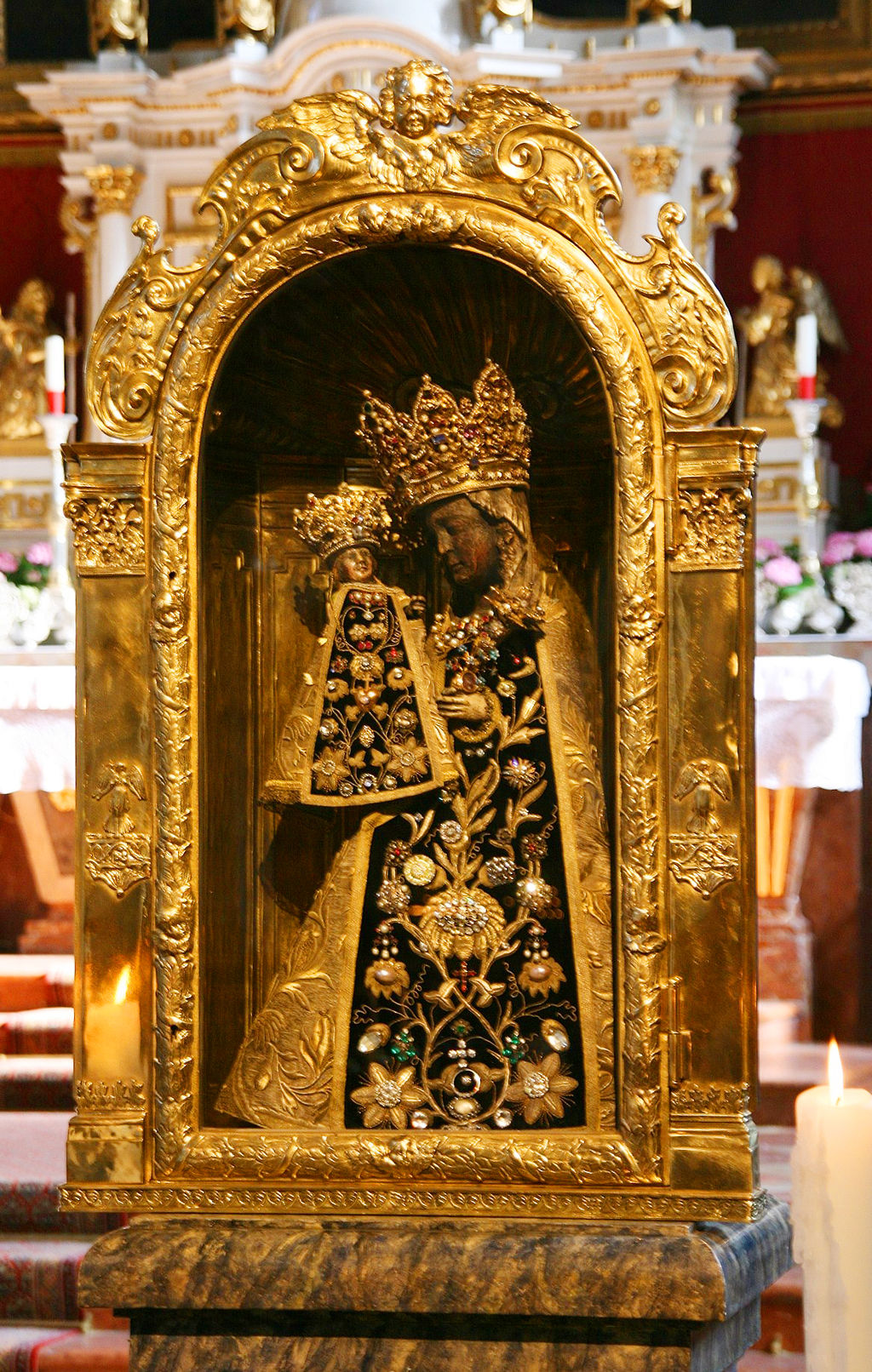
As Our Lady of Altötting, Germany Mary is said to have guided Joseph Ratzinger from birth to the papacy, through a childhood and young adulthood spent under the horrors of Germany’s Third Reich. His devotion to her has become legendary. Even now, when she temporarily resides in the parish church of St. Michael’s (pictured below) nearby while her ancient chapel is being restored, she carries in her scepter a custom-made sapphire ring. This ring was a gift to Fr. Ratzinger from his brother and sister, when he was appointed to be Archbishop of Munich. In 2006, after he was elected Pope Benedict XVI, Joseph returned to Altötting to give Mary his ring. (5)


Pope Benedict XVI had a great devotion to Our Lady of Altotting. It is said that she guided him throughout his life.

At the shrine of Our Lady of Knock in Ireland (pictured in banner), the shrine guide gave us this explanation about nineteenth century Marian apparitions there. (6)

“People always ask, ‘But what did Mary say?’ When we answer, ‘She was silent,’ everyone wonders how it could be, that Mary came among the garrulous Irish and didn’t say a word?

“Wherever she appears, Mary always asks for two things. She tells people to fast, and to pray. She didn’t ask us to fast because she knew we were already starving. She came with St. Joseph at her right, St. John on her left, with the angels and the Lamb on the altar, to show us that she had heard the constant prayers of her faithful Irish children.

“Everyone had lost so many members of their families to death from the Great Hunger, and then from the necessary emigration. The land had been decimated.

“We believe that Mary came just to hold us in her love, and to reassure us that there was a future. She came to bring us hope. She didn’t need to say anything. We all understood.”

© Copyright 2023 by Margaret King Zacharias, Ph.D.

Notes:

  1. https://en.wikipedia.org/wiki/Theotokos
  2. https://www.ourcatholicprayers.com/litany-of-the-blessed-virgin-mary.html#:~:text=The%20Litany%20of%20The%20Blessed%20Virgin%20Mary%2C%20also%20known%20as,1587%20by%20Pope%20Sixtus%20V.
  3. Liguori Publications, Liguori, Missouri, 1998.
  4. https://www.papalencyclicals.net/pius09/p9ineff.htm
  5. https://en.wikipedia.org/wiki/Shrine_of_Our_Lady_of_Altötting
  6. https://www.knockshrine.ie/history/

Photo credits:

Featured photo: Our Lady of Knock Interior Chapel Sculptures Attributions

Page URL: https://commons.wikimedia.org/wiki/File:Apparition_Chapel_with_Stained_Window.jpg

File URL: https://upload.wikimedia.org/wikipedia/commons/8/8a/Apparition_Chapel_with_Stained_Window.jpg

Attributions: KnockShrine, CC BY-SA 4.0 <https://creativecommons.org/licenses/by-sa/4.0>, via Wikimedia Commons

Inset Photo: Image of Our Lady of Altotting

Page URL: https://commons.wikimedia.org/wiki/File:Gnadenbild,_Gnadenkapelle_Alt%C3%B6tting.jpeg

File URL: https://upload.wikimedia.org/wikipedia/commons/e/ed/Gnadenbild%2C_Gnadenkapelle_Alt%C3%B6tting.jpeg

Attribution: Finner: Siddhartha Finner, Dipl.Ing.-Architektur, CC BY-SA 3.0 <https://creativecommons.org/licenses/by-sa/3.0>, via Wikimedia Commons

Licensure: https://creativecommons.org/licenses/by-sa/3.0/deed.en