
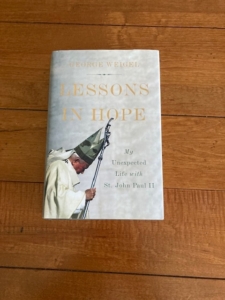
Commentary and Book Review George Weigel, Lessons in Hope: My Unexpected Life with St. John Paul II

New York: Basic Books, 2017

Polish athlete, actor, and youth resistance leader Karol Jozef Wojtyla looms as a charismatic presence over the 20th Century, and beyond, with a personal and spiritual influence few before him ever accomplished. His life story exhibits the numinous arc of a genuine archetypal hero. Whether admirer or critic, almost no one on our planet could deny the depth or breadth of his impact on the world.

Elected supreme pontiff of the Roman Catholic Church in 1978, at the young age of 58, he was regarded by the College of Cardinals as an “outsider,” a “compromise” candidate. He was the first non-Italian pope in 455 years and the third longest servant of that office in history (1).

He took the Church to the world with his own two feet, visiting an unprecedented number of new countries that had never before even dreamed they might experience a pope’s physical presence and blessing in their own midst.

John Paul II was the second pope to visit the United States and he covered new territory even here on his first visit in 1979.

We all have our stories. Mine include intense negotiations in my Rand McNally office to determine who could take the day off to attend the papal mass in Chicago’s Grant Park on October 5, 1979.

When our family moved to Iowa in 1985, the very air still vibrated with the energy of 350,000 people who attended the papal mass at Living History Farms just outside of Des Moines on the Feast of St. Francis, October 4, 1979. At the time, it was the largest crowd ever present for a single event in Iowa history (2).

The atmosphere still shimmers today as the stories are told — about one farmer in a tiny Iowa hamlet, who believed he could just write to the pope with an invitation and the Holy Father would come.

Cherished memories of that glorious day continue to pass from one person to another, especially at this season of year when we celebrate the harvest with the Iowa State Fair.

People recall a stormy morning, full of thunder, lightning, and drenching rain – until the clouds broke, and the sun reappeared just as John Paul II’s helicopter came into view for a landing on the fertile fields. They remember his reverent words of appreciation for people who toil on the soil in stewardship, to feed us all.

I remember a French rail strike, an Italian train robbery, a powerful homily presented in four languages in 1995 by a man who still possessed the physical stamina to stand in St. Peter’s Square with a hot Roman sun beating down on his heavy vestments; a man who spoke long enough – more than an hour without respite — to make sure every person there heard his words from his own voice in a language they could understand.

My memories include a bittersweet final United States mass in St. Louis, Missouri just four years later, in 1999, when a pope by then crippled with Parkinson’s disease modeled humility, standing by and offering up his painful suffering while readers and translators presented the homily he had written — for the same reason, so everyone present could hear, and understand.

Many biographies of John Paul II have been published. So why do I want to tell you about this particular book, Lessons in Hope?
George Weigel is a Distinguished Fellow of the Ethics and Public Policy Center in Washington, D. C., where he holds the William E. Simon Chair in Catholic Studies (3). He’s a prolific author of many books on a wide variety of Catholic topics (including several more recently published), and a regular contributor of thoughtful, incisive articles to the literary journal First Things.

Lessons in Hope is a unique hybrid. It’s a biography of John Paul II as well as an autobiography of George Weigel; it’s a memoir of a relationship that begins in Maryland in 1960, and concludes in Poland in 2012.

Organized chronologically and geographically, Lessons in Hope is a collection of vivid, digestible vignettes about how Divine Providence interwove the lives of two men who chose to spend their talents serving God and the Catholic Faith, each in their own different ways.

For more than 62 years, from Baltimore to Krakow — in Rome, Vienna, Moscow, Cuba, Portugal, Australia, Canada, Germany, and more – shuttling in and out of the weft, warp threads keep weaving together in their profound encounters.

What emerges is a tapestry that illustrates how the truths of our faith resonate most powerfully through our surprising interconnections with one another.

At this moment in 2025 when hope may seem for many of us quite difficult to maintain, Weigel’s book about his “unexpected life with St. John Paul II” offers timeless nourishment for each of our own life journeys.

May Christ’s peace that passes all understanding be with us now, and forever. Amen.

© Copyright 2025 by Margaret King Zacharias

Notes

  1. https://en.wikipedia.org/wiki/Pope_John_Paul_II
  2. https://www.lhf.org/aboutus-2/saint-pope-john-paul-ii-visit/#:~:text=On%20October%204%2C%201979%20Saint,cold%20and%20rainy%20autumn%20day.
  3. Book cover copy, George Weigel, Lessons in Hope: My Unexpected Life with St. John Paul II, New York: Basic Books, 2017.

Feature Image:

Author photo, used with permission

Inset photo: Cover of Lessons in Hope: My Unexpected life with St. John Paul II. Author photo, used with permission

She is not in Scripture, but St. Veronica Captures the ‘True Image’ of Christ’s Teachings

She is not in Scripture, but St. Veronica Captures the ‘True Image’ of Christ’s Teachings

July 2025 revealed significant information about family caregivers that applies to millions of people. The data has gone largely unnoticed in favor of more scintillating political headlines of the summer. AARP and the National Alliance for Caregiving released the 140-page,Caregiving in the US, a report which discloses the startling revelation that nearly 25 percent of Americans are long-term caregivers of a family member. That percentage translates to 63 million caregivers, an increase of 45 percent in only 10 years.¹

The non-quantifiers: loneliness, isolation, and lack of training haven’t changed in the last decade. The struggle to continue working for financial stability versus giving the appropriate care the loved one needs remains an issue, although government programs have been enacted this year to pay some caregivers. The majority of family caregivers are women, who are among the 59 million providing for patients that the report refers to as having a “complex medical condition or disability.” ¹

The role of faith and prayer are absent from the report and, if it were included, might provide a bright spot in an otherwise bleak portrait. The Catholic Church’s contributions to hospitals and hospice have been documented over the generations, but strangely, there is no patron saint for this kind of family caregiving. St. John typically pops up first in a search for bringing the Blessed Mother into his home following the Crucifixion. St. Vincent DePaul for his nurturing sometimes is mentioned. St. Elizabeth of Hungary who fed the poor is an option for people looking for a woman caregiver. There are others too, all of whom provided mighty works of corporal mercy, but don’t quite reflect the model of family caregivers that could provide the quiet, strong support the faithful seek.


Here is one to consider: St. Veronica. 

What did Veronica do?

Veronica is known for handing a cloth to Jesus Christ on the Via Dolorosa to wipe his face. He imprinted his face, and this cloth that is still believed to exist is stored in Rome at the Vatican. That is Veronica’s action at the most basic level.

But what exactly did she do and what does it have to do with modern-day family caregivers?

Veronica was available in the moment when Jesus would pass by, willing to change her whole life. She had paid attention to the events leading up to Jesus’s way to the cross and anticipated, regardless of the difficulties it would bring to her personally, the moment when she would be needed. She broke through the Centurion guards to reach Jesus. Consider that risk. Without looking and with just an elbow, one of the guards could have knocked her to the ground, rendering her unconscious. Any one of them could have applied more force, just for the fun of it. We know, based on what they did to Jesus, that inflicting pain was sport to them. In any way, they could have prevented her from reaching Him. Her focus, faith, and compassion, just to offer a moment of comfort and care to a man who was on his way to death, were stronger than a Centurion guard. It seems like so much to do for something so little, and in the end, wouldn’t change the outcome.

Family caregivers exhibit these characteristics.

True, in 2025 the landscape is much different, but caregivers still have their own kind of Centurion guards. Anyone dealing with insurance companies, medical establishment, or critical and absent family members faces their own Centurion guards. There is also the inner Centurion guard to confront. Uprooting your life to take care of someone isn’t easy to do, even knowing it’s the right thing and you’ll end up doing it. These foes want to tear the caregiver down, but faith, focus, and compassion prove stronger. Caregiving can last for weeks, months, or years. Some days can feel like years, but in many cases the whole period turns out to be little more than a blink compared with two people’s lifetimes. It’s a big job too, but it’s those ordinary happenings — sharing a memory while buttoning a pajama top or finding a silly moment during a bath— that prove to have the same impact as offering and receiving a face cloth. 

Who was Veronica?

Maybe the most surprising facet of the Veronica story is that, unlike Simon of Cyrene and the weeping women, Veronica is not mentioned in the Bible. She is a part of Catholic tradition. We know her from the sixth of the 14 traditional Stations of the Cross, a Catholic devotion that has been in existence for centuries. Some traditions claim her as the unnamed woman who hemorrhaged for 12 years (Matthew 9:20-22; Mark 5:25-34; Luke 8:43-48). We also know her through Catholic mystics. The 14th Century reclusive English nun, Julian of Norwich, refers to her by name in the second and eighth visions in The Revelation of Divine Love in Sixteen Showings but does not speak specifically about her.

No one, however, offers a caregiver profile of Veronica better than Bl. Anne Catherine Emmerich, beatified by Pope St. John Paul II in 2004. She describes Veronica in enthralling detail in the visions recounted in The Complete Vision of Anne Catherine Emmerich.² In his podcast, The Life of Jesus Christ in a Year, taken from the four-volume set of the same title, Fr. Edward Looney reads from the book and offers his insights that mirror the same captivating minutiae. ³ In Complete Visions, she sets the scene in a tense and crowded Jerusalem streetscape when, emerging from a flight of steps, a “tall elegant woman holding a little girl by the hand” hurries toward the procession. ² Her name is Seraphia, and she is the wife of a Temple council member named Sirach. The girl, about nine or ten, is her adopted daughter, and she is hiding a mug of spiced wine under her cloak to offer to the Lord. The two encountered resistance when trying to break through frontline guards.

“Transported with love and compassion, with the child holding fast to her dress, she pressed through the mob running at the side of the procession, in through the soldiers and executioners, stepped before Jesus, fell on her knees, and held up to Him the outspread end of the linen kerchief …” ²

The kerchief, sometimes called a cloth, sometimes the veil of Veronica, is described as “… a strip of fine wool about three times as long as wide. It was usually worn around the neck, and sometimes a second was thrown over the shoulder. It was customary upon meeting one in sorrow, in tears, in misery, in sickness, or in fatigue, to present it to wipe the face. It was a sign of mourning and sympathy.” ²

If that is not a sign of a caregiver, then what is?

Additionally, Bl. Anne Catherine goes on to say that Seraphia, who was older than the Blessed Mother, is a relative of Jesus through John the Baptist’s father, and that she knew Mary since the Queen of Heaven had been a little girl. Seraphia knew Jesus was the Messiah, having also been related to Simeon who helped to raise her, and that she made sure Jesus, as a 12-year old, was fed during the harried time Mary and Joseph were searching for Him only to find the boy preaching in His Father’s house. She literally was a family caregiver of various methods over the lifetime of Jesus Christ.

Our Lord’s sense of irony won’t be lost on many caregivers who feel unseen and unheard: the individual who cares for Him and preserves His image is absent in Scripture. 

Bl. Anne Catherine says so much about this courageous woman in only two pages of Complete Visions and also in The Life of Christ, including how she came to be known as “Veronica.” It means “true image.”² The cloth that the Vatican protects is often referred to as “The Veronica.” Like many who loved the Lord, she was later persecuted, arrested, and died a martyr from starvation. Her feast day is in July (12th), the same month this latest report on caregivers was released. She is heralded rightly as the patron saint of photographers and of laundresses. If we are to believe Bl. Anne Catherine Emmerich, however, she deserves as well to be regarded as patron of one of the most precious roles in modern society: the family caregiver.

Saint Veronica, pray for all caregivers!


1. AARP and the National Alliance for Caregiving, Caregiving in the US Research Report (Location unlisted July 2025), 7.

2. Emmerich, Anne Catherine and Catholic Book Club Editors, The Complete Visions of Anne Catherine Emmerich, Catholic Book Club. (Location unlisted 2014), 676.

3.  Looney, Edward. “Day 274: Veronica Wipes the Face of Jesus. The Mystical City of God in a Year.” April 11, 2022. Audio Podcast, 35 min. 5 sec. https://open.spotify.com/episode/4JYwyULbJvqYggsXB3A0nU?si=Dm0ED69mSTS7jJJ6NuSnBQ

Featured Image by 🆓 Use at your Ease 👌🏼 from Pixabay

Copyright 2025 by Mary McWilliams

Edited by Rietta Parker


Lawrence, Lorenzo, and Lorcán

Lawrence, Lorenzo, and Lorcán


The Roman Catholic Church has canonized at least three very different holy men who are all known, in English, as St. Lawrence.

The name that they share is derived from a Latin word, Laurentium, and goes back even further in history to an Old Greek name, Lavrenti (1).  The Latin place name is thought to refer to a grove of Laurel trees.

Both Greek and Roman mythologies document that groves of laurel trees were regarded as sacred in these cultures, where a crown of laurel leaves was bestowed on the victors of various competitions in sports, dance, music, and poetry (2).

Mother Church has determined through her process of discernment for canonization that all of these three St. Lawrences have indeed won their crowns of eternal life.

They were born with unique gifts, into different cultures and historical circumstances, and each of them served different roles during their lives on earth.

St. Lawrence of Rome, 225-258, Deacon, Canonized “pre-Congregation”

The Martyrdom of St. Lawrence of Rome, Peter Paul Rubens, 1614

American Catholics might most readily recognize as “St. Lawrence” the Roman Deacon made famous in hagiographic stories about his humor while outwitting an emperor, and while undergoing martyrdom on a roasting grill.

The stories of St. Lawrence’s distribution of Church valuables to the indigent of Rome, and his presentation of the Christian people to Emperor Valerian as “the wealth of the Church,” are believed to be reliable (3).

But one historian has challenged the roasting story, claiming that it stemmed from a transcription error in the written records, and suggesting that St. Lawrence, the Deacon of Rome, was more likely beheaded in 258, soon after his friend, Pope Sixtus II experienced the same martyrdom. (4)

Deacon Lawrence’s bountiful service to the poorest people of his time, and his saintly courage in the face of martyrdom (by whatever means), are undisputed. These heroic qualities are recognized in his Feast celebrated on the United States liturgical calendar each August 10. (5)


San Lorenzo de Brindisi, Order of Friars Minor Capuchin, 1559-1619, Canonized 1881, Doctor of the Church, 1959

St. Lorenzo of Brindisi, Doctor of the Church.

Our easier recollection of the earliest “St. Lawrence,” above, may in part be due to the fact that the saintly incandescence of August, while still blinding, appears to be slightly less overwhelming than it is in this month of July.

From St. Junipero Serra, patron saint of Serra International, the Vatican apostolate for vocations, who began the month on July 1, to St. Ignatius of Loyola, creator of the Spiritual Exercises and founder of the Society of Jesus, who completes it on July 31, the list of Roman Catholic Saints who are liturgically honored in July is replete with luminaries (6).

It would be so easy to overlook the Optional Memorial for San Lorenzo de Brindisi, who also is known in English as St. Lawrence, on July 21.

Father Butler’s Lives of the Saints reports the historical date of his death as July 22. His Feast Day in the pre-Vatican II liturgical calendar, was also celebrated on July 22. Butler describes San Lorenzo as a “Confessor” (7). The 2025 USCCB liturgical calendar now describes St. Lawrence of Brindisi as “Priest and Doctor of the Church.” (8)

Born Guglielmo (or Guilio) de Rossi (or Russi) in the Kingdom of Naples, to a Venetian merchant family, he was gifted by God with an exceptional abundance of talents. (9)

Documented as a prodigy from early childhood, he presented popular narratives about Baby Jesus during the Christmas festivities in Venice, and was already recognized for his oratorical gifts. He began his formal studies at St. Mark’s college when he was 12 years old.

He was called to preach the Venetian Lenten sermons while still a deacon, and completed his advanced studies at the University of Padua. He was ordained a priest at the age of 23. He joined the Franciscan Capuchins as Brother Lorenzo, and was elected a provincial superior by the time he was 31. (9)

A genuine linguistic polymath, St. Lawrence of Brindisi read, wrote, and fluently spoke in Hebrew, Greek, Latin, and all of the European languages of his time. He memorized the entirety of the Bible. (9)

His lifetime production of written works numbered eight volumes of sermons, two treatises on oratory, a commentary on Genesis, a commentary on Ezekiel, and three volumes of religious polemics. (9)

He served as chaplain of the Imperial army in the immediate aftermath of Christian victory at the Battle of Lepanto. Victories against the Turks that defied all odds in the subsequent land battles were attributed to his intercession. (9)

San Lorenzo was sent throughout the known world of his time as an evangelizer, and as a diplomat to settle constant disputes among princes, during one of Europe’s most turbulent centuries. (9)

Despite his retirement to a respite of welcome spiritual contemplation at the end of his life, he did not refuse one last request to undertake yet another arduous sailing voyage to Spain. His death resulted from the fatigue caused by that final diplomatic mission. (9)

Lorcán Ua Tuathail, 1128-1180, Canonized 1225

Most of us in the United States might not even recognize this name in Irish Gaelic, and only a few might have heard of him as St. Lawrence O’Toole. Unless I failed to find it, his memorial does not appear in the USCCB liturgical calendar for the United States.

But the November 14 Feast of this influential twelfth-century Archbishop of Dublin, and that city’s enduring patron saint, is still celebrated with great affection in Ireland today. (10).

He was born in County Kildare, where his father was chief of Hy Murray. According to the custom of the time, Irish politics required that Lorcán, as the chief’s son, be sent as a “guarantee hostage” to the King of Leinster. (11)

Leinster’s monarch treated the child with such abuse that “…his father obliged the King to turn him over to the Bishop of Glendalough…” (11)

St. Lawrence O’Toole was elected the new Abbot of lake-and-forest monastery Glendalough, founded by hermit St. Kevin, by the youthful age of 25. (12)

He served the monastery as Abbot until he was called to the See of Dublin  in 1161, to become its second Archbishop (11) at a time when cultural conflicts between the indigenous Irish and newly arriving Norman settlers had become particularly contentious (12).

The story is told that St. Lawrence O’Toole was attacked by a terrorist while approaching the altar at the court of King Henry II of England. He asked for water, blessed it, and applied it to what all the witnesses present had believed was a mortal wound. The bleeding stopped immediately and the Archbishop carried on to celebrate mass (11).

On November 14, 2019, Archbishop Diarmuid Martin, in his address celebrating two retiring Bishops in the Archdiocese of Dublin, recalled the many accomplishments of this great Irish saint. (12)

Archbishop Martin also noted that St. Lawrence O’Toole had “…attended the Third Lateran Council in Rome in 1179, at a time when travel across Europe was perilous…” (12)

St. Lawrence O’Toole died in France just one year later, on another diplomatic journey, to attempt yet again a lasting peace with the Normans. (12)

He is the only St. Lawrence who speaks directly to readers in Ronda de Sola Chervin’s 20th century book, Quotable Saints.

 “My Will! What are you talking about? Thank God, I haven’t a penny left in the world.” (13)

St. Lawrence of Rome, San Lorenzo de Brindisi, St. Lawrence O’Toole,

Pray for us.


© Copyright 2025 by Margaret King Zacharias

Notes and Sources

  1. https://en.wikipedia.org/wiki/Lawrence_(given_name)#:~:text=Meaning,Lawrie%2C%20Laurie%2C%20Larold%2C%20Law
  1. https://en.wikipedia.org/wiki/Laurel_wreath
  1. https://en.wikipedia.org/wiki/Saint_Lawrence#Gallery
  1. https://en.wikipedia.org/wiki/Saint_Lawrence#cite_note-Healy-11
  2. https://bible.usccb.org/bible/readings/081024.cfm
  1. https://www.ewtn.com/catholicism/library/saints-of-the-roman-calendar-5801
  1. Butler, Rev. Alban, Lives of The Saints: With Reflections for Every Day in the Year, New Edition, New York, Boston, Cincinnati, Chicago, San Francisco: Benziger Brothers, Inc., “Printers to the Holy Apostolic See”, 1955, pp. 408-409
  1. https://bible.usccb.org/bible/readings/072125.cfm
  2. This information is based on its primary source https://en.wikisource.org/wiki/Catholic_Encyclopedia_(1913)/St._Lorenzo_da_Brindisi

And

https://en.wikipedia.org/wiki/Lawrence_of_Brindisi#:~:text=(22%20July%201559%20–%2022%20July,%2C%20Spanish%2C%20and%20French%20fluently

  1. https://anastpaul.com/2018/11/14/saint-of-the-day-14-november-st-laurence-otoole-c-1128-1180/,

and

https://www.catholicireland.net/retirement-two-bishops-ordination-deacon-mass-dublins-patron-saint/

  1. https://www.catholicnewsagency.com/saint/st-lawrence-otoole-53
  2. https://www.catholicireland.net/retirement-two-bishops-ordination-deacon-mass-dublins-patron-saint/
  3. Chervin, Ronda De Sola, Quotable Saints, Ann Arbor, MI, Servant Publications, 1992, p. 106.

Image credits:

Feature Photo: Glendalough, Early-Medieval Monastic Complex, Wicklow, Ireland

Attribution: Joe King, CC BY-SA 3.0 <https://creativecommons.org/licenses/by-sa/3.0>, via Wikimedia Commons

The Martyrdom of St. Lawrence of Rome, Peter Paul Rubens, 1614

Attribution © José Luiz Bernardes Ribeiro

This file is licensed under the Creative Commons Attribution-Share Alike 4.0 International license.

St. Lorenzo of Brindisi, Doctor of the Church

Attribution: http://www.cappuccinivenezia.org/spirito.htm, Public domain, via Wikimedia Commons


Meeting Bruder Klaus

Meeting Bruder Klaus

Part II

Niklaus von Flüe was born to a successful and well-respected Swiss farming family in the Flüeli-Ranft region near Sachseln, Canton Obwalden, Switzerland, in 1417. At the age of 30, he married a local teenager named Dorothy, and together they brought forth ten children, while Klaus maintained and extended his family’s position in his community. He served his community as a soldier, councilor, and judge. He was known for his strong moral conscience, practical prudence, and thoughtful wisdom. Then he received a call from God that changed everything.

Biographers, theologians and, most recently, psychologists have translated and interpreted in different ways the historical resources about mystical visions Bruder Klaus experienced throughout his life. These visions began while he was still in the womb. But all commentators have come away with deep respect for his genuine holiness.

The first biography was written by the Abbot of Einsiedeln Abbey while Niklaus was still alive (1). Bruder Klaus recognized both the places and people at his infant baptism, because he had seen them before he was born, and his adult spiritual director, Heiny am Grund of Lucerne, authenticated these recollections (2).

Bruder Klaus gave wise counsel that prevented a civil war from arising in a conflict between urban and rural cantons, at the Tagsatzung of Stans in 1481.

His direct and powerful experiences of God eventually led him to become a hermit in the Ranft, with his wife Dorothy’s full support. She continued to raise their family in their original family home, while his older sons worked the farm.

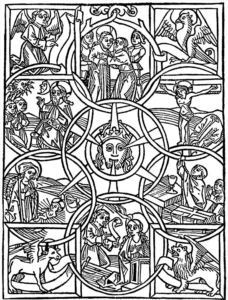
Bruder Klaus himself was illiterate. He drew maps of his encounters with a living God, and shared his drawings with trusted priests and monks as well as his loyal wife and children. As a man of the people and a man of his time, Bruder Klaus lived by the sacraments and prayer. He used images to communicate the ineffable.

His invincible moral character has continued to inspire pilgrimages to his simple home, and awe for his holiness, for more than six hundred years. He lived in a time of polarization, greed, and the violence of war – a time not unlike our own — through a century when even the Church was electing three conflicting popes.

And his legacy of faith has endured. He was beatified in 1669, and canonized in 1947 by Pope Pius XII.

I could go on and on myself, trying to tell you about Bruder Klaus.

What I really want to do today is to show you. Here’s an opportunity for a virtual pilgrimage of your own. I think you’ll find the film and images that follow worthy of meditation, should you feel inclined to experience the spirit of St. Niklaus, and his lasting impact, through traditional sounds and scenery of Switzerland that still resonate today. Film: https://www.youtube.com/watch?app=desktop&v=sm2Wjjs3-f0

Peace be with you.

Bruder Klaus Prayer

“My Lord and my God, take from me everything that distances me from you.
My Lord and my God, give me everything that brings me closer to you.
My Lord and my God, detach me from myself to give my all to you.”

Source, with attribution to the Catechism of the Catholic Church,

https://en.wikipedia.org/wiki/Nicholas_of_Flüe


© Copyright 2025 by Margaret King Zacharias

Sources

  1. https://en.wikipedia.org/wiki/Nicholas_of_Flüe
  2. Von Franz, Marie-Louise, Niklaus von Flüe and Saint Perpetua: A Psychological Interpretation of Their Visions, Asheville, N.C., 2022, pp. 10-11, IP 15, fn. 13-24. This work is cited here for scholarly translation of original German biographical sources and summary of historical facts about Bruder Klaus, originally written in German and only recently translated; without endorsing all interpretations made in this volume, per the caveat offered in the book below.
  3. Ulanov, Anne Belford, and Dueck, Alvin, The Living God and Our Living Psyche: What Christians Can Learn from Carl Jung, B. Eerdmans Publishing Co., 2008. The authors warn that, although theology and psychology can each offer valuable insights to the other, they are not the same, and not all of their different perspectives always overlap or agree.

Images:

Featured Image: Main room of the home where St. Niklaus von Flüe lived with his wife Dorothy and ten children during the first half of his life. Attribution: A Pakeha, CC BY-SA 4.0 <https://creativecommons.org/licenses/by-sa/4.0>, via Wikimedia Commons. File URL

Painting after the prayer wheel visions hand-drawn by St. Nicholas of Flüe. Attribution: Public domain, via Wikimedia Commons.

Woodcut after the map of his visions, hand-drawn by St. Niklaus von Flüe. He called the original scrap he used for prayer in the humble Ranft hermitage, his “book.” Attribution: Public domain, via Wikimedia Commons.


Meeting Bruder Klaus 

Meeting Bruder Klaus


On our third day in Switzerland, guide and driver Tony … took us into the rural hamlet of Flüeli, near the town of Sachseln, to visit the home of St. Nicholas von Flüe. I had no idea who this man was. How had I never heard of him?


Part I

A mysterious experience, and perhaps the most meaningful pilgrimage of my life, began in January of 2006. An advertisement in the local diocesan newspaper jumped out to me with that feeling I’d come to associate with lectio Divina – highlighting words that seemed to be meant specifically for me, a request from the Holy Spirit to pay particular attention.

Miraculous Journeys, a group from Omaha, Nebraska under the direction of a woman named Leona Kavan, was planning a trip to Roman Catholic shrines in Switzerland, Germany, and Austria the following October.

I’d long dreamed about visiting this part of Europe because so many of my ancestors had come from that Alpine region. My mother’s four grandparents emigrated to the United States from the Swiss Cantons of Bern and Basel.

So, I called Leona to ask for more information. We both felt an instant affinity in that first telephone conversation, and I told her I wanted to pray about it. I’d get back to her if I was interested.

As I entered the Perpetual Adoration chapel in my parish, a lay Carmelite friend I often joined for First Friday and First Saturday vigils, was praying in the rear pew. She beckoned me over, and whispered, “I understand you’ve just been talking to my friend Leona in Omaha.”

The signs continued. After I formally registered, making my own airline reservations because I would be flying out of Des Moines on American Airlines rather than from Omaha on KLM with the group, it transpired that Leona had a request.

Sister Frances, an Oblate Sister of Mary Immaculate from the National Shrine of Our Lady of the Snows in Belleville, Illinois, had received a large donation of American Airline miles from a patron of the shrine, as a gift for her retirement. She wanted to use them for this trip.

Sister Juanita, a younger vowed sister of the same order, had been assigned by their superior to accompany and assist, because Sister Frances would still be in the latter phase of recovery from knee surgery at the time this pilgrimage would take place.

We were all using the same airline. Would I please meet the sisters at Zurich airport and help them find the group when we arrived?

My original itinerary on American had routed me through Chicago, and their international transfer hub was going to be Dallas-Fort Worth. I’d never flown to Zurich and had no idea what that airport even looked like. I decided to change my ticket and meet them in the Dallas-Fort Worth airport, where I had at least some experience.

We, too, found immediate fellowship when I met Sister Frances and Sister Juanita at our international departure gate. Once we landed in Zurich, it required two trains and my best Canadian French to find out where the Omaha group had arrived – as it turned out, in a completely different terminal, invisible to us, on the other side of major construction.

But fortunately, nuns stay together in one place when you ask them, and the Holy Spirit was looking after us all. Sister Frances and Sister Juanita were waiting patiently where I left them when I returned with a map showing the correct location, and a safe route around the construction zone.

On our third day in Switzerland, guide and driver Tony, a former member of the Pontifical Swiss Guard, took us into the rural hamlet of Flüeli, near the town of Sachseln, to visit the home of St. Nicholas von Flüe.

I had no idea who this man was, and I had been a voracious reader about the saints since I joined the Church in 1989. How had I never heard of him?

Through our Omaha translator, who was fluent in German and carefully translated Tony’s exact words, it became apparent that he regarded this shrine as holier than even Engelberg Abbey, one of the greatest Benedictine houses of the high Middle Ages, and felt that our visit to Flüeli was the most sacred honor he could bestow on us during our visit.

Sister Frances, Sister Juanita, and I all looked at each other, and shook our heads. They’d never heard of this St. Nicholas, either.

The historic log chalet in front of us looked pretty rustic, and the pathway down to what our guide called “The Ranft,” on the banks of a rushing river, could only be described as treacherously steep. At least, we observed to each other, it was paved.

We composed ourselves with appropriate reverence and disembarked. Our driver pulled out Sister Frances’ foldable wheelchair from the belly of the bus, and Sister Juanita put on her game face.

We were about to learn how a 15th century farmer, soldier, hermit, and visionary became the patron saint of Switzerland, how he changed human history in his own time and for ours, and why his fellow countrymen call him simply Bruder Klaus, with great affection, to this very day.

Stay tuned for Part II next month.

Peace.


© Copyright 2025 by Margaret King Zacharias

Feature Photo: The Home of St. Nicholas von Flüe 

File URL https://upload.wikimedia.org/wikipedia/commons/e/e7/Flueli-Ranft_Wohnhaus_Bruder_Klaus.jpg

Page URL https://commons.wikimedia.org/wiki/File:Flueli-Ranft_Wohnhaus_Bruder_Klaus.jpg

Attribution Ikiwaner, CC BY-SA 3.0 <http://creativecommons.org/licenses/by-sa/3.0/>, via Wikimedia Commons

Inset photo The Ranft of St. Nicholas von Flüe, Hermit – Page 4

Page URL https://commons.wikimedia.org/wiki/File:Ranft,_Chapelles_sup%C3%A9rieure_et_inf%C3%A9rieure_de_Nicolas_de_Fl%C3%BCe.jpg

File URL https://upload.wikimedia.org/wikipedia/commons/d/d8/Ranft%2C_Chapelles_sup%C3%A9rieure_et_inf%C3%A9rieure_de_Nicolas_de_Fl%C3%BCe.jpg

Attribution Paul Bissegger, CC BY-SA 4.0 <https://creativecommons.org/licenses/by-sa/4.0>, via Wikimedia Commons

The four temperaments from a Catholic perspective: a review of Piety and Personality

The four temperaments from a Catholic perspective: a review of Piety and Personality

“The Almighty and All-merciful God … would not have created us with a temperament that was a stumbling block to our salvation. On the contrary, He gave us exactly the right temperament to help us gain Heaven.” — Rosemary McGuire Berry

The Lord has “counted the hairs” on our head (Mt. 10:30), just one passage often used to express how intimately He knows and cherishes His creations – from our hair to our thoughts, our actions, and our temperaments. Every quirk and strength, the Lord God made them all in us, although being humans, we are inclined to distort, ignore, and throw off balance the grace-filled characteristics he molded within us. Sinful, yes, but we are ultimately intended for His Kingdom and the tendencies toward laziness, brashness, hopelessness, and any traits we fight on a daily basis, are all under His continuous watch.

Even the saints, often depicted in beautiful, flower-adorned books and prayer cards as serene, other-worldly beings, battled their human weaknesses just like we do. Yet, they reached the Kingdom and so can we.

That’s the point of the Spring 2025 release of Piety and Personality: The Temperaments of the Saints (Tan Books), a first issue by Rosemary McGuire Berry. She offers a beginner examination, through the actions of 16 well-known and beloved saints, of the four temperaments, or humors, first established by Hippocrates: Choleric, Melancholic, Phlegmatic, and Sanguine. With this understanding, a dab of self-awareness, and significant persistence and prayer, we can begin to overcome our less desirable inclinations. If this sounds like another “self-help” book in an already saturated multibillion dollar industry, she cleverly enters through the specific niche of the Catholic audience, referring to Catholic practices such as praying the Rosary and going to Confession.

She states her purpose up front: that saints weren’t born holy; they worked at it and so can we, right now, in our difficult world.

“If we study our weaknesses, we can battle them more effectively,” she advises. “If we acknowledge our strengths, we can thank our Maker and work to develop those good tendencies” (p. 3), an angle takes it beyond the modern notion of “self-help.”

She quotes Father Joseph Massmann from his book, Nervousness, Temperament and the Soul, who contends we are duty-bound to understand our imperfections and strive to improve:

“‘The man who is not striving to become a better man resists the truth and keeps out of its way. For those who are striving after inward perfection – even for those who merely want to make a success of life – it is useful, indeed necessary, to examine these questions’” (pp.2-3, Berry).

Additionally, if we recognize the distinctive traits, people we don’t understand will begin to make more sense to us. The dominant, fearless, opinionated, “big picture” boss might have similarities with the Choleric St. Paul. The impulsive sister who always acts before she thinks might be a Sanguine, like St. Peter. That sullen boy could be a sympathetic Melancholic like the Little Flower.

“The Almighty and All-merciful God … would not have created us with a temperament that was a stumbling block to our salvation. On the contrary, He gave us exactly the right temperament to help us gain Heaven,” the author writes (p. 4).

She opens with brief paragraphs that generally describe each of the four. Then she jumps right into the saints and why she thinks a specific saint owns that particular temperament. This method of organization speaks to the point of the title, but at times, particularly in the chapters on St. Francis de Sales and St. Peter, while enjoyable, can be confusing and repetitive. In both, she moves on to address other saints of the same temperament, perhaps to give additional examples of the trait, but sometimes it sounds as though she is trying to force the saint to fit the trait. St. Francis de Sales is described as “Melancholic-Choleric” in the chapter title and she spends the first few pages talking about the Choleric disposition. She notes, however, that, upon studying his life and words, Choleric is the least of his traits. To her point, she impresses upon the reader that, ideally, we want to become a balance of the best of all four traits, which St. Francis de Sales achieved through a great deal of prayer, intention, and work.

Arguably, the most fascinating, tightly written and even poignant sections are on two Phlegmatic Thomases: Aquinas and More.

In the chapter on St. Thomas Aquinas, Mrs. Berry digs into his thorny family relations and the wreckage that is left when one strong personality dominates through its imbalanced state, essentially beating up on the meeker one. She reckons that his mother and brothers were ambitious Cholerics. The meditative and peaceful Thomas did not share their interests, and he was labeled slow and lazy. Often the “silent watchers,” Phlegmatics, she explains, “… do not have to battle their passions of anger, impatience, and dramatic tempestuous sorrow …. They are born calmer and more laid-back” (p. 139). The St. Thomas Aquinas chapter, more than any other in the book, shows the clashing of misunderstood personalities, particularly the child-parent relationship and sibling dynamics.

The piece on St. Thomas More demonstrates the Phlegmatic’s work ethic and eternal optimism, even in the most harrowing circumstances. His love of family radiates throughout the chapter. The author fills the section with writings of the martyred saint that show his peace, humor, diligence, and holiness.

Mrs. Berry offers helpful sidebar tips on each page to make the most of strong traits and help turn around the weaker ones. The author draws insightful distinctions between “good sadness” and “bad sadness,” and “meekness” versus “weakness”.

More than an offering an entertaining side of the saints, the book doles out information to give us another tool to help bring us closer to God and, perhaps, be more compassionate with one another. If Piety and Personality can give families more awareness of the misunderstood sides of one another to bring harmony and acceptance into the home, it’s worth the price.

© Copyright 2025 by Mary McWilliams

Feature Photo by Raka Miftah: https://www.pexels.com/photo/brown-eggs-on-a-concrete-surface-4216386/

Inset photo by Mary McWilliams

Massman, Joseph. Nervousness, Temperament and the Soul. Roman Catholic Books: Fort Collins, CO, 1941.


Pierre Toussaint: NYC’s OG Black Hairdresser and Future Saint

Pierre Toussaint: NYC’s OG Black Hairdresser and Future Saint 

By Janet Tamez 

Before he was declared venerable by St. John Paul II, Pierre Toussaint was an OG New Yorker, a master hairstylist to the rich and a quiet godfather to the poor. He arrived in New York City in 1796, when George Washington had just stepped down from the presidency, the United States was a young blood, and NYC was the place to be. 

Born into slavery in Haiti, Pierre came to America with his owners, who fled the Haitian Revolution. Hoping to maintain their way of life, Pierre’s owner brought him and the other slaves to America. Far from being abolitionists, they were progressive in one key way: they allowed Pierre to be trained as a hairdresser and keep his earnings. This came in clutch as NYC was filled with rich aristocrats like the Schuyler sisters who needed their hair did for social events. Pierre soon built a reputation as one of the city’s most sought-after stylists. 

Then came an unexpected twist of fate. His owner, Jean Jacques Bérard, died, leaving behind a widowed wife who struggled to support herself. Rather than turn his back on her, Pierre used his earnings to financially sustain her until her death. In gratitude, she granted him freedom on her deathbed. He was over 40 years old at the time. 

Pierre wasted no time securing the freedom of those he loved. He purchased his fiancée Juliette’s freedom, as well as his sister’s. He and Juliette settled in a modest home on Reade Street, where they opened their doors to orphaned children, feeding them and teaching them valuable trade skills. They also raised his niece, Euphemia, as their own after his sister’s passing. 

Pierre wasn’t just a talented hairstylist, he was a hustler in the best sense. He invested in real estate and banks, building wealth not for himself but for the people around him. What makes him a saint is not how he started from the bottom but how generous he was with his wealth. He donated heavily to charities across New York, including Elizabeth Seton’s orphanage (which, at the time, only served white children). Most notably, he was one of the first benefactors of St. Patrick’s Old Cathedral, where he is buried today, the only layperson granted that honor. 

Rumor has it that when a friend pointed out that he could retire early, Pierre replied, “Pierre loves the kids.” Okay, just kidding. What he actually said was, “Madam, I have enough for myself, but if I stop work, I have not enough for others.” And he lived by that philosophy.

Even when the Great Fire of 1835 destroyed his real estate investments, costing him what would be equivalent to $900,000 today, he continued to fund orphanages and charities, laying the foundation for what is now Catholic Charities in New York. He also started the first Black Catholic school in the city. 

To the Haitian immigrants who arrived in New York, Pierre was a lifeline, offering them jobs, financial assistance, and guidance. When yellow fever devastated the city, he was one of the few who entered quarantined neighborhoods to care for the sick. Pierre was able to mingle with both the elites of NYC and the poor of New York, earning the love and respect of both. 

When he died in 1853, the entire neighborhood turned out to honor him, the rich, the poor, Black and White, all recognizing the life of a man who gave everything to his community. 

This Black History Month, we remember Venerable Pierre Toussaint—not just as a philanthropist or entrepreneur, but as a man of the people. Respected in the streets, honored in the church, and hopefully, one day, celebrated as a saint by the global Church.


Copyright 2025 by Janet Tamez

Edited by Angela Lano

Love Among the Saints

Love Among the Saints

Do we think of saints being married? Among the most popular — St. Therese, St. Francis, St. Pio of Pietrelcina, St. Teresa of Calcutta were wed to Christ and the church. Yet Catholic history proclaims saintly husbands and wives who lived lives much like the rest of us. Who could ever imagine that the father of one of the most scholarly popes would have crafted a newspaper ad to find his wife? Or that a couple, now on their way to sainthood, would have a story that rivals Romeo and Juliet in family drama? Only one husband lived not just to testify to his wife’s saintliness but also to be present at her canonization. Another saint married twice. And one husband literally tried the patience of a saint.

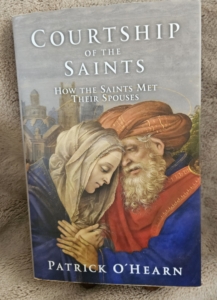
Patrick O’Hearn’s Courtship of the Saints: How the Saints Met their Spouses, offers lively, loved-filled accounts of couples from Biblical times into the 21st Century. They shaped the church in some way through their sacrifice and devotion to one another and to their families by making the prayer their foundation and God the center of their lives.

Mr. O’Hearn, also the author of Parents of the Saints: The Hidden Heroes Behind Our Favorite Saints, and former acquisitions editor with Tan Books, clearly strives to provide an antidote to the decades old “hookup culture” that has degraded marriage, women, and men. He does this with inspirational examples of a proven formula for meeting one’s true love. People have, over the centuries, continued to seek love, but the ways of going about it have failed. He promises that the contents lying beyond the beckoning cover of the intimate painting, “The Meeting of Joachim and Anne outside the Golden Gate of Jerusalem,” by Fillipino Lippi (1497) are “… better than any romantic novel because they return to the source of love: God Himself” (p. 5), and Mr. O’Hearn is as eager as any evangelist to share the news.

He doesn’t begin there, however, because without the proper framework, the stories would only be pretty romance tales. Mr. O’Hearn commences by defining courtship and its significance, offering historical and contemporary perspectives. He explains how it is different from modern “dating” and urges those called to marriage to pursue it. “Our culture will only be renewed when the family is strong … when marriages reflect Christ’s radical love for His church; when couples love each other madly through the good times and bad, and are open to the number of children God wants to provide them.” (pp. 5-6). He peppers the narrative with quotes from Ven. Fulton Sheen, St. Thomas Aquinas, and other well-known and favored theologians.

“Courtship looks to the future – to eternity,” he explains. “Courtship asks the following questions: Does this person have virtue? Is this the best person to lead me — and, God willing, my future children — to heaven?” (p. 11). He moves into betrothal: “…a time for a couple to intensify their prayer life as they prepare for marriage” (p. 19). Introspective questions give further substance to the book and to Mr. O’Hearn’s premise of returning to a prayer-filled, God-invited relationship. Part Two “Courtship Counsel and Prayers” is a kind of action plan that offers contemplative questions such as: How do I pray daily for my future spouse? Where should I look for a future spouse? It also advises how to choose a spouse, discern marriage as a vocation, and offers prayers and saintly inspirational quotes.  A section for married couples opens with this guidance: “Rediscover why you fell in love in the first place and continue to fall in love. Don’t let the fire burn out.” Mr. O’Hearn then suggests practical applications for doing so.

Sandwiched between the practical is the romantic with the couple’s entertaining encounters. The 23- year union between Karol and Emilia Wojtyla so influenced their young son that it helped to shape his perception of the love between a man and a woman that the author asserts it “… provided the first education concerning the splendor of marital love” contained in Pope St. John Paul II’s “Theology of the Body.” His parents are now Servants of God. Accounts like the Wojtylas will melt hearts. Others might drop jaws, such as the meeting of Josef and Maria Ratzinger that occurred when she responded to a newspaper ad he wrote to find a wife. St. Thomas More transitions from the martyr who dared to defy King Henry VII to the guy down the street who is widowed prematurely and, out of concern for his young children, begins looking for a wife. No doubt readers will chuckle – because they know a couple just like this — when they read about Bl. Anna-Maria Taigi and her husband, Dominic, who possessed “rough” manners.

Others will bring tears. Arguably, no other romance is as beautiful as that between Pietro Molla and Gianna Beretta and the family life they created. The author devotes nearly 20 pages to them. Anyone who has read Journey of Our Love: The Letters of Saint Gianna Beretta and Pietro Molla, which the author cites, will marvel at how he was able to keep it to 20.

Among the 25 couples, readers will have many favorites because, regardless of the time, all have uniqueness and relatability. Each one also has the commonality of fervent prayer and love of God. Anyone willing to put their love life into God’s hand will be able to find joy, endure hardships, and withstand suffering, proving that but no one can write a love story better than the Father Himself.

© Copyright 2025 by Mary McWilliams

Feature Photo by Eugenia Remark: https://www.pexels.com/photo/decorated-cards-golden-plate-and-ring-in-box-14784845/
Inset photo by Mary McWilliams

St. Macrina the Younger: The Saint Who Made a Family Her Mission

St. Macrina the Younger was simply a big sister who never stopped showing up for her family. She cared for her widowed mother, raised her nine younger siblings (including two future saints), and turned her family estate into a monastery where service and community thrived.

In this post, I explore how St. Macrina made family her mission and what her example can teach us about building family unity when life is pulling us apart. If you’re longing for deeper connection with your loved ones, her story might just hold the blueprint.

Who was St. Macrina the Younger?

St. Macrina the Younger (c. 330–379) was the eldest in a remarkable family of ten children, several of whom became saints. But behind their greatness was Macrina. After losing her fiancé at a young age, she chose not to marry, devoting her life instead to caring for her widowed mother and raising her younger siblings.

She lived with her mother until her dying breath. Their bond was so strong that her mother would joke that she never stopped being pregnant with Macrina because Macrina was always with her. Macrina ran the household like a family business, managing everything from daily chores, finances, to spiritual formation. She was a mother and father figure to her youngest brother Peter, who was born when their father died, a guiding hand to Gregory of Nyssa, and a sharp voice of humility to Basil the Great when he returned home pompous from his studies in Athens.

After the sudden death of their brother Naucratius, Macrina helped her family turn their grief into purpose. Her words literally lifted her poor mother off the floor from despair. She told her it was better to rejoice in the blessings she enjoyed than to grieve over those that were missing. 

She and her mother turned their estate into a monastery and freed their workers, asking them to join their community as sisters in Christ. Macrina and Peter founded one of the first co-ed monasteries on their estate in Annisa. She led the women’s side, and he led the men’s. 

Her calling was simple but profound: to serve her family with love. Through that calling, she helped shape the early Church.

After her death, her brother Gregory of Nyssa honored her by writing The Life of Saint Macrina, preserving the story of her extraordinary holiness, wisdom, and unwavering devotion.

Finding Family Unity in Today’s World 

St. Macrina’s life was a testimony to family unity. She kept her family together by serving her mother and working on projects with her brother Peter, such as founding one of the first dual monasteries. St. Macrina was the abyss of the women’s side and Peter ran the men’s quarters.  Family unity is harder to achieve today than in the past. First, families used to live in close  proximity, sometimes even in the same household. Families today are more likely to live in different cities, states, or even countries due to job opportunities, education, or lifestyle choices.  Although technology has helped connect families across lots of distances, overreliance on technology has also caused superficial connections i.e. sending a text instead of giving a phone call. Our busy lives have also caused long work hours and scheduling conflicts. The rise of mobile devices has created a new norm of families reclining to their own spaces and devices for entertainment, whereas before families would watch a show together on one television set.  Also, families were larger back then, with multiple generations often living together, creating natural opportunities for bonding and shared caregiving roles. Because of the decline of intergenerational living, nursing homes, senior living communities, and independent living are more common, reducing interaction between generations. 

So how can you foster family unity today? 


Here are 9 ways to build strong families: 

  1. Prioritize Quality Time 
  • Regular Family Meetings: Schedule time to check in on each other’s lives, share concerns, and celebrate milestones. 
  • Meal Times Together: Dedicate at least one meal a day to sit down together without distractions like phones or TV. 
  • Plan Activities: Organize family game nights, hikes, or movie nights to spend quality time together. 
  1. Embrace Technology Wisely 
  • Video Calls with Distant Family: Use video platforms to regularly connect with relatives who live far away. 
  • Shared Digital Spaces: Create a family group chat for daily updates, encouragement,  or sharing photos and memories. 
  • Set Screen-Free Zones: Establish areas or times (like dinner) where everyone disconnects from devices to focus on one another.
  1. Serve Each Other in Practical Ways 
  • Acts of Kindness: Surprise a family member with a simple act of kindness or charity, like making their favorite meal or helping with chores for example.
  • Share Responsibilities: Take turns with household tasks or support a family member’s workload when they’re overwhelmed. 
  • Be a Listener: Sometimes, the greatest act of service is giving your full attention to a family member who needs to talk. 
  1. Engage in Community Service Together 
  • Volunteer as a Family: Participate in activities like serving at a soup kitchen, cleaning up parks, or helping at a local charity. 
  • Support a Cause: Choose a cause important to your family and work together to make a difference, such as organizing a donation drive. 
  • Random Acts of Kindness: Spread kindness in your community, like delivering baked goods to neighbors or writing thank-you notes. 
  1. Celebrate Traditions and Create New Ones 
  • Maintain Rituals: Celebrate holidays, birthdays, or milestones with special traditions that bring everyone together. 
  • Create New Memories: Start simple traditions, like a weekly gratitude practice or a family recipe night. 
  • Honor Cultural Practices: Teach and participate in rituals or traditions that connect with your family’s heritage. 
  1. Cultivate Empathy and Understanding 
  • Express Gratitude: Regularly thank each other for the roles they play in the family.
  • Resolve Conflicts Thoughtfully: Practice active listening and open communication to address disagreements respectfully. 
  • Encourage Vulnerability: Create a safe space for family members to share their feelings without fear of judgment. 
  1. Grow Spiritually Together 
  • Pray or Meditate Together: Build a spiritual connection by sharing prayer, meditation,  or devotions. 
  • Study Together: Read religious texts or other meaningful literature and discuss how they apply to your family’s life.
  • Practice Gratitude: Reflect as a family on the things that you’re grateful for, reinforcing positivity and togetherness. 
  1. Build a Shared Vision 
  • Set Family Goals: Work together to set goals for the household, whether financial,  personal, or relational. 
  • Support Dreams: Encourage and assist each other in achieving individual goals, like career aspirations or personal growth. 
  • Collaborate on Projects: Tackle projects together, such as redecorating a room or planning a vacation, to help strengthen teamwork. 
  1. Teach and Learn Together 
  • Skill Sharing: Teach each other skills, like cooking, driving, or DIY crafts.
  • Educational Activities: Visit museums, attend workshops, or read books as a family to expand knowledge and bond. 
  • Mentor Younger Generations: Encourage older family members to share their experiences and wisdom with younger ones. 

St. Macrina’s Patronage and Associations 

St. Macrina the Younger is not traditionally associated with a specific patronage in the way that some saints are (e.g., St. Anthony for lost items or St. Francis for animals). However, her life  and legacy might make her an inspirational figure for particular groups or causes such as: 


  1. Theologians and Scholars: 

St. Macrina played a significant role as a theologian, deeply influencing her brothers, St. Basil the Great and St. Gregory of Nyssa, in their theological work.  She is often recognized for her wisdom and contributions to early Christian thought. 

  1. Older Siblings:  

St. Macrina was the eldest of ten siblings. She cared for them and instructed them in religious studies. She often reprimanded St. Basil when his ego was puffed up from his studies. She uplifted St. Gregory when Emperor Valens stripped him of his position as a Bishop of Nyssa. 

As an educator, especially for her brothers, St. Macrina might be seen as a model for teachers and mentors, particularly in faith and moral instruction.

      3. Ascetics and Monastics: 

Her commitment to a life of prayer, fasting, and asceticism makes her an inspirational figure for those who pursue a monastic or ascetic lifestyle. 

  1. Family Unity and Service: 

St. Macrina never left her mother’s side. She helped her with housework,  finances, and child-rearing.  

  1. Women in Leadership Roles: 

As a woman who profoundly shaped the spiritual and intellectual lives of others,  she serves as an example for women in leadership, particularly within religious and educational contexts. 

  1. Charity

St. Macrina’s monastery was widely known for its generosity. They fed the country during a famine, picking up those laid out on the side of the road and children abandoned by their parents.

How St. Macrina can help us overcome family struggles

Family life can feel hard. We’re pulled in a thousand directions—by work, screens, and packed schedules. But St. Macrina reminds us that holiness is often found in the quiet, unseen work of loving and serving those closest to us. At times, caring for family can feel like a burden—but that’s exactly what made St. Macrina a saint. She chose to stay by her widowed mother’s side and helped carry the weight of single motherhood. When family life feels overwhelming, we can look to St. Macrina for inspiration and pray for the grace to serve our loved ones with the same love and devotion as she did.


copyright 2025 Janet Tamez

Edited by Angela Lano

What are you looking for?

“The two disciples heard what he said and followed Jesus. Jesus turned and saw them following him and said to them, ‘What are you looking for?’” John 1:38


My favorite hymn when I was a child was, Here I Am, Lord. I loved the rhythm and the simple prose, and I thought the sentiment behind the words was lovely even if I didn’t quite understand their importance. As an adult, the song continues to be my favorite hymn, and it brings tears to my eyes every single time I hear it. Though I still love the music and the words, it’s the deeper meaning that gets to me now. Jesus asks us to serve, and we need to respond like Samuel and the Apostles, ready to answer and do His will.

Awaiting God’s Call

This month, we celebrate the feast day of St. Elizabeth Ann Seton, our first American-born saint. Two of my three daughters graduated from Mount St. Mary’s in Emmitsburg, Maryland. Emmitsburg was the home and final resting place of Mother Seton. Mother Seton to Emmitsburg moved in 1809, where she founded the Sisters of Charity of St. Joseph’s, the first community for religious women established in the United States. It was in Emmitsburg where she also began St. Joseph’s Academy and Free School, the beginning of Catholic education in the United States. 

Before becoming a nun, Elizabeth was a wife and mother. She was not Catholic but was very religious. While nursing her sick husband in Italy, she learned about Catholicism from friends who lived there and was intrigued by the Church and its sacred traditions. The more she learned and attended Mass, the more she felt called to become Catholic.

Hearing God’s Call

Years, later, she heard the call to become a nun, and later, she heard the call to found the order and the school in Emmitsburg. 

Mother Seton wrote, “We know certainly that our God calls us to a holy life. We know that he gives us every grace, every abundant grace; and though we are so weak of ourselves, this grace is able to carry us through every obstacle and difficulty.”

Many generations before Mother Seton, Jesus asked Andrew and John, “What are you looking for?” (John 1:38) They immediately followed Him, asking where He was staying. Then they sought others and encouraged them to join as well (Andrew’s brother, Simon, John’s brother, James, and Andrew’s friend, Phillip). Without hesitating, they answered Jesus’ question with their actions. 

Jesus still asks this question, but so many fail to hear it or understand from whom it comes. So many of us spend our lives searching for meaning, for happiness, for belonging when Jesus openly and willingly offers us all that and more. When faced with Jesus’ question, we look for the answer in other people, in media and entertainment, or in addictions, and often overlook the most basic, most obvious places—Holy Scripture, the Mass, the Church. It was in the Church, at Mass, and through the sacraments that Mother Seton heard the call to convert, to become a nun, to serve, and to teach.

Answering God’s Call

We, too, are being called. We can hear God’s voice each time we attend Mass, go to Confession, or seek the Lord in Adoration. He is calling out to us to help Him build His Kingdom, to serve, to teach, and to bring others to Him.

Listen for the voice of Jesus in your daily life. Shut out the noise and the distractions. Be alert and awake. He is asking, “What are you looking for?” All you need to do is answer in the same way Mother Seton did, “Here am I, Lord; I come to do your will,” (1 Samuel 3:8, Psalm 40:9). “Speak, for your servant is listening” (1 Samuel 3:10).

Let us pray, “Oh my God, forgive what I have been, correct what I am, and direct what I shall be” (St. Elizabeth Seton). Amen.


copyright 2025 Amy Schisler

Edited by Heather Gaffney