Hope and Resilience
Only Divine Providence could have woven such a tale. I can just offer you a sketchy map, and a few further clues. But we’re all a part of it. You’ll find your way.
This story opens in the mid-1800’s, with an English nobleman who collected American tree specimens to forest his Irish estate across the Atlantic Ocean. It encounters White Russians fleeing persecution following the communist revolution in 1917. It continues into the 1920’s, with an ambitious Irish diplomatic attaché in Paris; and a devastating family tragedy in Ireland.
Our tale emerged again in a small Swiss town in 1957, when a Protestant housewife received an indelible message in prayer from an Eastern Orthodox Catholic Saint.
But perhaps the most interesting plot twist occurred in the late 1940’s or early 1950’s, when a group of Irish schoolboys discovered dusty 15th-century religious icons while searching for treasure in a 19th-century reproduction-Gothic castle.
For me, it began on a recent March morning when a massive herd of glossy cattle crossed the road in front of our tour bus for more than fifteen minutes on their way to pasture. These cows dwell at Glenstal Abbey near Murroe, County Limerick, in the ancient Munster region of Ireland. (1)
Assisted by their dedicated local lay-oblate community, the Benedictine monks at Glenstal administer a substantial farm; a nationally-accredited Roman Catholic boarding school; and a conference center that offers retreats, spiritual consultations, and pilgrimages to individuals and groups of different faiths from around the world. A major inspiration for many pilgrimages to Glenstal Abbey is its unique collection of rare Eastern Orthodox prayer icons. These icons are displayed in a custom-built underground chapel beneath the main church.
In the Eastern Orthodox faith tradition, iconography is regarded as a particular kind of worship and a specific religious vocation. Although drawing and painting are involved, icons are always referred to as “written,” not made. The most important stages in their writing are the trained religious artists’ disciplines, fasting and prayer. Orthodox believers do not “look at” their icons; they present themselves before them, so that the saints can communicate with human beings on earth through the windows of their eyes.
The White Russians eventually found their way to Paris, France. Many families at that time were trapped in an economic depression that gripped continental Europe as well as North America. Too often, they were forced to part with their most precious possessions in order to support their families. For the Russian émigrés, that meant selling their family icons.
It seems that a diplomatic attaché for the Irish government, stationed in Paris, was happy to assist with the disposition of religious art works. The monks at Glenstal Abbey believe that this is how their Russian Orthodox icons were transferred to Roman Catholic Ireland.
At some point the icons landed at the castle forested with North American trees, once owned by the Barrington family. When their daughter was killed by Irish freedom fighters in 1921, the family returned to England. A local priest, Monsignor James Ryan, purchased Glenstal Castle in 1926 and donated it to the Benedictine Order, to found an abbey and school in the Archdiocese of Cashel. Glenstal Priory was inaugurated in January of 1928; the abbey boys’ school was established four years later in 1932. (2)
But following the turmoil of World War II, by the early 1950’s the Orthodox icons’ presence at Glenstal Abbey had been almost forgotten. Inquisitive schoolboys, digging through nooks and crannies, apparently came upon them stored somewhere in the castle. The Russian Orthodox saints traveled across a Roman Catholic campus in children’s hands, to decorate dorm room walls or to lie hidden under beds as secret prayer talismans.
Back on the continent, in 1957 the small-town wife of a Reformed Church pastor began to see saints and angels, including Mother Mary, beckoning to her from Roman Catholic churches in central Switzerland. Eventually, Joa Bolendas entered these churches to pray.
According to one of Bolendas’ accounts, St. Nicholas appeared to her and said, “This is the testimony of an early Saint of the Russian Orthodox Church.” In their encounters, St. Nicholas showed her images of icons that he said were “missing.” He told her that these icons were important for the future of the world and must be found. St. Nicholas thought that the icons he sought were somewhere in Ireland.
Bolendas’ nephew by marriage, John Hill, a graduate of Glenstal Abbey School, was in residence at that time in the C. G. Jung Institute of Zurich. Acting as a family member and not in his professional capacity, John began to accompany his wife’s aunt to church. He observed her in ecstatic prayer (3).
Joa Bolendas was described by all who knew her as “a strong woman,” and “a thoroughly practical person.” John himself watched her come out of prayer visions and briskly proceed to a nearby shop. There she would haggle with the butcher for his best cut of meat at the lowest price, to cook for her family’s dinner. John Hill deemed her fully grounded in reality.
He had a vague recollection of “those icons we used to play with at Glenstal as boys.” The matter seemed worthy of investigation. John called his old friend Mark Patrick Hederman, a monk, writer, teacher and administrator for the same abbey school where they both grew up.
In 1976, John and his wife Anne-Marie, with a photographer selected by Joa Bolendas, traveled back to Glenstal Abbey to examine whatever icons they might be able to find there.
Photographs of the icons they located in a thorough search of abbey and school were shown to Joa after they returned to Switzerland. She confirmed them as the same images St. Nicholas had revealed to her in visions. The saint then requested through Joa that the Benedictine brothers at Glenstal “build a chapel at their abbey to preserve them.”
All of the saints and angels who spoke with Joa over many years conveyed the same essential message. Whether explicitly or implicitly, the thrust of these revelations was always the importance of unity among mankind. If the chapel was built at Glenstal, St. Nicholas told her, “Unity will follow for Germany and Ireland.”
When Brother Patrick first presented a multi-million-dollar bid he’d received from a local contractor, the proposal to build a free-standing icon chapel on the abbey grounds was firmly rejected by the Glenstal monastic community.
Over time, however, the Benedictine brothers eventually developed a consensus. If Brother Patrick could find a way to build this chapel in the unused dirt cellar under the abbey church, they might be willing to help support it.
A third Glenstal Abbey School classmate, Jeremy Williams, had grown up to become one of Ireland’s leading architects. Patrick called Jeremy to the abbey for a consult. The aesthetic they both envisioned was a smaller version of the chapel at St. Sophia Church in Istanbul.
Their design was ultimately built in Glenstal Abbey’s church cellar to house the Russian icons, as well as an equally-precious donated collection of Greek Orthodox icons.
Their cement contractor in Cologne, Germany, who ground real stone for use in the colored-concrete chapel floor, provided the abbey with hefty discounts. In return the monastic community granted permission for the contractor to use an image of the finished chapel in promotional materials.
Before construction even began, while the abbey team was still examining the underground structure, a man no one had ever seen before walked in.
He said, “I know what you’re doing here! I know how to do it! No one else must touch it!”
With the monks’ permission, he spent the night alone, “inside the black box,” for inspiration. That ‘stranger’ turned out to be a local man, the brilliant and idiosyncratic Irish artist James Scanlon, who created luminous stained-glass medallions to anchor and illuminate a portion of the chapel ceiling vault.
Even the cows offered up their own fair share of the chapel costs, in cream and butter. Dairy sales from the farm help to support all of the spiritual and educational programs offered at Glenstal Abbey.
The finished icon chapel opened on April 10, 1988, with ancient musical tones and choral chants. These were researched as well as performed by Irish composer Michael O’Sullivan, with Rev. Nóirín Ní Riain, Ph.D. as liturgical cantor. (4)
Just nineteen months later, on November 9, 1989, the Berlin wall that had divided Germany for more than five decades fell to the ground. On 10 April, 1998, the tenth anniversary of the chapel’s consecration, Good Friday Agreements brought peace to Northern Ireland, putting an end to physical interreligious violence there.
This evidence is anecdotal, of course. Private devotions are treated as optional, not obligatory, in our Roman Catholic church. Still, the discerning monks of Glenstal Abbey visit their icon chapel every day, at the same time, to pray for healing in our world. This devotion is performed in addition to their traditional Benedictine charism, ora et labora, a daily rhythm of work and prayer in the Liturgy of the Hours.
If nothing else, the length and breadth of this history illustrate that dark times of many different kinds have always besieged humanity. The haunting eyes of early saints in the Glenstal Abbey chapel continue to regard contemporary pilgrims with eternal compassion.
Glenstal Abbey will celebrate the icon chapel’s 35th anniversary on April 10, 2023.
Should you, yourself, feel called to reflect on how a group of 1950’s Irish schoolboys ‘just happened’ to be in the right places, at the right times, prepared with the exact adult skills to provide every resource required to incarnate this chapel … Please join in prayers for unity and peace on Easter Monday.
“Drive away the darkness that surrounds us,
Shed onto us the mantle of your light.
Help us to know your will,
And give us the courage to do it.” (5)
Amen.
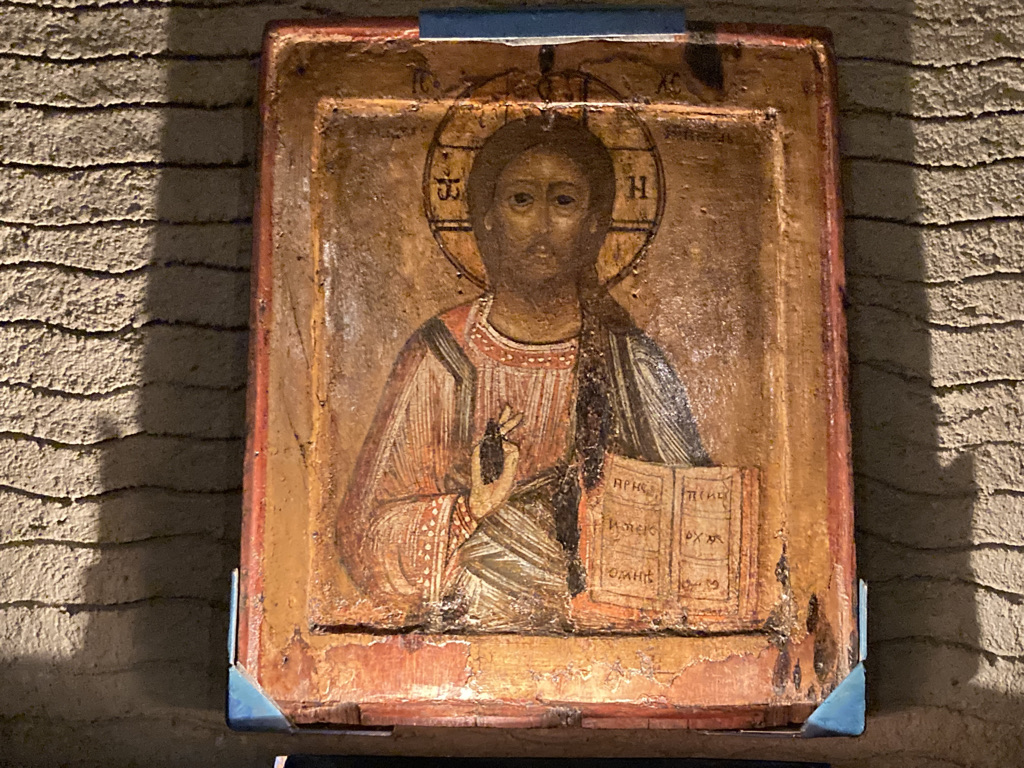
Original Russian Icon “The Healing Christ” in the Glenstal Abbey Icon Chapel Photo by Margaret Zacharias, taken with permission from Don Mark Patrick Hederman
Featured Image: Collection of Original Eastern Orthodox Icons in the Glenstal Abbey Chapel Photo by Margaret Zacharias, taken with permission from Don Mark Patrick Hederman The “Angel of Silence” can be seen at lower right.
Notes:
- https://glenstal.com/abbey/
- A more detailed history of Glenstal Abbey, and exposition about the educational philosophy of the secondary-level boy’s school, may be found in former Headmaster Mark Patrick Hederman’s book:
The Boy in the Bubble: Education as Personal Relationship
https://www.amazon.com/Boy-Bubble-Education-Personal-Relationship/dp/1847304052/ref=tmm_pap_swatch_0?_encoding=UTF8&qid=1680133263&sr=8-1
- The full story of Joa Bolendas’ visionary prayer experiences may be found in her books:
So That You May Be One
https://www.amazon.com/s?k=Joa+Bolendas+That+You+Be+One&crid=1RFFTDTLMZBLJ&sprefix=joa+bolendas+that+you+be+one%2Caps%2C155&ref=nb_sb_noss
Alive in God’s World
https://www.amazon.com/Alive-Gods-World-Described-Bolendas/dp/097010975X/ref=sr_1_1?crid=Q8W6BZWU4KAG&keywords=Joa+Bolendas+Alive+In+God%27s+World&qid=1679641031&sprefix=joa+bolendas+alive+in+god%27s+world%2Caps%2C144&sr=8-1.
- Recordings of the early Christian music that accompanied the consecration of Glenstal Abbey’s icon chapel may be found here:
Vox De Nube
https://www.amazon.com/dp/B09S3F6YQ1/ref=sr_1_2?crid=3RR326YJQLC6A&keywords=vox+di+nube&qid=1679728636&sprefix=vox+de+nube%2Caps%2C142&sr=8-2
- One prayer given in a dream to Don Mark Patrick Hederman, now Abbot emeritus of Glenstal Abbey.
This article was prepared with help and permission from Don Mark Patrick Hederman and John Hill.
Any errors of fact or interpretation are the sole responsibility of the author.
© Copyright 2023 by Margaret King Zacharias, Ph.D.