From Grief Through Mourning

Last year, I could not do it. This year I did.

In the Catholic Church, the month of November begins with two consecutive liturgies that honor our beloved dead, The Solemnity of All Saints and the Commemoration of All Souls.

We always hope that departed family members and friends might be celebrating the first feast with us, already among the saints in heaven. We trust that our prayers will help to console and sustain any loved ones who might, this year, still remain in purgatory.

It takes most people a long time to establish their ‘new normal’ after a family member’s or close friend’s death.

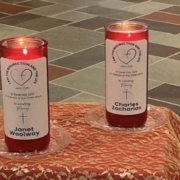
In my parish, one of these opportunities is a Mass of Remembrance offered each year on the Saturday morning before All Saints Day. A candle is provided for each family to place around the altar when their loved one’s name is proclaimed, and these candles are lit for each mass through the month of November

Last year, the 2024 Mass of Remembrance was scheduled just ten days after my husband’s funeral. With a sincere intention, I had placed his name on the list.

But when that Saturday morning arrived, I found myself still too exhausted from his sudden, unexpected death, the need to transport his remains from another state, and managing to stay functional — with help from close family and friends — for the funeral.

Last year, another dear friend stepped up to carry Charles’ Mass of Remembrance candle for me. This year I was able to carry it myself.

***

Beyond Catholic parishes’ roles in helping to organize funeral liturgies and hospitality, many also offer valuable longer-term support options, to help families survive devastating grief and manage the psychological challenges that always accompany any great loss.

We are all unique creations of God, and every person’s grief process is unique. So, I want to briefly share two more long-term support options offered by the grief ministry in my parish.

What has served me best might not be right for you. Likewise, parts of these programs that did not most resonate with me, might be just right for you.

I include them here because I believe they offer a range of valuable options to meet a variety of needs for different mourners.
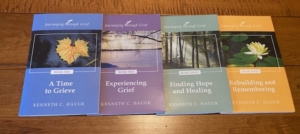
The first is a year-long series of booklets, +/- 40 pp. each, written by Kenneth C. Hauck and published by Stephen Ministries in 2004. Entitled  A Time to Grieve, Experiencing Grief, Finding Hope and Healing, and Rebuilding and Remembering. These were mailed to me quarterly after my late husband’s funeral, as gifts from my parish.

Because I am an introverted person who normally reads and writes alone, I appreciated the freedom to digest these words of wisdom privately, and on my own schedule. The quarterly mailing time frame felt just right, too.

For those who feel more enthusiastic than I do about watching videos and participating in weekly discussion groups, another excellent support option offered by my parish is titled Grieving with Great Hope.

Meditation Journal written by John O’Shaughnessy, Sandy O’Shaughnessy, and Fr. John Riccardo,
part of the Grieving with Great Hope parish program, published by Good Mourning Ministry, Inc.

This program includes a series of videos, and small discussion groups with fellow mourners from your own parish. Ordinarily, those who join this program are in closely similar time periods after a loss.

The program includes a journal published by John and Sandy O’Shaughnessy, with Contributing Writer Fr. John Riccardo, as part of Good Mourning Ministry, Inc.

Of the resources offered by this ministry, I’ve personally found silent meditation and private writing, with the suggested journal

reflections, to be the most helpful. But I have also witnessed the benefits gleaned by others, from watching the videos and participating in discussion groups.

***

At the Mass of Remembrance on October 25, 2025, my deceased husband’s date of passing was the longest elapsed. I had been prepared beforehand, by our deacon’s gentle and compassionate wife, to hear his name called first and to face the empty altar alone.

As I bowed before the altar I tried to discern, among all the candle holders so lovingly arranged, where might be Charles’ place. The Holy Spirit led me to a place on the side by my accustomed pew, when I sing with the funeral choir, near the altar and close under the crucifix.

While a total of almost forty names were called, I prayed for each soul, and watched each family approach the deacon to receive their candles.

Charles’ light had to hold his mountain alone, for a long time. I began to wonder, who will God send, to occupy that spot beside him?

About three-quarters of the way through the list, I heard the name of a dear friend, mentor, and fellow funeral choir member. She and her late husband had coordinated our county-wide nursing home citizen-visitor ministry throughout their long retirement years. I had been a part of that ministry.

I watched Janet’s four children — none of whom I had ever met — come up to receive their candle, and bow. I could feel them doing their own discernment.

When they came over, to place Janet’s candle next to Charles, I could almost hear her saying, “Don’t worry, Margaret. I’ll look after him myself.”

***

Wherever any of you may be in your own grief journeys, no matter who you might be mourning this November, please know that I am
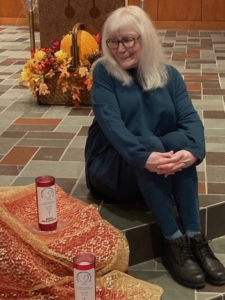
Author meditating on the candles, after Mass of Remembrance at St. Theresa of the Child Jesus Catholic Church, Des Moines, Iowa, October 25, 2025.

praying for you.

I ask your continuing prayers for me, too.

This will be my last CWG column for a while. I need a brief sabbatical; to continue dealing with the massive changes I’ve experienced

over the past fourteen months, and to discern where my own ‘new normal’ life will lead.

May the compassion of Our Lord’s most Sacred Heart, the love of Mary’s Immaculate Heart, and the wisdom of the Holy Spirit remain with you, as well.

Blessings, always,

Margaret


© Copyright 2025  by Margaret King Zacharias

All photos from author’s personal collection; used with permission by the author

Featured photo: Candles lit for Mass of Remembrance, St. Theresa of the Child Jesus Parish, Des Moines, Iowa, on
October 25, 2025. Author’s personal photo, published with permission.




Memento Mori

Teach us to count our days aright,
that we may gain wisdom of heart.
(Psalm 90:12). (1)

Memento Mori

When I was growing up, “Remember your death” was an almost universal expression of Christian practice during Lent.

Parents taught their children that we are “ashes to ashes, dust to dust.” My own mother, and a variety of other mature women I knew then, quipped their excuses for not mopping under beds with the old joke, “My friends might be down there, visiting me today.”

It’s human nature to fantasize that we are the exceptions, that we will never wrinkle and decline, that we ourselves will never die. The elders then were offering us as children an essential grounding in reality.

Last September, I lost my beloved husband of almost 50 years

Although I recognized our advancing age, decreasing energy, and the burgeoning of necessary medical checkups, I shied away from his earnest attempts to provide me with important survival information.

My response was bright-eyed and cheery. “But we’re not going to die,” I kept telling him. “At least, not yet.”

I know he showed me where he was hiding the outdoor emergency house key … Five months later, the kids and I still haven’t been able to find it. Fortunately, we had other keys.

A massive heart attack, caused by blockage in the LAD, left artery descending, took Charles away from us far too soon. This silent and deadly killer is nicknamed “the widow maker” by medical professionals, for good reason.

I’m deeply thankful for the memory that last April, he raced me across the parking lot at St. Thomas the Apostle Church in Tucson, right after we had received Eucharist together on Easter Sunday. I’ll never forget his grin when he beat me to the car.

Despite my evasion, a spiritual call to prayer for the dying does run in my maternal family line. I experienced it even in my Methodist childhood, with elderly family members “checking in” as their time of passing neared.

Once I was confirmed in the Roman Catholic Church in 1989, insistent calls to pray for fellow parishioners, and even total strangers, drew me to the Adoration Chapel more and more often.

After a while, I began to notice that every time I felt a particular call to prayer, the same people were already there, or coming through the door right behind me; each of us always with a rosary in our hands.

At a Catholic Life in the Spirit conference held at Notre Dame University in 1998, I heard a speaker on the topic of charismatic gifts say, “Here’s a terrible one – knowing when people are going to die.”

I disagree. It’s a beautiful gift in the Body of Christ, a blessing that Our Lord pours through us, in the power of the Holy Spirit.

These calls to prayer mean that someone who loves us knows when we’re coming home; someone is lighting a candle in the window to guide us and welcome us; someone is calling companions together to support us. The transportation provided for that journey is prayer.

Every time any member of the Church prays a rosary, aren’t we asking the Blessed Mother for this very assistance at the time of our own deaths?

Catholics who respond to a felt call, to pray a rosary for others, are serving Mother Mary as her hands here on earth.

Has this understanding spared me any of the dreadful earthly experiences that follow the sudden death of a spouse — the incapacitating waves of grief, the hollow feeling of emptiness, the seemingly endless sleepless nights – the lawyers, bankers, and brokers, with their complicated rules and reams of paperwork – the daunting responsibilities to console grieving children and grandchildren, and to navigate the family through a disorienting new universe?

No. I have not been spared any of these.

But I’m grateful that, by mystical grace, I was granted the privilege to be with my husband, in prayer, at the time of his death; with God’s love swirling around us and through us both. That, for me, is everything.

T.S. Eliott wrote, in the concluding lines of his profoundly religious poem Ash Wednesday:

“When the voices shaken from the yew-tree drift away,
Let the other yew be shaken and reply.
… Teach us to sit still
Even among these rocks,
Our peace in His will
And even among these rocks
Sister, mother
… Spirit of the river, spirit of the sea,
Suffer me not to be separated
And let my cry come unto Thee.” (2)

Holy Mary, Mother of God, pray for us now, and at the hour of our death.

Amen.

Notes:
1. https://bible.usccb.org/bible/psalms/90
2. https://englishverse.com/poems/ash_wednesday © 2003-2025 English Verse

Copyright by Margaret King Zacharias, February 15, 2025.

Feature photo used by permission of the author.

For I know the Plans I Have for You

For I know the Plans I Have for You (Jer. 29:11)

Greetings, fellow travelers. I am (probably) the newest contributor to the CWG blog. In an attempt to introduce myself, I decided to offer the following recollections that I wrote for a smaller audience. This is a deeply personal account, but it’s how I roll.

I was widowed two years ago, and it significantly altered my perception of marriage, God and our eternal trajectory. Retrospect is the critical viewpoint in this narrative, since my husband and I did not convert to Catholicism until we were in our mid-thirties. Hence, God’s plan for our lives was not immediately intuited, although we eventually recognized the critical nature of the Catholic faith in our marriage. It was this faith that would provide continuity and structure to the sacrament we shared. We were married for 42 years, and this is our story:

My husband, Steve, was a risk-taker.

I was not.

Our third date I found him cheerfully explaining the constellations of scars on his head and chin—which he identified as wounds from embedded gravel—the result of a tire blowout during a high-speed motorcycle ride on a gravel road. Apparently, he went airborne before the force of gravity did what gravity tends to do—and it sucked him into the hard, graveled surface below him.

I watched, horrified, as he retold the story, complete with sound effects, and enthusiastic arm-flapping.

“You’re lucky to be alive!” I gasped. He smiled.

“Yeah,” he said. His grin grew even wider.

“Weren’t you scared?” I exclaimed.

“Nah,” he said casually, “I was too busy trying to keep the bike from falling on top of me and killing me.”

I remember being incredulous, as I tried to comprehend his explanation. I did not understand this attitude toward life. I risked nothing. I gambled on nothing, and I kept everything in my world ordered and safe. We could not have been more different. Who is this guy? I thought.

Eventually, and against my better judgment, Steve managed to talk me onto the back of his dirt bike—after assuring me that he wouldn’t go too fast. I believed him (mostly) even when we were sailing over huge hills with considerable hang time, before landing on the other side of the hill. I remember clutching my arms around his waist and screaming into his back, while he yelled reassurances that everything was fine. (I think he really enjoyed that part.)

Steve frequently challenged the forces of nature with every ounce of his seemingly immortal body. If he wasn’t defying gravity, he was water skiing without skis, or driving snowmobiles across frozen ponds. It always seemed to me that he was like one of those giant grasshoppers that flies erratically into oncoming cars—barely missing the windshield with an artful dodge.

Alternatively, the laws of physics and the general nature of risk, did nothing to inspire intestinal fortitude within. My formative years had been painful, and I trusted no one. Night after night, I remember begging a distant God for deliverance—a deliverance that always seemed elusive—rendering my nominal faith into shadows.

Despite my spiritual quagmire, I gradually began to appreciate Steve’s attitude toward life. Scientific laws can be harnessed if you have the right tools, and the world is approachable if you are comfortable with who you are. Steve was all those things—and slowly, patiently (sometimes) he taught me to take risks: with others, with myself, and of course … his motorcycle.

Initially, I did not realize that God had finally offered me deliverance in the form of a young man with an irrepressible temperament—but it seems rather obvious now. It would have required someone with that kind of fortitude to wage battle with the seen and unseen forces around me.

It turns out that God had been listening all along.

It should come as no surprise that Steve went on to have a successful career in law enforcement before retiring due to injuries he sustained in the line of duty. Those injuries are what ultimately caused his death, but he would have settled for nothing less. That’s just how HE rolled.

January marked the second anniversary of Steve’s death, and if I could tell him anything right now, I think it would be this: Thank you for taking a chance on this wisp of a soul. You are proof that God answers prayer on the most elemental level. I am forever grateful to you—and most importantly—to God, who is ever-merciful, and actively involved in the most intimate details of our lives.

This knowledge fills me with child-like trust–secure in the knowledge that God always has a plan.


©Copyright 2023 by Sarah Torbeck