
Pilgrim Tales: The Story Behind “Faithful Journeys, Hidden Sanctuaries”

They stood in silence for a moment, the old man and the young, united by faith, by craft, by blood, and by the shared knowledge of what it meant to be touched by something beyond understanding. -“Faithful Journeys, Hidden Sanctuaries”

When invited to contribute to the CWG Anthology, I was happy for the opportunity to write a historical fiction story as a way to learn about the saints. In particular, a group of saints that we learned about while traveling through England this past winter. 

We expected our visit to York to be about Yorkshire pudding and Vikings. Instead, we learned of the extraordinary courage of people who risked everything to practice their faith, the  Forty Martyrs of England and Wales. Among them was Margaret Clitherow, the “Pearl of York,” a wife and mother who hid priests in her home and died under torture rather than betray them.  

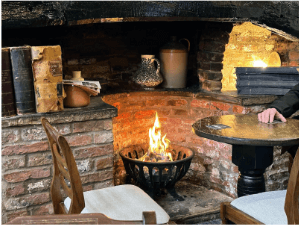
Our first stop was The Red Lion pub for lunch.  Besides steak pie and real ale, this medieval pub featured a priest hole. Further research revealed the remarkable tale of Nicholas Owen, a carpenter whose genius for concealment saved countless lives through his construction of priest holes—those hiding places built into the walls, floors, and chimneys of Catholic homes during the persecution in Elizabethan times.

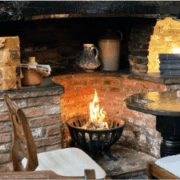
Picture of a bread oven circa 1300s- brick surrounding a fire pit structure

Bread oven circa 1300’s at The Red Lion pub in York. Photo credit: John Ruberto


These two figures captivated me, and I knew I wanted to honor them in fiction. But how do you tell this story? St. Margaret Clitherow held secret Mass at her home, protecting so many Catholics in York, and St. Thomas Owen, who operated in Oxford, built over one hundred priest holes across England before his death by torture in the Tower of London. They were separated by time and distance. 

That’s when the pilgrimage tradition entered my imagination, to tie in another amazing experience traveling through Great Briton. 

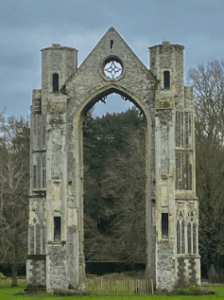
 Our Lady of Walsingham had been England’s greatest pilgrimage site for centuries before Henry VIII ordered its destruction in 1538. What if a young Nicholas Owen—grieving, questioning, struggling with faith—journeyed to the ruins of Walsingham? What if that pilgrimage became the crucible where his calling was forged?

Picture of the ruins of the Priory in Walsingham - looks like a giant stone castle-like arch with lush greenery in the background

Remains of the Priory in Walsingham, once a great pilgrimage site in England.
Photo credit: John Ruberto

The resulting story follows a fictionalized Nicholas on a journey from Yorkshire to Norfolk, encountering Margaret Clitherow along the way. It’s a coming-of-age tale set against the dangerous backdrop of Elizabethan England, where celebrating Mass could cost you your life and harboring a priest meant death.

Through Nicholas’s eyes, we see how pilgrimage—even to a destroyed shrine—can transform a heart. We witness how grief can become purpose, how craftsmanship can become ministry, and how ordinary people become saints not through grand gestures but through faithful, hidden service.

“Faithful Journeys, Hidden Sanctuaries” appears in the anthology Pilgrim Tales, celebrating the tradition of Christian pilgrimage through fiction. It’s my small attempt to remember those who built secret sanctuaries and kept the faith alive through England’s darkest era.


John Ruberto and his wife, Laura, write about their pilgrimage experiences on their blog, The Hallowed Way

Read “Faithful Journeys, Hidden Sanctuaries,” and other short stories by the Catholic Writers Guild in Pilgrim Tales: a Catholic Writers Guild Short Story Anthology available now on Amazon in print and e-book.

Feature Photo by John Ruberto

© Copyright 2026 by John Ruberto


Edited by Rietta Parker

Pilgrim Tales: What is a Pilgrim?

We both know you can’t make someone believe in God and religion, so I think I got the better end of the deal. -“Pilgrim in Name Only”

In walking the Camino de Santiago and later the Via Francigena, my husband and I quickly realized that we were some of the only ones walking for the original purpose of a pilgrimage – “a journey to a sacred place undertaken as an act of religious devotion.” Most pilgrims today take these ancient religious routes for a variety of non-religious reasons including adventure, travel, nature, reflection, exercise, history, culture, and camaraderie. While about 35% – 45% of pilgrims say they had mainly religious motivations, it is important to note that for the Camino, one must state a “spiritual” reason in order to obtain the coveted completion certificate (Compostela). In talking to pilgrims enroute, it seemed far fewer folks than this had pious purposes in mind.

The non-religious reasons people go are all good, and I am not finding fault. Yet, as a veteran pilgrim, I know their pilgrimages could be more deeply fulfilling if they partook of all that there was to experience along the way. There we were on a path literally filled with churches, monasteries, and shrines of timeless sacred art and architecture. That kind of beauty speaks to the soul! Often we were the only ones stopping at them. Our fellow hikers professed ignorance or indifference if we mentioned entering a church – even the Christians. It seemed not much thought was given to their habit of just passing by these holy places. Thousands of opportunities were being wasted.

It stayed on my heart that a considerable number of “pilgrims” were missing out from a faith perspective. They were of course pilgrims in one sense but not in the original sense- not in the sense that had the potential to transform their lives.

And so, I decided to explore what kind of transformation a non-religious recent college graduate pilgrim might go through in making the 1,240-mile Via Francigena if he had some “rules” to follow as he hiked. What might it take to open his heart just a bit? Enter his beloved Catholic uncle who offers his classic Alfa Romeo as the motivation for his insecure lazy, yet well-meaning nephew, and creates the list of rules including keeping a journal, doing an act of kindness, and sitting in a church 10 minutes each day. In a nod to my mom’s heritage and my dad’s talent, the uncle is a wise big-hearted Sicilian and a winning wrestling coach.

Sure, I wanted our hero to get the car, but more than that I wanted him to experience the richness of the faith all around him. Will he tear up the list in frustration? In traversing four countries and rugged terrain, how will he hold up? Who will he meet? Will his outlook be different afterwards? Is he just going through the motions to get the prize?  

One thing is sure, like every pilgrimage, his will not go quite as planned.

Laura Ruberto and her husband John blog about pilgrimages and more at hallowedway.com.

Read “Pilgrim in Name Only,” and other short stories by the Catholic Writers Guild in Pilgrim Tales: a Catholic Writers Guild Short Story Anthology available now on Amazon in print and e-book.

Feature Photo by Laura Ruberto

© Copyright 2026 by Laura Ruberto


Edited by Rietta Parker

Pilgrim Tales: The Day the Dome Dropped on my Head

Even being on a pilgrimage, sometimes it felt like the emphasis was more on the stops than on stopping. –“The Day the Dome Dropped on My Head” 

The title “The Day the Dome Dropped on My Head,” has the ring of a 1950s pulp fiction paperback, but reflects more of a supernatural experience that happens in a well-known Roman church and culminates in a spiritual conversion.

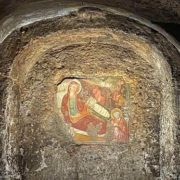
“Maria e Gesu”, a dome-like 13th Century mosaic by Pietro Cavallini, is the center and most prominent art in the apse of the Basilica of Santa Maria in the Trastevere section of Rome. For our protagonist in the story, the experience is not an example of enlightenment through Visio Divino – meditation on art of a spiritual nature that results in a
breakthrough understanding. In fact, nearing the end of her pilgrimage, she is overcome with an ennui of all the ancient mosaics and tapestries the pilgrims had seen with little opportunity to take in all their significance. She doesn’t even see it. Rather, it becomes an interaction with God who put His hand out to her as answer to a pleading prayer.

That hand in the mosaic is around the shoulder of His mother, as though to reassure and guide her. It rests gently around her shoulder, the tips of His fingers peeking around her shoulder. He is not tugging, pulling, controlling or weighing her down. She leans into Him ever so slightly, and her left hand gestures toward Him. It’s as though they both are saying to each other, “You are mine,” but they look ahead.

To beckon the rest of us? Or, in the case of the protagonist, to find us and reach out?

She learns that He has been with her during her whole life.

He was with her when she thought she was completely alone.

He was the one who saved her from herself.

The Basilica’s website is the best place to view the mosaic and learn its meaning as intended by the artist. The Basilica’s website, at this writing, appears down, but many visitors have shared their videos experiencing the art, architecture and history on YouTube. They offer a glimpse not only of Maria e Gesu but of other breathtaking and inspirational images. Exciting Europe offers a brief video with several close up shots of the mosaic beginning at 4:26. At 5:42, Chris Channel moves in to the image, resulting in a very fast but very close view. Finally, Makc Markc, has a great gradual close-up from minute 1:28-1:56.


Read “The Day the Dome Dropped on My Head,” and other short stories by the Catholic Writers Guild in Pilgrim Tales: a Catholic Writers Guild Short Story Anthology available now on Amazon in print and e-book.

AI Feature image generated in Adobe Firefly/Gemini 2.5 with Nano Banana by Mary
McWilliams

© Copyright 2025 by Mary McWilliams


Edited by Rietta Parker


Pilgrim Tales: God of the Unexpected: A Pilgrim’s Romance

There was only one person who could motivate me to do something so ridiculous as to set off for a hike through the mountains before dawn: Jeremy. -“Pilgrim’s Romance”

I fell in love with Bernadette’s story the moment it popped into my head. At 9:00AM. On the morning of the anthology submissions deadline. Yikes!

I’d always been one to do things last-minute, but that was cutting it close, even for me. Truth be told, I’d written off participating in the anthology, because it was for short stories. Until that day, I’d never written a short story that hadn’t ballooned into a full-fledged novel—or a multi-book series. Brevity has never been one of my gifts. So write a short story? Me? That was a funny joke.

But God has a sense of humor.

See, over the years I’ve noticed this pattern… Maybe you’ve experienced it too? How God likes to look at our lists of “Things I Will Never Do Because (fill in the blank with our insecurities),” and then proceed to ask us to do them. It seems He takes great delight in calling us to things that we are only capable of accomplishing with His help. When we write ourselves off, He holds out His hand, smiles a somewhat mischievous smile, and says, “Trust Me.”

Translation: Watch this.

When Pope John Paul II said that “Life with Christ is a wonderful adventure,” he wasn’t kidding! Some of the best—and hardest—things God has ever called me to have been things that I would never have been capable of doing without His constant provision. It’s an exciting way to live, though honestly, it isn’t easy. Still, it has always been worth it.

Bernadette has a chance to step forward into her own adventure in “A Pilgrim’s Romance,” trusting God in unexpected ways. No surprise, JPII has his own little part to play in her story as well. The hiking pilgrimage she and Jeremy take is named after the beloved saint, who himself often took young people on hikes up into the mountains while he was still a parish priest in Poland during the Communist regime. Then Fr. Karol Wojtyla had a deep love for youth, and a passion for calling them to greatness—something he never lost when he became Pope John Paul
II.

I was deeply inspired by him when I was a teenager and young adult, and felt that call to greatness through his words and example. I firmly believe he has been praying for me for the past twenty years, and it is no accident that my first—somewhat miraculous—short story includes a group of young people hiking with their pastor. I didn’t plan it that way, but I surrendered my “I can’ts,” and it turned out far better than I ever expected.

Isn’t that just how God works?

Read “A Pilgrim’s Romance,” and other short stories by the Catholic Writers Guild in Pilgrim Tales: a Catholic Writers Guild Short Story Anthology available now on Amazon in print and e-book.

Feature Photo by Nancy Bechel
© Copyright 2025 by Nancy Bechel

Edited by Rietta Parker

Questions about the Catholic Writers Conference Online? We have answers!

The Catholic Writers Conference Online is happening Jan 30-Feb 1, with pitch practice Feb 2-3 and pitch sessions Feb 9-12. It’s $65 for non-members, $45 for members. Register at https://www.bigmarker.com/series/2026-catholic-writers-confer/series_summit.

Here are some of the common questions we get.

  1. I can’t make every session. Will there be recordings? We always record unless the presenter asks us not to. We try to publish as quickly after a session as possible, but all will be available after the conference. You’ll use the link that got you into the session, so don’t delete those emails!
  • Recordings should be available for several months, and you can see them more than once. However, they are only for conference attendees, so you cannot share or copy them.
  1. Will there be handouts or lecture notes? Some presenters will offer handouts. Please keep in mind that, like the recordings, these cannot be reproduced without permission, but they are available for your use. We’ll make those available with the recordings.
  2. How do I learn about pitch sessions? Please go to https://www.catholicwritersguild.org/cwco-pitch-sessions. All the details, from publishers and guidelines links to the schedule and signup form, are on that page. Please research the publishers and pick the best fit. We charge for people changing their minds after registering. (It is extra work and often means someone was denied a spot.)
  3. I can’t make the conference, but I want to pitch. How can I do that? Please email [email protected], and we’ll send details. We are letting CWG members pitch for $5 and non-members for $10.
  4. I’m not sure the online conference is worth it. Where can I learn more about the presentations? Go to https://www.catholicwritersguild.org/online-conference/. We have the schedule, presenter bios, and pitch session information.
  5. Do I need to download an app? No. Our BigMarker webinar software does not require you to download anything. That said, it’s a bandwidth hog. It works better with strong internet connections—and you might want to get those in your family to lay off the MMORPGs for the weekend.
  6. Where’s the coupon code for members? Dues-paying CWG members get a $20 discount. (That’s half your annual dues back right there!). Go to Heartbeat and look under Members, either in Member-bennies or Online-conference. Clergy and religious sisters and brothers are free. Contact [email protected] for the code.

Back-to-School Isn’t Just for Kids: Why Student Memberships Matter for Aspiring Publishing Professionals

Back-to-School Isn’t Just for Kids: Why Student Memberships Matter for Aspiring Publishing Professionals

A week ago, I dropped off my daughter at her first day of high school. She was nervous about the new environment and stepping onto the campus with no friends. 

Stepping into the workforce can feel the same way, too. 

I recently graduated with a master’s in publishing from Pace University and am transitioning in my 40s from English teacher to publishing professional. As I prepared to graduate this past May, I asked myself, What now? I would be stepping into the real world of publishing, navigating a job search with no friends or connections in publishing.

That transition taught me about the value of student memberships in professional organizations. Just like a high schooler joining after-school clubs, joining professional organizations is a great way to make friends with people who share your passion, and grow in your trade. Plus, student memberships offer an alternative to internships, which often aren’t an option for adults with families and full-time jobs.

How Student Memberships Open Doors

When I was preparing to graduate last May, I was afraid that I would lose the only connection with the publishing world that I had. I remember mentioning this to my professor during one of our last online classes. She recommended that I ask the university to keep me on the mailing list so I could continue receiving their job postings, and assured us that we could still reach out to her after we graduated. Classmates made it a point to connect on LinkedIn by sharing their profiles at the end of our last presentation. 

All of this was helpful, but I knew I needed more. 

Internships weren’t an option for me; I was an online student working as a full-time teacher far from the New York City campus where most opportunities existed. That’s when I started to look into mentorship programs and professional publishing organizations. Luckily, Pace offered a mentorship program that was ideal for online students like myself. Pace paired me with an industry mentor, and later, Johanna Vondeling from Bay Area Women in Publishing generously offered to mentor students after speaking in one of my classes. Both mentorships helped me grow and introduced me to wonderful people in the field.

But soon the mentorships were over, too, and I was left with uncertainty. I found myself looking for the next step. That’s when I began exploring professional publishing organizations.

From Writing Groups to Publishing Organizations

I had already been part of writing communities like the Catholic Writers Guild —which, by the way, also offers a student member rate (I’ll share the discount code at the end)—as well as Romance Writers of America, and First Coast Romance Writers. However, I didn’t fully understand the distinction between writer organizations and publisher organizations until I conducted my thesis research on diversity challenges in Catholic and Christian publishing.

I interviewed leaders at the Association of Catholic Publishers (ACP) and the Protestant Church-Owned Publishers Association (PCPA). I was inspired by their vision for inclusive publishing, and both offered affordable student memberships that I joined.

I then began to Google other publishing organizations with student membership rates. One thing that I want to share is that if you find an organization and don’t see a student membership advertised, don’t hesitate to reach out. I reached out to the Independent Book Publishers Association (IBPA) and asked about a student rate, only to learn that they had just launched the program and hadn’t advertised it yet, and the CEO emailed me directly and was kind enough to give me an early-bird student code! 

Winning the FAPA Scholarship

And then I found FAPA. The Florida Authors and Publishers Association (FAPA) offers a generous student scholarship that I’ve yet to see matched. Winners receive a one-year student membership, a $500 award, and a complementary ticket to their annual FAPACon. 

I applied and won.

Attending FAPACon this summer was eye opening. I was impressed by how they fund their scholarship program: from proceeds raised by raffle baskets. They also had a unique “Speed Dating with the Pros” event where small groups rotated among tables to meet industry experts for an intimate Q&A. 

I also met many Christian authors and publishers there. As a Catholic writer, I had assumed I’d only meet Faith-based peers at explicitly Christian events, so I was pleasantly surprised to discover Christian publishers at FAPA. This experience reminded me that publishing communities are more diverse than we expect, and there’s growth in stepping outside our usual circles.

Publishing Organizations with Student Benefits

Although I’m new to many of these organizations and learning about all the benefits they offer, here is a snapshot of the perks I found useful:

  • Association of Catholic Publishers (ACP)
    • Only $10 for students
    • Online member platform for communication
    • Catholic Reads book club.
    • Access to webinars
  • Independent Book Publishers Association (IBPA)
    • $85 student rate
    • Discounted registration for Pub University (their annual educational conference)
    • Member networking through Slack
    • Webinars and roundtables
  • Protestant Church-Owned Publishers Association (PCPA)
    • $25 student membership
    • Annual conference
    • Free weekly webinar
    • Active job board

3 Ways to Make the Most of Student Memberships

  1. Introduce Yourself and Connect
    Every group has a platform—Slack, an app, or a forum. Don’t just sign up; post an introduction and start meeting people.
  2. Show Up for Events
    Conferences, webinars, and roundtables are where real connections happen. Even one good conversation can make a difference.
  3. Use the Perks
    Take advantage of discounts, free subscriptions, and services. These benefits save money and keep you plugged into the industry.

Final Thoughts

So as this school year begins, I encourage every college or graduate student—especially those exploring publishing—to look into student memberships. I only learned about them in my last year of grad school, and I wish I had taken advantage of them sooner.

Starting a new career can feel a lot like being an awkward freshman—you’re unsure where to sit, whom to talk to, or how to find your place. Professional organizations are like those after-school clubs that give students a sense of belonging. They provide community, guidance, and opportunities that make the transition less intimidating and much more rewarding.

If you’re stepping into publishing, don’t do it alone. Find your “club,” introduce yourself, and start making connections. Before long, you’ll realize you’re not the new kid anymore—you’re part of the community.

P.S. If you’re a student writer looking for your first “club,” the Catholic Writers Guild is a great place to start. CWG offers a special student membership code for 50% off the regular price. Use code: STUDENTGUILDIE when registering to claim your discount and start connecting with fellow Catholic writers.

Copyright 2025 Janet Tamez

Edited by Gabriella Batel

Catholic Writers Conference Online

REGISTER NOW


In 2008 (or was it 2009? It was so long ago!), I attended an online writing conference called MuseItUp. It was done in chatrooms and forums and it was amazing! I learned so much, made lifelong friends, and even got a book contract. 

The year before, some of us Catholic writers had started the Guild, and we’d talked about having a conference, but a live one was so much work for the few of us there were—not to mention the expense. But what about an online one?

That year, Ann Lewis and I created the Catholic Writers Conference Online. It was a blast, with chats and classes. The next year, we added pitch sessions. Now, twenty-five years later, it has launched careers, brought writers together, and helped forward the mission of bringing great Catholic writing—and writers—into the world.

The next conference is January 31-Feb 2, 2025. We have 24 webinars covering writing (fiction and nonfiction), promotions and marketing, AI, and (of course) the influence of faith in writing. We have seven publishers and an agent ready to hear pitches. We even have two practices scheduled to help you get ready (Feb 3 and 4).

It’ll be our best conference yet, but we need the secret ingredient.

You.

If you’ve been looking for something to jumpstart your writing, revitalize your motivation, or just get you pumped up—or if you’re new to writing or looking to grow your knowledge, there’s no better place and time. 

Join us Friday, January 31 – February 2, with pitch practice on Feb. 3 & 4, and pitch sessions on Feb. 10-13.

The cost is $65 for nonmembers and $45 for CWG members. (Find the coupon code in the #online-conference thread on Heartbeat)

Not a member of the Catholic Writers Guild yet? Join now to get that discounted rate for the Online Conference!

Online Conference Registration – CLICK HERE


copyright 2025 Karina Fabian

Edited by Heather Gaffney

Serendipity

“The wind* blows where it wills, and you can hear the sound it makes, but you do not know where it comes from or where it goes; so it is with everyone who is born of the Spirit.” John 3:8 (1)

Serendipity

The winds of March always have been infamous. Some days you might be lucky enough to fly a kite along the beach, or above an open field where the grass is beginning to show a bit of green. Other days you might cower inside, with a hot cup of tea, while a raging blizzard or northeaster demolishes the emerging shoots of spring bulbs.

Whether you are experiencing the lamb or the lion as you read this, on our first March Saturday of 2024, I want to introduce you to some new friends in faith I’ve been blessed to encounter through the wind of the Holy Spirit this Lent.

Even though I’ve written and edited for small literary publications for most of my adult life, I grew up in the era of print. The role of managing editor for an online literary journal is relatively new for me. So, with a good intention towards “continuing education” — but little real hope — I ran a Google search.

And behold! An organization called Catholic Literary Arts (3) popped up in the search results, with a class entitled “How to Run a Literary Journal: The How, Why, and Wherewith” (4).

Founded by multi-faceted literary artist and president, Sarah Cortez (5), in 2020 –the year of their first Sacred Poetry Contest (6) — Catholic Literary Arts is based in the state of Texas. Already it is blessed by, and welcomes, writers from a variety of different cultural backgrounds.

The organization received assistance with its establishment, Sarah told me, from Catholic Writers Guild’s own beloved founder, supporter, and former vice president, Deacon Arthur Powers, who also served as one of CLA’s first instructors for online classes (7).

Two additional seminars on the 2024 CLA website looked so appealing that I signed up for those, as well.

Dr. J. Larry Allums’ seminar, now concluded, “The Short Story’s Brilliance and Clarity in Revealing Spiritual Truth,” focused on classical writers Nathaniel Hawthorne, Gustav Flaubert, Gabriel Garcia Marquez, and James Joyce (8).

I was amazed and delighted by the openness of sharing about spiritual insights among participants. I appreciated the opportunity to recollect how important it is to study the classical spiritual writers.

Ryan Wilson, Editor-in-Chief for Literary Matters (9), based at the Catholic University of America, and the CLA instructor for “How to Run a Literary Journal …” already in our first session offered an in-depth history of literary journals; and updated participants with the latest news about an extensive list of contemporary journals. He highlighted those that are most open to submissions from writers with a spiritual focus, especially for poets (10).

I’m looking forward to “Image, Tone, and Pacing …” with popular poet Tamara Nicholl-Smith, whose work appears in some astonishing venues around the city of Albuquerque, New Mexico; as well as in the prestigious Guttenberg Bible display at the University of St. Thomas (11), in her class that will be coming up next.

Although CLA discussions thus far have taken a slightly more “academic” and classical approach to Catholic writing than the sessions I enjoyed so much at our Catholic Writers Guild live meeting with the Catholic Publishers Association meeting in Chicago last May 30-June 1, 2023 — I’ve found the warm hospitality in Catholic Literary Arts sessions equally welcoming.

With taglines like “Write with Spirit” and “Fearless Catholic Writing” (12), CLA shares with CWG a common call, and we stand together on the same home ground. Their mission statement reveals how congruent they are with our own commitment to work in the world with our God-given talents, and to help bring about the creative vision of Saint Pope John Paul II.

“Catholic Literary Arts encourages ongoing growth in literary, artistic, and spiritual development of artists and writers so that the Cultural Patrimony and rich treasures of the Catholic Church may be more perfectly explored and used to draw all peoples to God.” (13)

If you’re a published or aspiring author of Catholic children’s books, and would like to connect with influential editors from Our Sunday Visitor, Word on Fire’s new children’s imprint Spark, and Pauline Books & Media, there’s still time to register for CLA’s Meet-the-Editor Panel: Children’s Edition, on March 6 at 7:00 PM CST (14).

This might be a worthwhile option to help sustain your motivation from CWCO last month, stay on task, and relieve some of the letdown that can follow periods of deep fellowship with our spiritual colleagues at conferences.

Whatever life you are living as a Catholic writer and wherever you must go this month, may you dance in the winds of March with the Holy Spirit, who leads us all through crucifixion to resurrection.

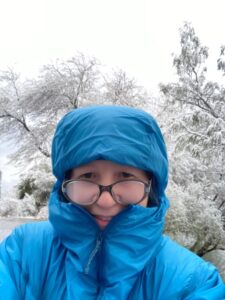
The author, out for a walk after the March 2, 2023 snowstorm in Tucson, Arizona.
Author’s personal photo, used with permission.
Margaret King Zacharias

© 2024 by Margaret King Zacharias

Feature photo: Snowstorm rolling into Tucson, Arizona on March 2, 2023. Author’s personal photo, used with permission.

Notes:

  1. 1. https://bible.usccb.org/bible/john/3#51003008-f
  2. https://bible.usccb.org/bible/john/3#51003008-f
  3. https://www.catholicliteraryarts.org
  4. https://www.catholicliteraryarts.org/classes
  5. https://www.catholicliteraryarts.org/our-board#cortezs
  6. https://www.catholicliteraryarts.org/2020-contests
  7. Sarah Cortez, personal communication.
  8. https://www.catholicliteraryarts.org/classes
  9. https://www.literarymatters.org
  10. https://www.catholicliteraryarts.org/classes
  11. https://www.catholicliteraryarts.org/classes
  12. https://www.catholicliteraryarts.org
  13. https://www.catholicliteraryarts.org/our-mission
  14. https://www.catholicliteraryarts.org/classes

Catholic Writers Conference Online

Two years ago, a friend told me about the Catholic Writers Guild and their annual online conference. At the time, I had just started dreaming of publishing a Catholic chapter book series, but I didn’t know where to start. Feeling overwhelmed, I pursued the Catholic Writers Guild website to see about this conference.

The skeptical part of my brain told me it was too good to be true. The frugal part of my brain told me $40 was a honey of a deal for access to three days’ worth of presentations. (The conference is free for clergy and $60 if you’re not a Catholic Writers Guild member; also, membership is totally worth the $40/year dues). Additionally, all the sessions are recorded, so I could go back and rewatch my favorites and check out the ones my schedule conflicted with.

To say my mind was blown by what $40 got me is an understatement. I took almost a whole journal’s worth of notes and gathered ideas for what it means to be a Catholic writer in the world today. I learned about things that I didn’t even know I needed to know, and felt the Holy Spirit reaffirming that this is what I am called to do. I met other people who shared my passion for writing within a Catholic lens. I started to believe I could actually do this.

I left that conference on fire. Since then, in the last two years, I have published the first three books of my chapter book series, visited Catholic schools to talk about my stories, written and published countless articles (one was even translated into Hungarian!), and started writing and editing Catholic curriculum. None of this would have happened without the Catholic Writers Guild.

The Guild is composed of fellow Catholics who want to use their gifts from God for good. Our genres and styles are as varied as we are, but we all strive to grow in holiness as we write. During the online conference, some presentations were more relevant and helpful to me, but I learned something from every talk.

This year, I am counted among the presenters, and I’m thrilled to volunteer to share my own experiences in the hopes of encouraging and educating other Catholic writers. Sure, I get a small stipend and exposure to other Catholic writers, but that’s not why I’m presenting this year.

Two years ago, women and men from the Catholic Writers Guild planted seeds that have begun to sprout in my life. With God’s continued light and watering, I know I will have full-grown trees one day. In the meantime, I want to spend my time planting seeds of my own.

You don’t have to be an established writer to attend this conference. You don’t have to know what you want to write or even the genre. All you need is an interest: a tiny prompting of the Holy Spirit that the written word may be one of your gifts He is asking you to share.

Join us at the online conference this year from February 23–25, 2024. Worst-case scenario? You’re out $40. Best-case scenario? Well, only God knows that.

© Maria Riley 2024

The Catholic Writers Guild 2024 Conferences and All the News You Need!

The Catholic Writers Guild 2024 Conferences and All the News You Need!

null

Since it’s November and, in the United States, we’ll soon celebrate Thanksgiving, I want to share a little game I play with myself. I often challenge myself to name 10, 15, or 25 things I’m grateful for in the moment or from throughout the day. (I’ve never not been able to exceed my challenge. God is good!)

Here’s an off-the-cuff list of 10 things I’m grateful for about the Catholic Writers Guild:

  1. Camaraderie with members who share similar goals and missions.
  2. People who get the “Catholic stuff” in my writing.
  3. The online conference, through which I’ve learned so much during seasons where getting away for in-person events was difficult.
  4. The live conference, through which I’ve met so many fantastic people – writers and others – in person.
  5. The connections I’ve made with publishers, editors, authors, bloggers, etc.
  6. The goodness of our members, who are quick to lift up others in prayer and with practical means of support.
  7. The generosity of our members who, though busy, are willing to take on volunteer responsibilities to serve their fellow Guild members.
  8. The Guild’s founders, who saw a need and invested the time and effort to make this organization a reality.
  9. The dedication of our Board members, past and present, who truly have the best interest of the Guild at heart.
  10. The retreats hosted. Would a Catholic writers retreat even be a thing if the Guild weren’t offering it? (And I’ll just take this opportunity to thank Guild member Margaret Rose Realy for all the work she did to make last month’s Guild retreat a success! Thank you, Margaret.)

See how easy it is? I bet you could come up with a list of your own.

There’s a lot going on in the Guild, so please read on for news about our online and live 2024 conferences and other Guild activities and opportunities!

Finally, according to our bylaws, November is the time for our annual elections! Look for a separate email for nominations within a week.

I’ve served the Guild as president since September 2021 and before that as vice president. As the list above indicates, I’m so grateful to the members who have been kind, supportive, and have stepped up to help in so many different ways. You are a generous bunch!

While I’ll be continuing to serve as the Evaluator Coordinator for the Seal of Approval and assist in transitioning to our new website for continuity’s sake (we are so close, and we can’t wait to share it with you!), I will not accept a nomination for president for 2024.

God is still laying stories on my heart over these past very busy years, and I want to get back to writing them. I won’t bore you with my list of other obligations and commitments beyond the Guild – we all have them! – but it’s time for me to scale things back a little bit.

To that end, I hope that some of you will be generous in considering who might be willing and able to take on this role and then submit your nominations.


Guild Member-Hosted Retreat in Sunny Florida!

Sorry, gentlemen. This one is for ladies only.

Longtime Guild member Karina Fabian is  hosting a writing retreat open to ladies of the Catholic Writers Guild.

When: January 5-9, 2024.

Where: The Fountains, Orlando, Florida.

How much: $300 includes accommodations, food, and transportation to Mass at the Basilica of Our Lady, Queen of the Universe.

Limited to the first six paid registrations.

Questions? Email Karian Fabian at [email protected].

null


Registration is Open for CWCO 2024!

CWCO 2024 is scheduled for February 23-25, 2024, with pitch practice on February 26 & 27 and pitch sessions on February 28-March 1. Register at https://catholicwritersguild.org/online-conference

Here are some of the things you can look forward to:

  • A greater emphasis on how our faith informs our writing. We have speakers who will discuss writing as a Calling, literature as evangelization, and even how genre fiction like horror and science fiction can still reflect our Catholic values.
  • Practical advice and tips you can put to work immediately. From managing your time to reconstructing your plot, and developing great characters to building your social media presence, our experienced and well-published presenters share their best practices.
  • Webinar format that incorporates audio and visuals. It’s easy – if you can handle Skype or FaceTime, you can do this! Or call in to listen to the presentations if your internet is slow. (Don’t worry, there’s still chat available for talking or “passing notes.”)
  • Networking. We’ve built in time each year for open chat, sharing links and books, even reading and on-the-fly critique.
  • Recordings! We’ll have recordings of each session available free for attendees.

null


Spread the Word

Help spread the word about CWCO 2024 to fellow Catholics by sharing the information below and the image above in your parish bulletin.

The Catholic Writers Guild is hosting its annual online writing conference February 23-24. It features presentations on faith and writing, chances to meet fellow authors, and opportunities to pitch to Catholic publishers like Ave Maria and Chrism Press. It’s totally online—no travel!—and costs $60. Learn more at https://catholicwritersguild.org/online-conference


CWG Live Conference 2024

The Guild is excited to announce that our live conference will once again be hosted in conjunction with the Association of Catholic Publishers (ACP) meeting in Chicago, Illinois!

Our conference dates are Tuesday, May 28 through Thursday, May 30. We have an invitation to attend the ACP’s breakout sessions on Thursday afternoon, and we look forward to the chance to get to know their members. You’ll definitely want to plan your departure for Friday morning to take advantage of this opportunity to meet and learn from Catholic publishing experts. We’ve also invited the ACP members to consider joining us as attendees, speakers, panelists, and mentors!

Consider sharing your expertise as a speaker or panelist: to apply, fill out our Speaker and Panelist Application.

Last year’s conference was our first time working with the ACP, and we’re grateful to be invited back and to have the opportunity to integrate better with their conference. Mark your calendar now; we’ll open registration in February.

null


null


Job Opportunity

Catholic Book Publishing, located in Totowa, New Jersey, has served the Catholic community for 112 years. We are currently seeking an experienced editor.

Description

As an editor, you will join a dedicated team that is committed to the publication of timely and timeless Catholic resources that achieve the highest quality of content and production. Our extensive line includes Bibles; Missals; Prayer Books and Devotionals; Spirituality, Marian, and Saints Titles; Liturgical Books; Spanish Resources; Communion Gifts; and Children’s Books.

The successful candidate for this position will possess a strong command of the competencies and requirements listed below.

Competencies:
·      Solid knowledge of the Catholic Faith and familiarity with liturgy
·      Exceptional writing, editing, and proofreading skills
·      Well organized, with the ability to manage multiple projects simultaneously
·      Attention to detail
·      Excellent communication skills
·      Capable of demonstrating resourcefulness in problem-solving
·      Strong initiative
·      Marketing capabilities

Requirements:
·      Proven editorial work experience for a minimum of 5 years in the Catholic publishing sector
·      Work in office (no remote or hybrid)
·      Collaborative, cooperative spirit
·      Dedicated, hardworking, adaptable
·      Willingness to travel occasionally
·      Knowledge of Spanish a plus
·      Trade and consumer show experience a plus

Qualified individuals for this full-time, salaried position should send a cover letter, resume, and salary requirements to carla@catholicbookpublishing.com.


Heartbeat

Whether you’re a new member or you missed the email invitation in your inbox, we’d like invite you to join the Catholic Writers Guild Heartbeat community!

More than 280 of our members have joined, and it has become a lively place for our members to discuss, chat, critique, plan meet-ups, and more!

If you are an active member (meaning your dues are paid up) and have not received or have lost your invitation, reply to this email, and I’ll be sure you receive an invitation. (If you’re not a member, you can still access our Sunday night chats and the public portion of our community.)


Seal of Approval

Currently seeking an Author Coordinator!

The Author Coordinator prepares the Main Spreadsheet before the start of each quarterly submission period, communicates with submitting authors as to whether their submission has been accepted or if they are waitlisted, updates the Main Spreadsheet to reflect new applications, and uploads book files to the appropriate SOA folder. To volunteer, email [email protected].

Application dates for 2024:

  • Monday, January 15
  • Monday, April 15
  • Monday, July 15
  • Monday, September 16

During the 24-hour application window, you can access the Seal of Approval application form. Reminder: If your book has received an Imprimatur, it is ineligible for the Seal of Approval but receives all benefits associated with the Seal. More information on the Seal of Approval process.

Reminder: Books designated with an Imprimatur or nihil obstat are not eligible for the Seal of Approval but automatically enjoy all the benefits of that designation.

To become a volunteer evaluator, email the SOA committee at [email protected]. Training is provided.