
Literature Revisited
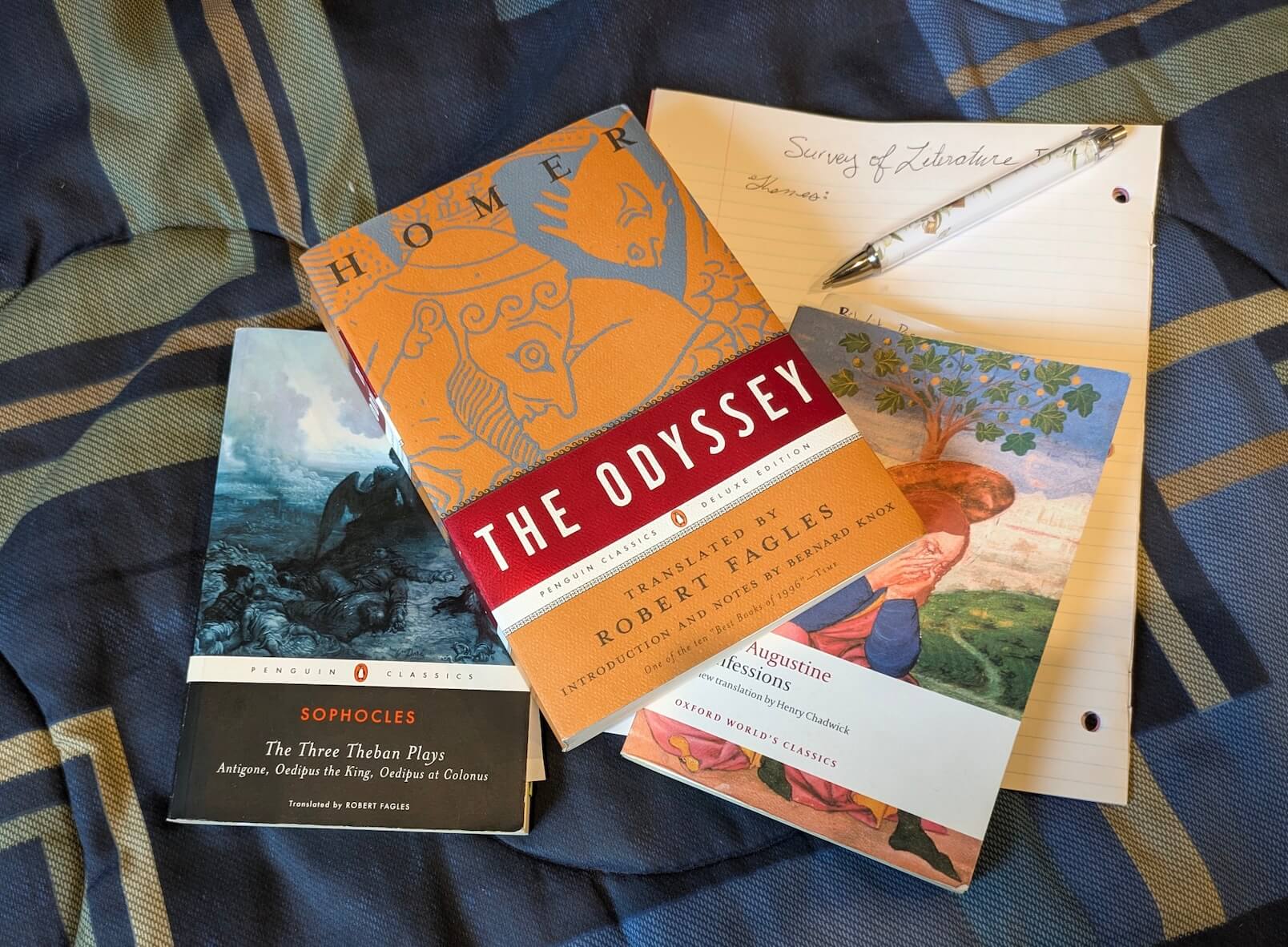
There is something about reading a great book again outside of the college class context that really allows for a new experience of a story. When the book is no longer sitting in front of you as an obstacle to be surmounted in an unrealistic time crunch, there is an opportunity to get to know the work and, perhaps, to become friends. As I tutor my homeschooling brother through a Grade 10 literature course, using what I learned in my three years of college, I find new joy in the old works. The Classical Literature I read in my very first semester has more meaning now that I return to them with more educated eyes, and as a tutor for another. I am no longer reading in order to pass exams and write essays; I am reading now to help instill wonder and appreciation into another. Together, we are trying to see the world as the ancient authors saw it.
Rereading the old books with my brother, I discovered that The Odyssey was an epic adventure story, that Oedipus Rex was a heart-rending cry of the pagan world for a savior, and that Augustine’s Confessions are a love story between a fallen mortal and the Savior God for whom the pagans longed. We are currently working through The Confessions, and I have been additionally tickled by Augustine’s writing on infants as I nurse my own newborn. Great literature has a way of touching on universal experiences which will speak to readers at various points and stages of life.
Revisiting works of literature prompted me to revisit some of my own writing projects that had fallen by the wayside while I completed my college studies. As I looked through old WIP files, I began to wonder what it is that imbues great literature with such enduring life. What pillars of great storytelling would a modern author do well to keep in mind?
While there are countless elements one might point out in great literature as keys to success, I have derived three main lessons from my studies with my brother.
First, The Odyssey highlighted for me the importance to multi-layered stories. The Odyssey is just as much the goddess Athena’s story as it is Odysseus’ or Telemachus’. The journeys of father and son would not have been possible without the guiding – and oft-times interfering – hands of the gods. While a pantheon is not in alignment with Christian belief, the understanding of higher, often invisible, powers at work in the world operates as a backbone to any great story.
Second, as I learned from my revisit of Oedipus Rex, I would suggest that great literature delves into the dark side of the human condition. Sometimes, the trials of human life just don’t make sense, as with Oedipus’ unfortunate fate. Sometimes, as every human has experienced, there is no logical “why” to the horrible sufferings in life. Yes, sometimes man is the author of his own misfortunes, but other times suffering comes as a result of another’s poor choices. Great literature ought not to shy away from such a bitter reality.
Finally, as I am currently re-learning from St. Augustine, great literature written by a Christian should turn the interactions between man and the invisible world back into a love story with the Invisible God. While most of the great books won’t blatantly tell a love story – St. Augustine’s work is quite saturated with love-hymns to God – a touch of other-worldly romance ignites literature and transforms it from mediocre to outstanding. The divine romance needn’t be obvious – indeed, I have a bone to pick with those who incessantly spout Scripture verses throughout their story in order to Christianize it – but a passion for God in some form must pervade a great story.
Of course, this is an incomplete and simplified list of requirements for a great story. These three elements are simply the ones that have leapt out and grabbed me from my most recent reading projects. My bottom line is simply that we modern writers have a lot to learn from those who have gone before us. We have such a rich tradition of literature to lean into – so let us all benefit from it as much as possible!
©️ 2026 Maggie Rosario. All rights reserved.
- Literature Revisited - November 15, 2026
- Molly Chase: An Inspirational Work of Catholic Literature - May 17, 2026
- “Exult, let them exult”: The Church in Paschal Celebration - April 19, 2026

Leave a Reply
Want to join the discussion?Feel free to contribute!